Key Findings
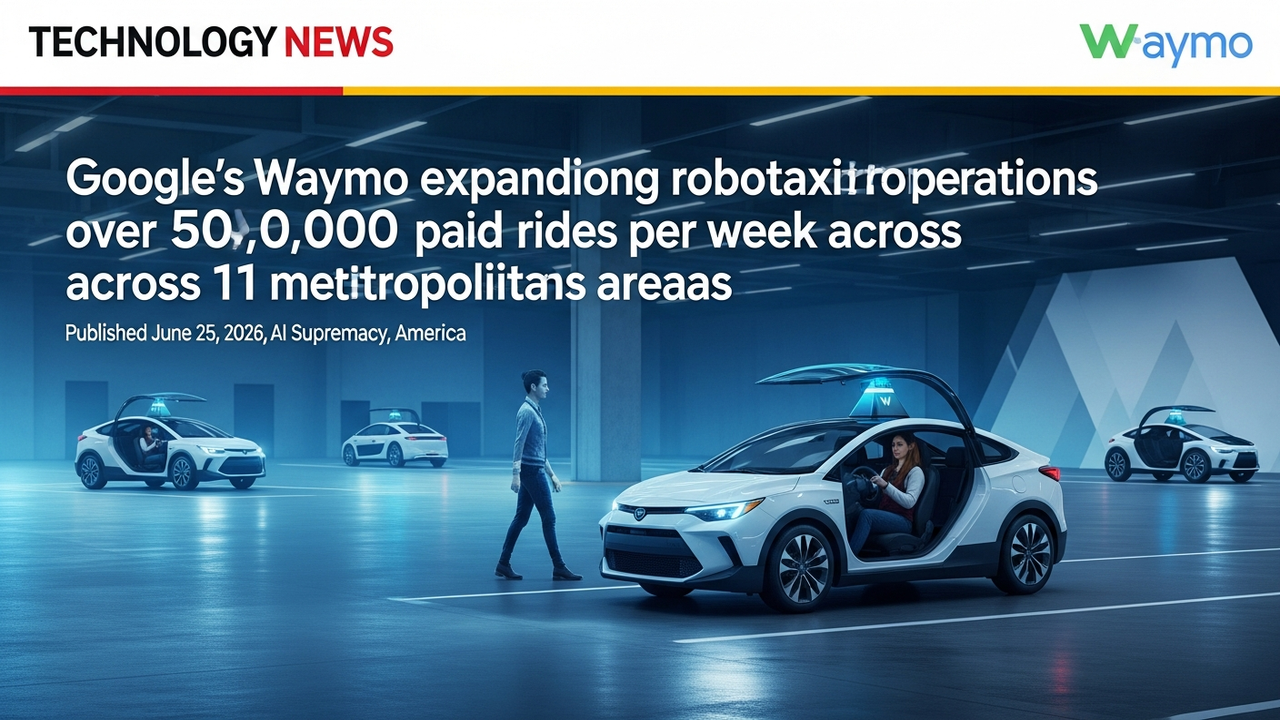
Google’s Waymo is dramatically scaling its robotaxi operations, now delivering over 500,000 paid driverless rides weekly across 11 metropolitan areas. This achievement stands as a robust demonstration of AI operating at scale in the physical world, solidifying Waymo’s leadership in a sector where autonomous-vehicle startups collectively raised a record $21.4 billion in the first months of 2026.
Technical / Clinical Details
Waymo’s autonomous driving system, the “Waymo Driver,” combines a sophisticated sensor suite (LiDAR, radar, cameras) with advanced AI algorithms to perceive, predict, and plan safe driving maneuvers in complex urban environments. The volume of over 500,000 weekly rides attests to the system’s reliability and scalability, moving beyond experimental phases to become a consistent part of daily urban mobility. The article highlights a crucial shift in autonomous driving development: the “Driver” system has evolved into a “foundation-model problem.” This signifies a move from highly modular, separate components (perception, prediction, planning) to a more integrated, end-to-end AI approach that mimics human cognitive processes from sensing to action. This foundation-model paradigm enables the AI to adapt more rapidly and effectively to new city geographies and unforeseen situations, significantly accelerating new city launches.
Background & Context
Autonomous driving technology promises to revolutionize transportation by improving safety, efficiency, and accessibility. However, technical complexities, regulatory hurdles, and substantial development costs have historically constrained its widespread adoption. Waymo’s success is the culmination of years of intensive R&D and real-world testing, indicating a significant maturation of the technology and its commercial viability. The concentration of capital in a few leading companies reflects the economies of scale and technological advantages required to succeed in this highly competitive field.
Strategic Significance & Outlook
Waymo’s large-scale robotaxi deployment is poised to play a pivotal role in shaping the future of urban mobility. The evolution towards a foundation-model approach promises even faster geographical expansion, potentially bringing the benefits of autonomous services to more populations. Key challenges moving forward include further improving cost-efficiency, navigating evolving regulatory landscapes, and enhancing capabilities in adverse weather conditions or highly unstructured environments. Nevertheless, the documented success of over half a million paid driverless rides weekly signals a clear transition of autonomous driving from science fiction to a tangible, scalable commercial service, with profound implications for the global mobility industry.
Source: https://www.ai-supremacy.com/p/how-googles-waymo-is-scaling-robotaxis-in-2026
Get our weekly technology intelligence — free
Receive an infographic that lets you judge at a glance whether each field’s analysis report is worth reading.
Subscribe Free — Weekly Tech Intelligence
By subscribing, you’ll receive Troy-Technical’s weekly technology intelligence newsletter.
- Your email and selected fields are used only to deliver the newsletter.
- We never share your information with third parties.
- You can unsubscribe anytime via the link in each email.
See our Privacy Policy for details.
Takes about a minute · Unsubscribe anytime