Key Findings
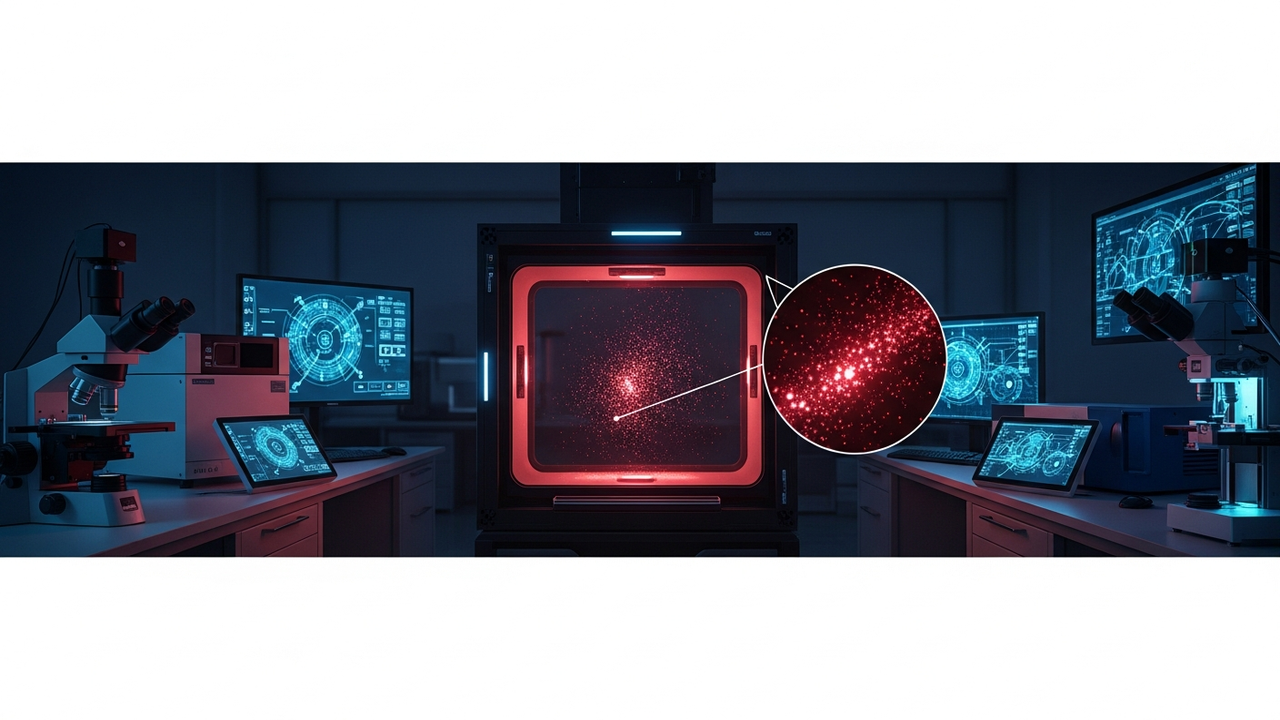
A collaborative research team from Tohoku University and the National Institute for Materials Science (NIMS) has engineered Nd-doped CdTe quantum dots that overcome the limitations of the energy gap law, demonstrating highly efficient emission at 1730 nm within the near-infrared second biological window (NIR-IIb/c). These novel quantum dots achieve an impressive photoluminescence quantum yield (PLQY) of 11.34 ± 0.79% in aqueous solution, paving the way for clinical-grade deep-tissue bioimaging and fluorescence-guided surgery.
Technical / Clinical Details
The developed Nd-doped CdTe quantum dots address a fundamental challenge in semiconductor physics: the energy gap law, which typically dictates a decrease in quantum yield for narrower bandgap materials due to increased non-radiative recombination. The research team employed a novel polaronic engineering approach, precisely controlling the interaction between electrons and lattice vibrations within the quantum dots. This strategy, coupled with the strategic introduction of Nd ions, optimized the energy levels of the emissive centers and effectively suppressed non-radiative processes. The result is stable, high-efficiency emission at 1730 nm, a wavelength where biological tissues exhibit minimal light absorption and scattering. This enables high-sensitivity and high-resolution imaging of deep tissues (several millimeters or more), facilitating the visualization of vascular structures and tumors. The high-efficiency emission in aqueous solutions also indicates their potential for biocompatible drug delivery systems and advanced diagnostic probes.
Background & Context
NIR-II (1000–1700 nm) bioimaging offers significant advantages over visible and NIR-I imaging, including reduced scattering and absorption by biological tissues, leading to deeper penetration depth and higher spatial resolution. These attributes are highly desirable for applications such as early cancer detection, disease monitoring, and precise identification of lesions during surgery. However, the development of high-efficiency, biocompatible emissive materials for this spectral window has remained a formidable technical hurdle. Conventional quantum dots have historically suffered from low quantum yields in the NIR-II region, limiting their practical application. This research represents a significant breakthrough, opening new avenues for medical imaging.
Strategic Significance & Outlook
These Nd-doped CdTe quantum dots hold transformative potential for early cancer diagnosis and personalized medicine, allowing for more accurate detection of deep-seated tumors and microvascular anomalies. In fluorescence-guided surgery, the technology could provide clearer visualization of lesion boundaries, thereby improving the precision and completeness of tumor resection and enhancing patient safety. Future work will focus on long-term in vivo safety evaluations and the establishment of large-scale production techniques. Once translated to clinical practice, this technology is expected to revolutionize the diagnostic and therapeutic landscape, significantly improving patient outcomes across various medical conditions.
Source: https://pubmed.ncbi.nlm.nih.gov/42351345/
Get our weekly technology intelligence — free
Receive an infographic that lets you judge at a glance whether each field’s analysis report is worth reading.
Subscribe Free — Weekly Tech Intelligence
By subscribing, you’ll receive Troy-Technical’s weekly technology intelligence newsletter.
- Your email and selected fields are used only to deliver the newsletter.
- We never share your information with third parties.
- You can unsubscribe anytime via the link in each email.
See our Privacy Policy for details.
Takes about a minute · Unsubscribe anytime