
Key Findings
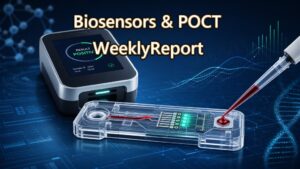
New research published in ‘Lab on a Chip’ by RSC Publishing demonstrates that machine learning (ML)-augmented lateral flow assays (LFAs) are dramatically enhancing detection performance in point-of-care (PoC) infectious disease diagnostics. While LFAs are widely adopted for their speed, low cost, and ease of use, traditional systems have faced challenges with limited analytical sensitivity, qualitative or semi-quantitative outputs, and subjective visual interpretation of results. This study showcases how combining cutting-edge innovations in nanomaterial engineering, signal amplification strategies, and multiplex assay design with AI/ML-based image analysis can overcome these limitations, transforming LFAs into highly precise and quantitative diagnostic tools.
Technical / Clinical Details
Conventional LFAs typically rely on visual interpretation of colored lines to determine positive/negative results, which can be imprecise, especially at low analyte concentrations. The proposed ML-LFA system significantly enhances detection sensitivity through signal amplification technologies using nanoparticles (e.g., gold nanoparticles, quantum dots). For example, reported improvements show detection limits for specific viral antigens reduced by hundreds to thousands of times compared to traditional methods. Furthermore, multiplex assay designs are incorporated, allowing simultaneous detection of multiple biomarkers on a single strip, thereby increasing diagnostic comprehensiveness. AI and ML algorithms analyze images of LFA strips captured by smartphones or dedicated readers, identifying subtle color changes and pattern differences that are imperceptible to the human eye. This image processing and pattern recognition enable accurate quantification of target molecule concentrations and reduce the risk of false positives and negatives, thereby dramatically improving diagnostic objectivity and reliability. Quantitative data is particularly critical for assessing disease progression and monitoring treatment efficacy in clinical settings.
Background & Context
Rapid diagnosis of infectious diseases is crucial for pandemic preparedness, outbreak containment, and effective antibiotic stewardship programs. While traditional LFAs have been useful for initial screening, they were often insufficient for more complex diagnostics and disease management. The advent of ML-LFA technology improves diagnostic quality while expanding the scope of POCT applications. In resource-limited settings, this high-precision, affordable technology can contribute significantly to community health. It also helps alleviate the burden on central laboratories and reduces turnaround times from diagnosis to treatment, thus improving the efficiency of the entire healthcare system.
Strategic Significance & Outlook
The convergence of machine learning and LFAs holds immense potential to reshape the future of infectious disease diagnostics. In the coming years, this technology is expected to be widely applied for rapid and highly accurate diagnosis of a broad spectrum of infectious diseases, including COVID-19, influenza, malaria, and dengue. Furthermore, there is an anticipation for its evolution into fully integrated telehealth diagnostic platforms, enabling patient self-diagnosis at home with AI automatically analyzing results and transmitting them to healthcare providers. This will enhance public health surveillance, facilitate earlier disease detection, and prompt intervention, thereby contributing significantly to improving global health outcomes.
Source: https://pubs.rsc.org/en/content/articlelanding/2026/lc/d5lc01124h
Get our weekly technology intelligence — free
Receive an infographic that lets you judge at a glance whether each field’s analysis report is worth reading.
Subscribe Free — Weekly Tech Intelligence
By subscribing, you’ll receive Troy-Technical’s weekly technology intelligence newsletter.
- Your email and selected fields are used only to deliver the newsletter.
- We never share your information with third parties.
- You can unsubscribe anytime via the link in each email.
See our Privacy Policy for details.
Takes about a minute · Unsubscribe anytime







Comments