Background
Catalysts form the fundamental backbone of the chemical industry, indispensable for manufacturing processes spanning pharmaceuticals, plastics, and fuels. They are equally critical for advancing high-performance clean energy technologies—such as fuel cells, hydrogen production, and CO2 capture and utilization—all vital for mitigating global warming. Despite their importance, catalyst discovery has historically relied heavily on expert intuition and empirical experience. The protracted development cycle, compounded by pervasive data fragmentation and difficulties in information sharing, has long represented a significant bottleneck for industrial innovation.
Japan boasts a distinguished history in catalyst research, home to numerous world-leading institutions. The emergence of AI-powered platforms from prominent research hubs like Tohoku University’s AIMR not only strengthens Japan’s competitive edge in materials science but also promises substantial contributions towards achieving a sustainable global society. As the chemical and energy sectors increasingly demand more efficient and environmentally friendly processes, advanced tools like DigCat 4.0 are strategically positioned to fulfill these critical requirements.
Key Findings
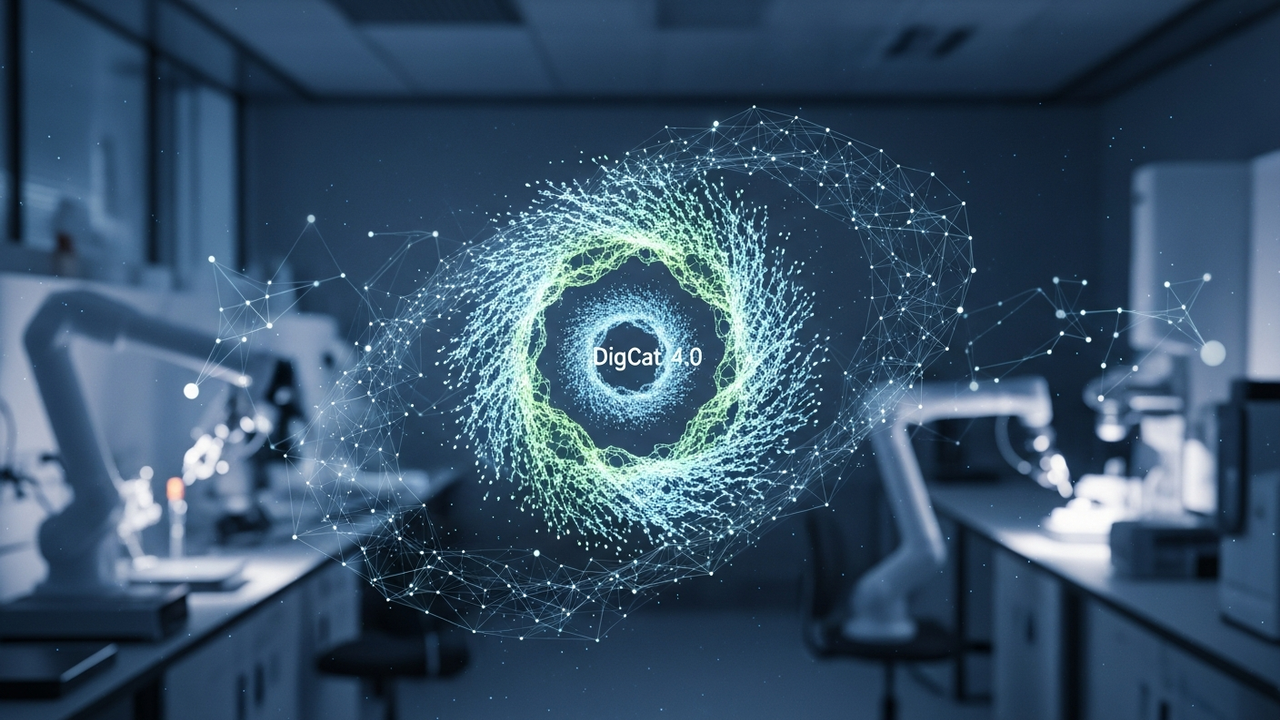
A research team at Tohoku University’s Advanced Institute for Materials Research (AIMR) has unveiled ‘DigCat 4.0,’ an artificial intelligence (AI)-powered digital platform specifically designed for catalyst discovery. This innovative platform fundamentally addresses the inefficiencies inherent in the traditional catalyst discovery process by centrally integrating previously disparate experimental data, theoretical calculation results, and scientific literature. The introduction of DigCat 4.0 is anticipated to dramatically accelerate the identification of novel catalytic materials, which are essential for applications in fuels, chemicals, and clean energy technologies.
Technical Details
DigCat 4.0 is groundbreaking in its capacity to integrate vast amounts of data from diverse sources, enabling AI models to accurately predict catalyst performance and suggest optimal compositions and structures. The platform leverages machine learning to discern success and failure patterns from past experimental results, combining these insights with molecular-level understanding derived from theoretical calculations, such as Density Functional Theory (DFT), and knowledge extracted from a broad spectrum of academic literature. This integrated approach empowers researchers to significantly reduce costly and time-consuming trial-and-error experiments, allowing them to focus resources on the most promising catalyst candidates.
The system proves particularly effective for exploring complex multi-component catalysts and those requiring optimal performance under specific, challenging reaction conditions (e.g., high temperature and pressure). The AI efficiently navigates the expansive chemical space, uncovering novel material design principles and previously unknown structure-function relationships that human intuition or traditional methods might overlook. This capability is expected to accelerate the development of highly efficient and durable catalysts for critical industrial processes, including ammonia synthesis, CO2 reduction, and hydrogen production.
Strategic Outlook
DigCat 4.0 is expected to significantly broaden its application across a more diverse spectrum of catalytic reaction systems, driven by increased collaboration with both academic research institutions and industry partners. As the volume and diversity of data incorporated into the platform expand, and the sophistication of its underlying AI models continues to improve, its prediction accuracy and overall discovery efficiency are projected to rise substantially. Looking ahead, there is significant potential for seamless integration with autonomous robotic experimental systems, envisioning a fully automated ‘closed-loop’ materials discovery cycle. In this paradigm, AI would intelligently design novel catalysts, while robotic systems would autonomously synthesize and evaluate them. This represents a groundbreaking advancement poised to fundamentally reshape the future landscape of materials science and engineering.
Source: https://www.eurekalert.org/news-releases/1131777
Get our weekly technology intelligence — free
Receive an infographic that lets you judge at a glance whether each field’s analysis report is worth reading.
Subscribe Free — Weekly Tech Intelligence
By subscribing, you’ll receive Troy-Technical’s weekly technology intelligence newsletter.
- Your email and selected fields are used only to deliver the newsletter.
- We never share your information with third parties.
- You can unsubscribe anytime via the link in each email.
See our Privacy Policy for details.
Takes about a minute · Unsubscribe anytime








Comments