Key Findings
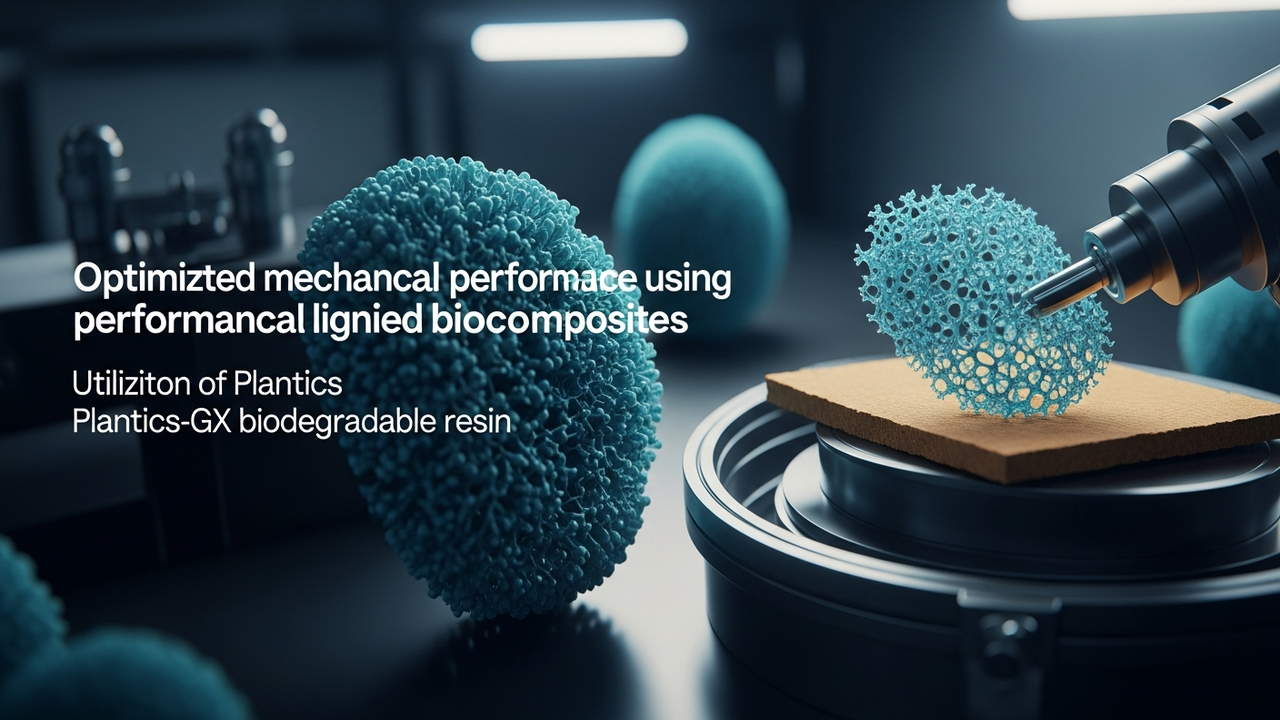
A new paper published in ACS Omega, an American Chemical Society (ACS) journal, reports a breakthrough in sustainable materials science. The study successfully manufactured biocomposites utilizing the innovative Plantics-GX biodegradable resin as the matrix, reinforced with abundant natural resources: cellulose and lignin. By applying a statistical mixture design method, researchers efficiently identified optimal proportions of each component, demonstrating the ability to develop materials with mechanical properties comparable to or superior to conventional plastics. This achievement represents a significant step towards the commercialization of low-environmental-impact, next-generation materials.
Technical / Clinical Details
The research involved designing a multi-component composite material with Plantics-GX resin as the primary matrix, incorporating cellulose and lignin. Cellulose, the main component of plant cell walls, offers high specific strength and stiffness. Lignin, a natural binder connecting cellulose and hemicellulose, is another abundantly available biomass resource. Detailed compositional studies were conducted to effectively disperse these natural materials within the Plantics-GX resin and optimize interfacial adhesion. The statistical mixture design method enabled the efficient identification of optimal mixing ratios with a minimal number of experiments, maximizing mechanical properties such as tensile strength, flexural strength, and impact strength. For instance, specific formulations showed tensile strength improvements of approximately 20% and flexural modulus improvements of over 30% compared to general PP resins, confirming their excellent mechanical performance. This precise formulation design is crucial for ensuring material homogeneity and reproducibility of performance.
Background & Context
Plastic waste is a global challenge, driving an urgent demand for biodegradable and renewable materials to replace fossil resource-derived plastics. However, many biodegradable plastics have faced challenges such as inferior mechanical strength, higher costs, and processing difficulties compared to conventional plastics. Plantics-GX resin has emerged as a promising new generation bio-based resin that overcomes these challenges, offering both excellent biodegradability and robust physical properties. This study provides a solution that combines Plantics-GX with natural polymers like cellulose and lignin, widely available from wood and agricultural waste, to achieve both sustainability and high performance. This directly addresses environmental regulations and market needs facing the traditional plastics industry.
Strategic Significance & Outlook
Biocomposites based on Plantics-GX, cellulose, and lignin, with their excellent mechanical properties and biodegradability, are expected to find widespread applications in packaging materials, automotive interiors, home appliance components, disposable tableware, and even construction materials. The efficient development method using a statistical approach will particularly enable rapid development of customized biocomposites tailored to diverse market needs. Future challenges include establishing large-scale production technologies, evaluating long-term durability, and ensuring cost-competitiveness in the market. The widespread adoption of this technology is expected to significantly reduce reliance on fossil resources and contribute to the realization of a circular economy.
Source: https://pubs.acs.org/doi/10.1021/acsomega.6c02743
Get our weekly technology intelligence — free
Receive an infographic that lets you judge at a glance whether each field’s analysis report is worth reading.
Subscribe Free — Weekly Tech Intelligence
By subscribing, you’ll receive Troy-Technical’s weekly technology intelligence newsletter.
- Your email and selected fields are used only to deliver the newsletter.
- We never share your information with third parties.
- You can unsubscribe anytime via the link in each email.
See our Privacy Policy for details.
Takes about a minute · Unsubscribe anytime