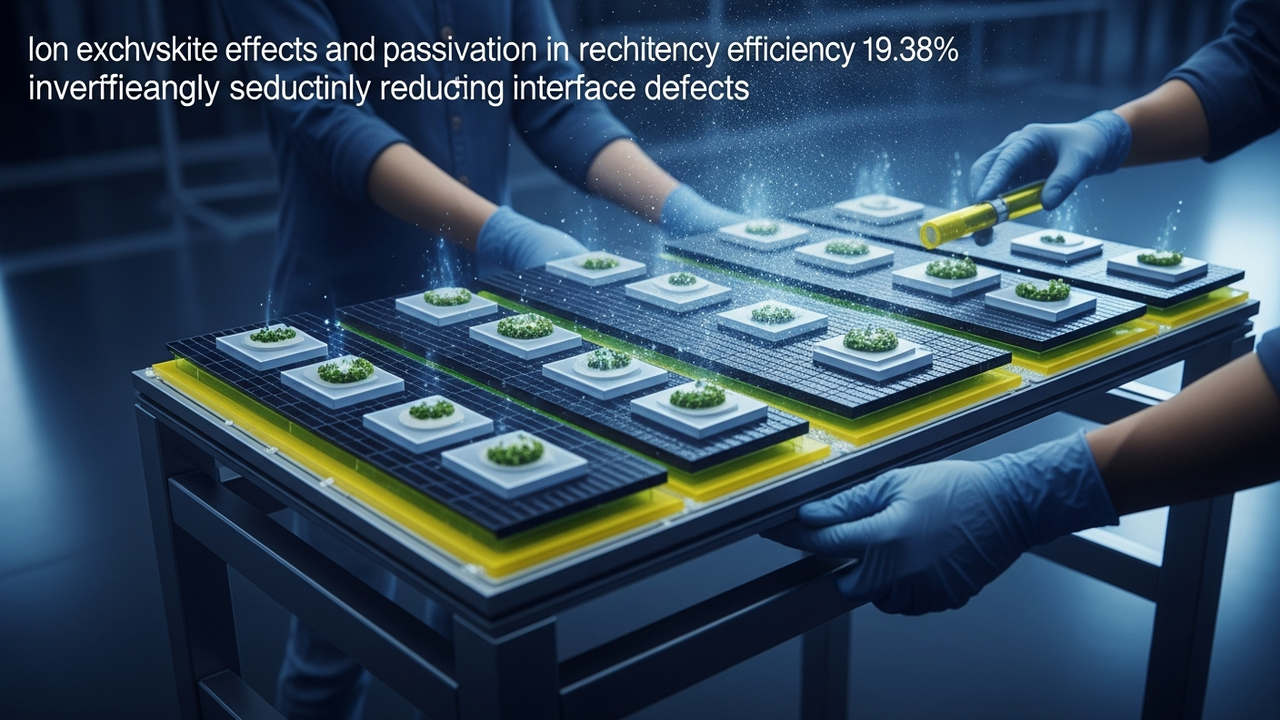
The Promise and Pitfalls of Perovskite Solar Cells
Inverted perovskite solar cells (PSCs) are rapidly emerging as a frontrunner for commercialization due to their streamlined architecture and compatibility with cost-effective, solution-based manufacturing techniques like spin-coating and printing. However, widespread adoption has been hampered by persistent challenges, primarily defects and energy losses at the interfaces between the perovskite layer and the charge transport layers. The quality of these interfaces, particularly the buried interface between the hole transport layer (HTL) and the perovskite, critically determines a device’s overall efficiency and long-term reliability.
Dual-Function Interface Engineering Unleashes Performance
This study presents a significant advancement in inverted PSC technology through synergistic buried interface engineering, integrating both ion exchange and passivation mechanisms. The core innovation lies in the optimized treatment of the widely used poly(3,4-ethylenedioxythiophene):poly(styrenesulfonate) (PEDOT:PSS) buried interface with sodium acetate. While PEDOT:PSS is a well-established hole transport material, its interfacial properties profoundly impact device performance.
Experimental evidence confirms that the sodium acetate treatment imparts a dual functionality: it induces beneficial ion exchange reactions at the interface while simultaneously passivating detrimental interfacial defects between the perovskite and PEDOT:PSS layers. This dual-function modulation synergistically reduces non-radiative recombination of charge carriers and concurrently enhances charge extraction efficiency. The combined effect of reduced defect density and suppressed energy loss leads to improvements in both the open-circuit voltage (Voc) and short-circuit current density (Jsc), directly contributing to the enhanced power conversion efficiency.
Record Efficiency and Enhanced Stability Achieved
The implementation of this dual-function modulation approach dramatically improved the device’s performance metrics. Power conversion efficiency (PCE) witnessed a substantial increase from 17.91% to an impressive 19.38%. Furthermore, the fill factor (FF), a critical indicator of efficient charge extraction, reached a remarkable 81.70%. These figures represent a notable leap in perovskite solar cell performance, demonstrating the efficacy of the developed interface engineering strategy.
Implications for Commercialization and Scalability
The synergistic buried interface engineering developed in this research offers a practical and effective strategy for simultaneously boosting the efficiency and stability of perovskite solar cells. Crucially, this technology is well-suited for industrial-scale applications, including the fabrication of large-area devices and high-throughput processes such as roll-to-roll manufacturing. The significant reduction in defect density and the improved fill factor contribute directly to enhanced long-term reliability, making these devices considerably more attractive for commercial deployment. Looking ahead, the research team aims to further optimize this approach and explore its applicability across various perovskite compositions and charge transport materials, paving the way for the widespread adoption of next-generation perovskite solar cell technologies.
Source: https://pubs.acs.org/doi/10.1021/acsami.6c08440
Get our weekly technology intelligence — free
Receive an infographic that lets you judge at a glance whether each field’s analysis report is worth reading.
Subscribe Free — Weekly Tech Intelligence
By subscribing, you’ll receive Troy-Technical’s weekly technology intelligence newsletter.
- Your email and selected fields are used only to deliver the newsletter.
- We never share your information with third parties.
- You can unsubscribe anytime via the link in each email.
See our Privacy Policy for details.
Takes about a minute · Unsubscribe anytime





Comments