Background and Context
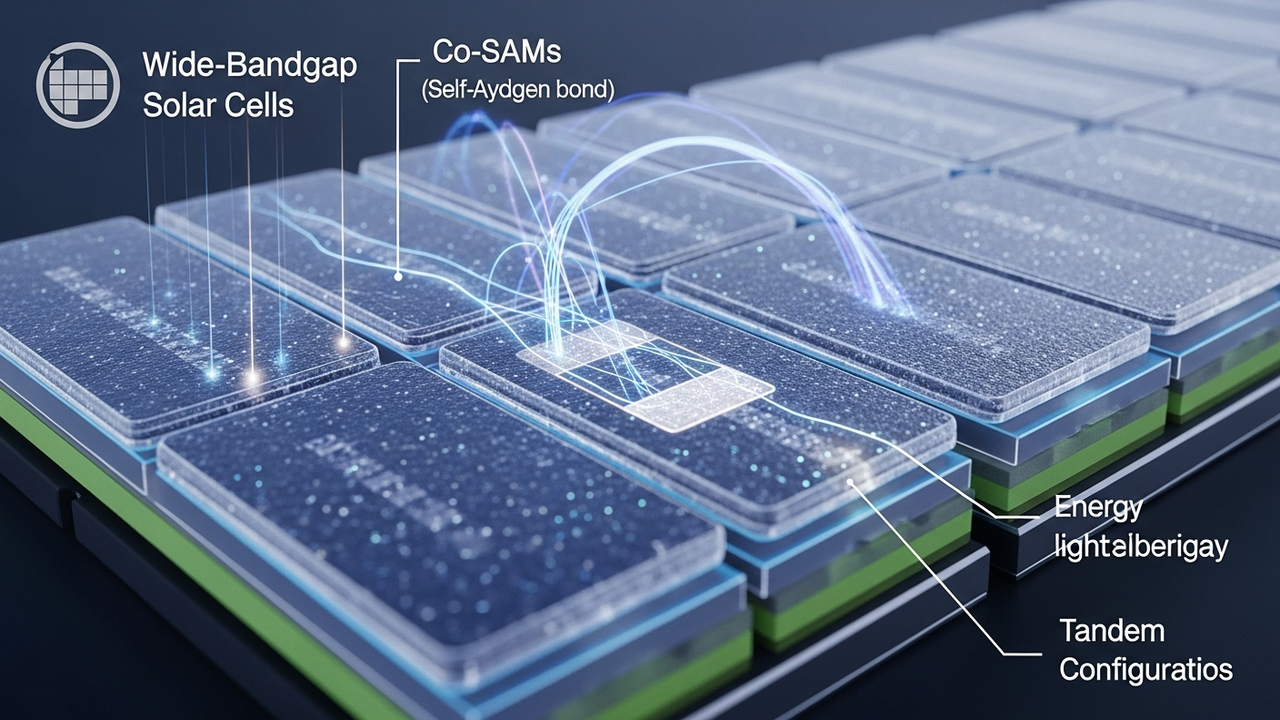
Perovskite solar cells are garnering significant attention as a promising next-generation photovoltaic technology, thanks to their high theoretical efficiency and potential for low-cost manufacturing. However, wide-bandgap perovskite materials, crucial for tandem architectures, have historically struggled with both efficiency and long-term stability. Tandem solar cells, particularly those combining perovskite with silicon, are leading contenders for surpassing the efficiency limits of single-junction devices, yet their overall performance hinges critically on the efficacy of the wide-bandgap perovskite top cell. The innovative Co-SAM strategy presented here dramatically enhances the performance of these wide-bandgap perovskites, marking a substantial breakthrough for the practical deployment of high-efficiency tandem solar cells.
Key Findings
This study unveils the successful development of highly efficient and stable wide-bandgap perovskite solar cells, facilitated by a novel strategy employing co-assembled monolayers (Co-SAMs) mediated by multiple hydrogen bonds. The Co-SAM-based inverted 1.68 eV perovskite solar cell achieved a record-breaking champion efficiency of 23.02%. Furthermore, when integrated into a four-terminal perovskite/silicon tandem configuration, this technology demonstrated an extraordinary power conversion efficiency of 30.61%.
Technical Details
In high-efficiency perovskite solar cells, particularly wide-bandgap perovskites designed for the top cell in tandem structures, the integrity of the buried NiOₓ (nickel oxide)/perovskite interface is paramount for both performance and stability. The Co-SAM strategy precisely engineered in this research allows for atomic-level control over this critical interface, leveraging multiple hydrogen bonding interactions. These Co-SAMs effectively passivate detrimental defect sites at the interface, thereby substantially mitigating non-radiative recombination losses. Crucially, they also suppress interface-induced perovskite degradation, leading to a marked improvement in the long-term stability of the devices. The standalone inverted 1.68 eV perovskite solar cell, utilizing this approach, achieved a near-certified efficiency of 23.02% on a small active area of 0.042 cm². The integration of this high-performance top cell with a conventional silicon bottom cell in a four-terminal tandem architecture enabled a significantly broader utilization of the solar spectrum, culminating in an exceptional overall power conversion efficiency of 30.61%.
Strategic Significance and Outlook
The achievement of 30.61% tandem efficiency unequivocally positions perovskite solar cell technology as a formidable contender, capable of significantly outperforming current state-of-the-art photovoltaic technologies. This Co-SAM strategy offers a highly practical and scalable method for simultaneously enhancing the efficiency and stability of wide-bandgap perovskites, which will undoubtedly accelerate the commercialization pathway for perovskite/silicon tandem solar cells. Future research endeavors are anticipated to concentrate on further optimizing the Co-SAM architecture, scaling up active device areas, and driving down manufacturing costs. Successful market introduction of this technology promises to dramatically improve the cost-efficiency of solar power generation, thereby serving as a powerful catalyst for the widespread global adoption of clean energy solutions.
Source: https://pubs.acs.org/doi/10.1021/acsphotonics.6c00381
Get our weekly technology intelligence — free
Receive an infographic that lets you judge at a glance whether each field’s analysis report is worth reading.
Subscribe Free — Weekly Tech Intelligence
By subscribing, you’ll receive Troy-Technical’s weekly technology intelligence newsletter.
- Your email and selected fields are used only to deliver the newsletter.
- We never share your information with third parties.
- You can unsubscribe anytime via the link in each email.
See our Privacy Policy for details.
Takes about a minute · Unsubscribe anytime









Comments