Background
Perovskite solar cell manufacturing conventionally necessitates an inert gas atmosphere, such as a nitrogen-filled glovebox, contributing to increased costs and manufacturing complexity. An ambient air processing route would circumvent this bottleneck, paving the way for scalable, cost-effective production. However, the presence of moisture and oxygen in the air has historically impeded film crystallization and compromised device performance. The profound significance of this work lies in achieving performance on par with, and even surpassing, state-of-the-art efficiencies previously reported exclusively for inert atmosphere fabrication, despite utilizing an ambient air process. This accomplishment constitutes a significant breakthrough, dismantling one of the primary hurdles to perovskite solar cell commercialization.
Key Findings
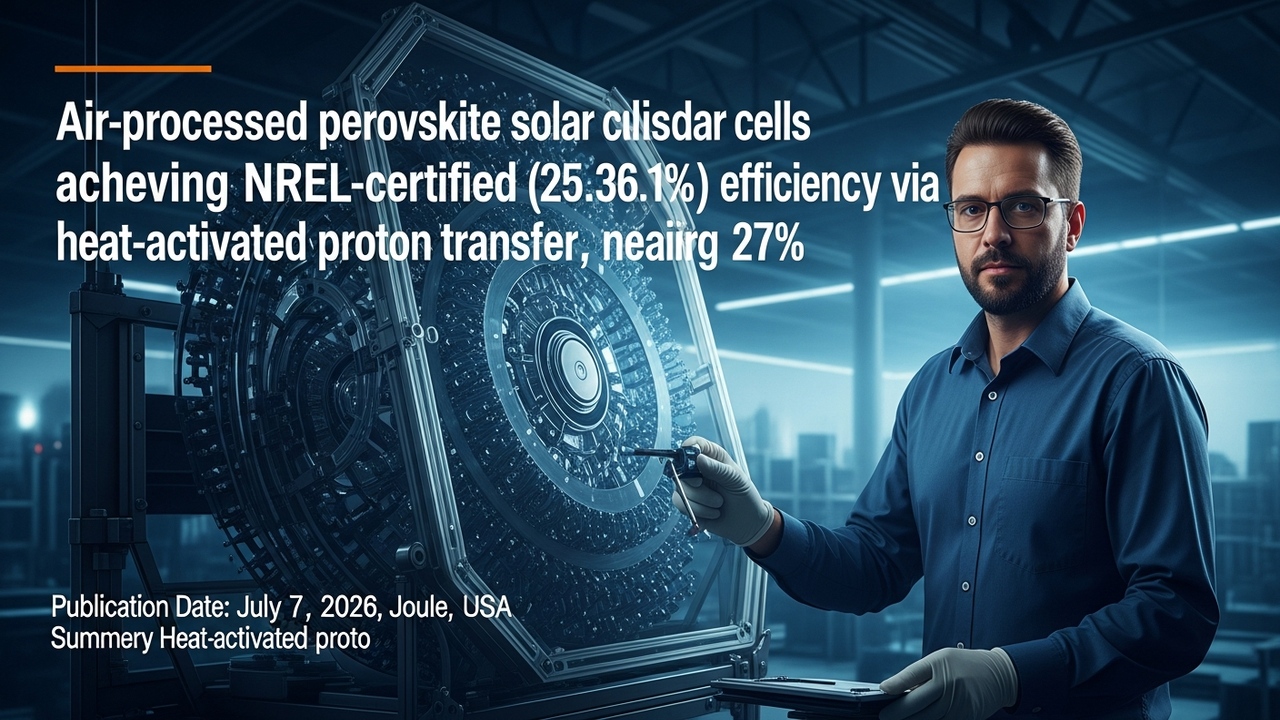
This study reports that perovskite solar cells fabricated in ambient air have achieved remarkably high efficiencies, reaching 26.1% (laboratory data) and an astonishing NREL (National Renewable Energy Laboratory)-certified quasi-steady-state efficiency of 25.33%, through an innovative technique called thermally activated proton transfer. This marks a significant milestone as perovskite solar cell efficiency approaches 27%.
Technical Details
The research team successfully addressed the challenges of air processing by incorporating semicarbazide hydrochloride into the perovskite precursor solution. This additive initiated a thermally activated proton transfer mechanism, which facilitates optimal crystallization of α-phase formamidinium lead iodide (FAPbI₃) perovskite films. This mechanism leads to several key improvements:
- Uniform vertical distribution of A-site cations: Ensures optimal charge carrier transport pathways throughout the film.
- Large crystal grains: Reduces grain boundaries, thereby suppressing charge carrier recombination losses.
- Reduced voids at buried interfaces: Improves the quality of the interface between the perovskite and charge transport layers, minimizing interfacial defects.
These structural and compositional improvements synergistically boosted the device’s open-circuit voltage (Voc), short-circuit current density (Jsc), and fill factor (FF). Independent NREL certification further validates this high efficiency, bolstering its credibility within the scientific community.
Strategic Significance and Outlook
The demonstrated success of air-processed perovskite solar cells, enabled by thermally activated proton transfer, is poised to significantly accelerate the practical deployment of this technology. Streamlined manufacturing and substantial cost reductions will dramatically bolster the market competitiveness of perovskite solar cells. Future efforts are expected to concentrate on further optimizing this technology, scaling up for large-area fabrication, and conducting rigorous long-term stability and durability assessments under diverse environmental conditions. This breakthrough positions perovskite solar cells as a powerful contender to emerge as a leading next-generation photovoltaic technology, becoming an indispensable component of the global energy infrastructure.
Get our weekly technology intelligence — free
Receive an infographic that lets you judge at a glance whether each field’s analysis report is worth reading.
Subscribe Free — Weekly Tech Intelligence
By subscribing, you’ll receive Troy-Technical’s weekly technology intelligence newsletter.
- Your email and selected fields are used only to deliver the newsletter.
- We never share your information with third parties.
- You can unsubscribe anytime via the link in each email.
See our Privacy Policy for details.
Takes about a minute · Unsubscribe anytime





Comments