Key Findings
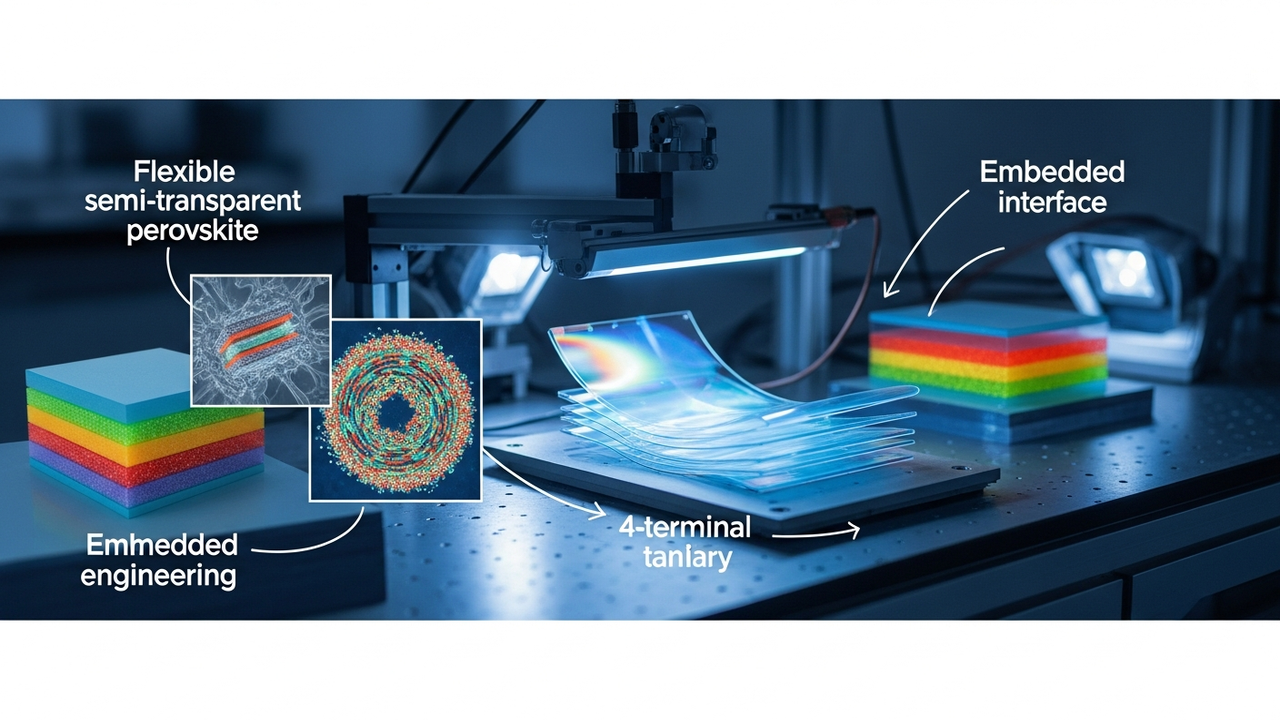
Researchers have developed an innovative buried-interface engineering strategy, leading to the creation of flexible semitransparent perovskite solar cells (FS-PSCs) with a remarkable champion efficiency of 21.4%. Furthermore, applying this technology, an all-flexible perovskite/silicon four-terminal tandem solar cell was fabricated, recording an exceptionally high champion efficiency of 27.7%. Crucially, these devices exhibit outstanding long-term stability and mechanical robustness.
Technical Details
The buried-interface engineering technique focuses on optimizing the interactions between the perovskite layer and adjacent functional layers. While specific details of the materials and structural approaches are not fully elaborated, it is understood that new methodologies were employed to maximize charge carrier extraction efficiency and suppress non-radiative recombination at these critical interfaces. The flexible and semitransparent nature of the FS-PSCs is vital for specific applications, such as integrated windows or wearable electronics. The 21.4% efficiency for FS-PSCs served as a strong foundation for the 4-terminal perovskite/silicon tandem configuration, where optimized layering led to the 27.7% efficiency. A highlight of this research is the unprecedented mechanical stability demonstrated: the devices showed negligible efficiency degradation after 500 hours of continuous maximum power point (MPP) tracking under 1-sun illumination, and impressively maintained 94.5% of their initial efficiency even after 2000 bending cycles. This represents a significant breakthrough for the practical realization of flexible photovoltaic devices.
Background & Context
The demand for flexible solar cells is rapidly increasing due to their advantages in conformability to curved surfaces, lightweight design, and portability, which are challenging for traditional rigid panels. Semitransparent flexible solar cells, in particular, open up new market segments that balance aesthetics and functionality, such as building-integrated photovoltaics (BIPV), automotive applications, and consumer electronics. However, simultaneously achieving high efficiency, flexibility, and long-term stability has been a substantial technological hurdle. This buried-interface engineering provides an effective solution to these challenges, accelerating the commercial viability of flexible solar cells.
Strategic Significance & Outlook
The 27.7% efficiency achieved for flexible four-terminal tandem solar cells is highly competitive, even when compared to established photovoltaic technologies. This advancement has broad implications for BIPV, wearable electronics, IoT sensors, and automotive solar applications. The superior mechanical stability suggests these devices can withstand harsh operational conditions, contributing to extended product lifetimes and reduced maintenance costs. Future research will concentrate on demonstrating the scalability of this technology for mass production and further validating its long-term reliability under more diverse and extreme environmental conditions.
Source: https://pubs.acs.org/doi/10.1021/acsenergylett.6c01361
Get our weekly technology intelligence — free
Receive an infographic that lets you judge at a glance whether each field’s analysis report is worth reading.
Subscribe Free — Weekly Tech Intelligence
By subscribing, you’ll receive Troy-Technical’s weekly technology intelligence newsletter.
- Your email and selected fields are used only to deliver the newsletter.
- We never share your information with third parties.
- You can unsubscribe anytime via the link in each email.
See our Privacy Policy for details.
Takes about a minute · Unsubscribe anytime

Comments