Key Findings
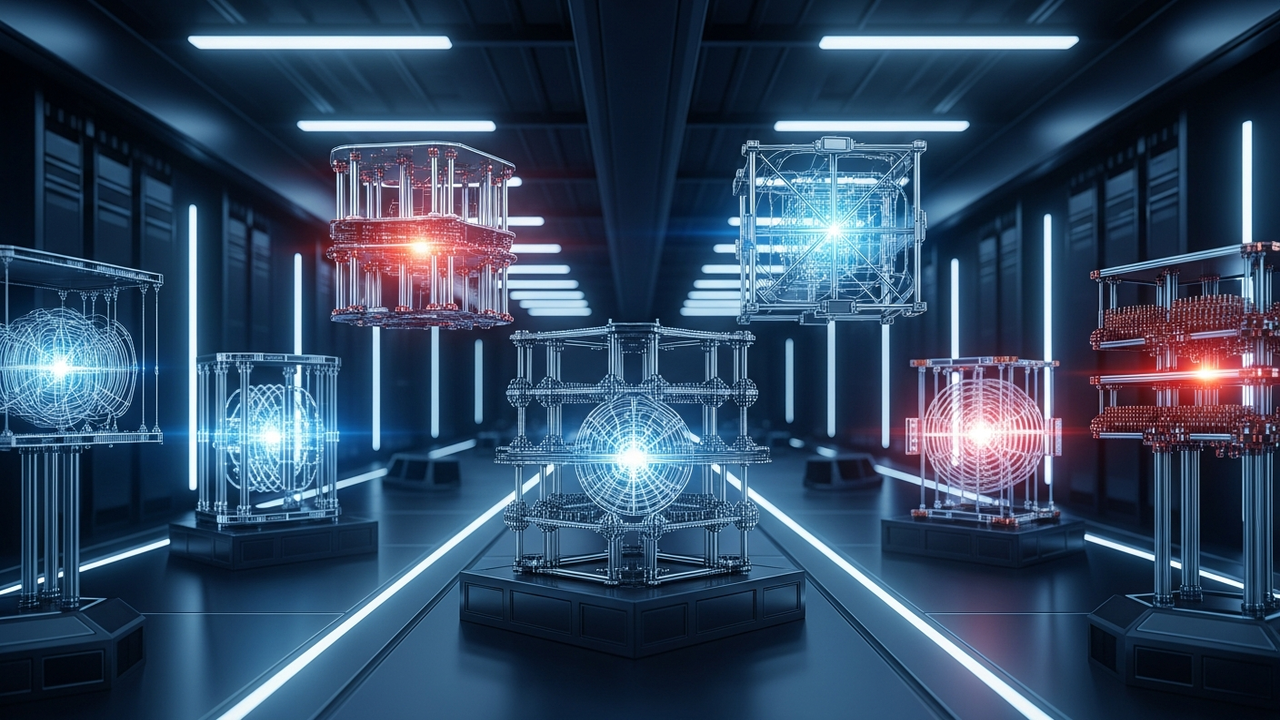
The pursuit of scalable, fault-tolerant quantum computing (FTQC) is currently characterized by intense competition among six major hardware approaches, including superconducting, trapped ion, neutral atom, and silicon spin qubits. Unlike the historical trajectory of classical computing, a single dominant quantum architecture has yet to emerge, with each ‘quantum tribe’ championing its unique approach and technological advantages.
Technical / Clinical Details
Each qubit type presents distinct technical challenges and opportunities for achieving fault tolerance and scalability:
- Superconducting Qubits: Offer potential for high-speed gate operations and scalability but face hurdles with cryogenic operating temperatures and high error rates.
- Trapped Ion Qubits: Known for high gate fidelity and long coherence times, but scaling presents challenges in connectivity and control complexity.
- Neutral Atom Qubits: Provide high scalability and relatively long coherence times, with flexible arrangement, though gate operation speed and efficiency are still under active research.
- Silicon Spin Qubits: Show high compatibility with existing semiconductor manufacturing processes and promise high integration density, but individual qubit control and readout remain challenging.
These technologies exhibit different strengths across dimensions such as speed, fidelity (low error rates), qubit connectivity, system scalability, and ease of manufacturing. Achieving fault tolerance necessitates quantum error correction, which is estimated to require millions of physical qubits; how these diverse approaches meet this requirement is critical.
Background & Context
Quantum computing holds the potential to solve problems intractable for classical computers in diverse fields like drug discovery, materials science, and financial modeling. However, its practical realization is hampered by the ‘noise’ problem, characterized by short qubit coherence times and high operation error rates. Consequently, the ultimate goal is to achieve fault-tolerant quantum computing, which can perform computations while correcting errors. Government agencies, universities, startups, and major technology companies are all investing heavily in various hardware platforms, driving a robust technological race.
Strategic Significance & Outlook
A prolonged period of diverse research and development is expected before a single technology dominates the market. The evolution of each approach, coupled with advancements in quantum error correction techniques, will determine the viability of fault-tolerant quantum computers. Future developments may also include hybrid approaches or the integration of different qubit technologies. This ongoing competition is an indispensable phase in shaping the future of quantum computing, with technological diversity fostering innovation.
Get our weekly technology intelligence — free
Receive an infographic that lets you judge at a glance whether each field’s analysis report is worth reading.
Subscribe Free — Weekly Tech Intelligence
By subscribing, you’ll receive Troy-Technical’s weekly technology intelligence newsletter.
- Your email and selected fields are used only to deliver the newsletter.
- We never share your information with third parties.
- You can unsubscribe anytime via the link in each email.
See our Privacy Policy for details.
Takes about a minute · Unsubscribe anytime




Comments