Materials Informatics– category –
-

GNoME and MatterGen: AI materials discovery specs for 2026
AZoM UK Overview The integration of AI and automation is revolutionizing materials discovery, notably with Google DeepMind's GNoME and Microsoft's MatterGen. GNoME has identified over 10 million novel crystal structures, while MatterGen ... -
Materials Informatics Weekly Report September 26, 2026
▼ ▼ ▼ If the infographic makes you want to read the full report, please click the download button below. ▼ ▼ ▼ 📄 Weekly Report September 26, 2026 (PDF) — Download Weekly Report September 26, 2026 (PDF) — DownloadDownload 🎙 Podcast Septe... -
ML Interatomic Potentials: DocShare 2026 accuracy explained
DocShare Unknown Overview A study published on DocShare identified a consistent 'systematic softening' in the potential energy surfaces (PES) of universal machine-learned interatomic potentials (uMLIPs) such as M3GNet, CHGNet, and MACE-M... -
CoFe2O4: AI foundation model vs DFT site preference specs
Ouro Unknown Overview Recent analysis reveals that AI foundation models for materials science, such as CHGNet and MACE-MP-0, exhibit limitations in accurately predicting d-electron site preferences in spinel structures. Specifically, for... -
UCB-Bandit & LLM: Bayesian optimization for materials design 2026
arXiv International Overview A new paper reformulates acquisition function selection in constrained multi-objective Bayesian optimization (CMOBO) for materials design as an adaptive policy selection problem. Two novel controllers, UCB-Ba... -
Co-Based Superalloys: ML-driven 15% solvus temperature boost 2026
arXiv Unknown Overview This study introduces a physics-guided machine learning framework for the inverse design of Co-based superalloys, successfully identifying new alloy compositions that enhance the γ' solvus temperature by up to 15% ... -
UFO-MGen explained: Flow-based generative model for crystals 2026
arXiv Unknown Overview This arXiv study introduces UFO-MGen, a flow-based universal generative model that learns topological features of Wyckoff representations, achieving over 90% success rate in crystal generation. UFO-MGen demonstrate... -
MLIP training: Small-dataset strategy for 0.3 eV error in 2026
arXiv (Preprint) Unknown Overview A preprint on arXiv proposes a novel training scheme for machine-learned interatomic potentials (MLIPs) to accelerate point defect simulations. This efficient method trains MLIPs using limited DFT data, ... -
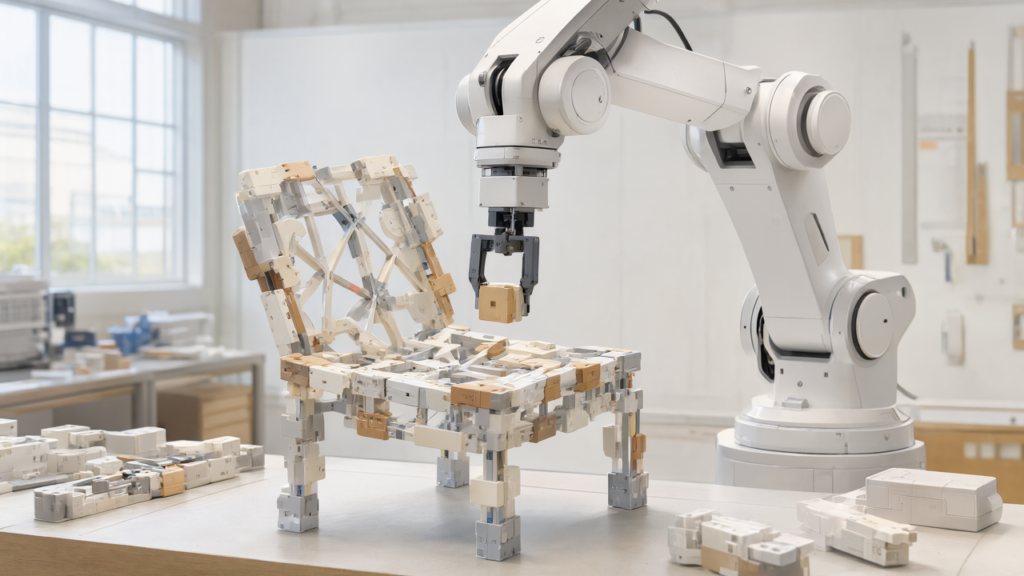
MIT 3D Generative AI: Text-to-physical object specs for 2026
Bits to Atoms (MIT CDFAM Washington DC 2026 presentation) USA Overview MIT's Alexander Htet Kyaw has unveiled a pioneering research pipeline that combines 3D generative AI, vision-language models, and robotic assembly. This system can ge... -
MLIPs: Truncated Automatic Sparse Differentiation efficiency specs
Cool Papers (Preprint/Research Highlight) Unknown Overview Calculating high-order derivatives, such as Hessians, for machine learning interatomic potentials (MLIPs) has been computationally intensive for large systems. This research prop...