COMPANY PROFILE / DRONES AND ROBOTICS
Harmonic Drive Systems
The strain wave gear reducers inside robot joints: about 30% of sales go to industrial robots, and AI robots are starting “more slowly than assumed”
Harmonic Drive Systems makes the reducers that slow rotation and raise force inside robot joints. Its main “Harmonic Drive” is a strain wave gear that uses the flex of thin metal, and its annual securities report says it is built into the joints of industrial robots. Consolidated sales for the year to March 2026 were ¥59.6 billion; the securities report does not state the share going to industrial robots, and a chart in the earnings briefing implies about 30% (our calculation). The company says demand from AI robots is starting more slowly than assumed, and has revised its medium-term plan to add aerospace and defense and e-mobility as growth fields. This article sets out what it sells, how far the numbers are disclosed, and which parts of the AI-robot story are company statements and which are unconfirmed, within what the securities report and official pages say. Checked 25 October 2026.
- Harmonic Drive Systems in 30 seconds, and where it stands in drones and robotics
- The logo and how the name is written
- Where the company sits in drones and robotics
- Scale (focused on robots)
- Resources committed to robots
- What it has done so far
- What comes next
- What the company is aiming for in drones and robotics
- Map of partnerships in drones and robotics
- Technology, products and services
- The risks this company carries
- Glossary / References / Claim-to-source audit
1. Harmonic Drive Systems in 30 seconds, and where it stands in drones and robotics
JapanMain departments are concentrated in Azumino, Nagano
Prime MarketMoved from the Standard Market in February 2026 (securities report)
enabling softwarePrecision parts such as strain wave gears. The grouping is ours
securities reportThe briefing chart implies about 30% (our reading and calculation)
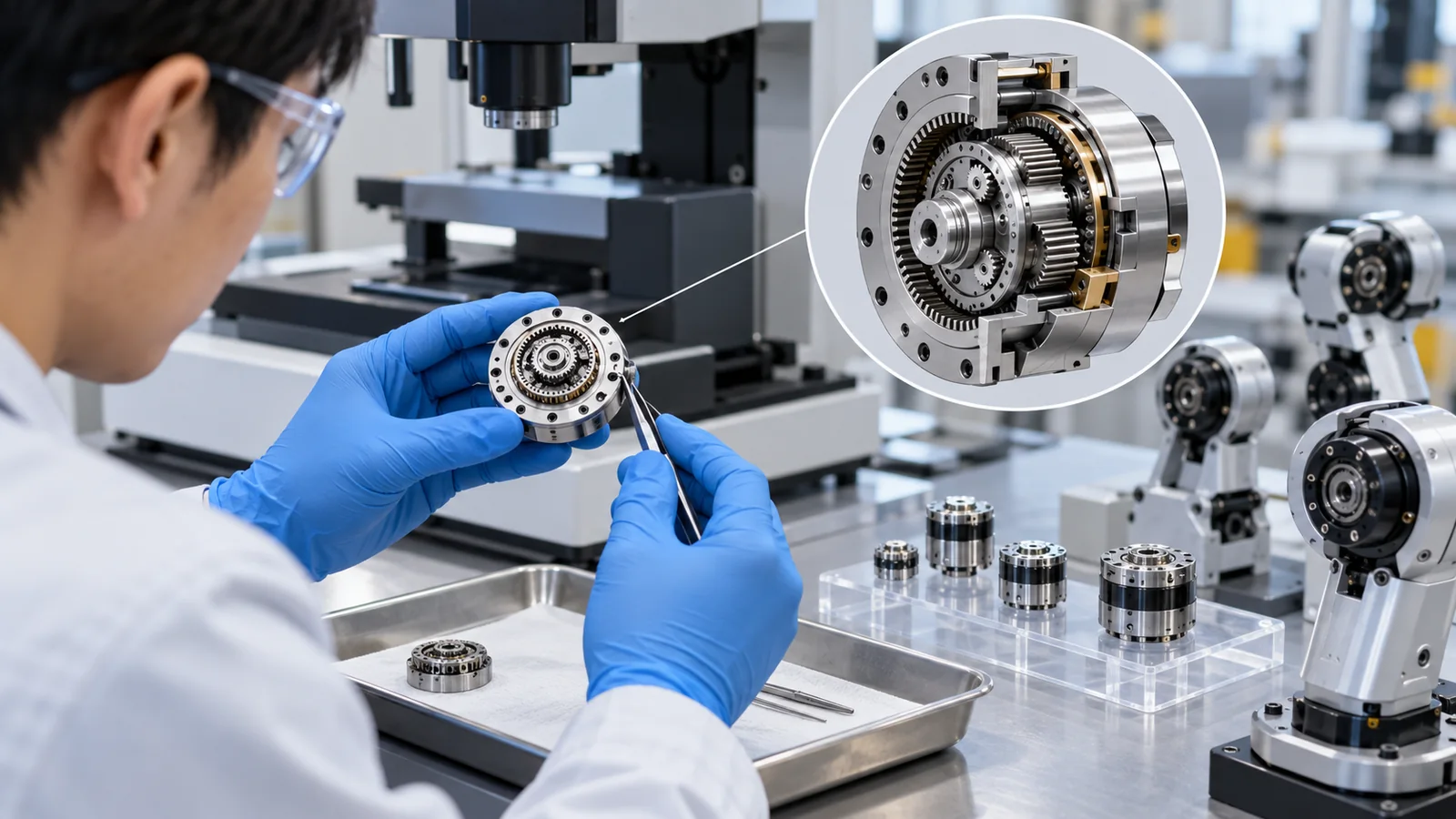
Harmonic Drive Systems does not make robots. It makes the reducers inside robot joints. A reducer turns a motor’s fast rotation into slower, stronger rotation. Its “Harmonic Drive” is a strain wave gear that uses the flex of thin metal, and the company says it is small, light and highly accurate in positioning Sourced. The annual securities report says it is built into the joints of industrial robots and has won a high share in the world market (the company’s claim; no share figure could be confirmed).
What matters here is that the securities report does not give the share of sales going to industrial robots. The application chart in the earnings briefing implies about 30%, but that is our reading and calculation Our calculation. The company also says that demand from humanoid and AI robots is starting up “more slowly than assumed”, and its new medium-term plan adds aerospace and defense and e-mobility as growth fields beyond robots Sourced.
2. The logo and how the name is written

A note on names: the company is Harmonic Drive Systems Inc. “Harmonic Drive”, “Accudrive” and “Harmonic Planetary” are registered product names (reducers), not company names. Harmonic Drive SE of Germany (formerly Harmonic Drive AG) and Harmonic Drive LLC of the US are consolidated subsidiaries and separate legal entities. This article follows the company names in the securities report.
Source of the logo image: https://www.hds.co.jp/Portals/0/files/common/images/logo_blue.png
3. Where the company sits in drones and robotics
Companies in this field are easiest to understand by what they build and who buys it. Harmonic Drive Systems is in “components & enabling software”: it sells the parts that make robot joints to robot and equipment makers. It does not build the final product.
4. Scale (focused on robots)
The company reports a single segment, “precision reducers”, and robot-only profit is not disclosed. Whole-company figures are as follows (¥ million) Sourced.
| Item (¥ million) | FY2023 (year to Mar 2024) | FY2024 (year to Mar 2025) | FY2025 (year to Mar 2026) |
|---|---|---|---|
| Consolidated sales | 55,796 | 55,646 | 59,558 |
| Operating profit | Not checked | 6 | 2,567 |
| Ordinary profit | 570 | 151 | 2,540 |
| Net profit (loss) attributable to owners of the parent | (24,807) | 3,474 | 1,609 |
| Orders (consolidated) | Not checked | Not checked | 61,613 |
| Category (year to March 2026) | Sales (¥ million) | Share and change |
|---|---|---|
| Reducers (Harmonic Drive and others) | 46,333 | 77.8% (up 9.5%) |
| Mechatronics products (actuators and others) | 13,224 | 22.2% (down 0.9%) |
| Japan (segment) | 26,626 | Up 22.5% |
| North America | 12,107 | Up 4.1% |
| Europe | 16,776 | Up 0.7% |
| China | 4,046 | Down 28.0% (lower sales to industrial robots) |
| R&D, investment and people | Content |
|---|---|
| R&D expenses | ¥3,950 million (year to March 2026). 151 R&D staff |
| Total capital expenditure | ¥4,796 million. North America ¥2,261 million (production capacity up 13%), Japan ¥1,421 million, China ¥108 million |
| Employees (consolidated) | 1,419 (plus 342 temporary staff). Robot-dedicated headcount is not disclosed |
The figures above are for the whole company. Robot-only sales, profit, R&D and headcount are not stated in the securities report and are not disclosed Not yet confirmed. The “sales to industrial robots” below are reference values we read from a chart in the briefing materials, not a ratio the company has stated.
Sales to industrial robots (read from the briefing chart)
| Period | Consolidated sales (¥ million) | Industrial robots (¥ million) | Share (our calculation) |
|---|---|---|---|
| Apr to Jun 2025 | 13,496 | 4,126 | 30.6% |
| Jul to Sep 2025 | 14,342 | 4,471 | 31.2% |
| Oct to Dec 2025 | 14,345 | 4,626 | 32.2% |
| Jan to Mar 2026 | 17,374 | 6,384 | 36.7% |
| Subtotal (year to March 2026) | 59,557 | 19,607 | 32.9% |
| Apr to Jun 2026 | 16,681 | 4,920 | 29.5% |
From the chart “Consolidated sales by application (quarterly)” we read the bottom segment, which matches the first legend item (industrial robots). The chart also has semiconductor equipment, machine tools, medical, AI robots, aerospace and defense, automotive and others. The AI robot segment is small and hard to read accurately, so we do not use its figures. Shares are “application amount divided by the quarter’s consolidated sales”, our calculation Our calculation.
5. Resources committed to robots
We sorted four angles (people, money, outside relationships, research institutions) by whether the securities report and official pages confirm them. “Not stated” is also a result.
| Angle | What we could confirm | Type |
|---|---|---|
| People | 1,419 consolidated employees. 151 R&D staff. An office in Silicon Valley for research and surveys. Robot-dedicated staff are not disclosed | Sourced / not disclosed |
| Money | R&D ¥3,950 million and capital expenditure ¥4,796 million (whole company, year to March 2026). New production machinery in North America lifted local capacity by 13% (December 2025). Robot-only amounts are not disclosed | Sourced / not disclosed |
| Plants | Japan: the Hotaka plant in Azumino, Nagano, and others. Cross roller bearings, a key part of the reducer unit, are made by the subsidiary Harmonic Precision (Matsumoto, Nagano). Bases also in Massachusetts (US) and Germany | Sourced |
| Outside investments, acquisitions and joint ventures | Harmonic Drive SE in Germany: 25% in 2002, 35% in 2008, additional shares bought in March 2017 with the Innovation Network Corporation of Japan (INCJ, formerly a state-backed fund) to make it a subsidiary (74.7% held), and full ownership in July 2021. Harmonic Drive LLC in the US also became wholly owned in February 2021. A 49.2% stake in Ome Casting (equity-method, unconsolidated subsidiary) since 2008 | Sourced |
| Universities and institutions | Developed an ultra-small reducer for a robot hand with the Ishikawa laboratory of the University of Tokyo (the need was raised in 2000; a 13 mm outer-diameter unit was delivered in 2001). Examples of partners include Akita University, Osaka University, the National Institute of Advanced Industrial Science and Technology, Shinshu University, the University of Tokyo, Tohoku University and Nagoya Institute of Technology. Public research funding was not found in the sources we checked | Sourced / not confirmed |
Main products (as far as official company sources confirm)
All performance values are the company’s stated values. We do not compare with other makers’ products or rank them. Checked on 25 October 2026.
| Name (type) | Main specifications (company description, conditions) | Deployment record | Stage and date | Source |
|---|---|---|---|---|
| Harmonic Drive (strain wave gear reducer) | Three parts. Standard reduction ratios of 1/30 to 1/320. No gap where the teeth mesh, allowing accurate positioning (company description) | Used in industrial robots, semiconductor equipment, satellites, advanced medical equipment and more (company statement). Units and customers not disclosed | On sale (production began in 1970) | Refs. 1, 3 |
| Accudrive and Harmonic Planetary (planetary reducers) | Ratios of 1/3 to 1/45. A proprietary mechanism to remove backlash (play between gears) (company description) | Industrial robots, machine tools and others. Units not disclosed | On sale. The FPA series (AC servo actuator with a planetary gear) was added in the year to March 2026 | Refs. 1, 3 |
| CSF-mini (compact unit type) | A compact unit in a field the company focuses on. New model numbers were added in the year to March 2026 (securities report) | Units not disclosed | On sale (models added) | Ref. 1 |
| CSF-3 (13 mm outer diameter) | A small strain wave gear delivered to a University of Tokyo laboratory in 2001. The company calls it the “world’s smallest” (company claim) | For robot-hand research. Later made a standard product, and won an award from the Organization for Small and Medium Enterprises and Regional Innovation at the 2007 Robot Award (company statement) | Offered as a standard product (timing not confirmed) | Ref. 4 |
| AC servo actuators (FHA-Cmini series and others) | Drive units combining a reducer, motor and sensor. The LW type is lighter and shorter (company description) | Units not disclosed | On sale (added in the year to March 2026) | Refs. 1, 3 |
Customer names (robot makers and others), shipment numbers, prices and independent third-party verification of performance are not stated in the sources we checked Not yet confirmed. “High share” and “world’s smallest” are the company’s statements, and we cannot back them with figures.
6. What it has done so far
| When | Event | Meaning |
|---|---|---|
| 1970 | Founded as a joint venture of Hasegawa Gear and USM of the US. Began making Harmonic Drive reducers at the Matsumoto plant | Start of the Harmonic Drive business under a technology tie-up with USM (company history) |
| 1977 | Began making and selling factory-automation equipment (now mechatronics products) | From reducers to drive units |
| 1990 | Completed the Hotaka plant in Azumino, Nagano, and moved production there | The area where main departments are still concentrated |
| 2000 to 2001 | At the request of the Ishikawa laboratory of the University of Tokyo, developed and delivered a 13 mm reducer and an ultra-small servo motor | For a robot hand the size of a finger |
| March 2017 | Made Harmonic Drive AG (now SE) of Germany a subsidiary by buying shares with INCJ | Brought the European business in |
| 2021 | Made Harmonic Drive LLC of the US (February) and Harmonic Drive SE of Germany (July) wholly owned | Full ownership in North America and Europe |
| Year to March 2024 | Net loss attributable to owners of the parent of ¥24.8 billion (five-year indicators) | The cause is not stated in the report we used (only the figures) |
| 13 May 2024 | Announced a medium-term plan for FY2024 to FY2026 (targets included ¥90 billion in FY2026 sales) | The company says the pace of AI robot adoption now differs from the assumptions |
| February 2026 | Moved to the Tokyo Stock Exchange Prime Market | Change of market segment (securities report) |
| 16 June 2026 | Filed the 38th annual securities report and drew up a new medium-term plan (FY2026 to FY2030) | Focus shifted to AI robots, aerospace and defense, and e-mobility |
7. What comes next
The company shows a new medium-term plan (FY2026 to FY2030) and a forecast for the year to March 2027. Targets and forecasts are the company’s own and are not accomplished fact Not yet confirmed.
On the gap between the old plan’s assumptions and reality, the company writes that expectations for the AI robot market over the medium to long term are unchanged, but that it is at a very early stage and the pace of adoption in society is departing from assumptions Sourced. It gave as its reason for raising the forecast in August 2026 higher demand for reducers and mechatronics products across main applications, mainly industrial robots and semiconductor manufacturing equipment (briefing materials).
Sales to AI robots and humanoid robots, customer names, the scale of mass production and details of capacity expansion plans are not stated in the sources we checked Not yet confirmed. The securities report says only that it “won orders as customers in AI robots moved to mass production” and that “orders from AI robot customers in North America increased”.
8. What the company is aiming for in drones and robotics
This section includes points the company does not state directly. They are inferences read from primary sources, shown with their basis.
| What we read | Primary source basis | Type |
|---|---|---|
| About 30% of sales go to industrial robots, so robot demand swings hit the company directly | Briefing chart (32.9% by our calculation). Securities report risk: most products are parts for industrial robots, semiconductor equipment and similar machines, so capital-spending trends matter | Sourced / Our calculation |
| AI robots contribute little to sales so far and have started more slowly than assumed | Securities report: the field is at an early stage and adoption differs from assumptions. The AI robot amounts in the briefing chart are small | Sourced |
| The new plan aims to widen the pillars of sales beyond robots | Aerospace and defense and e-mobility were added as growth fields; the report also lists satellites, advanced medical equipment and automotive as uses of its reducers | Inference |
| It is adding capacity in North America to meet AI robot demand | Orders from AI robot customers in North America rose (securities report), and North American production capacity rose 13% (December 2025). Customers are undisclosed, so the link is our inference | Inference |
| Profitability is recovering with higher sales | Operating profit rose from ¥6 million to ¥2,567 million. The company cites a better manufacturing cost ratio from higher plant utilisation | Sourced |
The securities report says that in North America “orders from defense uses fell, but orders from AI robots rose, and sales rose 4.1%”, and, in its capital-spending section, that production machinery introduced in North America raised that unit’s capacity by 13% Sourced. Reading the two together, the company may be adding local capacity to capture AI robot demand in North America Inference. However, the purpose and customers are not stated, and the machinery would also serve other uses, including industrial robots. The report goes no further than “orders as AI robot customers move to mass production”, and the real scale of mass production could not be confirmed Not yet confirmed.
9. Map of partnerships in drones and robotics
Because it is a parts maker, the most important relationship, with customers, does not appear in the map. The securities report speaks of “diverse customers” and discloses almost no individual customer names Not yet confirmed. We do not name any robot maker as a user of its reducers.
10. Technology, products and services
The products fall into two groups: reducers (Harmonic Drive and planetary reducers) and mechatronics products (actuators and controllers that combine a reducer with a motor, sensors and so on).
| Category | Content (company description) | Plain explanation |
|---|---|---|
| Reducers | Harmonic Drive (strain wave gear); Accudrive and Harmonic Planetary (planetary reducers) | Reducer: a part that slows rotation and raises force |
| Mechatronics products | Actuators and others that combine a reducer, motor, sensor, driver and controller. Used mainly in semiconductor manufacturing equipment | Actuator: a drive unit that produces motion |
| Cross roller bearings | A key part of reducer units. Made and processed by the subsidiary Harmonic Precision | Bearing: a part that supports rotation |
| Core technologies | Precision cutting, thin-walled metal parts, small-module gears, precision grinding and measurement | Small-module gear: a gear with very small teeth |
In a strain wave gear a thin metal part flexes with every turn and springs back Sourced. Because robot joints are used for a long time, the metal must resist fatigue (weakening from repeated stress) and keep its shape after machining (a general point). The company lists thin-walled metal part machining, small-module gear machining, precision grinding and precision measurement as core technologies, but it does not disclose which alloys or heat treatments it uses Not yet confirmed.
On developing the 13 mm unit, the company says the parts and gears were so small that “machining and measurement required technology and skill in unknown territory” (company description). Casting (through its stake in Ome Casting) and steels for bearings are likely to be involved on the materials side, but suppliers and material names could not be confirmed. It helps to read this with our explainers on speed reducers and gears, joint actuators, and structural materials for robots and drones.
11. The risks this company carries
| Risk | Content | Type |
|---|---|---|
| Demand swings | Most products are parts for industrial robots, semiconductor and flat-panel equipment and similar machines, so they follow capital spending and market conditions (the company rates likelihood “high” and impact “large”) | Sourced |
| Build-to-order | Many products are made to order to customer-specific specifications; long lead times can cost orders | Sourced |
| Slow start of AI robots | The pace of adoption differs from assumptions. The old plan (¥90 billion in FY2026 sales) was revised | Sourced |
| Lower sales to China | In the year to March 2026, sales in China fell 28.0% on lower sales to industrial robots | Sourced |
| Intangible assets of the European subsidiary | Customer-relationship assets of ¥9,187 million and technology assets of ¥2,454 million at Harmonic Drive SE. If its plan is missed, an impairment may follow (at the previous year-end the company saw signs of impairment but recognised no loss) | Sourced |
| Financial covenants | Loan agreements require net assets to stay at 70% or more of the larger of the prior year-end and March 2024 levels, and no ordinary loss in two consecutive years | Sourced |
| Tariffs, currencies and sourcing | The report mentions U.S. additional tariffs, currency swings and higher energy and logistics costs from tensions in the Middle East | Sourced |
| Quality | Unexpected product defects could occur (the company rates likelihood “high”) | Sourced |
| Aerospace and defense | Positioned as a growth field. No specific products or customers could be confirmed, and this article does not cover them (we do not cover attack weapons) | Not yet confirmed |
12. Glossary
- Reducer
- A part that turns a motor’s fast rotation into slower, stronger rotation.
- Strain wave gear (Harmonic Drive)
- A reducer that uses the flex of thin metal to get a large reduction ratio from few parts.
- Planetary reducer
- A reducer in which several gears orbit a central gear.
- Reduction ratio
- How many times slower the output turns than the input. 1/100 means one-hundredth.
- Backlash
- The gap (play) where gear teeth mesh. The smaller it is, the more accurate the positioning.
- Actuator
- A drive unit that produces motion. The core of a robot joint.
- AC servo motor
- An alternating-current motor whose position and speed can be controlled precisely.
- Cross roller bearing
- A type of bearing that supports a rotating shaft.
- Industrial robot
- An arm-type robot that welds, moves or assembles in a factory.
- AI robot
- The company’s term for a robot that uses AI to act according to the situation.
- Mechatronics
- Technology combining mechanics and electronic control.
- Equity method
- Accounting that takes in an investee’s profit in proportion to the ownership share.
- INCJ
- The former Innovation Network Corporation of Japan, a state-backed fund.
- ROE / ROIC
- Profit relative to equity or to invested capital.
- Annual securities report
- The yearly report that listed Japanese companies file with the government, published on EDINET.
13. References
- Harmonic Drive Systems Inc. Annual Securities Report (Yuka Shoken Hokokusho), 38th fiscal year (1 April 2025 to 31 March 2026), filed with the Kanto Local Finance Bureau on 16 June 2026 (in Japanese; public PDF on EDINET, Japan’s official disclosure system). Company overview, history, business, results, trends by use and region, R&D, capital expenditure, employees, risks, medium-term plan. https://disclosure2dl.edinet-fsa.go.jp/searchdocument/pdf/S100YBHC.pdf
- Harmonic Drive Systems Inc. Earnings briefing materials for the first quarter of the year to March 2027 (published 7 August 2026; in Japanese). The “consolidated sales by application (quarterly)” chart and the revision of the full-year forecast. Posted on the company’s investor relations page. https://contents.xj-storage.jp/xcontents/AS06879/b045fd4d/ec48/4539/8d39/4b66e7a74f0a/140120260807515115.pdf
- Harmonic Drive Systems Inc. Business domain and business model (company website, in Japanese; checked 25 October 2026). Product groups and the description of the strain wave gear (three parts, ratios of 1/30 to 1/320). https://www.hds.co.jp/company/business/model/
- Harmonic Drive Systems Inc. Joint development with industry, government and academia (company website, in Japanese; checked 25 October 2026). The case with the Ishikawa laboratory of the University of Tokyo and examples of partners. https://www.hds.co.jp/development/structure/university/
- Harmonic Drive Systems Inc. Core technologies (company website, in Japanese; checked 25 October 2026). Precision cutting, thin-walled metal parts, small-module gears and related processing. https://www.hds.co.jp/development/hd_skill/core/
- Harmonic Drive Systems Inc. Official logo file (logo_blue.png; source of the logo image; checked 25 October 2026). https://www.hds.co.jp/Portals/0/files/common/images/logo_blue.png
14. Claim-to-source audit
| Claim in the text | Type | Source |
|---|---|---|
| Legal name, head office, English name, move to the Prime Market (February 2026) | Sourced | Reference 1 https://disclosure2dl.edinet-fsa.go.jp/searchdocument/pdf/S100YBHC.pdf |
| Consolidated sales, operating profit, ordinary profit and net profit or loss (FY2023 to FY2025) | Sourced | Reference 1 https://disclosure2dl.edinet-fsa.go.jp/searchdocument/pdf/S100YBHC.pdf |
| Product groups (reducers 77.8%, mechatronics 22.2%) and sales and changes by region | Sourced | Reference 1 https://disclosure2dl.edinet-fsa.go.jp/searchdocument/pdf/S100YBHC.pdf |
| R&D ¥3,950 million, 151 R&D staff, capital expenditure ¥4,796 million, 1,419 employees | Sourced | Reference 1 https://disclosure2dl.edinet-fsa.go.jp/searchdocument/pdf/S100YBHC.pdf |
| The share of sales to industrial robots is not stated in the securities report | Not yet confirmed | Reference 1 Not stated in the report. This article does not estimate it from the report https://disclosure2dl.edinet-fsa.go.jp/searchdocument/pdf/S100YBHC.pdf |
| Reading of sales to industrial robots from the briefing chart and the share calculation | Our calculation | Reference 2 Our own reading and calculation. The chart’s categories are the company’s classification https://contents.xj-storage.jp/xcontents/AS06879/b045fd4d/ec48/4539/8d39/4b66e7a74f0a/140120260807515115.pdf |
| Forecast for the year to March 2027 (sales of ¥74.5 billion; revised 7 August 2026) | Sourced | Reference 2 The company’s forecast, not accomplished fact https://contents.xj-storage.jp/xcontents/AS06879/b045fd4d/ec48/4539/8d39/4b66e7a74f0a/140120260807515115.pdf |
| New medium-term plan (FY2026 to FY2030) targets and growth fields; revision of the old plan | Sourced | Reference 1 https://disclosure2dl.edinet-fsa.go.jp/searchdocument/pdf/S100YBHC.pdf |
| The company’s statement that AI robot adoption differs from assumptions | Sourced | Reference 1 https://disclosure2dl.edinet-fsa.go.jp/searchdocument/pdf/S100YBHC.pdf |
| Rise in North American AI robot orders and the 13% rise in North American capacity | Sourced | Reference 1 https://disclosure2dl.edinet-fsa.go.jp/searchdocument/pdf/S100YBHC.pdf |
| Acquisition and full ownership of Harmonic Drive SE and LLC, stake in Ome Casting, history | Sourced | Reference 1 https://disclosure2dl.edinet-fsa.go.jp/searchdocument/pdf/S100YBHC.pdf |
| Specifications of the strain wave gear and planetary reducers (three parts, 1/30 to 1/320, 1/3 to 1/45) | Sourced | Reference 3 https://www.hds.co.jp/company/business/model/ |
| Case with the Ishikawa laboratory of the University of Tokyo, partner examples, CSF-3 | Sourced | Reference 4 https://www.hds.co.jp/development/structure/university/ |
| Core technologies (precision cutting, thin-walled metal parts, small-module gears and others) | Sourced | Reference 5 https://www.hds.co.jp/development/hd_skill/core/ |
| Risks (demand swings, build-to-order, European intangibles, financial covenants and others) | Sourced | Reference 1 https://disclosure2dl.edinet-fsa.go.jp/searchdocument/pdf/S100YBHC.pdf |
| Customer names, shipment numbers, sales to AI and humanoid robots, public research funding | Not yet confirmed | Not stated in the sources checked. This article does not guess |
| Support for the claims “high world share” and “world’s smallest” | Not yet confirmed | Reference 1, 4 Company statements. No figures or third-party verification found https://disclosure2dl.edinet-fsa.go.jp/searchdocument/pdf/S100YBHC.pdf https://www.hds.co.jp/development/structure/university/ |
| Reading: robot demand swings hit the company directly | Inference | Reference 1, 2 Our own reading of the risk statements and our calculation https://disclosure2dl.edinet-fsa.go.jp/searchdocument/pdf/S100YBHC.pdf https://contents.xj-storage.jp/xcontents/AS06879/b045fd4d/ec48/4539/8d39/4b66e7a74f0a/140120260807515115.pdf |
| Reading: widening the pillars of sales beyond robots | Inference | Reference 1 Our own reading of the growth fields in the new plan https://disclosure2dl.edinet-fsa.go.jp/searchdocument/pdf/S100YBHC.pdf |
| Reading: adding North American capacity for AI robot demand | Inference | Reference 1 Our own reading of the North American orders and capacity statements https://disclosure2dl.edinet-fsa.go.jp/searchdocument/pdf/S100YBHC.pdf |
| Company type (components & enabling software) | Our calculation | Our own grouping. Company names are examples from this series |
Last updated 25 October 2026 / Troy Technical
Figures in this article come from Harmonic Drive Systems’ annual securities report (EDINET) and from earnings materials and pages on its website. No research-firm estimates or press-based figures have been used. Expressions such as “high world share” are company statements and have not been independently verified. Passages marked “Inference” are our own reading of primary sources, not statements by the company. This article is not investment or purchasing advice.