COMPANY PROFILE / DRONES AND ROBOTICS
Physical Intelligence
– A company that builds only the AI "brain" of robots, aiming to run it on many different robots
A robot is made of a body (hardware), such as arms and fingers, and a brain (software) that moves it. Physical Intelligence ("PI" below) builds only the brain. Its website describes the group as developing learning algorithms to create a model that can control any robot to do any task. This article sorts out which models PI has released, what is open, who uses them, and what we cannot yet confirm, using only the company’s own blog posts, model card, papers and GitHub repository as evidence.
- Physical Intelligence in 30 seconds, and where it sits in drones and robotics
- Logo and naming
- Where the company sits in the field
- Scale of the company
- Resources behind its robot work (people, money, investments, university ties, model status)
- Track record so far
- Plans
- What the company seems to be aiming for
- Partnership map
- Technologies, products and services
- Risks the company faces
- Glossary / References / Claim-to-source audit
1. Physical Intelligence in 30 seconds, and where it sits in drones and robotics
Secondary: Components & enabling softwareBuilds the model that drives robots, not the robot
When people hear "robot company", they often picture a firm that builds and sells humanoid robots. PI is different. Its stated goal is a model that can control any robot for any task (a "robot foundation model"). We could not confirm in official materials that it manufactures or sells robots itself Sourced. A foundation model, like the large AI systems behind chatbots, is trained once on a great deal of data and then adjusted with a small amount of extra data for a specific purpose. PI’s models take in language and images and then output the motor commands for a robot’s joints (such models are called VLAs, short for vision-language-action models). In short, PI wants to be the supplier of the "AI brain" that other companies’ robots use. In this article we treat the company’s statements as fact only where they are written in official materials.
2. Logo and naming
Naming note: the company name is Physical Intelligence. The site title carries "(π)", which appears to echo the "pi" in the model names, but we found no official explanation of the origin. The model names are π0 (pi-zero), π0.5, π0.6, π*0.6 (with an asterisk) and π0.7; they are not company names. The only image we could find on the official site was the small browser-tab icon (48 x 48 pixels). We found no proper logo file, so the name is shown as text.
Official site: https://www.pi.website/3. Where the company sits in the field
"Humanoids & physical AI" here means companies that build humanoid robots or AI that drives robots through learning. Physical AI means AI that works on real objects in the physical world, not only on a screen. Within this type PI differs from companies that build humanoid bodies (such as Figure AI in this series) because it concentrates on the brain, not the body. Because it also offers its models to other companies, it has the character of "components & enabling software" too; we treat the two as main and secondary types Our calculation.
4. Scale of the company
Because PI is privately held, it has no legal duty to publish revenue or headcount, and official materials do not. Here is what we could and could not confirm Sourced.
| Item | What we could confirm | Type |
|---|---|---|
| Base | An office in San Francisco’s Mission District (careers page) | Sourced |
| Headcount | Not disclosed. For reference, the author list of the π0.7 post has 87 names, but that is not a headcount (the post does not say whether outside collaborators are included) | Sourced |
| Year founded | Not found in official materials | Not confirmed |
| Revenue | Not disclosed | Sourced |
| Funding raised | No amount in official materials. The official site thanks Bond, Jeff Bezos, Khosla Ventures, Lux Capital, OpenAI, Redpoint Ventures, Sequoia Capital, CapitalG and Thrive Capital (no amounts or dates are given) | Sourced |
| U.S. SEC filings | A full-text search of EDGAR for Form D found no filing by the company itself. Because of possible name variants or other filers, we do not conclude that none exists | Not confirmed |
Press reports sometimes cite funding amounts or company valuations. This article uses only what the company announced or what appears in filings with regulators, so none are included. Nothing here is an investment opinion on the company’s value or prospects.
5. Resources behind its robot work
We sort the four resource types (people, money, outside investments, and ties to universities or public bodies) by whether primary sources let us confirm them. "Not mentioned" is itself a finding.
| Resource | Content | Type |
|---|---|---|
| People | The San Francisco base is hiring across research, hardware, machine learning, software, business and operations (careers page). Headcount is not disclosed | Sourced |
| Money | R&D spending, capital expenditure and funding raised are not disclosed. The only named supporters are in the thanks line on the official site | Sourced |
| Outside investments, acquisitions, joint ventures | None mentioned in official materials | Not confirmed |
| Universities, research institutes, public bodies | No formal research agreements and no participation in public-agency programs (NASA, DARPA, NSF and the like) are mentioned in official materials. The openpi post does show outside researchers running the model in settings at the University of Montreal, the University of Washington, KAIST and elsewhere (individual collaboration; the post does not say whether any institutional agreement exists) | Not confirmed (individual examples are sourced) |
| Robot hardware | The company evaluates its models on its own lab robots and on commercial or research robots such as UR5e, Franka and ALOHA. We could not confirm that it manufactures or sells robots | Sourced |
Status of the main models and services (checked 25 October 2026)
| Name | Kind | Main specifications (company’s statements) | Use and operating record | Regulatory approval | Stage and date |
|---|---|---|---|---|---|
| π0 | VLA model | Built on a vision-language model of about 3 billion parameters and outputs motion by flow matching. Trained on the company’s data from several robots plus open datasets such as Open X-Embodiment (blog and paper) | Laundry folding, table clearing and box assembly evaluated in the company’s own settings | Not applicable (software; no approval mentioned) | Announced; weights released. 31 October 2024; released 4 February 2025 |
| π0-FAST | VLA model | Uses the "FAST tokenizer", which turns motion into discrete symbols. The blog says training is about 5 times faster than earlier models and that inference costs about 4 to 5 times more than π0 (the company’s own experience) | Public checkpoints available | Not applicable | 16 January 2025 (method); 4 February 2025 (release) |
| π0.5 | VLA model | Co-training on mixed data lets it tidy homes it has not seen. The openpi base models are pre-trained on more than 10,000 hours of robot data (README) | Tidying kitchens and bedrooms in new homes (company evaluation) | Not applicable | Announced 22 April 2025; weights released in September 2025 (README) |
| π0.6 | VLA model | Starts from Gemma 3 4B and SigLIP (about 400M); the action expert has about 860M parameters. One action chunk takes 63 ms on a single H100 (5 denoising steps, 3 cameras) | Evaluated "out of the box", with no task-specific fine-tuning (model card) | Not applicable | Announced 17 November 2025. Not among the models listed in the openpi README |
| π*0.6 | π0.6 improved by reinforcement learning | Learns from experience with a method called Recap. The company says throughput more than doubled and failure rates fell by half or more on some hard tasks | Espresso drinks (5:30am to 11:30pm as described), 50 laundry items, 59 boxes in a factory (company demonstrations) | Not applicable | Announced 17 November 2025 |
| π0.7 | VLA model | Follows varied prompts (language, goal images, strategy hints). The company says one model matched fine-tuned specialist models | Folded laundry on a UR5e bimanual robot with no training data on that robot; the company says the success rate matched expert teleoperators (mean 375 hours of experience) doing the task there for the first time | Not applicable | Announced 16 April 2026; paper PDF available |
| Pi API | Cloud service | Upload data, fine-tune on compute the company manages, and run the fine-tuned model through hosted inference | Early-access examples on the official blog (Chapter 9) | Not applicable | Beta. Announced 13 October 2026; by application |
The figures in this table are results the company obtained on its own robots and its own tasks. Robots, tasks and evaluation methods differ from row to row, so the numbers cannot be lined up to rank anything. The "demonstrations" are company claims, and we found no independent replication under the same conditions in official materials.
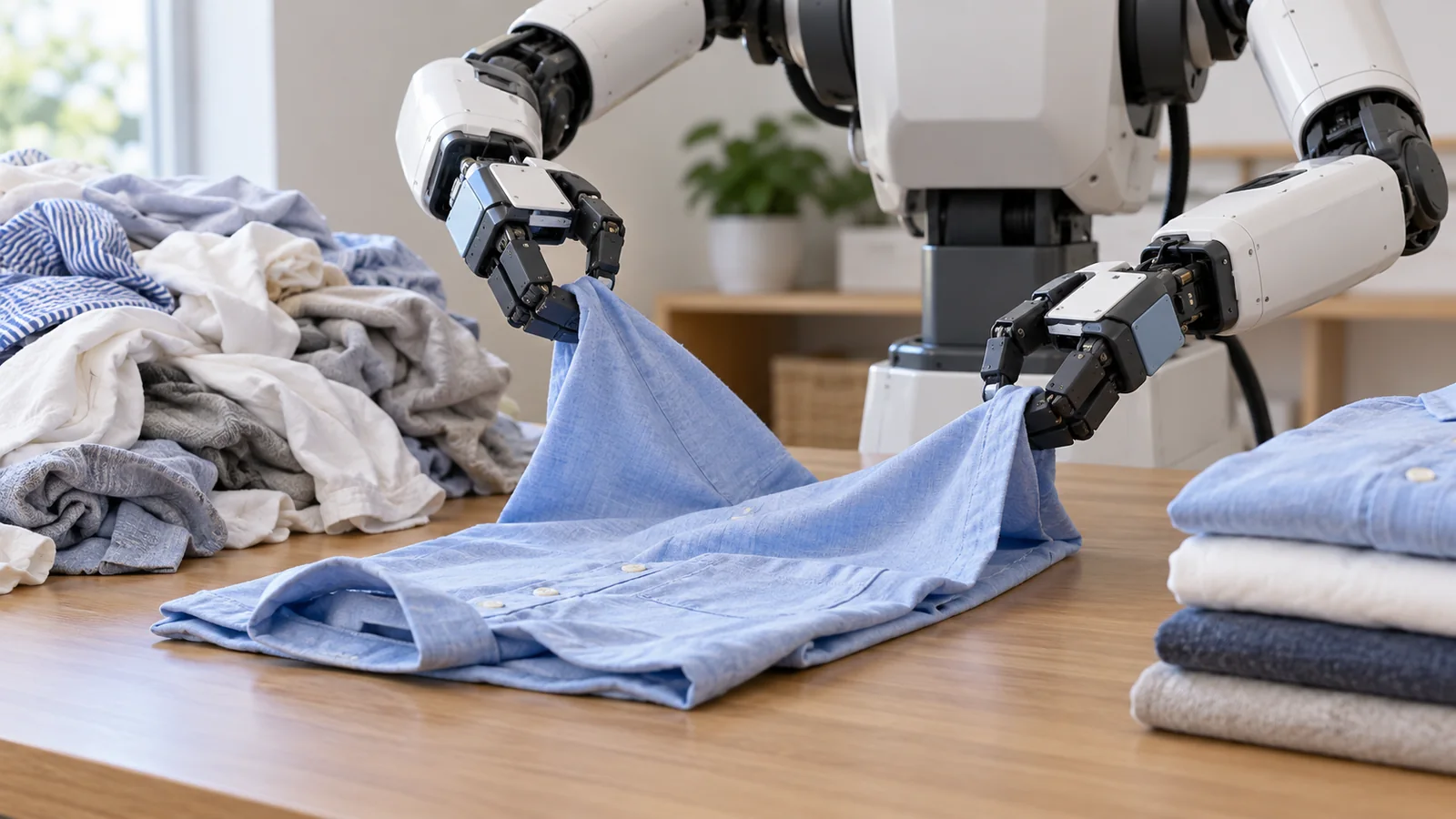
PI makes models, and robot-part materials are not its product. Still, reading its materials with a materials eye, you notice that many of the objects it handles are soft and change shape Sourced. Weave, a partner, writes that laundry is deformable and varies in size, fabric, colour and shape, and that a slightly misplaced corner changes the result. Differences in fabric friction, thickness and stretch are a difficulty for both the robot’s hand (finger-surface materials, touch sensors) and the model. Our explainers "Robot hands and grasping" and "Tactile sensors and electronic skin" show how body and brain share the work.
PI’s materials say nothing about gripper materials or fingertip surfaces (we found none). Model performance presumably depends on hand-material design as well, but the split cannot be read from public materials Not yet confirmed.
6. Track record so far
| When | What happened | Meaning |
|---|---|---|
| 31 Oct 2024 | π0 announced: a general-purpose robot model that adds flow-matching motion output to a vision-language model | The company’s first generalist model |
| 16 Jan 2025 | "FAST", a way of turning motion into symbols, announced | A way to speed up training |
| 4 Feb 2025 | Weights and code of π0 and π0-FAST released (openpi) | Lets outside researchers try the model on their own robots. The company adds a caveat that it is an experiment and may not work for everyone |
| 22 Apr 2025 | π0.5 announced: tidying homes it has never seen | The focus is generalization to new settings, not one fixed place |
| 28 May to 9 Jun 2025 | Knowledge Insulation (learning motion without damaging the language model’s knowledge) and Real-Time Chunking (keeping motion smooth despite compute delay) published | Training and execution refinements |
| Sep 2025 | π0.5 and PyTorch support added to openpi (README) | Wider release |
| 17 Nov 2025 | π0.6 model card and π*0.6 (reinforcement learning with Recap) announced | A push toward higher success rates and faster work |
| 16 and 22 Dec 2025 | Analysis of how human video transfers to robots; the "Robot Olympics" challenge, proposed by an outside researcher, attempted by fine-tuning π0.6, with initial solutions reported at "gold" level in 3 of 5 categories and "silver" in the other 2 | The company reports a mean success rate of 52% and task progress of 72%; results vary by task |
| 24 Feb 2026 | Deployment accounts from Weave and Ultra published | Examples of the models running on other companies’ robots |
| 3 and 19 Mar 2026 | MEM (memory for tasks longer than ten minutes) and RL Token (quickly improving precise tasks) published | Long tasks and precise tasks |
| 16 Apr 2026 | π0.7 announced | Stresses combining skills to follow new instructions |
| 13 Oct 2026 | Pi API beta announced | The company starts offering its models to outside developers |
These dates are blog publication dates. The blog’s descriptions cover tasks and conditions the company chose; they are not independent third-party verification.
7. Plans
On the API, the company writes that it can update the models behind it quickly and plans to keep providing its latest and most capable models Not yet confirmed. The end of the π0.7 post also mentions, as a future possibility, models that think through possible ways to do a task and revise the plan after reflecting on the outcome Not yet confirmed. Both are plans or outlooks, not things already achieved.
None of the following appears in official materials Not yet confirmed.
API pricing / the date of general availability / the number or revenue of API customers / any plan to build or sell robots / any plan to release weights after π0.5 / the amount and timing of funding. We do not use press-reported figures such as "how many by when".
8. What the company seems to be aiming for
This chapter includes points the company does not state directly. They are inferences that stay within what primary sources allow, given with their grounds.
| What can be read | Primary-source basis | Type |
|---|---|---|
| The goal is to supply a "layer of intelligence" that robots run, not to sell robots | The post "The Physical Intelligence Layer" describes foundation models as a ready-made layer anyone can build on and sketches offering it by API. No robot sales are mentioned | Sourced (company’s description) |
| The API is likely to be the main external offer for now | The API beta announced on 13 October 2026 bundles upload, fine-tuning and inference. No pricing or revenue is mentioned | Inference |
| Deployments at customers may also be a source of data for the next model | Ultra’s section says human intervention keeps producing new data that improves the next model, and a comparison adds Weave’s or Ultra’s own data to pre-training | Inference |
| The emphasis is widening from "can do anything" to "practical quality (speed and success rate)" | The order of the blog posts: π0.5 on generalization to new places, π*0.6 on speed and success rate, π0.7 aiming at both in one model | Inference |
| Cloud inference that depends on the network has field problems | The API post says some users had network-connectivity problems | Sourced |
The reading that "customer deployments also feed the next model’s data" rests on a section Ultra wrote itself. About its warehouse packing robots, Ultra says that when the model stumbles a human-in-the-loop intervention system steps in to ensure correctness, while continuously generating new data that improves the next model iteration Sourced. A further condition, in which Ultra’s data is added to pre-training, is reported to raise packing throughput (items per hour) even more. From this we read that, for PI, a customer deployment may be both a customer and a source of data. What contract terms govern PI’s receipt of such data is not confirmed in official materials Not yet confirmed.
9. Partnership map
| Counterparty | Relationship (as stated on the blog) | Note |
|---|---|---|
| Weave | Builds home robots; folds laundry in a San Francisco laundromat. Moving from π0.5 to π0.6 raised the share of autonomous work, and adding Weave’s data to pre-training cut missed grasps by 42% and interventions by 50% | Section written by Weave; remote specialists intervene |
| Ultra | Warehouse packing robots. With π0.6, a full shift of order packing ran at 96.4% autonomy | Section written by Ultra; human intervention used alongside |
| Actor | Autonomous heavy machinery. In a real commercial deployment, an autonomous wheel loader loads soil into a dump truck with no operator in the machine | On the API post as a video; number of machines and hours not stated |
| Hugging Face | Prepared a PyTorch port of openpi | From the openpi release post |
| API early-access firms | Almond, Argon Robotics, Chef Robotics and other companies listed on the blog took part in a limited early access. Almond showed its Axol robot deburring parts with a model obtained after four days of iteration | Names as listed; uses differ; company’s presentation |
| Outside researchers | Demos were posted of researchers running the openpi weights and code on their own robots | Individual collaboration; no contract relationship is stated |
10. Technologies, products and services
PI’s "product" is not a robot but the model and the way it is built. Here are the main elements that the official blog and papers let us confirm, in plain terms Sourced.
| Element | Plain explanation | Place in official materials |
|---|---|---|
| VLA (vision-language-action model) | An AI that turns camera images and a spoken instruction directly into robot motion | The basic form from π0 on. It builds on the knowledge in a language model |
| Action expert | A dedicated part that produces continuous motion values, separate from the language-handling part | About 860M parameters in π0.6 (model card) |
| FAST | Turns motion into symbols, like text, which speeds up training | Paper available (arXiv 2501.09747) |
| Knowledge Insulation | Separates the gradient flow so that learning motion does not damage what the language model knows | Paper available (arXiv 2505.23705); the model card says π0.6 uses it |
| Real-Time Chunking | Keeps motion smooth even when computation lags | Paper available (arXiv 2506.07339) |
| Recap (reinforcement learning) | Learns from demonstrations, human corrections and the robot’s own attempts: "getting better by practice" | Applied in π*0.6; paper available (arXiv 2511.14759) |
| RL Token and MEM | Quickly improving precise work / memory for tasks longer than ten minutes | Published March 2026; described on the official research pages |
PI’s blog videos are striking, but the company’s own numbers include failures too. In the Robot Olympics tasks, for example, the mean success rate was 52% and mean task progress 72%, and the company notes the policies are often not consistent. In customer examples, too, remote human intervention is used alongside the model to keep quality. In practice, what matters is the success-rate figure, what happens when the robot stops, and how often a person must step in. Read a video as an example of "it can work sometimes", not proof of "it always works".
11. Risks the company faces
| Risk | Content | Type |
|---|---|---|
| Evaluation is the company’s own | The evaluations in official materials were run on the company’s own robots and tasks. We found no independent third-party verification | Sourced |
| Stability in the field | Customer examples also use human intervention. The API post states that network-connectivity problems occurred for some users | Sourced |
| Limited routes to the newest models | The public repository covers π0, π0-FAST and π0.5; π0.6 and π0.7 weights are not in it. Using the newest models presumes the API (beta, by application) | Sourced |
| Hard to check continuity from outside | Revenue, funding and headcount are undisclosed, so outside sources give no way to check the durability of the business | Not yet confirmed |
| Securing data | The company itself says robot data cannot be mined from the web the way text can. How data is gathered shapes performance | Sourced |
| Similar models exist elsewhere | Other companies also build robot foundation models (see our NVIDIA profile, among others). This article does not rank them | Inference |
12. Glossary
- Foundation model
- An AI trained in advance on large data that is then adjusted with a small amount of data for a purpose.
- VLM
- Vision-language model: AI that handles images and words together.
- VLA
- A VLM with motion output added. It turns images and instructions directly into robot motion.
- Flow matching
- A generative method that starts from noise and refines it step by step into smooth motion values.
- Action chunk
- A block of motion for a short stretch of time, output all at once.
- Fine-tuning
- Adapting a pre-trained model to a task with a small amount of your own data.
- Reinforcement learning
- Learning that increases good behaviour based on how well attempts turn out.
- Teleoperation
- A person operating a robot remotely; used to collect demonstrations and to step in when the robot stops.
- Throughput
- The amount of work finished per unit of time (for example, items per hour).
- Zero-shot
- Trying a task with no training data for that task.
- Physical AI
- AI that handles real objects in the physical world, not only on a screen.
- openpi
- The GitHub repository in which PI publishes weights and code.
13. References
- Physical Intelligence Official website (home page). Company description, news list, thanks to supporters. https://www.pi.website/
- Physical Intelligence Frontier Models for Every Robot: Announcing our API beta (13 October 2026). Pi API beta, early-access companies, cloud inference. https://www.pi.website/blog/api-beta
- Physical Intelligence π0.7: a Steerable Model with Emergent Capabilities (16 April 2026). https://www.pi.website/blog/pi07
- Physical Intelligence π*0.6: a VLA that Learns from Experience (17 November 2025). Recap and evaluation conditions. https://www.pi.website/blog/pistar06
- Physical Intelligence π0.6 Model Card (17 November 2025). Architecture, parameter counts, inference time, evaluation conditions. https://website.pi-asset.com/pi06star/PI06_model_card.pdf
- Physical Intelligence π0.5: a VLA with Open-World Generalization (22 April 2025). https://www.pi.website/blog/pi05
- Physical Intelligence π0: Our First Generalist Policy (31 October 2024). https://www.pi.website/blog/pi0
- Physical Intelligence Open Sourcing π0 (4 February 2025). What openpi contains and the company’s caveats. https://www.pi.website/blog/openpi
- Physical Intelligence GitHub: Physical-Intelligence/openpi. README (which models are released, 10k+ hours of pre-training, hardware requirements) and the license (Apache License 2.0). https://github.com/Physical-Intelligence/openpi
- Physical Intelligence The Physical Intelligence Layer (24 February 2026). Deployment accounts from Weave and Ultra (sections written by those companies). https://www.pi.website/blog/partner
- Physical Intelligence Moravec’s Paradox and the Robot Olympics (22 December 2025). https://www.pi.website/blog/olympics
- Physical Intelligence Join Us (careers page). San Francisco office and a description of the work. https://www.pi.website/join-us
- Physical Intelligence Precise Manipulation with Efficient Online RL (RL Token, 19 March 2026). https://www.pi.website/research/rlt
- Physical Intelligence VLAs with Long and Short-Term Memory (MEM, 3 March 2026). https://www.pi.website/research/memory
- arXiv π0: A Vision-Language-Action Flow Model for General Robot Control (2410.24164, 31 October 2024). https://arxiv.org/abs/2410.24164
- arXiv π0.5: a Vision-Language-Action Model with Open-World Generalization (2504.16054, 22 April 2025). https://arxiv.org/abs/2504.16054
- arXiv π*0.6: a VLA That Learns From Experience (2511.14759, 18 November 2025). https://arxiv.org/abs/2511.14759
- arXiv FAST: Efficient Action Tokenization for Vision-Language-Action Models (2501.09747). https://arxiv.org/abs/2501.09747
- arXiv Knowledge Insulating Vision-Language-Action Models: Train Fast, Run Fast, Generalize Better (2505.23705). https://arxiv.org/abs/2505.23705
- arXiv Real-Time Execution of Action Chunking Flow Policies (2506.07339). https://arxiv.org/abs/2506.07339
- U.S. SEC EDGAR full-text search (query "Physical Intelligence", form type D). No filing by the company itself appeared in the results (checked 25 October 2026). https://efts.sec.gov/LATEST/search-index?q=%22Physical%20Intelligence%22&forms=D
14. Claim-to-source audit
| Claim in the text | Type | Source |
|---|---|---|
| Company description: developing learning algorithms for a model that controls any robot | Sourced | Reference 1 https://www.pi.website/ |
| Base (San Francisco Mission District) and open roles | Sourced | Reference 12 https://www.pi.website/join-us |
| Thanks to supporters (Bond, Jeff Bezos, Khosla Ventures and others) | Sourced | Reference 1 https://www.pi.website/ |
| π0 announcement (31 October 2024), VLM of about 3 billion parameters, data from several robots | Sourced | Reference 7 https://www.pi.website/blog/pi0 Reference 15 https://arxiv.org/abs/2410.24164 |
| Release of π0 and π0-FAST weights and code (4 February 2025), caveats, FAST inference-cost remark | Sourced | Reference 8 https://www.pi.website/blog/openpi |
| Scope of openpi (π0, π0-FAST, π0.5), 10k+ hours of pre-training, Apache License 2.0 | Sourced | Reference 9 https://github.com/Physical-Intelligence/openpi |
| π0.5 announcement (22 April 2025) and tidying of unseen homes | Sourced | Reference 6 https://www.pi.website/blog/pi05 Reference 16 https://arxiv.org/abs/2504.16054 |
| π0.6 architecture (Gemma 3 4B, SigLIP, about 860M action expert) and 63 ms | Sourced | Reference 5 https://website.pi-asset.com/pi06star/PI06_model_card.pdf |
| π*0.6 announcement, the claim of more than doubled throughput and halved failures, and the demonstrations | Sourced | Reference 4 https://www.pi.website/blog/pistar06 Reference 17 https://arxiv.org/abs/2511.14759 |
| π0.7 announcement (16 April 2026), UR5e laundry folding, 87 names in the author list | Sourced | Reference 3 https://www.pi.website/blog/pi07 |
| Robot Olympics results (mean success 52%, progress 72%, gold in 3 and silver in 2) | Sourced | Reference 11 https://www.pi.website/blog/olympics |
| FAST, Knowledge Insulation and Real-Time Chunking papers | Sourced | Reference 18 https://arxiv.org/abs/2501.09747 Reference 19 https://arxiv.org/abs/2505.23705 Reference 20 https://arxiv.org/abs/2506.07339 |
| RL Token (19 March 2026) and MEM (3 March 2026) | Sourced | Reference 13 https://www.pi.website/research/rlt Reference 14 https://www.pi.website/research/memory |
| Weave and Ultra accounts (sections written by each company) and use of human intervention | Sourced | Reference 10 https://www.pi.website/blog/partner |
| Pi API beta (13 October 2026), early-access companies, Actor example, network issues | Sourced | Reference 2 https://www.pi.website/blog/api-beta |
| Hugging Face PyTorch port of openpi | Sourced | Reference 8 https://www.pi.website/blog/openpi |
| Form D: no filing by the company itself in the search results | Sourced | Reference 21 https://efts.sec.gov/LATEST/search-index?q=%22Physical%20Intelligence%22&forms=D |
| Revenue, headcount, funding amounts, year founded | Not yet confirmed | Not in official materials; we do not estimate https://www.pi.website/ |
| API pricing and general-availability date; release plan for π0.6 and later weights | Not yet confirmed | Not in official materials https://www.pi.website/blog/api-beta |
| Plan to keep offering the latest models; future research direction | Not yet confirmed | Reference 2 https://www.pi.website/blog/api-beta Reference 3 https://www.pi.website/blog/pi07 |
| Institutional ties to universities or public bodies; outside investments or acquisitions | Not yet confirmed | Not in official materials; we do not assert that none exist https://www.pi.website/ |
| Four-type classification (main: Humanoids & physical AI; secondary: Components & enabling software) | Our calculation | Our own classification |
| The reading that the goal is to supply an intelligence layer rather than sell robots | Inference | Our own reading (basis: Reference 10 https://www.pi.website/blog/partner) |
| The readings that the API is the main external offer, that deployments feed data, and that emphasis is moving to practical quality | Inference | Our own reading (basis: References 2 and 10 https://www.pi.website/blog/api-beta) |
| The risk that similar models exist elsewhere | Inference | Our own reading, based on other profiles in this series |
Last updated: 25 October 2026 / Troy Technical
This article rests on Physical Intelligence’s official blog, model card, arXiv papers and GitHub repository. We use no market-research estimates or press-reported figures. Demonstrations, deployments and success rates are claims or reports by the company (or its customers) and are not independent verification. Passages marked "Inference" are our own readings of primary sources and are not statements by the company.