INSTITUTION PROFILE / DRONES AND ROBOTICS
FCC (Federal Communications Commission)
The U.S. regulator that guards the entry point for radio-emitting equipment
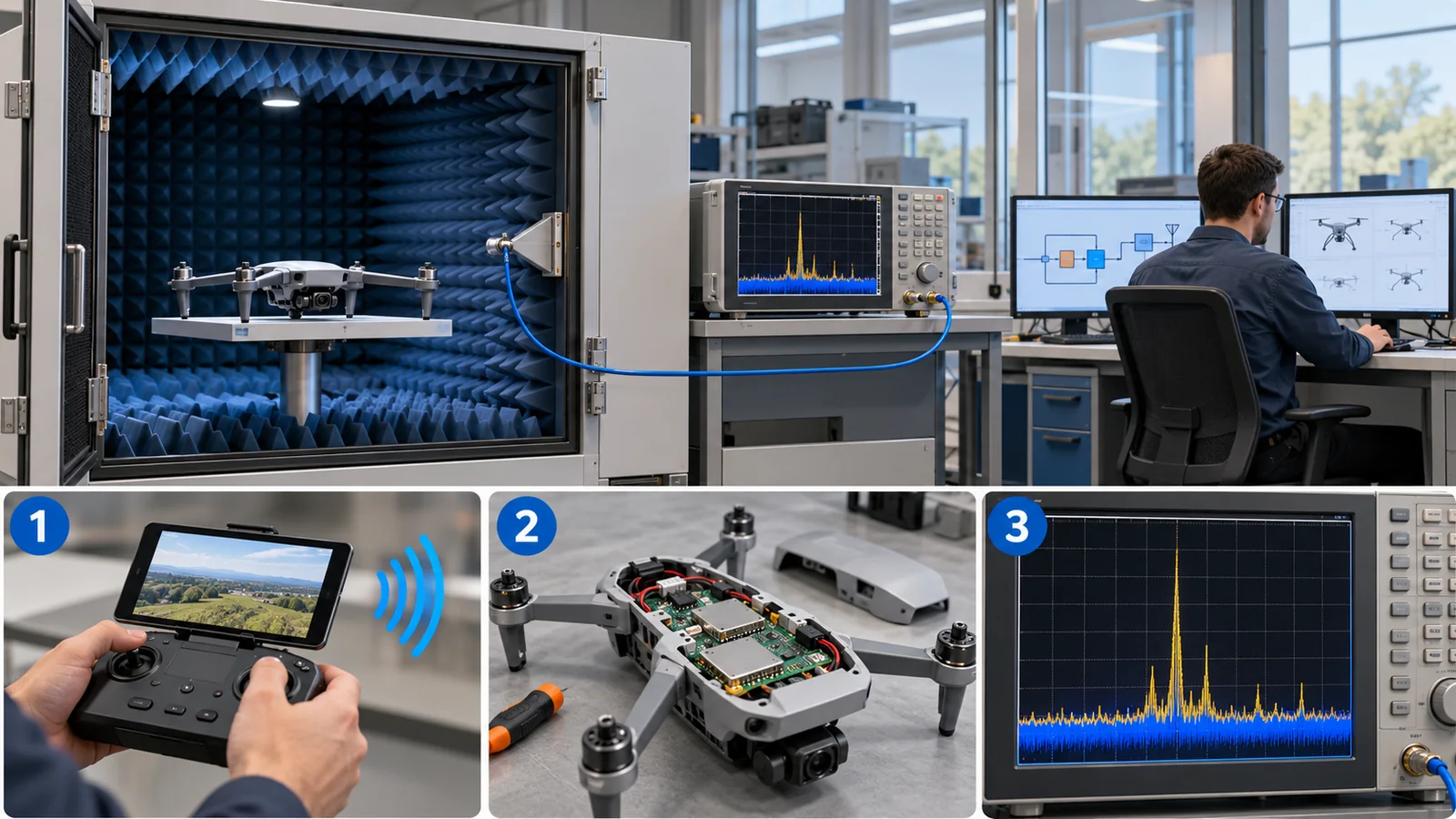
Drones and robots talk to their operators over Wi-Fi or dedicated radio links, so before they are imported or sold in the United States they need FCC equipment authorisation. The FCC places equipment that national-security agencies have judged to be a risk on its Covered List, and stops new models of that equipment from being authorised. On 22 December 2025 drones produced in foreign countries were added to the list, and on 28 July 2026 so were foreign-produced “advanced robotic devices”. But the FCC does not itself decide what is a national-security threat, and it is not responsible for aviation safety rules or aircraft certification (the FAA’s job). This profile checks the dates and scope against primary documents, takes no side on any country or company, and asks what the FCC can decide and what it cannot.
- The FCC in 30 seconds
- What kind of body it is: the four types of influence
- What it does for drones and robotics
- How far its influence reaches (powers and geography)
- Who it works with: how the Covered List moves
- Outlook
- Glossary, references and claim-to-source audit
1. The FCC in 30 seconds
The FCC is not the body that decides that something is a security risk; it carries out decisions made elsewhere. The FCC itself explains that the Covered List can be updated only after a determination by a qualifying national-security authority, and that the FCC cannot update it on its own Sourced. For drones, the determination came from an executive-branch interagency body convened by the White House. The FCC’s public notice (DA 25-1086) says it received that determination on 21 December 2025 and added the equipment to the list on 22 December Sourced. The FCC’s influence is large because it controls equipment authorisation: without authorisation, a new model cannot be imported or sold in the United States.
2. What kind of body it is: the four types of influence
Unlike the companies in this series, none of the institutions in drones and robotics builds aircraft or robots. What separates them is the route by which they influence the industry, and that gives four types.
The FCC is a “Policy & regulation” type, but its remit is limited to radio equipment and communications. Its mission is to regulate interstate and international communications by radio, television, wire, satellite and cable Sourced. Whether an aircraft flies safely, or whether a robot is safe near people, is outside its remit.
3. What it does for drones and robotics
Three of the FCC’s functions matter for drones and robotics.
| Function | What it involves | Basis found |
|---|---|---|
| Equipment authorisation | Most electronic devices need FCC authorisation before being imported or sold in the U.S. Drones and robots are covered if they carry a radio. Equipment on the Covered List cannot receive new authorisations | FCC FAQs; rule 47 CFR 2.903 |
| Maintaining the Covered List | Publishing and updating the list on the basis of national-security agencies’ determinations (the job of the Public Safety and Homeland Security Bureau, PSHSB) | FCC Covered List page |
| Spectrum for drones | Sets rules (Part 88) for using the 5030-5091 MHz band for drone control links. The definition of a drone (uncrewed aircraft system) used in the Covered List comes from here | 47 CFR Part 88 (rules published in the Federal Register on 8 January 2025) |
Drones added to the Covered List: dates and stages
Rules must be read as proposed, final or in force. The table below follows the order that the FCC’s notices and pages show.
| Date | FCC document | Stage | What it does |
|---|---|---|---|
| 21 Dec 2025 22 Dec 2025 | National Security Determination (received) Public notice DA 25-1086 | Final (addition to the list) | Adds “UAS (uncrewed aircraft systems) and UAS critical components produced in a foreign country“, plus the equipment listed in section 1709 of the FY2025 National Defense Authorization Act. Authorisation of new models stops. Import, sale and use of models already authorised are not directly restricted |
| 7 Jan 2026 | Public notice DA 26-22 (as cited in DA 26-758) | Final (exemptions added) | Following a Department of War determination, equipment on the Blue UAS Cleared List and U.S. “domestic end products” were exempted. The original end date was 1 January 2027 |
| 21 Jan 2026 | OET public notice | Final (waiver) | Waives restrictions on Class I permissive changes, minor changes that need no new authorisation (such as firmware). Basic software and firmware updates can continue |
| 17 Mar 2026 onward | Conditional-approval public notices | Final (individual exceptions) | When the Department of War or Department of Homeland Security finds a particular device does not pose the risk, it is removed from the list through a conditional approval. The first approvals were on 17 March. More have followed, and the list is updated on the FCC’s page |
| 15 Jun 2026 | Public notice | Final (exemption added) | Reflects a Department of War determination removing toy drones |
| 21 Jul 2026 | Covered List update Public notice DA 26-758 | The update is final. The notice is a proposal | Update: public notice DA 26-761 (same day) extended the end date of the Blue UAS and domestic-end-product exemptions from 1 January 2027 to 1 January 2028, following a new Department of War determination (Conditional Approvals with no stated end date stay in effect indefinitely while the holder keeps to its conditions). Proposal (DA 26-758): to bar the import and marketing of already-authorised foreign-produced UAS and components that are on the list and are defined as “military-grade”. Not applicable to federal-government use or domestic production, and the use of units already bought is unaffected. Comments were due 2 September 2026 |
| 28 Aug 2026 | Order DA 26-892 | Procedural | Denies three requests to extend the comment period on that proposal, citing national-security reasons |
Note: the FCC’s list of documents (updated 23 October 2026) that we checked does not include a final decision on the proposal to bar imports. We could not confirm whether it is still only a proposal or has been decided. The end date of the Blue UAS and domestic-end-product exemptions is 1 January 2028 (public notice DA 26-761; public notice DA 26-1063 of 2 October 2026 says the same). The 1 January 2027 that remains in the same-day proposal notice DA 26-758 and in some FAQ answers predates the extension; DA 26-761 states that it supersedes the January 2026 determination.
According to the FCC’s FAQ, the test is place of production, and the nationality of the producer is irrelevant. UAS critical components include data-transmission devices, communications systems, flight controllers, ground stations and controllers, navigation systems, sensors and cameras, batteries and battery-management systems, and motors. However, a general-purpose camera is not a critical component; the rule reaches parts designed and intended primarily for drones. Ground-based robots are not “aircraft”, so they are handled under a separate entry Sourced.
Robots added to the Covered List (28 July 2026)
Public notice DA 26-786 says the FCC received two determinations (on power inverters and on advanced robotic devices) from the interagency body on 27 July 2026, and on 28 July 2026 added “foreign-produced advanced robotic devices” to the list Sourced. The FCC’s FAQ defines an “advanced robotic device” as follows Sourced.
| Item | Covered | Not covered (FCC’s definition) |
|---|---|---|
| Form | Mechanical mobile devices that move on the ground, including autonomous mobile robots (AMRs), humanoids and quadrupeds | Fixed, non-mobile robots (articulated arms, parallel, Cartesian and SCARA robots). Vehicles that run only on rail |
| Conditions | Capable of locomotion, obstacle avoidance or navigation; operates at a distance from a human operator or in response to sensor data; the device plus any docking station weighs over 4.4 lb (about 2 kg); and contains all of: a sensor that perceives its environment, a component providing network connectivity of at least 200 kbps, and software (including AI models) that controls autonomous navigation, data collection or remote command-and-control | Drones (UAS), underwater vehicles, connected vehicles, and items classified as medical devices (such as surgical instruments and walking aids) |
| “Foreign-produced” | Anything that does not qualify as a U.S. “domestic end product” under the Buy American standard: made in the U.S. with domestic components costing over 65% (2024 to 2028), over 75% from 2029 | The producer’s nationality is not used. The FCC calls the action country-neutral |
Note: the conversion of 4.4 lb to about 2.0 kg is our own Our calculation. The FCC’s FAQ says automated guided vehicles (AGVs) following set paths can fall within the definition. Conditional approvals for robots are assessed by the Department of War alone, and approvals and exemptions are listed on the FCC’s page.
4. How far its influence reaches (powers and geography)
| Aspect | What the FCC has | What the FCC does not have |
|---|---|---|
| Powers | The decision to authorise radio equipment or not. Publishing and updating the Covered List. Rules on drone spectrum. Action over false certifications | Deciding what is a national-security threat (the FCC implements determinations by the interagency body and the Department of War or Homeland Security). Aircraft certification, flight rules and pilot qualifications (the FAA and others). Robot safety standards (ISO and others) |
| Geography | Anyone who imports or sells radio equipment in the U.S. If production is foreign, companies of any nationality are covered. This reaches other countries’ companies that want to sell in the U.S. | Sales and use outside the U.S. Sales to federal agencies (the FAQ says they are unaffected) |
| What an addition covers | An addition stops authorisation of new models. Import, sale and use of models already authorised are not barred by the addition itself. Small imports for testing and development, and imports for trade-show demonstration, are allowed | Restrictions on use of machines already bought (no ban on use has been proposed). But if the 21 July 2026 proposal is finalised, new import and marketing of already-authorised units defined as military-grade could stop |
| Scale | 1,294 FTE requested for FY2027; about US$416 million in regulatory-fee budget authority enacted for FY2026 | Budget or staff for drones and robotics alone (we could not find these published) |
(1) A listing is not a blanket import ban. Its direct effect is to stop authorisation of new models, and there are several exceptions (Blue UAS, domestic end products, conditional approvals, toy drones). (2) It does not name a country or company. The FCC distinguishes drones and robots by place of production and says the producer’s nationality is irrelevant. This article takes no side on any country or company. (3) A listing is not a safety assessment. It implements a national-security determination and says nothing about how safe a machine is to fly or how well it performs. (4) It is separate from FAA rules. The FCC says the Covered List is independent of other agencies’ regulatory regimes, including the FAA’s Sourced.
5. Who it works with: how the Covered List moves
The figure below shows how the drone and robot listings moved, in the order that the FCC’s notices describe.
| Organisation | Relationship stated in the FCC’s materials |
|---|---|
| The White House-convened interagency body | Issued the national-security determinations on drones and on robots |
| Department of War | Issues the determinations behind the exceptions (conditional approvals, Blue UAS, domestic end products, toy drones). For robots, it alone assesses them |
| Department of Homeland Security (DHS) | Assesses conditional approvals for drones together with the Department of War |
| FAA | The FCC says the Covered List is independent of other agencies’ rules (see our FAA profile for FAA rules and certification) |
6. Outlook
| What we can read from the sources | Primary source | Category |
|---|---|---|
| Whether, and when, the proposal to bar import and marketing of already-authorised military-grade drones is finalised | Public notice DA 26-758 (a proposal). Comments were due 2 September 2026. No final decision appears in the FCC’s document list of 23 October 2026 | Not yet confirmed |
| The Blue UAS and domestic-end-product exemptions end on 1 January 2028. The date is set, but whether they are extended again, or the equipment is added to the list, depends on future Department of War determinations and is unknown today | Public notices DA 26-761 and DA 26-1063; the Covered List table (updated 23 October 2026) | Not yet confirmed |
| The domestic-content share for a robot to count as a “domestic end product” rises from over 65% to over 75% (items delivered from 2029) | The Buy American standard (48 CFR 25.101(a)) cited in the FCC’s FAQ | Not yet confirmed |
| For robots too, exceptions through individual conditional approvals may keep growing, as they have for drones | Public notices on conditional approvals and exemptions for robots appeared in September 2026 (FCC document list). For drones, approvals have kept being added since the first in March 2026 | Inference |
| The FY2027 request is for 1,294 staff, and the budget document anticipates a reduction in workforce. Whether staffing changes will affect the speed of authorisation or enforcement is unknown | FY2027 budget request. A request, not a congressional decision | Not yet confirmed |
7. Glossary
- Covered List
- A list of communications equipment and services that national-security agencies have found to pose an unacceptable risk to national security. The FCC publishes it.
- Equipment authorisation
- The FCC’s permission needed to import or sell radio-emitting equipment in the U.S. It is granted by certification (which gives an FCC ID) or by supplier’s declaration of conformity (SDoC).
- National Security Determination
- A document in which the interagency body or the Department of War tells the FCC whether equipment is a risk. The FCC updates the list on that basis.
- Conditional Approval
- A finding that a particular device does not pose the risk, which takes it out of the Covered List’s scope. The Department of War or Homeland Security assesses it.
- Blue UAS
- A list of approved drones and components published by a Department of War agency (DCMA). One of the FCC’s exceptions, and time-limited.
- Domestic end product
- A product made in the U.S. with domestic components above a set share of cost. The FCC borrows this Buy American standard to define “foreign-produced”.
- PSHSB and OET
- The FCC’s Public Safety and Homeland Security Bureau and its Office of Engineering and Technology. The former maintains the list; the latter handles equipment authorisation.
8. References
- FCC List of Equipment and Services Covered By Section 2 of The Secure Networks Act (the Covered List: listing dates for UAS and robots, exceptions, conditional approvals, document list; updated 23 October 2026). Checked 25 October 2026. https://www.fcc.gov/supplychain/coveredlist
- FCC Covered List FAQs: UAS and UAS Critical Components (updated 21 July 2026: definitions, exceptions, how “foreign” is judged, relation to the FAA). https://www.fcc.gov/covered-list-faqs-uas-and-uas-critical-components
- FCC Public Notice DA 25-1086 (22 December 2025): addition of foreign-produced UAS and UAS critical components to the Covered List; determination received 21 December 2025. https://docs.fcc.gov/public/attachments/DA-25-1086A1.pdf
- FCC Public Notice DA 26-758 (21 July 2026): proposal to prohibit import and marketing of previously authorised military-grade foreign UAS and components; background on the exemptions added on 7 January 2026. https://docs.fcc.gov/public/attachments/DA-26-758A1.pdf
- FCC Order DA 26-892 (28 August 2026): denial of requests to extend the comment period on that proposal. https://docs.fcc.gov/public/attachments/DA-26-892A1.pdf
- FCC Public Notice DA 26-786 (28 July 2026): addition of foreign-produced power inverters and advanced robotic devices to the Covered List; determinations received 27 July 2026. https://docs.fcc.gov/public/attachments/DA-26-786A1.pdf
- FCC FAQs on Recent Updates to FCC Covered List Regarding Foreign-Produced Advanced Robotic Devices and Power Inverters (definition of advanced robotic devices, how “foreign-produced” is judged, country-neutral action, treatment of federal-government sales). https://www.fcc.gov/covered-list-faqs-robots-inverters
- FCC About the FCC (mission; commissioners currently listed). https://www.fcc.gov/about/overview
- FCC What We Do (five commissioners, appointment, rulemaking). https://www.fcc.gov/about-fcc/what-we-do
- FCC FY 2027 Congressional Budget Justification (3 April 2026: FY2026 enacted amounts, FY2027 request, staffing request of 1,294). https://docs.fcc.gov/public/attachments/DOC-420449A1.pdf
- U.S. Government Publishing Office 47 U.S.C. 151 (section 1 of the Communications Act: the FCC created by the Act of 19 June 1934). https://www.govinfo.gov/content/pkg/USCODE-2023-title47/html/USCODE-2023-title47-chap5-subchapI-sec151.htm
- Code of Federal Regulations 47 CFR Part 88, Uncrewed Aircraft System Services (rules for the 5030-5091 MHz band; 90 FR 1395, 8 January 2025). https://www.ecfr.gov/current/title-47/part-88
- FCC Public Notice DA 26-761 (21 July 2026): extension of the Blue UAS and domestic-end-product exemptions to 1 January 2028; treatment of Conditional Approvals. https://docs.fcc.gov/public/attachments/DA-26-761A1.pdf
9. Claim-to-source audit
| Claim in the article | Category | Source |
|---|---|---|
| Listing dates for UAS and robots, content of the exceptions, existence of conditional approvals, and that the FCC cannot update the list on its own | Sourced | Reference 1 https://www.fcc.gov/supplychain/coveredlist |
| Definition of UAS critical components, judgment by place of production regardless of nationality, independence from FAA and other rules, treatment of authorised models and federal-government sales | Sourced | Reference 2 https://www.fcc.gov/covered-list-faqs-uas-and-uas-critical-components |
| Determination received 21 December 2025; list updated 22 December 2025; the White House-convened interagency body as the source of the determination | Sourced | Reference 3 https://docs.fcc.gov/public/attachments/DA-25-1086A1.pdf |
| Background of the 7 January 2026 exemptions; content of the 21 July 2026 proposal and its comment deadline | Sourced | Reference 4 https://docs.fcc.gov/public/attachments/DA-26-758A1.pdf |
| Denial of requests to extend the comment period (28 August 2026) | Sourced | Reference 5 https://docs.fcc.gov/public/attachments/DA-26-892A1.pdf |
| Determination received 27 July 2026 and advanced robotic devices listed on 28 July 2026; only the Department of War assesses exceptions for robots | Sourced | Reference 6 https://docs.fcc.gov/public/attachments/DA-26-786A1.pdf |
| Definition of and exclusions from advanced robotic devices, the 65% and 75% tests, the country-neutral action, treatment of AGVs | Sourced | Reference 7 https://www.fcc.gov/covered-list-faqs-robots-inverters |
| The FCC’s mission; three commissioners currently listed | Sourced | Reference 8 https://www.fcc.gov/about/overview |
| Five commissioners, presidential appointment and Senate confirmation, rulemaking | Sourced | Reference 9 https://www.fcc.gov/about-fcc/what-we-do |
| FY2026 enacted about US$416 million, FY2027 request US$398 million, spectrum auctions US$133 million, staffing request of 1,294 | Sourced | Reference 10 https://docs.fcc.gov/public/attachments/DOC-420449A1.pdf |
| Extension of the exemption end date to 1 January 2028 on 21 July 2026; treatment of Conditional Approvals | Sourced | Reference 13 https://docs.fcc.gov/public/attachments/DA-26-761A1.pdf |
| The FCC created by section 1 of the Communications Act (1934) | Sourced | Reference 11 https://www.govinfo.gov/content/pkg/USCODE-2023-title47/html/USCODE-2023-title47-chap5-subchapI-sec151.htm |
| Spectrum rules for drones (5030-5091 MHz) and the definition of UAS | Sourced | Reference 12 https://www.ecfr.gov/current/title-47/part-88 |
| Conversion of 4.4 lb to about 2.0 kg, the grouping into four types of institution, and the “cannot decide” box in Fig. 2 | Our calculation | This article’s own grouping (based on References 2, 6 and 7) |
| Final decision on the proposed import ban, the treatment of the exemptions after 2028, effect of staffing changes, budget for drones and robotics alone | Not yet confirmed | Not stated in References 1, 2, 4, 10 or 13; this article does not estimate them |
| The outlook item on growth in robot conditional approvals (chapter 6) | Inference | This article’s reading of the dates of notices in the document list of Reference 1 |
Last updated 25 October 2026 / Troy Technical
Dates and scope come from the FCC’s website and public notices. Rules are described as proposed, final or in force, and no judgment is made about any country or company. Items marked “Inference” are this article’s reading of the primary information.