TECHNOLOGY EXPLAINER
Introduction to Drones and Robotics
— The shared skeleton of robots and drones: sense, think, act
Robots and drones look like quite different machines. Yet both are built from a combination of sensing (sensors), thinking (control and intelligence) and acting (actuators). As the entrance to the drones-and-robotics series, this article lays out in plain terms what robots and drones are, the degrees of autonomy, adoption statistics, and the trade-off between lift and battery.
In the second half, we look through a materials engineer’s eyes at how robot and drone performance rests on materials and parts: gear steel, motor magnets, fingertip rubber, lightweight materials and batteries.
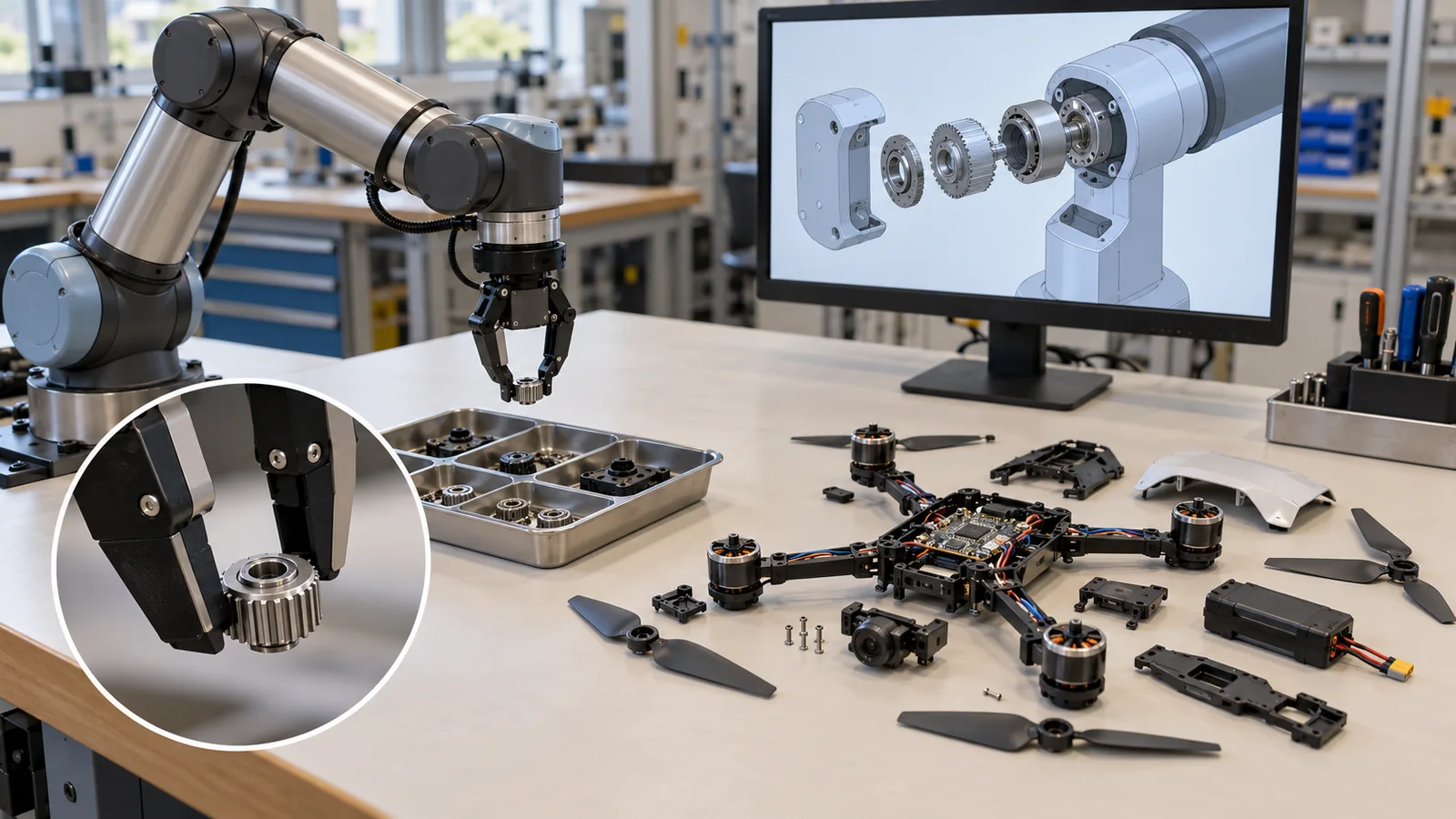
- Short version / before you read / place in the series
- What is a robot?
- What is a drone?
- Sense, think, act
- A map of the kinds
- Degrees of autonomy
- Where robots stand (IFR statistics)
- Drone basics: thrust, weight, battery
- Through a materials engineer’s eyes
- Limits and summary
- How to read the yardsticks and standards
- Glossary
- References
- Claim-to-source audit
Sourced = stated in a published source (link given)
Our calculation = a value this article calculated from stated assumptions
Not yet confirmed = drafts, plans, targets and other items that are not settled
Our own readings for materials and design are marked as commentary. Inference is shown in bold. Every analogy comes with its limits.
The flight times in Chapter 8 are examples from a simple model calculated under stated assumptions, not the performance of any real aircraft. IFR statistics are used as figures published by the federation itself; market estimates from research firms are not used. For ISO standards only the number, title, edition and stage were checked, not the paid text. This field moves quickly, so the state of standards and rules carries a check date (25 October 2026). No company, aircraft or country is ranked.
1. The short version / what to know first / where this fits in the series
- Robots and drones are both a combination of “sense, think, act”. Sensors tell the machine about its surroundings, control and intelligence decide, and actuators (the parts that act as the robot’s muscles) move it. NIST also defines autonomy as sensing, perceiving, analyzing, planning, deciding and acting taken togetherSourced[Ref. 5]
- “Autonomous” comes in steps. NIST splits it into four modes, from remote control by a person all the way to fully autonomous operationSourced[Ref. 5]. “Runs automatically” is not the same as “is autonomous”.
- Much of the performance comes from parts and materials. On a simple model, a 1.0 kg aircraft hovers for about 22 minutes with a 0.5 kg battery, and only about 31 minutes with 2.0 kg, where the gain levels offOur calculation. A bigger battery makes the aircraft heavier.
No prior knowledge is needed. It is enough to picture a machine that looks around, thinks, and moves its body. Each technical term is explained where it first appears and is collected in the glossary at the end (25 entries). This article is the entrance to the whole drones-and-robotics series: the words and analogies fixed here keep the same meaning in the other articles.
The series can be read in five groups: (1) parts and materials (speed reducers and gears, joint actuators, robot hands and grasping, tactile sensors and electronic skin, soft robots, structural materials, power sources, permanent magnets, LiDAR and more); (2) intelligence and control (robot control, SLAM, vision, imitation and reinforcement learning, foundation models, simulation, teleoperation); (3) kinds of robots (industrial and collaborative, humanoid, legged, warehouse, surgical, underwater, micro, agricultural and construction); (4) drones (multicopters, fixed-wing and VTOL, communication and positioning, logistics, eVTOL); and (5) institutions and strategy (safety standards, regulation and airspace, national strategies). This article is the common base for all of them.
2. What is a robot? In the words of the international standard
“Robot” does not mean only a human-shaped machine. ISO 8373, the international standard for robotics vocabulary, defines a robot as a programmed actuated mechanism with a degree of autonomy that performs locomotion, manipulation or positioning. This is the definition the International Federation of Robotics (IFR) uses when it compiles statisticsSourced[Ref. 2, 1].
The “degree of autonomy” here means the ability to carry out an intended task from the current state and sensor input without human intervention. For service robots it ranges from partial autonomy, where a person helps, to full autonomySourced[Ref. 3].
| Category | Key point of the definition | Familiar examples |
|---|---|---|
| Industrial robot | An automatically controlled, reprogrammable, multipurpose manipulator (arm) programmable in three or more axes, for factory automationSourced[Ref. 2] | Arms for welding, painting, assembly |
| Service robot | A robot in personal or professional use that performs useful tasks for humans or equipmentSourced[Ref. 3] | Cleaning, delivery, guidance, inspection |
| Medical robot | A robot intended for use as medical electrical equipment or systems; a third category next to industrial and service robots in the 2021 editionSourced[Ref. 3] | Surgical robots (in another article) |
| Mobile robot | A robot able to travel under its own control; it may also have a means of remote controlSourced[Ref. 2] | Delivery vehicles, legged robots, humanoids |
Source: IFR pages quoting ISO 8373. The definitions are paraphrased; the paid standard text was not checked.
The facts: The definition above has no condition about a human shape. A factory arm is a robot. IFR itself explains that its service-robot statistics include systems with human-robot interaction and even fully teleoperated systemsSourced[Ref. 3]. When you read a robot count, check what was counted.
3. What is a drone? In the words of aviation
“Drone” is the everyday word. The rules call it an unmanned aircraft. The US federal rule (14 CFR § 107.3) defines an unmanned aircraft as an aircraft operated without the possibility of direct human intervention from within or on the aircraft, and a small unmanned aircraft as one weighing less than 55 pounds (about 25 kg) on takeoffSourced[Ref. 6]. That weight includes everything on board.
In Japan, every unmanned aircraft (drones and radio-controlled aircraft) of 100 g or more flown outdoors must be registered, carry its registration mark and have a remote ID function by lawSourced[Ref. 8]. ISO 21384-4:2025, the international vocabulary for uncrewed aircraft systems, was published in July 2025Sourced[Ref. 20].
In research, drones are also called “aerial robots”, and survey papers organize their types and issuesSourced[Ref. 11]. This series also treats robots and drones in one framework (sense, think, act). Whether a given aircraft counts as a “robot” under ISO 8373, however, was not checked, because the standard text is paid.
4. The skeleton they all share: sense, think, act
Start with an everyday example. When you pick up a bottle, your eyes check where it is (sense), you decide where to reach (think), and your arm muscles move (act). A robot replaces these three with machine parts.
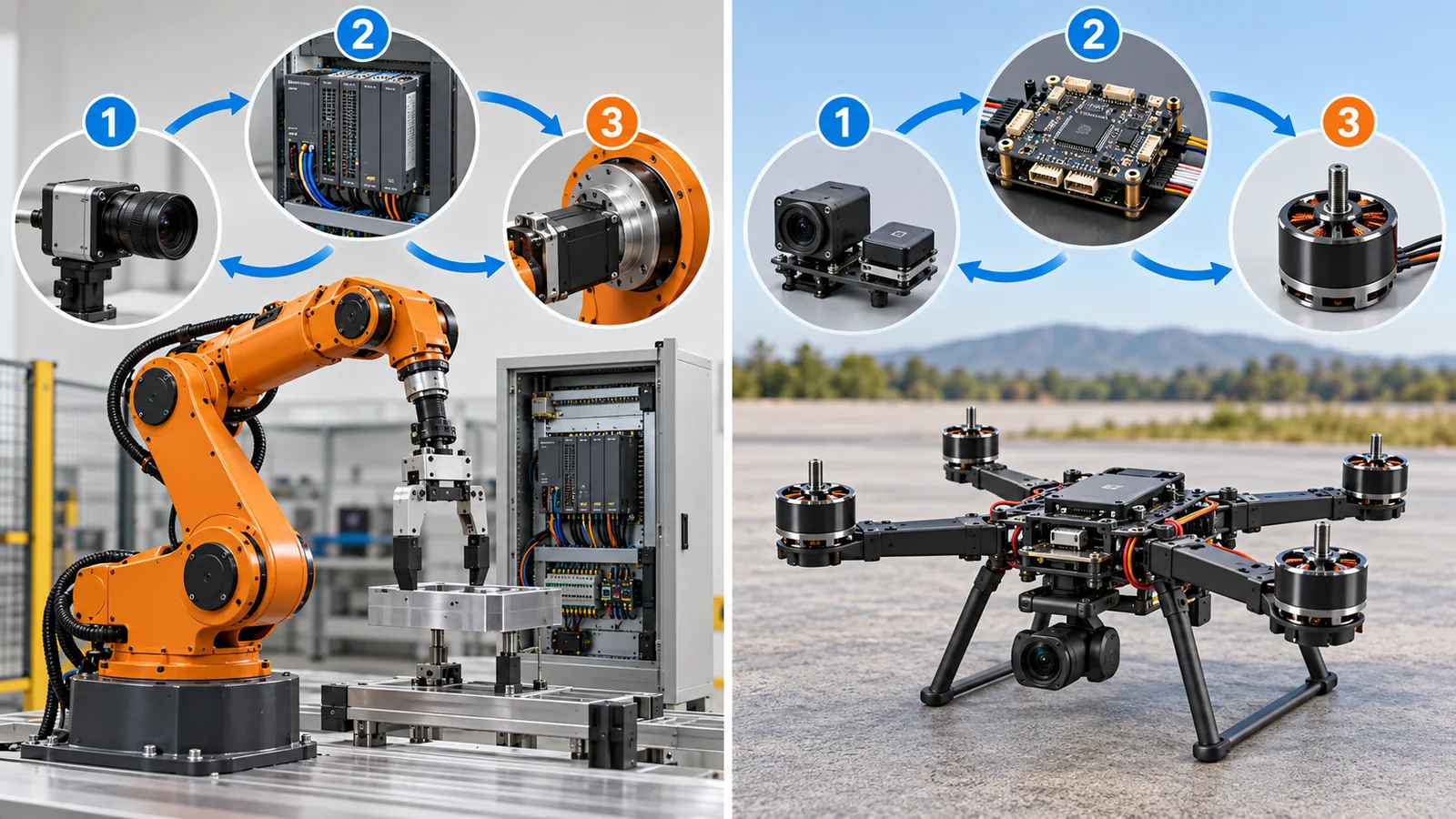
Original SVG, detailed explanation and sources
Original SVG reference: Concept diagram (vector drawing). Two example machines (a robot arm and a drone) are shown side by side. The contents differ, but the repeated cycle of sensing, thinking, acting, the environment changing and sensing again is the same. The parts are conceptual examples, not the build of any model.
(1) Sense: sensors
Sensors turn joint angle, tilt, force, distance and images into electrical signals. Cameras and LiDAR (a device that measures distance with laser light) are typical. LiDAR is covered in the LiDAR article of this series, and touch in the article on tactile sensors and electronic skin.
(2) Think: control and intelligence
This is the part that decides which joint to move, how much, and when. There is control, which repeats a fixed procedure accurately, and intelligence, which judges according to the situation. Estimating your own position while building a map of the surroundings is called SLAM (simultaneous localization and mapping).
(3) Act: actuators
An actuator turns energy such as electricity into force and motion; it is the robot’s muscle. Most are a motor combined with a speed reducer. A reducer slows the motor’s fast rotation to gain force, much like a bicycle gear (where the analogy stops: real reducers lose energy to friction and have play between the teeth; see the article on speed reducers and gears).
Degrees of freedom (DOF) is the number of directions in which the joints can move. The human arm is often described as having seven (shoulder, elbow and wrist together; a textbook summary), which lets it grasp objects in any orientation. Six-axis arms are common in factories (commentary). IFR’s definition likewise requires an industrial robot to be programmable in three or more axesSourced[Ref. 2].
Drones need care too. An aircraft in the air has six motions: three of position and three of attitude. A common quadcopter, however, has only four independently controlled quantities (the speeds of its four propellers). The rest are achieved by combining them, for example tilting to move sideways (commentary).
Talk about robot intelligence often brings up “physical AI” and “robot foundation models”. In this article, read them as AI that has learned general ways of moving from the experience of many robots. Where the analogy stops: even when such AI looks general-purpose, it can be weak in situations it has not learned. See the articles on world models and embodied AI, and on robot foundation models and VLA.
5. A map of the kinds — tell them apart with three questions
When you meet a new machine, ask these three questions.
- Where does it work? (factory floor, warehouse, outdoor ground, air, water, inside the body)
- What does it do? (grasp, carry, look, measure, cut)
- Who decides? (a person operates all the time, a person supervises, the machine is trusted)
Once you have the three answers, you can roughly see which parts matter and which rules and standards apply. For “in the air, carrying parcels, flying itself”, for example, lightness, batteries and aviation rules are central.
6. Degrees of autonomy: remote control, semi-autonomous, fully autonomous
The word “autonomous” may bring to mind a machine that decides everything. In practice the split between person and machine has steps. The glossary compiled by NIST (ALFUS) divides the operation of unmanned systems into four modesSourced[Ref. 5].
Japan’s drone flight levels depend on whether the flight is piloted or automatic, in sight or out of sight, and whether there are people below. Level 4 is out-of-sight flight with no observers over populated areas (over third parties); it became possible on 5 December 2022 once aircraft certification, pilot licensing and operating rules were in placeSourced[Ref. 7][Ref. 9].
ALFUS also offers a framework that rates autonomy on three axes: (1) human independence (how much human help is needed), (2) mission complexity and (3) environmental complexitySourced[Ref. 5]. Even among “automatic” machines, shuttling back and forth on a tidy factory floor and delivering a parcel outdoors in wind while dodging obstacles are quite different problems.
The facts: A video alone does not tell you whether the robot is autonomous or teleoperated. ALFUS formally separates teleoperation and remote control as operating modesSourced[Ref. 5]. When you watch a demonstration, check whether it was autonomous or teleoperated, how many units were tried for how long, what the task was, and whether a third party verified it. Treat a demonstration without these details as a company claim, not as proof of capability.
Automatic means following a procedure fixed in advance. Autonomous means sensing the situation, deciding for itself, and coping with the unexpected (commentary). A factory arm that follows the same path every time is automatic; a warehouse robot that dodges people and parcels and changes its destination is closer to autonomous. The boundary is blurry, and ALFUS treats it as steps.
7. Where robots stand: reading the IFR statistics
A good clue to how widely robots are used is the statistics that the International Federation of Robotics (IFR) publishes each year. According to IFR’s World Robotics 2025, 542,076 industrial robots were installed worldwide in 2024, the second highest ever after 2022 (552,946). At the end of 2024, 4,663,698 industrial robots were in operation (+9% on the year)Sourced[Ref. 4].
- The largest customer was electrical/electronics (128,899 units, 24%), narrowly ahead of automotive (126,088). Metal and machinery took 88,777, plastic and chemical products 26,491 (about 5%), and food 20,792Sourced[Ref. 4].
- By region, Asia took 401,665 units (74%) and China 295,045 (54%). Japan had 44,453 and the United States 34,164Sourced[Ref. 4].
- Outlook: IFR expects 575,000 units in 2025 and more than 700,000 by 2028. These are IFR’s own forecasts, not settled numbersNot yet confirmed[Ref. 4].
A note on reading: this statistic counts industrial robots. “Counts” of service robots, humanoids and drones have different definitions and collection methods. This article does not use market-size estimates from research firms or figures reported only in the news.
8. Drone basics: thrust versus weight, and the battery trade-off
The condition for a drone to rise is simple: if thrust (the upward force the propellers get by pushing air down) is at least the weight (gravity), it lifts off. If thrust equals weight, the drone stays still in the air; this is called hovering.
The power needed to hover can be estimated with a basic theory called momentum theory. A multicopter study (Bauersfeld and Scaramuzza, 2022) gives the following formulaSourced[Ref. 10].
Ph = (m g)3/2 / ( ηP · √(2 ρ π Nr r2) )
In words: the heavier the aircraft (mass m, in kg), the more power it needs, rising with the 1.5th power of weight. More propellers (Nr) and larger radius r (a wider area of air pushed) need less power. ρ is air density (about 1.225 kg/m³), g is gravitational acceleration, and ηP is the propeller efficiency, called the figure of merit (0.5 to 0.7 is typical; 0.6 is used here)Sourced[Ref. 10].
Checking with numbers (Our calculation): an aircraft with 1.0 kg of non-battery mass and a 0.5 kg battery (1.5 kg in total), four propellers of 0.127 m radius (10-inch diameter), ηP = 0.6 and 80% motor efficiency. The weight is 1.5 x 9.81 = about 14.7 N. The formula gives about 133 W of mechanical power, or 133 / 0.8 = 167 W of electrical power. Assuming a battery of 150 Wh/kg and 80% usable, the usable energy is 0.5 x 150 x 0.8 = 60 Wh. 60 / 167 = 0.36 hours, or about 22 minutes.
In the graph, doubling the battery from 0.5 kg to 1.0 kg lengthens the flight only from about 22 to about 28 minutes. The maximum of about 31 minutes comes near 2 kg, and adding more makes it shorterOur calculation. A bigger battery adds weight, and the power needed grows with the 1.5th power of weight.
The effect of going lighter (Our calculation): if the aircraft is 10% lighter, the power needed is 0.91.5 = about 0.85 times, a cut of about 15%. Conversely, 10% heavier needs 1.11.5 = about 1.15 times, about 15% more. This is why lightening the aircraft with better parts and materials helps both flight time and payload.
The facts: As the calculation shows, a bigger battery makes the aircraft heavier and the gain levels off. Real batteries also deliver less energy when drawn hard (the Peukert effect). Bauersfeld and Scaramuzza use a battery model that captures this, and in six example aircraft their estimated range and endurance were almost always within 10% of the manufacturers’ specificationsSourced[Ref. 10]. Real flight time varies with weight, wind, speed, temperature and battery condition.
In the right-hand graph, the horizontal axis is battery mass and the vertical axis is flight time. Read it in order: (1) the left end has no battery, so no flight; (2) it climbs quickly (a little battery is enough to fly); (3) it flattens (the effect of weight starts to show); (4) it passes a peak and falls. The position of the peak (2 kg here) depends on aircraft weight and propeller size (a result of the assumed simple model).
9. Robots and drones through a materials engineer’s eyes
Let us look at the story so far through the eyes of materials and parts. The brain (software) of a robot or drone tends to get the attention, but what often sets the limits of motion, force, lifetime and weight are the parts and materials.
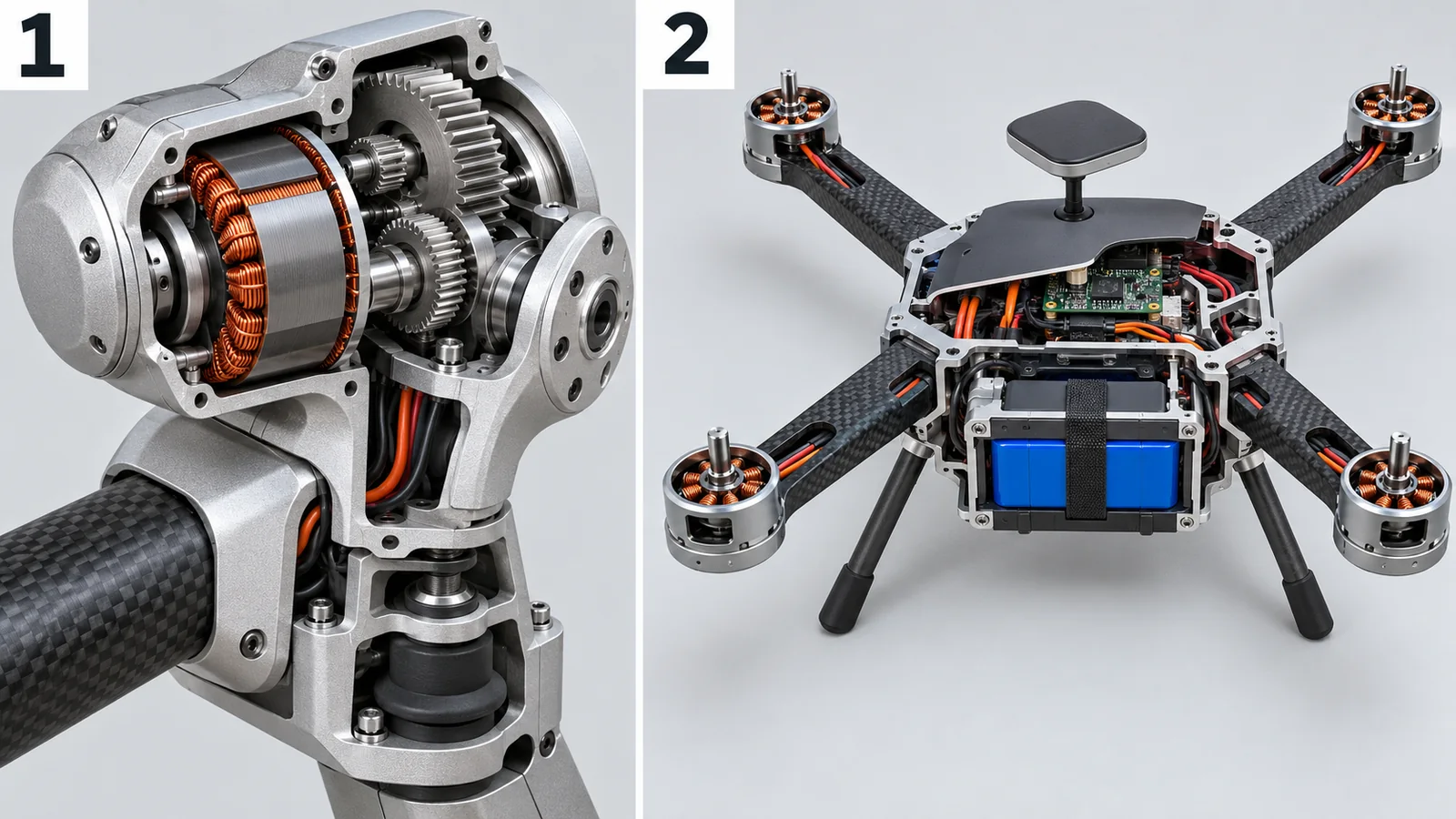
Original SVG, detailed explanation and sources
Original SVG reference: Concept diagram (vector drawing). Parts of a robot arm and a multicopter, and the materials that matter in each. Layout and material names are generic examples, not the build of a specific model. Each part is covered in more detail in the relevant article of this series.
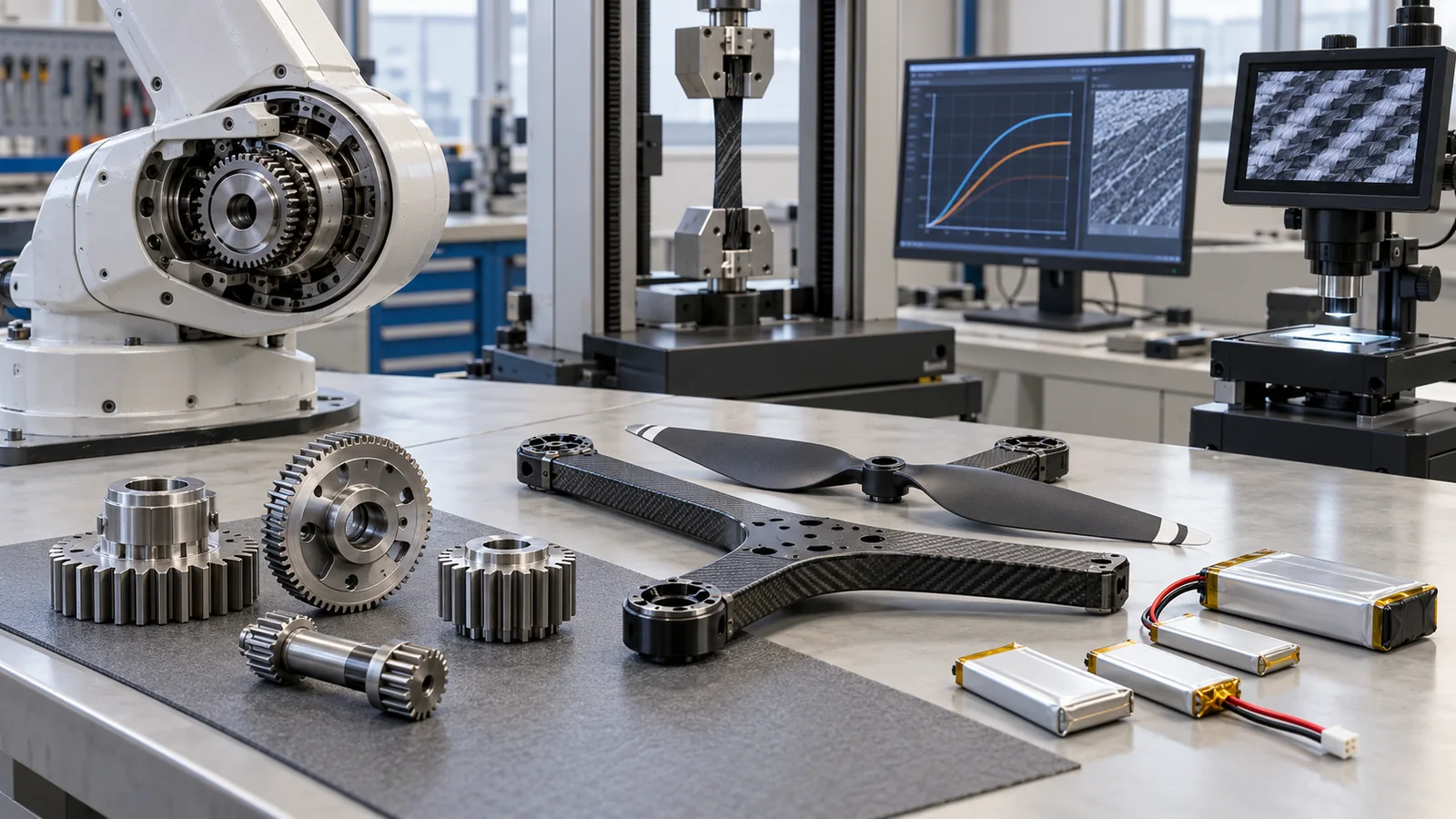
A reducer gear in a joint, for example, needs fatigue strength to endure repeated loads and surface hardness to resist wear (the world of steel and heat treatment). A motor magnet needs strong magnetism that it keeps as the temperature rises (the world of rare earths). A drone propeller or frame needs lightness and stiffness. As Chapter 8 showed, a 10% lighter aircraft needs about 15% less power, so weight saving connects directly to flight time (Our calculation).
A robot joint produces large force in a small volume and moves millions of times. Here wear, fatigue and temperature rise decide the lifetime. A battery, too, becomes harder to manage thermally and against degradation as its energy per unit weight rises. Making something lighter lowers strength or lifetime, making it stronger makes it heavier, and being both raises the cost. Robot and drone design is a tug of war among these four (commentary). Heat is covered in the joint actuators article and batteries in the article on power sources.
| Part | Typical materials (examples) | What matters in the material | Series article with details |
|---|---|---|---|
| Speed reducer | Alloy steel, heat treatment, lubricant | Fatigue strength, surface hardness, wear | Speed reducers and gears |
| Motor | Neodymium magnets, copper wire, electrical steel | Magnetism, coercivity (heat resistance), losses | Permanent magnets and rare earths; joint actuators |
| Fingertip and skin | Silicone and urethane rubber, conductive materials | Friction, softness, durability, sensitivity | Robot hands and grasping; tactile sensors and electronic skin |
| Lightweight structure | Aluminium, CFRP, polymers | Specific strength, stiffness, fatigue | Structural materials for robots and drones |
| Battery | Lithium-based electrodes and electrolytes | Energy per weight, power, heat | Lithium-ion battery basics; thermal runaway and battery safety; power sources for robots and drones |
Material names are general examples. This table is our own commentary; individual values are given with sources in each article.
10. Limits, what could not be confirmed, and a summary
- The paid text of ISO 8373 was not checked. The robot definitions rely on the wording quoted on IFR’s pages. Whether a drone counts as a robot under ISO 8373 was not checked either.
- No drone count or market statistics are used. Estimates by research firms are excluded, and no association-published statistic for the total number of drones was found.
- Counts of humanoids and service robots are not covered. Only the IFR industrial robot statistics are used.
- The calculation in Chapter 8 is a simple model. Structure, battery discharge behavior, wind, flight speed and motor variation are ignored. The numbers show a trend and are not the performance of a real aircraft.
- Drone regulation outside the US and Japan (for example EASA in the EU) is not covered here. It is covered in the series article on drone regulation and airspace management.
- Robots and drones both run on a sense-think-act loop. ISO 8373 defines a robot as a programmed actuated mechanism with a degree of autonomy that performs locomotion, manipulation or positioningSourced
- Autonomy comes in steps. NIST has four modes and Japan has four drone flight levels. A demonstration video is a company claim until you confirm whether it was autonomous or teleoperatedSourced
- 542,076 industrial robots were installed worldwide in 2024 and 4,663,698 were in operation (IFR). Plastic and chemical customers took about 5%Sourced
- A drone lifts when thrust is at least its weight. Required power rises with the 1.5th power of weight, so a bigger battery gives diminishing returns (in a simple model, a 1.0 kg aircraft peaks at about 31 minutes near a 2 kg battery)Our calculation
- Much of the performance is set by parts and materials. Gear steel, motor magnets, fingertip rubber, lightweight airframe materials and batteries underpin motion, force, lifetime and flight time (commentary)
11. How to read the yardsticks and standards
The “quality” of a robot or drone cannot be expressed by one number. For a robot we measure how accurately it can repeat a position (repeatability), how much load it can handle, and whether it is safe near people. For a drone the yardsticks are how many minutes it can fly, how much it can carry, and who may fly it in which airspace. What matters most is the conditions under which the number was measured: the same word, “accuracy”, gives different numbers under different test conditions. The table below organizes what could be confirmed (checked on 25 October 2026).
| What is evaluated | Typical tests and benchmarks (name, source) | Standards, rules and guidance (ISO, NIST, FAA and others) | Reading notes |
|---|---|---|---|
| Terms and categories | — (a vocabulary, not an evaluation) | ISO 8373:2021 (published November 2021; stage 90.92 “to be revised”; successor ISO/DIS 8373 under development)[Ref. 1]Not yet confirmed | The basis for what counts as a “robot”. It is under revision, so a future edition may change the definition |
| Industrial robot accuracy and performance | Test methods for pose repeatability and similar (ISO 9283) | ISO 9283:1998 “Manipulating industrial robots — Performance criteria and related test methods” (confirmed in 2021, now under review)[Ref. 16]Sourced | Check the test conditions (load, speed, posture) behind a catalog repeatability value. The test details were not checked (paid text) |
| Industrial robot safety | Not found (safety is shown by conformity to requirements, not by a performance number) | ISO 10218-1:2025 (the robot itself) and ISO 10218-2:2025 (robot applications and cells), both published February 2025[Ref. 13, 14]Sourced | A standard usually binds only when cited by law or contract (commentary). The requirements themselves were not checked |
| Safety of personal care robots | Not found | ISO 13482:2014 (February 2014, confirmed in 2020; the page says it is expected to be replaced by ISO/FDIS 13482)[Ref. 15]SourcedNot yet confirmed | Covers mobile servant, physical assistant and person-carrier robots (per the ISO page). The replacement is still at the planned stage |
| Service robot performance | Test methods for wheeled locomotion (Part 1), navigation (Part 2) and manipulation (Part 3) | ISO 18646-1:2016 (confirmed), -2:2024 (January 2024) and -3:2021 (June 2021, under review)[Ref. 17, 18, 19]Sourced | Each part has a different scope. Parts for legged robots and others show a development stage and are not covered here |
| Drone vocabulary | — (a vocabulary) | ISO 21384-4:2025 (published July 2025)[Ref. 20]Sourced | The words “drone”, “unmanned aircraft” and “UAS” differ between rules and sources |
| Drone rules and classes | — (rules, not a benchmark) | US 14 CFR § 107.3 (small unmanned aircraft: under 55 pounds)[Ref. 6]Sourced. Japan: registration and remote ID from 100 g, and the Level 4 system (started 5 December 2022)[Ref. 8, 7]Sourced | Rules differ by country and are amended. Weight classes differ by country (see the series article on drone regulation and airspace management) |
| Degree of autonomy | NIST ALFUS: four operating modes and three axes (human independence, mission complexity, environmental complexity)[Ref. 5]Sourced | NIST SP 1011-I-2.0 (October 2008): a terminology document, not a binding standard (commentary) | Autonomy is not one number: ask what it does, where, and without human help |
| Flight time and range | Bauersfeld et al. model: in six example aircraft, estimates were almost always within about 10% of manufacturer specifications[Ref. 10]Sourced | Not found (no unified international test standard for flight time was found in this survey) | A catalog flight time depends on load, speed, temperature and battery state. Do not rank numbers measured under different conditions |
| Adoption statistics | IFR World Robotics 2025 (installations and operational stock of industrial robots)[Ref. 4]Sourced | — (statistics, not a standard) | Industrial robots only. The forecast is IFR’s own outlook, not settled |
The table layout is our organization (Our calculation). Numbers, titles and stages were checked on each body’s official page (checked 25 October 2026). Standard texts are paid, so only titles and scope are given.
Reading notes (for materials engineers)
- A demonstration, a benchmark and a real site are three different things. What you see at a trade show or in a video is a staged demonstration. A benchmark compares on a fixed task, while a real factory or outdoor site adds dirt, temperature swings and people moving about.
- A manufacturer’s stated value and third-party verification are different. Catalog values are measured under conditions the maker chose. Do not compare numbers whose conditions are not stated.
- Standards may be recommendations or requirements. An ISO standard generally binds only when cited by law or contract (commentary). National rules such as 14 CFR or the Japanese Aviation Act, in contrast, are legally binding.
- A plan and an achievement are different. IFR’s forecast and drafts under revision such as ISO/DIS 8373 are not settled facts.
12. Glossary
- Robot
- Under ISO 8373, a programmed actuated mechanism with a degree of autonomy that performs locomotion, manipulation or positioning.
- Industrial robot
- An automatically controlled, reprogrammable, multipurpose manipulator (arm) programmable in three or more axes.
- Service robot
- A robot in personal or professional use that performs useful tasks for humans or equipment.
- Mobile robot
- A robot able to travel under its own control.
- Sensor
- A part that turns distance, angle, force or images into electrical signals. It handles “sense”.
- Control
- Computing commands to the actuators to follow a set procedure or target.
- Actuator
- A part that turns energy such as electricity into force and motion; the robot’s muscle.
- Speed reducer
- A part that slows the motor’s rotation to gain force; similar to a bicycle gear.
- Degrees of freedom (DOF)
- Degrees of freedom: the number of directions in which joints can move.
- SLAM
- Simultaneous localization and mapping: estimating your own position while building a map.
- Physical AI / robot foundation model
- AI that has learned general ways of moving from the experience of many robots; it can be weak in situations it has not learned.
- Autonomy
- The ability to perform intended tasks from the current state and sensing without human intervention.
- Remote control / teleoperation
- Operation by a person from a distance. In ALFUS they are separate operating modes.
- ALFUS
- Autonomy Levels for Unmanned Systems: terminology and a framework for autonomy compiled by NIST.
- Unmanned aircraft / UAS
- Unmanned aircraft system: an aircraft with no person on board together with its control and communication elements.
- Multicopter
- An aircraft with several rotors that can take off and land vertically and hover.
- Fixed-wing
- An aircraft that gets lift from wings; flies far and fast but needs a runway or launch.
- VTOL
- Vertical take-off and landing.
- Thrust
- The force a propeller gets by pushing air; equal to weight in a hover.
- Hover
- Staying still in the air.
- Figure of merit (FM)
- Propeller efficiency: ideal power divided by actual power. Typically 0.5 to 0.7.
- Payload
- The weight an aircraft can carry as load, including sensors and the like.
- BVLOS
- Beyond visual line of sight: flight outside what the pilot can see.
- Installations / operational stock
- In IFR statistics, units newly installed in the year / the total in use.
- ISO/TC 299
- The ISO technical committee responsible for robotics standards.
13. References (primary sources)
- ISO ISO 8373:2021 “Robotics — Vocabulary” (Edition 3, November 2021; ISO page; stage 90.92 “to be revised”, successor ISO/DIS 8373 under development) — iso.org/standard/75539.html
- IFR “Standardisation” (quotes the ISO 8373 robot definitions that IFR uses for its statistics) — ifr.org/standardisation
- IFR “Service Robots” (service-robot definition, degree of autonomy, medical robots as a third category) — ifr.org/service-robots/
- IFR “World Robotics 2025 – Industrial Robots”, Executive Summary (2025; statistics published by the federation itself) — ifr.org/img/worldrobotics/Executive_Summary_WR_2025_Industrial_Robots.pdf
- NIST Huang H.-M. (ed.) “Autonomy Levels for Unmanned Systems (ALFUS) Framework, Volume I: Terminology, Version 2.0”, NIST Special Publication 1011-I-2.0 (October 2008) — nist.gov/document/nistsp1011-i-2-0pdf
- U.S. Federal Aviation Administration / eCFR 14 CFR § 107.3 “Definitions” (small unmanned aircraft: less than 55 pounds on takeoff) — ecfr.gov/current/title-14/part-107/section-107.3
- Ministry of Land, Infrastructure, Transport and Tourism (MLIT) “Level 4 Flight Portal for Unmanned Aircraft” (in Japanese; definition of Level 4 flight, system started on 5 December 2022) — mlit.go.jp/koku/level4/
- MLIT “General Portal for Unmanned Aircraft” (in Japanese; registration of aircraft of 100 g or more, and other rules) — mlit.go.jp/koku/info/
- Cabinet Secretariat, Office for Small Unmanned Aerial Vehicles (Japan) “Realizing Level 4 flight and beyond”, March 2022 (in Japanese; diagram of drone flight Levels 1 to 4) — mlit.go.jp/common/001475188.pdf
- Bauersfeld L., Scaramuzza D. “Range, Endurance, and Optimal Speed Estimates for Multicopters”, IEEE Robotics and Automation Letters 7(2), 2953–2960 (2022), DOI 10.1109/LRA.2022.3145063 (arXiv:2109.04741) — arxiv.org/abs/2109.04741
- Liew C. F. et al. “Recent Developments in Aerial Robotics: A Survey and Prototypes Overview”, arXiv:1711.10085 (2017) — arxiv.org/abs/1711.10085
- Siciliano B., Khatib O. (eds.) Springer Handbook of Robotics, 2nd ed., Springer (2016), DOI 10.1007/978-3-319-32552-1 — doi.org/10.1007/978-3-319-32552-1
- ISO ISO 10218-1:2025 “Robotics — Safety requirements — Part 1: Industrial robots” (Edition 3, February 2025) — iso.org/standard/73933.html
- ISO ISO 10218-2:2025 “Robotics — Safety requirements — Part 2: Industrial robot applications and robot cells” (Edition 2, February 2025) — iso.org/standard/73934.html
- ISO ISO 13482:2014 “Robots and robotic devices — Safety requirements for personal care robots” (February 2014; confirmed in 2020; the page says it is expected to be replaced by ISO/FDIS 13482) — iso.org/standard/53820.html
- ISO ISO 9283:1998 “Manipulating industrial robots — Performance criteria and related test methods” (April 1998; confirmed in 2021; stage 90.60 “under review”) — iso.org/standard/22244.html
- ISO ISO 18646-1:2016 “Robotics — Performance criteria and related test methods for service robots — Part 1: Locomotion for wheeled robots” (September 2016, confirmed) — iso.org/standard/63127.html
- ISO ISO 18646-2:2024 “Robotics — Performance criteria and related test methods for service robots — Part 2: Navigation” (January 2024) — iso.org/standard/82643.html
- ISO ISO 18646-3:2021 “Robotics — Performance criteria and related test methods for service robots — Part 3: Manipulation” (June 2021; stage 90.60 “under review”) — iso.org/standard/73591.html
- ISO ISO 21384-4:2025 “Uncrewed aircraft systems — Part 4: Vocabulary” (July 2025) — iso.org/standard/85053.html
14. Claim-to-source audit
| Claim in the text | Basis | Type |
|---|---|---|
| ISO 8373 definitions of robot, industrial robot and mobile robot, and that IFR uses them for statistics | IFR standardisation page Reference 2 https://ifr.org/standardisation | Sourced |
| Service robot and degree-of-autonomy definitions, medical robots as third category, and that IFR statistics include teleoperated systems | IFR service robots page Reference 3 https://ifr.org/service-robots/ | Sourced |
| Edition, date and stage (90.92) of ISO 8373:2021, and ISO/DIS 8373 under development | ISO page Reference 1 https://www.iso.org/standard/75539.html | SourcedNot yet confirmed |
| Definition of autonomy (sensing, perceiving, analyzing, planning, deciding, acting), four operating modes, three axes | NIST SP 1011-I-2.0 Reference 5 https://www.nist.gov/document/nistsp1011-i-2-0pdf | Sourced |
| Definitions of unmanned aircraft and small unmanned aircraft (under 55 pounds) | 14 CFR § 107.3 Reference 6 https://www.ecfr.gov/current/title-14/part-107/section-107.3 | Sourced |
| Registration and remote ID from 100 g, definition and start of Level 4 (5 December 2022), diagram of Levels 1 to 4 | Two MLIT pages and a Cabinet Secretariat document Reference 8 https://www.mlit.go.jp/koku/info/ Reference 7 https://www.mlit.go.jp/koku/level4/ Reference 9 https://www.mlit.go.jp/common/001475188.pdf | Sourced |
| Title and date of ISO 21384-4:2025 (July 2025) | ISO page Reference 20 https://www.iso.org/standard/85053.html | Sourced |
| Numbers, titles, editions and stages of ISO 10218-1/-2:2025, ISO 13482:2014 and ISO 9283:1998 | ISO pages Reference 13 https://www.iso.org/standard/73933.html Reference 14 https://www.iso.org/standard/73934.html Reference 15 https://www.iso.org/standard/53820.html Reference 16 https://www.iso.org/standard/22244.html | SourcedNot yet confirmed |
| Numbers, titles, editions and stages of ISO 18646-1:2016, -2:2024 and -3:2021 | ISO pages Reference 17 https://www.iso.org/standard/63127.html Reference 18 https://www.iso.org/standard/82643.html Reference 19 https://www.iso.org/standard/73591.html | Sourced |
| 2024 installations 542,076, 2022 552,946, 2023 541,302, stock 4,663,698, counts by industry and region, forecasts for 2025 and 2028 | IFR World Robotics 2025 Executive Summary Reference 4 https://ifr.org/img/worldrobotics/Executive_Summary_WR_2025_Industrial_Robots.pdf | SourcedNot yet confirmed |
| The hover-power formula, propeller efficiency 0.5 to 0.7 (typical), the Peukert effect, and estimates within about 10% of manufacturer specifications for six aircraft | Bauersfeld and Scaramuzza (2022) Reference 10 https://arxiv.org/abs/2109.04741 | Sourced |
| Drones are also called aerial robots, and surveys of their types and issues exist | Liew et al. survey Reference 11 https://arxiv.org/abs/1711.10085 | Sourced |
| Battery mass versus hover time in Fig. 6 (about 22 min at 0.5 kg, about 28 min at 1.0 kg, about 31 min at 2.0 kg), power change of about 15% for a 10% change in mass, and the 167 W calculation | Our calculation (Python; formula (5) of Bauersfeld et al.; assumptions: four propellers, 0.127 m radius, ηP 0.6, 80% motor efficiency, 150 Wh/kg, 80% usable). Not the performance of a real aircraft | Our calculation |
| Seven degrees of freedom in the human arm, six-axis arms being common, automatic versus autonomous, four independent controls of a quadcopter, the materials engineer’s views, the physical-AI analogy, and the three questions | Our own commentary based on general textbook understanding; no source is attached | Commentary |
| The text of ISO 8373, whether drones count as ISO 8373 robots, drone count statistics, humanoid counts, rules of other countries such as the EU, and a unified flight-time test standard | Not stated, because they could not be confirmed within this survey | Commentary |
Last updated: 25 October 2026. Sources are limited to primary material (official ISO, NIST, IFR, FAA and MLIT documents, peer-reviewed papers, and an arXiv survey). Market estimates from research firms are not used. The numbers in Chapter 8 come from our simple model and are not the performance of a real aircraft. The text of ISO 8373, whether drones count as ISO 8373 robots, drone count statistics and the rules of other countries could not be confirmed and are not stated. Figures 1 and 8 are ImageGen-generated conceptual illustrations; the rest are explanatory concept diagrams or drawings that include our calculation.