TECHNOLOGY EXPLAINER
Fixed-Wing, VTOL and Long-Endurance Flight
— Why wings save energy, how a wing-borne aircraft can take off without a runway, and how to read “flew for 67 days”
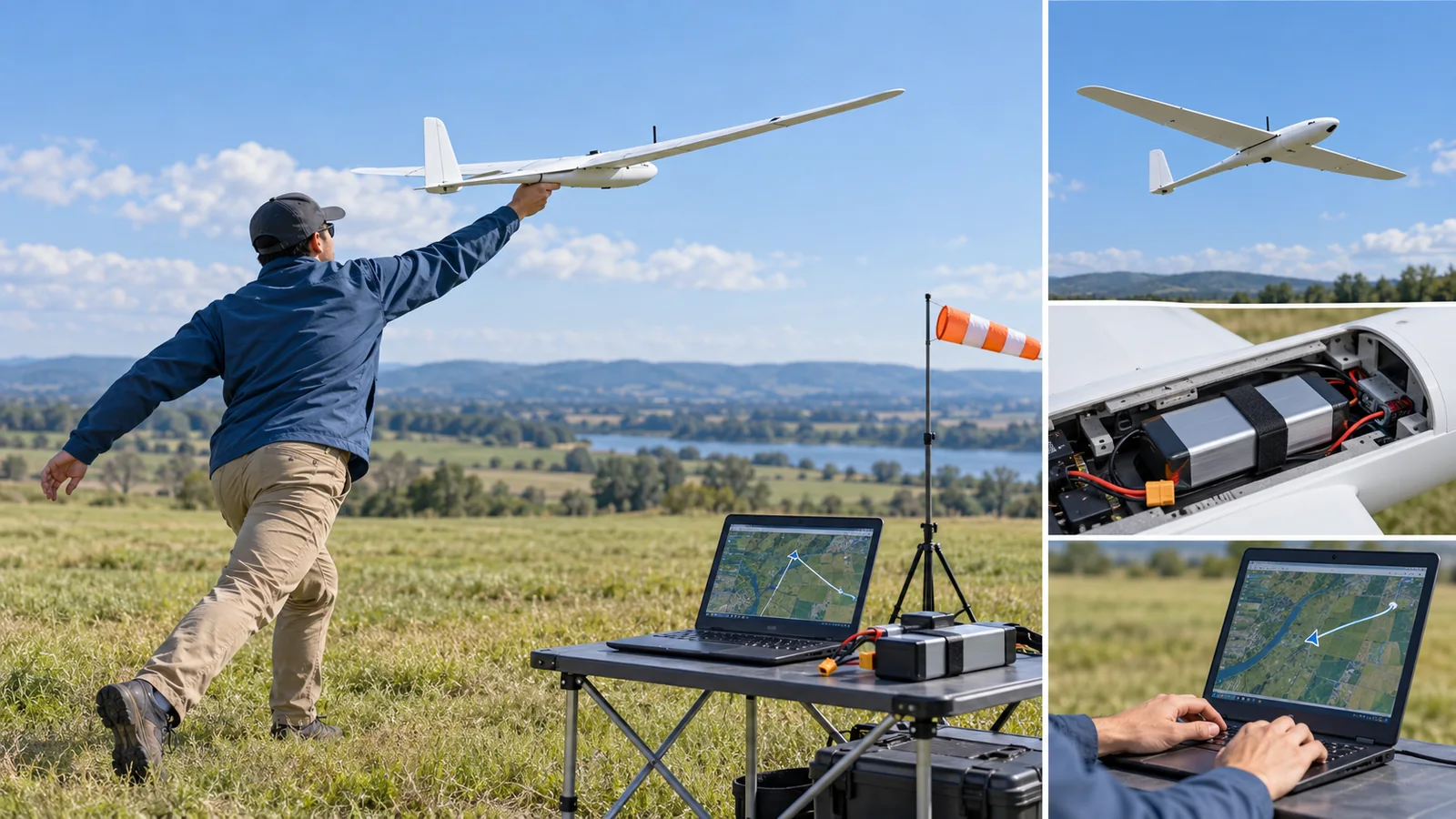
When most people hear “drone”, they picture a small machine with four propellers. But “unmanned aircraft” covers two very different ways of staying in the air: rotors that push the aircraft up with thrust, and wings that lift it as it moves forward. They need very different amounts of energy. This article is written for materials engineers with no aeronautics background. It explains (1) why a wing lets an aircraft fly longer, (2) the VTOL layouts that let a wing-borne aircraft take off without a runway, (3) the batteries, hydrogen and sunlight behind long flights, and (4) how to read a record such as “flew for 67 days” — official records versus company statements.
This article does not rank aircraft. Performance values are labelled as manufacturer-stated or as official records, with the conditions attached. Checked on 25 October 2026.
- Three-line summary / Before you read / Place in the series
- Two ways to stay up: thrust or wings
- The weakness of wings, and four VTOL layouts
- Three keys to long flights: wings, energy, lightness
- Energy sources: batteries, hydrogen, sunlight
- Reading “flew for N days”: official records versus company statements
- A materials engineer’s view, and what we could not confirm
- How to read the yardsticks and standards / Glossary / References / Claim-to-source audit
Sourced = stated in a published source (link given)
Our calculation = a value this article calculated from stated assumptions
Not yet confirmed = plans, targets, estimates and other things not yet settled
Our own readings are marked as commentary, and Inference is shown in bold.
Manufacturer figures are “manufacturer-stated”. Flight time and range change a great deal with aircraft mass, payload, temperature, wind and battery condition, so figures for different aircraft cannot be lined up to decide a winner. For “world records”, this article separates records certified by the World Air Sports Federation (FAI) from statements made by companies. Status as of 25 October 2026.
1. Three-line summary / Before you read / Place in the series
- A wing lets the same weight be carried with far less force. A rotor-borne aircraft must produce thrust equal to its weight all the time. A wing-borne aircraft gets lift by moving forward, and the force needed to push it along is only a small fraction of its weight. In our example (5 kg, 200 Wh battery) the flight time comes out at about 16 minutes versus about 104 minutes [References 1, 2]. Our calculation
- VTOL fixes the “needs a runway” weakness of wings. Vertical take-off layouts include tail-sitters, lift + cruise and tilt designs, and each is good at different things [Reference 4].
- “Flew for N days” depends on who is saying it. For the solar-electric stratospheric aircraft Zephyr, the FAI record database lists 336 h 22 min (2010) and 454 h 30 min (2021). Companies have announced 64 days (2022) and 67 d 6 h 52 min (2025), but we could not confirm that those were registered as FAI records [References 8-13].
You only need one intuition: to stay in the air, something must push up with a force equal to the weight. Viewing a drone as a combination of sensing, thinking (control and intelligence) and moving (actuators) is explained in our “Introduction to Drones and Robotics”. This article focuses on how the force that keeps an aircraft flying is made.
Rotor-borne aircraft design is covered in our explainer on multicopter principles and design. Batteries are covered in “Lithium-Ion Battery Basics” and “Power Sources for Robots and Drones”, hydrogen in “Fuel-Cell Vehicles and PEFCs”, airframe and wing materials in “Structural Materials for Robots and Drones”, communication and positioning in “Drone Communication, Positioning and Collision Avoidance”, and rules in “Drone Regulation and Airspace Management”. This article covers the choice to fly on wings, and the tricks for flying long.
2. Two ways to stay up
Start with a familiar feeling. A helicopter stays up because its rotor keeps pushing air downward. Even when it hovers in place, it falls if the engine stops. A paper plane, by contrast, glides with no motor once thrown. Its wings use the forward motion to take an upward force from the air.
Four forces act on an aircraft: lift (up), weight (down), thrust (forward) and drag (backward). In steady straight flight at constant speed they are balanced [Reference 1]. Sourced The lift a wing makes depends on wing area, air density, the square of the speed and other factors [Reference 2]. Sourced
The key point in Fig. 2 is that the fixed-wing aircraft on the right needs only about 4 N of thrust. The wing carries the 49 N weight; the propeller only has to beat air resistance. Lift divided by drag is called the lift-to-drag ratio (L/D); the larger it is, the less force is needed to fly. In the figure it is 12.
It means that a 4 N push can move an aircraft while its 49 N weight is carried by the wing. Think of pushing a loaded hand cart: on a flat floor, even a heavy load moves with a small force. Limit of the analogy: a cart holds its load even when stopped, but a wing makes no lift unless it moves (see the note under the right half of Fig. 2).
Converting this into power and flight time
Now turn the difference in Fig. 2 into electric power. For a multicopter to hover, the rotors must keep pushing air downward, which came out at about six times the power of a fixed-wing aircraft cruising (Fig. 3). With the same 200 Wh battery, flight time is about 16 minutes versus about 104 minutes. Our calculation
Real products show the same tendency. Wingtra, for example, states for its tail-sitter VTOL fixed-wing survey drone a maximum flight time of 59 minutes (RGB and multispectral sensors) and 45 minutes with a LiDAR payload. It also says that flight time depends on the sensor and flying conditions; these are manufacturer-stated figures [Reference 7]. Sourced They cannot be lined up against other makers’ figures to pick a winner.
What is actually true: a higher battery energy density does extend flight time, but a hovering-type aircraft must keep producing thrust equal to its weight, so its energy use stays high. Flying long takes a combination: using wings, making the aircraft lighter, and meeting operating rules, not just better batteries (rules are covered in our explainer on drone regulation and airspace management).
3. The weakness of wings, and four VTOL layouts
Wings have weaknesses too. (1) A runway or launcher is needed, because there is no lift without forward motion. (2) The aircraft cannot stay still in the air, so it is poorly suited to lowering a package on the spot or inspecting something from directly above. VTOL (vertical take-off and landing) is the way to cover these weaknesses.
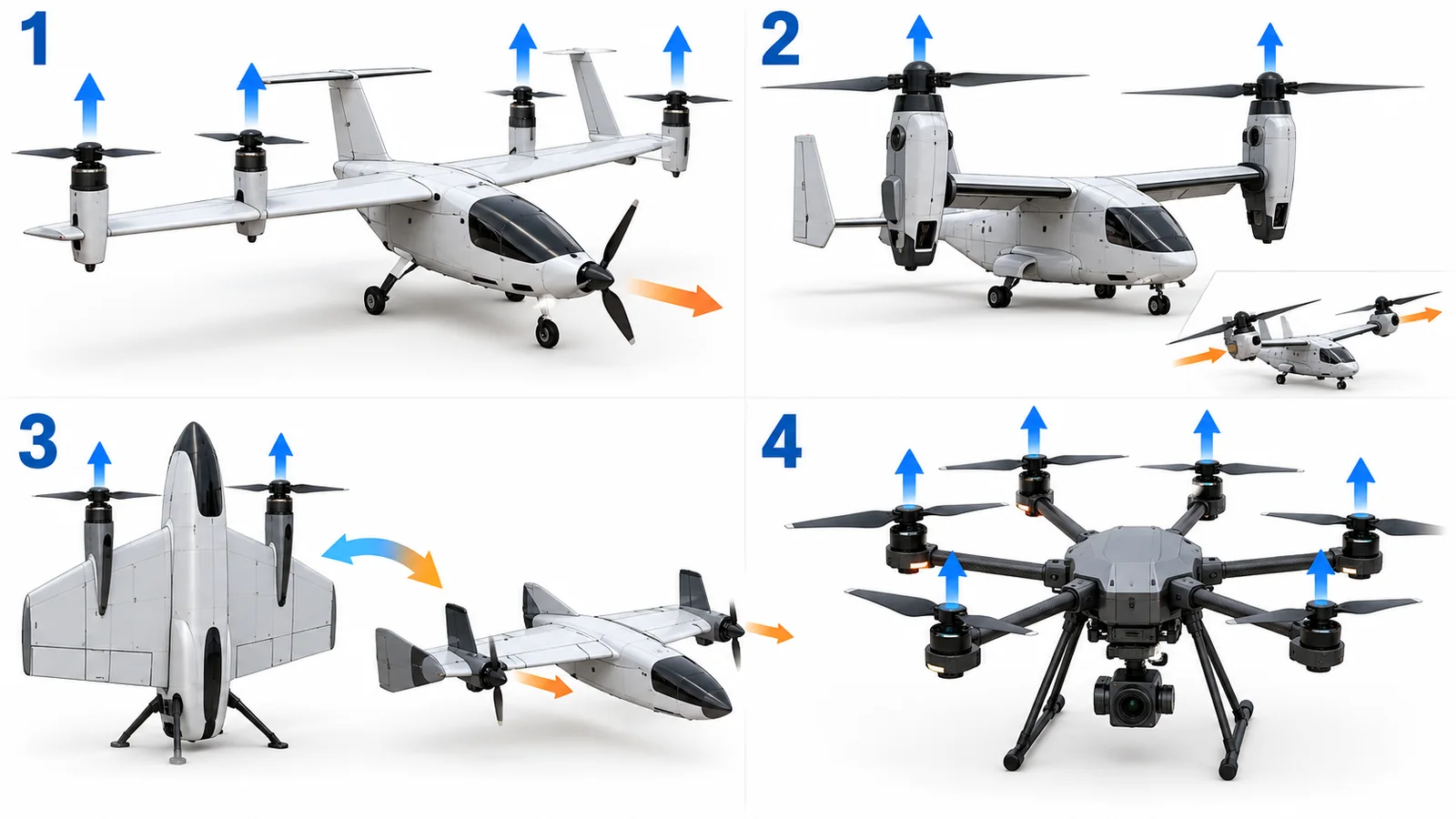
Original SVG, detailed explanation and sources
Original SVG reference: Concept diagram (vector drawing). Four common VTOL layouts. This is a general tendency arranged for beginners and does not show the performance of any particular aircraft. Bacchini and Cestino (2019) compared three electric VTOL configurations using representative aircraft and concluded that the best configuration depends on the mission [Reference 4].
| Layout | How it works (plainly) | Typical strengths and weaknesses | Reading note |
|---|---|---|---|
| Multicopter | Lifted and moved by rotors alone | Efficient in hover, uses more power in cruise [Reference 4] | Included as a kind of VTOL for comparison |
| Lift + cruise | Separate lift rotors for take-off and landing, and a wing with propeller for cruise | A compromise between hover and cruise [Reference 4] | In cruise the lift rotors are unused weight |
| Tail-sitter | Takes off and lands standing on its tail, then tips over to cruise | Few extra parts. Wingtra describes its own aircraft as this type [Reference 7] | Wind and landing control tend to be hard (commentary) |
| Tilt | Rotors or wings swivel | Tends to be efficient in cruise (vectored thrust) [Reference 4] | Complex mechanism. Passenger-carrying air taxis are covered in our explainer on eVTOL and air taxis |
Sourced (papers and manufacturer pages). The arrangement of the columns is this article’s commentary. A survey of hybrid UAVs is Saeed et al. (2018) [Reference 5].
Rotors added for take-off become dead weight in cruise and also add air resistance. A wing that is efficient in cruise is useless at take-off. Leaning toward one side weakens the other, so the choice depends on the mission: long hovering time or long distance.
4. Three keys to long flights
Long-endurance aircraft generally combine three things.
- (1) Wings: a long, thin wing (high aspect ratio) has lower induced drag, the drag that comes as the price of making lift [Reference 3]. Sourced This is why long-endurance aircraft tend to have long, slender wings (commentary). Airbus describes Zephyr S as having a 25 m wingspan and a mass under 75 kg [Reference 9].
- (2) Energy: batteries, hydrogen with a fuel cell, or sunlight (next chapter).
- (3) Lightness: the lighter the aircraft, the less lift and thrust it needs. Light materials such as carbon-fibre-reinforced plastics matter here (see “Structural Materials for Robots and Drones”).
5. Energy sources: batteries, hydrogen, sunlight
(1) Batteries: energy per kilogram is the key
If a battery stores little energy per kilogram, the battery itself becomes most of the aircraft’s weight. As one example, Amprius (a U.S. battery maker) lists 450 Wh/kg at 1C continuous discharge for the energy design of its silicon-anode lithium-ion cells (manufacturer-stated, single cell). However, cycle life differs by design and conditions, and the figures were not consistent between sources, so the conditions need to be checked before using any number [Reference 17]. Sourced We could not confirm whether this cell is used in Zephyr. For battery basics, see our “Lithium-Ion Battery Basics”.
(2) Hydrogen and fuel cells: light fuel, heavy container
The DOE explains that hydrogen has the highest energy per mass of any fuel but a low energy per volume. It is therefore stored in pressure vessels at 350-700 bar or as a liquid with a boiling point of -252.8 C [Reference 15]. Sourced
Fig. 5 shows that hydrogen as a fuel is lighter by orders of magnitude, but including the tank cuts the figure sharply. The efficiency of turning it into electricity (50% here, as an illustration) and the mass of the fuel cell itself then have to be added. Fuel-cell basics are in our “Fuel-Cell Vehicles and PEFCs”.
As an example of actual flights, the U.S. Naval Research Laboratory (NRL) reported flying its fuel-cell aircraft Ion Tiger for 48 hours 1 minute on liquid hydrogen in April 2013. The previous best was 26 hours 2 minutes in 2009, using compressed hydrogen at 5,000 psi (about 345 bar). NRL explains that liquid hydrogen is about three times denser than 5,000 psi gas, and that success needed a lightweight insulated tank and matching the boil-off rate to the fuel consumption [Reference 14]. Sourced This is a research laboratory’s report of a demonstration flight; we checked it through a search-result summary and could not open the page itself.
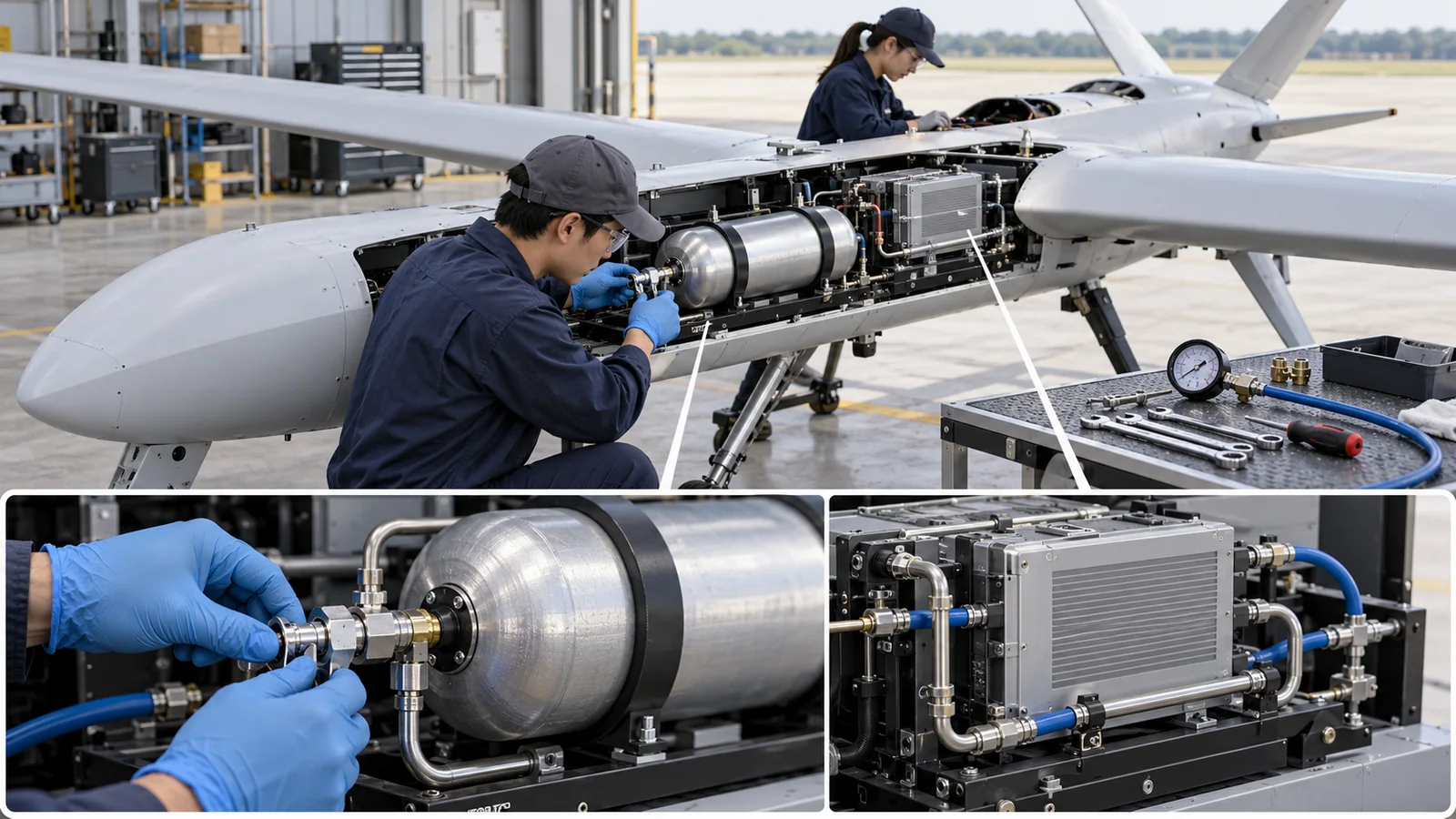
The flight time of a hydrogen drone is set by how much of its mass is fuel. High-pressure tanks are made light with wound carbon fibre, and liquid hydrogen needs vacuum or multilayer insulation to keep heat out (see our “Fuel-Cell Vehicles and PEFCs” and, in the hydrogen-energy field, the explainers on high-pressure tanks and liquid hydrogen). The materials that matter are the strength-to-weight of fibre and resin, an inner barrier that hydrogen cannot easily leak through, and joints that do not crack at low temperature. The point is not to give back the lightness of hydrogen as tank weight.
(3) Sunlight: generate by day, fly on the battery at night
Airbus explains that Zephyr generates power with solar cells on its wings while flying, and stores surplus electricity in secondary batteries to get through the night [Reference 8]. Sourced The stratosphere (about 20 km) lies above the layer where weather happens. Airbus’s 2021 document says Zephyr flies at an average altitude of about 21 km, above weather and regular air traffic [Reference 9].
A solar aircraft repeats “fill the battery by day, use it up at night” every day. Light weight (Wh/kg) comes first, but the battery also needs a life long enough for repeated charge and discharge. Amprius makes silicon-anode batteries and is the company Airbus announced an investment in during 2019, described as using a silicon-nanowire anode [Reference 10]. Silicon anodes can be light, but their swelling and shrinking during cycling is a known challenge, and in the manufacturer’s own listing cycle life varies with design and conditions [Reference 17]. Thin, light solar cells and coatings that withstand ultraviolet light and low temperatures are materials challenges too.
6. Reading “flew for N days”: official records versus company statements
How much a long-flight record weighs depends on who confirmed it. The FAI (World Air Sports Federation) certifies world records in air sports, and its record database lists the date, place, aircraft and status of each certified record. A company statement, on the other hand, is the company describing its own flight.
| Year | What | Source | What we checked |
|---|---|---|---|
| July 2010 | QinetiQ Zephyr 7: 336 h 22 min 8 s (Yuma, Arizona) | FAI record database | Shown as confirmed but since superseded (checked via a search summary) [Reference 12] Sourced |
| 2018 | Over 25 days on the Zephyr S maiden flight | Airbus statement (October 2019) | Confirmed as a company statement; FAI registration not confirmed [Reference 10] Sourced |
| September 2021 | Zephyr 8: 454 h 30 min (about 18 days 22 h 30 min) | FAI record database / Airbus document | FAI via search summary; Airbus document checked directly [References 9, 13] Sourced |
| 2022 | A 64-day flight | Company and U.S. Army statements | FAI registration not confirmed Sourced |
| February-April 2025 | 67 d 6 h 52 min continuous flight (from Kenya) | AALTO (Airbus subsidiary) statement | Confirmed as a company statement; FAI registration not confirmed [Reference 11] Sourced |
Sourced. The FAI record pages could not be opened directly because of bot protection; we checked the summaries shown in search results (checked 25 October 2026).
What is actually true: “world record” is also used as a marketing phrase. An FAI-certified record can be checked in the database for its date, place, aircraft and status. Whether a company-announced flight has been registered as an FAI record is a separate question, and this article reports only what we could confirm. Even when a company calls a flight such as the 67 d 6 h 52 min of 2025 the “longest ever”, we could not confirm FAI registration. The reason (not applied for, still under review, and so on) could not be confirmed from public sources, so we do not state one.
The operating side
Airbus’s 2021 document says Zephyr flew outside the test range in U.S. national airspace for the first time, with approval from the FAA (Federal Aviation Administration) [Reference 9]. Sourced How such long-endurance stratospheric aircraft coexist with existing air traffic is covered in our explainer on drone regulation and airspace management.
7. A materials engineer’s view, and what we could not confirm
Zephyr S has a mass under 75 kg and a 25 m wingspan [Reference 9]. With so little mass for its span, the wing must be thin and flexible. Light structural materials (such as carbon-fibre-reinforced plastics), thin-film solar cells, light batteries and coatings that tolerate heat and cold are designed as one system. Because every gram saved extends flight time, strength-to-weight, fatigue and ultraviolet degradation translate directly into service life.
What we could not confirm
- The exact type of battery cell on Zephyr, and its cycle life and operating conditions (not confirmable from public company materials).
- Whether the 2022 and 2025 flights were registered as FAI records, or even whether registration was applied for.
- The exact duration of the 2018 maiden flight and how FAI treated it (Airbus’s 2019 document says only “over 25 days”).
- An official FAI record for a hydrogen fuel-cell drone (the Ion Tiger flight is a research laboratory report).
- Official records and performance of other high-altitude aircraft than Zephyr S are outside this article.
8. How to read the yardsticks and standards
Long-endurance aircraft are measured by flight time (endurance), range, payload (mass carried) and tolerance to wind and temperature. These mean something only together with aircraft mass, payload, speed, temperature, battery condition and altitude. “Up to 59 minutes” is the value under the most favourable conditions. A record is also the result of one flight, which is not the same as being able to operate repeatedly.
| What is measured | Typical test or benchmark (name, source) | Standard, rule or guidance (name, source checked) | Reading note |
|---|---|---|---|
| Flight time and range | Manufacturer-stated values with test conditions (Wingtra: depends on sensor and flying conditions) [Reference 7] Sourced | No common yardstick was found | Not comparable if payload, wind and altitude differ. Company’s stated value |
| Endurance records | FAI record database (duration; Zephyr 7: 336 h 22 min 8 s, Zephyr 8: 454 h 30 min) [References 12, 13] Sourced | FAI record rules (the certifying body’s rules); clause numbers were not confirmed | Separate from company statements. Check whether registered |
| Lift-to-drag and efficiency | NASA Glenn educational pages (lift and induced drag) [References 1-3] Sourced | Not confirmed | Our calculation is illustrative, not data for a real aircraft Our calculation |
| Battery and fuel energy | Amprius stated value (450 Wh/kg); DOE tank estimate (1.71 kWh/kg) [References 16, 17] Sourced | Not confirmed (no dedicated standard for aircraft hydrogen tanks was found) | Values differ between cell and pack or system. Check what is included |
| Quality and safety of unmanned aircraft systems | Not confirmed | ISO 21384-2:2021 “Unmanned aircraft systems — Part 2: UAS components” (checked via a search summary) [Reference 18] Sourced | A voluntary standard; legal force depends on whether national rules adopt it (commentary). Text not read |
| Permission to operate | Zephyr flew in U.S. airspace with FAA approval (Airbus statement) [Reference 9] Sourced | National rules are in our explainer on drone regulation and airspace management | The scope and conditions of an approval differ per aircraft, use and period. ASTM standards were not consulted |
The arrangement of the table is Our calculation (organisation). Names and status were checked on official pages (checked 25 October 2026).
Reading notes (for materials engineers)
- A demonstration is not operation: one successful long flight does not guarantee daily operation or success in other weather.
- Manufacturer-stated values differ from third-party verification: Wingtra’s flight time and Amprius’s energy density are manufacturer-stated. An FAI record is an example of a record certified by a third party.
- Separate cell, pack and system: “Wh/kg” for batteries or hydrogen can differ by a large factor depending on what is included (Fig. 5).
9. Glossary
- Fixed-wing aircraft
- An aircraft whose wings are fixed and make lift because the aircraft moves forward.
- Multicopter
- An aircraft lifted by several rotors. Good at hovering.
- VTOL
- Vertical take-off and landing. No runway needed.
- Lift
- The upward force a wing receives from the air.
- Drag
- Air resistance acting against the direction of motion.
- Thrust
- The force made by a propeller or rotor that pushes the aircraft forward or up.
- Lift-to-drag ratio (L/D)
- Lift divided by drag. The larger it is, the less force is needed to fly.
- Aspect ratio
- Wingspan squared divided by wing area. Long thin wings have a high value.
- Induced drag
- Drag that comes with making lift. It is smaller for a high aspect ratio.
- Tail-sitter
- A VTOL that takes off and lands standing on its tail and tips forward for cruise.
- Lift + cruise
- A layout with separate lift rotors and a wing with propeller for cruise.
- Tilt
- A layout where rotors or wings swivel between lift and forward flight.
- HAPS
- High-altitude platform station. Long-staying aircraft in the stratosphere.
- Stratosphere
- The layer of air above the layer where weather happens. Zephyr is said to fly near 20 km.
- FAI
- The World Air Sports Federation, which certifies world air-sports records.
- Fuel cell
- A device that makes electricity from hydrogen and oxygen.
- Liquid hydrogen
- Hydrogen cooled to about -253 C. Dense, but needs an insulated tank.
- Cell / pack
- A single battery unit (cell) and a bundle with control electronics (pack).
- Specific energy
- Energy stored per kilogram (Wh/kg). It directly sets flight time.
- Payload
- The mass of cargo or sensors carried.
10. References (primary sources)
- NASA Glenn Research Center Forces on an Airplane (lift, weight, thrust and drag) — www.grc.nasa.gov/www/k-12/VirtualAero/BottleRocket/airplane/forces.html
- NASA Glenn Research Center Lift Equation (L = Cl x rho V^2 / 2 x A) — www1.grc.nasa.gov/beginners-guide-to-aeronautics/lift-equation-2/
- NASA Glenn Research Center Induced Drag Coefficient (aspect ratio and induced drag) — www1.grc.nasa.gov/beginners-guide-to-aeronautics/induced-drag-coefficient/
- Bacchini, A. and Cestino, E. Electric VTOL Configurations Comparison, Aerospace 6(3):26 (2019) — doi.org/10.3390/aerospace6030026
- Saeed, A. S. et al. A survey of hybrid Unmanned Aerial Vehicles, Progress in Aerospace Sciences 98 (2018) — doi.org/10.1016/j.paerosci.2018.03.007
- Traub, L. W. Range and Endurance Estimates for Battery-Powered Aircraft, Journal of Aircraft 48(2) (2011) — doi.org/10.2514/1.C031027
- Wingtra (manufacturer) Mapping drone (tail-sitter VTOL fixed-wing survey drone; manufacturer-stated flight times) — wingtra.com/mapping-drone-fast-accurate-surveying/
- Airbus Zephyr High Altitude Platform Station (HAPS) (company product page) — www.airbus.com/en/products-services/defence/uas/zephyr
- Airbus Zephyr 2021 Test Flight Campaign (company information document) — www.airbus.com/sites/g/files/jlcbta136/files/6c2c26ccdc745cb8b1f212c6962b95bb_EN-Information-Ze
- Airbus Airbus partners with Amprius, leader in high energy density battery technology (31 October 2019) — www.airbus.com/en/newsroom/press-releases/2019-10-airbus-partners-with-amprius-leader-in-high-e
- AALTO (Airbus subsidiary) Zephyr sets world record for longest continuous flight, flying 67 days in stratosphere (1 May 2025) — www.aaltohaps.com/zephyr-sets-world-record-for-longest-continuous-flight-flying-67-days-in-stra
- FAI (World Air Sports Federation) Record database: QinetiQ HALE team (GBR), duration 336 h 22 min 8 s, 23 July 2010, Zephyr 7 (confirmed via search summary; the page itself is behind bot protection and could not be opened directly) — www.fai.org/record/16052
- FAI (World Air Sports Federation) Record database: Airbus Zephyr Programme (USA), duration 454 h 30 min, 13 September 2021, Yuma, AZ, Zephyr 8 (confirmed via search summary; page not opened directly) — fai.org/node/190067
- U.S. Naval Research Laboratory NRL Shatters Endurance Record for Small Electric UAV (Ion Tiger, 48 h 1 min on liquid hydrogen; confirmed via search summary, page not opened directly) — www.nrl.navy.mil/Media/News/Article/2563183/nrl-shatters-endurance-record-for-small-electric-ua
- U.S. Department of Energy (DOE) Physical Hydrogen Storage (350-700 bar vessels; liquid hydrogen boils at -252.8 C) — www.energy.gov/eere/fuelcells/physical-hydrogen-storage
- U.S. Department of Energy (DOE) Onboard Hydrogen Storage Cost and Performance Status (700 bar tank system for cars, about 1.71 kWh/kg) — www.hydrogen.energy.gov/docs/hydrogenprogramlibraries/pdfs/24006-onboard-storage-cost-performan
- Amprius Technologies (manufacturer) SiCore silicon-anode lithium-ion cells (energy design 450 Wh/kg, 1C continuous discharge; manufacturer-stated) — amprius.com/solutions/sicore/
- ISO (International Organization for Standardization) ISO 21384-2:2021 Unmanned aircraft systems – Part 2: UAS components (confirmed via search summary; page not opened directly) — www.iso.org/standard/80123.html
11. Claim-to-source audit
| Claim in the text | Basis | Type |
|---|---|---|
| Four forces act on an aircraft, and lift depends on wing area, air density and the square of speed | NASA Glenn educational pages Reference 1 https://www.grc.nasa.gov/www/k-12/VirtualAero/BottleRocket/airplane/forces.html Reference 2 https://www1.grc.nasa.gov/beginners-guide-to-aeronautics/lift-equation-2/ | Sourced |
| Wings with a high aspect ratio have lower induced drag | NASA Glenn educational page Reference 3 https://www1.grc.nasa.gov/beginners-guide-to-aeronautics/induced-drag-coefficient/ | Sourced |
| Hover versus cruise power and time (737 W / 116 W, ~16 min / ~104 min) | Our calculation (assumptions in Fig. 3: ideal rotor induced power and weight x speed / lift-to-drag; illustrative) | Our calculation |
| Comparing electric VTOL configurations: multirotor is more efficient in hover, vectored thrust in cruise, lift + cruise is a compromise | Peer-reviewed paper (Aerospace, 2019) Reference 4 https://doi.org/10.3390/aerospace6030026 | Sourced |
| A survey paper on hybrid UAVs combining fixed wings and VTOL exists | Only the title and bibliographic data were checked Reference 5 https://doi.org/10.1016/j.paerosci.2018.03.007 | Sourced |
| Wingtra describes its drone as a tail-sitter VTOL fixed-wing with up to 59 min (RGB/multispectral) or 45 min (LiDAR); flight time depends on sensor and conditions (manufacturer-stated) | Manufacturer web page Reference 7 https://wingtra.com/mapping-drone-fast-accurate-surveying/ | Sourced |
| Zephyr S: 25 m wingspan, under 75 kg, average altitude about 21 km (Airbus description) | Company document Reference 9 https://www.airbus.com/sites/g/files/jlcbta136/files/6c2c26ccdc745cb8b1f212c6962b95bb_EN-Information-Zephyr-2021-Test-Flight-Campaign.pdf | Sourced |
| Zephyr is solar-electric, with secondary batteries charged by day for night flight | Company product page Reference 8 https://www.airbus.com/en/products-services/defence/uas/zephyr | Sourced |
| Zephyr 8 flew 454 h 30 min in September 2021 (listed in the FAI record database) | FAI database (checked via search summary) Reference 13 https://fai.org/node/190067 | Sourced |
| QinetiQ Zephyr 7 flew 336 h 22 min 8 s in 2010 (FAI record, since superseded) | FAI database (checked via search summary) Reference 12 https://www.fai.org/record/16052 | Sourced |
| Over 25 days on the 2018 maiden flight (Airbus statement) | Company press release Reference 10 https://www.airbus.com/en/newsroom/press-releases/2019-10-airbus-partners-with-amprius-leader-in-high-energy-density-battery | Sourced |
| 67 d 6 h 52 min continuous flight in 2025 (AALTO statement); FAI registration was not confirmed | Statement by the Airbus subsidiary Reference 11 https://www.aaltohaps.com/zephyr-sets-world-record-for-longest-continuous-flight-flying-67-days-in-stratosphere/ | Sourced |
| The 64-day flight in 2022 is a company and US Army statement; FAI registration was not confirmed | Commentary: within what this article checked (no FAI registration was found) | Sourced |
| Ion Tiger flew 48 h 1 min on liquid hydrogen (April 2013) after 26 h 2 min on 5,000 psi gas (2009) | US Naval Research Laboratory release (checked via search summary) Reference 14 https://www.nrl.navy.mil/Media/News/Article/2563183/nrl-shatters-endurance-record-for-small-electric-uav/ | Sourced |
| Hydrogen has the highest energy per mass but low energy per volume; stored at 350-700 bar or liquefied (boiling point -252.8 C) | DOE Reference 15 https://www.energy.gov/eere/fuelcells/physical-hydrogen-storage | Sourced |
| A 700 bar tank system is about 1.71 kWh/kg (an estimate for cars) | DOE Reference 16 https://www.hydrogen.energy.gov/docs/hydrogenprogramlibraries/pdfs/24006-onboard-storage-cost-performance-status.pdf | Sourced |
| Amprius SiCore energy design: 450 Wh/kg, 1C continuous discharge (manufacturer-stated, cell level); whether Zephyr uses this cell was not confirmed | Manufacturer web page Reference 17 https://amprius.com/solutions/sicore/ | Sourced |
| Amprius makes silicon-nanowire-anode batteries and Airbus invested (October 2019) | Airbus press release Reference 10 https://www.airbus.com/en/newsroom/press-releases/2019-10-airbus-partners-with-amprius-leader-in-high-energy-density-battery | Sourced |
| ISO 21384-2:2021 covers components of unmanned aircraft systems | ISO page (checked via search summary) Reference 18 https://www.iso.org/standard/80123.html | Sourced |
| The endurance of a battery aircraft depends on battery mass fraction, lift-to-drag and efficiencies (only the paper title was checked) | Only title and bibliographic data were checked Reference 6 https://doi.org/10.2514/1.C031027 | Sourced |
| Lower heating value of hydrogen, 33.33 kWh/kg | Commentary: same value as in our hydrogen-energy explainer on high-pressure tanks (based on NIST property data there) | Sourced |
| Energy source comparison (0.86 kWh/kg) | Our calculation: 1.71 kWh/kg x 50% fuel-cell efficiency (assumed) | Our calculation |
Last updated: 25 October 2026 / Sources are limited to primary sources (NASA Glenn, FAI, Airbus, AALTO, the U.S. Naval Research Laboratory, DOE, Wingtra, Amprius, ISO, and bibliographic data of peer-reviewed papers). The FAI record pages, the NRL release and the ISO pages could not be opened directly because of bot protection, and were checked through search-result summaries. FAI registration of the 2022 and 2025 flights, the type of battery cell on Zephyr, the exact duration of the 2018 flight, an official record for a hydrogen fuel-cell drone, and ASTM standards could not be confirmed and are therefore not stated. This article does not rank aircraft and is not medical, safety or legal advice. Weapons are not covered.