TECHNOLOGY EXPLAINER
Humanoid Robots
— What “human-shaped” means and where it stops, how a robot stays upright, and how to read demos and “deployment” claims
Announcements and videos of human-shaped robots (humanoids) make news almost every week. But is the robot in the video deciding for itself, or is a person operating it remotely? And for “deployment”, “orders” and “shipments”, who is saying so, and on what basis? This article assumes no robotics background. In order, it covers (1) what human-shaped means and joint counts, (2) how a two-legged robot stays upright, (3) control and learning, (4) how to read demo videos, (5) the present state as written in each company’s official materials (no ranking), (6) how to read deployment and order claims, and (7) the state of safety standards, with figures and small calculations. Numbers are the company’s stated value, and include preliminary values for products “in development”.
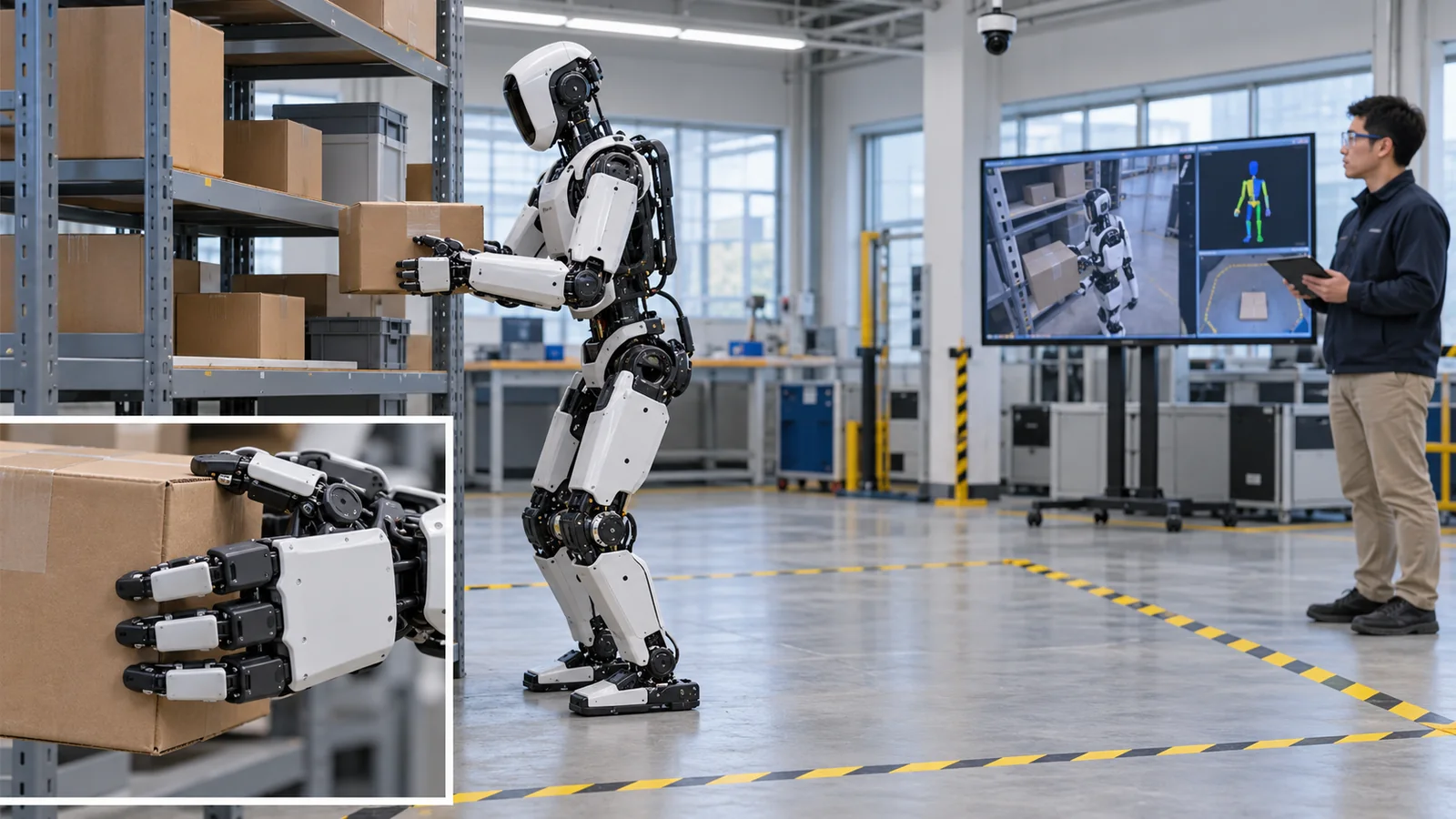
- The short version / what to know first / where this sits in the series
- What a humanoid is: why the shape, and joint counts
- Staying upright and walking: centre of mass and feet
- Control and learning: two families of walking methods
- Reading demo videos: autonomous or teleoperated?
- The present state by company, as far as official materials say
- How to read claims of deployment, orders and shipments
- Safety and standards: an area still being written
- Limits, what could not be confirmed, and summary
- How to read the yardsticks and standards
- Glossary
- References (primary sources)
- Claim-to-source audit
Sourced = stated in an official source (company page or filing, association, standards body, paper), with a link. Company claims are labelled “the company’s claim”
Our calculation = a value this article computed from stated assumptions
Not yet confirmed = plans, targets, specifications of products in development, standards being drafted: anything not yet settled
Our readings of structure and of materials are labelled commentary. An Inference is shown in bold. Every analogy comes with its limit.
Robot performance values are the company’s stated value, not measured by a third party. Numbers for products “in development” are preliminary values (estimates from pre-production units). “Works autonomously”, “N hours of real operation” and “world’s first” are company claims, and we found no independent verification for any of them. We do not rank different models by their numbers. Company plans and targets (mass production, annual output) are Not yet confirmed. This article does not touch any company’s share price, valuation or investment case, and it does not advise on buying or deploying any model. This field moves fast, so each status carries a check date (25 October 2026).
1. The short version / what to know first / where this sits in the series
- The reason for the human shape is “to work in places made for people”; the limits are “heavy, can fall, runs for hours”. Boston Dynamics says Atlas is built to operate in the same workstations with the same equipment as staff (the company’s claim) Sourced[Ref. 3]. IFR, on the other hand, writes that most humanoids are prototype or pilot-stage, and that for now industrial robots are economically superior for industrial production tasks Sourced[Ref. 1].
- A demo video is not, by itself, proof of “autonomy”. The Atlas specification sheet itself lists “autonomous”, “VR teleoperated” and “tablet control” as operating modes Sourced[Ref. 3]. Teleoperation is also a legitimate way to collect training data [Ref. 18]. What matters is whether the video says which one it is.
- “Deployment”, “orders” and “shipments” are company claims, and how much can be checked differs. Tesla’s filing describes Optimus as “in development” and says “we have yet to commercialize Bots” and that “there is no guarantee this business will be successful” Sourced[Ref. 10]. Agility’s Digit 5 page notes that it is in development, that its specifications may change, and that some safety features are still in development [Ref. 5].
You need no background. A robot is a combination of sensing, thinking (control and intelligence) and moving (actuators); an actuator is the robot’s muscle (motor plus reducer); degrees of freedom (DOF) means the number of directions the joints can move (the common view across this series). The degree of autonomy has levels, from “a person drives it entirely” to “automatic under human supervision”, and we keep this distinct from teleoperation.
This article gives the overall picture of humanoids and how to read announcements. Walking control and learning are covered in the series articles on the basics of robot control, imitation and reinforcement learning, robot foundation models and VLA, and robot simulation and digital twins; teleoperation and data collection in its own article; standards in the article on robot safety standards; four-legged robots in the article on legged and inspection robots; and factory industrial robots in the article on industrial and collaborative robots.
2. What a humanoid is: why the shape, and joint counts
A humanoid is a robot that resembles a person, with a head, a torso, two arms and two legs (this article’s description). Why make it human-shaped? The reason the companies’ official pages give is that it can work in environments built for people (stairs, shelves, workbenches, tools) without rebuilding them. The Atlas specification sheet says it can “move around and operate within the same workstations using the same equipment” as staff [Ref. 3], and Figure says it navigates “stairs, tight corners, and shifting layouts” in real homes [Ref. 7] (both are company claims).
(1) The number of joints (degrees of freedom) differs by model
The total degrees of freedom the companies state are 56 for Atlas, 31 for the Unitree H2, and 23 for the Unitree G1 (23 to 43 for the EDU version) Sourced[Ref. 3, 9, 8]. The H2 breakdown is head 2, arms 7 x 2, waist 3 and legs 6 x 2, which adds up to 2 + 14 + 3 + 12 = 31 Our calculation.
More joints let the body move in finer ways. But each joint needs a motor, a reducer, a bearing, sensors and wiring, adds weight, and adds something that can fail (commentary). Also, whether finger joints are counted may differ between makers (we did not check each company’s way of counting). So a joint count is not an indicator of dexterity or performance.
(2) The limits of the human shape, in numbers
- Weight: the pages give about 90 kg (1.9 m tall) for Atlas, about 70 kg (1.82 m) for the Unitree H2, about 35 kg (1.32 m) for the G1, and 61 kg (5 ft 8 in) for Figure 03 Sourced[Ref. 3, 9, 8, 7].
- Runtime: Atlas has a 4-hour battery life (2 hours with heavy lifting) and Figure 03 5 hours (company’s stated values) [Ref. 3, 7].
- Speed: Figure 03’s stated speed is 1.2 m/s [Ref. 7].
- Compared with industrial robots: IFR writes that for now industrial robots are economically superior for industrial production tasks, that humanoids may complement them, and that wide deployment needs substantial improvements in reliability, safety, operating time and economic viability Sourced[Ref. 1]. This is IFR’s assessment.
3. Staying upright and walking: centre of mass and feet
The difficulty of walking on two legs is that even just standing needs control that never stops, much as a person wobbles on one foot. The core idea is to keep the point under the centre of mass (the centre of the body’s mass) inside the area where the feet touch the ground (Fig. 3). Picture a tall bottle on a tray: tilt the tray and it falls, because the centre of mass leaves the tray’s area (the feet’s area). Limit of the analogy: a humanoid can move its feet to make a new area to stand on.
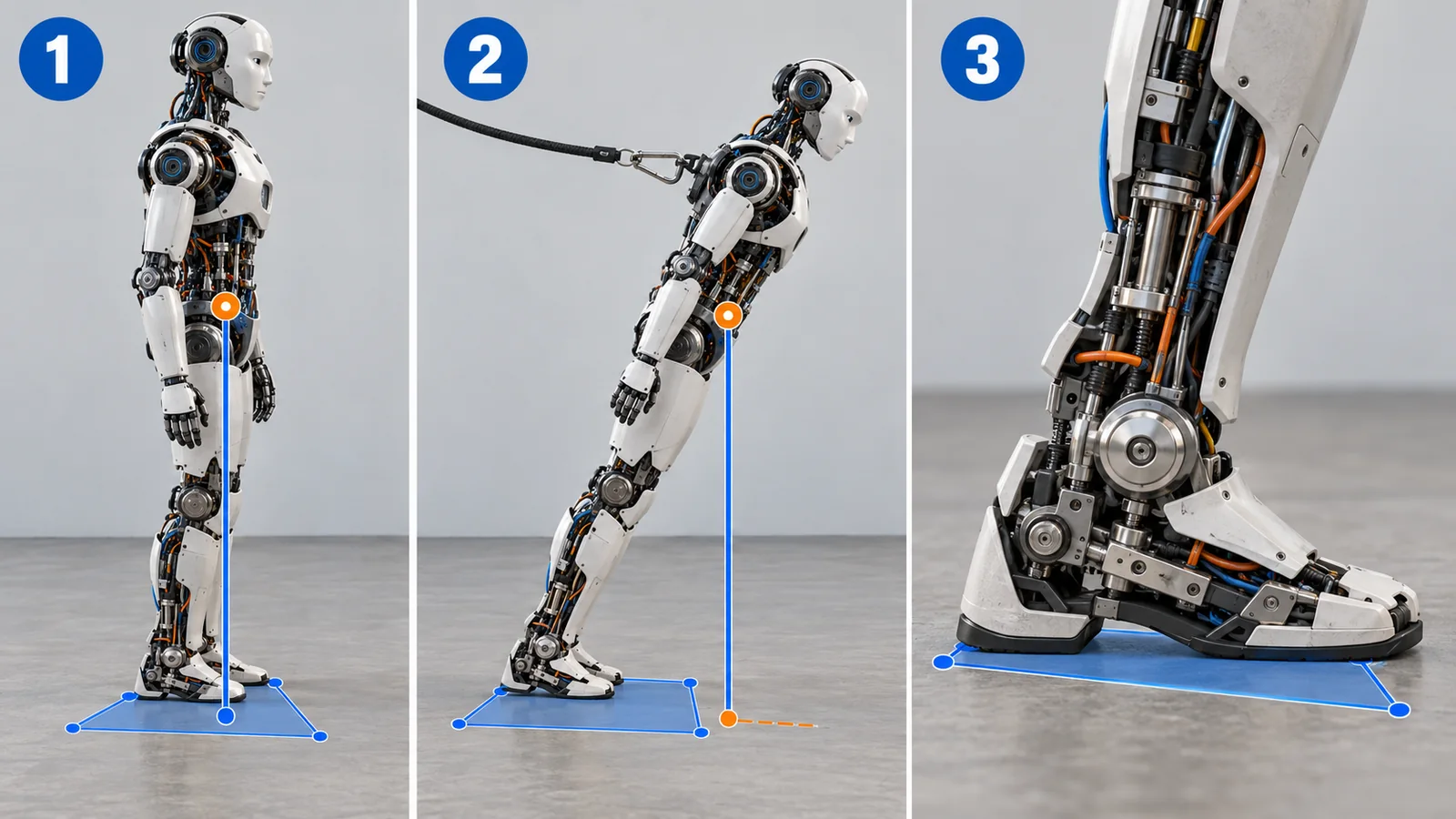
Original SVG, detailed explanation and sources
Original SVG reference: Conceptual diagram (vector drawing). Staying upright: centre of mass and feet. A schematic of the general idea that a robot can stand while the point under its centre of mass lies within its feet (commentary). That the first practical ZMP demonstration was at Waseda University in 1984 is stated in a paper Sourced[Ref. 14]. The capture-point paper is [Ref. 15].
The best-known version of this idea is the ZMP (zero-moment point). A paper by Vukobratović and Borovac (2004) says the concept has been in use for about 35 years and that its first practical demonstration was on the WL-10RD robot at Waseda University (Ichiro Kato’s laboratory) in 1984 Sourced[Ref. 14]. The capture point, which asks “where should the foot go to stop after a push?”, appears in the title of a 2006 paper by Pratt and co-authors: “A Step toward Humanoid Push Recovery” [Ref. 15] (we did not check the body of the paper).
Energy released in a fall (rough estimate)
When a robot falls, its potential energy becomes impact. Assuming the centre of mass is at half the height, we estimate energy = mass x 9.81 x height of the centre of mass. That gives about 227 J for the G1 (35 kg, 1.32 m), about 625 J for the H2 (70 kg, 1.82 m) and about 839 J for Atlas (90 kg, 1.9 m) Our calculation. For reference, a 25 kg load moving at 5 m/s has 312.5 J of kinetic energy (see the series article on industrial and collaborative robots). The real impact depends greatly on how the robot falls, the contact surface and the materials, and these numbers are a rough guide to scale.
Control that makes a robot fall less often is one thing; design that reduces harm when it does fall (outer shell, cushioning, how it falls, keeping people away) is another. A cart on wheels does not fall when power is cut. A robot that stands on legs can fall if power or control stops, which is why a safety standard for that kind of robot, ISO 25785-1, is being drafted now (Chapter 8).
4. Control and learning: two families of walking methods
Walking control comes in two broad families (Fig. 5).
- Model-based methods: the robot’s body is written as physical equations, and centre of mass, foot placement and forces are computed to decide joint torques. The survey by Gu and co-authors calls this the backbone of humanoid robotics for the past three decades, covering contact planning, motion planning and whole-body control Sourced[Ref. 17].
- Learning-based methods: a policy (a neural network) is obtained by practising at scale in simulation, then moved to the real robot. A 2024 paper by Radosavovic and co-authors reports a fully learning-based controller (a causal transformer that takes the history of observations and actions), trained by reinforcement learning in randomized simulated environments and deployed to the real robot zero-shot (without further tuning), which walked over various outdoor terrains and was robust to external disturbances Sourced[Ref. 16].
The survey also discusses imitation and reinforcement learning, integrating foundation models and the role of touch, and compares the strengths and limits of model-based and learning-based methods on robustness, computational efficiency, versatility and generalization [Ref. 17]. How far any real model uses each could not be confirmed from the companies’ materials.
“Walks by learning” means the robot uses the result of practising, falling many times in simulation, instead of a person writing the walking motion as equations. It is a little like learning to ride a bicycle by practice rather than from a manual. Limit of the analogy: the robot practises not with a real body but inside a simulation. So the gap between simulation and reality becomes the problem, and the series article on robot simulation and digital twins covers it. What was learned can be weak outside the range that was practised (commentary).
5. Reading demo videos: autonomous or teleoperated?
Humanoid videos look impressive. But a video alone does not show who operated the robot, or how much was prepared in advance. Fig. 6 sets out the levels of human involvement and six questions to ask of a video (our arrangement).
This is inaccurate. A robot may be teleoperated (a person moves it with VR and similar), or perform motions that were rehearsed or set up in advance. The Atlas specification sheet lists “autonomous”, “VR teleoperated” and “tablet control” among its operating modes [Ref. 3]. Teleoperation is not a bad thing in itself. The Mobile ALOHA paper by Fu and co-authors reports collecting data through whole-body teleoperation, after which the trained robot autonomously completed complex mobile manipulation tasks from 50 demonstrations (co-training with other data raised success rates by up to 90%) Sourced[Ref. 18]. So teleoperation is also used as a tool for collecting learning data. The problem is a video that does not say which one it is.
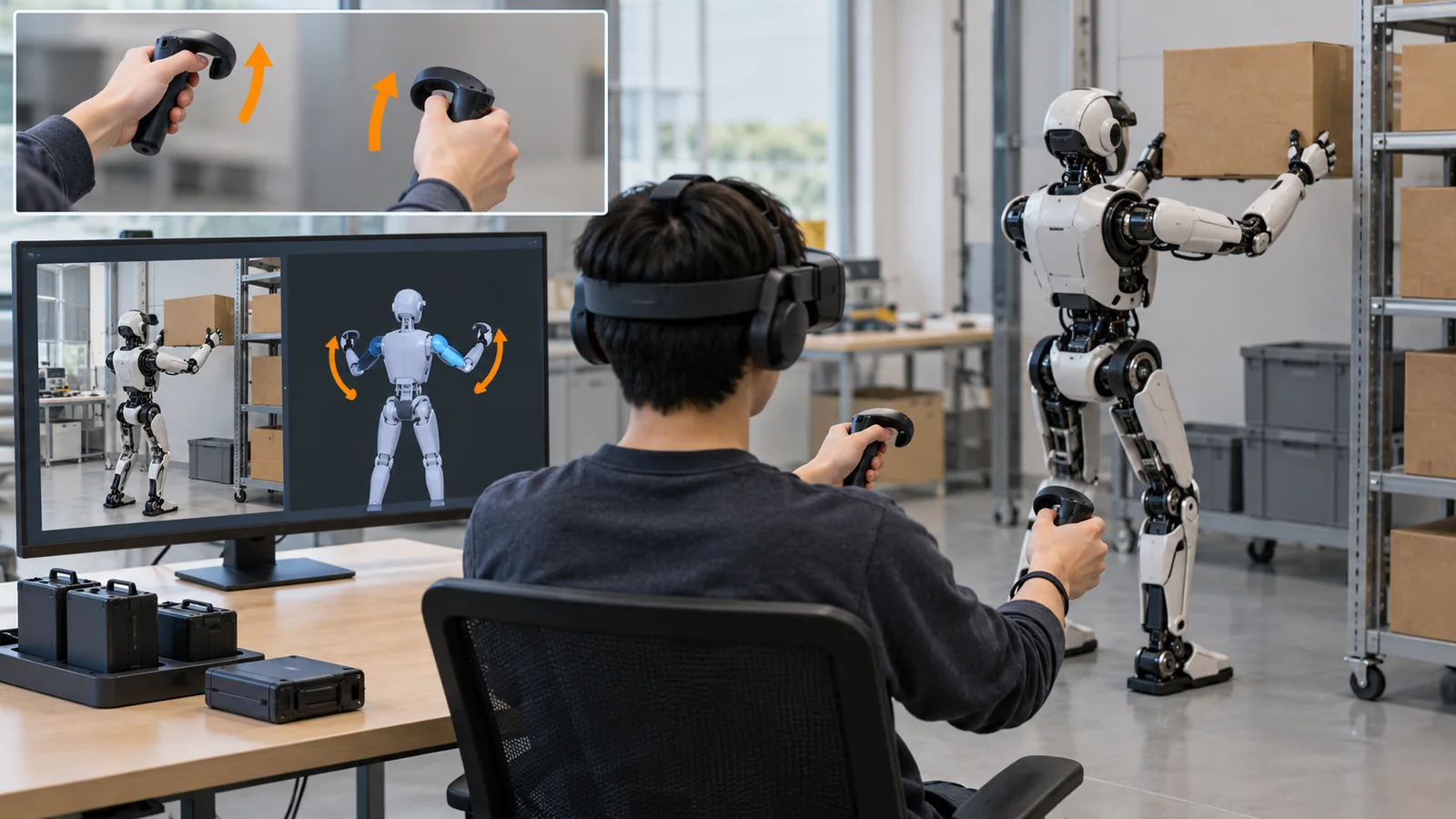
- Figure 03: the product page says it does household tasks “all autonomously” (the company’s claim) [Ref. 7]. How many units, how many hours, in what kind of homes, and whether there is independent verification could not be confirmed on that page.
- Atlas: the specification sheet includes teleoperation among its modes and says Atlas works autonomously with minimal supervision (the company’s claim) [Ref. 3].
- Digit 5: described as working “autonomously”, but a note on the same page says the product is in development and its specifications and capabilities are subject to change [Ref. 5].
- IFR (30 September 2026): about 7,000 full-size humanoids (above 140 cm) were sold worldwide in 2025 for commercial and professional uses beyond research and entertainment. IFR writes that most current applications remain specialized and often require human teleoperation, and names safety standards, high training and maintenance costs and the lack of a strong business case, particularly in industrial settings, as challenges Sourced[Ref. 2].
6. The present state by company, as far as official materials say
The table below collects only what the official pages, specification sheets and filings state. All numbers are companies’ stated values or claims, and they do not rank the models. Other companies, such as UBTech, AgiBot, Apptronik and 1X, were not checked here.
| Model (company) | Main numbers in official materials (company’s stated) | Descriptions and notes in official materials | Status (checked 25 Oct 2026) |
|---|---|---|---|
| Atlas (Boston Dynamics) | Height 1.9 m, weight 90 kg, 56 DOF, battery 4 h (2 h with heavy lifting), automatic battery swap 3 min, charge 1.5 h, weight capacity: instant 50 kg / sustained 30 kg / one-handed 20 kg, IP67, -20 to 40 C [Ref. 3] | Operating modes: autonomous, VR teleoperated, tablet control. “World’s first enterprise-grade, industrial humanoid” (company’s claim). “Starting with a select number of early adopters” [Ref. 4] | The specification sheet is the 15 October 2026 revision. Verified deployment counts and operation at customers could not be confirmed |
| Digit 5 (Agility Robotics) | Payload 23 kg, reach 2.2 m, run-to-charge ratio 10:1, 20 hours of work in 24 hours (all preliminary) [Ref. 5] | “Cooperative safety”: human-detection software and functional safety behaviours aimed at making external barriers unnecessary. “65,000 hours of real-world operational data” (company’s claim) | In development; specifications may change. Notes say “some safety features are still in development” and “safety features do not eliminate all operational risk” Not yet confirmed |
| Figure 03 (Figure AI) | Height 5 ft 8 in, payload 20 kg, weight 61 kg, runtime 5 h, speed 1.2 m/s, electric [Ref. 7] | Household tasks (laundry, cleaning, dishes) “all autonomously” (company’s claim). “After meaningful progress in the workforce, now moving into the home” | Availability, units and price could not be confirmed on the page |
| G1 / H2 (Unitree Robotics) | G1: 1320 x 450 x 200 mm, about 35 kg, 23 DOF (EDU 23 to 43), arm maximum load about 2 kg (EDU about 3 kg). H2: 1820 x 456 x 218 mm, about 70 kg, 31 DOF, arm payload peak about 15 kg / rated about 7 kg, battery 15 Ah (0.972 kWh) [Ref. 8, 9] | H2 materials: aircraft-grade aluminum, titanium alloy and high-strength engineering plastics. Joint motors are permanent magnet synchronous motors (PMSM) | Prices are shown on the pages (G1 “from $13.5K”, H2 $29,900, tax and shipping excluded). Shipment numbers could not be confirmed |
| Optimus (Tesla) | Numerical specifications could not be confirmed in the filings | 10-K: “a general purpose, autonomous humanoid robot in development”; “we have yet to commercialize Bots and cannot predict how demand will develop”. 10-Q (filed 22 October 2026): “preparations and investments in large-scale production” [Ref. 10, 11] | Production or sales results could not be confirmed. Plans are Not yet confirmed |
The numbers and descriptions in each row are as stated on each company’s page, specification sheet or SEC filing. Some companies change their pages often.
“Payload” and “runtime” are defined differently
Even for the same “payload”, Atlas splits it into instant, sustained and one-handed, Digit 5 gives a preliminary value, and Unitree gives arm peak and rated values (Fig. 8). Do not compare by size of number alone.
For runtime, Digit 5 states “20 hours of work in 24” and a “10:1 run-to-charge ratio”, so 20 / 10 = 2 hours of charging (the other 2 hours are not described) Our calculation. Atlas has a 4-hour battery life and a 3-minute automatic swap, so over 24 hours of continuous running that is 6 swaps totalling 18 minutes, or, with heavy lifting (2-hour life), 12 swaps totalling 36 minutes Our calculation. This assumes “running for 24 hours” and is not a record of real operation (Fig. 9).
The Unitree H2 page gives its materials as “aircraft-grade aluminum + titanium alloy + high-strength engineering plastics”, its joint output bearings as crossed roller bearings, and its joint motors as permanent magnet synchronous motors (PMSM) (company’s stated) Sourced[Ref. 9]. In other words, materials issues become the performance of the humanoid directly: lightness and strength (aluminum, titanium, plastics), joint stiffness and life (bearings, reducers), and force and torque (magnets). Magnets are covered in the series article on permanent magnets and rare earths, reducers in the article on reducers and gears, and structural materials in the article on structural materials for robots and drones. The H2 battery is given as 15 Ah (0.972 kWh). It is the battery that runs a 70 kg robot for hours, and battery mass, energy density and safety set the trade-off between runtime and weight (commentary; the H2’s battery mass and runtime could not be confirmed on the page. See the series articles on the basics of lithium-ion batteries and on thermal runaway and battery safety).
7. How to read claims of deployment, orders and shipments
“Deployment”, “orders”, “shipments” and “mass production” of humanoids are company claims. The table below sorts what we could check.
| Type of claim | Example we checked (source) | What to check (our arrangement) |
|---|---|---|
| Hours or experience in real operation | Agility: “65,000 hours of real-world operational data”; “Digit has 65,000 hours of real production experience” (company pages) [Ref. 5, 6] | How many units, which customers, what work; whether remote assistance was involved; independent verification (could not be confirmed) |
| Stage of deployment | Atlas: “starting with a select number of early adopters” [Ref. 4] | Number of units, hours of operation, autonomous or teleoperated (could not be confirmed) |
| Plans for mass production and sales | Tesla: “preparations and investments in large-scale production” of Optimus (10-Q); “have yet to commercialize”, “no guarantee of success” (10-K) [Ref. 10, 11] | Separate plans from results. A filing is the company’s formal statement, carrying legal responsibility |
| Preliminary values | Digit 5: “preliminary estimates based on internal testing and benchmarking of pre-production hardware and software” [Ref. 5] | Whether a production unit, tested by a third party, gives the same values |
| Position of the industry as a whole | IFR: most humanoids are prototype or pilot-stage; industrial robots are economically superior [Ref. 1] | An association’s assessment. It does not settle the future |
For words such as “world’s first” or “the best”, check who says so, and by what standard. Atlas’s “world’s first enterprise-grade, industrial humanoid” is the company’s claim and was not verified here [Ref. 4].
8. Safety and standards: an area still being written
Safety standards for humanoids are still in preparation. ISO 25785-1 (dynamically stable industrial mobile robots, including legged and wheeled types) is, on the ISO page of 25 October 2026, a committee draft (stage 30.60). It covers industrial environments; household and consumer uses are out of scope, and so are explosive atmospheres Sourced Not yet confirmed[Ref. 12]. ISO 10218-1 also excludes the “mobility” hazards when a robot is fixed to a mobile platform [Ref. 13]. For more, see the series article on robot safety standards.
On the company pages, the Atlas specification sheet lists “fenceless guarding” and “human detection” as its safety system [Ref. 3], and Digit 5 says it aims to make external barriers unnecessary with human-detection software and functional safety behaviours, while noting that “certain safety features are still in development” and that “safety features do not eliminate all operational risk” [Ref. 5]. Which standard, in which edition, a product conforms to could not be confirmed on these pages.
9. Limits, what could not be confirmed, and summary
(1) Verification of company claims
“Autonomous”, “N hours of real operation”, “world’s first” and “mass production” are all company claims, and we found no independent verification. Company pages are updated often.
(2) Companies and models not covered
Other companies, such as UBTech, AgiBot, Apptronik, 1X and XPeng, were not checked. For Tesla we checked only the filings, and could not confirm concrete Optimus specifications.
(3) Standards and benchmarks
ISO 25785-1 is in development, and its requirements cannot be confirmed. We did not find a common benchmark for comparing humanoid walking or work.
(4) The papers’ full texts
The ZMP and capture-point papers are cited within their titles and abstracts; we did not check their full texts.
- The human shape is for working in places made for people. The limits are weight, tendency to fall, runtime and safety. IFR says most humanoids are prototype or pilot-stage Sourced
- Read joint counts, payload and runtime with their definitions and conditions. Atlas 56, H2 31, G1 23 DOF. “Payload” is defined differently: instant, sustained, one-handed, preliminary, peak / rated Sourced
- A video is not proof of autonomy. IFR also writes that most current humanoid applications often require human teleoperation. The Atlas specification sheet itself has a teleoperation mode. Teleoperation is also a way to collect learning data, so what matters is whether the video says which one it is Sourced
- Deployment, orders and mass production are company claims. Tesla’s filing says it has “yet to commercialize” Bots. Digit 5 values are preliminary values for a product in development. Plans are Not yet confirmed
- Safety standards are being written. ISO 25785-1 is a committee draft. For “conforms to a safety standard”, check which standard and which edition Not yet confirmed
10. How to read the yardsticks and standards
There is not yet an established common yardstick for measuring what a humanoid can do. Companies show ability through specifications such as degrees of freedom, payload, runtime and speed, and through demo videos. These are values under conditions the maker chose; they do not measure the success rate, safety or cost on a real job. In papers, walking robustness, imitation-learning success rates and so on are reported under each study’s own conditions. The table below shows what we could confirm (checked 25 October 2026).
| What is evaluated | Typical test or benchmark (name, source) | Standard, rule or guidance | Reading notes |
|---|---|---|---|
| Degrees of freedom (joint count) | Company’s stated: Atlas 56, H2 31, G1 23 (EDU 23 to 43) [Ref. 3, 9, 8] Sourced | Could not be confirmed | The way of counting (fingers and so on) may not be aligned |
| Payload | Company’s stated: Atlas instant 50 / sustained 30 / one-handed 20 kg; Digit 5 23 kg (preliminary); Figure 03 20 kg; H2 arm peak about 15 / rated about 7 kg [Ref. 3, 5, 7, 9] Sourced | Could not be confirmed | The definitions differ, so the numbers cannot be lined up |
| Runtime | Atlas 4 h (2 h with heavy lifting); Figure 03 5 h; Digit 5 preliminary “10:1 run-to-charge” [Ref. 3, 7, 5] Sourced | Could not be confirmed | The workload and environment are not stated |
| Robustness of walking and balance | Experiments in individual papers (for example, learned outdoor walking, Radosavovic et al. 2024) [Ref. 16]. Theory: ZMP [Ref. 14], capture point [Ref. 15] Sourced | Could not be confirmed (no common benchmark was found) | Robot, environment and metric differ between studies |
| Autonomy and success rate of tasks | Could not be confirmed (company videos and claims only). A research example: Mobile ALOHA (success rates up to 90% higher with 50 demonstrations) [Ref. 18] Sourced | Could not be confirmed | Does the source say whether it was teleoperated or rehearsed? |
| Safety | Could not be confirmed | ISO/CD 25785-1 (in development, 30.60) [Ref. 12] Not yet confirmed. ISO 10218-1:2025 excludes mobility on a mobile platform [Ref. 13] Sourced | A committee draft can change. For “conformity”, check edition and scope |
| Deployment, shipments, orders | SEC filings (Tesla) [Ref. 10, 11]; company pages (Agility, Boston Dynamics) [Ref. 5, 4] Sourced | – | Company claims. Independent verification could not be confirmed |
| Units sold | IFR (30 September 2026): about 7,000 full-size humanoids (above 140 cm) sold in 2025 for commercial and professional uses [Ref. 2] Sourced | – (association statistics) | One year’s sales. It does not show units in operation or autonomy (IFR says applications often require human teleoperation) |
| Position of the whole industry | IFR World Robotics 2026: most humanoids are prototype or pilot-stage [Ref. 1] Sourced | – (association’s assessment) | It does not settle the future |
The arrangement of the table is our own Our calculation (arrangement). Standard stages were checked on the ISO page (25 October 2026).
Reading notes (for materials engineers)
- A demo and a work site are different things: a video may be one chosen success. Ask for records of continuous operation, failure rates and maintenance
- A maker’s stated value and a third party’s verification are different: every number in this article is a company’s stated value, not a third-party measurement
- Whether a standard is a recommendation or a requirement differs: a standard still being drafted has no legal force
- Separate plans from results: “N units a year” and “start of mass production” are plans that are not settled
- Check the scope of any certification or conformity: “has safety features” and “conforms to a standard” are different statements
The Atlas specification sheet lists IP67 (a protection class against dust and water; we did not check its definition), an operating temperature of -20 to 40 C, tactile fingers and palm, and field-replaceable components (company’s stated) Sourced[Ref. 3]. Unitree’s pages list hollow routing of wiring through the joints [Ref. 8, 9]. Cables that pass through joints suffer fatigue from repeated bending, so the flex resistance of the sheath and conductors sets their life (commentary). Touch in the hand is a matter of electronic-skin materials, covered in the series article on tactile sensors and electronic skin. Because humanoids are meant for places where people live, not only factories, the material of the outer shell when the robot falls or touches a person (absorbing impact, not burning skin, resisting fire) also becomes a design condition (commentary; the specific materials could not be confirmed in official materials).
11. Glossary
- Humanoid (human-shaped robot)
- A robot resembling a person, with head, torso, two arms and two legs (this article’s description).
- Degrees of freedom (DOF)
- The number of directions the joints can move.
- Centre of mass
- The centre of the body’s mass. If the point under it leaves the feet’s area, the robot falls.
- Support polygon (feet’s area)
- The area where the soles of the feet touch the ground.
- ZMP
- Zero-moment point. A well-known idea for the stability of two-legged walking.
- Capture point
- A point that tells where to put the foot after a push in order to stop.
- Whole-body control
- Control that moves arms, legs and body together as one.
- Reinforcement learning
- Learning a way of acting from the rewards of trials.
- Imitation learning
- Learning movements by copying human demonstrations.
- Policy
- A rule, or a neural network, that decides actions (joint commands) from states (sensor values).
- Zero-shot (transfer)
- Using on the real robot what was learned in simulation, without further tuning.
- Teleoperation
- A person operates the robot from a distance.
- Autonomy
- The robot decides and acts without a person’s step-by-step operation. It may still be under human supervision.
- Payload
- The mass of load it can carry. The definition differs by company.
- Preliminary value
- An unconfirmed estimate based on pre-production units.
- PMSM
- Permanent magnet synchronous motor: a motor that uses magnets.
- Crossed roller bearing
- A stiff bearing in which cylindrical rollers are arranged at right angles to each other.
- IP67
- One protection class against dust and water (as listed on the Atlas specification sheet).
- 10-K / 10-Q
- Annual / quarterly reports that US listed companies file with the SEC (Securities and Exchange Commission).
- Pilot stage
- A stage in which the product is tried out at a small number of sites.
- ISO 25785-1
- A safety standard (in development) for industrial mobile robots such as legged ones.
- Fenceless guarding
- Protecting people by detecting them rather than relying on physical fences (a term from the Atlas specification sheet).
- Physical AI
- AI for driving physical machines such as robots.
12. References (primary sources)
- IFR (International Federation of Robotics) “World Robotics 2026 – Industrial Robots, Executive Summary” (published 24 September 2026; includes its comment on humanoids) — ifr.org/img/worldrobotics/Executive_Summary_WR_2026_-_Industrial_Robots.pdf
- IFR (International Federation of Robotics) “Global Sales of Professional Service Robots Surge 24%” (World Robotics 2026 Service Robots press release, 30 September 2026; units of full-size humanoids sold, comment on teleoperation) — ifr.org/ifr-press-releases/news/global-sales-of-professional-service-robots-surge-24-percent
- Boston Dynamics “Atlas” specification sheet (revision of 15 October 2026; height, weight, degrees of freedom, battery, weight capacity, operating modes, IP rating) — bostondynamics.com/wp-content/uploads/2026/01/atlas-spec-sheet.pdf
- Boston Dynamics “Atlas Humanoid Robot” (product page; the company’s statement that it is the “world’s first enterprise-grade, industrial humanoid robot”; the note that it starts with a select number of early adopters; checked 25 October 2026) — bostondynamics.com/products/atlas/
- Agility Robotics “Digit 5” (product page; preliminary specifications of a product in development; the company’s statement about 65,000 hours of real-world operational data; safety-feature notes; checked 25 October 2026) — agilityrobotics.com/solutions/digit-5
- Agility Robotics “Industrial Humanoid Automation” (home page; the company’s statement that Digit has 65,000 hours of real production experience; checked 25 October 2026) — agilityrobotics.com/
- Figure AI “Figure 03” (product page; height, payload, weight, runtime, speed; the company’s statement that it does household tasks “all autonomously”; checked 25 October 2026) — figure.ai/figure
- Unitree Robotics “Unitree G1” (product page; dimensions, weight, degrees of freedom, arm maximum load; checked 25 October 2026) — unitree.com/g1/
- Unitree Robotics “Unitree H2” (product page; dimensions, weight, breakdown of degrees of freedom, arm payload, materials, battery capacity; checked 25 October 2026) — unitree.com/H2
- Tesla, Inc. Form 10-K (year ended 31 December 2025, filed 29 January 2026; Optimus “in development”; “We have yet to commercialize Bots”; risk factors) — sec.gov/Archives/edgar/data/1318605/000162828026003952/tsla-20251231.htm
- Tesla, Inc. Form 10-Q (quarter ended 30 September 2026, filed 22 October 2026; “preparations and investments in large-scale production” of Optimus; R&D expense drivers) — sec.gov/Archives/edgar/data/1318605/000162828026066775/tsla-20260930.htm
- ISO “ISO/CD 25785-1 Robotics — Safety requirements for dynamically stable industrial mobile robots (legged, wheeled, or other forms of locomotion) — Part 1: Robots” (ISO page; stage 30.60; checked 25 October 2026) — iso.org/standard/91469.html
- ISO “ISO 10218-1:2025 Robotics — Safety requirements — Part 1: Industrial robots” (ISO page; mobility hazards when fixed to a mobile platform are out of scope) — iso.org/standard/73933.html
- Vukobratović M., Borovac B. “Zero-Moment Point — Thirty Five Years of Its Life”, Int. J. Humanoid Robotics 1(1), 157-173 (2004), DOI 10.1142/S0219843604000083 — doi.org/10.1142/S0219843604000083
- Pratt J., Carff J., Drakunov S., Goswami A. “Capture Point: A Step toward Humanoid Push Recovery”, Proc. 2006 6th IEEE-RAS International Conference on Humanoid Robots, pp. 200-207, DOI 10.1109/ICHR.2006.321385 — doi.org/10.1109/ICHR.2006.321385
- Radosavovic I. et al. Radosavovic I. et al., “Real-world humanoid locomotion with reinforcement learning”, Science Robotics 9(89), 2024, DOI 10.1126/scirobotics.adi9579 (arXiv:2303.03381) — doi.org/10.1126/scirobotics.adi9579
- Gu Z. et al. Gu Z. et al., “Humanoid Locomotion and Manipulation: Current Progress and Challenges in Control, Planning, and Learning”, arXiv:2501.02116 (survey) — arxiv.org/abs/2501.02116
- Fu Z., Zhao T. Z., Finn C. Fu Z., Zhao T. Z., Finn C., “Mobile ALOHA: Learning Bimanual Mobile Manipulation with Low-Cost Whole-Body Teleoperation”, arXiv:2401.02117 — arxiv.org/abs/2401.02117
13. Claim-to-source audit
| Claim in the text | Basis | Type |
|---|---|---|
| IFR summary: most humanoids remain prototypes or pilot-stage technologies rather than industrial-grade products; at present industrial robots are economically superior for industrial production tasks; humanoids may complement them, but wide deployment needs substantial gains in reliability, safety, operating time and economics; general-purpose physical AI is not yet industry-grade | IFR World Robotics 2026 summary Reference 1 https://ifr.org/img/worldrobotics/Executive_Summary_WR_2026_-_Industrial_Robots.pdf | Sourced |
| Atlas specification sheet (15 October 2026 revision): height 1.9 m, weight 90 kg, 56 degrees of freedom, battery 4 h (2 h with heavy lifting), automatic swap 3 min, charge 1.5 h, weight capacity (instant 50 / sustained 30 / one-handed 20 kg), reach 2.3 m, safety system (fenceless guarding, human detection), operating modes (autonomous, VR teleoperated, tablet), IP67, -20 to 40 C, tactile fingers and palm | Maker specification sheet (company’s stated values) Reference 3 https://bostondynamics.com/wp-content/uploads/2026/01/atlas-spec-sheet.pdf | Sourced |
| Atlas page: “world’s first enterprise-grade, industrial humanoid robot” (the company’s claim) and “starting with a select number of early adopters” | Maker product page (company’s claims) Reference 4 https://bostondynamics.com/products/atlas/ | Sourced |
| Digit 5: payload 23 kg, reach 2.2 m, run-to-charge ratio 10:1, 20 hours of work in 24 hours (preliminary). In development and subject to change. Some safety features still in development; safety features do not eliminate all operational risk. Cooperative safety. “65,000 hours of real-world operational data” | Maker product page (preliminary values, company’s claims) Reference 5 https://www.agilityrobotics.com/solutions/digit-5 | Sourced |
| Agility home page: Digit has 65,000 hours of real production experience (the company’s statement) | Maker home page (company’s claim) Reference 6 https://www.agilityrobotics.com/ | Sourced |
| Figure 03: height 5 ft 8 in, payload 20 kg, weight 61 kg, runtime 5 h, speed 1.2 m/s, electric. Household tasks “all autonomously” (the company’s claim) | Maker product page (company’s stated values and claims) Reference 7 https://www.figure.ai/figure | Sourced |
| Unitree G1: 1320 x 450 x 200 mm, about 35 kg, 23 degrees of freedom (EDU 23 to 43), arm maximum load about 2 kg (EDU about 3 kg), price shown as “from $13.5K” | Maker product page (company’s stated values) Reference 8 https://www.unitree.com/g1/ | Sourced |
| Unitree H2: 1820 x 456 x 218 mm, about 70 kg, 31 degrees of freedom (head 2, arm 7, waist 3, leg 6), arm payload (peak about 15 kg, rated about 7 kg), materials (aluminum, titanium alloy, engineering plastics), PMSM, crossed roller bearings, battery 15 Ah (0.972 kWh), price shown as $29,900 (tax and shipping excluded) | Maker product page (company’s stated values) Reference 9 https://www.unitree.com/H2 | Sourced |
| Tesla Form 10-K (filed 29 January 2026): Optimus is in development, Bots are not yet commercialized, demand cannot be predicted, there is no guarantee of success | SEC filing Reference 10 https://www.sec.gov/Archives/edgar/data/1318605/000162828026003952/tsla-20251231.htm | Sourced |
| Tesla Form 10-Q (filed 22 October 2026): preparations and investments in large-scale production of Optimus, and increased R&D expense | SEC filing Reference 11 https://www.sec.gov/Archives/edgar/data/1318605/000162828026066775/tsla-20260930.htm | SourcedNot yet confirmed |
| IFR service robot statistics (30 September 2026): about 7,000 full-size humanoids (above 140 cm) sold in 2025; most current applications are specialized and often require human teleoperation; challenges are safety standards, training and maintenance costs and the business case in industry | IFR press release Reference 2 https://ifr.org/ifr-press-releases/news/global-sales-of-professional-service-robots-surge-24-percent | Sourced |
| ISO/CD 25785-1: title and scope (industrial environments; non-industrial uses and explosive atmospheres out of scope), stage 30.60, under development | ISO page (checked 25 October 2026) Reference 12 https://www.iso.org/standard/91469.html | SourcedNot yet confirmed |
| ISO 10218-1:2025 excludes mobility hazards when the robot is fixed to a mobile platform or similar | ISO page Reference 13 https://www.iso.org/standard/73933.html | Sourced |
| ZMP is a concept in use for about 35 years, and its first practical demonstration was at Waseda University in 1984 (WL-10RD) | Paper abstract (via Crossref) Reference 14 https://doi.org/10.1142/S0219843604000083 | Sourced |
| Title of the capture-point paper, “Capture Point: A Step toward Humanoid Push Recovery” (2006) | Paper bibliography (via Crossref) Reference 15 https://doi.org/10.1109/ICHR.2006.321385 | Sourced |
| A learning-only (transformer) controller trained by reinforcement learning in randomized simulated environments, deployed zero-shot, walking over outdoor terrain and robust to external disturbances | Paper abstract Reference 16 https://doi.org/10.1126/scirobotics.adi9579 | Sourced |
| Survey: model-based methods as the backbone for three decades; learning (reinforcement and imitation), foundation models, tactile sensing, and comparison of strengths and limits | arXiv abstract Reference 17 https://arxiv.org/abs/2501.02116 | Sourced |
| Mobile ALOHA: whole-body teleoperation to collect data; with 50 demonstrations, co-training raised success rates by up to 90% and the robot completed complex tasks autonomously | arXiv abstract Reference 18 https://arxiv.org/abs/2401.02117 | Sourced |
| The sum of H2 degrees of freedom (2 + 14 + 3 + 12 = 31), the rough potential energy in a fall (G1 about 227 J, H2 about 625 J, Atlas about 839 J), Digit 5’s 20 / 10 = 2 hours, and Atlas’s 6 swaps in 18 minutes or 12 swaps in 36 minutes over 24 hours | Our calculation (from makers’ stated values; assumed examples) | Our calculation |
| Independent verification of autonomy, deployed units and operating hours, concrete Optimus specifications, conformity to safety standards, the full text of the ZMP and capture-point papers, and other companies such as UBTech and AgiBot | Could not be confirmed in the scope of this research, so not stated (this article) | Commentary |
| The readings on why humanoids and their limits, why more joints is not better, falling less versus being safe when falling, what walking by learning means, and the six questions for a video | Our commentary based on the published content; not a view stated by any of the bodies | Commentary |
| Figures 2 to 6, 8 and 9 are explanatory drawings, not observations of real data; Figures 1 and 7 are frames for AI-generated images | Note in this article | Commentary |
Last updated: 25 October 2026 / Sources are limited to companies’ official pages and specification sheets, SEC filings, IFR publications, official ISO pages, papers and arXiv. Performance values are companies’ stated values, and company claims are written as claims. The degree of autonomy in demos, independent verification of deployed units and operating hours, concrete Optimus specifications, conformity of each product to safety standards, the full texts of the ZMP and capture-point papers, and the state of other companies could not be confirmed and are not stated. The figures are explanatory concept drawings or drawings that include our calculation; Figures 1 and 7 are ImageGen-generated conceptual illustrations.