TECHNOLOGY EXPLAINER
Microrobots and Bio-Inspired Robots
― Tiny machines in sticky water, and materials designed by copying how living things work
A robot as thin as a hair senses temperature and pumps liquid. A millimetre-scale soft machine swims, walks and jumps under a magnet’s pull. A robot with living muscle on a jelly-like scaffold takes a step. All of these were reported in research within the last few years. This article assumes no background in robotics or biology. It covers (1) how small these machines are, (2) why water turns “sticky” in the small world (checked with numbers), (3) four ways of driving them: magnetic fields, light, chemistry and living muscle, (4) which biological mechanisms were copied, (5) materials (magnetic elastomers, shape-memory polymers, hydrogels, piezoelectric ceramics), and (6) uses and problems in medicine and the environment, using diagrams and small calculations.
Everything covered here is at the research stage. No claim is made about practical use in medicine or the environment. It separates what could be confirmed, what is a university or institution claim, what is a plan, and what could not be confirmed. It gives no medical advice.
- The short version / what to know first / where this fits in the series
- How small is small: a size map
- Physics of the small world: water gets “sticky”
- Four ways to drive them: magnetic fields, light, chemistry and living muscle
- Copying the mechanism: cilia, flapping, deep-sea fish and muscle
- Materials: magnetic elastomers, shape-memory polymers, hydrogels and piezoelectric ceramics
- Uses and problems in medicine and the environment: from research to the field
- Where things stand (checked 25 October 2026)
- How to read the yardsticks and standards
- Glossary / References / Claim-to-source audit
Sourced = stated in a published source (link given)
Our calculation = a value we calculated from stated assumptions
Not yet confirmed = a plan, a target, or research with no confirmed track record
Structural summaries and materials-related readings are marked as “explanation”. Inference is shown in bold. Every analogy comes with its limits.
The examples are results from laboratories, tanks and animals such as mice. Clinical use in people, and practical use in environmental sites, could not be confirmed within this article’s sources. Words such as “first” and “demonstration” in papers and university announcements are written as the claims of the universities and researchers, together with the environment, size and duration in which they were tested. Living cells and living bodies appear in the text, but this is a general technical explainer and not medical or safety advice. This field changes quickly, so statuses carry a check date (25 October 2026).
1. The short version / what to know first / where this fits in the series
- When things get small, water behaves like a different substance: sticky. Researchers say “small-scale robots”, from several millimetres down to a few micrometres, may be able to enter confined, closed spaces Sourced[Ref. 1]. For a 2 µm particle moving at 20 µm/s in water, our calculation gives a Reynolds number (the ratio of inertia to stickiness) of about 4 x 10^-5, a world where inertia does not act at all Our calculation.
- There are four ways to drive them: magnetic fields, light, chemistry and living muscle. Magnetic fields are described as a safe and effective way to manipulate in enclosed spaces such as the body Sourced[Ref. 2]; light is wireless and can be aimed at selected places Sourced[Ref. 4]; chemistry uses catalysts or metal reactions Sourced[Ref. 5, 6]; and ETH Zurich reported living-muscle robots that jump, swim, walk and grip in 2026 Sourced[Ref. 13].
- Materials design decides the motion. Magnetic-particle elastomers, shape-memory polymers, liquid-crystal elastomers, hydrogels and piezoelectric ceramics are used. For medicine and the environment, research is still mostly in the laboratory; Lee et al. (2023) say much of it stays at proof-of-concept with materials that are hard to translate clinically Sourced[Ref. 7].
No prior knowledge is needed. Think of a robot as three things combined: sensing (sensors), thinking (control and intelligence), and moving (actuators). A tiny robot has almost no room for a battery or motor, so it needs a trick: force applied from outside (magnetic field, light), a fuel found on the spot (chemistry), or living muscle.
This article covers the problems that smallness creates, and design that learns from living things. For soft actuators (films that deform with voltage, artificial muscles) see our explainer on soft actuators and artificial muscles; for shape-memory metals see our explainer on shape memory alloys; for magnet materials see permanent magnets and rare earths; for machines that work underwater see underwater and marine robots; and for skin that conveys touch see tactile sensors and electronic skin. Our explainer on surgical robots shows how medical devices are reviewed.
2. How small is small: a size map
The word “microrobot” is used for many sizes. Hu et al. (2018) describe “small-scale” robots as ranging from several millimetres down to a few micrometres and say they may enter confined, closed spaces non-invasively Sourced[Ref. 1]. One millimetre is 1,000 µm, and a hair is about 0.1 mm (100 µm) thick.
The figure places this article’s examples on a logarithmic length axis (one tick per factor of ten). The smallest is a short rod of platinum and gold, about 2 µm long Sourced[Ref. 5]. Cornell’s microrobots are described as “a hair’s breadth in diameter” Sourced[Ref. 10]. ETH’s muscle robot is about 15 mm Sourced[Ref. 13], and an insect-sized flying robot is defined as having a mass under 500 mg and a wingspan under 5 cm Sourced[Ref. 14].
On a logarithmic axis the ticks are equally spaced for each factor of ten. For example, the 15 mm muscle robot is about 7,500 times larger than the 2 µm rod (15,000 µm / 2 µm) Our calculation. On an ordinary axis the smallest item would not even show as a dot. Under the single heading “small robots” there are differences of many powers of ten.
3. Physics of the small world: water gets “sticky”
For a swimmer, is water “runny” or “sticky”? The answer depends on size and speed. The measure is the Reynolds number: Re = density x speed x length / viscosity. When it is large, inertia (the tendency to keep moving) matters; when it is small, stickiness dominates.
Let us calculate, assuming water with a density of 1,000 kg/m3 and a viscosity of 0.001 Pa·s. For a particle 2 µm long moving at 20 µm/s (the rod of Paxton et al. (2004), taken as a total of 2 µm from its 1 µm Pt and 1 µm Au segments, and as 10 body lengths per second x 2 µm), Re = 1,000 x 0.000020 x 0.000002 / 0.001 = about 4 x 10^-5 Our calculation. For ETH’s walking muscle robot (about 15 mm long at 6.2 mm/s, assumed to be in water) it is about 93 Our calculation, and for a human swimmer (1.7 m at 1 m/s) about 1.7 x 10^6 Our calculation.
In a world with Re around 10^-5, it stops the instant it stops pushing (no coasting). Think of swimming in honey (limits of the analogy: real viscosity is far lower than honey’s, and what matters is the ratio that includes size and speed). A well-known account of this physics is Purcell’s “Life at low Reynolds number” (1977) Sourced[Ref. 9].
A back-and-forth motion cannot get you anywhere
In a world dominated by stickiness, a motion that retraces the same shapes in reverse (reciprocal motion) leaves no net flow and no net progress. To move you need a motion with a sequence (nonreciprocal motion) (Purcell’s argument, summarized by us) Sourced[Ref. 9]. Cornell’s microrobots push liquid with a paddle-like motion made by moving two hinges in a set order. The design follows cilia, the thin hairs that organisms such as paramecium use to move and to pump liquid Sourced[Ref. 10].
This is wrong. When size changes, the forces that matter change. The smaller it gets, the less inertia acts and the more stickiness dominates (Chapter 3). So a big machine’s way of moving (propellers, legs that swing back and forth) may not work if simply shrunk. Instead of shrinking, you must choose again a principle that suits the size (our explanation, following Purcell’s argument). Cornell’s microrobots also carry electronic circuits that sequence the motion, producing movements suited to the sticky world [Ref. 10].
4. Four ways to drive them: magnetic fields, light, chemistry and living muscle
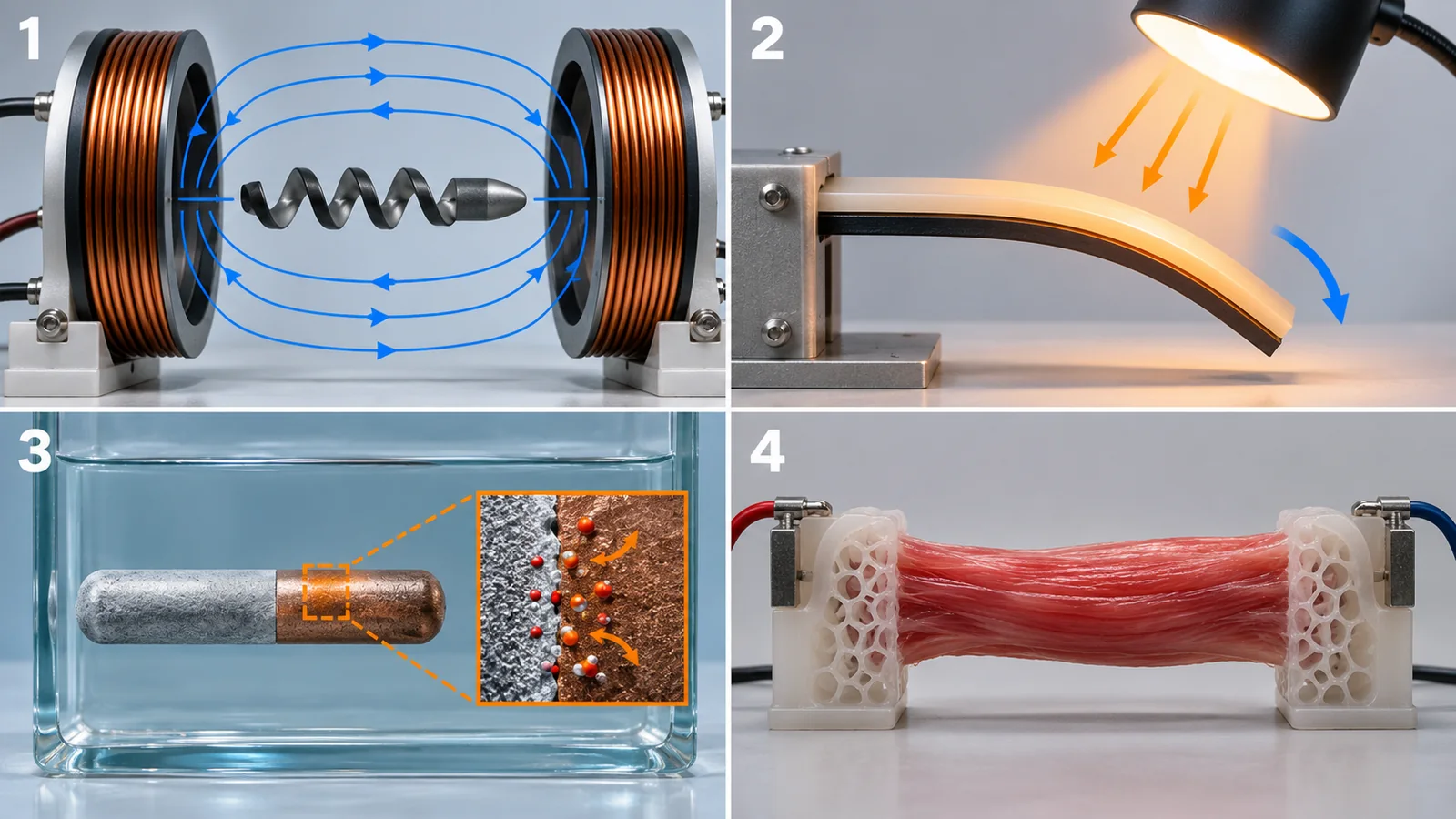
A tiny robot can hardly carry a battery or motor, so the options studied are taking force from outside, using a fuel found on the spot, or using living muscle. Lee et al. (2023) group the forces that move microrobots into external fields (magnetic, acoustic, electric) and environmental sources (chemical reactions, biological signals) Sourced[Ref. 7].
Original SVG, detailed explanation and sources
Original SVG reference: Concept diagram (vector drawing). Four ways to move a small robot: magnetic field, light, chemistry and living muscle. Examples come from Hu and Kim (2018), Palagi (2016), Paxton (2004), Gao (2015) and ETH (2026).
(1) Magnetic fields: put “magnet grains” in a soft material
Kim et al. (2018) say magnetic fields are a safe and effective way to manipulate remotely in enclosed, confined spaces such as the body Sourced[Ref. 2]. Hu et al. (2018) report magneto-elastic soft millimetre-scale robots that swim in and on liquids, climb liquid menisci, roll and walk on solid surfaces, jump over obstacles, crawl in narrow tunnels, and carry and release cargo Sourced[Ref. 1]. Kim et al. 3D-printed an elastomer containing ferromagnetic microparticles, applying a magnetic field at the nozzle to align the particles, and made materials that change quickly into complex shapes Sourced[Ref. 2].
(2) Light: change shape and swim with a “wave”
Palagi et al. (2016) drove soft microrobots made of photoactive liquid-crystal elastomer with structured monochromatic light so that they self-propel with a travelling wave (swimming by moving the body in a wave). They note that light is wireless and can be aimed at selected places Sourced[Ref. 4].
(3) Chemistry: catalysts and metals use “fuel on the spot”
The catalytic nanorods of Paxton et al. (2004) are rods 370 nm in diameter with 1 µm segments of platinum (Pt) and gold (Au). In aqueous hydrogen peroxide they move by themselves because oxygen forms at the Pt end. In 2-3% peroxide they reach up to 10 body lengths per second, with a force of order 10^-14 N Sourced[Ref. 5]. Gao et al. (2015) gave zinc micromotors to mice by mouth: acid-driven propulsion in the stomach improved binding and retention on the stomach wall, and the bodies gradually dissolved in gastric acid, releasing their cargo and leaving nothing toxic behind, as reported Sourced[Ref. 6].
Wehner et al. (2016) reported an untethered robot made entirely of soft materials. Microfluidic logic autonomously regulates catalytic decomposition of an on-board fuel, and the gas that forms inflates fluidic channels to move it Sourced[Ref. 15].
(4) Living muscle: contracting on an electrical pulse
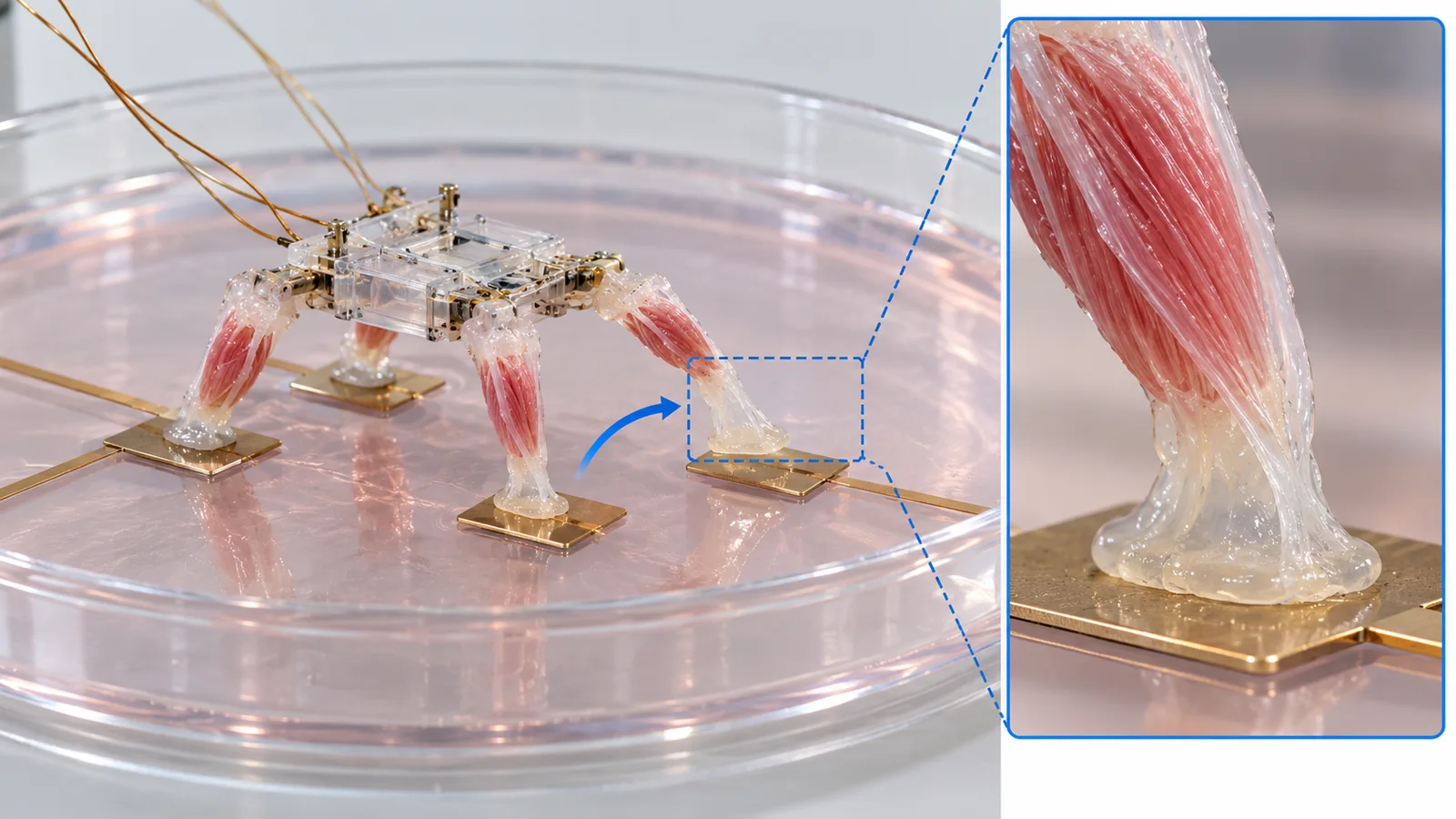
ETH Zurich’s bioactuators are made of living skeletal muscle grown from mouse myoblasts (C2C12) on a hydrogel scaffold. Muscle and scaffold were designed together on a computer, grooves in the scaffold align the muscle fibres, and the range of motion is reported as up to eleven times that of earlier designs with a comparable amount of muscle. Jumping, swimming, walking and gripping were shown, and the walking version reached 6.2 mm/s Sourced[Ref. 13, 12].
Magnetic fields and light need equipment outside, and whether they reach the place (inside a body or underwater) becomes the problem. Chemistry needs a fuel, and whether that fuel suits the environment (is not harmful) is the problem. Living muscle must be kept supplied with nutrients. No method is best in general; the choice depends on the purpose (explanation).
5. Copying the mechanism: cilia, flapping, deep-sea fish and muscle
“Biomimicry” does not mean copying appearance; it means putting a mechanism into a design. We organize this article’s examples by “what” was copied into “which structure”.
Cilia: sense temperature and pump liquid (Cornell, 2026)
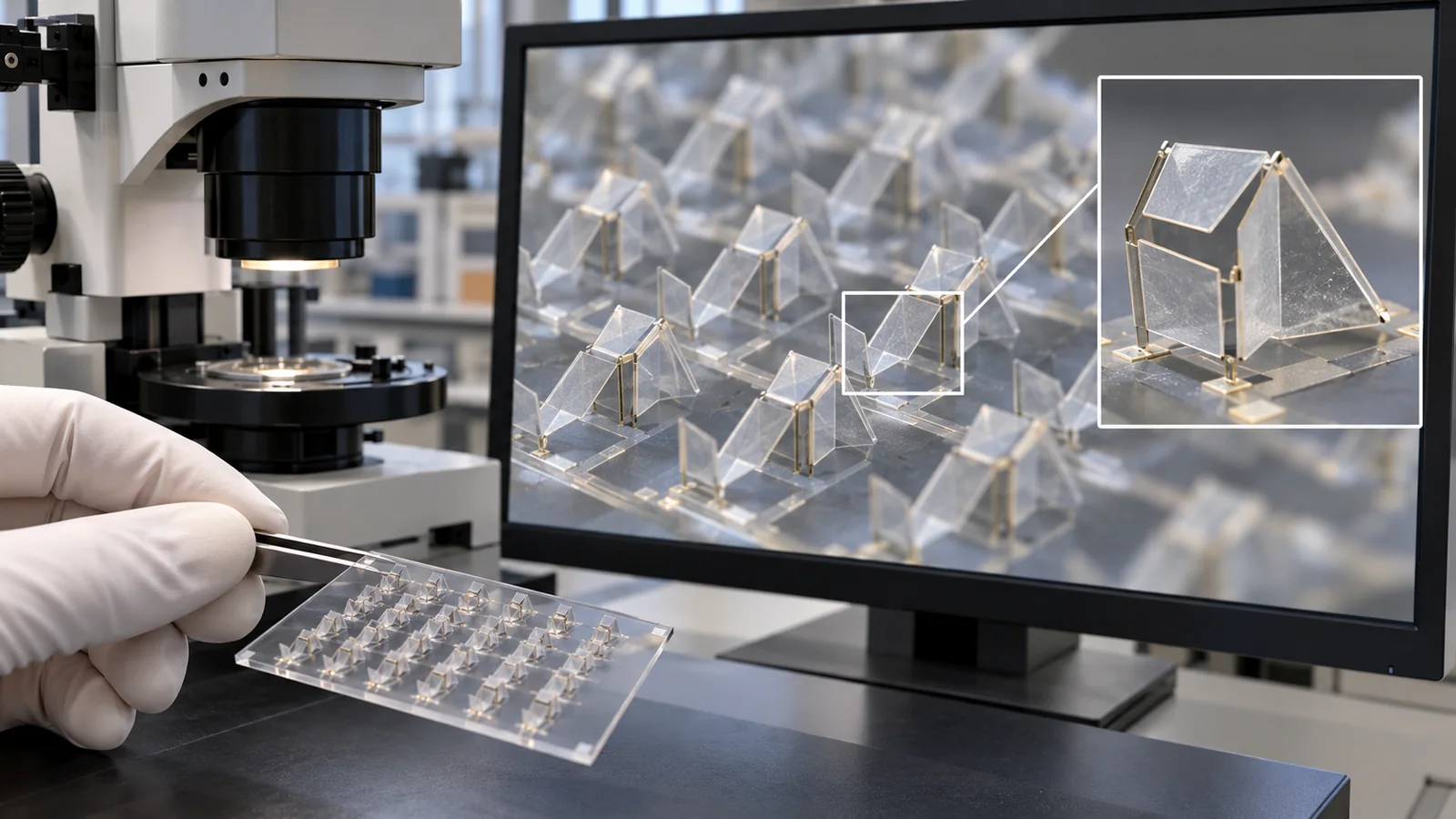
A Cornell University team published in Nature Electronics on 23 September 2026 microrobots that sense temperature and pump liquid on the spot Sourced[Ref. 11, 10]. An array of 54 hinged cilia carries two temperature-sensing circuits, a leader and a follower, which communicate with each other and synchronize the cilia. Above a set temperature they pump in the forward direction, and below it in reverse. The sequenced hinge motion follows cilia, and the electronic synchronization follows fireflies. The robots are described as “a hair’s breadth in diameter” Sourced[Ref. 10]. The university calls pumping liquid from hot to cold regions the first example of microscopic robots that alter their physical environment (the university’s claim). Medical and agricultural uses are described only as future possibilities Not yet confirmed.
Flapping: untethered flight of an insect-sized robot (Jafferis et al., 2019)
Insect-sized robots (mass under 500 mg, wingspan under 5 cm) cannot easily carry a battery and for a long time were flown tethered to an external power supply. Jafferis et al. report that a 90 mg vehicle drove four wings with two alumina-reinforced piezoelectric actuators and, with a photovoltaic array and signal generator, weighed 259 mg at 110-120 mW, achieving sustained untethered flight Sourced[Ref. 14]. A larger flapping robot that moves between water and air is covered in our explainer on underwater and marine robots Sourced[Ref. 17, 18].
Deep-sea fish: dispense with the hard shell (Li et al., 2021)
Li et al., inspired by the deep-sea snailfish, reported a soft robot that embeds electronics in silicone and works without a rigid shell. To reduce stress between parts, the components are spread apart Sourced[Ref. 16].
Muscle: designing muscle tissue and scaffold as one (ETH Zurich, 2026)
The ETH study held that it is not just the amount of muscle but the interaction between muscle and scaffold that decides the motion, and designed both together on a computer Sourced[Ref. 12]. The researchers say muscle shape becomes a variable that engineers can design, not a fixed constraint Sourced[Ref. 12].
6. Materials: magnetic elastomers, shape-memory polymers, hydrogels and piezoelectric ceramics
The “muscle”, “bone” and “fuel” of a tiny robot are set by its choice of materials. Here are the materials of this article’s examples.
The material of Kim et al. (2018) is an ink of an elastomer with dispersed ferromagnetic microparticles. Applying a magnetic field at the nozzle during printing aligns the particles, so each extruded filament has its own magnetization direction. When a field is later applied to the finished structure, it changes shape quickly and remotely according to those directions Sourced[Ref. 2]. Material (type and amount of particles) and process (printing under a field) together therefore design the motion.
Ze et al. (2020) put two kinds of magnetic particles in an amorphous shape-memory polymer. The low-coercivity particles soften the polymer matrix by induction heating in a changing field. The high-remanence particles change shape quickly in a magnetic field. On cooling, the deformed shape is locked Sourced[Ref. 3]. This is polymer shape memory, different from the shape-memory alloys (metals that recover shape with temperature; see our explainer on shape memory alloys).
The scaffold of ETH’s bioactuator is printed by xolography (a light-based method that forms a volume in one go; about 60 s per scaffold) from a resin that mixes GelMA (gelatin with methacryloyl groups) and PEGDA (polyethylene glycol diacrylate), and it has fine grooves that line up muscle fibres. The muscle layer is made by placing a cell-containing mixture, including GelMA, on the scaffold and culturing for about two weeks to get contractile muscle. The paper says a scaffold stiffness of about 16.5 kPa worked (softer scaffolds curled up) Sourced[Ref. 13].
Living tissue has a nutrient and oxygen diffusion limit (about 100 µm), so the centre of a thicker muscle layer does not grow (statement in the paper) Sourced[Ref. 13]. ETH says larger systems need an artificial vascular system (a blood-like supply) and that variability between samples is also a problem Sourced[Ref. 12]. Not only the material design but the limits of biology set the size and shape (our explanation).
The insect-sized untethered flying robot uses piezoelectric actuators (ceramics that expand and contract with voltage), reinforced with alumina. The vehicle is 90 mg, 259 mg with the photovoltaic array and other parts, and the power use is 110-120 mW, according to the paper Sourced[Ref. 14]. Materials and structure are chosen to balance lightness, power and force. The trade-off between battery and weight in small aircraft is shared with our explainer on multicopter principles and design (explanation).
7. Uses and problems in medicine and the environment: from research to the field
Medicine: hopes, and the current stage
Microrobots are being explored for drug delivery, transport of biological material and minimally invasive surgery. But Lee et al. (2023) say that most current efforts are proof-of-concept studies with materials that are hard to translate clinically. They propose a “design-by-problem” approach (design from unsolved problems), and say the keys are biodegradable materials (that break down in the body and do not remain), how to deliver the robots, and a choice of biomaterials already investigated clinically Sourced[Ref. 7]. Biodegradability is essential where the body cannot clear the robots on its own, such as solid tumours or the bloodstream, and for magnetic response, biocompatible options such as iron oxide are preferred over cobalt Sourced[Ref. 7].
Animal testing is at the first step of evaluation in the body, as in Gao et al.’s (2015) zinc micromotors in the stomach of a mouse Sourced[Ref. 6]. No example of clinical use in people could be confirmed within this article’s sources.
Environment: breaking down, removing and monitoring pollutants
Micro/nanomotors are studied as moving reactors to degrade and remove pollutants, kill bacteria and monitor the environment. The review by He et al. (2024) says moving laboratory results to larger-scale field application is a challenge Sourced[Ref. 8].
This is inaccurate. Research so far centres on proof-of-concept in test tubes, tanks and animals such as mice, and clinical use in people could not be confirmed. To work inside the body they need materials that break down and leave nothing, a way to reach the target and safety evaluation, and the researchers themselves say that clinical translation is the challenge [Ref. 7]. This article does not show any treatment effect or safety.
The materials of proof-of-concept work (such as nickel and cobalt) and materials usable in the body (biodegradable polymers, iron oxide and so on) are different designs. Lee et al.’s table organizes biodegradable polymers such as PLGA (a copolymer of lactic and glycolic acid), whose degradation rate can be tuned by composition and which have a clinical track record Sourced[Ref. 7]. For environmental use, whether it can be recovered or will degrade (will not persist in the environment) decides the material choice (our explanation; the environmental requirements for materials could not be confirmed in the sources).
8. Where things stand (checked 25 October 2026)
This field changes quickly, so here is what could be confirmed from primary sources, with check dates. University and institution announcements are written as their claims.
| Item | What was confirmed | Label |
|---|---|---|
| Microrobots that sense temperature and pump liquid (Cornell) | Published in Nature Electronics on 23 September 2026. 54 hinged cilia, leader and follower circuits. Medical and agricultural uses are described only as future possibilities [Ref. 11, 10] | Sourced Not yet confirmed |
| Living-muscle biohybrid robots (ETH) | Published in Nature Communications on 11 September 2026. About 15 mm, up to eleven times the range of motion, a nutrient solution required. The researchers say long-term use and larger sizes need artificial vessels and similar [Ref. 13, 12] | Sourced Not yet confirmed |
| Insect-sized untethered flight | A 90 mg vehicle reported sustained untethered flight in 2019 (using a photovoltaic array) [Ref. 14] | Sourced |
| Evaluation in animals | Zinc micromotors in the stomach of mice (2015). Clinical use in people could not be confirmed within this article’s sources [Ref. 6, 7] | Sourced Not yet confirmed |
| Use at environmental sites | A 2024 review names moving from the laboratory to large-scale field use as a challenge. No field example could be confirmed [Ref. 8] | Not yet confirmed |
| Applicable ISO or IEC standard numbers, reproducibility of each study, exact dimensions of Cornell’s robots | Could not be confirmed within this article’s research | Not yet confirmed |
Checked 25 October 2026. University and institution plans and targets are separate from achieved facts.
“Small-scale robots” of several millimetres to a few micrometres move in a world dominated by stickiness (small Reynolds number), so they need a sequenced motion, not back-and-forth. They are driven by magnetic fields, light, chemistry or living muscle, and the materials include magnetic-particle elastomers, shape-memory polymers, liquid-crystal elastomers, hydrogels and piezoelectric ceramics. Research that puts the mechanisms of living things (cilia, flapping, deep-sea fish, muscle) into designs is advancing. Uses in medicine and the environment are at the proof-of-concept stage in laboratories and animals, and degradability, delivery and scale-up are the problems.
9. How to read the yardsticks and standards
The quality of a tiny robot cannot be measured by one number. There are several yardsticks: what moves it, how fast, how much force, how many times it works, whether it survives in the environment, and whether it breaks down in the body. Speed is often compared per body length: for example the rod of Paxton et al. reaches 10 body lengths per second, while ETH’s walking robot reaches, in our calculation, about 0.41 body lengths per second (6.2 mm/s / 15 mm) Our calculation. But their sizes, environments (underwater or on a dish) and drives all differ, so the numbers cannot be lined up to rank them. The table shows what each yardstick measures and does not measure, as far as could be confirmed.
| Item | Representative tests / benchmarks (name, source) | Standards, rules, guidance | Cautions when reading |
|---|---|---|---|
| Speed | Speed per body length: up to 10 body lengths/s for the rod of Paxton et al. [Ref. 5] Sourced. ETH’s walking robot at 6.2 mm/s [Ref. 12] | A unified standard could not be confirmed | Do not compare items of different body length. Check the environment (fluid viscosity, substrate) |
| Range of motion and force | ETH: up to eleven times the range of motion of earlier designs with similar muscle volume (the paper’s claim) [Ref. 13] Sourced | Could not be confirmed | “Up to” is the best value under chosen conditions. Check the comparison and its conditions |
| Safety (when used in the body) | Evaluation of distribution, retention and acute toxicity in mice (Gao et al.) [Ref. 6] Sourced | Review as a medical device or drug (FDA and others). No microrobot-specific standard could be confirmed. For how such review is viewed, see our explainer on surgical robots | Animal results do not show safety in people. Long-term toxicity and degradation products need separate evaluation (inference) |
| Biodegradability and materials | Lee et al.’s table: degradation rate, immune effects, FDA status and processing of biodegradable polymers [Ref. 7] Sourced | Material-by-material standards were not checked here | “Biocompatible” and “biodegradable” differ. Requirements depend on where in the body it is used |
| Reproducibility and reliability | ETH paper: variability, and a yield of 85% (share of functional bioactuators) [Ref. 13] Sourced | Could not be confirmed | Biological material varies a lot. Check how many times it was reproduced under the same conditions |
| Maturity of research | The stage: test tube, tank, animal, clinic or field (our organization) Our calculation | No official unified scale could be confirmed | “It moved” and “it can be used” are different. Check the environment, duration and number of trials |
The arrangement of the table is Our calculation (organization). No ASTM International standard or website was consulted. Medical standards were not read, so no names or numbers are given.
Cautions when reading (for materials engineers)
- Demonstrations, benchmarks and the field are different. Motion under a microscope or on a dish does not show performance in real environments such as blood or soil (flow, viscosity, contamination).
- University announcements and third-party verification are different. “The first example” and “up to eleven times” are the claims of those studies. No independent replication could be found among the sources checked.
- Check whether a standard exists. No dedicated international standard for microrobots could be confirmed within this article’s research. Use in medicine would need review as a device or drug (inference).
- Plans and achievements differ. Medical and agricultural uses, and scaling up with artificial vessels, are all not yet confirmed.
10. Glossary
- Microrobot
- A robot a few millimetres to a few micrometres in size. It can hardly carry a battery or motor.
- Reynolds number (Re)
- The ratio of inertia to stickiness. When small, stickiness dominates.
- Nonreciprocal motion
- A motion whose return does not retrace the same shapes. Needed to move in a sticky world.
- Cilia
- Thin hairs on a cell surface that move to pump liquid or propel the cell.
- Speed per body length
- How many body lengths are covered in a second. A guide for comparing things of different sizes.
- Magnetic elastomer
- A rubber-like material with dispersed magnetic particles. It changes shape in a magnetic field.
- Ferromagnetic
- Able to become a magnet (iron and similar metals).
- Shape-memory polymer
- A polymer that returns from a temporary shape to its original shape, for example with temperature.
- Liquid-crystal elastomer
- A rubber-like material with liquid-crystal ordering. Some types deform with light or heat.
- Hydrogel
- A jelly-like polymer containing a lot of water. Soft and close to living tissue.
- GelMA / PEGDA
- A gelatin derivative / a polyethylene glycol derivative. Materials for gels that harden with light.
- Xolography
- A 3D-printing method that forms a volume at once with light.
- Piezoelectric element
- A material (such as a ceramic) that expands and contracts when voltage is applied.
- Catalytic nanomotor
- A tiny particle or rod that propels itself using forces from a catalytic reaction.
- Biohybrid robot
- A robot that combines living cells or tissue with artificial parts.
- In vitro / in vivo
- Tests outside the body, as in test tubes / tests inside a living animal or person.
- Biodegradable
- Breaks down in the body or environment and does not remain.
- Biocompatible
- Does not cause harmful reactions in the body.
- Drug delivery
- Bringing a drug to the place where it is needed.
- PLGA
- A copolymer of lactic and glycolic acid; one of the polymers that break down in the body.
- Proof of concept
- Showing in a small test that a principle works. It does not show practicality.
11. References
- Hu W. et al. “Small-scale soft-bodied robot with multimodal locomotion”, Nature 554, 81-85 (2018) — doi.org/10.1038/nature25443
- Kim Y. et al. “Printing ferromagnetic domains for untethered fast-transforming soft materials”, Nature 558, 274-279 (2018) — doi.org/10.1038/s41586-018-0185-0
- Ze Q. et al. “Magnetic Shape Memory Polymers with Integrated Multifunctional Shape Manipulation”, Advanced Materials 32, 1906657 (2020) — doi.org/10.1002/adma.201906657
- Palagi S. et al. “Structured light enables biomimetic swimming and versatile locomotion of photoresponsive soft microrobots”, Nature Materials 15, 647-653 (2016) — doi.org/10.1038/nmat4569
- Paxton W. F. et al. “Catalytic Nanomotors: Autonomous Movement of Striped Nanorods”, Journal of the American Chemical Society 126, 13424-13431 (2004) (abstract checked on the Penn State record page; DOI 10.1021/ja047697z) — pure.psu.edu/en/publications/catalytic-nanomotors-autonomous-movement-of-striped-nanorods/
- Gao W. et al. “Artificial Micromotors in the Mouse’s Stomach: A Step toward in Vivo Use of Synthetic Motors”, ACS Nano 9(1), 117-123 (2015) (open version on PMC) — pmc.ncbi.nlm.nih.gov/articles/PMC4310033
- Lee J. G. et al. “Microrobots for Biomedicine: Unsolved Challenges and Opportunities for Translation”, ACS Nano 17(15), 14196-14204 (2023) (open version on PMC) — pmc.ncbi.nlm.nih.gov/articles/PMC10928690
- He Y. et al. “Application of Micro/Nanomotors in Environmental Remediation: A Review”, Micromachines 15(12), 1443 (2024) — doi.org/10.3390/mi15121443
- Purcell E. M. “Life at low Reynolds number”, American Journal of Physics 45(1), 3-11 (1977) — doi.org/10.1119/1.10903
- Cornell Chronicle “Microscopic robots inspired by fireflies, cilia sync to reshape surroundings” (Cornell University announcement, September 2026; checked 25 October 2026) — news.cornell.edu/node/333690
- Wang W., Zhang J. et al. “Microscopic robots that sense and reshape their environment”, Nature Electronics (23 September 2026; checked 25 October 2026; full text not read) — doi.org/10.1038/s41928-026-01709-x
- ETH Zurich “One small leap for a muscle, one giant step for robotics” (ETH Zurich announcement, 22 October 2026; checked 25 October 2026) — ethz.ch/en/news-and-events/eth-news/news/2026/10/one-small-leap-for-a-muscle-one-giant-ste
- Balciunaite A. et al. “Co-optimized volumetric muscle design for large dynamic deformations in versatile biohybrid robots”, Nature Communications 17, 10732 (11 September 2026; open-access version read) — doi.org/10.1038/s41467-026-77655-1
- Jafferis N. T. et al. “Untethered flight of an insect-sized flapping-wing microscale aerial vehicle”, Nature 570, 491-495 (2019) — doi.org/10.1038/s41586-019-1322-0
- Wehner M. et al. “An integrated design and fabrication strategy for entirely soft, autonomous robots”, Nature 536, 451-455 (2016) — doi.org/10.1038/nature19100
- Li G. et al. “Self-powered soft robot in the Mariana Trench”, Nature 591, 66-71 (2021) — doi.org/10.1038/s41586-020-03153-z
- Zufferey R. et al. “Leaping out of the water: Aerial-aquatic locomotion with flapping wings”, Science 393(6807), 207-211 (2026) — doi.org/10.1126/science.aeb6744
- MIT News “New flapping robot swims and flies like a diving bird” (9 July 2026; the institution’s announcement) — news.mit.edu/2026/new-flapping-robot-swims-and-flies-like-diving-bird-0709
12. Claim-to-source audit
| Claim in the text | Basis | Label |
|---|---|---|
| “Small-scale robots” range from several millimetres to a few micrometres and may access confined, enclosed spaces non-invasively; magneto-elastic soft mm-scale robots swam in and on liquids, climbed menisci, rolled and walked on solids, jumped, crawled in tunnels, and picked and released cargo | Abstract of Hu et al. (2018) Reference 1 https://doi.org/10.1038/nature25443 | Sourced |
| Magnetic fields are described as a safe and effective way to manipulate in enclosed, confined spaces; an elastomer with ferromagnetic microparticles was printed with a field at the nozzle to orient the particles, giving materials that transform quickly between complex 3D shapes | Abstract of Kim et al. (2018) Reference 2 https://doi.org/10.1038/s41586-018-0185-0 | Sourced |
| A composite with two types of magnetic particles in an amorphous shape-memory polymer: induction heating of low-coercivity particles softens the matrix, high-remanence particles drive the shape change under a field, and cooling locks the shape | Abstract of Ze et al. (2020) Reference 3 https://doi.org/10.1002/adma.201906657 | Sourced |
| Soft microrobots of photoactive liquid-crystal elastomer driven by structured monochromatic light produce travelling-wave motion to self-propel; light is wireless, scalable and spatiotemporally selective | Abstract of Palagi et al. (2016) Reference 4 https://doi.org/10.1038/nmat4569 | Sourced |
| Rods 370 nm in diameter with 1 µm Pt and Au segments move autonomously in aqueous hydrogen peroxide by oxygen formation at the Pt end, at up to 10 body lengths per second in 2-3% peroxide, with a force of order 10^-14 N | Abstract of Paxton et al. (2004) Reference 5 https://pure.psu.edu/en/publications/catalytic-nanomotors-autonomous-movement-of-striped-nanorods/ | Sourced |
| Zinc-based micromotors given orally to mice were tested in the stomach: acid-driven propulsion improved binding and retention on the stomach wall, the bodies dissolved gradually in gastric acid releasing their payload and leaving nothing toxic behind, as reported (an early in vivo evaluation) | Abstract of Gao et al. (2015) Reference 6 https://pmc.ncbi.nlm.nih.gov/articles/PMC4310033 | Sourced |
| Much microrobot work stays at proof-of-concept with materials that are hard to translate; the “design-by-problem” proposal; biodegradability is needed in many uses while most proofs of concept use non-biodegradable parts; the grouping of drives into external fields (magnetic, acoustic, electric) and environmental sources (chemical reactions, biological signals); iron oxide instead of cobalt; the table of biodegradable polymers such as PLGA | Lee et al. (2023) Reference 7 https://pmc.ncbi.nlm.nih.gov/articles/PMC10928690 | Sourced |
| Micro/nanomotors are studied for degrading and removing contaminants, killing bacteria and environmental monitoring, and moving from the laboratory to larger-scale field use is a challenge | Abstract of He et al. (2024) Reference 8 https://doi.org/10.3390/mi15121443 | Sourced |
| The physics of low Reynolds numbers (viscous-dominated flow and the principle that reciprocal motion cannot propel) | Purcell (1977) Reference 9 https://doi.org/10.1119/1.10903 | Sourced |
| Cornell: microrobots that sense temperature and pump liquid; an array of 54 hinged cilia, two temperature-sensing circuits (leader and follower), a two-hinge nonreciprocal stroke, forward pumping above a threshold temperature and reverse below it, robots a hair’s breadth in diameter, synchronization inspired by fireflies, published in Nature Electronics on 23 September 2026 | Cornell announcement and Nature Electronics record Reference 10 https://news.cornell.edu/node/333690 Reference 11 https://doi.org/10.1038/s41928-026-01709-x | Sourced |
| ETH: living skeletal muscle (mouse C2C12 myoblasts) and a hydrogel scaffold (GelMA and PEGDA) designed together by computation; about 15 mm bioactuators, scaffold stiffness about 16.5 kPa, xolography (about 60 s), microgrooved scaffolds, up to eleven-fold larger range of motion, jumping, swimming, walking and gripping, walking at 6.2 mm/s, a nutrient solution needed, an oxygen and nutrient diffusion limit of about 100 µm, variability, and long-term use still far off | ETH announcement and Nature Communications paper Reference 12 https://ethz.ch/en/news-and-events/eth-news/news/2026/10/one-small-leap-for-a-muscle-one-giant-step-for-robotics.html Reference 13 https://doi.org/10.1038/s41467-026-77655-1 | Sourced |
| The definition of insect-sized (under 500 mg, wingspan under 5 cm), a 90 mg vehicle, four wings driven by two alumina-reinforced piezoelectric actuators, 259 mg including photovoltaic array and signal generator, 110-120 mW power, and sustained untethered flight | Abstract of Jafferis et al. (2019) Reference 14 https://doi.org/10.1038/s41586-019-1322-0 | Sourced |
| An untethered robot made only of soft materials: microfluidic logic autonomously regulates catalytic decomposition of an on-board fuel, and the gas inflates fluidic networks to actuate; made by moulding, soft lithography and embedded 3D printing | Abstract of Wehner et al. (2016) Reference 15 https://doi.org/10.1038/nature19100 | Sourced |
| Deep-sea soft robot: electronics in silicone with no rigid vessel, dielectric-elastomer fins, actuated at 10,900 m, swam at 3,224 m, and decentralized components to reduce stress | Abstract of Li et al. (2021) Reference 16 https://doi.org/10.1038/s41586-020-03153-z | Sourced |
| MIT/EPFL flapping robot: under 300 g, tank and lake tests, a hydrophobic nanoparticle wing coating, frequency and wing flexibility, and preset flapping | Zufferey et al. (2026) and MIT News Reference 17 https://doi.org/10.1126/science.aeb6744 Reference 18 https://news.mit.edu/2026/new-flapping-robot-swims-and-flies-like-diving-bird-0709 | Sourced |
| Reynolds number Re = rho v L / mu (rho = 1,000 kg/m3 and mu = 0.001 Pa·s assumed): about 4 x 10^-5 for the rod (2 µm, 20 µm/s), about 93 for the ETH walker (15 mm, 6.2 mm/s) and about 1.7 x 10^6 for a human swimmer (1.7 m, 1 m/s). The rod length of 2 µm assumes the sum of its 1 µm Pt and 1 µm Au segments | Our own calculation (assumptions stated in the text and figures) | Our calculation |
| The hair width taken as about 0.1 mm, the figure positions, the grouping of strengths and issues of each drive method, the biology-to-engineering mapping, and the readings marked as inference | This article’s explanation (our reading of the sourced facts) | Explanation |
| Clinical use in patients, human trials of biodegradable microrobots, the exact dimensions and speeds of the Cornell microrobots, reproducibility of each study, and applicable ISO or IEC standard numbers could not be confirmed within this article’s research and are not included | The scope of research for this article | Explanation |
Last updated: 25 October 2026. Sources are limited to primary material (papers in Nature, Science, Nature Communications, Nature Electronics, ACS Nano, Advanced Materials and Micromachines, and announcements from Cornell University, ETH Zurich and MIT). University and researcher claims are labeled as claims and kept separate from independent verification. The worked examples (Reynolds numbers, size ratio, speed per body length) are our own explanatory calculations and not specifications of any device. This article is a general technical explainer and not medical or safety advice. Clinical use in people, practical use at environmental sites, the exact dimensions of Cornell’s robots and the applicable international standard numbers could not be confirmed and are therefore not given. All figures are explanatory concept diagrams or drawings with our own calculations, except Figs. 1 and 6, which are ImageGen-generated conceptual illustrations. They do not depict real equipment, products or appearances.