TECHNOLOGY EXPLAINER
Power Sources for Robots and Drones
– What mass do you pay for energy, and what for power?
When we think about power for robots and drones, it is tempting to say “if battery Wh/kg goes up, they will fly and walk further”. But a power source has two yardsticks: energy (how long) and power (how hard). In a battery the two live in the same cell. In a fuel cell, the part that sets power (the stack) is separate from the part that sets energy (the hydrogen tank). Using manufacturers’ data sheets, numbers from papers and a few small calculations, this article sorts out why adding battery gives diminishing returns on flight time, roughly how long a flight must be for hydrogen to win, how big a humanoid robot’s battery is, and the limits of sunlight. Battery chemistry and safety are left to other articles in this series; here we look at power sources as carried on an aircraft or robot.
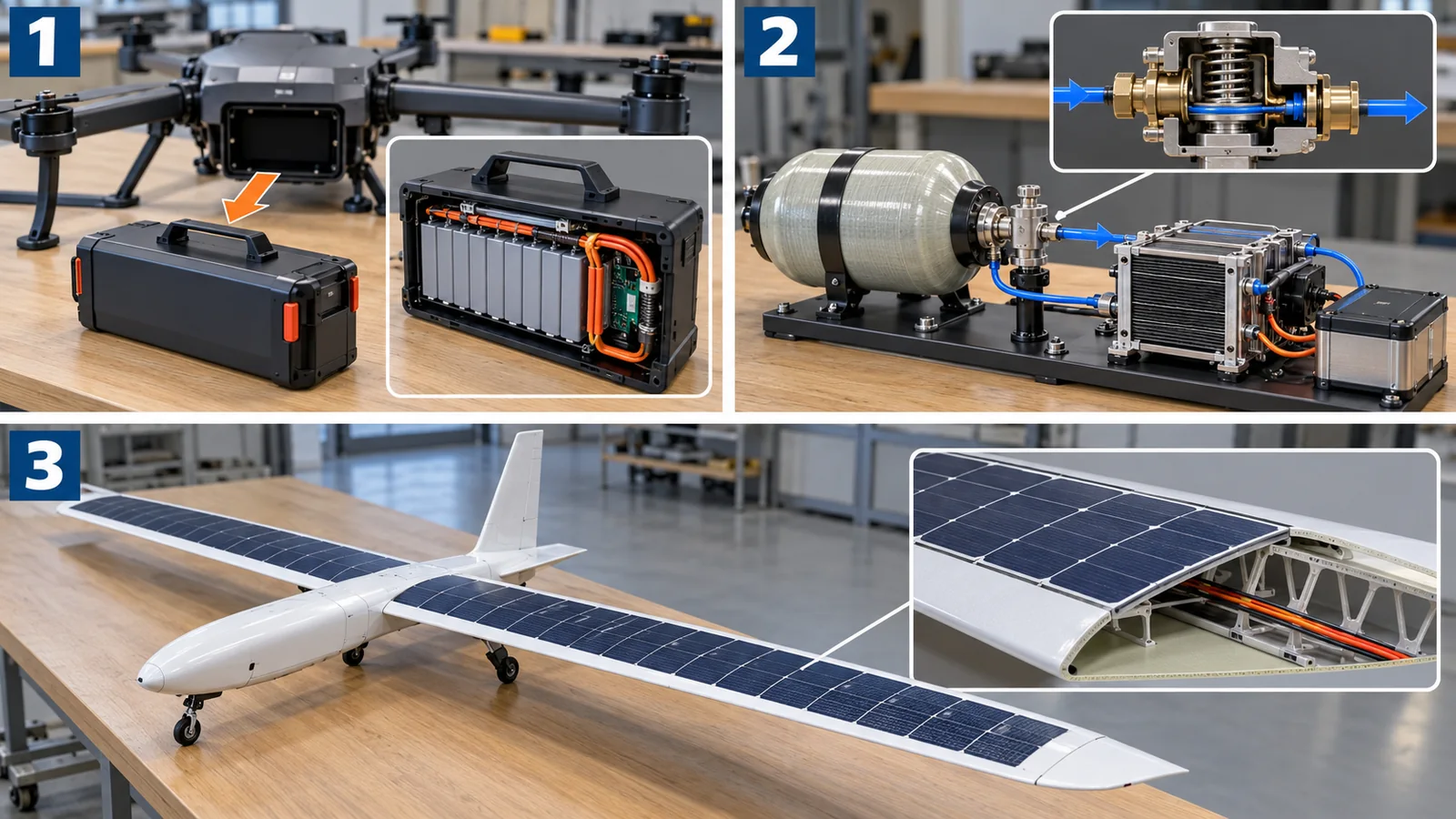
- Two yardsticks for a power source (the short version)
- Choosing a cell: energy type and power type
- At the aircraft level: mass breakdown and average power
- How far does more battery take you?
- Fuel cells and hydrogen: buying energy and power separately
- Power for humanoid robots: a 1 kWh class and mass
- Sunlight: area sets the power
- Limits, what we could not confirm, and a summary
- How to read the yardsticks and standards
- Glossary
- References (primary sources)
- Claim-to-source audit
Sourced = stated in a published source (linked)
Our calculation = our own calculation or arrangement using published values (assumptions are stated)
Not yet confirmed = plans, targets or standards under revision that are not settled
Inference is shown in bold. Readings that have no source are marked “commentary”.
Performance values (energy density, flight time, runtime) are company’s stated values given under conditions (payload, speed, temperature, battery state). They are not measurements or independent verification. We do not rank different aircraft or batteries by their numbers. Company announcements are written as company claims. This field moves fast, so aircraft and specifications are as of the check date (25 October 2026). We give no individual safety advice.
1. Two yardsticks for a power source (the short version)
- Judge a power source by energy and power: energy (Wh) is “how long can it run”, power (W) is “how hard can it deliver”. A battery holds both in the same cell; a fuel cell lets you change them separately (Fig. 2).
- For drones, more battery gives diminishing returns: as mass grows, hover power rises with the 1.5th power of mass. In an idealized calculation, flight time peaks when the battery is about 2/3 of total mass Our calculation.
- Hydrogen gets lighter on long flights: a fuel cell carries a fixed mass for its power. In our estimate (with stated assumptions), delivering 1.2 kW continuously, hydrogen becomes lighter once a flight exceeds about an hour Our calculation. For short flights the battery stays lighter.
In this series a robot is a combination of three things: “sense” (sensors), “think” (control and intelligence) and “move” (actuators). A drone is the same. The star of this article is the power source that feeds all of them. W (watt) is work per second, the unit of power. Wh (watt-hour) is W multiplied by time, a unit of energy: 1 W for an hour is 1 Wh. C rate is the discharge speed in which the current that empties a battery’s capacity in one hour is 1 C. A 5 Ah battery discharged at 15 A is at 3 C.
Where this fits in the series: how batteries work is in our explainer on lithium-ion battery basics, safety in the one on thermal runaway and battery safety, how fuel cells work in the one on fuel cell vehicles and PEFC, hydrogen tanks in the hydrogen-energy explainer on high-pressure hydrogen tanks, lightweight bodies in the one on structural materials for robots and drones, the airframe types for long endurance in the one on fixed-wing, VTOL and long endurance, and flight mechanics in the one on multicopter principles. Here we stick to how to read a power source when it is carried on a machine, without repeating them.
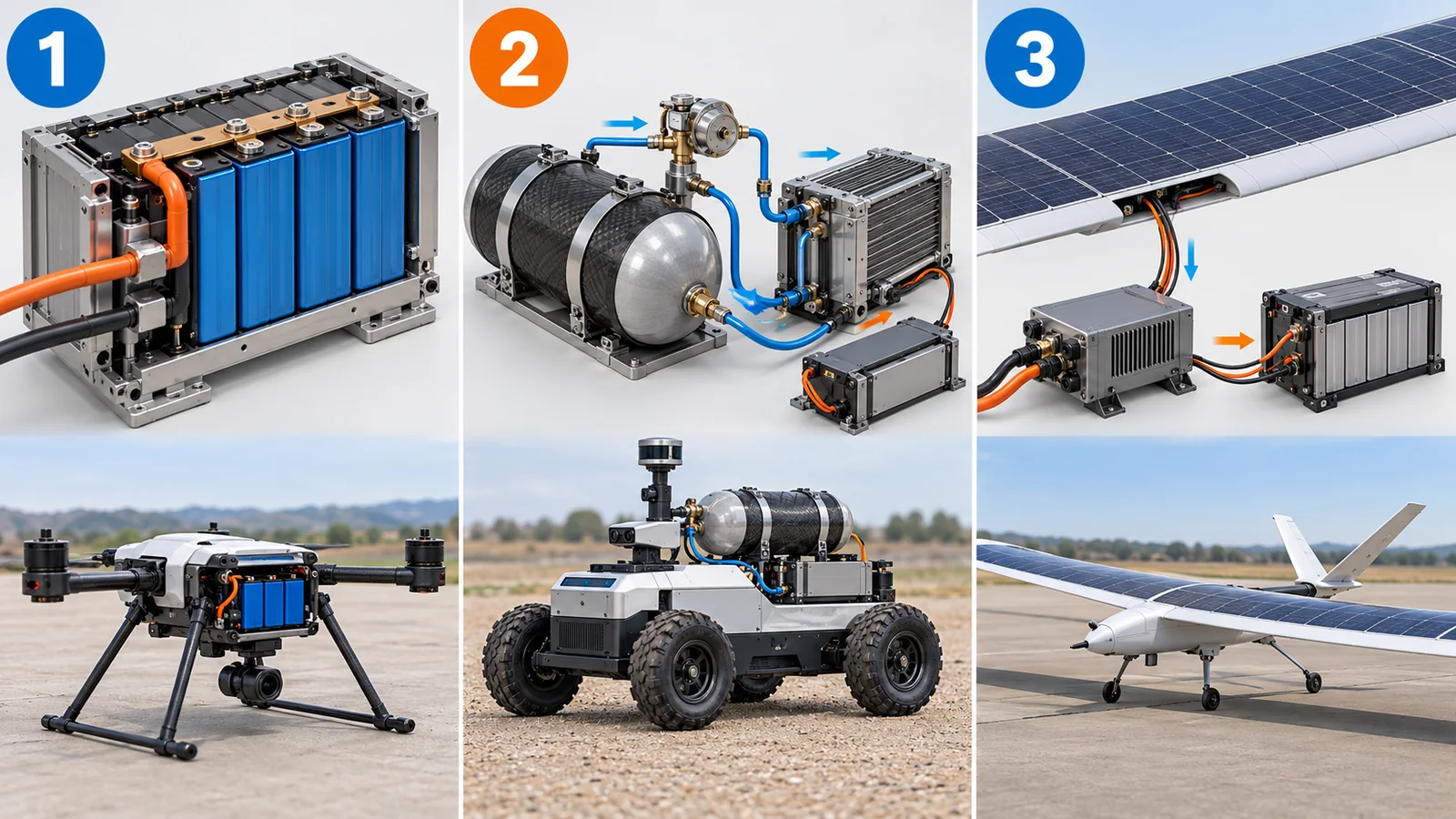
Original SVG, detailed explanation and sources
Original SVG reference: Concept diagram (vector drawing). Our arrangement of what sets power and energy for batteries, fuel cells with hydrogen tanks, and solar cells. It is not the make-up of any real aircraft. For individual numbers, see the sources in the later chapters.
2. Choosing a cell: energy type and power type
A battery pack is built by connecting many small cylindrical cells. Even among cells of the same size (21700: 21 mm in diameter, 70 mm long) there are energy types (large capacity) and power types (built to pass large currents). We compare three cells from the data sheets of Molicel (E-One Moli Energy) [Ref. 1, 2, 3].
| Cell (company’s stated values) | Capacity (typical) | Energy per mass | Continuous discharge current | Mass (maximum) |
|---|---|---|---|---|
| INR-21700-M50A [2] | 5000 mAh (18.0 Wh) | 269 Wh/kg | 15 A (3 C) | 70 g |
| INR-21700-P45B [1] | 4500 mAh (16.2 Wh) | 242 Wh/kg | 45 A (10 C) (cut off at a cell temperature of 80 °C) | 70 g |
| INR-21700-P50B [3] | 5000 mAh (18.0 Wh) | 260 Wh/kg | 60 A (12 C) (cut off at a cell temperature of 80 °C) | 71 g |
Values are as stated in the data sheets Sourced. C is current divided by capacity, calculated by us Our calculation (15 / 5 = 3, 45 / 4.5 = 10, 60 / 5 = 12). The data sheets say they are for reference and not a performance guarantee.
The table shows that energy per mass ranges only from 242 to 269 Wh/kg, a difference of about 10%. Yet the continuous current they can pass differs fourfold, from 15 A to 60 A. Multiplying by the nominal 3.6 V and dividing by mass gives a continuous power guide of about 771 W/kg for the M50A, about 2,314 W/kg for the P45B and about 3,042 W/kg for the P50B Our calculation (Fig. 3). Voltage falls as current flows, so real power is lower.
Wh/kg is the “how long” yardstick. Drones and robots also need the “how hard” yardsticks (continuous W/kg, C rate). In Fig. 3, three cells whose energy differs by only 10% differ fourfold in continuous power. The correct order: compute the average power and the peak power (for example at take-off) of the machine, then pick the cell with the highest Wh/kg among those that meet the required C rate (our commentary).
Cells of the same size can be made as energy types or power types mainly through how the electrodes are built (coating thickness, porosity, conductive-additive content, current-collector design) (commentary; electrode manufacturing is covered in our explainers on electrode manufacturing and on conductive additives and binders). The easier the current flows, the less active material is packed in, so energy falls a little; in Fig. 3, the power type P45B has about 10% less energy than the M50A. The data sheets give internal resistance as “DC (10 A, 10 s) 25 mΩ” for the M50A and “DC (50% state of charge) 12.8 mΩ” for the P50B; they are measured differently and cannot be compared directly [Ref. 2, 3] Sourced. Improvements on the materials side point toward electrodes that put the same energy in and out faster (commentary).
3. At the aircraft level: mass breakdown and average power
Connect cells and add a protection circuit and a case, and you have a pack. In the specifications of the DJI Matrice 350 RTK commercial drone, the flight battery TB65 has a capacity of 5880 mAh, a voltage of 44.76 V, an energy of 263.2 Wh and a mass of about 1.35 kg (company’s stated values) [Ref. 4] Sourced. Dividing gives about 195 Wh/kg Our calculation, lower than the bare cells in Fig. 3 (242 to 269 Wh/kg). The case, the protection circuit and the low-temperature self-heating function (given in the specifications) probably account for this (commentary).
The aircraft weighs about 3.77 kg without batteries and about 6.47 kg with two TB65 [Ref. 4] Sourced. The batteries come to 2 x 1.35 = 2.70 kg, about 42% of the total mass Our calculation (Fig. 4). The maximum flight time is 55 minutes, a reference value the company says it measured with no payload, no wind and about 8 m/s until the battery reached 0% [Ref. 4] Sourced.
From these numbers the average power is 526.4 Wh / (55 / 60 h) = about 574 W Our calculation, or about 89 W per kg of aircraft Our calculation. Dividing by the battery voltage of 44.76 V gives about 12.8 A, or about 6.4 A for each of two batteries. Against the 5.88 Ah capacity of one battery, that is about 1.1 C Our calculation. Compared with the 3 to 12 C the cells in Fig. 3 can deliver, the average for this style of flying is far gentler. Peak currents at take-off and climb must be larger, though (commentary; the peak value was not confirmed).
4. How far does more battery take you?
“Carry more battery and fly longer” is only half true. More battery adds energy, but it also makes the aircraft heavier and raises the hover power. Hover power is proportional to the 1.5th power of mass (Bauersfeld and Scaramuzza [Ref. 5]; we also used it in the explainer on structural materials for robots and drones).
Hold the non-battery mass constant and vary the battery mass, then compute the hover time. Flight time is energy (proportional to battery mass) divided by power (proportional to the 1.5th power of total mass). With battery mass mb and non-battery mass m0, flight time is proportional to mb / (m0 + mb)1.5 Our calculation. This is greatest at mb = 2 m0, that is, when the battery is about 67% of the total mass Our calculation (checked by differentiation; see “More detail” below).
As Fig. 5 shows, at a 20% battery share the flight time is about 0.46 of the maximum Our calculation. Raising it to 42%, as in the commercial drone of the previous chapter, reaches about 0.83 Our calculation. Going from there to the maximum at 67% adds only about 21% more flight time Our calculation (1 / 0.83), while the total mass grows from 6.47 kg to about 11.3 kg (three times 3.77 kg) Our calculation. In short, the “just add battery” approach becomes less and less effective.
What keeps working is raising the energy density of the battery. For the same mass, a battery with 20% higher energy density gives 20% more flight time (the dashed line in Fig. 5) Our calculation. That is the value of materials improvements.
More detail: why the maximum is at “battery = 2/3 of total mass”
Flight time t = e·mb / P, where e is energy per unit battery mass and P is hover power, P = k·m1.5 (m = m0 + mb, k a constant). So t = (e/k)·mb / (m0 + mb)1.5. Differentiating with respect to mb and setting the result to zero gives (m0 + mb) – 1.5·mb = 0, hence mb = 2·m0. The battery’s share of total mass is 2 / 3 = about 67%.
This simplification assumes that only the battery mass changes, while motor and propeller efficiency, battery power limits, payload and safety margin do not. In a real machine, more battery also needs larger motors and a stiffer structure, so the optimum shifts toward a smaller battery share (Inference). This is our commentary.
The heavier the machine, the more steeply power rises (1.5th power), so each extra bit of battery counts for less. It is like hiking uphill with a heavy pack: more food lets you walk longer, but the pack gets so heavy that your pace drops and the distance you cover in a day stops growing (the comparison’s limit: a drone must keep producing a force equal to its weight in order to stay up).
5. Fuel cells and hydrogen: buying energy and power separately
A fuel cell is a device that makes electricity from hydrogen and oxygen in the air (for how it works, see our explainer on fuel cell vehicles and PEFC). On a drone, the fuel cell (stack) takes care of power and the hydrogen tank takes care of energy. The mass of the stack that sets the power does not depend on flight time; to fly longer, you put more hydrogen in the tank. The difference from a battery is that the mass added per unit of energy is small.
A real fuel cell module (manufacturer’s data sheet)
The Intelligent Energy IE-SOAR 1.2 kW data sheet (May 2023) gives a continuous output of 1200 W, a peak output of up to 8000 W, a fuel-cell module mass of 2700 g, a hydrogen regulator of 315 g and a maximum cylinder pressure of 350 bar [Ref. 6] Sourced. The default configuration includes hybrid batteries (two 6S batteries in series, 535 g each, 3300 mAh, peak output 4800 W) [Ref. 6] Sourced. The fuel cell supplies steady power at a regulated voltage in place of a battery, and the batteries help with peaks such as take-off (commentary). The module alone gives 1200 W / 2.7 kg = about 444 W/kg Our calculation; counting the regulator and hybrid batteries, 1200 W / about 4.085 kg = about 294 W/kg Our calculation (the tank is not included).
Energy of hydrogen and the weight of the tank
Hydrogen itself holds a lot of energy (lower heating value 33.33 kWh/kg; see our explainer on high-pressure hydrogen tanks), but the weight of the tank that holds it at high pressure matters. In a US Department of Energy (DOE) record, an estimate for an automotive 700 bar Type 4 tank (5.6 kg of usable hydrogen, system mass 109 kg) is 1.71 kWh/kg per kg of system [Ref. 9] Sourced. The mass share of hydrogen is 5.6 / 109 = about 5.1% Our calculation. We could not confirm a value for small drone tanks; smaller tanks are likely to have a worse mass share (Inference).
An estimate: the crossover in mass between battery and hydrogen
Using these numbers, we estimate the mass of the power source when 1.2 kW is delivered continuously (Fig. 6). For a battery alone, mass = 1.2 kW x time / 0.195 kWh/kg, using the pack value of the TB65 [Ref. 4]. For a fuel cell, we add the tank mass to a fixed mass of about 4.085 kg. The tank mass is the electrical energy needed divided by 1.71 kWh/kg x a fuel-cell efficiency of 50% (our assumption) = 0.855 kWh/kg.
Under these assumptions the masses of battery and fuel cell cross at about 0.86 hours (about 52 minutes) Our calculation (6.154 t = 4.085 + 1.404 t). For a 4-hour flight, a battery alone would weigh about 24.6 kg and a fuel cell with hydrogen about 9.7 kg Our calculation. If the tank’s energy density is halved (imagining a small tank), the crossover is at about 1.22 hours Our calculation and the mass at 4 hours is about 15.3 kg Our calculation. While a flight is short, the battery is lighter.
Manufacturers’ announcements (company claims)
Heven AeroTech is a company that announces drones flown by hydrogen fuel cells. Its H2D55 (multirotor) page states a flight time of “up to 4 hours” (with payload), a maximum take-off mass of 65 lb (29 kg), a payload of 10 lb (about 4.5 kg), a cruise speed of 22 mph and a hydrogen tank swap in under 5 minutes [Ref. 7] Sourced (company’s stated values; we could not confirm detailed conditions or independent verification). In a November 2023 announcement, the H2D200 was stated to carry 4.5 kg with a range of 510 km and up to 4 hours of flight, and the H2D250 to carry 10 kg with a range of 750 km and up to 8 hours, keeping hover capability [Ref. 8] Sourced (company announcement). The company’s site presents defense, border monitoring and public-safety uses. This article deals only with hydrogen as a power source. The fuel-cell output, tank mass and hydrogen quantity were not found on public pages.
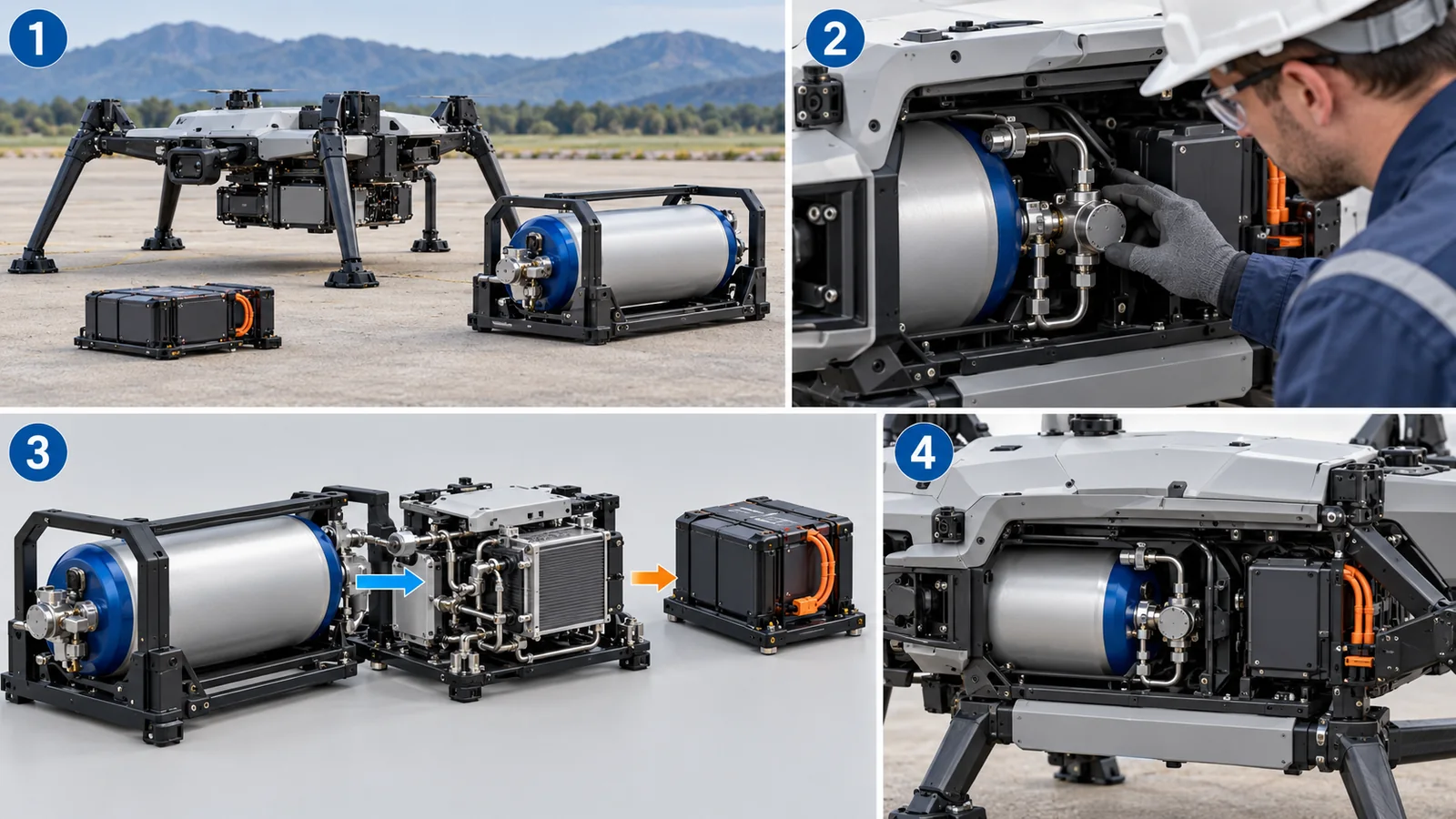
The energy per unit mass of hydrogen itself is large (33.33 kWh/kg), but on an aircraft you add the mass of the tank, regulator, fuel cell and the batteries for peaks. Even in the DOE’s automotive tank estimate, the whole system is 1.71 kWh/kg [Ref. 9]. As Fig. 6 shows, on short flights the fixed mass makes the battery lighter. The correct reading: “there are conditions in which hydrogen wins on long flights”, not “many times longer, always”. And “4 hours” with a different payload, speed or aircraft mass is a different number.
What sets the weight on the hydrogen side is the wall of the high-pressure tank. In the DOE’s automotive tank estimate the wall is mainly carbon-fiber composite, and cost is dominated by carbon fiber (our explainer on high-pressure hydrogen tanks). On a drone, where lightness matters even more, how the carbon fiber is used (lay-up, resin) counts (commentary). On the fuel-cell side, the polymer membrane that passes protons and the catalyst set degradation and life (our explainer on fuel cell vehicles and PEFC). The IE-SOAR warranty is 1000 hours (company’s stated value) [Ref. 6] Sourced, a short time compared with cars. Material durability looks like one of the challenges of small fuel cells (Inference).
6. Power for humanoid robots: a 1 kWh class and mass
A humanoid robot carries its battery inside its body. The Unitree H2 page gives a mass of about 70 kg (including battery), 31 degrees of freedom, a battery of 15 Ah (0.972 kWh) and a maximum voltage of 75.6 V [Ref. 10] Sourced (company’s stated values). The Boston Dynamics Atlas specification (revision of 15 October 2026) gives a mass of 90 kg, 56 degrees of freedom, a battery life of 4 hours (2 hours with heavy lifting), an automatic battery swap in 3 minutes and charging in 1.5 hours [Ref. 11] Sourced. The specification does not state Atlas’s battery capacity, so we could not confirm it.
“4 hours” becoming “2 hours” is a matter of higher power. With the same battery capacity, it means average power about doubled Our calculation. What the robot does changes the power it needs; lifting heavy loads or reaching far drains the battery faster (commentary).
We compare the H2 numbers with the drone. Dividing battery energy by total mass gives, for the H2, 972 Wh / 70 kg = about 13.9 Wh/kg Our calculation, and for the commercial drone of the previous chapter 526.4 Wh / 6.47 kg = about 81.4 Wh/kg Our calculation (Fig. 8). For the drone, batteries are about 40% of the mass; for the humanoid robot, the battery remains a small part. This is an indicator of design features, not a ranking of performance.
A bigger battery raises the torque the legs and arms must produce to carry it, which raises power use further – the same “chain of weight” as for drones above. On a humanoid, a heavy battery also makes balance and safety harder (commentary). So operational tricks are used too, such as Atlas swapping its own battery automatically in 3 minutes [Ref. 11]. It is a way of absorbing battery mass by design and operation (Inference).
Building the H2’s 0.972 kWh from 5 Ah 21700 cells takes 54 cells, as estimated in Fig. 8. The cells alone weigh about 3.8 kg, and a protection circuit, wiring and a case come on top. All of it has to fit in a limited space in the torso and be cooled together with the motors’ heat (commentary). The measures against thermal runaway (our explainer on thermal runaway and battery safety) matter especially for robots that work near people.
7. Sunlight: area sets the power
A solar cell gives power proportional to the area it receives. We check with numbers whether a small multicopter could fly on sunlight alone. For a 1 kg four-rotor aircraft (10 inch propellers), the ideal hover power is (mg)1.5 / (eta·sqrt(2 rho pi N)·r), about 72.7 W Our calculation (eta = 0.6; the equation and values of Bauersfeld and Scaramuzza [Ref. 5]). This is mechanical power in the ideal case, without motor or battery losses.
A 30 cm square (0.09 m²) solar cell, on the best-case assumption of noon (1000 W/m², efficiency 20%, both our assumptions), gives about 18 W Our calculation. A 50 cm square gives about 50 W Our calculation (Fig. 9). In other words, the area of a small multicopter does not reach its hover power. Sunlight suits supplementing the battery of a fixed-wing aircraft, whose cruise power is small (our explainer on fixed-wing, VTOL and long endurance) (commentary).
8. Limits, what we could not confirm, and a summary
What we could not confirm
- The mass share of small hydrogen tanks for drones: we confirmed only the DOE’s automotive tank estimate
- Heven AeroTech’s fuel-cell output, tank mass and hydrogen quantity: not found on public pages. Flight times are company claims, and we could not confirm independent verification
- The cell type and take-off peak current of DJI’s batteries: not in the specifications
- Atlas’s battery capacity: not in the specification. The real build of the Unitree H2 battery was not confirmed either
- Irradiance and solar-cell efficiency: not confirmed in sources, so stated as our assumptions
- The original text of the UN Manual of Tests and Criteria 38.3: the UNECE site showed a bot-verification screen, so we did not check it (we did not work around the screen). We checked only a cell test-result summary
- ASTM standards: ASTM International’s site states that it prohibits AI use, so we did not open it
Summary
- Look at a power source by energy (Wh) and power (W). Cells of the same size can differ only 10% in energy yet fourfold in continuous power Our calculation
- Adding battery gives diminishing returns on hover time (ideally maximum at about 67% battery). What keeps working is raising energy density Our calculation
- Hydrogen has a fixed mass for its power, so on short flights it is heavier than a battery. Under our assumptions the crossover is around an hour Our calculation
- A humanoid robot’s battery is a 1 kWh class and a small share of its mass; operational tricks (automatic swaps) help Sourced
- Sunlight does not suffice to hover a small multicopter (idealized calculation) Our calculation
9. How to read the yardsticks and standards
The performance of a power source is measured by yardsticks for energy (Wh, Wh/kg), power (W, W/kg, C rate), life and safety. All of them change with “cell, pack or system” and with “the conditions of measurement”. For example, Wh/kg is about 240 to 270 for a cell but about 195 for a pack (Fig. 3 and the text): the number drops just by changing the basis. The table lists what we could confirm (checked 25 October 2026).
| What is evaluated | Representative test or data source (name, source) | Standard, regulation or guideline (IEC, ISO, UN, etc.) | Cautions in reading |
|---|---|---|---|
| Cell performance (capacity, Wh/kg, continuous discharge) | Manufacturer data sheets (three Molicel cells) [1 to 3] Sourced | Not confirmed (we did not confirm a common definition of C rate) | The cut-off condition for continuous current (for example 80 °C) is written differently for each cell. Company values |
| Safety of portable cells | A certificate published by the maker: an IEC 62133-2:2017+A1 certificate for the INR-21700-P45B (TÜV Rheinland Japan, dated 13 December 2021, report number JPTUV-130578) [14] Sourced | IEC 62133-2:2017 “Secondary cells and batteries containing alkaline or other non-acid electrolytes – Safety requirements for portable sealed secondary cells, and for batteries made from them, for use in portable applications – Part 2: Lithium systems” (IEC Webstore; AMD1:2021 also exists) [12] Sourced | A certificate for a bare cell, separate from the safety of a pack or machine built from it. A certificate applies to that type and that date |
| Safety of industrial batteries (AGVs and others) | – | IEC 62619:2022 (lithium batteries for industrial use, including motive uses such as forklift trucks and AGVs, excluding road vehicles; 2nd edition, 24 May 2022) [13] Sourced | May be referenced for warehouse transport robots, but we did not confirm its application to individual robots (commentary) |
| Transport tests (UN 38.3) | A test-result summary published by the maker: items T1 to T8 for the P45B (altitude simulation, thermal test, vibration, shock, external short circuit, impact, overcharge, forced discharge; report dated 15 September 2020) [15] Sourced | UN Manual of Tests and Criteria 38.3: original text not confirmed | The “N/A” items in the summary (overcharge, crush) are as stated in that report; their meaning must be checked in the original |
| Flight time of a pack or aircraft | DJI: maximum flight time 55 min (no payload, no wind, about 8 m/s, until 0%) [4] Sourced. Heven: up to 4 hours (with payload) [7] Sourced | Not confirmed (we did not confirm a common way to measure flight time) | Do not compare numbers measured with different methods, payloads and speeds |
| Fuel cell module | Intelligent Energy data sheet (continuous power, mass, 1000-hour warranty) [6] Sourced | Not confirmed | Company values. Durability is within the warranty time |
| Hydrogen tank | DOE Program Record 24006 (estimate for an automotive 700 bar Type 4 tank: 1.71 kWh/kg) [9] Sourced | The DOE record is an estimate, not a standard. For automotive standards see our explainer on high-pressure hydrogen tanks | A value for a large car tank, not for drones |
| Runtime of humanoid robots | Atlas: battery life 4 hours (2 hours with heavy lifting) [11] Sourced. H2: battery 0.972 kWh [10] Sourced | Not confirmed | Changes with the motion performed. Company values |
Numbers, titles and status of standards were checked on the IEC Webstore (25 October 2026). The standard texts are paid, so we stay with the scope statements. The arrangement of the table is Our calculation. Because ASTM states that it prohibits AI use, we do not treat ASTM standard numbers in this article.
Cautions in reading (for materials engineers)
- A cell value and a pack value are different: 195 Wh/kg (TB65) is lower than for bare cells (242 to 269 Wh/kg). When you see “Wh/kg”, check whether it is for a cell, a pack or a system
- A company’s stated value and independent verification are different: flight times and runtimes are conditional company values. Heven’s “4 hours” is also a company claim, and we could not confirm independent verification
- Standards are mostly voluntary: IEC and ISO standards generally become binding only when cited in law or contract (commentary). Check the type and date on a certificate
- An estimate is set by its assumptions: the crossover in Fig. 6 (about 0.86 to 1.22 hours) moves with the assumed fuel-cell efficiency and tank value. It is not a conclusion about a real aircraft
10. Glossary
- Energy (Wh)
- The quantity that sets how long something can run. W x time.
- Power (W)
- Work that can be delivered per second: how hard it can deliver.
- C rate
- Discharge speed in which the current that empties the capacity in one hour is 1 C.
- Cell
- The smallest unit of a battery. Cylindrical 21700 (21 mm diameter, 70 mm long) is one type.
- Pack
- A battery built from connected cells with a protection circuit and case.
- Energy per mass (Wh/kg)
- The energy 1 kg of battery holds. It differs for a cell and a pack.
- S (series), P (parallel)
- How many cells are connected in series (6S = 6 cells) and in parallel.
- Hover
- A drone holding still in the air.
- Fuel cell
- A device that makes electricity from hydrogen and oxygen. The stack sets the power.
- Stack
- The main body of a fuel cell, made of stacked unit cells.
- Hybrid battery
- A battery used with a fuel cell to cover peak power.
- Lower heating value
- The heat obtainable when a fuel burns (not counting the heat of condensing water vapor). 33.33 kWh/kg for hydrogen.
- Type 4 tank
- A high-pressure hydrogen tank with a plastic liner wrapped in carbon-fiber composite.
- Maximum take-off mass (MTOW)
- The greatest mass at which an aircraft may take off (including payload, battery and fuel).
- Degrees of freedom (DOF)
- The number of directions in which a joint can move.
- Electrical energy
- Another name for energy, expressed in Wh or kWh.
- IEC 62133-2
- A safety standard for portable lithium batteries.
- UN 38.3
- The tests (T1 to T8) lithium batteries undergo before transport.
- Irradiance (W/m²)
- The power of sunlight arriving on each square meter.
11. References (primary sources)
- Molicel (E-One Moli Energy) “Product Data Sheet, Model INR-21700-P45B”, Version 1.2 – https://www.molicel.com/wp-content/uploads/INR21700P45B_1.2_Product-Data-Sheet-of-INR-21700-P45B-80109.pdf
- Molicel (E-One Moli Energy) “Product Data Sheet, Model INR-21700-M50A” – https://www.molicel.com/wp-content/uploads/INR21700M50A-V3-80097.pdf
- Molicel (E-One Moli Energy) “Product Data Sheet, Model INR-21700-P50B”, Version 1.1 – https://www.molicel.com/wp-content/uploads/Product-Data-Sheet-of-INR-21700-P50B-80122.pdf
- DJI Enterprise “Matrice 350 RTK – Specs” (masses, TB65 specifications, maximum flight time; checked 25 October 2026) – https://enterprise.dji.com/matrice-350-rtk/specs
- Bauersfeld L., Scaramuzza D. “Range, Endurance, and Optimal Speed Estimates for Multicopters”, IEEE Robotics and Automation Letters (2022; arXiv:2109.04741; hover-power equation (5) and the statement of a figure of merit of 0.5 to 0.7 checked) – https://arxiv.org/abs/2109.04741
- Intelligent Energy “IE-SOAR 1.2kW Fuel Cell Power Module Datasheet” (May 2023) – https://www.intelligent-energy.com/wp-content/uploads/2024/02/IE-SOAR-1.2kW-MAY-2023.pdf
- Heven AeroTech “H2D55” (product page; company’s stated values; checked 25 October 2026) – https://hevenaerotech.com/h2d55/
- Heven AeroTech “Introducing our new H2D200 series” (blog, 27 November 2023; company announcement) – https://hevenaerotech.com/introducing-our-new-h2d200-series/
- US Department of Energy (DOE) Hydrogen Program Record 24006 “Onboard Type IV Compressed Hydrogen Storage System – Cost and Performance Status” (28 April 2025) – https://www.hydrogen.energy.gov/docs/hydrogenprogramlibraries/pdfs/24006-onboard-storage-cost-performance-status.pdf
- Unitree Robotics “Unitree H2” (product page; mass, battery capacity, voltage; checked 25 October 2026) – https://www.unitree.com/H2/
- Boston Dynamics “Atlas Specifications” (specification sheet, Rev. 15 October 2026) – https://bostondynamics.com/wp-content/uploads/2026/01/atlas-spec-sheet.pdf
- IEC “IEC 62133-2:2017” (IEC Webstore) – https://webstore.iec.ch/en/publication/32662
- IEC “IEC 62619:2022” (IEC Webstore) – https://webstore.iec.ch/en/publication/64073
- Molicel (E-One Moli Energy) IEC 62133-2:2017+A1 certificate (INR-21700-P45B, TÜV Rheinland Japan, 13 December 2021) – https://www.molicel.com/wp-content/uploads/1202-IEC2017-INR21700P45B-S.-001-Cert.pdf
- Molicel (E-One Moli Energy) Summary of UN 38.3 test results (INR-21700-P45B, report number EDP210629001-001, 15 September 2020) – https://www.molicel.com/cn/wp-content/uploads/1201-UN-INR21700P45B-Enex.pdf
12. Claim-to-source audit
| Claim in the text | Basis | Category |
|---|---|---|
| Molicel three cells: capacity, Wh, energy per mass (269 / 242 / 260 Wh/kg), continuous discharge current (15 / 45 / 60 A), maximum mass (70 / 70 / 71 g), cut-off at 80 °C (P45B, P50B), internal-resistance entries | Molicel (E-One Moli Energy); Molicel (E-One Moli Energy); Molicel (E-One Moli Energy) Reference 1 https://www.molicel.com/wp-content/uploads/INR21700P45B_1.2_Product-Data-Sheet-of-INR-21700-P45B-80109.pdf Reference 2 https://www.molicel.com/wp-content/uploads/INR21700M50A-V3-80097.pdf Reference 3 https://www.molicel.com/wp-content/uploads/Product-Data-Sheet-of-INR-21700-P50B-80122.pdf | Sourced |
| C = current / capacity (3 C, 10 C, 12 C); continuous power guide (about 771 / 2,314 / 3,042 W/kg) | Our calculation (inputs are published values from the sources, or assumptions stated in the text) Reference 1 https://www.molicel.com/wp-content/uploads/INR21700P45B_1.2_Product-Data-Sheet-of-INR-21700-P45B-80109.pdf Reference 2 https://www.molicel.com/wp-content/uploads/INR21700M50A-V3-80097.pdf Reference 3 https://www.molicel.com/wp-content/uploads/Product-Data-Sheet-of-INR-21700-P50B-80122.pdf | Our calculation |
| DJI Matrice 350 RTK: about 3.77 kg without batteries, about 6.47 kg with two TB65; TB65 5880 mAh, 44.76 V, 263.2 Wh, about 1.35 kg; maximum flight time 55 min (no payload, no wind, about 8 m/s, down to 0%) | DJI Enterprise Reference 1 https://enterprise.dji.com/matrice-350-rtk/specs | Sourced |
| About 195 Wh/kg; batteries about 42% of total mass; average power about 574 W; about 89 W/kg; about 12.8 A; about 1.1 C; 526.4 Wh | Our calculation (inputs are published values from the sources, or assumptions stated in the text) Reference 1 https://enterprise.dji.com/matrice-350-rtk/specs | Our calculation |
| Hover-power equation (5): proportional to the 1.5th power of mass; figure of merit eta 0.5 to 0.7, and 0.6 used here | Bauersfeld L., Scaramuzza D. Reference 1 https://arxiv.org/abs/2109.04741 | Sourced |
| Flight time proportional to m_b/(m_0+m_b)^1.5; maximum at a battery share of about 67% (m_b = 2 m_0); 0.46 at 20%, 0.83 at 42%; about 21% more up to the maximum; total mass about 11.3 kg; +20% energy density gives +20% flight time | Our calculation (inputs are published values from the sources, or assumptions stated in the text) Reference 1 https://arxiv.org/abs/2109.04741 | Our calculation |
| IE-SOAR 1.2 kW: continuous 1200 W, peak up to 8000 W, module 2700 g, regulator 315 g, maximum pressure 350 bar, default hybrid batteries (2 x 6S in series, 535 g, 3300 mAh, peak 4800 W), warranty 1000 hours | Intelligent Energy Reference 1 https://www.intelligent-energy.com/wp-content/uploads/2024/02/IE-SOAR-1.2kW-MAY-2023.pdf | Sourced |
| About 444 W/kg (module only); about 294 W/kg (with regulator and hybrid batteries, about 4.085 kg) | Our calculation (inputs are published values from the sources, or assumptions stated in the text) Reference 1 https://www.intelligent-energy.com/wp-content/uploads/2024/02/IE-SOAR-1.2kW-MAY-2023.pdf | Our calculation |
| DOE estimate for an automotive 700 bar Type 4 tank: 5.6 kg usable hydrogen, system mass 109 kg, 1.71 kWh/kg, 0.86 kWh/L | US Department of Energy (DOE) Reference 1 https://www.hydrogen.energy.gov/docs/hydrogenprogramlibraries/pdfs/24006-onboard-storage-cost-performance-status.pdf | Sourced |
| 5.6/109 = about 5.1%; 1.71 x 50% = 0.855 kWh/kg; crossover about 0.86 h (about 1.22 h with the tank value halved); masses at 4 h (about 24.6 / 9.7 / 15.3 kg) | Our calculation (inputs are published values from the sources, or assumptions stated in the text) Reference 1 https://enterprise.dji.com/matrice-350-rtk/specs Reference 2 https://www.intelligent-energy.com/wp-content/uploads/2024/02/IE-SOAR-1.2kW-MAY-2023.pdf Reference 3 https://www.hydrogen.energy.gov/docs/hydrogenprogramlibraries/pdfs/24006-onboard-storage-cost-performance-status.pdf | Our calculation |
| Heven AeroTech H2D55: up to 4 hours (with payload), maximum take-off mass 65 lb (29 kg), payload 10 lb, cruise 22 mph, tank swap under 5 minutes (company’s stated values) | Heven AeroTech Reference 1 https://hevenaerotech.com/h2d55/ | Sourced |
| H2D200: payload 4.5 kg, range 510 km, up to 4 hours; H2D250: payload 10 kg, range 750 km, up to 8 hours (company announcement of November 2023) | Heven AeroTech Reference 1 https://hevenaerotech.com/introducing-our-new-h2d200-series/ | Sourced |
| Unitree H2: mass about 70 kg (with battery), 31 degrees of freedom, 15 Ah (0.972 kWh), maximum 75.6 V | Unitree Robotics Reference 1 https://www.unitree.com/H2/ | Sourced |
| Atlas: mass 90 kg, 56 degrees of freedom, battery life 4 hours (2 hours with heavy lifting), automatic swap 3 min, charging 1.5 h (battery capacity not stated) | Boston Dynamics Reference 1 https://bostondynamics.com/wp-content/uploads/2026/01/atlas-spec-sheet.pdf | Sourced |
| 972/70 = about 13.9 Wh/kg; 526.4/6.47 = about 81.4 Wh/kg; average power about doubled from 4 h to 2 h; 18 in series x 3 in parallel = 54 cells; 54 x 70 g = 3.8 kg (about 5.4%) | Our calculation (inputs are published values from the sources, or assumptions stated in the text) Reference 1 https://enterprise.dji.com/matrice-350-rtk/specs Reference 2 https://www.unitree.com/H2/ Reference 3 https://bostondynamics.com/wp-content/uploads/2026/01/atlas-spec-sheet.pdf | Our calculation |
| Ideal hover power of a 1 kg four-rotor aircraft about 72.7 W; solar cells about 18 W at 0.09 m² and about 50 W at 0.25 m² (irradiance 1000 W/m² and efficiency 20% are our assumptions) | Our calculation (inputs are published values from the sources, or assumptions stated in the text) Reference 1 https://arxiv.org/abs/2109.04741 | Our calculation |
| IEC 62133-2:2017 (safety of portable lithium batteries; AMD1:2021 exists) | IEC Reference 1 https://webstore.iec.ch/en/publication/32662 | Sourced |
| IEC 62619:2022 (industrial use; motive uses including AGVs, excluding road vehicles; 2nd edition, 24 May 2022) | IEC Reference 1 https://webstore.iec.ch/en/publication/64073 | Sourced |
| IEC 62133-2:2017+A1 certificate for the P45B (TÜV Rheinland Japan, 13 December 2021, JPTUV-130578) | Molicel (E-One Moli Energy) Reference 1 https://www.molicel.com/wp-content/uploads/1202-IEC2017-INR21700P45B-S.-001-Cert.pdf | Sourced |
| UN 38.3 test-result summary for the P45B (T1 to T8, report number EDP210629001-001, 15 September 2020) | Molicel (E-One Moli Energy) Reference 1 https://www.molicel.com/cn/wp-content/uploads/1201-UN-INR21700P45B-Enex.pdf | Sourced |
| Why cell and pack values differ, that power types are made by electrode construction, why a robot battery cannot simply be enlarged, how to view materials for hydrogen drones, the place of sunlight | Commentary (reading not found in a source); our own organization, not the view of any institution | Commentary |
| Nature of the figures: Figures 2 to 6, 8 and 9 are concept diagrams or charts with our calculation; Figures 1 and 7 are frames for AI-generated images | Commentary (reading not found in a source); our own organization, not the view of any institution | Commentary |
| Mass share of small hydrogen tanks, Heven’s fuel-cell output and tank mass, DJI cell type and peak current, Atlas battery capacity, the original text of UN 38.3, sources for irradiance and solar-cell efficiency, ASTM standards | Could not be confirmed in primary sources within the scope of this article, so it is not stated | Commentary |
Last updated: 25 October 2026 / Sources are limited to primary sources (manufacturers’ data sheets and official pages, a DOE record, papers, official IEC pages). Performance values are company’s stated values under conditions. The mass of small hydrogen tanks for drones, Heven AeroTech’s fuel-cell output, the cell type and peak current of DJI’s batteries, Atlas’s battery capacity, the original text of UN 38.3 and sources for irradiance and solar-cell efficiency could not be confirmed, so they are not stated. Figures 2 to 6, 8 and 9 are concept diagrams or charts with our calculation made for explanation; Figures 1 and 7 are frames for AI-generated images (no image placed yet).