TECHNOLOGY EXPLAINER
Robot Foundation Models and VLA
— how an AI that “sees, listens and moves” works, and how to read its results
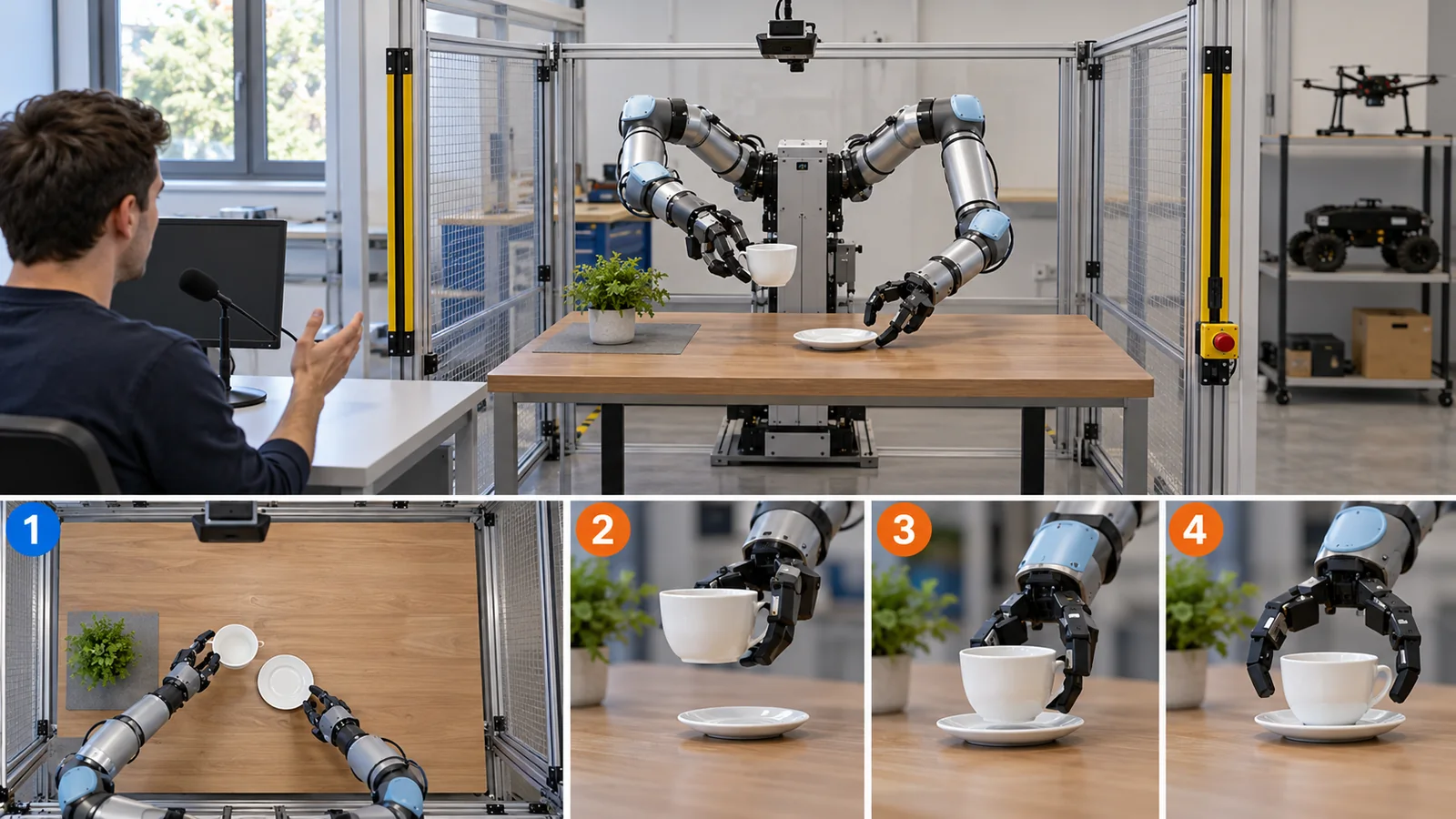
In recent years AI models that take an image and an instruction in words and output a robot’s actions directly (VLA: vision-language-action models) have appeared one after another. RT-2, OpenVLA, π0, GR00T N1, Gemini Robotics: the names are many, but the idea underneath is shared: “take a large model that learned from web images and text, and have it output robot actions”. Using analogies a materials engineer can relate to, this article explains the basic shape of a VLA, the three ways of outputting actions, and where the main models sit. The second half covers how to read success rates on benchmarks such as LIBERO, how to watch demonstration videos, and how to read yardsticks and standards, checking each point against papers and small calculations of our own. We do not rank specific models.
- What robot foundation models and VLAs are (the short version)
- The “foundation model” analogy — learning from the experience of many robots
- What is inside a VLA — from image, words and state to action
- Three ways of outputting actions, and a word on speed
- Reading the main models — what they report and how they are released
- Reading benchmarks — LIBERO as an example
- How to view demonstration videos and the word “general-purpose”
- A materials engineer’s view 2: a difference in “body” is a difference in materials and parts
- Limits, and what could not be confirmed / summary
- How to read the yardsticks and standards
- Glossary
- References
- Claim-to-source audit
Sourced = stated in published material (link given)
Our calculation = a figure this article derived, with the assumptions spelled out
Not yet confirmed = a plan, draft or work in progress that is not settled
Interpretations are marked separately as Commentary. Inference is shown in bold.
This field moves fast, and the state of models and evaluations changes within months. The model names, dates and status here are what we could confirm from public material on 25 October 2026. The success rates and processing speeds are values reported for the robots, tasks, environments, numbers of trials and computers each paper chose, and most were measured by the group that developed the model. We do not rank models by lining up numbers from different set-ups. Words such as “general-purpose” or “world first” are treated as the developer’s claims. The calculations in Chapters 4 and 6 are arithmetic on values from the papers (not the performance of any real machine). For standards (ISO) we confirmed only number, title and stage and did not read the text.
1. What robot foundation models and VLAs are (the short version)
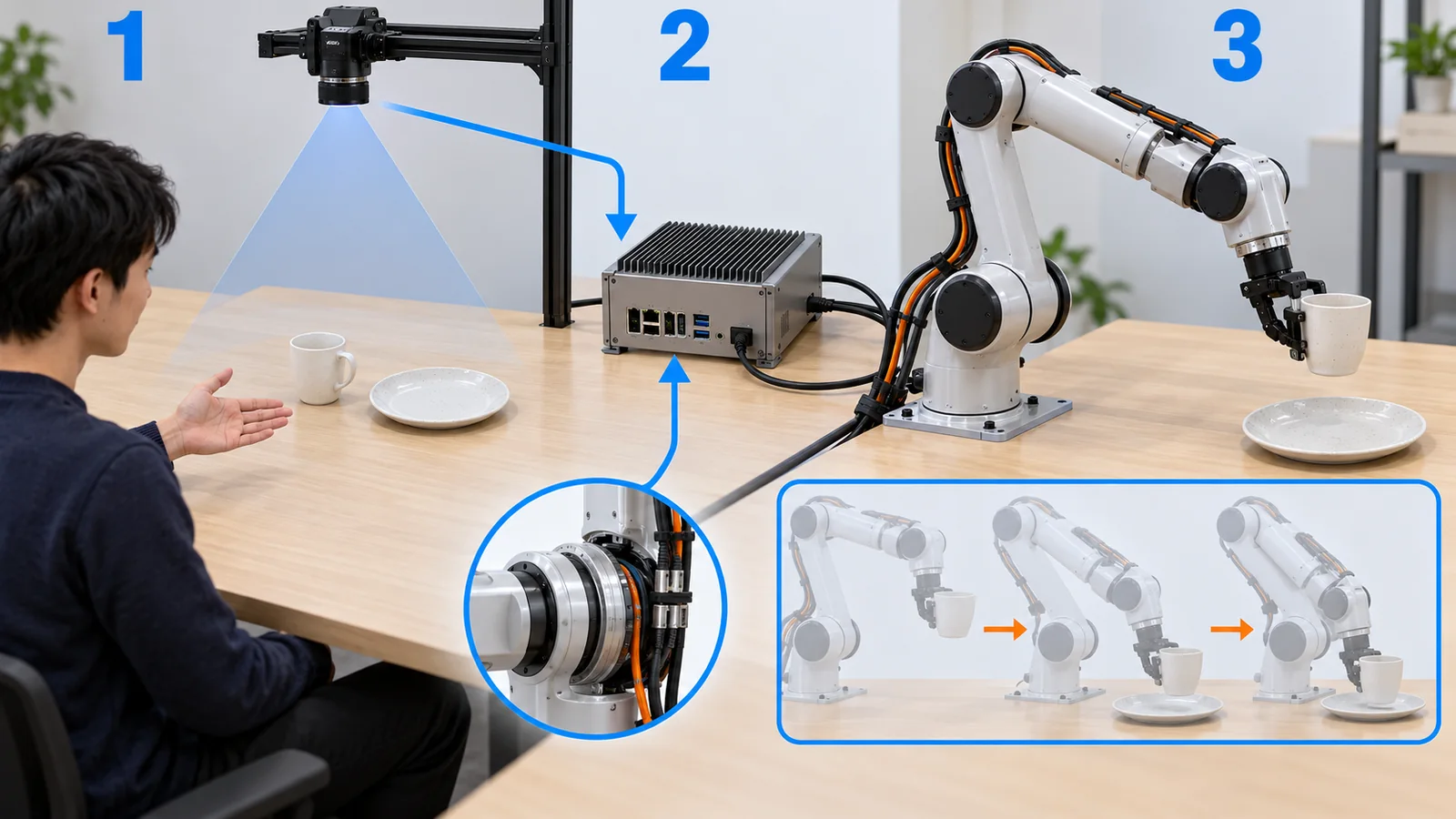
- A VLA “sees, listens and moves”: give it camera images, an instruction in words (for example “put the red cup on the plate”) and the robot’s state, and it returns several steps of actions. What they share is that they build on a vision-language model (VLM) pre-trained on web images and textSourced[Ref. 2]
- How actions are output is the crux of the design: there are methods that cut each dimension into 256 bins and emit “tokens” (RT-2, OpenVLA), a method that compresses them into fewer tokens (FAST), and methods that generate smooth continuous values (π0, GR00T N1)Sourced[Ref. 2, 5, 8, 7, 11]. For dexterous work at high frequencies such as 50 Hz, this choice matters
- 97% on a benchmark is not 97% on the shop floor: even on the same LIBERO benchmark, the number changes with inputs and fine-tuning set-upSourced[Ref. 6]. There are also reports (preprints) that performance falls sharply when conditions are changed a littleSourced[Ref. 16, 17]. Read a success rate together with the robot, task, number of trials, whether it was fine-tuned and whether it was autonomous
In this series’ shared picture, a physical-AI or robot foundation model is “an AI that has learned general ways of moving from the experience of many robots”. The limit of that picture is that, however general it looks, it can be weak in situations it has not been trained on. One more word: policy. It is a function that returns the next action from what is seen (the observation), and a VLA is a policy built as a very large neural network. A robot is a combination of “sense (sensors), think (control and intelligence) and act (actuators)”, and a VLA sits at the centre of “think”.
Our article on world models and embodied AI gives an overview of the flow of VLAs, together with world models, and a list of the main models. This article follows on and goes deeper into what is inside a VLA (how actions are output) and how to read benchmarks. Our article on imitation and reinforcement learning covers the two main families of learning, our article on teleoperation and data collection covers how training data is gathered, our article on robot simulation and digital twins covers the simulators that are also used for evaluation, and our article on the fundamentals of robot control covers the lower layer that moves the robot to the targets a VLA outputs.
A success rate has meaning only when it comes with “on which robot, which task, how many times, under which set-up”. “A general-purpose robot at X%” without those conditions can be used neither for comparison nor for expectation.
2. The “foundation model” analogy — learning from the experience of many robots
The AI that moves a robot has usually been built afresh for each machine and each job: collect data and train for one task on one robot. The foundation-model idea changes this. First learn general abilities from diverse, large-scale data (pre-training), then adjust with data from your own robot and your own task (fine-tuning).
For example, Open X-Embodiment pooled data on 527 skills (160,266 tasks) collected by 21 institutions on 22 kinds of robot into a standard format, and reports that a model trained on it showed “positive transfer” from the experience of other robots [Ref. 3]Sourced. Octo is an open model trained on 800,000 trajectories from that data, and the authors state that it can be fine-tuned to new sensors and action spaces in a few hours on consumer GPUs [Ref. 4]Sourced.
Pre-training is a starting point. Your robot’s hand shape, friction, camera position and workbench differ from those in the pre-training data, so fine-tuning is usually needed. The OpenVLA paper also studies efficient fine-tuning because of the problem that VLAs need fine-tuning on a new robot set-up [Ref. 5] (this includes our commentary).
3. What is inside a VLA — from image, words and state to action
Let us look at the basic shape in a figure. There are three inputs: an image, an instruction in words and the robot’s state (joint angles and so on). A vision-language model (VLM) pre-trained on web images and text receives them, and an action output part at the end produces several steps of actions.
Original SVG, detailed explanation and sources
Original SVG reference: Conceptual diagram (vector drawing). A model that takes images, words and the robot’s state and returns several steps of actions. Building on knowledge learned from web images and text is what VLAs since RT-2 [Ref. 2] have in common. The figure is a rough arrangement, not the internal structure of any specific model.
(1) RT-2: treating actions as “a kind of language”
RT-2 co-fine-tunes a web-scale VLM on robot trajectory data and on web vision-language tasks (such as question answering about images) and has it output robot actions as text tokens, in the same format as language. The paper calls such models VLAs. It reports 6,000 evaluation trials, with generalisation to new objects and the interpretation of commands not in the training data [Ref. 2]Sourced.
(2) OpenVLA: an open 7B VLA
OpenVLA is an open VLA with 7 billion (7B) parameters, trained on 970,000 real-robot demonstrations. It combines the Llama 2 language model with visual features from DINOv2 and SigLIP. It reports 16.5% higher absolute success than the 55B RT-2-X across 29 tasks (with one-seventh of the parameters), and 20.4% higher than Diffusion Policy when fine-tuned to new settings (values under the paper’s settings) [Ref. 5]Sourced.
(3) π0 and GR00T N1: a dedicated part for actions
- π0 adds an action expert of about 300 million parameters to the 3B VLM (PaliGemma), for 3.3 billion parameters in all. It generates actions as continuous values by flow matching, and handles chunks of 50 steps of actions (action chunks) at up to 50 Hz [Ref. 7]Sourced
- GR00T N1 has two systems. The VLM, System 2, interprets the environment and the instruction (10 Hz on an L40 GPU), and a diffusion transformer, System 1, generates smooth motion at a high frequency (120 Hz). The released GR00T-N1-2B has about 2.2 billion parameters. It reports training on a mixture of real-robot trajectories, human video and synthetic data [Ref. 11]Sourced
A language model is built to output “the next token”. A robot’s action is a set of continuous numbers, such as joint angles, and cannot be emitted as it is. Three ideas emerged: (1) cut the numbers into bins and turn them into “tokens”, (2) compress them into fewer tokens, and (3) add a dedicated part that produces the numbers directly. The next chapter checks the three (this is this article’s arrangement).
4. Three ways of outputting actions, and a word on speed
(1) Emit as tokens: cut into 256 bins
RT-2 cuts each action dimension (except the termination command) into 256 bins and expresses one action as 8 integers [Ref. 2]Sourced. OpenVLA also cuts each dimension into 256 bins, dividing evenly the range between the 1st and 99th percentiles of the training data so that extreme outliers do not make the bins coarse [Ref. 5]Sourced.
(2) Emit compressed: FAST
Simple binning was found to produce too many tokens, and to learn poorly, for high-frequency data such as 50 Hz. FAST converts the action sequence into frequency components with a discrete cosine transform, compresses it, and expresses it with few tokens [Ref. 8]Sourced.
As the paper’s table shows, the number of tokens under simple binning equals dimensions x control frequency (35 for 7 dimensions at 5 Hz, 700 for 14 dimensions at 50 Hz)Our calculation. If one second of actions is written out as tokens, ten times the frequency means ten times the tokens. For FAST, the paper reports that under the same conditions 700 tokens for 14 dimensions at 50 Hz become 53, a difference of about 13-fold [Ref. 8]Sourced.
(3) Generate continuous values directly: flow matching and diffusion
The flow matching of π0 and the diffusion transformer of GR00T N1 are generation methods that start from noise and gradually extract a smooth action sequence [Ref. 7, 11]. Since they do not convert to tokens, they can output a whole chunk of actions at once, even at high frequency. π0 reports an on-board inference time of 73 ms (image processing, observation processing, ten iterations to generate actions, and network latency together) [Ref. 7]Sourced.
Putting speed into numbers
To run at a high frequency, the model’s “decision interval” matters. From the values in the papers we calculate the interval of one decision (Our calculation).
| Model (source) | Speed stated in the paper | Interval of one decision (our calculation) | Note |
|---|---|---|---|
| RT-2 (55B) [Ref. 2] | 1-3 Hz (queries a multi-TPU cloud service) | about 0.33-1 s | The 5B version runs at about 5 Hz (about 0.2 s) |
| OpenVLA (7B) [Ref. 5] | about 6 Hz (RTX 4090, no optimisation) | about 0.17 s | One step of action per decision |
| π0 [Ref. 7] | On 50 Hz robots, inference after every 25 steps executed (every 0.5 s) | 25 steps every 0.5 s | Inference takes 73 ms. The high frequency comes from chunks of actions, not from the number of decisions |
| GR00T N1 [Ref. 11] | System 2 at 10 Hz, System 1 at 120 Hz. A chunk of 16 actions takes 63.9 ms (L40) | System 1: an action about every 8.3 ms | Roles are divided between two systems |
Our calculation. Decision interval = 1 / frequency. The computers, robots and tasks differ, so the numbers cannot be ranked. We use the values stated in the papers as they are.
What this shows is that a method that outputs chunks of actions can run a robot at a high frequency even if the model is slow. For example, even with two inferences per second, outputting 25 steps at a time makes a 50 Hz motion possible. The price is that, in the middle of a chunk, the robot cannot react to new observations (commentary).
OpenVLA (7B) states that it needs 15 GB of GPU memory without quantisation [Ref. 5]. RT-2’s approach of querying the cloud depends on network delay and connection [Ref. 2]. Carrying a computer inside the robot increases power consumption, heat, cooling and the weight of the battery (this is this article’s general view, not a measurement on a particular machine). This connects to our articles on edge AI and on-device AI (limits of power and heat) and on power sources for robots and drones (batteries and weight). Attempts at small VLAs exist too: SmolVLA is reported to be trainable on a single GPU, to run on consumer GPUs or even CPUs, and to perform comparably to VLAs ten times larger [Ref. 14]Sourced (a report by its developers, which we did not independently confirm).
5. Reading the main models — what they report and how they are released
The table below lines up the main models in terms of what each paper reports and how it is released. Because the evaluation conditions differ, the numbers in different rows cannot be compared to rank the models.
| Model (source) | Key points (as described in the paper) | Evaluation conditions (as reported) | Release status | Notes on reading |
|---|---|---|---|---|
| RT-1 (Google, 2022) [Ref. 1] | Studied how generalisation depends on data size, model size and diversity, using large-scale real-robot data and a high-capacity transformer | A study based on large-scale data collection on real robots | Not checked here | Not a VLA; an early example of outputting actions directly |
| RT-2 (Google DeepMind, 2023) [Ref. 2] | Co-fine-tunes a VLM and outputs actions as text tokens. Used the name “VLA” | 6,000 evaluation trials | Not checked here | The 55B model runs at 1-3 Hz. Large, and assumes a network connection |
| Octo (2024) [Ref. 4] | An open policy trained on 800,000 trajectories; fine-tuned in a few hours | Tested on nine robot platforms | Open source (as stated in the paper) | A policy not built on a VLM |
| OpenVLA (2024) [Ref. 5] | 970,000 demonstrations, 7B. LoRA fine-tuning and quantisation | 16.5% higher absolute success than RT-2-X over 29 tasks | Checkpoints and code released (as stated in the paper) | Comparisons are on the paper’s tasks and set-up |
| π0 (Physical Intelligence, 2024) [Ref. 7] | PaliGemma plus an action expert, flow matching, up to 50 Hz | Laundry folding, table cleaning, box assembly and others | The official repository openpi is under Apache-2.0 [Ref. 10]. Contents of the weights not checked | The tasks were chosen by the developer |
| GR00T N1 (NVIDIA, 2025) [Ref. 11] | A dual system. A mixture of real-robot data, human video and synthetic data | Simulation benchmarks and bimanual tasks on the Fourier GR-1 | Described as an “open foundation model”; GR00T-N1-2B released | The baselines were chosen by the paper |
| Gemini Robotics (Google DeepMind, 2025) [Ref. 12] | A VLA built on Gemini 2.0, and an embodied-reasoning (ER) model | Reports that with additional fine-tuning new short tasks can be learned from about 100 demonstrations | Not checked here | Reported on the developer’s tasks. Independent reproduction not confirmed |
| π0.5 (2025) [Ref. 9] | Co-training on heterogeneous tasks; long-horizon work in new homes | Tasks such as cleaning a kitchen or bedroom in new homes | Not checked here | The conditions of the “new homes” and any human intervention must be checked in the paper |
| Gemini Robotics 1.5 (2025) [Ref. 13] | Motion Transfer to learn from several embodiments, and reasoning before acting | Describes improved breakdown and execution of multi-step tasks | Not checked here | “State of the art” is the developer’s wording |
| SmolVLA (Hugging Face, 2025) [Ref. 14] | Small. Trained on a single GPU, runs on consumer GPUs or CPUs | Reports performance comparable to VLAs ten times larger | Code, models and training data released (as stated in the paper) | A report by the developers |
The arrangement of the table is this article’s own (commentary); all entries are Sourced from the papers and official material. Release status was checked on 25 October 2026 within what the papers state and what GitHub shows publicly. “Not checked here” does not mean “does not exist”.
6. Reading benchmarks — LIBERO as an example
(1) What LIBERO is
LIBERO is a simulated benchmark for studying “lifelong learning” in robot manipulation. It provides four task suites (130 tasks in total) and demonstrations teleoperated by people. Spatial, Object and Goal have 10 tasks each, and LIBERO-100 has 100 tasks [Ref. 15]Sourced. VLA papers often use four suites (Spatial, Object, Goal and Long), fine-tune on each suite and report success rates. In the OpenVLA-OFT paper each suite has 10 tasks and 500 expert demonstrations, and evaluation is 500 trials per suite (10 tasks x 50 episodes) [Ref. 6]Sourced.
(2) The “set-up” behind the numbers
- Inputs differ: rows that use only a third-person image sit in the same table as rows that add a wrist-camera image and the robot’s state [Ref. 6]
- Values quoted from other papers: many baselines in the table are values from their original papers, with different implementers and set-ups [Ref. 6]
- Handling of training data: even for the same OpenVLA-OFT, the same paper’s tables give an average of 97.1% with a modified dataset (unsuccessful demonstrations and similar removed) and 94.5% with the original data [Ref. 6]Sourced
- Best result reported: the paper says that checkpoints were tested every 50,000 steps and the best performance of each run was reported [Ref. 6]Sourced
- Fine-tuned per suite: these are not the scores of a general-purpose model solving the tasks “as it is”, but scores after adaptation to each suite [Ref. 6]
(3) Calculating the width of the numbers
With 500 trials per suite, a success rate of 97.1% has a 95% confidence interval (Wilson’s method) of about 95.4-98.3%, and a rate of 95.3% has about 93.0-96.8%Our calculation. This assumes independent trials under identical conditions and expresses only the statistical width. If the difference between rows is smaller than this width, you cannot say which is higher. And rows with different set-ups are not on the same yardstick to begin with.
(4) What was found after “nearly full marks”
Success rates in the 90s have become common on LIBERO, and “saturation” has been pointed out. In October 2025 two reports (preprints) re-evaluated models with conditions changed a little.
- LIBERO-PRO reports that when objects, initial states, instructions and environments are varied within reasonable bounds, the success rate of models above 90% on standard LIBERO falls to 0.0%, and points to a reliance on memorisation of layouts and motion sequences seen in training [Ref. 16]
- LIBERO-Plus reports that small changes of camera viewpoint or the robot’s initial state can drop performance from 95% to below 30%, and states that models barely react to changes in the language instruction and tend to ignore the instruction [Ref. 17]
Both are preprints, and we did not check their peer-review status. The models they evaluated may also differ from the one you use. What can be said is the general caution that a high success rate on a benchmark is a result under that benchmark’s set-up and need not hold when conditions change (commentary).
In fact: a benchmark success rate is a value for that simulation environment, task and fine-tuning set-up. There are reports that a small change in camera position, lighting, objects or initial layout can bring performance down sharply [Ref. 16, 17]. On the shop floor, re-measure with your own robot, your own objects and your own environment.
(5) Seven questions for reading a success rate
Other benchmarks are read with the same questions. CALVIN is a simulated benchmark of language-conditioned, long-horizon manipulation [Ref. 18]. SIMPLER consists of simulation environments paired with real-robot policy evaluation, and reports a strong correlation with real-robot results for particular robot set-ups [Ref. 19]. RoboArena is a distributed real-robot evaluation in which evaluators freely choose tasks and environments and compare two policies double-blind; it ranked seven policies through more than 600 pairwise comparisons [Ref. 20]Sourced.
7. How to view demonstration videos and the word “general-purpose”
Videos are often used to introduce robots. A video can be shot by choosing the scene to show, so we do not treat it as evidence of capability. Check the following (this is this article’s arrangement).
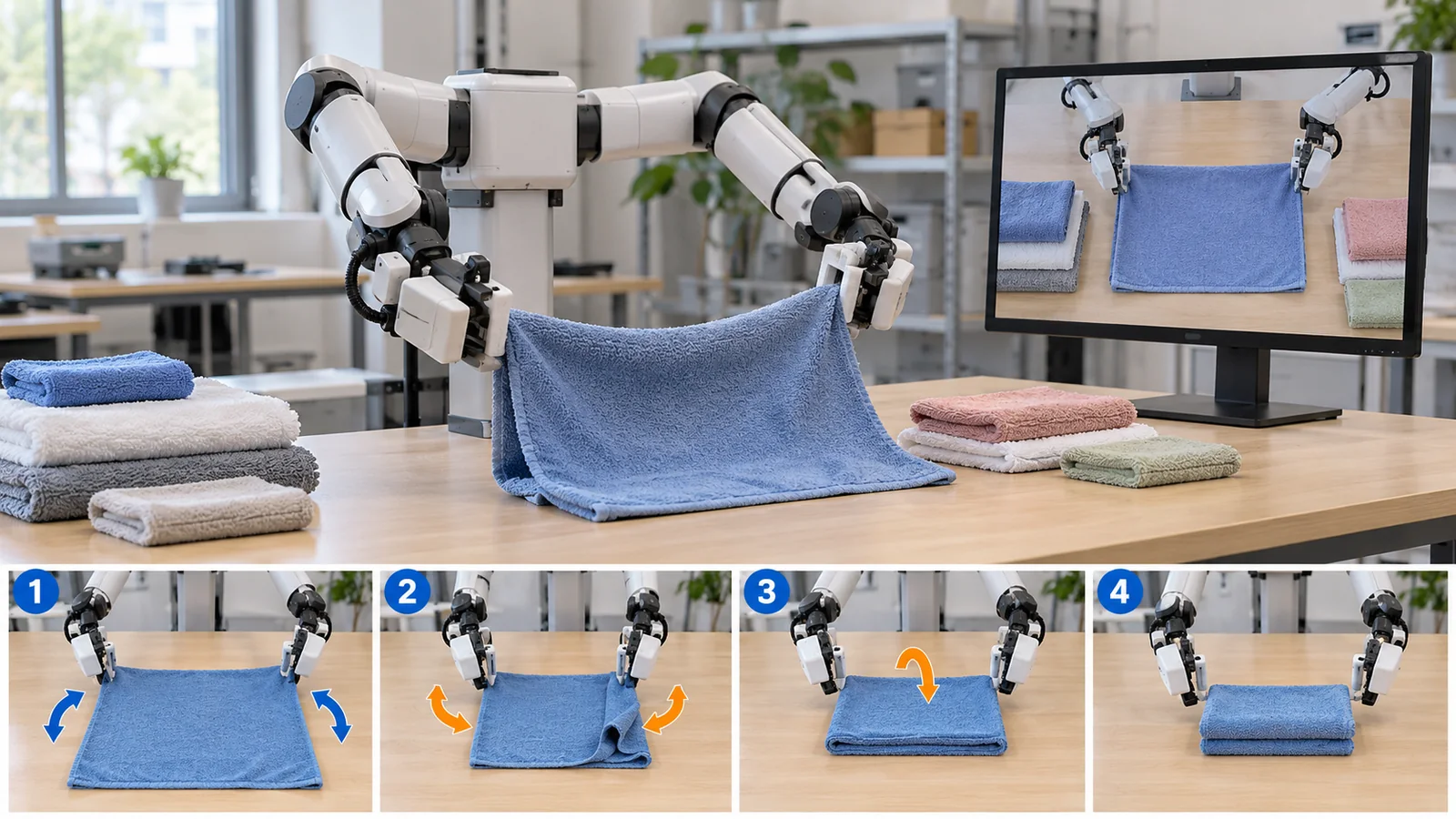
- Autonomous or teleoperated: is the robot moving by itself under a policy, or is a person operating it remotely? Is the motion a fixed sequence practised in advance? See whether the video’s description says “autonomous”, “1x speed” or “no teleoperation”
- One run out of how many: has a successful run been cut out? Are the success rate and number of trials given in a paper or technical document?
- Editing and speed: is there any fast-forwarding or cutting and splicing?
- Is the environment new: is it the same place and objects used in training? π0.5 describes evaluation in “new homes”, but the conditions (whether people intervened, for example) must be checked in the paper [Ref. 9]
How demonstration data are collected (teleoperation), and how to tell autonomous from teleoperated runs, are covered in detail in our article on teleoperation and data collection. Note that the training data of GR00T N1 include teleoperated data collected by people operating devices [Ref. 11]. Training data being teleoperated is a separate matter from a robot at evaluation time running autonomously, but it is worth checking whether the material says which one it is.
In fact: from the video alone you cannot tell whether the motion is autonomous under a policy, remotely operated by a person, or a fixed motion practised in advance. Treat the claim as the company’s statement, and check in papers and technical documents the degree of autonomy, the number of units, hours and tasks, and whether there has been independent verification.
8. A materials engineer’s view 2: a difference in “body” is a difference in materials and parts
In foundation models a difference in body is called embodiment. Open X-Embodiment pooled 22 kinds of robot [Ref. 3]. Seen with a materials eye, the differences in body are differences in properties and parts: friction of the fingertip material (rubber, metal, resin), stiffness and play of the joints, deflection of the arm and stiffness of the camera mounting. Even for the same “grasp” command, whether the object slips depends on the friction of the fingertips.
So fine-tuning data reflect the state of your own machine’s materials and parts. As rubber wears and joint play grows, the machine becomes different from the one the data were taken on, and fine-tuning may have to be repeated (this is this article’s general view, not a measurement on a particular model). Objects that change shape, such as cloth, are an even harder target.
9. Limits, and what could not be confirmed / summary
(1) Comparing model performance
Success rates and processing speeds are values reported for the robots, tasks, environments and computers each paper chose. We did not confirm independent third-party reproduction. We do not rank models.
(2) The inside of undisclosed models
For models whose weights are not released, such as Gemini Robotics, internal details can be confirmed only within the technical reports. We limited release status to what the papers state and what GitHub shows publicly, and did not check the availability of companies’ services.
(3) Preprints
LIBERO-PRO and LIBERO-Plus are preprints from October 2025, and we did not check their peer-review status. Their results are reports on the models those papers evaluated.
(4) The text of standards
For ISO standards we confirmed only number, title and stage and did not read the text. We could not confirm a published standard that directly defines how to assess the safety of learned policies (VLAs).
(5) What we did not cover
World models are in our article on world models and embodied AI, and humanoid products and businesses in our article on humanoid robots. We do not cover market size, prices or share prices.
- A VLA builds on a web-trained VLM and outputs actions from images, words and state. Use the analogy “an AI that learned from the experience of many robots” together with its limit: it is weak in situations it has not been trained onSourced
- There are three ways to output actions: tokens (256 bins), compressed tokens (FAST) and generation of continuous values (flow and diffusion). At high frequencies the number of tokens under simple binning grows as “dimensions x frequency”SourcedOur calculation
- Benchmark success rates change with set-up of inputs, fine-tuning and sources, and some reports say they fall sharply when conditions change a little. Read them with the seven questionsSourced
10. How to read the yardsticks and standards
A VLA is basically evaluated by the success rate on tasks, measured on simulated benchmarks and on real robots. In practice, robustness when conditions change, speed of inference (latency) and the amount of data needed for fine-tuning also act as yardsticks. Common standards are still few, and safety rests on existing standards such as those for industrial robots (checked 25 October 2026).
| Item evaluated | Representative tests and benchmarks (name, source) | Standards, rules and guidance (ISO and others) | Notes on reading |
|---|---|---|---|
| Success rate in simulation | LIBERO (four suites, 130 tasks) [Ref. 15], CALVIN [Ref. 18]Sourced | Could not be confirmed | Values change with inputs, fine-tuning and the source of quoted values. Saturation and memorisation have been pointed out (Chapter 6) |
| Robustness (evaluation with conditions changed) | LIBERO-PRO [Ref. 16], LIBERO-Plus [Ref. 17] (preprints)Sourced | Could not be confirmed | The definition of evaluation differs by study. Peer-review status not checked |
| Correspondence between simulation and real machine | SIMPLER (strong correlation with real machines on particular robot set-ups) [Ref. 19]Sourced | Could not be confirmed | Generalisation to other robots and tasks is not guaranteed |
| Evaluating generalist policies on real machines | RoboArena (double-blind pairwise comparison, seven policies, over 600 comparisons) [Ref. 20]. RT-2’s 6,000 evaluation trials [Ref. 2]Sourced | Could not be confirmed | Letting evaluators choose tasks gives diversity at the cost of unmatched conditions |
| Safety of industrial robots | — (a standard, not a benchmark) | ISO 10218-1:2025 (the robot itself) and ISO 10218-2:2025 (applications and robot cells) [Ref. 21, 22]Sourced | They do not directly define how to evaluate a learned policy. The text is paid |
| Using AI in safety-related functions | — | ISO/IEC TR 5469:2024 (a technical report) [Ref. 23]. ISO/IEC CD TS 22440-1 (requirements; committee-draft stage) [Ref. 24]SourcedNot yet confirmed | A technical report provides information. TS 22440 is in preparation and its content is not settled |
The arrangement of the table is Our calculation (organising). Numbers, titles and stages of ISO standards were checked on the official pages (25 October 2026). The text of the standards is paid, so we stay with titles and stages.
Notes on reading (for materials engineers)
- Demonstrations, benchmarks and the shop floor are different things: videos and benchmarks give values for chosen tasks in tidy environments. Re-measure with your own objects, lighting, floor and a worn machine
- A developer’s report and independent verification are different: most VLA results are reported by the group or company that developed the model. Check whether independent evaluation (such as RoboArena) exists
- Is a standard a requirement, information, or in preparation? ISO 10218 sets safety requirements, ISO/IEC TR 5469 provides information, and ISO/IEC TS 22440 is in preparation. “Conforms to a standard” does not mean a learned policy is safe
- Plans and schedules are not settled: companies’ “coming soon” or “mass production” statements are Not yet confirmed. We do not cover them here
11. Glossary
- Foundation model
- A large model pre-trained on diverse, large-scale data and later fine-tuned for many uses.
- Robot foundation model
- An AI that has learned general ways of moving from the experience of many robots. It can be weak in situations it has not been trained on.
- VLM (vision-language model)
- A model that handles images and words together.
- VLA (vision-language-action model)
- A model that takes images and an instruction in words and outputs robot actions.
- Policy
- A function that returns the next action from observations.
- Token
- The smallest unit a model handles. In some VLAs, actions are also expressed as tokens.
- Action tokenisation
- Turning continuous action values into a sequence of tokens.
- Bin
- An interval into which a continuous value is cut. RT-2 and OpenVLA cut each dimension into 256.
- Action chunk
- Several steps of actions output at once.
- Flow matching / diffusion
- Generation methods that gradually recover an action sequence from noise.
- Embodiment
- The robot’s body: its shape, joints and sensors.
- Pre-training
- Learning general abilities first from large amounts of data.
- Fine-tuning
- Training a pre-trained model further on your own data.
- LoRA
- A light fine-tuning method that adds and trains only a small number of parameters.
- Zero-shot
- Handling a new task or instruction with no additional training.
- Embodied reasoning (ER)
- Reasoning needed by robots, such as understanding space and time and pointing at objects.
- Benchmark / suite
- A shared set of tasks for comparing performance; a suite is a group of tasks within it.
- Success rate
- The fraction of trials that achieved the task; read together with the number of trials and conditions.
- Memorisation
- Succeeding by remembering the layouts and motion sequences of training rather than understanding the task.
- Control frequency
- How many times per second actions are decided (Hz).
- Inference latency
- The time from receiving an observation to producing an action.
12. References
- Brohan A. et al. “RT-1: Robotics Transformer for Real-World Control at Scale”, arXiv:2212.06817 (2022) — arxiv.org/abs/2212.06817
- Brohan A. et al. “RT-2: Vision-Language-Action Models Transfer Web Knowledge to Robotic Control”, arXiv:2307.15818 (2023) — arxiv.org/abs/2307.15818
- Open X-Embodiment Collaboration “Open X-Embodiment: Robotic Learning Datasets and RT-X Models”, arXiv:2310.08864 (2023) — arxiv.org/abs/2310.08864
- Octo Model Team “Octo: An Open-Source Generalist Robot Policy”, arXiv:2405.12213 (2024) — arxiv.org/abs/2405.12213
- Kim M. J. et al. “OpenVLA: An Open-Source Vision-Language-Action Model”, arXiv:2406.09246 (2024) — arxiv.org/abs/2406.09246
- Kim M. J., Finn C., Liang P. “Fine-Tuning Vision-Language-Action Models: Optimizing Speed and Success” (OpenVLA-OFT), arXiv:2502.19645 (2025) — arxiv.org/abs/2502.19645
- Black K. et al. (Physical Intelligence) “π0: A Vision-Language-Action Flow Model for General Robot Control”, arXiv:2410.24164 (2024) — arxiv.org/abs/2410.24164
- Pertsch K. et al. “FAST: Efficient Action Tokenization for Vision-Language-Action Models”, arXiv:2501.09747 (2025) — arxiv.org/abs/2501.09747
- Physical Intelligence et al. “π0.5: a Vision-Language-Action Model with Open-World Generalization”, arXiv:2504.16054 (2025) — arxiv.org/abs/2504.16054
- Physical Intelligence GitHub repository “openpi” (Apache License 2.0). Repository and licence confirmed through GitHub’s public API (25 October 2026); the contents of the released weights were not checked here — github.com/Physical-Intelligence/openpi
- NVIDIA et al. “GR00T N1: An Open Foundation Model for Generalist Humanoid Robots”, arXiv:2503.14734 (2025) — arxiv.org/abs/2503.14734
- Gemini Robotics Team “Gemini Robotics: Bringing AI into the Physical World”, arXiv:2503.20020 (2025) — arxiv.org/abs/2503.20020
- Gemini Robotics Team “Gemini Robotics 1.5: Pushing the Frontier of Generalist Robots with Advanced Embodied Reasoning, Thinking, and Motion Transfer”, arXiv:2510.03342 (2025) — arxiv.org/abs/2510.03342
- Shukor M. et al. “SmolVLA: A Vision-Language-Action Model for Affordable and Efficient Robotics”, arXiv:2506.01844 (2025) — arxiv.org/abs/2506.01844
- Liu B. et al. “LIBERO: Benchmarking Knowledge Transfer for Lifelong Robot Learning”, arXiv:2306.03310 (2023; NeurIPS 2023 Datasets and Benchmarks) — arxiv.org/abs/2306.03310
- Zhou X. et al. “LIBERO-PRO: Towards Robust and Fair Evaluation of Vision-Language-Action Models Beyond Memorization”, arXiv:2510.03827 (2025; preprint). A preprint; its peer-review status was not checked here — arxiv.org/abs/2510.03827
- Fei S. et al. “LIBERO-Plus: In-depth Robustness Analysis of Vision-Language-Action Models”, arXiv:2510.13626 (2025; preprint). A preprint; its peer-review status was not checked here — arxiv.org/abs/2510.13626
- Mees O. et al. “CALVIN: A Benchmark for Language-Conditioned Policy Learning for Long-Horizon Robot Manipulation Tasks”, arXiv:2112.03227 (2021) — arxiv.org/abs/2112.03227
- Li X. et al. “Evaluating Real-World Robot Manipulation Policies in Simulation” (SIMPLER), arXiv:2405.05941 (2024) — arxiv.org/abs/2405.05941
- Atreya P. et al. “RoboArena: Distributed Real-World Evaluation of Generalist Robot Policies”, arXiv:2506.18123 (2025) — arxiv.org/abs/2506.18123
- ISO ISO 10218-1:2025 “Robotics — Safety requirements — Part 1: Industrial robots” (Edition 3, February 2025). Checked 25 October 2026 — iso.org/standard/73933.html
- ISO ISO 10218-2:2025 “Robotics — Safety requirements — Part 2: Industrial robot applications and robot cells” (Edition 2, February 2025). Checked 25 October 2026 — iso.org/standard/73934.html
- ISO/IEC ISO/IEC TR 5469:2024 “Artificial intelligence — Functional safety and AI systems” (Edition 1, January 2024). Checked 25 October 2026 — iso.org/standard/81283.html
- ISO/IEC ISO/IEC CD TS 22440-1 “Artificial intelligence — Functional safety and AI systems — Part 1: Requirements” (committee draft; stage 30.60). Checked 25 October 2026 — iso.org/standard/89535.html
13. Claim-to-source audit
| Claim in the text | Basis | Class |
|---|---|---|
| The definition of a VLA: co-fine-tuning a web-scale VLM on robot trajectory data and web vision-language tasks and outputting actions as text tokens (RT-2); 6,000 evaluation trials; generalisation to new objects | Brohan et al. (RT-2, abstract) Reference 2 https://arxiv.org/abs/2307.15818 Reference 1 https://arxiv.org/abs/2212.06817 | Sourced |
| RT-2: each action dimension (except the termination command) is cut into 256 bins and an action is expressed as 8 integers; the 55B model runs at 1-3 Hz and the 5B model at about 5 Hz | Brohan et al. (RT-2, body text) Reference 2 https://arxiv.org/abs/2307.15818 | Sourced |
| OpenVLA: 7B parameters, trained on 970,000 real-robot demonstrations, Llama 2 with DINOv2 and SigLIP visual features; 16.5% higher absolute success than RT-2-X (55B) across 29 tasks and 20.4% over Diffusion Policy; LoRA fine-tuning; 256 bins per dimension (cut between the 1st and 99th percentiles of the training data); about 6 Hz on an RTX 4090 and 15 GB in bf16 | Kim et al. (abstract, Section 3) Reference 5 https://arxiv.org/abs/2406.09246 | Sourced |
| pi0: a pre-trained VLM (PaliGemma 3B) plus an action expert (about 300M), 3.3B parameters in total; flow matching, action chunk H = 50, up to 50 Hz; evaluated on laundry folding, table cleaning, box assembly and more; 73 ms of on-board inference | Black et al. (abstract, body, appendix) Reference 7 https://arxiv.org/abs/2410.24164 | Sourced |
| FAST: naive binning-based action tokenisation performs poorly on high-frequency data; a compression scheme based on the discrete cosine transform; tokens per one-second chunk (BridgeV2 35 to 20, DROID 105 to 29, Bussing 140 to 28, Shirt Fold 700 to 53) | Pertsch et al. (abstract, Table I) Reference 8 https://arxiv.org/abs/2501.09747 | Sourced |
| That the naive token count = dimensions x control frequency (7 x 5 = 35, 7 x 15 = 105, 7 x 20 = 140, 14 x 50 = 700) matches the table, and the recomputed compression ratios of each row | Our calculation (a check of the values in Table I of the FAST paper) | Our calculation |
| GR00T N1: a dual system (the VLM System 2 at 10 Hz, the diffusion-transformer System 1 at 120 Hz); the released GR00T-N1-2B has about 2.2 billion parameters (1.34 billion in the VLM); 63.9 ms for a 16-action chunk on an L40 GPU; trained on a mix of real-robot trajectories, human video and synthetic data; bimanual tasks on the Fourier GR-1 | NVIDIA et al. (technical report) Reference 11 https://arxiv.org/abs/2503.14734 | Sourced |
| Gemini Robotics: a VLA built on Gemini 2.0 and an ER model with stronger spatial and temporal understanding; with further fine-tuning, new short tasks can be learned from as few as 100 demonstrations. Gemini Robotics 1.5: Motion Transfer to learn from data of several embodiments, and multi-level reasoning before acting | Gemini Robotics Team (technical reports, abstracts) Reference 12 https://arxiv.org/abs/2503.20020 Reference 13 https://arxiv.org/abs/2510.03342 | Sourced |
| pi0.5: reported to perform long-horizon, dexterous tasks in entirely new homes through co-training on heterogeneous tasks; SmolVLA: a small VLA trainable on a single GPU and deployable on consumer GPUs or CPUs, reported to perform comparably to VLAs ten times larger | Physical Intelligence et al.; Shukor et al. (abstracts) Reference 9 https://arxiv.org/abs/2504.16054 Reference 14 https://arxiv.org/abs/2506.01844 | Sourced |
| Open X-Embodiment: standardised data from 21 institutions, 22 robots and 527 skills (160,266 tasks); Octo: an open model trained on 800,000 trajectories from Open X-Embodiment, fine-tunable in a few hours on consumer GPUs and tested on nine robot platforms | Open X-Embodiment Collaboration; Octo Model Team (abstracts) Reference 3 https://arxiv.org/abs/2310.08864 Reference 4 https://arxiv.org/abs/2405.12213 | Sourced |
| That the openpi repository is public under the Apache License 2.0 (the contents of released weights were not checked) | GitHub public API (25 October 2026) Reference 10 https://github.com/Physical-Intelligence/openpi | Sourced |
| LIBERO: four task suites with 130 tasks in total, with human-teleoperated demonstrations; Spatial, Object and Goal have 10 tasks each and LIBERO-100 has 100 | Liu et al. (abstract, Figure 1) Reference 15 https://arxiv.org/abs/2306.03310 | Sourced |
| The LIBERO set-up in the OFT paper: four suites (Spatial, Object, Goal, Long), 10 tasks and 500 expert demonstrations per suite, 500 trials per suite (10 tasks x 50 episodes); independent fine-tuning per suite; inputs differing between rows of the table; the same OFT averaging 97.1% or 94.5% depending on the handling of training data (a modified version without unsuccessful demonstrations versus the original); reporting the best checkpoint of each run; OpenVLA’s average success rising from 76.5% to 97.1%; the values in each table row | Kim et al. (OFT, abstract, experimental section, tables) Reference 6 https://arxiv.org/abs/2502.19645 | Sourced |
| The confidence intervals of success rates from 500 trials (about 95.4-98.3% at 97.1% and about 93.0-96.8% at 95.3%) and the recomputed four-suite averages (76.5, 95.35, 97.1, 94.15) | Our calculation (Wilson’s method; idealised as independent trials under identical conditions) | Our calculation |
| LIBERO-PRO: a report that models above 90% on standard LIBERO fall to 0.0% when objects, initial states, instructions and environments are varied within reasonable bounds, and a point about reliance on memorisation. LIBERO-Plus: a report that performance falls from 95% to below 30% with modest changes of camera viewpoint and initial state, and that models are largely insensitive to language changes and tend to ignore instructions (both preprints) | Zhou et al.; Fei et al. (abstracts; preprints) Reference 16 https://arxiv.org/abs/2510.03827 Reference 17 https://arxiv.org/abs/2510.13626 | Sourced |
| CALVIN (a simulated benchmark of language-conditioned long-horizon manipulation), SIMPLER (simulation environments paired with real-robot policy evaluation, reported to correlate strongly with the real world) and RoboArena (seven policies ranked through more than 600 pairwise real-robot comparisons) | Mees et al.; Li et al.; Atreya et al. (abstracts) Reference 18 https://arxiv.org/abs/2112.03227 Reference 19 https://arxiv.org/abs/2405.05941 Reference 20 https://arxiv.org/abs/2506.18123 | Sourced |
| The numbers, titles and stages of ISO 10218-1:2025 and ISO 10218-2:2025 (safety requirements for industrial robots), ISO/IEC TR 5469:2024 (functional safety and AI; a technical report) and ISO/IEC CD TS 22440-1 (functional safety and AI: requirements; committee draft) | ISO pages Reference 21 https://www.iso.org/standard/73933.html Reference 22 https://www.iso.org/standard/73934.html Reference 23 https://www.iso.org/standard/81283.html Reference 24 https://www.iso.org/standard/89535.html | Sourced |
| The analogy of an AI that has learned general ways of moving from the experience of many robots and its limits, the seven questions for reading success rates, the three-way arrangement of action output, and why fine-tuning is needed | This article’s commentary based on the published material; not views stated by the institutions | Commentary |
| Independent third-party reproduction of each model, rankings among models, the internal structure of undisclosed models, whether each demonstration video is autonomous or teleoperated, and the text of standards | Not included because they could not be confirmed from primary sources within this article’s research (commentary) | Commentary |
| That Figures 1 and 8 are frames for AI-generated images, Figures 2, 3, 4 and 7 are explanatory concept diagrams, and Figures 5 and 6 contain our calculations | This article’s own note | Commentary |
Last updated: 25 October 2026 / Sources are limited to primary material (arXiv papers, public GitHub information and the official ISO pages). We could not read the text of the ISO standards because it is paid. LIBERO-PRO and LIBERO-Plus are preprints. The numerical examples are arithmetic on values from the papers and are not the performance of any real machine. We could not confirm, and so do not state, independent third-party reproduction of each model, rankings among models, the internal structure of undisclosed models, or a standard that directly defines the safety assessment of learned policies. Figures 1 and 8 are ImageGen-generated conceptual illustrations; the other figures are explanatory concept diagrams or figures containing our calculations.