TECHNOLOGY EXPLAINER
Surgical Robots
― How a tele-operated system extends the surgeon’s hands, and how to read an FDA “clearance”
“Surgical robot” makes many people picture a machine that operates by itself. The systems in wide use today, such as Intuitive’s da Vinci, are not like that. They are tele-operated: the surgeon moves hand controllers, and the system transmits that motion to the instruments. They do not decide on and perform surgery on their own. This article assumes no background in robotics or medicine. It covers (1) what the machine does, (2) how hand motion reaches the instrument (scaling, tremor filtering and wrists), (3) what is inside the instruments and the material problems they raise, (4) the difference between FDA “clearance” and “approval” and how to read the scope by type of surgery, and (5) the levels of autonomy and where research stands, using diagrams and a few small calculations.
It does not claim anything about treatment benefit or safety. It separates what could be confirmed, what is a company’s claim, what is a plan, and what could not be confirmed. This is a general technical explainer and not medical advice.
- The short version / what to know first / where this fits in the series
- What a surgical robot is: the robot does not do the surgery
- How hand motion reaches the instrument: pivot, wrist and scaling
- Inside the instruments, and materials: cables, fatigue, cleaning and sterilization
- FDA “clearance” and “approval”: three routes
- Reading the scope by type of surgery: the same machine differs by country and model
- Levels of autonomy, and where research stands
- How to read claims about effectiveness and safety (without concluding)
- Where things stand (checked 25 October 2026)
- How to read the yardsticks and standards
- Glossary / References / Claim-to-source audit
Sourced = stated in a published source (link given)
Our calculation = a value we calculated from stated assumptions
Not yet confirmed = a plan, a target, or research with no confirmed track record
Structural summaries and materials-related readings are marked as “explanation”. Inference is shown in bold. Every analogy comes with its limits.
An FDA “clearance” or “approval” means a device may be marketed for a defined range of uses. It does not show that outcomes are better than with other methods. This article only organizes which device is authorized for which type of surgery, as far as regulator documents show. It gives no advice on comparing operations, choosing a procedure, or choosing a hospital. Company announcements (installed base, procedure counts, trial results) are treated as company claims. This field changes quickly, so model names, indications and regulatory status carry a check date (25 October 2026).
1. The short version / what to know first / where this fits in the series
- Surgical robots are tele-operated. The FDA says that such a device cannot perform surgery without direct human control, so it is not actually a robot Sourced[Ref. 1]. The surgeon moves hand controllers at a console, and the motion is carried to the arms and instruments on a cart beside the patient.
- “Approval” and “clearance” are different words, and the scope is set per type of surgery. FDA documents describe the da Vinci 5 for urologic, general laparoscopic, gynecologic laparoscopic and general thoracoscopic procedures in adults (documents of 14 March 2024 and 16 July 2025) Sourced[Ref. 6, 7]. Medtronic’s Hugo was cleared on 3 December 2025 for minimally invasive urologic procedures in adults Sourced[Ref. 8].
- Machines that perform surgery autonomously are at the research stage. A 2022 study had a robot suture intestine autonomously in pigs, but within this article’s sources no marketed device doing this in human surgery could be confirmed Sourced[Ref. 21]. In September 2026 the FDA issued a draft guidance on premarket submissions for such devices; it is a draft and not yet in force Sourced[Ref. 5].
No prior knowledge is needed. It is enough to know that some operations are done through a few small holes, with a camera and long, thin instruments (laparoscopic surgery). Think of a robot as three things combined: sensing (sensors), thinking (control and intelligence), and moving (actuators). In a surgical robot the “thinking” is mainly done by the surgeon, and the robot’s job is to carry the motion accurately and correct it. (Limits of this view: the control software does do some “thinking”, such as correcting motion and monitoring safety.)
In drones and robotics, this is the standard example of a robot that a human operates. Remote operation in factories and disaster sites is covered in our explainer on teleoperation and data collection. Levels of autonomy and robot foundation models are covered in our explainer on robot foundation models and VLA. The parts that move an instrument’s wrist and joints are covered in our explainers on joint actuators and on speed reducers and gears, and how to read safety standards in general is covered in our explainer on robot safety standards. Medical-device regulation is a framework separate from industrial-robot safety standards, and that is the core of this article.
2. What a surgical robot is: the robot does not do the surgery
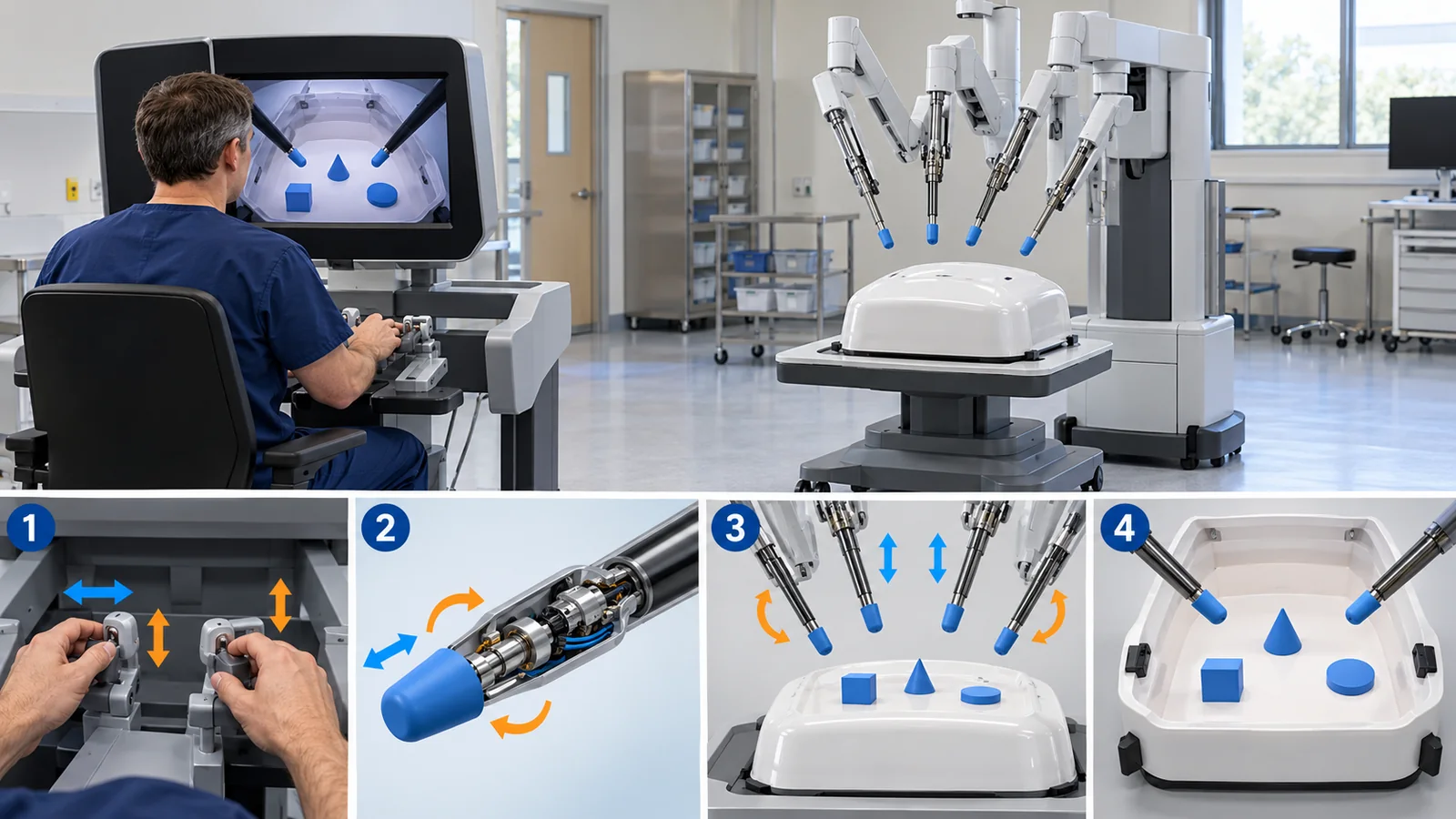
Start with laparoscopic surgery. A few small holes are made in the abdomen. A camera (endoscope) goes in through one, long thin instruments go in through the others, and the surgeon moves the instruments while watching a screen (explanation). A surgical robot helps with exactly this task of “watching a screen and moving long thin instruments”.
The U.S. Food and Drug Administration (FDA) calls these devices robotically-assisted surgical (RAS) devices and describes them as devices that let the surgeon use computer and software technology to control instruments. The parts are a console, a patient-side cart with mechanical arms, and a separate cart with supporting hardware. On the same page the FDA says the device cannot perform surgery without direct human control, so it is not actually a robot Sourced[Ref. 1].
Map the figure onto the three elements of a robot. Sensing is the endoscope camera, whose video reaches the surgeon’s eyes (force sensors exist only in some instruments). Thinking is mainly the surgeon. The control computer adjusts the motion ratio, filters tremor and monitors safety, but it does not decide how the operation proceeds. Moving is done by the motors in the arms and instruments (explanation).
This is inaccurate. The FDA says that a surgical robot cannot perform surgery without direct human control [Ref. 1]. Intuitive likewise describes its technology as translating the surgeon’s hand movements into movements of the instruments [Ref. 17]. The surgeon operates and the machine carries the motion. Autonomous robots are still at the research stage, as Chapter 7 shows. Some assistive functions, such as motion correction and safety monitoring, are automatic. The division of labor is neither “all manual” nor “all automatic”: the human decides, and the machine transmits and corrects the motion accurately.
3. How hand motion reaches the instrument: pivot, wrist and scaling
(1) The problem: the pivot reverses the motion
The instrument in conventional laparoscopic surgery is a straight stick. It pivots about the small hole in the abdominal wall, so when the hand moves left, the tip inside the body moves right. Think of a seesaw: the far side of the pivot moves the opposite way. (Limits of the analogy: a real stick also slides a little at the hole.) The stick also has no joint at its end, so the tip cannot be bent to change its direction (explanation).
Many surgical robots soften this with two devices. One is an instrument that bends like a wrist. Intuitive says most of its instruments have wristed joints for natural dexterity, with tips such as forceps, scissors and electrocautery tools shaped for each procedure Sourced[Ref. 17]. Hugo’s 510(k) summary also lists nine wristed instruments (needle drivers, graspers, shears and others) Sourced[Ref. 8]. The other is software that corrects direction, so the direction of the surgeon’s hand and the direction of the tip agree (panel 2 is a concept diagram of the idea).
(2) Scaling the motion and reducing tremor
Hand motion at the console is not copied one-to-one. A ratio can scale it down. Intuitive says its technology translates the surgeon’s hand movements into precise real-time micro-movements of the instruments, uses motion scaling to support precision in delicate tasks, and filters the tremor of the hands Sourced[Ref. 17].
Check it with numbers. Assume a 3:1 ratio. When the hand moves 30 mm, the instrument tip moves 30 / 3 = 10 mm Our calculation. A 1.5 mm hand tremor becomes 1.5 / 3 = 0.5 mm at the tip Our calculation. (The ratio is an assumed value for illustration; actual ratios were not checked.) Scaling shrinks the tremor by the same factor. A filter is a separate process that removes tremor on top of this.
You may think that if the robot corrects the motion it is half automatic. A paper that organizes the levels of autonomy for medical robots (Yang et al., 2017) helps here. It places a tele-operated surgical robot with motion scaling at “no autonomy (Level 0)”, because the output still represents the motion the surgeon wants Sourced[Ref. 20]. Scaling and tremor removal are ways to convey the surgeon’s intention more accurately; the robot is not choosing its own goal (the levels are shown in Chapter 7).
(3) Touch has long been a weak point
A known weakness of tele-operation is that no sense of force comes back to the surgeon’s hands. Intuitive says that the da Vinci 5, which the FDA cleared in 2024, has instruments that let surgeons sense and measure the force exerted on tissue (force feedback) Sourced[Ref. 17]. According to K232610, a sensor on the instrument detects directional forces and sends them back through the hand controls on the console, and six force-feedback instruments, including needle drivers and graspers, were added Sourced[Ref. 6].
The same document states that the force-feedback needle driver is contraindicated (must not be used) in hysterectomy and myomectomy, and recommends non-force-feedback needle drivers for suturing in those procedures Sourced[Ref. 6]. A new function therefore has a scope that the documents define in detail, procedure by procedure. Intuitive also states that the European certification of the da Vinci 5 (July 2025) excludes force feedback Sourced[Ref. 17].
4. Inside the instruments, and materials: cables, fatigue, cleaning and sterilization
It is often said that much of a surgical robot’s performance is set at the thin instrument wrist at the end of the arm. Let us look inside the instrument as a materials engineer.
Cables move the wrist
The shaft of an instrument is narrow, so motors cannot sit near the wrist. Many surgical robots therefore pull the wrist and jaws with cables from a drive unit at the base of the shaft. It resembles a puppet on strings. (Limits of the analogy: real cables run over several pulleys, and several are pulled in coordination at once.) Hugo’s 510(k) summary calls the system “cable-connected” capital equipment, but that describes how the main equipment is wired, not how the instruments are driven Sourced[Ref. 8]. The cable material and construction inside the instruments could not be confirmed from official sources for any specific model.
The general problems of cable-driven mechanisms have been studied. A 2017 University of Washington PhD thesis, using the RAVEN II surgical robot as its basis, reports that cable-driven mechanisms face control challenges from the hysteretic stretch of the cable and the dynamic friction of the guide pulleys, and it investigates the cable’s fatigue life and presents a prediction model Sourced[Ref. 23]. Hysteresis means that the stretch differs between loading and unloading at the same force. These are results for a research robot, not lifetimes of commercial systems.
A cable of twisted fine metal wires is a part that bends and pulls tens of thousands of times. If it stretches a lot, the tip lags behind the motor (backlash). If friction is high, force transmission differs by direction. If fatigue breaks it, the instrument’s life ends. The choice of cable material and construction therefore affects both tip position accuracy and the number of times the instrument can be reused (our explanation).
Intuitive says that most instruments are reusable for a defined number of procedures and that a memory chip inside each instrument generally does not allow use beyond the prescribed number Sourced[Ref. 17]. The actual number was not checked in this article. Managing life by a count can be read as a way to stay on the safe side with a conservative upper limit, without measuring each instrument’s damage from fatigue, wear and repeated cleaning and sterilization (inference).
Wash, sterilize, use again
Reusable instruments must be cleaned, inspected and sterilized for each surgery. Hugo’s 510(k) summary lists non-clinical tests that include sterility testing, shelf-life testing, reprocessing (cleaning and sterilization) validation, and biocompatibility and pyrogenicity testing Sourced[Ref. 8]. The same summary says the drapes and instrument tip covers are single-use (packaged sterile) and that the reusable instruments are not shipped sterile (the hospital processes them) Sourced[Ref. 8]. The da Vinci 5 endoscope tray is stainless steel, and its use is described for several sterilizers and cycles such as STERRAD and STERIS V-PRO Sourced[Ref. 6].
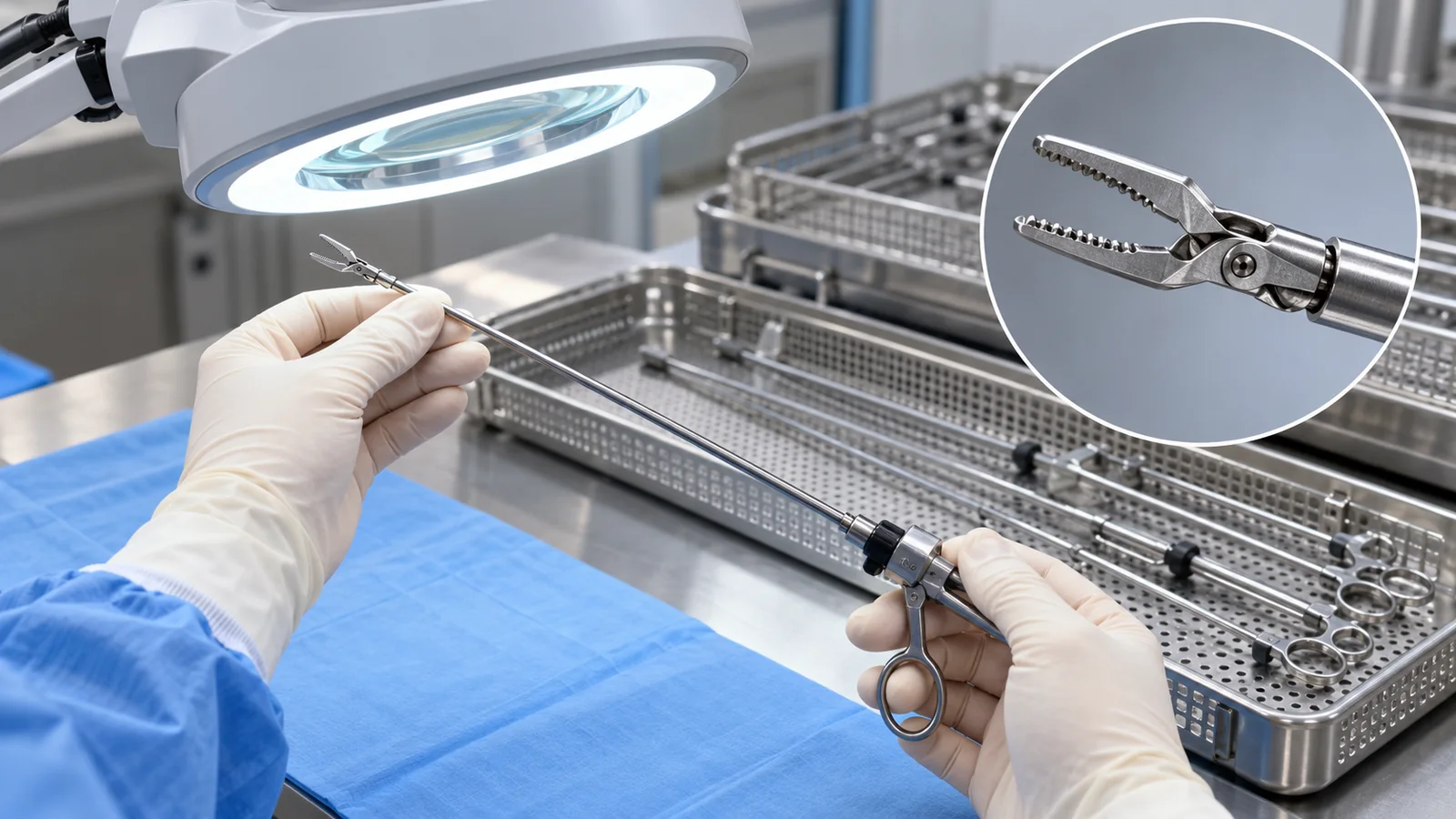
The inside of a thin tube and the hinge of a wrist are hard to wash. For a reusable instrument, dimensions, lubrication, surfaces and seals must stay unchanged through repeated cleaning and sterilization. A thin polymer film such as a drape, in contrast, is designed to be thrown away, which removes the processing effort and the contamination risk. Intuitive’s 10-K also describes the risk that regulators may require customers to suspend use if cleaning and sterilization instructions are not followed [Ref. 17] (the company’s risk statement). From the materials side, “how many times can it be washed” is one of the measures that set an instrument’s value and cost (our explanation).
5. FDA “clearance” and “approval”: three routes
In the United States the FDA reviews medical devices before they are marketed. The route depends on the risk and novelty of the device. News often says “FDA approved”, but the word depends on the route.
- 510(k) (premarket notification): a route in which the device is shown to be “substantially equivalent” to an earlier predicate device already on the market. The FDA’s result is called “clearance”. Substantial equivalence does not require the devices to be identical Sourced[Ref. 2].
- De Novo: a route for a new type of device with no predicate. When granted, a new classification regulation is created and the device can serve as a predicate for later 510(k)s Sourced[Ref. 3].
- PMA (premarket approval): the strictest review, required for Class III devices and some high-risk new devices. The result is “approval” Sourced[Ref. 4].
Within what could be confirmed here, the surgical robot platforms reached the market through 510(k) or De Novo. A search of FDA’s data returns more than 100 510(k) records with “da Vinci” in the name [Ref. 16], and Intuitive says that the first da Vinci was cleared by the FDA in 2000 for general laparoscopic surgery Sourced[Ref. 17]. The product code is NAY for da Vinci (Class II, 21 CFR 876.1500) [Ref. 11] and SCV for Hugo and Versius (Class II, 21 CFR 878.4964) [Ref. 10]. The definition of SCV reads, in substance, a software-controlled electromechanical system that lets a qualified user perform surgical techniques during minimally invasive procedures Sourced[Ref. 10].
A chain: a new route becomes the benchmark for the next device
De Novo and 510(k) are linked. CMR Surgical’s Versius was granted De Novo (DEN230078) on 11 October 2024 (received 21 November 2023), creating a new classification (product code SCV) Sourced[Ref. 9]. Medtronic’s Hugo was then cleared in a 510(k) (K250725) on 3 December 2025 with Versius as its predicate. Hugo’s summary records the predicate’s indication as cholecystectomy in adults aged 22 or older who are eligible for minimal-access soft-tissue surgery Sourced[Ref. 8].
This is wrong. (1) A 510(k) is not an “approval”. It is a route that confirms substantial equivalence to a predicate, and the result is called “clearance” [Ref. 2]. (2) What is authorized is a scope that depends on the type of surgery (Chapter 6). (3) The FDA page states that the FDA has not granted marketing authorization to robotically-assisted surgical devices for the prevention or treatment of cancer, and has not granted any RAS device marketing authorization for mastectomy Sourced[Ref. 1]. The FDA documents do not say that being cleared means the device performs better in that surgery.
6. Reading the scope by type of surgery: the same machine differs by country and model
The “Indications for Use” section of an FDA document is the text that fixes what the device is for, in whom, and in which procedures. The table and figure below line up what the documents checked here state.
| Device (company) | FDA document | Scope stated (summary) | Label |
|---|---|---|---|
| da Vinci 5 (IS5000, Intuitive) | 510(k) K232610 (14 March 2024), K251202 (16 July 2025) | Urologic, general laparoscopic, gynecologic laparoscopic and general thoracoscopic procedures. Adults. The force-feedback needle driver is contraindicated in hysterectomy and myomectomy [Ref. 6, 7] | Sourced |
| Hugo RAS System (Medtronic [Covidien LLC]) | 510(k) K250725 (3 December 2025) | Minimally invasive urologic procedures; adults; per the representative procedures in the “Hugo RAS System Indications Document” [Ref. 8]. Medtronic names prostatectomy, nephrectomy and cystectomy [Ref. 18] | Sourced |
| Versius (CMR Surgical) | De Novo DEN230078 (11 October 2024) | Cholecystectomy (adults 22 and older, as written in Hugo’s summary) [Ref. 9, 8] | Sourced |
| Mako (Mako Surgical) | 510(k) (for example K260222, 25 February 2026) | Product code OLO (orthopedic stereotaxic instrument). There are separate 510(k)s for knee, hip and shoulder applications [Ref. 14, 12] | Sourced |
| Ion Endoluminal System (Intuitive) | 510(k) (for example K182188, 14 February 2019) | Product code EOQ (bronchoscope). Intuitive describes it as a system for minimally invasive lung biopsy [Ref. 15, 13, 17] | Sourced |
Checked 25 October 2026. The table summarizes what the documents checked here state. Read the full documents (and the FDA databases) for the actual indications.
Surgical robots are not one kind of machine. Tele-operated systems for soft tissue inside the abdomen (da Vinci, Hugo, Versius), systems for cutting bone in orthopedics (Mako), and systems that advance a thin tube deep into the lung (Ion) are authorized under different product codes and different indications (explanation). Lumping them as “surgical robots” hides these differences.
Even the same da Vinci 5 has a different scope by country
Intuitive’s 10-K describes the scope of da Vinci 5 authorizations by region as follows (the company’s description) Sourced[Ref. 17].
| Region | Timing | Scope as described by Intuitive | Label |
|---|---|---|---|
| United States (FDA) | March 2024 | Procedures indicated for the da Vinci Xi, excluding cardiac and pediatric indications | Sourced |
| South Korea | October 2024 | Urologic, general, gynecologic, thoracoscopic, thoracoscopically-assisted cardiotomy and transoral otolaryngology procedures | Sourced |
| Japan | 2025 (the 10-K gives both June and July) | Procedures indicated for the da Vinci Xi, excluding cardiac indications | Sourced |
| EU (EU MDR certification) | July 2025 | Adult and pediatric minimally invasive endoscopic abdominopelvic and thoracoscopic procedures (including urologic, gynecologic and general laparoscopic). Excluding force feedback | Sourced |
This summarizes the company’s own description; the regulators’ original texts (Korea, Japan, EU) were not checked. The U.S. scope is consistent with FDA documents K232610 and K251202.
Japan’s hinotori (Medicaroid, a company funded by Kawasaki Heavy Industries and Sysmex) was announced to have obtained regulatory approval in Japan in August 2020 Sourced[Ref. 19]. That announcement does not state which surgeries the approval covers, and the scope could not be confirmed from regulator documents within this article’s research.
An “indication” is, in regulatory terms, the range of uses the manufacturer may advertise and label. A physician using a device outside its indications (off-label use) can happen in medical practice, but that is outside this article. Only what the documents say is covered here. The regulatory documents do not show how many operations are actually done or how the devices are used in practice.
7. Levels of autonomy, and where research stands
There is a proposal to think about “how much does the robot act by itself” in levels. Yang et al. (2017) divided the autonomy of medical robots into six levels, from Level 0 (no autonomy) to Level 5 (full autonomy) Sourced[Ref. 20]. It resembles the “levels” of self-driving cars, but because medicine involves a wide range of settings and risks, the paper says the same level can mean different things in different contexts.
In this framework a tele-operated system with scaling, the basic form of today’s surgical robots, is Level 0. For Level 2 the paper’s example is the surgeon indicating where a suture should be placed, the robot performing it, and the surgeon monitoring. Level 4 is the analogy of a “robotic resident” making medical decisions under supervision. For Level 5, a “robotic surgeon”, the paper wrote in 2017 that it is “in the realm of science fiction” Sourced[Ref. 20].
A research example: STAR (suturing intestine in pigs)
Saeidi et al. (2022) reported a method in which a robot autonomously performs intestinal anastomosis (joining two ends of bowel by suturing) laparoscopically. The operator selects among autonomously generated surgical plans, and the robot executes a wide range of tasks on its own. They evaluated it in phantoms and in live pig small intestine with a one-week survival period Sourced[Ref. 21]. In phantoms, the authors report that their system outperformed expert surgeons’ manual technique and robot-assisted technique in consistency and accuracy, and say the same held in vivo. This is, however, a study in pigs; it does not show use in human surgery or marketing. In terms of Yang et al.’s definitions, “the robot makes the plan and the human selects it” reads close to a Level 3 description (inference).
FDA draft guidance (September 2026)
In September 2026 the FDA issued a draft guidance titled “Robotically-Assisted Surgical Devices – Premarket Submissions”. It gives recommendations for premarket submissions on non-clinical testing, clinical data and labeling, and it defines RAS devices as teleoperated, software-controlled systems. The page states that it is not for implementation and contains non-binding recommendations; comments are due 24 November 2026 Sourced[Ref. 5]. Whether the draft will be finalized, and how it may change, cannot be confirmed Not yet confirmed.
This is wrong. Success in pigs is not proof of safety or effectiveness in humans. Use in people needs premarket review of the device (the three routes above) and clinical evaluation, and Yang et al. note that the higher the autonomy, the larger the regulatory debate [Ref. 20]. Read research results and the scope of marketed devices separately.
8. How to read claims about effectiveness and safety (without concluding)
“Is it good for patients?” is a natural question, but this article does not judge effectiveness or safety. Instead, here are three cautions for reading documents.
- Look at the study design. The clinical study in Hugo’s 510(k) summary (Expand URO) was a prospective, multicenter, non-randomized, single-arm study of 137 people (29 cystectomy, 53 nephrectomy, 55 prostatectomy) at six U.S. sites, with data collected through 30 days after the procedure Sourced[Ref. 8]. 29 + 53 + 55 = 137 Our calculation. A single-arm study is not designed to compare directly with other methods. Medtronic announced that the study met its primary safety and effectiveness endpoints (a company claim) [Ref. 18].
- A company’s numbers are the company’s numbers. Intuitive reports about 11,106 da Vinci systems installed at the end of 2025, 1,721 new placements in 2025 and 1,231 da Vinci 5 systems installed Sourced[Ref. 17]. The da Vinci 5 is 1,231 / 11,106 = about 11% of the installed base Our calculation. These figures show the scale of sales, not how good the treatment results are.
- Read what the FDA has not done. The FDA page says it has not granted marketing authorization to RAS devices for cancer prevention or treatment, or for mastectomy Sourced[Ref. 1]. Absence of authorization does not mean “dangerous” or “ineffective”, but it does mean that outside the authorized scope the FDA has not evaluated the use (explanation).
It does not compare surgical outcomes for particular operations, advise on choosing hospitals or procedures, conclude that a device is safe or superior, or assess costs. If you have such questions, please check with your own physician and the current information of public bodies (the FDA, PMDA and others).
9. Where things stand (checked 25 October 2026)
This field changes quickly, so here is what could be confirmed from primary sources, with check dates. Company claims are written as company claims.
| Item | What was confirmed | Label |
|---|---|---|
| Scale of da Vinci (company claim) | About 11,106 systems installed at the end of 2025 (about 9,902 at the end of 2024), 1,721 new placements in 2025, 1,231 da Vinci 5 systems. Intuitive reports procedures up about 18% in 2025 [Ref. 17] | Sourced |
| Force feedback on the da Vinci 5 | Cleared by the FDA on 14 March 2024 in K232610, with six force-feedback instruments. In the EU the company says the July 2025 certification does not include force feedback [Ref. 6, 17] | Sourced |
| Hugo in the U.S. | FDA clearance (K250725) on 3 December 2025 for minimally invasive urologic procedures in adults. Medtronic says it intends to add indications for general and gynecologic surgery (plan) [Ref. 8, 18] | Sourced Not yet confirmed |
| Versius in the U.S. | De Novo (DEN230078) on 11 October 2024; indication cholecystectomy (adults 22 and older) [Ref. 9, 8] | Sourced |
| FDA draft guidance | September 2026. A draft, non-binding. Comments until 24 November 2026. The timing of finalization cannot be confirmed [Ref. 5] | Sourced Not yet confirmed |
| Autonomous surgery | A study of intestinal suturing in pigs exists (2022); no marketed device for human surgery could be confirmed in this article’s sources [Ref. 21] | Not yet confirmed |
| Scope of hinotori approval, cable materials of each model, numerical instrument-use limits | Could not be confirmed within this article’s research | Not yet confirmed |
Checked 25 October 2026. Company plans and targets are separate from achieved facts.
Surgical robots are tele-operated: the surgeon moves controls at a console and the machine carries the motion, and the FDA says they cannot perform surgery without direct human control. The core of the mechanism is a wristed instrument, motion scaling and tremor filtering, and thin cable-driven instruments. From a materials viewpoint the problems are cable stretch, friction and fatigue and the reuse limit set by cleaning and sterilization. Market authorization comes by three routes, “clearance”, De Novo and “approval”; the platforms seen here went through 510(k) or De Novo, and the scope differs by type of surgery and by country. Autonomous surgical machines are at the research stage, and this article does not judge effectiveness or safety.
10. How to read the yardsticks and standards
The quality of a surgical robot cannot be measured by one number. Machine performance such as positional accuracy, motion delay and instrument life can be measured in a laboratory. But “how is it for patients” is judged by clinical studies and evaluation per type of surgery, and “may it be marketed” is decided by regulatory review (510(k), De Novo, PMA). These yardsticks measure different things. The table below shows what each measures and does not measure, as far as could be confirmed.
| Item | Representative tests / benchmarks (name, source) | Standards, rules, guidance (FDA, IEC and others) | Cautions when reading |
|---|---|---|---|
| Market authorization (U.S.) | 510(k) substantial-equivalence review, De Novo, PMA [Ref. 2, 3, 4] Sourced | The three FDA routes. Hugo and Versius: product code SCV, 21 CFR 878.4964 (Class II). Hugo’s summary says it conforms with the special controls for product code SCV [Ref. 10, 8] Sourced | “Clearance” and “approval” differ. The scope is per type of surgery |
| Basic safety and essential performance of the equipment | Could not be confirmed (test names are in the standard’s text, which is paid and was not read) | IEC 80601-2-77:2019 “Medical electrical equipment – Part 2-77: Particular requirements for the basic safety and essential performance of robotically assisted surgical equipment” (full text paid and not read; one catalogue mentions a 2023 amendment and a draft of the next edition, which was not checked here) [Ref. 22] Sourced | A standard is a reference for showing conformity; “conforms to the standard” does not mean clinical outcomes are good |
| Non-clinical testing | Hugo 510(k) summary: animal testing, human-factors validation, bench testing (including motion accuracy and system testing), software, electromagnetic compatibility and electrical, thermal and mechanical safety, sterility, shelf life, reprocessing, biocompatibility and pyrogenicity [Ref. 8] Sourced | The FDA draft guidance (September 2026, draft) gives recommendations on non-clinical testing, clinical data and labeling [Ref. 5] Sourced Not yet confirmed | The summary gives test names but not the pass criteria or numbers |
| Clinical data | Hugo’s Expand URO: 137 subjects, single-arm, non-randomized, to 30 days [Ref. 8] Sourced. Medtronic says primary endpoints were met (company claim) [Ref. 18] | Clinical-data needs differ by device and indication (the FDA draft guidance covers clinical-data recommendations) [Ref. 5] | A single-arm study is not a head-to-head comparison, and follow-up is limited |
| Degree of autonomy | Yang et al. (2017), Levels 0-5 [Ref. 20] Sourced | Could not be confirmed as an official regulatory classification (the paper presents it as a framework for discussion) | The framework is a proposal, not a regulatory criterion |
| Terminology standard (robots in general) | – | ISO 8373 (robot vocabulary) was not checked here. For the relation to industrial-robot standards, see our explainer on robot safety standards | Medical robots are viewed under a different framework (medical-device regulation) from industrial-robot standards |
The arrangement of the table is Our calculation (organization). Numbers and titles of standards and rules were checked on the official FDA and IEC pages (25 October 2026). The IEC text is paid and was not read, so only the title and scope are given. No ASTM International standard or website was consulted.
Cautions when reading (for materials engineers)
- “Machine performance”, “clinical results” and “market authorization” are different yardsticks. High positional accuracy is not the same as good surgical results. FDA clearance indicates substantial equivalence to a predicate (or a new classification), not superior outcomes.
- Separate company announcements from regulator documents. Installed base, procedure counts and “met the primary endpoints” are company claims. The FDA’s 510(k) summary is a closer-to-primary source that shows the design and scope of tests.
- A standard is a “reference frame”, not law itself. IEC 80601-2-77 is one standard used to demonstrate conformity within national and regional regulations (inference). Its text was not read here, so its requirements are not described.
- Plans and achievements differ. The draft guidance and Medtronic’s targets for added indications are not yet confirmed.
11. Glossary
- Laparoscopic surgery
- Surgery in which a camera (endoscope) and long thin instruments are inserted through small holes in the abdomen.
- Tele-operation (teleoperation)
- A human operating a machine from a distance. The basic form of surgical robots.
- Surgeon console
- The seat where the surgeon sits, with hand controllers and a 3D display.
- Patient-side cart
- The cart with arms placed beside the patient.
- RAS device
- FDA term for a robotically-assisted surgical device: a teleoperated, software-controlled surgical-assist system.
- Wristed instrument
- A surgical instrument with a joint at its tip that bends like a human wrist.
- Motion scaling
- Reducing hand motion by a fixed ratio before it reaches the instrument.
- Pivot (fulcrum)
- The point about which a stick rotates; in laparoscopic surgery, the hole in the abdominal wall.
- Hysteresis
- A property in which the stretch differs between loading and unloading at the same force.
- Fatigue
- Damage that accumulates under repeated small loads until the material breaks.
- Reprocessing
- Washing, inspecting and sterilizing a used instrument so it can be used again.
- Drape
- A single-use cover that keeps equipment clean.
- 510(k)
- The FDA premarket notification that checks for “substantial equivalence” to a predicate. The result is “clearance”.
- De Novo
- The FDA route that creates a new classification for a device with no predicate.
- PMA
- Premarket approval, the strictest review; the result is “approval”.
- Clearance / approval
- The result of a 510(k) is “clearance” and the result of a PMA is “approval”. The two are easily confused.
- Indications for Use
- The documented scope of what a device is for, in whom, and in which procedures.
- Predicate device
- The device already on the market that a 510(k) uses as its comparison.
- Product code
- A three-letter FDA code for a type of device (for example SCV, NAY).
- Force feedback
- A mechanism that lets the surgeon feel the force the instrument experiences.
- Levels of autonomy (Level 0-5)
- The six levels of autonomy for medical robots proposed by Yang et al.
- Anastomosis
- A suture that joins tubular tissue such as two ends of bowel.
- Single-arm study
- A study that examines one group with no comparison group.
12. References
- FDA “Computer-Assisted Surgical Systems” (FDA web page, content shown as current to 24 September 2026; checked 25 October 2026) — fda.gov/medical-devices/surgery-devices/computer-assisted-surgical-systems
- FDA “Premarket Notification 510(k)” (FDA web page, current to 22 August 2024; checked 25 October 2026) — fda.gov/medical-devices/premarket-submissions-selecting-and-preparing-correct-submission/p
- FDA “De Novo Classification Request” (FDA web page, current to 30 September 2025; checked 25 October 2026) — fda.gov/medical-devices/premarket-submissions-selecting-and-preparing-correct-submission/d
- FDA “Premarket Approval (PMA)” (FDA web page, current to 16 May 2019; checked 25 October 2026) — fda.gov/medical-devices/premarket-submissions-selecting-and-preparing-correct-submission/p
- FDA “Robotically-Assisted Surgical Devices – Premarket Submissions” (draft guidance, September 2026; comments due 24 November 2026, docket FDA-2026-N-9505; checked 25 October 2026) — fda.gov/regulatory-information/search-fda-guidance-documents/robotically-assisted-surgical
- FDA 510(k) K232610, da Vinci Surgical System Model IS5000 (decision date 14 March 2024; indications, force-feedback instruments and predicates; checked 25 October 2026) — accessdata.fda.gov/cdrh_docs/pdf23/K232610.pdf
- FDA 510(k) K251202, da Vinci Surgical System (IS5000) (decision date 16 July 2025; indication text; checked 25 October 2026) — accessdata.fda.gov/cdrh_docs/pdf25/K251202.pdf
- FDA 510(k) K250725, Hugo RAS System (Covidien LLC, decision date 3 December 2025; indications, predicate, performance testing, Expand URO study summary; checked 25 October 2026) — accessdata.fda.gov/cdrh_docs/pdf25/K250725.pdf
- FDA De Novo DEN230078, Versius Surgical System (CMR Surgical; received 21 November 2023, granted 11 October 2024; checked 25 October 2026) — accessdata.fda.gov/scripts/cdrh/cfdocs/cfpmn/denovo.cfm?id=DEN230078
- FDA (openFDA) Product code SCV, “Modular Electromechanical Surgical System” (21 CFR 878.4964, Class II; checked 25 October 2026) — api.fda.gov/device/classification.json?search=product_code:SCV
- FDA (openFDA) Product code NAY, “System, Surgical, Computer Controlled Instrument” (21 CFR 876.1500, Class II; checked 25 October 2026) — api.fda.gov/device/classification.json?search=product_code:NAY
- FDA (openFDA) Product code OLO, “Orthopedic Stereotaxic Instrument” (21 CFR 882.4560, Class II; checked 25 October 2026) — api.fda.gov/device/classification.json?search=product_code:OLO
- FDA (openFDA) Product code EOQ, “Bronchoscope (Flexible Or Rigid)” (21 CFR 874.4680, Class II; checked 25 October 2026) — api.fda.gov/device/classification.json?search=product_code:EOQ
- FDA (openFDA) 510(k) records search: Mako Surgical Total Knee, Total Hip and Shoulder applications, for example K260222 (25 February 2026, product code OLO; checked 25 October 2026) — api.fda.gov/device/510k.json?search=device_name:%22mako%22&limit=100&sort=decision_date:de
- FDA (openFDA) 510(k) records search: Intuitive Ion Endoluminal System, for example K182188 (14 February 2019, product code EOQ; checked 25 October 2026) — api.fda.gov/device/510k.json?search=device_name:%22ion%22+AND+applicant:%22intuitive%22&li
- FDA (openFDA) 510(k) records search: records whose names include “da Vinci” (from K002489 in 2001 to K251213 in 2025; includes an unrelated device with the same name; checked 25 October 2026) — api.fda.gov/device/510k.json?search=device_name:%22da+vinci%22&limit=100&sort=decision_dat
- Intuitive Surgical Form 10-K for the year ended 31 December 2025 (filed 3 February 2026; the company’s own description; checked 25 October 2026) — sec.gov/Archives/edgar/data/1035267/000103526726000010/isrg-20251231.htm
- Medtronic Press release “Medtronic announces FDA clearance of Hugo robotic-assisted surgery system for urologic surgical procedures” (3 December 2025; the company’s announcement; checked 25 October 2026) — news.medtronic.com/2025-12-03-Medtronic-announces-FDA-clearance-of-Hugo-TM-robotic-assiste
- Medicaroid / Kawasaki Heavy Industries / Sysmex Press release (11 August 2020; announcing Japanese regulatory approval of the hinotori Surgical Robot System; checked 25 October 2026) — global.kawasaki.com/news_200811-1e.pdf
- Yang G.-Z. et al. “Medical robotics—Regulatory, ethical, and legal considerations for increasing levels of autonomy”, Science Robotics 2(4), eaam8638 (2017) — doi.org/10.1126/scirobotics.aam8638
- Saeidi H. et al. “Autonomous robotic laparoscopic surgery for intestinal anastomosis”, Science Robotics 7(62), eabj2908 (2022) — doi.org/10.1126/scirobotics.abj2908
- IEC IEC 80601-2-77:2019 “Medical electrical equipment – Part 2-77: Particular requirements for the basic safety and essential performance of robotically assisted surgical equipment” (IEC webstore page; full text is paid and was not read; checked 25 October 2026) — webstore.iec.ch/en/publication/29933
- Miyasaka M. “Cable Driven Robots: Hysteretic Cable Stretch, Cable-Pulley Network Friction, Fatigue Life, and Kinematics of Two-Arm Multi Staged Flexible Manipulator” (University of Washington PhD thesis, 2017; based on the RAVEN II; checked 25 October 2026) — digital.lib.washington.edu/researchworks/handle/1773/40641
13. Claim-to-source audit
| Claim in the text | Basis | Label |
|---|---|---|
| FDA describes robotically-assisted surgical devices as unable to perform surgery without direct human control and has cleared them for certain laparoscopic procedures; FDA has not granted marketing authorization for cancer prevention or treatment, or for mastectomy | FDA web page Reference 1 https://www.fda.gov/medical-devices/surgery-devices/computer-assisted-surgical-systems | Sourced |
| A 510(k) shows substantial equivalence to a predicate and FDA calls the result “clearance”; De Novo is the route for novel devices with no predicate; PMA is the strictest review and is called “approval” | Three FDA web pages Reference 2 https://www.fda.gov/medical-devices/premarket-submissions-selecting-and-preparing-correct-submission/premarket-notification-510k Reference 3 https://www.fda.gov/medical-devices/premarket-submissions-selecting-and-preparing-correct-submission/de-novo-classification-request Reference 4 https://www.fda.gov/medical-devices/premarket-submissions-selecting-and-preparing-correct-submission/premarket-approval-pma | Sourced |
| Title and status of the draft guidance (draft, non-binding, September 2026), docket, comment deadline, and its definition of RASD (teleoperated, software-controlled) | FDA draft guidance page Reference 5 https://www.fda.gov/regulatory-information/search-fda-guidance-documents/robotically-assisted-surgical-devices-premarket-submissions | Sourced |
| Indications of the da Vinci 5 (IS5000): urologic, general laparoscopic, gynecologic laparoscopic and general thoracoscopic procedures in adults; added force-feedback instruments; the stated contraindication for the force-feedback needle driver; predicates (IS4000 and Senhance); stainless-steel endoscope tray and sterilizers | FDA 510(k) K232610 (14 March 2024) Reference 6 https://www.accessdata.fda.gov/cdrh_docs/pdf23/K232610.pdf | Sourced |
| The 510(k) of 16 July 2025 (K251202) again states the same four surgical categories for adults for the IS5000 | FDA 510(k) K251202 Reference 7 https://www.accessdata.fda.gov/cdrh_docs/pdf25/K251202.pdf | Sourced |
| Hugo RAS System indication (minimally invasive urologic procedures in adults), architecture (system tower, surgeon console, arm carts), nine wristed instruments, the predicate Versius (DEN230078), the non-clinical test list, and the Expand URO study (137 subjects: cystectomy 29, nephrectomy 53, prostatectomy 55; six US sites; non-randomized single-arm; follow-up to 30 days) | FDA 510(k) K250725 (3 December 2025) Reference 8 https://www.accessdata.fda.gov/cdrh_docs/pdf25/K250725.pdf | Sourced |
| Versius De Novo (received 21 November 2023, granted 11 October 2024, product code SCV, regulation 878.4964); indication cholecystectomy in adults 22 and older (as written in the Hugo 510(k) summary) | FDA De Novo database and K250725 Reference 9 https://www.accessdata.fda.gov/scripts/cdrh/cfdocs/cfpmn/denovo.cfm?id=DEN230078 Reference 8 https://www.accessdata.fda.gov/cdrh_docs/pdf25/K250725.pdf | Sourced |
| Names, regulation numbers and classes of product codes SCV, NAY, OLO and EOQ (all Class II) | FDA product classification (openFDA) Reference 10 https://api.fda.gov/device/classification.json?search=product_code:SCV Reference 11 https://api.fda.gov/device/classification.json?search=product_code:NAY Reference 12 https://api.fda.gov/device/classification.json?search=product_code:OLO Reference 13 https://api.fda.gov/device/classification.json?search=product_code:EOQ | Sourced |
| Existence of 510(k) records for Mako orthopedic applications (product code OLO) and the Ion Endoluminal System (product code EOQ); more than 100 records with “da Vinci” in the name | FDA 510(k) records (openFDA) Reference 14 https://api.fda.gov/device/510k.json?search=device_name:%22mako%22&limit=100&sort=decision_date:desc Reference 15 https://api.fda.gov/device/510k.json?search=device_name:%22ion%22+AND+applicant:%22intuitive%22&limit=10&sort=decision_date:asc Reference 16 https://api.fda.gov/device/510k.json?search=device_name:%22da+vinci%22&limit=100&sort=decision_date:asc | Sourced |
| Intuitive’s own account: 2000 FDA clearance, architecture (console, patient-side cart, vision), motion scaling and tremor filtering, wristed instruments and the in-instrument chip limiting uses, force-feedback da Vinci 5, installed base of 11,106 systems with 1,231 da Vinci 5, 2025 growth rates, and differences in indication scope among the US, EU and Japan | The company’s account (Form 10-K) Reference 17 https://www.sec.gov/Archives/edgar/data/1035267/000103526726000010/isrg-20251231.htm | Sourced |
| Medtronic’s announcement: FDA clearance for urologic procedures on 3 December 2025, how it describes the Expand URO study, and its claims about use outside the US (company claims) | Company press release Reference 18 https://news.medtronic.com/2025-12-03-Medtronic-announces-FDA-clearance-of-Hugo-TM-robotic-assisted-surgery-system-for-urologic-surgical-procedures | Sourced |
| Announcement that the hinotori system obtained Japanese regulatory approval in August 2020; the scope of the approval could not be confirmed from regulator documents within this article’s research | Company press release Reference 19 https://global.kawasaki.com/news_200811-1e.pdf | Sourced |
| The six levels of autonomy (Level 0-5), scaled tele-operation counting as Level 0, the suturing example, and the 2017 description of full autonomy as science fiction | Yang et al. (2017) Reference 20 https://doi.org/10.1126/scirobotics.aam8638 | Sourced |
| STAR: the operator selects among autonomously generated plans and the robot executes; porcine intestinal anastomosis with a 1-week survival period; the authors report higher consistency and accuracy in phantom and in vivo models | Saeidi et al. (2022) Reference 21 https://doi.org/10.1126/scirobotics.abj2908 | Sourced |
| Title and scope of IEC 80601-2-77:2019 (basic safety and essential performance of robotically assisted surgical equipment) | IEC webstore page Reference 22 https://webstore.iec.ch/en/publication/29933 | Sourced |
| Cable-driven mechanisms face hysteretic cable stretch, pulley friction and fatigue life (research based on the RAVEN II) | University of Washington PhD thesis Reference 23 https://digital.lib.washington.edu/researchworks/handle/1773/40641 | Sourced |
| Scaling 30 mm to 10 mm at 3:1 (illustrative), da Vinci 5 share of installed base 1,231 / 11,106 = about 11%, and Expand URO 29+53+55 = 137 | Our own calculation (assumptions stated in the text) | Our calculation |
| The approved scope of hinotori, cable materials of da Vinci and Hugo, numerical instrument-use limits, outcome comparisons between systems and regulation of remote telesurgery could not be confirmed within this article’s research and are not included | The scope of research for this article | Explanation |
| The explanation of laparoscopic surgery, the sense-think-act mapping, the pivot reversal, the materials-engineer notes, the analogies and their limits, and the fact that Figs. 1-9 are explanatory drawings | This article’s explanation (our reading of the sourced facts) | Explanation |
Last updated: 25 October 2026. Sources are limited to primary material (FDA pages and 510(k) / De Novo records, Intuitive Surgical’s Form 10-K, announcements by Medtronic and Medicaroid, Science Robotics papers, and an IEC standard page). Company figures and announcements are labeled as company claims and kept separate from regulator documents. The worked examples (the scaling ratio, the share of the installed base, the sum of study participants) are our own explanatory calculations and not the specifications of any device. This article is a general technical explainer and not medical advice. The scope of hinotori’s approval, the cable materials of each model and the numerical instrument-use limits could not be confirmed and are therefore not given. All figures are explanatory concept diagrams or drawings with our own calculations, except Figs. 1 and 6, which are ImageGen-generated conceptual illustrations. They do not depict real facilities, products or appearances.