TECHNOLOGY EXPLAINER
Teleoperation and Data Collection
— how a robot’s “teaching material” is gathered, and how to tell whether a video shows autonomy or teleoperation
To make a robot smarter by learning, you need records of motions that people showed it (demonstration data). The main way of collecting them is teleoperation: a person operates the robot from a distance, and the motion and images are recorded. When a robot video looks impressive, one important question is whether it shows the robot’s own decisions (autonomy) or a person operating it behind the scenes. Using analogies a materials engineer can relate to, this article sorts out, with papers and small calculations of our own, the styles of teleoperation, data collection with human video and gloves, and the quantity and quality of data (including the finding that variety can matter more than quantity). The second half covers how to tell whether a demonstration is autonomous or teleoperated, with a checklist and examples of how companies’ official pages word it. We do not rank particular companies or machines.
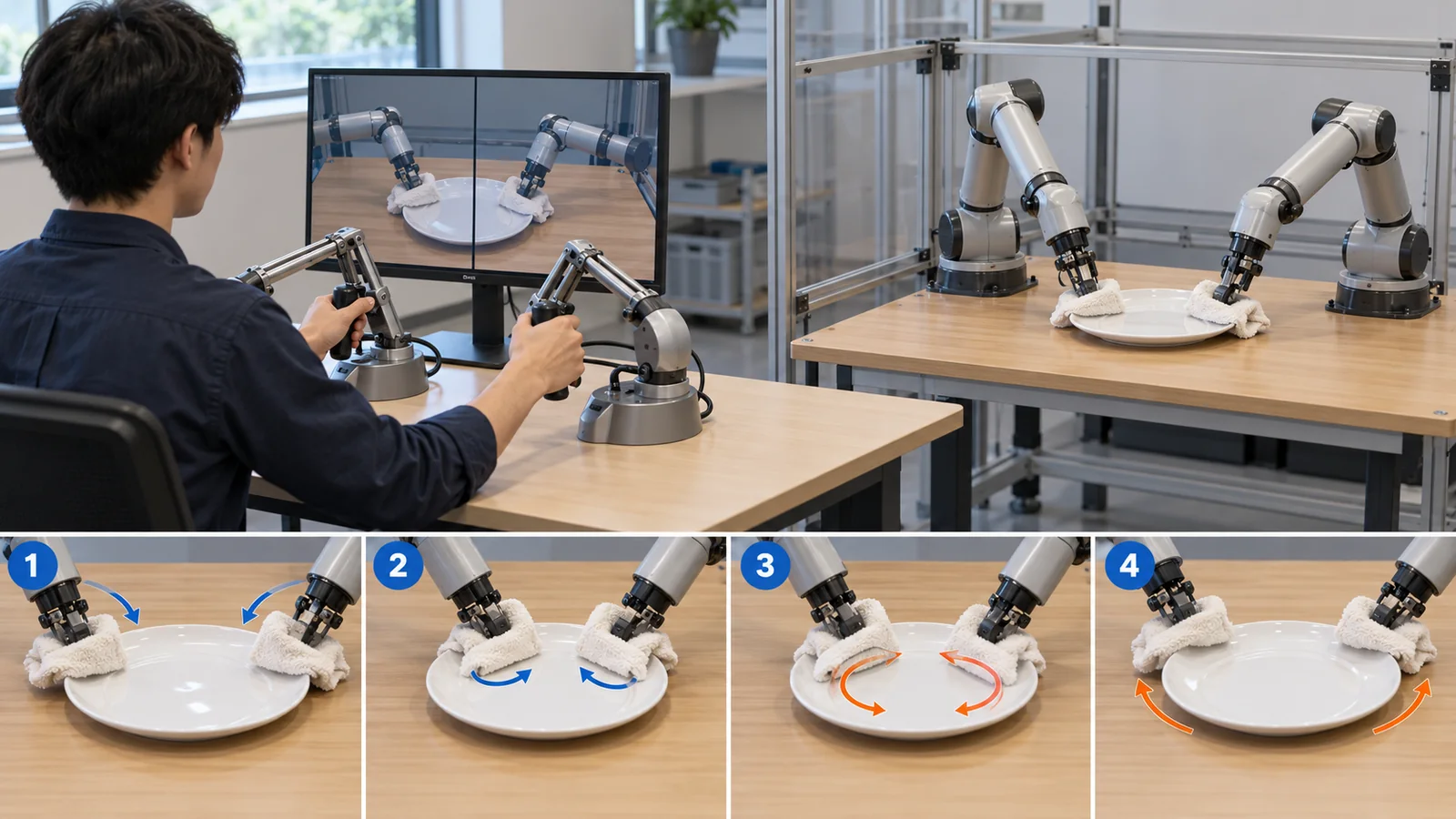
- What teleoperation and data collection are (the short version)
- What teleoperation is — the border with autonomy
- Four ways to collect demonstrations
- Comparing the ways — what is gained and what is given up
- Quantity and quality of data — how many items, how many hours, how varied
- How to tell whether a demonstration is autonomous or teleoperated (important)
- A materials engineer’s view: quality of data, gloves and the materials of devices
- Limits, and what could not be confirmed / summary
- How to read the yardsticks and standards
- Glossary
- References
- Claim-to-source audit
Sourced = stated in published material (link given)
Our calculation = a figure this article derived, with the assumptions spelled out
Not yet confirmed = a plan, draft or work in progress that is not settled
Interpretations are marked separately as Commentary. Inference is shown in bold.
The numerical examples in Chapters 2, 5 and 6 are calculations from values we assumed (the time of one demonstration, the breakdown of interventions and so on). They are not the results of any real robot or operator. Dataset sizes, success rates and collection times are values reported under the conditions each paper chose, and we do not rank them by lining up numbers from different papers. Companies’ videos and announcements are treated as the company’s claims, and we add, as far as we can confirm, whether they are autonomous or teleoperated, the number of units, hours and tasks, and whether there has been independent verification. For standards (ISO) we confirmed only number and title and did not read the text. We did not open the ASTM site.
1. What teleoperation and data collection are (the short version)
- Teleoperation has two faces: (1) people doing work from a distance, in dangerous or far-away places (real work); (2) a means of recording examples to teach robots (data collection). This article is mainly about (2)
- Variety can matter more than quantity: from over 40,000 demonstrations and over 15,000 real rollouts, Lin et al. report that generalisation improved roughly as a power law of the number of environments and objects, and that the variety of environments and objects mattered more than the total number of demonstrationsSourced[Ref. 18]
- A video alone does not show whether it is autonomous or teleoperated: companies’ official pages include one that states “uncut, from a single policy operating fully autonomously”, one that says it worked closely with operators during data collection, and one whose text did not let us confirm eitherSourced[Ref. 22, 23, 24]. What counts is the stated conditions
In this series’ shared picture, a robot is a combination of “sense (sensors), think (control and intelligence) and act (actuators)”, and autonomy comes in degrees, from “fully piloted by a person” to “automatic under human supervision”. Teleoperation is at one end of that range and is distinguished from autonomy. One more word: a demonstration is a motion that a person showed (operated), recorded as pairs of observations (images, joint angles) and actions (how much things were moved). It is the teaching material for a learned policy (a function that decides actions).
Our article on imitation and reinforcement learning covers how to learn from demonstrations and how errors compound, our article on robot foundation models and VLA covers models pre-trained on large-scale data, and our article on robot simulation and digital twins covers how synthetic data are made. This article is limited to the collecting side (teleoperation and human data), their quality and quantity, and how to read videos. Our articles on robot hands and grasping and on tactile sensors and electronic skin cover hands and the sense of touch.
A robot video or “success rate” can be read only together with “autonomous, teleoperated, or with human intervention” and “how many of how many”. Smoothness of motion is not evidence of autonomy.
2. What teleoperation is — the border with autonomy
Teleoperation is a person operating a robot from a distance. The person’s hand motion becomes the robot’s motion directly, so the robot is “an extension of the person’s limbs”. Autonomy, by contrast, is the robot moving on its own judgement (a policy). Between them there are several stages.
(1) Returning the operator’s “feel”: bilateral teleoperation
A scheme in which the force the robot feels on touching something is returned to the operator’s hand is called bilateral teleoperation. A historical survey is the paper by Hokayem and Spong [Ref. 1] (we confirmed only title and bibliographic data, not the contents). When images and force are returned to the operator, fine work is thought to become easier, but it becomes hard when the delay is large (commentary).
(2) Delay in numbers
The farther away the operator, the longer a signal takes to go and come back. Assuming the speed of light in optical fibre to be about 200,000 km/s, we calculate the round-trip delay from propagation alone (Our calculation).
| Distance between operator and robot | Round-trip propagation time (assumed) | How to read it (commentary) |
|---|---|---|
| 100 km | about 1 ms | Video processing, transmission and device delays are often larger than propagation |
| 1,000 km | about 10 ms | The scale of remote operation within a country |
| 10,000 km | about 100 ms | The scale of intercontinental links. A delay a person can notice |
Our calculation. Round-trip propagation time = 2 x distance / speed of light. The speed in optical fibre is assumed to be about 200,000 km/s (about two-thirds of that in vacuum). Route curvature, equipment processing and video compression times are not included.
How delay matters depends greatly on the task and the system. RoboTurk is a system that collects data from remote workers using smartphones, and it reports that poor network conditions such as low bandwidth and high delay did not substantially affect the remote workers’ ability to carry out demonstrations successfully [Ref. 2]Sourced. That is a result for the paper’s tasks and set-up and need not hold for precise work with force feedback (commentary).
Teleoperation is used as a tool for work in dangerous places such as rescue [Ref. 26]. Today it is also used as a tool for making learning data. For example, Mobile ALOHA reports that success rates rose by up to 90% with 50 whole-body teleoperated demonstrations per task co-trained with existing data [Ref. 4]Sourced. So a robot that learned from teleoperated data may afterwards move autonomously. That data were collected by teleoperation and that the motion in a video is teleoperated are two different matters.
3. Four ways to collect demonstrations
Ways of collecting demonstrations can be sorted by “whether a robot is used” and “what is measured of the person”.
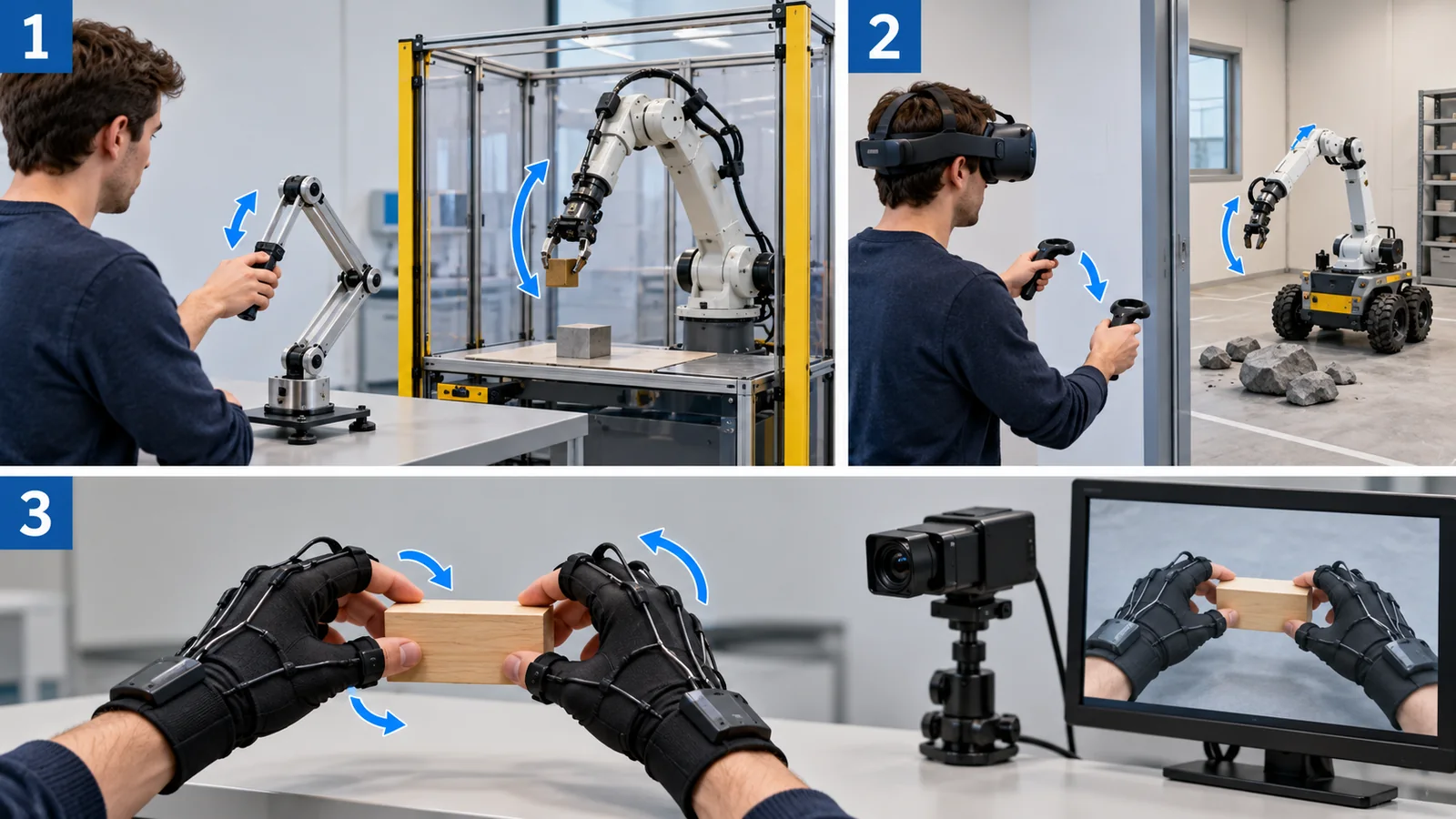
Original SVG, detailed explanation and sources
Original SVG reference: Conceptual diagram (vector drawing). A: GELLO is a device with the same kinematic structure as the target robot arm, built from 3D-printed parts and off-the-shelf motors [Ref. 5]. B: [Ref. 6, 7]. C: [Ref. 9]. D: [Ref. 10, 11, 12].
A. Leader-follower (a robot plus a device of the same structure)
The robot (follower) reproduces the motion of a “leader” device moved by a person. ACT (ALOHA) collected demonstrations with low-cost hardware and its own teleoperation device and reports learning six difficult tasks at 80-90% success with 10 minutes of demonstrations [Ref. 3]. GELLO is a way of building a device with the same kinematic structure as the target robot arm from 3D-printed parts and off-the-shelf motors, and a user study reports that it collected demonstrations more reliably and efficiently than VR controllers and 3D spacemouses [Ref. 5]Sourced.
B. VR and hand tracking
Open-TeleVision is an immersive teleoperation system in which the operator can look around the robot’s surroundings actively in stereo. It collected data on four long tasks (can sorting, insertion, folding and unloading) with two kinds of humanoid and deployed the learned policies on the real machines [Ref. 6]. AnyTeleop handles vision-based teleoperation of dexterous arm-hand systems in one system across several robots and camera set-ups [Ref. 7]. HumanPlus tracks a person’s whole-body and hand motion with only an RGB camera so that a humanoid “shadows” it like a shadow; it collected whole-body data this way and reports that, with up to 40 demonstrations, the humanoid carried out tasks autonomously at 60-100% success [Ref. 8]Sourced.
C. Gloves and motion capture
DexCap is a portable hand motion capture system based on SLAM and electromagnetic fields. It tracks wrist and finger motion resistant to occlusion and also records the 3D surroundings. It also proposed a method of learning dexterous robot-hand policies from human hand-motion data (DexIL) and a mechanism for a person to correct the policy during execution, and was evaluated on six dexterous tasks [Ref. 9]Sourced.
D. Hand-held tools and human video
UMI uses hand-held grippers to collect in-the-wild demonstrations without a robot and transfers them directly to robot policies. With inference-time latency matching and a relative-trajectory action representation, it says the policies become hardware-agnostic [Ref. 10]. EgoMimic uses egocentric video of people taken with Project Aria glasses together with 3D hand tracking, and co-trains on human and robot data as the same kind of “demonstration data”. It reports a scaling trend in which adding one hour of hand data is significantly more valuable than adding one hour of robot data [Ref. 11]. Ego4D is a dataset of 3,670 hours of everyday egocentric video from 931 camera wearers, and is not robot demonstrations as such [Ref. 12]Sourced.
A human hand and a robot hand differ in shape, joints and strength. To learn from human video you must convert the person’s motion into actions the robot can execute (inverse kinematics in DexCap, the alignment of human and robot data in EgoMimic, and so on). Errors in this conversion can be a source of drift (commentary).
4. Comparing the ways — what is gained and what is given up
| Method | What you get | What you give up (commentary) | Where it fits (commentary) |
|---|---|---|---|
| A. Leader-follower | The robot’s own motion and images are recorded directly as the “right answer” | A device is needed per robot. Affected by the operator’s skill and fatigue | Teaching precise work on a specific robot |
| B. VR and hand tracking | Intuitive operation. Can map dexterous hand motion | Must bridge the difference in hand shapes. Delay of VR gear | Demonstrations for humanoids and multi-fingered hands |
| C. Gloves and motion capture | Hand motion can be collected without a robot | Errors in converting human motion to robot actions | Collecting data on human dexterity in many places |
| D. Hand-held tools and video | Can be collected anywhere, cheaply and in large quantities | Force and touch information need extra measures. Differences in viewpoint and body between human and robot | Data from diverse real-world environments |
The table is this article’s arrangement (commentary), not a recommendation by the papers. We do not say which method is better. In practice many examples combine several methods.
5. Quantity and quality of data — how many items, how many hours, how varied
(1) The scale of main datasets
| Dataset (source) | Scale (as stated in the paper) | Features |
|---|---|---|
| BridgeData V2 [Ref. 14] | 60,096 trajectories, 24 environments | Collected on one kind of low-cost robot. Can be conditioned on language or goal images |
| DROID [Ref. 13] | 76k trajectories, 350 hours, 564 scenes, 84 tasks | Collected by 50 people in North America, Asia and Europe over 12 months |
| RH20T [Ref. 15] | Over 110,000 contact-rich sequences | Visual, force, audio and action data, with human demonstration video and language descriptions |
| AgiBot World [Ref. 16] | Over 1 million trajectories, 217 tasks, five scenarios | A standardised collection pipeline with human verification |
| Open X-Embodiment [Ref. 17] | 21 institutions, 22 robots, 527 skills | Pooled data in a standard format |
All Sourced (abstracts of the papers). Robots, tasks and collection methods differ, so the numbers cannot be lined up to rank them.
(2) Counting the human time
Demonstrations are made out of human time. If we assume that one demonstration takes 40 s of operation plus 20 s of resetting, 60 s in all, then 100 demonstrations take about 1.7 hours, 1,000 about 16.7 hours, 10,000 about 167 hours, 100,000 about 1,667 hours and 1 million about 16,667 hours (Our calculation). DROID has 76,000 trajectories in 350 hours, which is about 16.6 s of “interaction time” per trajectory (350 hours / 76,000) [Ref. 13].
The GR00T N1 paper says that robot data scale linearly with human labour because a human operator has to teleoperate the robot to produce each trajectory, and reports expanding its 88 hours of in-house teleoperated data about tenfold to 827 hours using video-generation models [Ref. 21]Sourced. Ways of reducing human time (video, synthesis, using human video) are a major concern in data collection.
(3) “Variety” rather than “quantity”
Even for the same 1,000 demonstrations, 1,000 in one place and 100 in each of ten places have different content. Lin et al. report that generalisation improved roughly as a power law of the number of environments and objects, that the variety of environments and objects mattered more than the total number of demonstrations, and that once the number of demonstrations per environment or object passed a threshold, extra demonstrations had little effect. They also state that data collected by four people in one afternoon brought two tasks to about 90% success in new environments with unseen objects [Ref. 18]Sourced.
In fact: adding demonstrations under the same conditions can hit a plateau. Under which tasks and conditions it helps is still being studied. The results above are for the tasks and settings of Lin et al. For your own work, widening the range of environments, objects and conditions and checking the change in success rate with few demonstrations may be the shorter path (commentary).
(4) Data quality and records
The quality of demonstration data includes the operator’s skill, habits, fatigue and the variation of conditions on the day. The ACT paper names non-stationary human demonstrations as a challenge [Ref. 3], and robomimic analyses dependence on demonstration quality [Ref. 19]. So if you record who, when, on which robot, in which environment and with which objects, success or failure, and whether a person intervened, you can later trace the causes of failure (commentary). As a shared data format, Open X-Embodiment pooled data from 21 institutions in a standard format [Ref. 17]. An open framework for learning is LeRobot (Apache-2.0) [Ref. 25].
6. How to tell whether a demonstration is autonomous or teleoperated (important)
When you come across a robot video, it is good practice to ask “is this autonomous?” But do not judge by appearance. Smooth motion can be teleoperated, and clumsy motion can be autonomous. What you check is the stated conditions (this is this article’s arrangement).
| What to check | Where to look | Why it matters |
|---|---|---|
| 1. Autonomous or teleoperated | Is there an explicit “autonomous” or “no teleoperation” in the video description, paper or technical document? | If a person is operating, what you see is the person’s skill |
| 2. Human intervention | Number, duration and content of interventions (did a person fix failures?) | Counting interventions changes what a success rate means (Fig. 7) |
| 3. Playback speed | Any mention of fast-forwarding or speed-up (“1x speed” and the like) | Speeding up makes a robot look more capable than it is |
| 4. Cuts and editing | One continuous recording, or cut and spliced? | Only successful scenes can be selected |
| 5. How many out of how many | Number of trials and successes, length of continuous running | One success is not a success rate |
| 6. Is the environment new | The same place and objects as in training? | It may be a replay of a familiar scene |
| 7. Who measured it | The developer, or a third party? | Whether there is independent verification |
The table is this article’s arrangement (commentary). Absence of a statement does not mean the run is teleoperated; “could not be confirmed” is the appropriate wording.
Examples of how companies’ official pages word it (checked 25 October 2026)
Here are examples of how actual official pages describe autonomy, teleoperation and speed. They do not judge the companies, nor whether a given video is actually autonomous.
- Physical Intelligence (31 October 2024): for its laundry video it states “uncut, from a single policy operating fully autonomously”. Whether the evaluation videos are autonomous or teleoperated, and the playback speed, could not be confirmed from the text [Ref. 22]Sourced
- Figure (26 February 2025): for logistics work it describes “working closely with the teleoperators to refine and uniformise manipulation strategies” to train the policy. It also says a test-time method of speeding up execution can run faster than the demonstrators (up to 50% speed-up). In the text we could not confirm whether each video is autonomous or its playback speed [Ref. 23]Sourced
- Google DeepMind (12 March 2025): in the text of the blog, the video descriptions are brief captions, and we could not confirm whether the videos are autonomous or teleoperated, or the playback speed [Ref. 24]Sourced. Detailed conditions have to be checked in the technical report
These differences in wording also reflect different purposes of the blog posts. An introductory blog does not necessarily state every condition. That is why the honest way to read is to check papers, technical reports and specifications, and to write “could not be confirmed” where nothing is stated (commentary).
The counting rule changes the “success rate”
When people intervened, the way of counting changes the number. As an assumption, suppose that of 100 task attempts, 70 were completed autonomously, 18 were completed after a person intervened and 12 failed.
- Counting every completion, intervention or not, as a success gives 88% (70 + 18)
- Counting only completions without human help gives 70%
- The share of attempts in which a person intervened is 18% (18 / 100)
Our calculation. The breakdown is an illustrative assumption, not the result of any real robot.
In fact: what a success rate means changes with whether interventions are included. Check the stated counting rule to see whether “90%” is a value without human help or a completion rate that includes interventions. Also check the number of trials, the environment and the speed conditions.
7. A materials engineer’s view: quality of data, gloves and the materials of devices
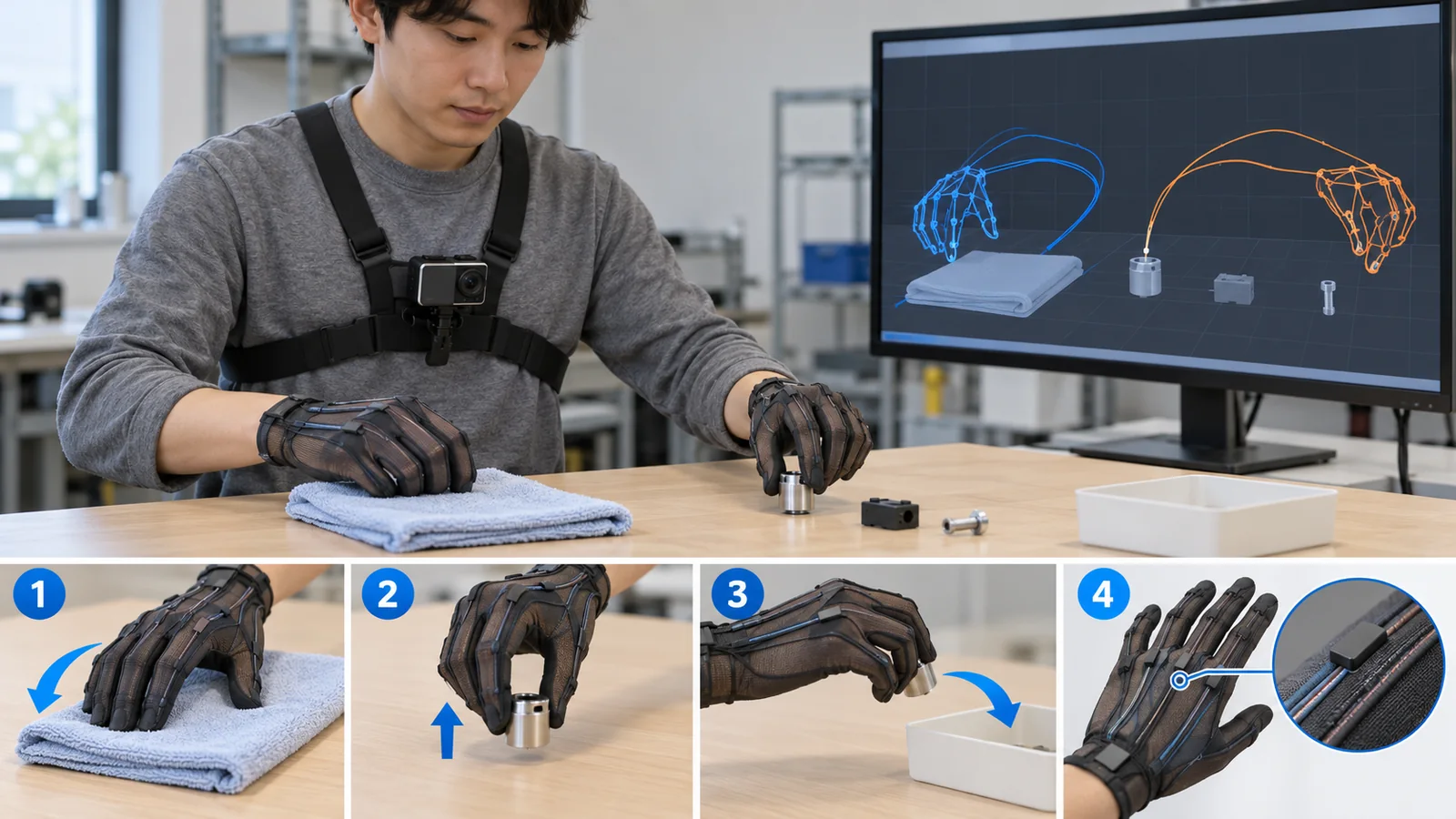
Demonstration data carry the operator’s skill, habits and the conditions of the day as they are. As with factory process data, records of who, when, on which robot, with which object and under what conditions are the clues for tracing why a policy fails. Whether to keep failed demonstrations or remove them as outliers is also a data-design question (commentary). The ISO/IEC 5259 series deals with terminology for data quality for machine learning and with requirements and guidelines for data quality management [Ref. 27, 28] (we did not read the text).
Gloves and instruments that measure human hand motion sit next to materials issues: conductive materials that withstand bending, stretchable sensors, resistance to wear and sweat, and ease of washing. Drift in measurement and the calibration effort for different hand sizes also affect data quality (this is this article’s general view, not a measurement on any product). DexCap uses measurement based on SLAM and electromagnetic fields [Ref. 9]. On the other hand, leader devices such as GELLO are said to be buildable from 3D-printed parts and off-the-shelf motors [Ref. 5], and the design of materials and structures that are cheap, durable and light on the operator’s arms widens the base of data collection (commentary). RH20T records visual, force, audio and action data in sync, so the materials and calibration of the sensors (touch and force) that capture force data bear directly on data quality [Ref. 15].
Data collected with leader-follower and data collected with hand-held tools or video record different information (force, touch, viewpoint). The nature of the learned policy changes too, so always keep in mind the difference between the tool used to collect data and the machine that runs the policy (commentary).
8. Limits, and what could not be confirmed / summary
(1) Comparing results in papers
Dataset sizes, success rates and collection times are values reported under the conditions each paper chose. We did not confirm independent third-party reproduction. We do not rank them.
(2) Companies’ videos
The wording of companies’ official pages is a set of examples within the text we checked, and “could not be confirmed” does not mean a run is teleoperated. We did not check the autonomy of all videos and announcements of each company. We did not include cases, such as 1X, for which we could not reach the official page.
(3) The text of standards
For ISO standards we confirmed only number, title and publication date and did not read the text. We could not confirm an international standard that defines classes of teleoperation and autonomy. We did not open the ASTM site. The NIST “Response Robots” page says it is developing test methods and performance metrics for remotely operated robots (including operator proficiency), but it does not give numbers or titles of individual standards.
(4) What we did not cover
Remote operation of medical robots (surgical assistance) is in our article on surgical robots, and remote operation in space and underwater in the respective articles. We do not cover market size or prices.
- Teleoperation is a tool for real work and also a tool for making learning data. Autonomy comes in degrees and is distinguished from teleoperationSourced
- With data, variety can matter more than quantity. Human time grows in proportion to the number of demonstrations (assumed: 1,000 demonstrations at 60 s each is about 16.7 hours)SourcedOur calculation
- Read videos and success rates through statements of autonomous or not, any intervention, how many out of how many. Depending on the counting rule the same runs give 88% or 70%Our calculation
9. How to read the yardsticks and standards
The yardsticks for data collection are the quantity, variety and quality of data and the success rate of the policy learned from them. For teleoperation itself, there are test methods, including operator proficiency, for rescue-type robots. We could not confirm a common classification that defines autonomous versus teleoperated (checked 25 October 2026).
| Item evaluated | Representative tests and benchmarks (name, source) | Standards, rules and guidance (ISO and others) | Notes on reading |
|---|---|---|---|
| Quantity and variety of data | DROID (76k trajectories, 564 scenes), BridgeData V2, AgiBot World, Open X-Embodiment [Ref. 13, 14, 16, 17]. The power-law study of Lin et al. [Ref. 18]Sourced | Could not be confirmed | Look not only at the size but at the variety of environments, objects and tasks |
| Data quality | robomimic (analysis of dependence on demonstration quality) [Ref. 19]Sourced | ISO/IEC 5259-1:2024 (data quality: overview, terminology, examples) and ISO/IEC 5259-3:2024 (data quality management requirements and guidelines) [Ref. 27, 28]Sourced | For machine learning in general, not specific to robot demonstrations. The text is paid |
| Capability of teleoperated robots | NIST Response Robots: test methods and performance metrics for remotely operated ground, aerial and aquatic robots covering mobility, manipulation, sensors, energy, communications, operator proficiency and safety [Ref. 26]Sourced | The NIST page describes these as being standardised in a corresponding committee of ASTM International (E54.09). We do not give individual standard numbers or titles | Aimed at rescue robots, not at collecting learning data |
| Safety of industrial robots | — (a standard, not a benchmark) | ISO 10218-2:2025 (safety requirements for industrial robot applications and cells) [Ref. 29]Sourced | It does not define how to evaluate teleoperation or autonomy. The text is paid |
| Autonomous or teleoperated | — (we could not confirm a common benchmark) | Could not be confirmed | Check each company’s and paper’s statements with the checklist in Chapter 6 |
The arrangement of the table is Our calculation (organising). Numbers, titles and publication dates of ISO standards were checked on the official ISO pages (25 October 2026). The text of the standards is paid, so we stay with titles and scope.
Notes on reading (for materials engineers)
- Demonstrations, benchmarks and the shop floor are different things: success rates on videos and datasets are values for chosen tasks and environments. Re-measure with your own objects and environment
- A developer’s statement and independent verification are different: whether a video is autonomous and its success rate are the developer’s wording. Check whether independent evaluation exists
- Is a standard a requirement or information? ISO/IEC 5259 is a framework for data quality and ISO 10218 sets safety requirements for industrial robots; neither directly defines the quality of robot demonstration data or whether a video is autonomous
- Plans and schedules are not settled: companies’ “coming soon” or “mass production” statements are Not yet confirmed. We do not cover them here
10. Glossary
- Teleoperation
- A person operating a robot from a distance.
- Leader-follower
- A scheme in which the robot (follower) reproduces the motion of a “leader” device moved by a person.
- Bilateral teleoperation
- Teleoperation in which the force the robot feels is returned to the person’s hand.
- Telepresence
- A set-up in which the operator feels present at the robot’s location.
- Shared autonomy
- A person and a robot dividing the work of moving between them.
- Supervised autonomy
- The robot works automatically and a person watches and intervenes only when needed.
- Intervention
- A person adding control or correction while a robot is running autonomously.
- Demonstration
- A motion shown or operated by a person and recorded as an example for learning.
- Trajectory
- The time sequence of observations and actions of one demonstration or trial.
- Episode
- One run from the start to the end of a task.
- Behavior cloning
- Building a policy by fitting (observation, action) pairs with supervised learning.
- Embodiment
- The robot’s body: its shape, joints and sensors.
- Motion capture
- Technology that measures and records human motion.
- Egocentric video
- Video shot from the wearer’s eye position.
- Diversity
- The range of environments, objects and conditions in the data.
- Latency
- The time from an operation until the robot moves (or the video returns).
- Round-trip delay
- The time for a signal to go and come back.
- Standard format
- A recording format fixed so that data from several institutions and robots can be used together.
- Success rate
- The fraction of trials that achieved the task; check the counting rule (whether help counts).
- Data quality
- The degree to which data are accurate, complete and consistent for their purpose.
11. References
- Hokayem P. F., Spong M. W. “Bilateral teleoperation: An historical survey”, Automatica 42(12), 2035–2057 (2006), DOI 10.1016/j.automatica.2006.06.027. Title and bibliographic data checked in Crossref; contents not checked here — doi.org/10.1016/j.automatica.2006.06.027
- Mandlekar A. et al. “RoboTurk: A Crowdsourcing Platform for Robotic Skill Learning through Imitation”, arXiv:1811.02790 (2018) — arxiv.org/abs/1811.02790
- Zhao T. Z. et al. “Learning Fine-Grained Bimanual Manipulation with Low-Cost Hardware” (ALOHA, ACT), arXiv:2304.13705 (2023) — arxiv.org/abs/2304.13705
- Fu Z., Zhao T. Z., Finn C. “Mobile ALOHA: Learning Bimanual Mobile Manipulation with Low-Cost Whole-Body Teleoperation”, arXiv:2401.02117 (2024) — arxiv.org/abs/2401.02117
- Wu P. et al. “GELLO: A General, Low-Cost, and Intuitive Teleoperation Framework for Robot Manipulators”, arXiv:2309.13037 (2023) — arxiv.org/abs/2309.13037
- Cheng X. et al. “Open-TeleVision: Teleoperation with Immersive Active Visual Feedback”, arXiv:2407.01512 (2024) — arxiv.org/abs/2407.01512
- Qin Y. et al. “AnyTeleop: A General Vision-Based Dexterous Robot Arm-Hand Teleoperation System”, arXiv:2307.04577 (2023) — arxiv.org/abs/2307.04577
- Fu Z. et al. “HumanPlus: Humanoid Shadowing and Imitation from Humans”, arXiv:2406.10454 (2024) — arxiv.org/abs/2406.10454
- Wang C. et al. “DexCap: Scalable and Portable Mocap Data Collection System for Dexterous Manipulation”, arXiv:2403.07788 (2024) — arxiv.org/abs/2403.07788
- Chi C. et al. “Universal Manipulation Interface: In-The-Wild Robot Teaching Without In-The-Wild Robots”, arXiv:2402.10329 (2024) — arxiv.org/abs/2402.10329
- Kareer S. et al. “EgoMimic: Scaling Imitation Learning via Egocentric Video”, arXiv:2410.24221 (2024) — arxiv.org/abs/2410.24221
- Grauman K. et al. “Ego4D: Around the World in 3,000 Hours of Egocentric Video”, arXiv:2110.07058 (2021) — arxiv.org/abs/2110.07058
- Khazatsky A. et al. “DROID: A Large-Scale In-The-Wild Robot Manipulation Dataset”, arXiv:2403.12945 (2024) — arxiv.org/abs/2403.12945
- Walke H. et al. “BridgeData V2: A Dataset for Robot Learning at Scale”, arXiv:2308.12952 (2023) — arxiv.org/abs/2308.12952
- Fang H.-S. et al. “RH20T: A Comprehensive Robotic Dataset for Learning Diverse Skills in One-Shot”, arXiv:2307.00595 (2023) — arxiv.org/abs/2307.00595
- AgiBot World Contributors “AgiBot World Colosseo: A Large-scale Manipulation Platform for Scalable and Intelligent Embodied Systems”, arXiv:2503.06669 (2025) — arxiv.org/abs/2503.06669
- Open X-Embodiment Collaboration “Open X-Embodiment: Robotic Learning Datasets and RT-X Models”, arXiv:2310.08864 (2023) — arxiv.org/abs/2310.08864
- Lin F. et al. “Data Scaling Laws in Imitation Learning for Robotic Manipulation”, arXiv:2410.18647 (ICLR 2025) — arxiv.org/abs/2410.18647
- Mandlekar A. et al. “What Matters in Learning from Offline Human Demonstrations for Robot Manipulation”, arXiv:2108.03298 (2021) — arxiv.org/abs/2108.03298
- Luo J. et al. “Precise and Dexterous Robotic Manipulation via Human-in-the-Loop Reinforcement Learning” (HIL-SERL), arXiv:2410.21845 (2024) — arxiv.org/abs/2410.21845
- NVIDIA et al. “GR00T N1: An Open Foundation Model for Generalist Humanoid Robots”, arXiv:2503.14734 (2025) — arxiv.org/abs/2503.14734
- Physical Intelligence Blog post “π0: Our First Generalist Policy” (31 October 2024). Text checked on 25 October 2026 — pi.website/blog/pi0
- Figure AI News post “Helix Accelerating Real-World Logistics” (26 February 2025). Text checked on 25 October 2026 — figure.ai/news/helix-logistics
- Google DeepMind Blog post “Gemini Robotics brings AI into the physical world” (12 March 2025). Text checked on 25 October 2026 — deepmind.google/discover/blog/gemini-robotics-brings-ai-into-the-physical-world
- Hugging Face GitHub repository “huggingface/lerobot” (Apache License 2.0). Licence confirmed through GitHub’s public API (25 October 2026) — github.com/huggingface/lerobot
- NIST “Response Robots” (standard test methods and performance metrics for remotely operated robots). Checked 25 October 2026 — nist.gov/el/intelligent-systems-division-73500/response-robots
- ISO/IEC ISO/IEC 5259-1:2024 “Artificial intelligence — Data quality for analytics and machine learning (ML) — Part 1: Overview, terminology, and examples” (July 2024). Checked 25 October 2026 — iso.org/standard/81088.html
- ISO/IEC ISO/IEC 5259-3:2024 “Artificial intelligence — Data quality for analytics and machine learning (ML) — Part 3: Data quality management requirements and guidelines” (July 2024). Checked 25 October 2026 — iso.org/standard/81092.html
- ISO ISO 10218-2:2025 “Robotics — Safety requirements — Part 2: Industrial robot applications and robot cells” (Edition 2, February 2025). Checked 25 October 2026 — iso.org/standard/73934.html
12. Claim-to-source audit
| Claim in the text | Basis | Class |
|---|---|---|
| That a historical survey of bilateral teleoperation exists (Hokayem and Spong, Automatica, 2006) | Crossref bibliographic data (title, journal, year); contents not checked Reference 1 https://doi.org/10.1016/j.automatica.2006.06.027 | Sourced |
| GELLO: a device with the same kinematic structure as the target arm, built from 3D-printed parts and off-the-shelf motors; a user study showing more reliable and efficient demonstration collection than VR controllers and 3D spacemouses | Wu et al. (abstract) Reference 5 https://arxiv.org/abs/2309.13037 | Sourced |
| ACT/ALOHA: learning from low-cost teleoperated demonstrations, with compounding errors and non-stationary human demonstrations as challenges; Mobile ALOHA: whole-body teleoperation, where 50 demonstrations per task and co-training with existing data raised success rates by up to 90% | Zhao et al.; Fu et al. (abstracts) Reference 3 https://arxiv.org/abs/2304.13705 Reference 4 https://arxiv.org/abs/2401.02117 | Sourced |
| Open-TeleVision (immersive stereoscopic teleoperation; four tasks on two humanoids), AnyTeleop (vision-based teleoperation of dexterous arm-hand systems in one system), HumanPlus (shadowing human motion to collect whole-body data; 60-100% success with up to 40 demonstrations) | Cheng et al.; Qin et al.; Fu et al. (abstracts) Reference 6 https://arxiv.org/abs/2407.01512 Reference 7 https://arxiv.org/abs/2307.04577 Reference 8 https://arxiv.org/abs/2406.10454 | Sourced |
| DexCap (portable hand motion capture based on SLAM and electromagnetic fields; six dexterous tasks), UMI (hand-held grippers to collect demonstrations without a robot; inference-time latency matching and a relative-trajectory action representation), EgoMimic (egocentric video from Project Aria and 3D hand tracking; one hour of hand data reported to be more valuable than one hour of robot data), Ego4D (3,670 hours, 931 camera wearers, 9 countries) | Wang et al.; Chi et al.; Kareer et al.; Grauman et al. (abstracts) Reference 9 https://arxiv.org/abs/2403.07788 Reference 10 https://arxiv.org/abs/2402.10329 Reference 11 https://arxiv.org/abs/2410.24221 Reference 12 https://arxiv.org/abs/2110.07058 | Sourced |
| RoboTurk: 137.5 hours of data from remote workers using smartphones (over 2,200 successful demonstrations in 22 hours of system use); low bandwidth and high delay did not substantially affect the success of demonstrations | Mandlekar et al. (abstract) Reference 2 https://arxiv.org/abs/1811.02790 | Sourced |
| Dataset scales: DROID (76k trajectories, 350 hours, 564 scenes, 84 tasks, 50 collectors, 12 months), BridgeData V2 (60,096 trajectories, 24 environments), RH20T (over 110,000 contact-rich sequences with visual, force, audio and action data), AgiBot World (over 1 million trajectories, 217 tasks, five scenarios), Open X-Embodiment (21 institutions, 22 robots, 527 skills) | Khazatsky et al.; Walke et al.; Fang et al.; AgiBot World Contributors; Open X-Embodiment Collaboration (abstracts) Reference 13 https://arxiv.org/abs/2403.12945 Reference 14 https://arxiv.org/abs/2308.12952 Reference 15 https://arxiv.org/abs/2307.00595 Reference 16 https://arxiv.org/abs/2503.06669 Reference 17 https://arxiv.org/abs/2310.08864 | Sourced |
| Lin et al.: from over 40,000 demonstrations and over 15,000 real rollouts, generalisation improved roughly as a power law of the number of environments and objects, diversity mattered more than the total number of demonstrations, extra demonstrations had little effect beyond a threshold per environment or object, and four collectors in one afternoon brought two tasks to about 90% success (ICLR 2025) | Lin et al. (abstract, body) Reference 18 https://arxiv.org/abs/2410.18647 | Sourced |
| robomimic: analysis including dependence on demonstration quality; HIL-SERL: demonstrations and human corrections combined with RL, reaching high success rates in 1 to 2.5 hours of training; GR00T N1: 88 hours of in-house teleoperated data (20 Hz; human motion measured with a wrist tracker, finger gloves and so on) expanded about tenfold to 827 hours with video-generation models, and the statement that robot data scale linearly with human labour | Mandlekar et al.; Luo et al.; NVIDIA et al. Reference 19 https://arxiv.org/abs/2108.03298 Reference 20 https://arxiv.org/abs/2410.21845 Reference 21 https://arxiv.org/abs/2503.14734 | Sourced |
| Examples of how companies’ official pages state things: Physical Intelligence (31 October 2024) describes its laundry video as uncut, from a single policy operating fully autonomously; Figure (26 February 2025) describes working closely with teleoperators to refine strategies and a test-time speed-up of up to 50% that can exceed the demonstrator’s speed; in the text of Google DeepMind’s blog (12 March 2025) we could not find whether videos are autonomous or teleoperated, or the playback speed | The respective official pages (checked 25 October 2026) Reference 22 https://www.pi.website/blog/pi0 Reference 23 https://www.figure.ai/news/helix-logistics Reference 24 https://deepmind.google/discover/blog/gemini-robotics-brings-ai-into-the-physical-world/ | Sourced |
| That the LeRobot repository is public under the Apache License 2.0; NIST’s “Response Robots”: test methods and performance metrics for remotely operated ground, aerial and aquatic robots covering mobility, manipulation, sensors, energy, communications, operator proficiency and safety | GitHub public API; NIST page Reference 25 https://github.com/huggingface/lerobot Reference 26 https://www.nist.gov/el/intelligent-systems-division-73500/response-robots | Sourced |
| The numbers, titles and publication of ISO/IEC 5259-1:2024 (data quality: overview, terminology, examples), ISO/IEC 5259-3:2024 (data quality management requirements and guidelines) and ISO 10218-2:2025 (safety requirements for industrial robot applications and cells) | ISO pages Reference 27 https://www.iso.org/standard/81088.html Reference 28 https://www.iso.org/standard/81092.html Reference 29 https://www.iso.org/standard/73934.html | Sourced |
| The assumed human time to collect demonstrations (60 s each: 1.7 hours for 100, 16.7 hours for 1,000, 167 hours for 10,000, 1,667 hours for 100,000 and 16,667 hours for 1 million), about 16.6 s per DROID trajectory (350 hours / 76,000), round-trip delay (light in optical fibre assumed at about 200,000 km/s: about 10 ms for 1,000 km), and the counting examples (88% and 70%) | Our calculation (assumed values; not results of any real robot or operator) | Our calculation |
| The readings that autonomy comes in degrees, that a video alone does not show whether a run is autonomous or teleoperated, that a success rate depends on the counting rule (whether help counts), that data quality can be traced through records of operators and conditions, and that glove sensors also pose materials questions | This article’s commentary based on the published material; not views stated by the institutions | Commentary |
| An international standard defining the classes of teleoperation and autonomy, whether each company video is autonomous or teleoperated, statistics on human intervention, and ASTM standards (numbers and text) | Not included because they could not be confirmed from primary sources within this article’s research (commentary). The ASTM site was not opened | Commentary |
| That Figures 1 and 8 are frames for AI-generated images, Figures 2, 3, 5 and 6 are explanatory concept diagrams, and Figures 4 and 7 contain our calculations | This article’s own note | Commentary |
Last updated: 25 October 2026 / Sources are limited to primary material (arXiv papers, companies’ official pages, the official NIST and ISO pages and public GitHub information). We could not read the text of the ISO standards because it is paid. We did not open the ASTM site. The numerical examples are calculations from values we assumed and are not the results of any real robot or operator. We could not confirm, and so do not state, an international standard that defines classes of teleoperation and autonomy, whether each company video is autonomous or teleoperated, or statistics on human intervention. Figures 1 and 8 are ImageGen-generated conceptual illustrations; the other figures are explanatory concept diagrams or figures containing our calculations.