COMPANY PROFILE / MATERIALS INFORMATICS
NVIDIA
A computing-infrastructure company that supplies ALCHEMI, tools for running materials and chemistry simulations fast
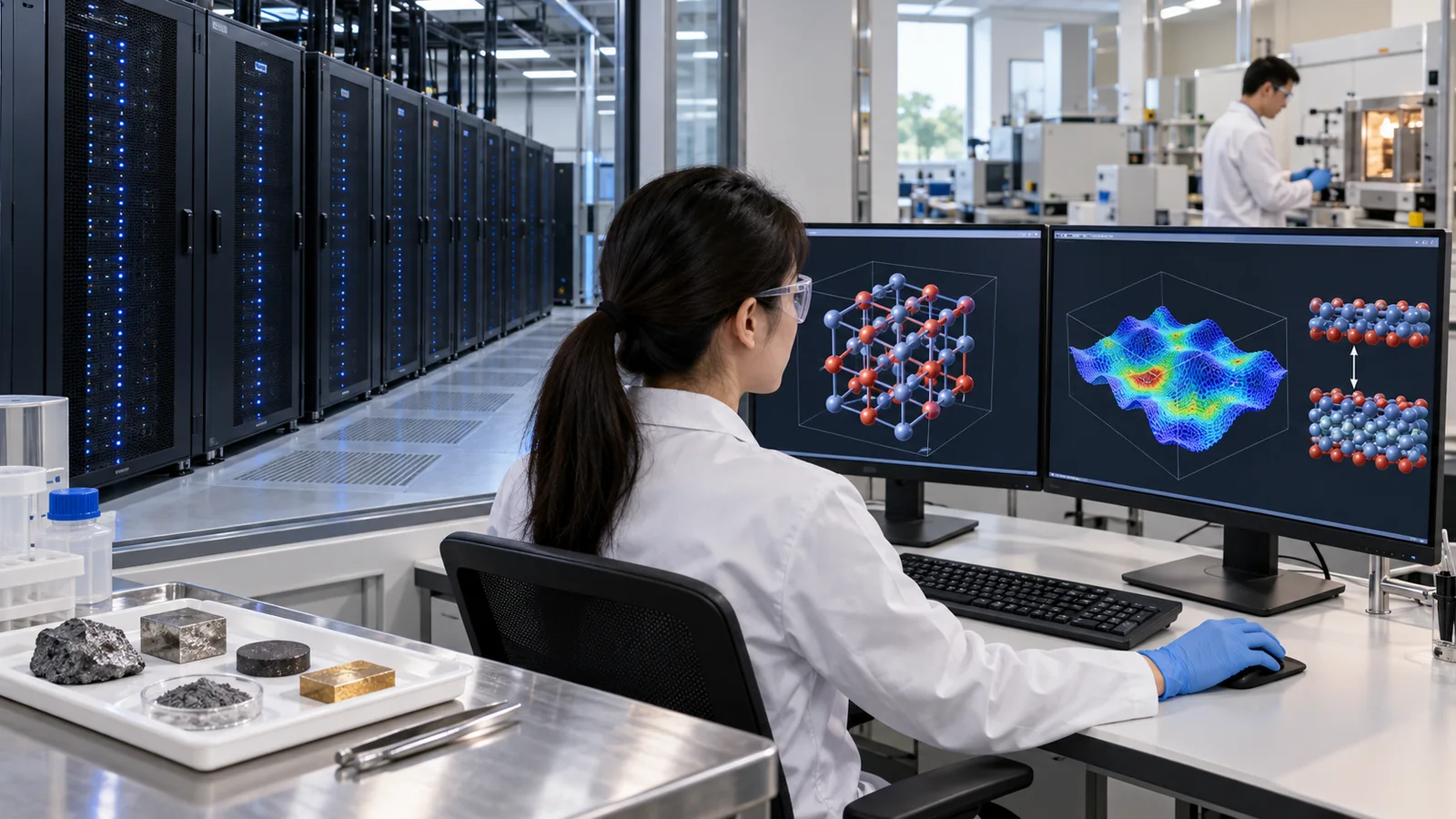
NVIDIA is known for the GPUs that power AI. In materials and chemistry it supplies ALCHEMI (AI Lab for Chemistry and Materials Innovation), a set of software for running AI-driven atomistic simulations quickly and in bulk on GPUs. It consists of ready-to-use cloud services (NIM) and the Toolkit for building your own workflows, among other parts, and the Toolkit is open source (Apache-2.0). At the same time, we could not find an AI model for materials that NVIDIA itself built, and the model that the services use by default is, according to official documentation, "not owned or developed by NVIDIA". The speed figures (100 times, 10,000 times and so on) are claims by the company and its users and vary with conditions. This profile separates the company's claims, the conditions of measurement and experimental confirmation, and uses only what primary sources let us confirm.
- NVIDIA in 30 seconds, and where it stands in materials informatics
- The logo and how the name is written
- Where the company sits in the materials informatics field
- Scale (the company as a whole, in brief)
- Resources committed to materials informatics
- What it has done so far
- What comes next
- What the company is aiming for in materials informatics
- Map of materials informatics partnerships
- Technology, products and services (how to read the numbers)
- The risks this company carries
- Glossary, references and claim-to-source audit
1. NVIDIA in 30 seconds, and where it stands in materials informatics
Materials informatics (MI) means using data, computation and AI to find new materials more efficiently. Its workflow has three broad steps: "data, then prediction and design, then experimental confirmation". NVIDIA works on the part that makes the computing for the prediction and design step faster. It is not a company that builds the AI models themselves; it supplies the computing foundation and tools for running the models.
Nasdaq: NVDACalifornia, U.S.
(the "compute" side)We could not confirm a materials model of its own
(NIM, Toolkit, Toolkit-Ops)A set of software that speeds up atomistic simulation on GPUs
Up to 10,000 times faster OLED evaluationFigures with conditions. We could not confirm independent verification (section 10)
NIM: NVIDIA's agreementsThe NIM is stated to be usable commercially and non-commercially. Read the original terms
NIMs released March 2026Initial release dates on NGC (official documentation)
ALCHEMI's speed-up means "running the same AI model on more structures, faster" Sourced. Being faster does not make a prediction more accurate. Accuracy depends on the model used (MACE, AIMNet2, TensorNet and others) and the DFT data it was trained on. According to official documentation, the default model is not owned or developed by NVIDIA. Throughout this profile we keep speed claims, the conditions of measurement and prediction accuracy apart.
2. The logo and how the name is written

A note on naming: in this article, "NVIDIA" means NVIDIA Corporation, the U.S. listed company. ALCHEMI is the name of a product family, and NIM is NVIDIA's name for an "inference microservice", a part that makes a trained model ready to run. NVentures is NVIDIA's venture investment arm. The 10-K reports figures for the whole company, not for ALCHEMI alone.
Official website: https://www.nvidia.com/en-us/about-nvidia/legal-info/logo-brand-usage/ (the logo is the image on NVIDIA's logo and brand usage page)3. Where the company sits in the materials informatics field
As Fig. 1 shows, within the "foundation models and compute" type NVIDIA is on the compute side. Of the MI workflow (data, then prediction and design, then experiment), it supports running the computation for prediction and design quickly and in bulk on GPUs. We could not find a foundation model for materials of NVIDIA's own; what it does is run third-party models (MACE, AIMNet2, TensorNet and others). The experimental check is done by the companies that use the tools Sourced.
A GPU is a chip that grew out of image processing and performs a very large number of similar calculations side by side, which suits AI. A NIM is a trained model packaged as a ready-to-use "part". Batching means calculating many structures together, at the same time, which is faster than doing them one at a time. In materials searches the candidates can number in the tens of thousands or even hundreds of millions, so being able to preview many of them quickly in one go matters. For the technical detail, see our explainers on machine-learning interatomic potentials, high-throughput computation, and molecular dynamics.
4. Scale (the company as a whole, in brief)
NVIDIA is a large company built around semiconductors and networking equipment for AI. We show only its size as a whole Sourced. Revenue, headcount and budget for the materials and chemistry business alone are not disclosed Not yet confirmed.
| Metric (whole company, US$ million) | FY2024 (year to January 2024) | FY2025 (year to January 2025) | FY2026 (year to January 2026) |
|---|---|---|---|
| Revenue | 60,922 | 130,497 | 215,938 |
| Research and development | 8,675 | 12,914 | 18,497 |
| Purchases related to property and equipment and intangible assets | 1,069 | 3,236 | 6,042 |
| Item | Detail |
|---|---|
| Employees (end of fiscal 2026) | About 42,000 (31,000 of them in research and development) |
| Headquarters | 2788 San Tomas Expressway, Santa Clara, California, U.S. |
| Listing | The Nasdaq Global Select Market (NVDA) |
| Mentions of materials science | The 10-K mentions, in one place only, that researchers and developers use its computing for applications ranging from molecular dynamics to climate forecasting, and that with support for 6,000 applications it enables discovery in areas including materials science. We could not find any mention of ALCHEMI |
The figures above describe the company as a whole. Of FY2026 revenue, Data Center accounted for US$193,737 million, about 90% of the total Our calculation (from the 10-K's revenue by market platform). Software for materials and chemistry appears to be a small part of that. How much of the roughly US$18.5 billion of R&D in the year to January 2026 went to ALCHEMI is not disclosed. The size of the company and the size of its commitment to materials and chemistry are two different things.
5. Resources committed to materials informatics
Amounts and headcounts are not disclosed, but we can set out what official sources do and do not show, under four headings.
| Heading | What we could confirm | Type |
|---|---|---|
| People | ALCHEMI's official blogs carry the names of several authors (Wen Jie Ong, Justin S. Smith, Dallas Foster, Kelvin Lee and others). The total number of people working on ALCHEMI is not disclosed | Sourced / not disclosed |
| Money | R&D spending and capital expenditure for ALCHEMI are not disclosed, and the 10-K does not mention them | Could not confirm |
| Investments, acquisitions, joint ventures, divestments | NVIDIA's venture arm NVentures (1) invested in Orbital Materials, a materials-AI company (announced by Orbital Materials on 22 October 2024; amount not disclosed), and (2) was disclosed as a supporter of Lila Sciences, a company building AI for science (disclosed by Lila at the close of its Series A in October 2025; NVentures' amount not disclosed). We could not confirm any acquisition, joint venture or divestment concerning materials AI | Sourced (announcements by the investees) / amounts not disclosed |
| Universities, research institutes and public funding | (1) Brookhaven National Laboratory (U.S. Department of Energy): uses NVIDIA Holoscan for image processing at the NSLS-II synchrotron facility (fast processing of experimental data; NVIDIA blog, November 2025). (2) AIMNet2 from the Isayev group at Carnegie Mellon University is one of the models ALCHEMI supports. (3) Corporate users: ENEOS, Universal Display and SES AI. We could not confirm receipt of public research funding | Sourced / could not confirm |
Status of the main products and software
| Name | Kind | Main specifications and conditions | Release and licence | Stage and date |
|---|---|---|---|---|
| ALCHEMI NIM: geometry relaxation (BGR) | Cloud microservice | Relaxes many structures to their stable shapes in one go. Supports MACE, AIMNet2 and TensorNet. Default is MACE-MPA-0 (a third-party model). The weights for AIMNet2 and TensorNet must be supplied by the user (a limitation of 1.0.0) | The NIM under the NVIDIA AI Product Agreement, the model under the NVIDIA AI Foundation Models Community License, as stated. Described as usable commercially and non-commercially | Offered (1.0.0 on NGC on 12 March 2026; now 1.1.0) |
| ALCHEMI NIM: molecular dynamics (BMD) | Cloud microservice | Runs NVE, NVT and NPT molecular dynamics with MLIPs. Default is MACE-MPA-0 | As above | Offered (1.0.0 on 13 March 2026) |
| ALCHEMI NIM: conformer search (BCS) | Cloud microservice | Searches for low-energy shapes of molecules. Uses AIMNet2. 10 to 100 milliseconds per conformer (H100, the company's measurement) | We could not confirm | Announced in November 2025. On the check date the official download list showed only BGR and BMD, so we could not confirm its availability |
| ALCHEMI Toolkit | Building blocks for simulations (PyTorch) | Optimisers, integrators and data structures. Wrappers for MACE, TensorNet and AIMNet2. Supports multiple GPUs and nodes | Open source (Apache-2.0) | Offered (announced 14 April 2026) |
| ALCHEMI Toolkit-Ops | GPU operation kernels | Neighbour lists, DFT-D3 dispersion correction and long-range electrostatics (Ewald and PME). Implemented with NVIDIA Warp | Open source (Apache-2.0) | Offered (GitHub in December 2025; blog on 19 December 2025) |
| An AI model for materials of its own | None found | The official materials we checked did not mention a materials model made by NVIDIA itself | None found | Could not confirm |
ALCHEMI is a tool for speeding up the "preview calculations" when there are many candidates Sourced.
(1) Accuracy depends on the model. MACE-MPA-0, the NIM's default model, is a third-party model. You need to check whether your own material system lies within its training range. As section 10 shows, the speed-up does not change accuracy.
(2) You can preview many at once. Thousands to tens of thousands of structures can be relaxed together, which suits the stage before narrowing candidates. The practical approach is still to check the important relaxed candidates with DFT or experiment.
(3) Environment. The Toolkit assumes an NVIDIA GPU (compute capability 7.0 or higher). The NIM is a cloud-oriented form run in containers such as Docker.
(4) Check the terms. The NIM container and the model follow separate agreements (the NVIDIA AI Product Agreement and the Community License). Companies should read the original text (this is not legal advice).
6. What it has done so far
| When | What happened | What it means |
|---|---|---|
| 22 October 2024 | NVentures invested in Orbital Materials (Orbital Materials' announcement) | An investment in a materials-AI company |
| 18 November 2024 | Announced ALCHEMI. The geometry-relaxation NIM was at the stage of "sign up to be notified when it is available". Measured relaxation of 2,048 crystals on an H100 falling from about 15 minutes to 9 seconds (about 100 times) | The company's measurement. Conditions in section 10 |
| 25 March 2025 | Published the SES AI case. SES AI used BGR (AIMNet2) and batched DFT to search for battery electrolyte candidates | A user case (as presented by the company) |
| 19 May 2025 | Announced that Microsoft Discovery will integrate the ALCHEMI NIM | A plan. We could not confirm that it has happened |
| October 2025 | Lila Sciences disclosed NVentures' support at the close of its Series A | An investment in an AI-for-science company |
| 17 to 18 November 2025 | Announced the conformer-search and molecular-dynamics NIMs at SC25. ENEOS and Universal Display were early-access users | The company's announcement. The figures are claims made jointly with the users |
| December 2025 | Released Toolkit-Ops (GitHub; blog on 19 December). Presented TorchSim, MatGL and AIMNet Central as adopting it | Open-sourcing of the GPU operation kernels |
| 12 to 13 March 2026 | Released version 1.0.0 of the geometry-relaxation NIM (12 March) and the molecular-dynamics NIM (13 March) on NGC | Offered about 1 year 4 months after the announcement (our calculation) |
| 14 April 2026 | Announced the ALCHEMI Toolkit, with integrations with Orbital, MatGL and Matlantis | Building blocks for building your own workflows, offered as open source |
7. What comes next
All of these are company plans and targets, not accomplished facts Not yet confirmed. The integration into Microsoft Discovery was described in the May 2025 announcement as something that "will" happen. On the date of this check (22 October 2026), we could not confirm from official sources that it has been completed. Microsoft's blog announcing general availability in June 2026 also contains no mention of NVIDIA or ALCHEMI.
None of the following appeared in official sources Not yet confirmed.
ALCHEMI's revenue and number of customers, whether it has a materials model of its own, release dates for further NIMs, investment and headcount, and completion of the integration into Microsoft Discovery.
8. What the company is aiming for in materials informatics
This section includes points the company has not stated directly. We give them as inferences drawn from primary sources, together with the evidence.
| What we read from the sources | Primary evidence | Type |
|---|---|---|
| It is opening up materials and chemistry as a new source of demand for GPUs | ALCHEMI is positioned around running fast on NVIDIA GPUs. The Toolkit requires an NVIDIA GPU. The customer cases stress that large-scale runs became possible on GPUs | Inference |
| The policy is to be the foundation that runs other parties' models rather than to build models | The default model is third-party. It supports MACE, AIMNet2 and TensorNet and integrates with Orbital, MatGL and Matlantis | Inference |
| A two-tier approach: open-source building blocks to widen adoption, and NIMs as the commercial entry point | The Toolkit and Toolkit-Ops are under Apache-2.0. The NIM is under separate agreements (the NVIDIA AI Product Agreement) | Inference |
| It engages with the materials-AI ecosystem through investment (NVentures) | The disclosed investments in Orbital Materials and Lila Sciences | Inference |
The ALCHEMI product page describes the NIM as for "researchers who need atomistic simulation at near-quantum chemistry accuracy", and the Toolkit and Toolkit-Ops as for "community code, independent software vendor (ISV) and startup developers" Sourced. From this we read that NVIDIA offers researchers a ready-to-use form (the NIM) and software companies the building blocks (the Toolkit), intending to increase the volume of materials simulation running on GPUs by either route Not yet confirmed.
9. Map of materials informatics partnerships
10. Technology, products and services
What NVIDIA offers for materials is ALCHEMI, made up of three layers (NIM, Toolkit and Toolkit-Ops). This section explains its structure, the conditions behind its numbers, and the claims by its users.
The structure of ALCHEMI (illustration)
According to the official page, the NIM is for researchers who need atomistic simulation at near-quantum chemistry accuracy. The Toolkit and Toolkit-Ops are for developers in the community, in software companies and in start-ups who train machine-learning interatomic potentials (MLIPs) or build fast simulation software Sourced.
How to read the numbers: what was measured, and under what conditions
| Figure (claimed by the company and its users) | Conditions and definition | Nature of the figure |
|---|---|---|
| Geometry relaxation about 25 times faster (NIM on) and about 100 times (batch of 128) | One NVIDIA H100 80 GB, MACE-MP-0, ASE's FIRE optimiser. 2,048 inorganic crystals (20 to 40 atoms per cell). 874 seconds without the NIM, 36 seconds with the NIM at batch size 1, and 9 seconds at batch size 128. What gets faster is the calculation; accuracy does not change | The company's measurement (software against software) |
| About 60 times for organic molecules, and about 800 times at batch 64 (AIMNet2) | 851 small organic molecules (about 20 atoms) from GDB-17. The blog explains that the difference between 100 times and 800 times comes from the systems (crystals against molecules), not from the models | The company's measurement (software against software) |
| 10 to 100 milliseconds per conformer, and molecular dynamics of over 350,000 atoms | Conformer search on an H100 with AIMNet2. Molecular dynamics on one HGX B200 with TensorNet, 1.4 microseconds per atom per step | The company's measurement (speed) |
| Universal Display: OLED thermal-stability prediction up to 10,000 times faster than DFT with "near-comparable accuracy" | Uses the conformer-search and molecular-dynamics NIMs. Within the official blog we could not confirm what exactly was compared with DFT. We could not confirm independent verification | A claim by the user and the company |
| ENEOS: over 1,000 promising non-PFAS immersion cooling fluids found in three weeks | A multi-stage calculation combining the conformer-search NIM, the molecular-dynamics NIM and batched DFT. In the passages we checked we found no experimental confirmation. A separate passage says about 10 million candidates were evaluated in a few weeks, at least 10 times more than before | A claim by the user and the company (computed candidates) |
| SES AI: 100,000 molecules mapped in half a day | Electrolyte candidates evaluated with the AIMNet2 NIM (as described in November 2024). A later article says the company found 17 candidate materials and synthesised and tested two | A claim by the user |
All the speeds above are times taken by the calculation. Whether the predictions agree with experiment is decided by the model and the data, and ALCHEMI does not change that Sourced. For the claim "10,000 times faster than DFT with near-comparable accuracy", what the accuracy was compared against and under what conditions could not be confirmed from the official materials, so we treat it as a claim by the company and its user. And "candidates found" are computed candidates, not counts of materials that were made and tested.
Three points from the cases matter to a materials engineer Sourced.
(1) A design of "narrow by calculation, experiment last". NVIDIA's blog describes ENEOS as narrowing candidates by calculation and testing only the most promising materials in real experiments. This is a way for calculation to reduce the number of experiments.
(2) A change in the scale of calculation changes how you search. A representative of ENEOS Holdings said the company had not thought of searching at the scale of 10 to 100 million before. This is a user's statement, not a confirmed result.
(3) Building a model on your own data is separate work. The Toolkit includes parts for training MLIPs, but making a model that suits your own material still needs DFT data to be prepared and validated.
11. The risks this company carries
| Risk | Detail | Type |
|---|---|---|
| Accuracy depends on third-party models | The NIM's default model is not owned or developed by NVIDIA. The limits of the model are not removed by ALCHEMI | Sourced |
| Speed figures are claims with conditions | They were measured on an H100 or B200 with particular models and systems. For the 10,000-times claim of a user, the comparison conditions could not be confirmed from official sources, nor independent verification | Sourced |
| A long gap from announcement to offering | About 1 year 4 months from the November 2024 announcement to the NIM's release on NGC (March 2026). We could not confirm the availability of the conformer-search NIM | Sourced / our calculation |
| Integration plans not confirmed as delivered | The integration into Microsoft Discovery was a 2025 plan. We could not confirm completion from official sources | Not yet confirmed |
| Dependence on NVIDIA GPUs | The Toolkit assumes an NVIDIA GPU. It is designed not to work on other vendors' computers | Sourced |
| The scale of the materials business is invisible from outside | The 10-K hardly mentions materials, and revenue, headcount and investment are not disclosed | Inference |
| Limits built into the calculations | The models are trained on DFT. Real-world complexity such as temperature, defects and interfaces is limited to the training range of the model used | Sourced |
12. Glossary
- Materials informatics (MI)
- Using data, computation and AI to find new materials efficiently.
- ALCHEMI
- AI Lab for Chemistry and Materials Innovation. The name of NVIDIA's software family for materials and chemistry.
- NIM
- NVIDIA's inference microservice. A part that makes a trained model ready to run.
- GPU
- A chip that runs a very large number of similar calculations side by side. Suited to AI computing.
- Batching
- Calculating many structures together at the same time, which is faster than one at a time.
- Machine-learning interatomic potential (MLIP)
- A way to calculate the forces between atoms quickly with AI. Used for structure relaxation and molecular dynamics.
- Geometry relaxation
- A calculation that moves atoms a little at a time to find the lowest-energy, stable shape.
- Conformer search
- A calculation that looks for the low-energy shapes (conformers) a molecule can take.
- MACE, AIMNet2, TensorNet
- Names of third-party MLIPs that ALCHEMI supports. They are not made by NVIDIA.
- NVentures
- NVIDIA's venture investment arm.
- Apache-2.0
- A permissive open-source licence that allows free use, including commercial use.
- 10-K
- The annual report that U.S.-listed companies file with the SEC.
13. References
- NVIDIA Form 10-K for the fiscal year ended January 25, 2026 (filed with the U.S. SEC on 25 February 2026). Group-wide revenue, R&D, capital expenditure and headcount, and the single mention of materials science and molecular dynamics. https://www.sec.gov/Archives/edgar/data/1045810/000104581026000021/nvda-20260125.htm
- NVIDIA Developer ALCHEMI: AI for Chemistry and Materials Science (official product page). The three layers of ALCHEMI (NIM, Toolkit, Toolkit-Ops), the list of offerings and the intended users. https://developer.nvidia.com/cuda/cuda-x-libraries/alchemi
- NVIDIA Technical Blog Revolutionizing AI-Driven Material Discovery Using NVIDIA ALCHEMI (18 November 2024). Announcement of ALCHEMI, the conditions of the geometry-relaxation speed tests, and SES AI's use. https://developer.nvidia.com/blog/revolutionizing-ai-driven-material-discovery-using-nvidia-alchemi/
- NVIDIA Technical Blog Accelerating the Future of Transportation with SES AI’s NVIDIA-Powered Innovation for Electric Vehicles (25 March 2025). SES AI's use and the company's account of its results. https://developer.nvidia.com/blog/accelerating-the-future-of-transportation-with-ses-ais-nvidia-powered-innovation-for-electric-vehicles/
- NVIDIA Technical Blog Faster Chemistry and Materials Discovery With AI-Powered Simulations Using NVIDIA ALCHEMI (18 November 2025). The conformer-search and molecular-dynamics NIMs, and the Universal Display and ENEOS examples with their claims. https://developer.nvidia.com/blog/faster-chemistry-and-materials-discovery-with-ai-powered-simulations-using-nvidia-alchemi/
- NVIDIA Blog NVIDIA Accelerated Computing Enables Scientific Breakthroughs for Materials Discovery (17 November 2025, SC25). The ENEOS, Universal Display and Brookhaven National Laboratory examples. https://blogs.nvidia.com/blog/ai-science-materials-discovery-sc25/
- NVIDIA Technical Blog Accelerating AI-Powered Chemistry and Materials Science Simulations With NVIDIA ALCHEMI Toolkit-Ops (19 December 2025). The GPU operation kernels and the open-source projects adopting them. https://developer.nvidia.com/blog/accelerating-ai-powered-chemistry-and-materials-science-simulations-with-nvidia-alchemi-toolkit-ops/
- NVIDIA Technical Blog Building Custom Atomistic Simulation Workflows for Chemistry and Materials Science with NVIDIA ALCHEMI Toolkit (14 April 2026). Announcement of the ALCHEMI Toolkit and its integrations with Orbital, MatGL and Matlantis. https://developer.nvidia.com/blog/building-custom-atomistic-simulation-workflows-for-chemistry-and-materials-science-with-nvidia-alchemi-toolkit/
- NVIDIA Docs NVIDIA NIM for ALCHEMI Batched Geometry Relaxation: Overview (AI transparency card). Initial release date (12 March 2026), the statement that the default model is third-party, and licences. https://docs.nvidia.com/nim/alchemi/alchemi-bgr/latest/ai-transparency-card/overview.html
- NVIDIA Docs NVIDIA NIM for ALCHEMI Batched Geometry Relaxation: Release Notes. Supported models and limitations (such as model weights provided externally). https://docs.nvidia.com/nim/alchemi/alchemi-bgr/latest/release-notes.html
- NVIDIA Docs NVIDIA NIM for ALCHEMI Batched Molecular Dynamics: Overview (AI transparency card). Initial release date (13 March 2026), default model and licences. https://docs.nvidia.com/nim/alchemi/alchemi-bmd/latest/ai-transparency-card/overview.html
- NVIDIA (GitHub) README of NVIDIA/nvalchemi-toolkit. Licence of the ALCHEMI Toolkit (Apache-2.0). https://github.com/NVIDIA/nvalchemi-toolkit
- NVIDIA (GitHub) README and LICENSE of NVIDIA/nvalchemi-toolkit-ops. Licence of Toolkit-Ops (Apache-2.0). https://github.com/NVIDIA/nvalchemi-toolkit-ops
- NVIDIA Blog NVIDIA and Microsoft Accelerate Agentic AI Innovation, From Cloud to PC (19 May 2025). The plan to integrate the ALCHEMI NIM into Microsoft Discovery. https://blogs.nvidia.com/blog/microsoft-build-agentic-ai-innovation-cloud-pc
- GlobeNewswire (Orbital Materials) Orbital Materials to Advance Materials and Climate Technologies with AI, Using Investment from NVentures (press release by Orbital Materials, 22 October 2024). Investment from NVentures, NVIDIA's venture arm; the amount is not disclosed. https://www.globenewswire.com/news-release/2024/10/22/2966994/0/en/Orbital-Materials-to-Advance-Materials-and-Climate-Technologies-with-AI-Using-Investment-from-NVentures.html
- Lila Sciences Announcing Lila’s $350M Series A (announcement by Lila Sciences, October 2025). Disclosure of support from NVentures and others at the second close of the Series A. https://www.lila.ai/news/announcing-the-close-of-our-series-a
- NVIDIA NVIDIA's logo and brand usage page on its official website (source of the logo). https://www.nvidia.com/en-us/about-nvidia/legal-info/logo-brand-usage/
14. Claim-to-source audit
| Claim in the text | Type | Source |
|---|---|---|
| NVIDIA's revenue, R&D and capital expenditure for FY2024 to FY2026, about 42,000 employees (31,000 in R&D), headquarters and listing | Sourced | Reference 1 https://www.sec.gov/Archives/edgar/data/1045810/000104581026000021/nvda-20260125.htm |
| The single mention of materials science and molecular dynamics in the 10-K, and the absence of any mention of ALCHEMI | Sourced | Reference 1 https://www.sec.gov/Archives/edgar/data/1045810/000104581026000021/nvda-20260125.htm |
| Revenue, headcount and budget for the materials and chemistry business are not disclosed | Not yet confirmed | Not in the 10-K. Reference 1 https://www.sec.gov/Archives/edgar/data/1045810/000104581026000021/nvda-20260125.htm |
| The three layers of ALCHEMI (NIM, Toolkit, Toolkit-Ops), the offerings (BGR and BMD), the NIM for researchers and the Toolkit for developers | Sourced | Reference 2 https://developer.nvidia.com/cuda/cuda-x-libraries/alchemi |
| Announcement of ALCHEMI (18 November 2024), the conditions of the geometry-relaxation test (H100, 2,048 crystals, 874, 36 and 9 seconds), about 60 and 800 times for organic molecules, SES AI's 100,000 molecules | Sourced | Reference 3 https://developer.nvidia.com/blog/revolutionizing-ai-driven-material-discovery-using-nvidia-alchemi/ |
| SES AI's use, and its statement that two of 17 candidates were synthesised and tested (the company's claim) | Sourced | Reference 4 https://developer.nvidia.com/blog/accelerating-the-future-of-transportation-with-ses-ais-nvidia-powered-innovation-for-electric-vehicles/ |
| Announcement of the conformer-search and molecular-dynamics NIMs (18 November 2025), 10 to 100 ms per conformer, over 350,000 atoms, Universal Display's 10,000 times, ENEOS's over 1,000 cooling fluids | Sourced | Reference 5 https://developer.nvidia.com/blog/faster-chemistry-and-materials-discovery-with-ai-powered-simulations-using-nvidia-alchemi/ |
| ENEOS and Universal Display as early-access users, ENEOS's evaluation of about 10 million and 100 million candidates, Brookhaven National Laboratory's use of Holoscan | Sourced | Reference 6 https://blogs.nvidia.com/blog/ai-science-materials-discovery-sc25/ |
| The content of Toolkit-Ops (neighbour lists, DFT-D3, long-range electrostatics, Warp) and the adoption by TorchSim, MatGL and AIMNet Central | Sourced | Reference 7 https://developer.nvidia.com/blog/accelerating-ai-powered-chemistry-and-materials-science-simulations-with-nvidia-alchemi-toolkit-ops/ |
| Announcement of the ALCHEMI Toolkit (14 April 2026), integrations with Orbital, MatGL and Matlantis, JAX support | Sourced | Reference 8 https://developer.nvidia.com/blog/building-custom-atomistic-simulation-workflows-for-chemistry-and-materials-science-with-nvidia-alchemi-toolkit/ |
| Initial release of the geometry-relaxation NIM (12 March 2026), a third-party default model, licences, usable commercially and non-commercially | Sourced | Reference 9 https://docs.nvidia.com/nim/alchemi/alchemi-bgr/latest/ai-transparency-card/overview.html |
| Supported models of the geometry-relaxation NIM (MACE, AIMNet2, TensorNet) and the limitation that AIMNet2 and TensorNet weights are supplied by the user | Sourced | Reference 10 https://docs.nvidia.com/nim/alchemi/alchemi-bgr/latest/release-notes.html |
| Initial release of the molecular-dynamics NIM (13 March 2026), NVE, NVT and NPT, default model | Sourced | Reference 11 https://docs.nvidia.com/nim/alchemi/alchemi-bmd/latest/ai-transparency-card/overview.html |
| Apache-2.0 licence of the ALCHEMI Toolkit | Sourced | Reference 12 https://github.com/NVIDIA/nvalchemi-toolkit |
| Apache-2.0 licence of ALCHEMI Toolkit-Ops | Sourced | Reference 13 https://github.com/NVIDIA/nvalchemi-toolkit-ops |
| Plan to integrate the ALCHEMI NIM into Microsoft Discovery (19 May 2025) | Not yet confirmed | Reference 14 https://blogs.nvidia.com/blog/microsoft-build-agentic-ai-innovation-cloud-pc |
| NVentures' investment in Orbital Materials (22 October 2024, amount not disclosed) | Sourced | Reference 15 https://www.globenewswire.com/news-release/2024/10/22/2966994/0/en/Orbital-Materials-to-Advance-Materials-and-Climate-Technologies-with-AI-Using-Investment-from-NVentures.html |
| Lila Sciences' disclosure of NVentures' support at the close of its Series A (October 2025) | Sourced | Reference 16 https://www.lila.ai/news/announcing-the-close-of-our-series-a |
| The logo image (NVIDIA's logo and brand usage page) | Sourced | Reference 17 https://www.nvidia.com/en-us/about-nvidia/legal-info/logo-brand-usage/ |
| About 1 year 4 months from the announcement to the NIM's release | Our calculation | Our own calculation from the announcement on 18 November 2024 and the initial release on 12 March 2026 |
| Data Center share of about 90% of FY2026 revenue | Our calculation | Our own calculation from Data Center revenue of US$193,737 million and total revenue of US$215,938 million in the 10-K |
| ALCHEMI's revenue and customer numbers, an own materials model, dates for further NIMs, investment and headcount, and completion of the integration | Not yet confirmed | Not in official sources. Not estimated in this article. Reference 2 https://developer.nvidia.com/cuda/cuda-x-libraries/alchemi |
| Acquisitions, joint ventures or divestments in materials AI, and receipt of public research funding | Not yet confirmed | Could not confirm. We do not claim they do not exist either. Reference 1 https://www.sec.gov/Archives/edgar/data/1045810/000104581026000021/nvda-20260125.htm |
| The foundation-models-and-compute type (the compute side) and the arrangement of Fig. 1 and Fig. 2 | Our calculation | Our own arrangement. Company names are examples from the companies covered in this series |
| The reading that it is opening up materials and chemistry as new demand for GPUs | Inference | Our own interpretation of how ALCHEMI is positioned and of what the cases stress |
| The reading that it aims to be a foundation that runs other parties' models | Inference | Our own interpretation of the third-party default model and the list of supported models |
| The reading of a two-tier approach of open-source parts and commercial NIMs | Inference | Our own interpretation of the difference in licences |
| The reading that it engages with the materials-AI ecosystem through NVentures | Inference | Our own interpretation of the investees' announcements |
| The risk that the scale of the materials business is invisible from outside | Inference | Our own interpretation of the near absence of materials in the 10-K |
Last updated 22 October 2026 / Troy Technical
The figures in this article come from NVIDIA's 10-K filed with the U.S. Securities and Exchange Commission, NVIDIA's official pages, blogs, product documentation and GitHub, and announcements by its investees. We do not use market estimates from research firms or figures from news reports. Passages marked "Inference" are our own readings of primary sources and are not statements by the company. Figures such as "so many times faster" are presented as claims by the company or its users, and we keep calculation speed apart from prediction accuracy, and computed candidates apart from experimental confirmation. The descriptions of licences summarise the official pages and are not legal advice. We say nothing about share prices, valuation or investment decisions.