COMPANY PROFILE / MATERIALS INFORMATICS
SES AI
A battery maker that built its own materials-discovery AI, and has begun to sell it as software and as materials
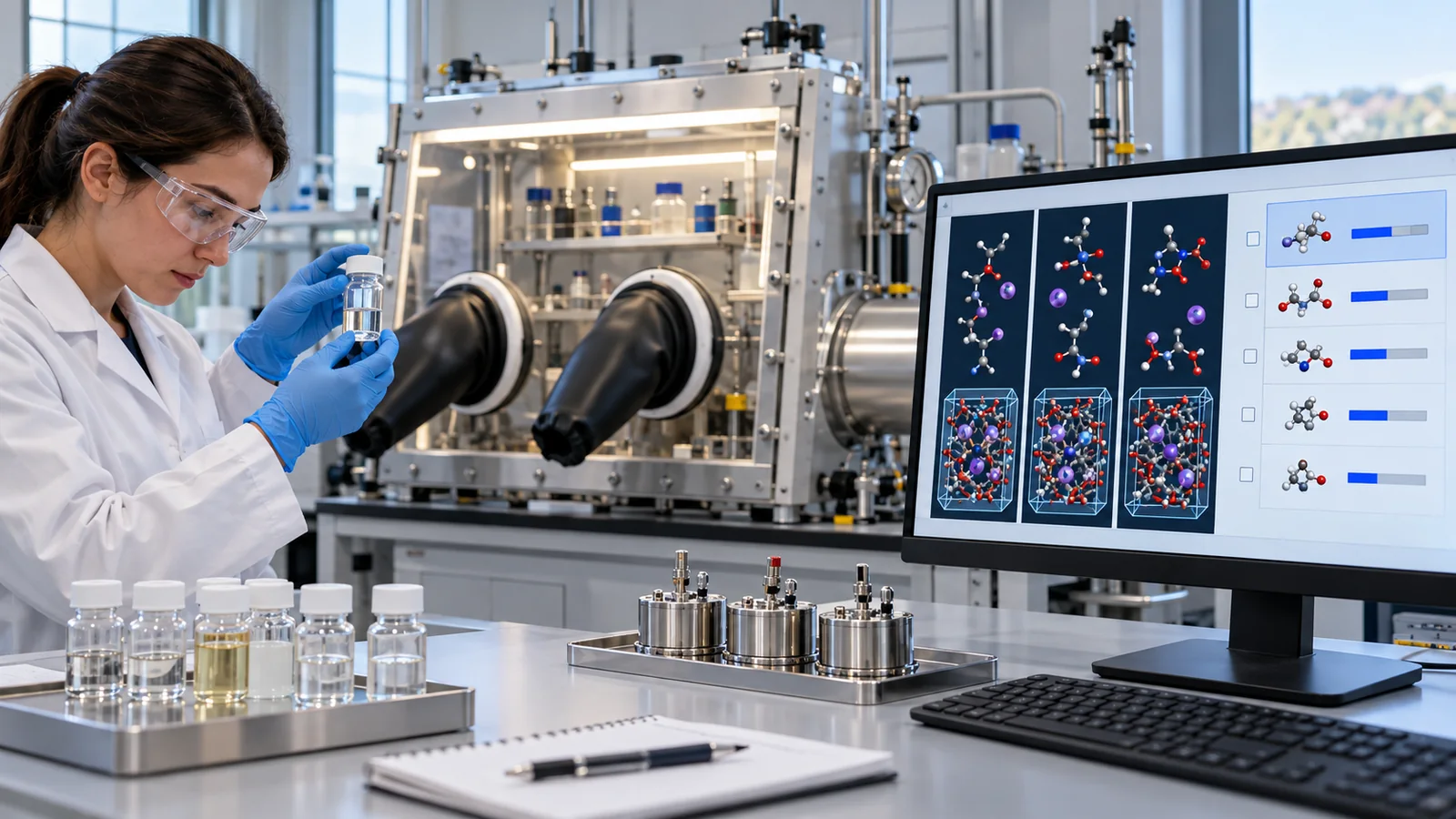
SES AI is a U.S. company that began with lithium-metal batteries. Today it runs four lines of business: energy storage systems (ESS), drone cells, battery materials such as electrolytes, and Molecular Universe, an AI platform for discovering battery materials. Seen through materials informatics (MI, the use of data and computation to narrow down candidate materials), the key point is that the state of its battery products and the story of its AI are two different things. This article keeps them apart. The electrolytes the company says AI has found are treated as the company's own claims, and the article shows what can and cannot be confirmed.
- SES AI in 30 seconds, and where it stands in materials informatics
- The logo and how the name is written
- Where the company sits in the materials informatics field
- Scale of the company
- Resources committed to materials informatics
- What it has done so far
- What comes next
- What the company is aiming for in materials informatics
- Map of partnerships in materials informatics
- Technologies, products and services
- The risks this company carries
- Glossary, references and claim-to-source audit
1. SES AI in 30 seconds, and where it stands in materials informatics
Secondary: MI software and materials AIUses AI both for its own development and as a product
40+ customers testingThe company's claim. Performance values are undisclosed (10-K for 2025)
within 2026The company's plan, not yet confirmed
When you read about SES AI, you need to separate the state of its battery products from the role of its AI. On the battery side, the company itself writes that it "originally focused on EVs" but "pivoted more than a year ago" to ESS and drones, and that ESS was its largest source of revenue in the second quarter of 2026 Sourced. The AI side, Molecular Universe, is software for finding battery materials, and also a product sold to others. How directly AI is involved differs by business. For electrolytes it is the part the company says AI found; for ESS it is the battery-health management software built into the system; for drone cells it is research the company says was "powered by" Molecular Universe. The degree of directness is not the same.
2. The logo and how the name is written

A note on names: the legal entity is SES AI Corporation (a Delaware corporation; before the February 2022 merger it was Ivanhoe Capital Acquisition Corp.). It has a subsidiary called Molecular Universe Pte. Ltd. (Singapore) that shares its spelling with the AI platform "Molecular Universe". The joint venture with Hisun is Molecular Universe Materials Pte. Ltd., yet another separate legal entity. This article calls the whole company "SES AI" and the platform "Molecular Universe" (abbreviated MU). The logo is the one shown in the header of the company's official website.
Official site: https://www.ses.ai/3. Where the company sits in the materials informatics field
Materials informatics (MI) is a flow in which data and computation narrow down "promising candidate materials", and experiments then confirm them (see our explainer on materials informatics for an overview). Companies involved in MI fall into four types, depending on which part of that flow they own.
SES AI is mainly an industrial user (batteries) that also sells MI software, which makes for an unusual combination. It makes and sells batteries, and it also sells the AI it uses to develop them. In terms of the MI flow, it is trying to hold "data (a molecular database and its own experimental data), then prediction and design (simulation and machine learning), then experimental confirmation (automated labs and cell tests)" together inside one company.
4. Scale of the company
This is a brief look at the whole company Sourced. No figures are disclosed for MI alone.
| Measure (US$ million) | Year to Dec 2024 | Year to Dec 2025 |
|---|---|---|
| Revenue from customers | 2.0 | 21.0 |
| of which services (contracted materials discovery and development to customer specifications) | 2.0 | 13.6 |
| of which products (ESS, drone cells, electrolytes and so on) | 0.1 | 7.4 |
| Research and development expense | 72.1 | 67.0 |
| Net loss | 100.2 | 73.0 |
| Other measures | Value | As of |
|---|---|---|
| Full-time employees | About 215 (about 68% in R&D-related roles, about 35% in the U.S.) | 31 December 2025 |
| Cash and cash equivalents plus short-term investments | 29.5 + 170.1 = 199.6 (our sum) | 31 December 2025 |
| Same | 64.1 + 98.9 = 163.0 (our sum) | 30 June 2026 |
| Revenue and net loss for the second quarter | 5.07 and 17.9 | April to June 2026 |
| Customer concentration | Top three customers: 48%, 15% and 12% of revenue | Year to Dec 2025 |
The figures above are for the whole company. Revenue and costs for Molecular Universe or materials discovery alone are not disclosed Not yet confirmed. Service revenue (13.6 million) includes "services for the discovery, design and development of battery materials to customer specifications", but the filing does not say how much of that used AI. Also, the financial statements show a 2025 net loss of US$73.0 million, while another passage in the same 10-K's management discussion says US$74.9 million, so the filing is not consistent with itself. This article uses the US$73.0 million in the financial statements.
5. Resources committed to materials informatics
The table shows, for people, money, outside investment and links with universities or public bodies, what could and could not be confirmed from primary sources. "Not stated" is also a finding.
| Type of resource | What is there | Status |
|---|---|---|
| People | About 68% of about 215 full-time staff work in R&D-related roles, with expertise in materials science, chemistry, engineering, machine learning and software, according to the company. A separate facility near the Woburn headquarters focuses on discovering new electrolyte molecules and developing synthesis routes. Staff in China and South Korea are mainly line operators | Sourced |
| People (MI only) | Headcount dedicated to Molecular Universe | Not disclosed |
| Money | R&D expense was US$67.0 million in 2025. The company says it rose by US$9.1 million from renting GPUs and developing Molecular Universe. Compute is rented, not bought | Sourced |
| Money (MI only) | Investment in Molecular Universe, and the scale of its compute | Not disclosed |
| Joint ventures, acquisitions, restructuring | The joint venture with Hisun (Molecular Universe Materials Pte. Ltd.) was formed in April 2026. SES holds 90% and Hisun 10%, with planned capital of US$5.0 million (SES had paid in US$3.0 million by 30 June 2026). SES consolidates it fully and has an option to buy Hisun's stake at fair market value from the third anniversary. The 10-Q describes a "shift away from in-house manufacturing" of certain battery materials. UZ Energy (an ESS maker) was acquired in September 2025, but that is a separate business from MI | Sourced |
| Corporate compute and software | Uses NVIDIA ALCHEMI (which speeds up machine-learning and DFT calculations), cuML, NeMo and DGX Cloud (NVIDIA technical blog, co-written with SES AI researchers) | Sourced |
| Ties with universities, institutes and public funding | No MI collaboration with universities or public bodies is stated in the 10-K or 10-Q. The one government grant, received from Korean government agencies in December 2022, is described as usable for facility-related expenses and is not tied to MI | Could not be confirmed |
Status of the main models and products
The table covers what could be confirmed from the company's own material (dates are those of the material available on the check date, 22 October 2026).
| Name | Kind | Main specifics (as disclosed) | Form of release and license | Stage | Source |
|---|---|---|---|---|---|
| MU-0 | Early tool | Properties computed for 121 million molecules, of which about 14 million were mapped with UMAP and about 14,000 met electrolyte constraints (NVIDIA blog, 8 May 2025) | Could not be confirmed | Released (mentioned in a May 2025 blog) | NVIDIA blog |
| MU-3.0 | Agentic workflow | Covers both sodium and lithium chemistries and links to automated labs. Described as running entirely on a customer's own premises | Cloud or on-premises subscription. License terms for models and data could not be confirmed | Released (April to June 2026) | Shareholder letter, official site |
| Search-in-a-Box | Module for fast materials screening | First order delivered to one top-tier battery maker (name and price undisclosed) | Delivered into the customer's environment | Offered (April to June 2026) | Shareholder letter, official site |
| MU-4.0 | Next version | Planned to generate new molecules from desired properties and to integrate with autonomous-lab hardware | Could not be confirmed | Not yet confirmed (due within 2026) | Shareholder letter |
| Six electrolyte products | Materials | Names (SES-H2.32 and others), cell chemistries, applications and improvement items are on the official page. No numbers are given (table in chapter 10) | Materials supplied to customers | In testing, with some in pilot deployment. Volume supply is Not yet confirmed | 10-K, shareholder letter, official site |
The NVIDIA blog's "121 million molecules", "about 14 million mapped" and "about 14,000 candidates" describe a broad computational survey of the electrolyte candidate space. They are not a count of materials confirmed in the lab Sourced. The same blog calls the roughly 14,000 "candidates" and does not report a confirmed new material. Even when a candidate electrolyte looks good on a computer, in a real battery the deciding properties are those you only learn by building and measuring cells: compatibility with the electrodes, cycle life, storage at high temperature, and output at low temperature. The improvement items for the six products on the official page are worded in the language of cell tests, such as "room-temperature cycle life", "60 degC storage" and "low-temperature C-rate", which fits that picture Not yet confirmed. Before relying on such claims for your own material system, check whether you can reproduce numbers of this kind in your own cells.
6. What it has done so far
| When | What happened | What it means |
|---|---|---|
| 2012 | The predecessor, SolidEnergy Systems Corp, is founded | The starting point as a battery maker (10-K) |
| 3 February 2022 | The business combination with Ivanhoe Capital Acquisition Corp. closes and SES AI Corporation becomes a listed company | The funding base |
| September 2022 | Molecular Universe Pte. Ltd. is incorporated in Singapore | The legal entity for the AI business (10-K) |
| 8 May 2025 | NVIDIA technical blog presents the molecular database and the early tool MU-0 | The scale of the data and computation behind MI becomes public |
| September 2025 | The acquisition of UZ Energy (an ESS maker) is completed | The battery side shifts toward ESS |
| 29 October 2025 (agreement) | Joint-venture agreement with Hisun, announced in November (10-K) | A set-up for outsourcing scale-up of AI-found materials |
| 4 March 2026 | Results for 2025 state "six novel electrolyte materials discovered, tested by over 40 customers" | The heart of the company's claim |
| April 2026 | The Hisun joint-venture entity is formed (SES pays in US$3.0 million initially) | The investment is carried out (10-Q) |
| April to June 2026 | MU-3.0 is released. The first Search-in-a-Box is delivered. Some materials finish testing and enter early pilot deployment | AI is sold externally and materials start early deployment (shareholder letter, published August 2026) |
7. What comes next
Everything below is the company's plan or outlook, not an achieved fact Not yet confirmed.
The company also states a view that "over the next 3 to 5 years, Molecular Universe will power the majority of product development, particularly in energy storage, before expanding into complex fluids and eventually other material applications" Not yet confirmed. This is the company's expectation, not a result.
None of the 10-K, 10-Q, shareholder letter or official site states the number of paying Molecular Universe customers under contract, subscription revenue, the models' prediction accuracy (with dataset, split and metric), performance values and test conditions for the six electrolyte products, or independent verification. This article makes no estimates and uses no figures taken from news reports.
8. What the company is aiming for in materials informatics
This chapter includes points the company does not state directly. They are inferences from what the primary sources say, set out with their grounds.
| What can be read | Primary source behind it | Status |
|---|---|---|
| It is trying to widen AI from a development tool into a product it can sell | The 10-K says it sees "multi-pronged business opportunities" in ESS, drones and materials through Molecular Universe, and sells MU itself as a subscription. The 10-Q also lists commercialization of MU as a key issue | Inference |
| On materials, it leans toward concentrating on discovery and design rather than manufacturing | The 10-Q describes a strategic shift away from in-house manufacturing of certain battery materials and a joint venture with Hisun to produce new materials at commercial scale. The 10-K also describes supply through the Hisun venture | Inference |
| It makes keeping customer data in-house (on-premises) a point of difference | The shareholder letter says few enterprise customers would let proprietary data leave their premises, and that a fully secured on-premises integration is needed | Sourced (company's claim) |
| It wants to close the loop across data, computation, automated experiments and cell evaluation | It describes MU-4.0 as letting users generate molecules, synthesize them, validate them in full devices and feed the data back to train models | Inference |
In describing its business environment, the 10-Q refers to a "strategic shift away from in-house manufacturing of certain battery materials", and says this is expected to reduce capital intensity and speed time to market Sourced. It also names the risks itself: dependence on third-party manufacturing partners and quality-control challenges. From this one can read a policy of "keep the AI-driven shortlisting as the company's strength and share the burden of owning factories with others" Not yet confirmed. That is our interpretation, though, and not something the company has declared as strategy.
9. Map of partnerships in materials informatics
10. Technologies, products and services
The table sets out SES AI's four current businesses, plus the EV business it has de-emphasized, separating the state of the battery or material product from its relationship with AI (checked 22 October 2026).
| Business | State of the battery or material product | Relationship with AI (company's account) |
|---|---|---|
| ESS (energy storage) | Made by UZ Energy (acquired September 2025). The largest revenue source in April to June 2026. In the U.S. it is pursuing steps such as certification by partners | Battery health and safety management software is built in. The company says the "edge box" is trained on the specific cells it uses |
| Drone cells | High-energy-density Li-Metal and Li-ion cells. A plan (Not yet confirmed) to raise capacity for cells compliant with the U.S. National Defense Authorization Act (NDAA) at a Korean plant from 200,000 to 1 million a year | The company says the cells are "regularly improved through research powered by Molecular Universe". No numbers on how much AI improved cell performance could be confirmed |
| Materials (electrolytes) | Six products. More than 40 customers are testing, and some are in early pilot deployment. Volume production is planned through the Hisun joint venture in the second half of 2026 | Described as found with MU. This is the most direct claim of an AI result |
| Molecular Universe | Software and services, not a battery product. Offered three ways: a cloud or on-premises subscription, services (contract work) and supply of materials | This is the business that is AI itself |
| Li-Metal batteries for EVs | Two of the EV prototype lines were converted to drones and UAM. The company says it moved its emphasis to ESS and drones | The state of EV volume production could not be confirmed |
The six electrolyte products AI is said to have found (company disclosure)
These are the six products listed on the "Materials" page of the official site. The improvement items are the company's wording, with no numbers, test conditions or baselines Not yet confirmed. The page says the products are ready for mass production, but the 10-K says more than 40 potential customers are testing them, and the Q2 2026 shareholder letter puts the status at "some have completed testing and entered early-stage commercial pilot deployment".
| Product | Cell chemistry | Application (company's wording) | Improvements the company cites |
|---|---|---|---|
| SES-H2.32 | Low-Si anode / NCM811 | EV | Room-temperature cycle life, 60 degC storage |
| SES-S8.62 | High-Si anode / NCM811 | Drones | Room-temperature cycle life, C-rate |
| SES-K3.1 | Graphite anode / LFP | Heavy-duty trucking | Low-temperature cycle life, C-rate |
| SES-I3/J1 | Si/graphite anode / LCO or NCM | Consumer electronics, EV | Cycle life at room temperature and 45 degC |
| SES-K3/4/11 | Graphite anode / LFP | ESS or EV | Room-temperature cycle life, 60 degC storage, C-rate at -20 degC |
| SES-G6-Gel | Graphite anode / LCO | Consumer electronics | Room-temperature cycle life, 45 degC storage |
Molecular Universe offers three things to outside users (official page, Sourced): (1) use of the software (cloud or on-premises), (2) services such as fast materials screening tailored to a customer's goal, and (3) supply of materials. For someone developing electrolytes, (2) is the easiest to picture. From a wide space of solvent, additive and salt (anion) combinations, AI is used to decide the order in which to test, and the final evaluation is done in your own cells. One caution is that the company has not published the accuracy of its prediction models. If you consider adopting it, a small trial that uses your own known electrolyte data, good cases and bad, to see whether its predictions hold lets you judge without relying on the company's claims. The option of keeping data on your own premises (on-premises) also matters if you want to protect your formulation data.
11. The risks this company carries
| Risk | What it is | Status |
|---|---|---|
| The AI market is still new | The 10-K says the market for AI services is still emerging and the programs may not reach the growth the company expects | Sourced |
| AI output may be wrong | The 10-K lists flawed algorithms, insufficient or biased data and insufficient back-testing as risks | Sourced |
| Little outside verification of results | Performance values and test conditions for the six electrolyte products are not published, and no third-party verification could be found | Not yet confirmed |
| Concentrated customers and continuing losses | Three customers made up about 75% of 2025 revenue (48%, 15% and 12%). Losses continue, and the 10-K says revenue will not cover expenses for a few more years | Sourced |
| Reliance on a partner for scale-up | The 10-Q cites production delays, quality-control challenges and dependence on third-party manufacturers | Sourced |
| Cost of compute | GPU rental is pushing up R&D expense, and the 10-K says training AI models needs large computing power | Sourced |
| Gap against competitors | The 10-K names C3.ai, Natrion, Intecells, Zeta Energy and Innoviz Technologies as competitors for the MU software, and many companies such as Enovix and Solid Power for battery materials. MU's advantage is the company's claim, and no comparative numbers could be confirmed | Inference |
12. Glossary
- Materials informatics (MI)
- Using data and computation to narrow down promising candidate materials, then confirming them by experiment.
- Molecular Universe (MU)
- The AI platform SES AI built for discovering battery materials. It is also sold to outside users as software.
- AI4Science
- Using AI in scientific research, here materials discovery. The company's own term for its business.
- Electrolyte
- The liquid in a battery that carries ions. Its properties depend on the mix of solvents, salts and additives.
- Li-Metal battery
- A battery that uses lithium metal as the negative electrode, which can raise energy density.
- ESS
- Energy storage system. Equipment that stores electricity and releases it when needed.
- DFT
- Density functional theory. A standard way to calculate the electronic structure of matter. Accurate, but slow.
- MD (molecular dynamics)
- A method that follows the motion of atoms and molecules over time.
- Agentic LLM
- A large language model that does more than answer questions: it calls tools and databases to carry out a task.
- On-premises
- Running software on the customer's own computers instead of in the cloud, so data need not leave the company.
- UMAP
- A method that squeezes many molecules' features into a two-dimensional map. Similar molecules end up close together.
- VIE (variable interest entity)
- A company whose control is not decided by voting stakes alone. SES consolidates the Hisun venture because it can appoint the board.
- NDAA-compliant cells
- Battery cells that meet the procurement rules of the U.S. National Defense Authorization Act, as required for drones.
- Form 10-K / 10-Q / 8-K
- The annual, quarterly and current reports filed with the U.S. SEC.
13. References
- SES AI Corporation Form 10-K for the fiscal year ended 31 December 2025 (filed with the U.S. SEC on 4 March 2026). Business overview, Molecular Universe, six new electrolyte materials, the Hisun joint venture, the UZ Energy acquisition, headcount, revenue, R&D expense, net loss and risk factors. https://www.sec.gov/Archives/edgar/data/1819142/000181914226000010/ses-20251231x10k.htm
- SES AI Corporation Form 10-Q for the quarterly period ended 30 June 2026 (filed with the U.S. SEC on 11 August 2026). Capital and accounting treatment of the Hisun joint venture (Molecular Universe Materials Pte. Ltd.), results for the second quarter and first half of 2026, and management's discussion of the business environment. https://www.sec.gov/Archives/edgar/data/1819142/000181914226000045/ses-20260630x10q.htm
- SES AI Corporation Letter to Our Shareholders, Q2 2026 (Exhibit 99.1 to a Form 8-K, August 2026). MU-3.0, Search-in-a-Box, pilot deployments, the planned MU-4.0 and the 2026 revenue outlook. https://www.sec.gov/Archives/edgar/data/1819142/000181914226000044/ses-20260806xex99d1.htm
- SES AI Corporation Official website, "Molecular Universe" page. The platform's components (agentic LLM, battery database, automated-lab integration, simulation engine, performance prediction) and how it is offered. https://www.ses.ai/mu
- SES AI Corporation Official website, "Materials" page. Names, cell chemistries, applications and improvement items for six electrolyte products, as the company words them. https://www.ses.ai/materials
- NVIDIA Technical Blog "Spotlight: Accelerating the Discovery of New Battery Materials with SES AI's Molecular Universe" (8 May 2025, co-written with SES AI researchers). Size of the molecular database and use of NVIDIA software and compute. https://developer.nvidia.com/blog/spotlight-accelerating-the-discovery-of-new-battery-materials-with-ses-ais-molecular-universe
- U.S. SEC EDGAR XBRL company facts API (CIK 0001819142). Used to cross-check revenue, R&D expense and net loss. https://data.sec.gov/api/xbrl/companyfacts/CIK0001819142.json
14. Claim-to-source audit
| Claim in the text | Status | Source |
|---|---|---|
| Legal name, headquarters (Woburn, Massachusetts, USA) and listing venue (NYSE) | Sourced | Reference 1 https://www.sec.gov/Archives/edgar/data/1819142/000181914226000010/ses-20251231x10k.htm |
| Became a listed company through a business combination on 3 February 2022 (formerly Ivanhoe Capital Acquisition Corp.) | Sourced | Reference 1 https://www.sec.gov/Archives/edgar/data/1819142/000181914226000010/ses-20251231x10k.htm |
| 2025 revenue of US$21.0 million (services 13.6 million, products 7.4 million); about 2.0 million in 2024 | Sourced | References 1, 7 https://www.sec.gov/Archives/edgar/data/1819142/000181914226000010/ses-20251231x10k.htm https://data.sec.gov/api/xbrl/companyfacts/CIK0001819142.json |
| R&D expense of US$67.0 million in 2025 (72.1 million in 2024) and net loss of 73.0 million (100.2 million in 2024) | Sourced | References 1, 7 https://www.sec.gov/Archives/edgar/data/1819142/000181914226000010/ses-20251231x10k.htm https://data.sec.gov/api/xbrl/companyfacts/CIK0001819142.json |
| Headcount of about 215 (31 December 2025), about 68% in R&D-related roles and about 35% in the U.S. | Sourced | Reference 1 https://www.sec.gov/Archives/edgar/data/1819142/000181914226000010/ses-20251231x10k.htm |
| Cash and cash equivalents of 29.5 million and short-term investments of 170.1 million (31 December 2025) | Sourced | Reference 1 https://www.sec.gov/Archives/edgar/data/1819142/000181914226000010/ses-20251231x10k.htm |
| Cash of 64.1 million and short-term investments of 98.9 million at 30 June 2026; second-quarter revenue of 5.07 million and net loss of 17.9 million | Sourced | References 2, 3 https://www.sec.gov/Archives/edgar/data/1819142/000181914226000045/ses-20260630x10q.htm https://www.sec.gov/Archives/edgar/data/1819142/000181914226000044/ses-20260806xex99d1.htm |
| Business overview: Li-Metal and Li-ion batteries, battery materials, and the Molecular Universe AI platform | Sourced | Reference 1 https://www.sec.gov/Archives/edgar/data/1819142/000181914226000010/ses-20251231x10k.htm |
| How Molecular Universe is offered (cloud or on-premises subscription) and that service revenue includes contracted materials discovery | Sourced | References 1, 4 https://www.sec.gov/Archives/edgar/data/1819142/000181914226000010/ses-20251231x10k.htm https://www.ses.ai/mu |
| The five components of Molecular Universe (agentic LLM, database, automated-lab link, simulation, performance prediction) | Sourced | Reference 4 https://www.ses.ai/mu |
| Six new electrolyte materials discovered with Molecular Universe, tested by more than 40 potential customers (10-K for 2025) | Sourced | Reference 1 https://www.sec.gov/Archives/edgar/data/1819142/000181914226000010/ses-20251231x10k.htm |
| Names, cell chemistries, applications and improvement items of the six electrolyte products (company's wording) | Sourced | Reference 5 https://www.ses.ai/materials |
| Second quarter of 2026: some materials finished testing and entered early pilot deployment; about six customers reached second-phase testing (company's account) | Sourced | Reference 3 https://www.sec.gov/Archives/edgar/data/1819142/000181914226000044/ses-20260806xex99d1.htm |
| MU-3.0 released; first Search-in-a-Box order shipped to a top-tier battery maker; autonomous-lab integration being trialed with many customers | Sourced | Reference 3 https://www.sec.gov/Archives/edgar/data/1819142/000181914226000044/ses-20260806xex99d1.htm |
| MU-0, the early tool: 121 million molecules with computed properties, 14 million mapped with UMAP, about 14,000 meeting electrolyte constraints (NVIDIA blog) | Sourced | Reference 6 https://developer.nvidia.com/blog/spotlight-accelerating-the-discovery-of-new-battery-materials-with-ses-ais-molecular-universe |
| Use of NVIDIA ALCHEMI, cuML, NeMo and DGX Cloud | Sourced | Reference 6 https://developer.nvidia.com/blog/spotlight-accelerating-the-discovery-of-new-battery-materials-with-ses-ais-molecular-universe |
| Hisun joint venture Molecular Universe Materials Pte. Ltd. (formed April 2026, SES 90% and Hisun 10%, planned capital of 5.0 million) | Sourced | Reference 2 https://www.sec.gov/Archives/edgar/data/1819142/000181914226000045/ses-20260630x10q.htm |
| Supply of materials from the Hisun joint venture planned to start in the second half of 2026 (10-K) | Not yet confirmed | Reference 1 https://www.sec.gov/Archives/edgar/data/1819142/000181914226000010/ses-20251231x10k.htm |
| 2026 revenue outlook of US$30 to 35 million (company outlook), planned release of MU-4.0, expected first supply contract for materials | Not yet confirmed | Reference 3 https://www.sec.gov/Archives/edgar/data/1819142/000181914226000044/ses-20260806xex99d1.htm |
| AI infrastructure cost: R&D expense rose by US$9.1 million from GPU rental and platform development (2025) | Sourced | Reference 1 https://www.sec.gov/Archives/edgar/data/1819142/000181914226000010/ses-20251231x10k.htm |
| Three customers made up 48%, 15% and 12% of 2025 revenue, and 99% of revenue came from outside the U.S. | Sourced | Reference 1 https://www.sec.gov/Archives/edgar/data/1819142/000181914226000010/ses-20251231x10k.htm |
| Acquired UZ Energy in September 2025 (ESS maker); ESS was the largest revenue source in the second quarter of 2026 | Sourced | References 1, 3 https://www.sec.gov/Archives/edgar/data/1819142/000181914226000010/ses-20251231x10k.htm https://www.sec.gov/Archives/edgar/data/1819142/000181914226000044/ses-20260806xex99d1.htm |
| Shifted emphasis from EVs to ESS and drones (shareholder letter) | Sourced | Reference 3 https://www.sec.gov/Archives/edgar/data/1819142/000181914226000044/ses-20260806xex99d1.htm |
| Performance values, test conditions and independent verification of the six electrolyte products | Not yet confirmed | Not stated in the 10-K, 10-Q, shareholder letter or official site. Our own note: no estimate is made here. |
| MI-dedicated headcount and spending, and MI collaborations with universities or public bodies | Not yet confirmed | Not stated in the 10-K or 10-Q. Our own note: this article does not assert that none exist. |
| License terms for Molecular Universe models and data (open or not) | Not yet confirmed | Could not be confirmed from official material. This article states only that it is sold as a commercial subscription. |
| The three-type classification (primary: industrial user, secondary: MI software and materials AI) | Our calculation | Our own grouping for this article. |
| The reading of the company's aims (four points in chapter 8) | Inference | Our own interpretation of statements in the 10-K, 10-Q and shareholder letter. |
| The risk list (items in chapter 11 that no filing states directly) | Inference | Our own interpretation of the risk factors and business description in the 10-K and 10-Q. |
Last updated: 22 October 2026 / Troy Technical
All figures in this article come from filings with the U.S. Securities and Exchange Commission and from official statements by the company and NVIDIA. No market-research estimates or figures taken from news reports are used. Passages marked "Inference" are our reading of primary sources and are not statements by the company. Statements about electrolyte performance and about what "AI discovered" are the company's claims, and we could not confirm independent verification.