TROY TECHNICAL · BEGINNER’S GUIDE
READ THIS FIRSTOptical communications and photonics — An Introduction
What does it mean to carry information with light? Start with the handoff from electricity.
Japanese version →Video and AI data often travel long distances as light. That does not mean every computation inside a computer is optical. A useful starting chain is electrical processing, optical transport, then conversion back to electricity. It connects lasers, fibre and silicon photonics instead of leaving them as separate terms.
01Divide the link into transmission, transport and reception
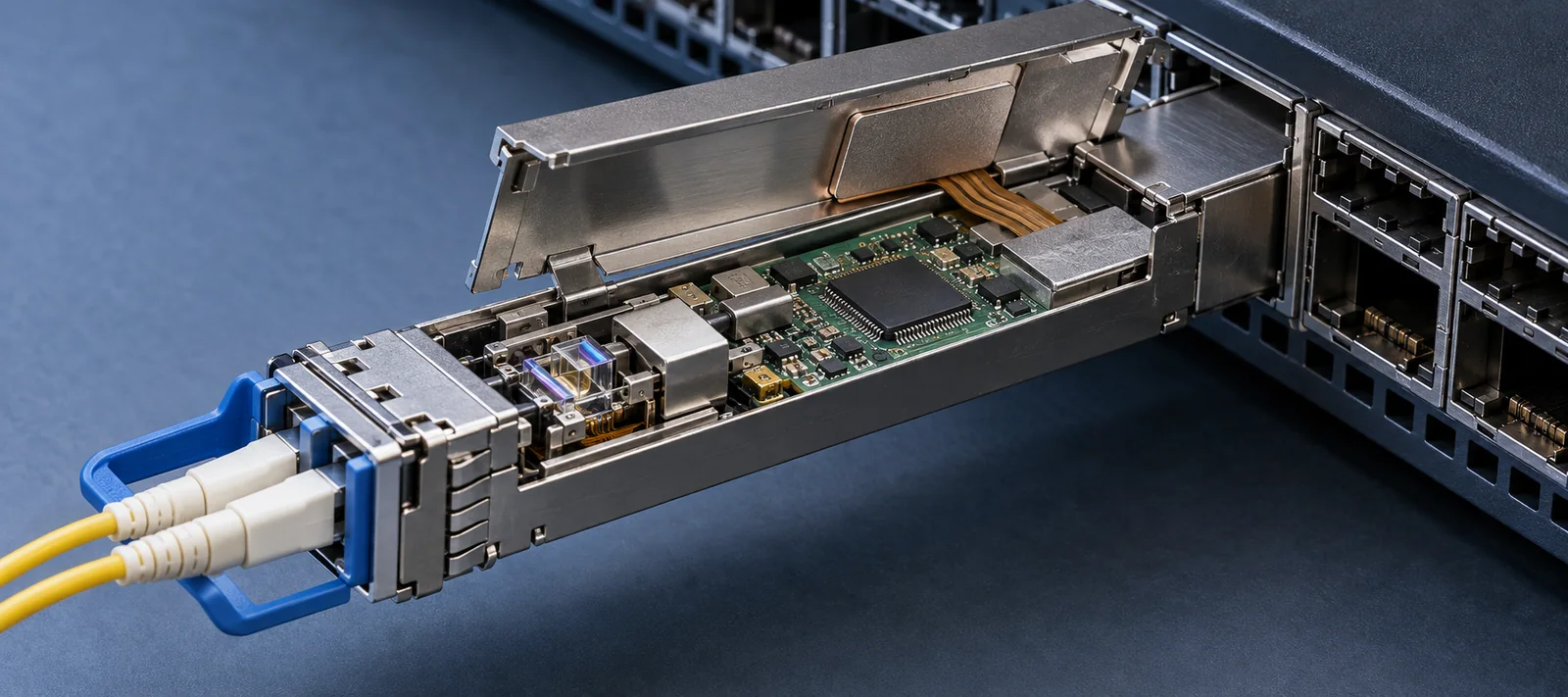
At the sender, data controls properties of laser light. This is modulation. At the receiver, a photodetector converts light into an electrical signal, and electronics recover the data. A transceiver combines sending and receiving functions.
Simple blinking is a helpful first image, but real systems may use multiple levels or phase as well. Distinguish generating light from encoding information onto it: a laser and a modulator can perform different roles.
Background: [1]
02Fibre and waveguides provide optical paths
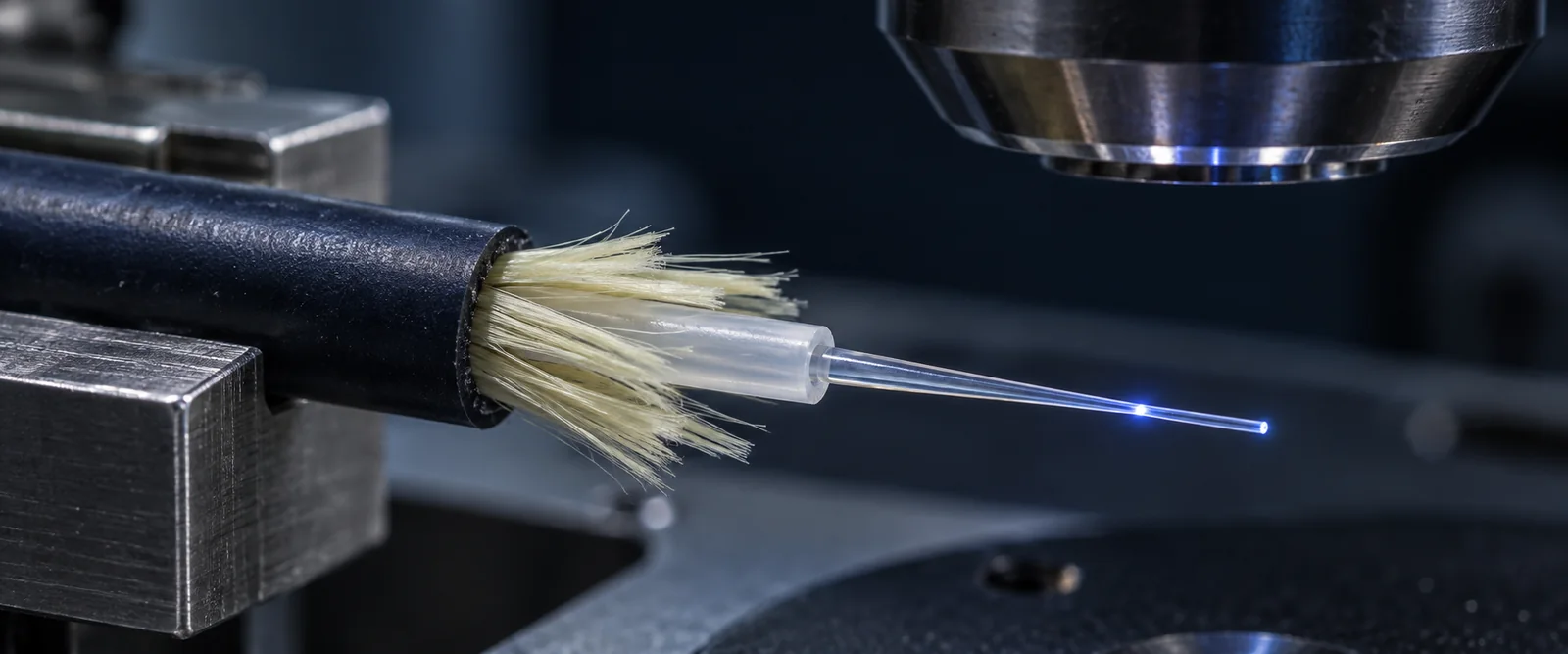
An optical fibre guides light using the refractive-index difference between its core and surroundings. It is not carrying electrical current along a metal wire. A waveguide on a chip provides a smaller optical path that can be combined with splitting, combining and wavelength-selective functions.
Light is still lost through absorption, scattering, bending and poor coupling. Misalignment between a fibre and a chip reduces the received signal. Small size alone is not enough; optical modes and connections must be controlled.
03Share a path without confusing capacity with speed
Wavelength-division multiplexing, or WDM, carries multiple channels on different wavelengths along one path. Separate traffic lanes are a useful analogy, but wavelengths are not physical grooves in the fibre.
Data per second, end-to-end delay and error rate are different measures. Higher capacity does not make delay vanish. Long-distance systems may also require sophisticated recovery of signals distorted along the route.
Background: [1]
04Why move optical components closer to a computing chip?
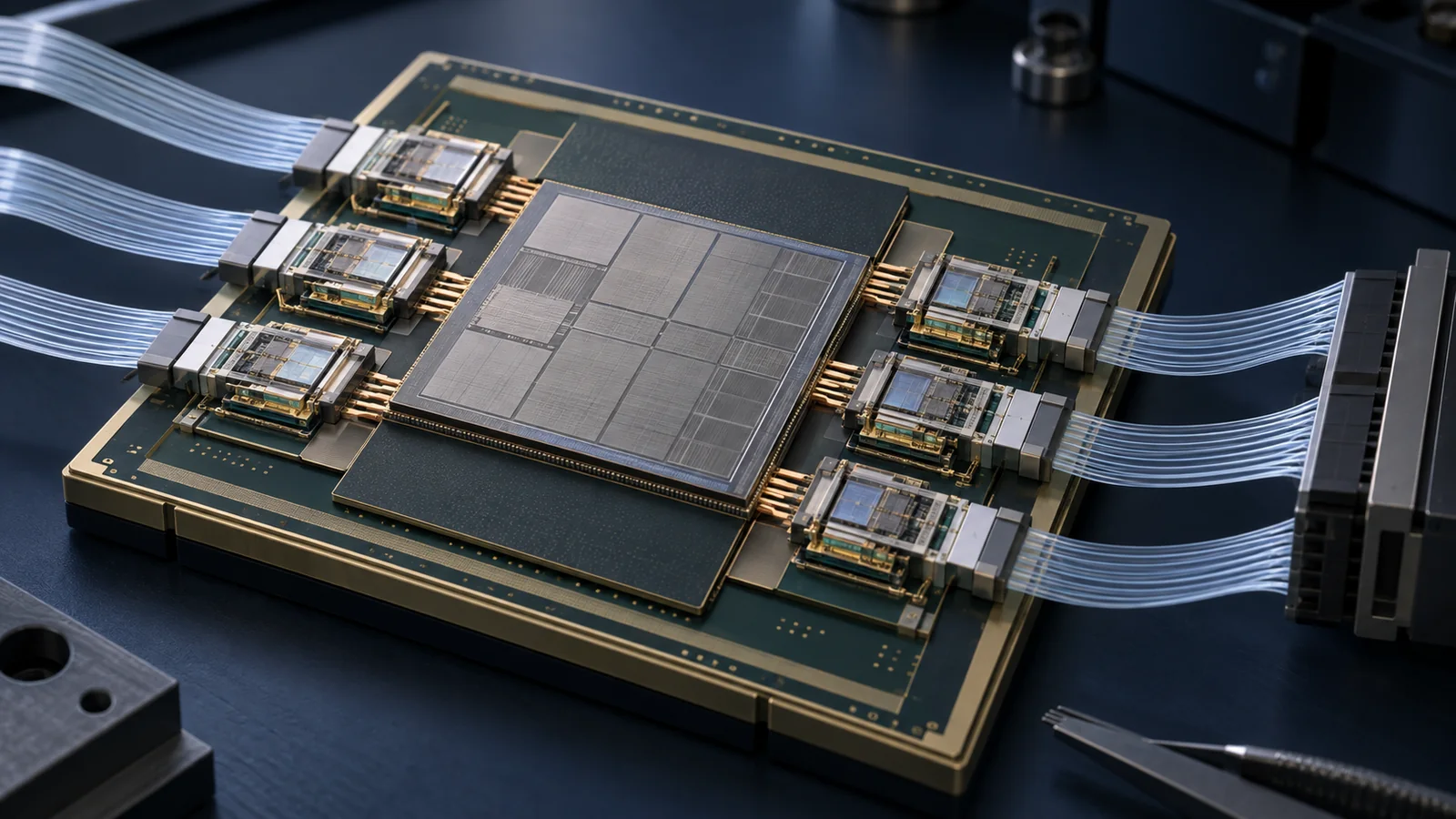
Electrical wiring between a computing chip and an optical component also consumes energy and introduces loss. Co-packaged optics, or CPO, places optical components near a processor or switch chip to shorten that electrical reach. Silicon photonics is an approach to making optical circuits with silicon-based fabrication. The terms are not synonyms.
Closer integration can complicate cooling, fibre attachment, testing and replacement. Pluggable modules and other architectures remain useful depending on reach, serviceability and system requirements.
Background: [3]
05Photonics extends beyond communications
Generating, guiding, modulating and detecting light also serve applications such as LiDAR and metrology. Different uses need different wavelengths, powers, noise characteristics and detection performance. Optical does not automatically mean faster or more energy-efficient at system level.
When reading an individual article, ask what the component converts, where it sits and how it connects to the components before and after it. That keeps materials and abbreviations attached to a useful purpose.
Connect the ideas in one situation
ILLUSTRATIVE SCENARIO — NOT A PERFORMANCE CLAIM
Suppose two servers need a data link
One end converts electrical data to light, a cable carries it, and the other converts it back. Assess received signal quality, errors, delay, power at both ends and replaceability.
An electrical link may suit a short reach; longer or higher-capacity connections change the trade-off. Compare the complete link rather than assuming optics always wins.
Return to the starting idea
Light is a carrier of information. Capacity, loss, energy use and cost are different questions, so follow the complete path from source to receiver.
You do not need to memorize every technology name. Understanding the intended improvement, the mechanism being changed and the conditions needed to demonstrate it gives you a foundation for the detailed articles. Choose one route that matches your question.
Choose your next article
Read a route from top to bottom, or select just the question you need. You do not have to read everything.
Follow an optical link
Build optical circuits
Systems and applications
Browse all technical articles in this field (18)
- What Co-Packaged Optics (CPO) Is
- IOWN
- LiDAR
- NPO and LPO
- Coherent Optical Communication and DSP
- What Silicon Photonics Is
- Optical Interconnects and SerDes
- Optical Connectors and Fiber Attach
- Optical Transceivers (Pluggable Optical Modules)
- Optical Fiber
- Optical Circuit Switches (OCS)
- Optical Modulation and Modulation Formats
- Photodetectors
- Photonic Integrated Circuits and Indium Phosphide
- Semiconductor Lasers
- Wavelength Multiplexing and Microrings
- Silicon Nitride Waveguides
- Thin-Film Lithium Niobate (TFLN)
Sources and scope
This introductory synthesis connects the existing technical articles. Its grouping and design scenarios are explanatory, not standard classifications or test results. It does not catalogue current records, product availability or approvals, or forecast costs. Foundational references are below; linked articles provide more detailed technical sourcing.