COMPANY PROFILE / QUANTUM COMPUTING
D-Wave Quantum
The company that has sold quantum computers built on “quantum annealing”. It has now stepped into gate-model machines, while its “quantum advantage” claim is still being debated
There are two broad ways to build a quantum computer. One is the general-purpose type (gate model), which can in principle compute anything. The other is the special-purpose type (quantum annealing), which is specialized in “finding the best combination among a huge number of options”. D-Wave has been making and selling the special-purpose type commercially for more than a decade. In January 2026 it acquired Quantum Circuits, which develops gate-model machines, and the company describes itself as the only one that does both annealing and gate-model systems. The claim it announced in 2025, a “demonstration of quantum supremacy (advantage)”, has drawn rebuttal papers from the classical-computing side, and both sides’ statements now stand next to each other. This profile explains what it builds, how much it spends, who it works with and what it is aiming for, using only primary sources we could check, and in terms a reader new to quantum computing can follow.
- D-Wave in 30 seconds, and where it stands in quantum computing
- The logo and how the name is written
- Where the company sits in quantum computing
- Scale
- Resources committed to quantum computing
- What it has done so far
- What comes next
- What the company is aiming for in quantum computing
- Map of quantum computing partnerships
- Technologies, products and services
- Risks this company carries
- Glossary, references and claim-to-source audit
1. D-Wave in 30 seconds, and where it stands in quantum computing
California, U.S.Plans to move to Boca Raton, Florida, by the end of 2026 (company statement)
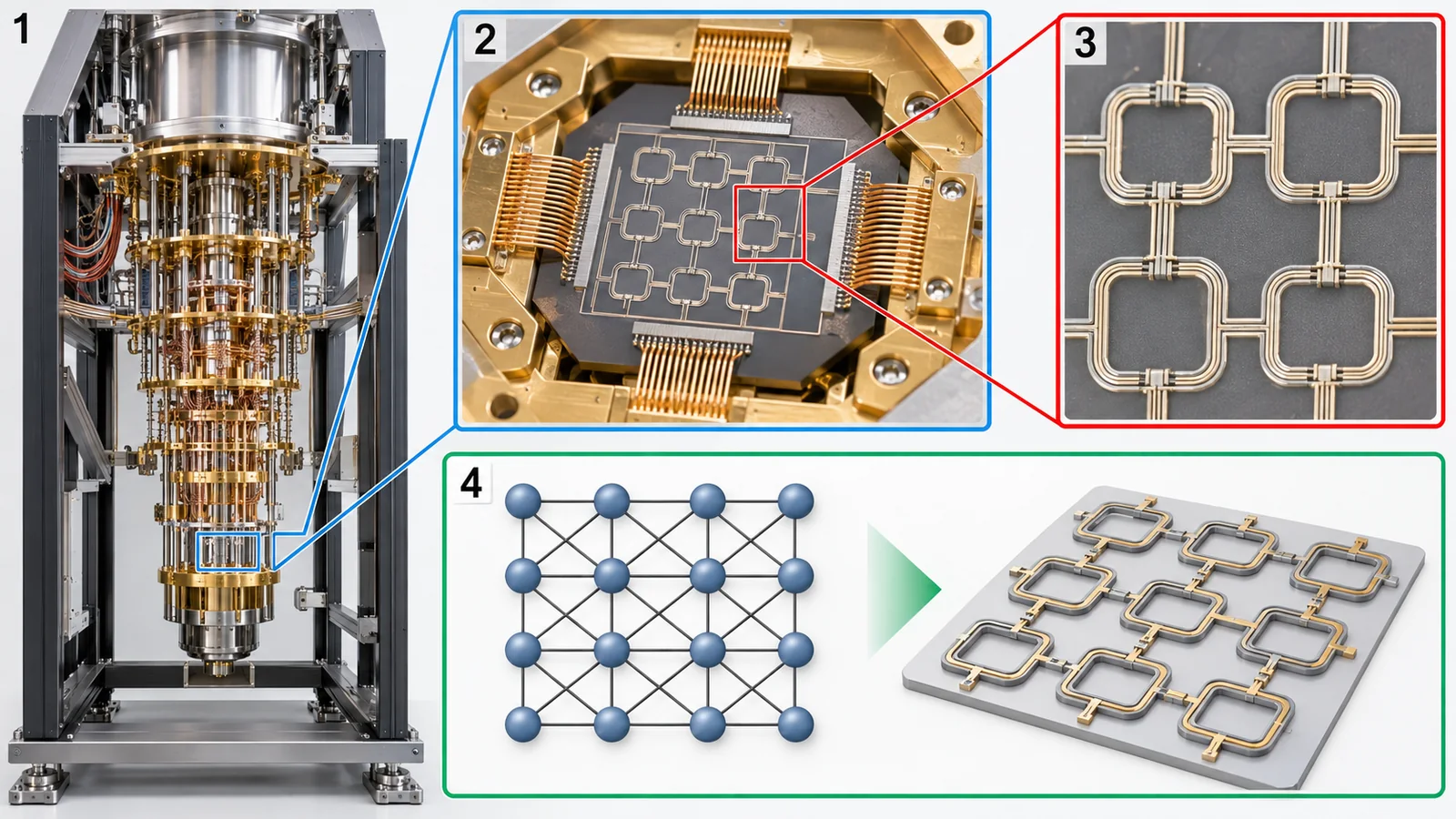
(cryogenic)Annealing machines have more than 4,400 qubits. The gate model is in development
plus US$249.6 million securitiesFrom the Form 10-Q for the second quarter of 2026
10,000-qubit gate modelStated in the U.S. Department of Commerce funding release. A company target, not an achievement
The way to read D-Wave is to separate “what it sells now” from “what it is going to build”.
What it sells now: quantum annealing machines (Advantage2) and their cloud service (Leap). They are special-purpose machines suited to optimization problems, and revenue comes from this cloud access, system sales and professional services Sourced.
What it is going to build: an error-corrected general-purpose (gate-model) machine. It rests on the technology of Quantum Circuits, acquired in January 2026, and the company states a target of delivering a first system in 2026, but as of 16 October 2026 what we could confirm goes only as far as a simulator beta program (1 October 2026) Not yet confirmed.
Quantum annealing: a quantum computer for finding the best combination (optimization) among many options. Picture rolling a ball over a bumpy landscape: it settles in the lowest valley, and the bottom of that valley is taken as the answer.
Gate model: a quantum computer that, like an ordinary computer, executes instructions (gates) in sequence and can compute anything. It needs a mechanism for fixing the errors of fragile qubits (error correction), and is still under development.
Reading qubit counts: the annealer’s “4,400 qubits” and the gate model’s “10,000 qubits” are numbers with different meanings. With different approaches, each qubit has a different role and needs a different precision, so they cannot be lined up to rank the machines. This article always states the approach and whether a number is physical or logical.
2. The logo and how the name is written

A note on names: the listed company is D-Wave Quantum Inc. (U.S.), and the products have been built by its subsidiary D-Wave Systems Inc. (British Columbia, Canada). Quantum Circuits, acquired in 2026 (formerly Quantum Circuits, Inc.), is now a D-Wave subsidiary (Quantum Circuits, LLC). The logo is the official white-lettered version for dark backgrounds, shown here on a dark panel.
Official site: https://www.dwavequantum.com/ (the logo was taken from the image used in the site header)3. Where the company sits in quantum computing
Quantum computing companies have different strengths and challenges depending on what they use to make a qubit. D-Wave falls in the first type, “superconducting”: both its annealing machines and its gate-model developments make qubits from superconducting circuits. But even within the same type, the two machines differ in purpose and in stage of development.
Here is each type in a sentence or two.
| Type | What the qubit is | Strength | Difficulty |
|---|---|---|---|
| Superconducting | An electrical circuit cooled to extremely low temperature | Circuits can be made with semiconductor-style processes | Needs refrigerators and a great deal of wiring |
| Trapped ions and neutral atoms | Atoms held in place with electric fields or light | Each one is identical, so precision is high | Increasing the number, and operating speed |
| Photonic, silicon and other | A particle of light (photon), the spin of an electron in silicon, and so on | May be made in factories; photons can be linked by optical fiber | The approach is still unproven |
| Software, cloud and ecosystem | No qubits of its own | Supports the whole field through cloud, software and communications | No hardware advantage of its own |
4. Scale
D-Wave is a U.S.-listed company, and its revenue and losses are in its Form 10-K Sourced.
| Metric (US$ thousand) | Year to Dec 2024 | Year to Dec 2025 |
|---|---|---|
| Revenue | 8,827 | 24,587 |
| of which system sales | - | 16,182 |
| of which cloud (QCaaS) | 6,745 | 5,517 |
| of which professional services | 1,938 | 2,720 |
| Research and development expense | 35,300 | 50,734 |
| Loss from operations | 77,223 | 100,368 |
| Net loss | 143,879 | 355,062 |
| Cash and cash equivalents at year end | 177,980 | 635,347 |
| 2026 (US$ thousand) | Q2 (April-June) | January-June total (prior year) |
|---|---|---|
| Revenue | 3,076 | 5,934 (18,096) |
| Research and development expense | 28,239 | 54,032 (22,982) |
| Net loss | 48,028 | 66,385 (172,750) |
| Cash and cash equivalents / marketable securities at 30 June | 296,642 / 249,573 | |
| Item | Detail |
|---|---|
| Employees | About 388 (5 February 2026, including those who joined with Quantum Circuits), of whom 382 were full-time |
| Main locations | Canada: Burnaby (system development and manufacturing) and Richmond. United States: Palo Alto (the company’s own wafer-processing facility, about 6,000 square feet) and New Haven, Connecticut (gate-model R&D). It plans to move its headquarters to Boca Raton, Florida, by the end of 2026 and open an R&D facility there |
Revenue swings with the number of machines sold. Of 2025 revenue, US$16.2 million was sales of systems (machines), which were almost absent the year before. First-half 2026 revenue is lower than a year earlier because of the large system sale in the earlier period; it does not directly show a worsening of the business (our reading).
Most of the net loss is not cash spending. The net loss of US$355.1 million for 2025 includes a non-cash loss of US$270.5 million from the change in fair value of warrants (rights to buy shares). The loss grows when the share price rises, which is a movement separate from the operating business. To see the business itself, loss from operations (US$100.4 million) and cash used in operating activities (US$72.0 million) are the better guides Sourced.
5. Resources committed to quantum computing
| Type of resource | Detail | Status |
|---|---|---|
| People | About 388 (February 2026). The CEO is Alan Baratz. Rob Schoelkopf is D-Wave’s chief scientist (company announcement) | Sourced |
| Money | R&D expense of US$50.7 million in 2025 (up 44%) and US$54.0 million in the first half of 2026. In 2025 it took in about US$779 million in cash from financing, through new share issuance, warrant exercises and similar. In January 2026 it paid US$250 million in cash plus shares for the Quantum Circuits acquisition | Sourced |
| Outside investments, acquisitions, joint ventures | Completed the acquisition of Quantum Circuits, Inc. on 20 January 2026. The consideration was US$250.0 million in cash and 10,430,444 common shares (subject to net-debt and other adjustments). No investments in or joint ventures with other companies appear in the materials we checked | Sourced / investments and joint ventures not found |
| Universities, research institutions, public funding | U.S. Department of Commerce: up to US$100 million under the CHIPS and Science Act (letter of intent on 21 May 2026, definitive agreement on 8 September; in return the government receives a minority equity stake) / second-year funding from the U.S. Department of War’s Microelectronics Commons (NORDTECH), awarded to the subsidiary Quantum Circuits, LLC / the Jülich Supercomputing Centre (an Advantage system installed in 2021), the University of Southern California’s Information Sciences Institute, and Davidson Technologies (Huntsville, Alabama) host or use systems | Sourced |
| Investment in manufacturing | Wafers are made on the process of the U.S. semiconductor foundry SkyWater. The company’s own wafer-processing facility is in Palo Alto (about 6,000 square feet). A system development and manufacturing site is in Burnaby. Commerce funding is planned for developing a 100,000-qubit annealer and a 10,000-qubit gate-model machine | Sourced / plans are Not yet confirmed |
Status of the main devices and products
| Name | Approach and scale | Typical performance or content (as published by the company; conditions stated) | Stage | Date and source |
|---|---|---|---|---|
| Advantage2 (annealing) | Superconducting annealer. More than 4,400 physical qubits. Each qubit is connected to 20 others (15 on the earlier machine) | The company says energy scale rose 40% and coherence (how long the state lasts) doubled. System power is 12.5 kilowatts (same cooling approach since the first machine) | Available (cloud “Leap” and on-premises sale) | Launched May 2025 (10-K) |
| Advantage2 prototype (more than 1,200 qubits) | Superconducting annealer (physical) | Used in the Science paper’s simulation experiment (reproducing the “quench” dynamics of a quantum spin glass, a model of a magnet) | Experimental demonstration | Paper: 2025 (Science 388, 199-204) |
| Dual-rail qubit (gate model) | Superconducting gate model. A qubit held in a pair of cavities, which makes “erasure” errors easy to detect (physical) | The Nature paper reports a two-qubit gate of about 500 ns, an erasure rate of about 0.5% per gate, and remaining Pauli errors below 0.1%. The company’s release says “about 99.9% fidelity” (which appears to exclude the detected erasures) | Experimental demonstration | Nature paper, 5 August 2026 (work of the Quantum Circuits team) |
| Gate-model simulator | Software that reproduces dual-rail behavior on a computer | A beta for trying error-aware programming. Participants are BBVA, FirstQFM, Florida Atlantic University and the Jülich Supercomputing Centre | Beta available | 1 October 2026 |
| First gate-model system | Dual-rail (physical) | The company targets delivering a first system in 2026. No performance figures appear in the materials we checked | Not yet confirmed | Target in the 10-K (February 2026). No delivery as of 16 October 2026 |
| Next-generation targets | 100,000-qubit annealer (physical); a 10,000-qubit (physical) gate-model machine for 100 logical qubits and more than one million operations | Company targets | Not yet confirmed | Release of 8 September 2026. No timing stated |
D-Wave’s qubits are small circuits made of superconducting thin films, built on silicon wafers by stacking layers in a semiconductor-style process. Wafers are made using the process of the U.S. semiconductor foundry SkyWater Sourced. The company says the annealers’ refrigerator power (12.5 kilowatts) has stayed the same across generations while only the number of qubits grew (about 50 times the first machine); cooling accounts for most of the power Sourced. For the gate model, the challenges are cryogenic control circuits placed near the quantum chip and packaging that links chips with superconducting wiring; in January 2026 the company announced a demonstration of on-chip cryogenic control of gate-model qubits Sourced. Through materials and process, the contest lies in the quality of the superconducting films (low loss) and packaging that cuts the number of wires by orders of magnitude Not yet confirmed.
6. What it has done so far
| When | Event | Meaning |
|---|---|---|
| 2010 | Released the first annealing machine, D-Wave One (company statement; the same 12.5 kW cooling approach is still used) | The company describes it as the forerunner of commercial quantum computers |
| 5 August 2022 | Completed the merger with a SPAC (DPCM Capital) and listed | Became a listed company, opening a route to raise funds |
| February 2024 | Made an Advantage2 prototype (more than 1,200 qubits) available | Early access to the new generation |
| March 2025 | A Science paper on “beyond-classical quantum simulation”. The company announced “quantum supremacy on a useful, real-world problem” | Rebuttal papers from the classical side followed (section 10) |
| May 2025 | Launched the sixth-generation Advantage2 (more than 4,400 qubits) | The current flagship product |
| 20 January 2026 | Completed the acquisition of Quantum Circuits (US$250 million in cash plus shares) | Gained gate-model technology and a “two-track” structure |
| 21 and 26 May 2026 | Letter of intent with the U.S. Department of Commerce for up to US$100 million (21st). The company’s statement on the rebuttal papers (26th) | Outlook for public funding, and the exchange over the advantage claim |
| 21 May 2026 | Science published a tensor-network paper by Flatiron Institute researchers and colleagues | Research arguing that D-Wave’s experiment can be approximated on classical computers |
| July 2026 | Moved its listing from the NYSE to Nasdaq | The ticker stays QBTS |
| 5 August 2026 | A Nature paper on a two-qubit gate for dual-rail qubits | Demonstration of a basic gate-model building block |
| 8 September 2026 | Definitive agreement with the Department of Commerce (up to US$100 million; the government takes a minority equity stake) | Public funding is now definitive |
| 1 October 2026 | Launched the gate-model simulator beta program | Software offered ahead of real machines |
7. What comes next
systemCompany target (10-K). Dual-rail approach
Boca RatonCompany plan (10-K and 10-Q)
100 logical qubitsCompany target. More than one million operations
All of these are company targets and plans, not achievements Not yet confirmed. In its 10-K the company states that no current quantum computer, D-Wave’s included, has reached broad quantum advantage, and that none may ever do so Sourced.
None of the following appears in the primary sources we checked Not yet confirmed.
The qubit count, error rate, price and confirmed delivery date of the first gate-model system / the completion dates of the 100,000-qubit and 10,000-qubit machines / any result showing logical qubits on real dual-rail hardware / revenue by customer / participation in DARPA’s Quantum Benchmarking Initiative (QBI) (D-Wave’s name did not appear in DARPA’s list current as of 8 October 2026).
8. What the company is aiming for in quantum computing
This section includes points the company does not state directly. They are inferences from what the primary sources show, given with their basis.
| What we read from the sources | Primary-source basis | Type |
|---|---|---|
| The aim is to earn revenue from the optimization machine while channeling it into developing the general-purpose machine | Revenue comes from annealing machines, their cloud access and professional services. R&D expense rose 44% in 2025 and rose further in the first half of 2026. US$250 million in cash went into the gate-model acquisition | Inference |
| Revenue swings widely with whether machines are sold. The steady revenue pillars are still cloud (QCaaS) and services | The gap between 2025 system sales of US$16.2 million and cloud of US$5.5 million. The drop in system sales in the first half of 2026 | Inference |
| Customers are companies with optimization problems, such as telecoms, finance and manufacturing | Customer examples in the 10-K (Mastercard, BASF, Pfizer, NTT DOCOMO and others) and the July-August 2026 announcements (production use at AT&T and NTT DOCOMO) | Sourced (company statement) |
| The gate model aims at error correction with few physical qubits, using Quantum Circuits’ dual-rail approach | The 10-K says physical qubits per logical qubit can be cut by up to an order of magnitude. The Nature paper reports properties suited to error detection | Sourced (company statement) |
| Reaching the targets requires growth by orders of magnitude | The gate-model target is 10,000 (physical) qubits. We found no record in the materials we checked of a gate-model experiment of that scale | Inference |
Of 2025 revenue of US$24.6 million, system sales were US$16.2 million, or about 66% Our calculation (16,182 / 24,587 = 0.658). Cloud (QCaaS) was 22% (5,517 / 24,587) and professional services 11% (2,720 / 24,587). So machine sales contributed heavily to 2025’s revenue growth, and revenue of that size will not necessarily recur every year. First-half 2026 revenue (US$5.9 million) is about a third of the prior-year period (US$18.1 million), which we read as showing that nature Not yet confirmed. This is not an assessment of how good the business is; it describes the structure in which revenue depends on when machines are sold.
9. Map of quantum computing partnerships
The figure below shows only relationships stated in the Forms 10-K and 10-Q and in press releases attached to Forms 8-K, with lines colored by type.
10. Technologies, products and services
D-Wave’s mainstay is a special-purpose machine that recasts an optimization problem as a landscape of hills and valleys. The next figure splits the flow into three steps.
What is quantum annealing?
- Turn the problem into a landscape: for example, “choose the shortest of all possible delivery routes” is rewritten as “find the lowest valley”. The depth of a valley is the quality of an answer.
- Move the qubits so they settle in a valley: superconducting qubits are gradually changed from a simple starting state to the problem’s landscape. The hope is that, using quantum properties, they can slip through hills rather than climb over them and so land in a low valley.
- Read out the answer: the qubits’ state is measured to pull out a candidate answer. The run is repeated many times and a good answer is chosen.
- Combine with classical computers: for real company problems, “hybrid” software also splits problems into smaller pieces and tidies the results. D-Wave’s cloud is described as offering hybrid solvers that can handle problems of up to two million variables.
An annealer is optimization-only; it cannot compute anything, as a gate-model machine can. A gate-model (general-purpose) machine, in turn, executes instructions in sequence and needs error correction built in. D-Wave is promoting a “two-track” approach in which the two machines are used according to the task (company statement).
The “quantum advantage” claim and the replies, side by side
| Issue | Company claim | What was confirmed (papers, primary sources) | Objections and caveats | Status |
|---|---|---|---|---|
| Did an annealer demonstrate a quantum simulation beyond classical reach? | Announced in March 2025 “quantum supremacy on a useful, real-world problem”. The 10-K says matching it for the largest problems would take nearly one million years on one of the world’s most powerful supercomputers; the May 2026 statement says nearly a million years on Frontier using matrix-product-state methods | The Science paper reports that a superconducting annealer can quickly produce samples close to solutions of the Schrödinger equation, and that several approximate methods (tensor networks, neural networks) could not match its accuracy within a reasonable time. The task was reproducing the sudden change (quench) dynamics of a model magnet, and the paper’s closing is cautious: such machines can answer important questions that may remain out of classical reach | Tindall and colleagues (Flatiron Institute and others) report that another tensor-network method approximates the same models with modest computing resources (arXiv, March 2025; published in Science on 21 May 2026). Mauron and Carleo (arXiv, March 2025) and Wiersema (arXiv, September 2026) report approximations with variational Monte Carlo. Krinitsin and colleagues (arXiv, July 2026) comment on the paper’s neural-network comparison | Under debate. Not yet confirmed |
| The company’s reply | The statement of 26 May 2026 says the advantage result has not been overturned, and that the rebuttal papers do not reproduce the hardest problem instances or the same observables | Confirmed in the statement (attached to a Form 8-K). The statement also refers to an arXiv paper by D-Wave-side researchers, “Evaluating Classical Simulations with a Quantum Processor” (August 2025) | The rebuttal side accepts that its reproduction is limited in scope but argues the approximations work in some regimes. What counts as “the same problem” is the point at issue | Under debate |
| A “useful” problem? | The 10-K describes it as a “useful” problem | The paper’s task is reproducing the dynamics of a model of a quantum magnet (a physics simulation), not a logistics or finance optimization problem | Direct usefulness for industrial optimization is not shown within the scope of our check | Interpretation Not yet confirmed |
| Broad quantum advantage | The 10-K states that no current quantum computer, D-Wave’s included, has reached broad quantum advantage, and that none may ever do so | Confirmed in the 10-K risk factors | - | Sourced |
This article does not state that D-Wave’s “quantum advantage” claim is right or that it has been overturned. Here are three pointers for reading.
1. The scope of “the same problem” is the point at issue. The company says the largest and hardest instances, and all of the observables, have not been reproduced. The rebuttal side says many cases of the same model can be approximated with little computation. The two sides differ on which part of the problem is being compared.
2. Classical methods keep improving. After the 2025 announcement, several research groups refined approximation methods, and how far each method reaches is still moving.
3. It is a separate question from business value. Whether an advantage is demonstrated and whether the machine is useful for a customer’s optimization problem are different matters. The customer examples (NTT DOCOMO, AT&T and others) are company announcements, and this article does not evaluate them. For more, see our explainers on reading quantum advantage and on quantum annealing.
Customer examples (company announcements)
In July and August 2026 D-Wave announced the following. AT&T is described as having cut the processing time of a network optimization workload from about an hour to under 15 seconds (early work). NTT DOCOMO is described as having put a second quantum application into production, reducing peak location-registration signals by 65.3% and paging signals by 7.0% Sourced. These are statements by the company and its customers; we could not confirm third-party verification or a like-for-like comparison with classical (conventional optimization) software.
11. Risks this company carries
| Risk | Detail | Type |
|---|---|---|
| The advantage claim is being debated | Several rebuttal papers have come from the classical side, and the company has replied. Neither side has reached a conclusion | Sourced |
| The gate model is at an early stage | What we could confirm is a simulator beta. Real-machine performance and timing are company targets | Not yet confirmed |
| Integrating the acquisition | The 10-K lists, as a business risk, the effects if the integration of Quantum Circuits does not go as expected | Sourced |
| Volatile revenue | Revenue varies greatly with the timing of machine sales. First-half 2026 revenue was about a third of the prior-year period | Sourced / Our calculation |
| Continuing losses | The operating loss was US$100.4 million in 2025. The 10-K says losses are expected to continue for the foreseeable future | Sourced |
| Outside manufacturing | Wafer manufacturing depends on an outside foundry’s (SkyWater’s) process | Sourced |
| Conditions on public funding | The Department of Commerce receives a minority equity stake in return for the funding. Progress against the plan could be affected by the terms | Sourced / Inference |
| Headquarters move | It plans to move from Palo Alto to Boca Raton by the end of 2026, which could burden staff and facilities | Sourced / Inference |
| Competition among approaches | Other approaches (superconducting gate-model, ion, neutral-atom and others) are also advancing. Which will reach utility scale first is not settled | Inference |
12. Glossary
- Quantum annealing
- A special-purpose quantum computer for finding the best combination (optimization) among many options.
- Gate model
- A general-purpose quantum computer that executes instructions (gates) in sequence and can compute anything. Needs error correction.
- Qubit
- The basic unit of quantum computation.
- Physical / logical qubit
- A physical qubit is one piece of hardware and is sensitive to noise. A logical qubit bundles many physical qubits so that errors can be corrected.
- Dual-rail qubit
- A qubit held in a pair of cavities, which makes “erasure” errors easy to detect.
- Erasure
- An error in which a qubit leaves the computational space. Its occurrence is easy to detect.
- QCaaS / Leap
- Quantum computing as a service in the cloud (Leap is D-Wave’s service).
- Hybrid solver
- Software that solves a problem by combining a quantum computer with conventional computers.
- Quantum spin glass
- A model of tiny magnets that influence one another in complicated ways. The subject of the Science paper’s simulation.
- Tensor network
- A classical method that approximates a quantum state with a web of small pieces.
- Quantum supremacy / advantage
- A claim that a quantum computer performs calculations classical computers cannot, or are far slower at. Read it as the company’s claim.
- Warrant
- A right to buy shares at a set price in future. Changes in its fair value show up in profit and loss.
- LOI (letter of intent)
- A document stating intent before a formal contract.
- SPAC
- Special purpose acquisition company: a shell company used to merge with a private company and make it listed.
- Forms 10-K / 10-Q / 8-K
- The annual report, quarterly report and current report filed with the U.S. SEC.
13. References
- D-Wave Quantum Inc. Form 10-K for the fiscal year ended December 31, 2025 (filed with the U.S. SEC, 26 February 2026). Business overview, financials, employees, locations, acquisition, products, risk factors. https://www.sec.gov/Archives/edgar/data/1907982/000190798226000026/qbts-20251231.htm
- D-Wave Quantum Inc. Form 10-Q for the quarter ended June 30, 2026 (filed with the U.S. SEC, 6 August 2026). Second-quarter financials, transfer to Nasdaq, locations. https://www.sec.gov/Archives/edgar/data/1907982/000190798226000129/qbts-20260630.htm
- D-Wave Quantum Inc. Press release attached to Form 8-K, “D-Wave’s Quantum Supremacy Result Stands” (26 May 2026). The company’s statement on the rebuttal papers. https://www.sec.gov/Archives/edgar/data/1907982/000190798226000071/exh_991xresponse.htm
- D-Wave Quantum Inc. Press release attached to Form 8-K, “D-Wave Quantum and Department of Commerce Sign Letter of Intent for $100 Million…” (21 May 2026). https://www.sec.gov/Archives/edgar/data/1907982/000190798226000066/exhibit991pressrelease.htm
- D-Wave Quantum Inc. Press release attached to Form 8-K, “D-Wave Quantum Finalizes Definitive Agreement with U.S. Department of Commerce for Up to $100 Million…” (8 September 2026). https://www.sec.gov/Archives/edgar/data/1907982/000190798226000141/chipsactpressrelease.htm
- D-Wave Quantum Inc. Press release attached to Form 8-K, “D-Wave Demonstrates Major Hardware Breakthrough for Quantum Error Correction…” (5 August 2026). https://www.sec.gov/Archives/edgar/data/1907982/000190798226000123/d-wavedemonstratesmajorhar.htm
- D-Wave Quantum Inc. Press release attached to Form 8-K, “D-Wave Launches Gate-Model Simulator Beta Program…” (1 October 2026). https://www.sec.gov/Archives/edgar/data/1907982/000190798226000159/exhibit101d-wavelaunchesga.htm
- D-Wave Quantum Inc. Press release attached to Form 8-K, “D-Wave Awarded Year 2 Microelectronics Commons Project Funding…” (26 May 2026). https://www.sec.gov/Archives/edgar/data/1907982/000190798226000069/exh_991.htm
- D-Wave Quantum Inc., NTT DOCOMO Press release attached to Form 8-K, “D-Wave Technology Drives NTT DOCOMO’s Second Production Quantum Application in Network Operations” (18 August 2026). https://www.sec.gov/Archives/edgar/data/1907982/000190798226000135/d-wavetechnologydrivesnttd.htm
- D-Wave Quantum Inc., AT&T Press release attached to Form 8-K, “AT&T Signs Agreement to Expand Use of D-Wave’s Quantum Computing Technology…” (27 July 2026). https://www.sec.gov/Archives/edgar/data/1907982/000190798226000117/attsignsagreementtoexpandu.htm
- King et al. (D-Wave and collaborators) “Beyond-classical computation in quantum simulation”, Science 388, 199-204 (2025). https://doi.org/10.1126/science.ado6285
- Tindall et al. “Dynamics of disordered quantum systems with two- and three-dimensional tensor networks”, Science 392, 868-872 (21 May 2026). https://doi.org/10.1126/science.adx2728
- Mauron, Carleo “Challenging the Quantum Advantage Frontier with Large-Scale Classical Simulations of Annealing Dynamics”, arXiv:2503.08247 (11 March 2025). https://arxiv.org/abs/2503.08247
- Wiersema “Numerical simulation of D-Wave’s quantum advantage experiment with time-dependent variational Monte Carlo”, arXiv:2609.01719 (1 September 2026). https://arxiv.org/abs/2609.01719
- Krinitsin et al. “Comment on ‘Beyond-classical computation in quantum simulation’”, arXiv:2607.08811 (9 July 2026). https://arxiv.org/abs/2607.08811
- Nocera et al. (D-Wave) “Evaluating Classical Simulations with a Quantum Processor”, arXiv:2508.15759 (21 August 2025). https://arxiv.org/abs/2508.15759
- Quantum Circuits (D-Wave) and others “An entangling gate for dual-rail erasure qubits”, Nature 656, 47-53 (5 August 2026). https://doi.org/10.1038/s41586-026-10822-y
- Defense Advanced Research Projects Agency (DARPA) Quantum Benchmarking Initiative (QBI) public page (list of participants current as of 8 October 2026). https://www.darpa.mil/research/programs/quantum-benchmarking-initiative
- D-Wave Official website (source of the logo; company overview). https://www.dwavequantum.com/
14. Claim-to-source audit
| Claim in the text | Type | Source |
|---|---|---|
| Legal name, headquarters (Palo Alto), the plan to move to Boca Raton by the end of 2026, locations (Burnaby, Richmond, New Haven), about 388 employees (5 February 2026) | Sourced | Reference 1, 2 https://www.sec.gov/Archives/edgar/data/1907982/000190798226000026/qbts-20251231.htm https://www.sec.gov/Archives/edgar/data/1907982/000190798226000129/qbts-20260630.htm |
| Listing through the SPAC (DPCM) merger on 5 August 2022, and the move from the NYSE to Nasdaq in July 2026 | Sourced | Reference 1, 2 https://www.sec.gov/Archives/edgar/data/1907982/000190798226000026/qbts-20251231.htm https://www.sec.gov/Archives/edgar/data/1907982/000190798226000129/qbts-20260630.htm |
| Revenue, breakdown, R&D expense, operating loss, net loss and year-end cash (years to December 2024 and 2025) | Sourced | Reference 1 https://www.sec.gov/Archives/edgar/data/1907982/000190798226000026/qbts-20251231.htm |
| The non-cash warrant fair-value loss of US$270.5 million, cash used in operations of US$72.0 million, and financing cash of US$779.1 million | Sourced | Reference 1 https://www.sec.gov/Archives/edgar/data/1907982/000190798226000026/qbts-20251231.htm |
| Second-quarter and first-half 2026 revenue, R&D expense, net loss, and cash and securities at 30 June | Sourced | Reference 2 https://www.sec.gov/Archives/edgar/data/1907982/000190798226000129/qbts-20260630.htm |
| Acquisition of Quantum Circuits (completed 20 January 2026; US$250.0 million in cash and 10,430,444 common shares) | Sourced | Reference 1 https://www.sec.gov/Archives/edgar/data/1907982/000190798226000026/qbts-20251231.htm |
| The target of delivering a first dual-rail system in 2026, and gate-model system sales planned for 2026 | Not yet confirmed | A company target, not confirmed. The statement of the target is in Reference 1 https://www.sec.gov/Archives/edgar/data/1907982/000190798226000026/qbts-20251231.htm |
| Advantage2: launched May 2025, more than 4,400 qubits, connectivity 15 to 20, energy scale up 40%, coherence doubled | Sourced | Reference 1 https://www.sec.gov/Archives/edgar/data/1907982/000190798226000026/qbts-20251231.htm |
| System power of 12.5 kilowatts, the same cooling approach since the first machine, about 50 times the qubits | Sourced | Reference 1 https://www.sec.gov/Archives/edgar/data/1907982/000190798226000026/qbts-20251231.htm |
| The “quantum supremacy” claim based on the March 2025 Science paper, the description of about one million years, and the statement that broad quantum advantage has not been reached | Sourced | Reference 1 https://www.sec.gov/Archives/edgar/data/1907982/000190798226000026/qbts-20251231.htm |
| The Science paper: an annealer produces samples close to Schrödinger-equation solutions; approximate methods fall short of its accuracy; its closing statement | Sourced | Reference 11 https://doi.org/10.1126/science.ado6285 |
| Tindall et al. (Science, 21 May 2026): a tensor-network method approximates the same models with modest computing resources | Sourced | Reference 12 https://doi.org/10.1126/science.adx2728 |
| Mauron and Carleo (March 2025) and Wiersema (September 2026) on approximation by variational Monte Carlo, and the comment by Krinitsin et al. (July 2026) | Sourced | Reference 13, 14, 15 https://arxiv.org/abs/2503.08247 https://arxiv.org/abs/2609.01719 https://arxiv.org/abs/2607.08811 |
| The company’s statement of 26 May 2026 (the result has not been overturned; the rebuttals do not reproduce the hardest problems and the same observables) | Sourced | Reference 3 https://www.sec.gov/Archives/edgar/data/1907982/000190798226000071/exh_991xresponse.htm |
| The statement’s reference to the arXiv paper by D-Wave-side researchers (August 2025) | Sourced | Reference 3, 16 https://www.sec.gov/Archives/edgar/data/1907982/000190798226000071/exh_991xresponse.htm https://arxiv.org/abs/2508.15759 |
| The Nature paper: a two-qubit gate for dual-rail qubits, about 500 ns, erasure of about 0.5%, remaining Pauli errors below 0.1% | Sourced | Reference 17 https://doi.org/10.1038/s41586-026-10822-y |
| The company release’s “about 99.9% fidelity” and its targets for the gate model (100,000 and 10,000 qubits) | Sourced | Reference 6 https://www.sec.gov/Archives/edgar/data/1907982/000190798226000123/d-wavedemonstratesmajorhar.htm |
| The gate-model simulator beta (1 October 2026) and its participants | Sourced | Reference 7 https://www.sec.gov/Archives/edgar/data/1907982/000190798226000159/exhibit101d-wavelaunchesga.htm |
| Letter of intent with the Department of Commerce for up to US$100 million (21 May 2026) and definitive agreement (8 September 2026), the government’s minority equity stake, and the development of a 100,000-qubit annealer and a 10,000-qubit gate-model machine | Sourced | Reference 4, 5 https://www.sec.gov/Archives/edgar/data/1907982/000190798226000066/exhibit991pressrelease.htm https://www.sec.gov/Archives/edgar/data/1907982/000190798226000141/chipsactpressrelease.htm |
| Second-year Microelectronics Commons (NORDTECH) funding (to Quantum Circuits, LLC) | Sourced | Reference 8 https://www.sec.gov/Archives/edgar/data/1907982/000190798226000069/exh_991.htm |
| NTT DOCOMO’s second production application (location-registration signals down 65.3%, paging signals down 7.0%) and AT&T’s expanded agreement (processing time from about an hour to under 15 seconds) | Sourced | Reference 9, 10 https://www.sec.gov/Archives/edgar/data/1907982/000190798226000135/d-wavetechnologydrivesnttd.htm https://www.sec.gov/Archives/edgar/data/1907982/000190798226000117/attsignsagreementtoexpandu.htm |
| Customer examples (Mastercard, BASF and others), systems at the Jülich Supercomputing Centre, USC ISI and Davidson Technologies, wafer manufacturing by SkyWater, and purchase through AWS Marketplace | Sourced | Reference 1 https://www.sec.gov/Archives/edgar/data/1907982/000190798226000026/qbts-20251231.htm |
| D-Wave’s name does not appear in DARPA’s QBI list current as of 8 October 2026 | Sourced | Reference 18 https://www.darpa.mil/research/programs/quantum-benchmarking-initiative |
| Qubit count, error rate and price of the first gate-model system, completion dates of the 100,000- and 10,000-qubit machines, logical qubits on real hardware | Not yet confirmed | Not stated in the primary sources we checked; this article does not guess |
| Investments in, joint ventures with or divestments of other companies | Not yet confirmed | Not in the materials we checked; this article does not claim they do not exist |
| System sales as a share of 2025 revenue (16,182 / 24,587 = about 66%), cloud about 22%, professional services about 11% | Our calculation | Our calculation. The inputs are in Reference 1 |
| First-half 2026 revenue about one third of the prior-year period (5,934 / 18,096) | Our calculation | Our calculation. The inputs are in Reference 2 |
| Year-end 2025 cash plus securities of about US$884.5 million (635.3 + 249.1) | Our calculation | Our calculation. The inputs are in Reference 1 |
| Classification of companies into four types | Our calculation | Our own classification; company names are examples from this series |
| Reading that optimization-machine revenue is channeled into general-purpose development | Inference | Our own reading of the revenue mix, the rise in R&D expense and the acquisition spending |
| Reading that revenue swings with the timing of machine sales | Inference | Our own reading of the system-sales share and the drop in first-half revenue |
| Reading that reaching the targets requires growth by orders of magnitude | Inference | Our own reading, comparing the targets with the scale of the experiments we could confirm |
| Risks from outside manufacturing, public-funding conditions, the headquarters move and competing approaches | Inference | Our own reading of the contract structure and the progress of other approaches |
Last updated: 16 October 2026 (date checked) / Troy Technical
Figures in this article are based on D-Wave Quantum’s Forms 10-K, 10-Q and 8-K filed with the U.S. Securities and Exchange Commission, papers in Science and Nature, and arXiv papers. Market-research estimates, share prices and valuations, and press figures are not used. Device names, roadmaps, contracts and corporate structure reflect what had been published as of 16 October 2026; because this field moves fast, check the company’s filings for the latest. Passages marked “Inference” are our reading of primary sources and are not statements by the company. This article does not conclude whether the quantum advantage claim is right, and neither evaluates nor blames any company or researcher.