COMPANY PROFILE / QUANTUM COMPUTING
IBM
A veteran of quantum computing that aims to own the whole superconducting stack: chip fabrication, error correction and the cloud
A quantum computer computes with "superpositions of 0 and 1" rather than plain 0s and 1s. IBM is one of the best-known makers of the kind that builds its qubits (the basic units of quantum computation) from superconducting circuits. It put a quantum computer on the cloud in May 2016 (the company describes it as the first cloud quantum computer), and by the date of this check, 16 October 2026, it says it has deployed "over 90" quantum systems worldwide. In 2026 it also announced a plan to invest more than US$10 billion in quantum over five years and the creation of Anderon, a company dedicated to making quantum chip wafers (a US$1 billion award under the CHIPS Act from the U.S. Department of Commerce was finalised on 16 September 2026). This profile covers quantum only, not IBM as a whole. It sets out what IBM builds and how, what it is putting in, and what it says it will deliver by when (plans, not achievements).
- IBM in 30 seconds, and where it stands in quantum computing
- The logo and how the name is written
- Where the company sits in the quantum computing field
- Scale (kept brief, quantum only)
- Resources committed to quantum computing
- What it has done so far
- What comes next (all of it plans)
- What the company is aiming for in quantum computing
- Map of quantum computing partnerships
- Technology, products and services
- The risks this company carries
- Glossary, references and claim-to-source audit
1. IBM in 30 seconds, and where it stands in quantum computing
NYSE: IBMQuantum research is based at Yorktown Heights, New York, among other sites
Software, cloud & ecosystem (secondary)The secondary type is cloud, Qiskit and HPC integration. The classification is our own
Heron (156 qubits)Nighthawk r2 offered on the cloud from August 2026, per IBM's blog (physical qubits)
200 logical qubits, 100 million gatesA company plan, not an achievement
HRL acquired (completed August)A dedicated quantum wafer foundry, and a lab working on silicon spin qubits
Companies in quantum computing fall into four broad groups according to how they build a qubit (Fig. 1). IBM is a superconducting company. Where many rivals concentrate on one piece of the stack, IBM links the factory that makes the chips (Anderon), the refrigerators that cool them, the error-correction method (qLDPC codes) and the cloud and software (Qiskit) into a single path Sourced. But Starling, the "large-scale, fault-tolerant quantum computer" due in 2029, and "quantum advantage in 2026" are company plans and claims. Neither has yet been confirmed by third parties Not yet confirmed. This profile keeps that distinction to the end.
Qubit: the smallest unit of quantum computation, the counterpart of the ordinary "bit" (0 or 1). A qubit can hold a blend of 0 and 1 at once. But it is fragile: a little heat or electrical noise makes it err.
Physical and logical qubits: the qubits actually built on the device are "physical". To fix errors, tens or hundreds of physical qubits are combined into one sturdier "logical" qubit. The two are counted very differently, so this profile always says which one it means.
Quantum advantage: a quantum computer producing, for some task, a better result than the best known method on a classical (ordinary) computer. This is a field where one side announces "we did it" and the other side answers "we matched it classically", again and again. This profile treats such statements as company claims.
2. The logo and how the name is written

A note on naming: the company is IBM (legal name International Business Machines Corporation). Its quantum business is called IBM Quantum inside the company, and its research division is IBM Research. The logo is the white-on-transparent "IBM Quantum" logo from the IBM Quantum website, shown on a dark background.
Easily confused: Qiskit (pronounced "kiss-kit") is the name of IBM's quantum programming software, and Anderon is the new IBM company, announced in 2026, that makes quantum wafers.
Official site: https://www.ibm.com/quantum3. Where the company sits in the quantum computing field
Quantum computing companies are easiest to sort by how they build a qubit, which gives four groups. Superconducting means "cool an electrical circuit until it behaves as a qubit". Trapped ions and neutral atoms means "use individual atoms themselves as qubits". Photonic, silicon and other approaches means "use particles of light, or the spin of electrons in silicon". Software, cloud and ecosystem companies do not build qubits; they make quantum computers easier to use.
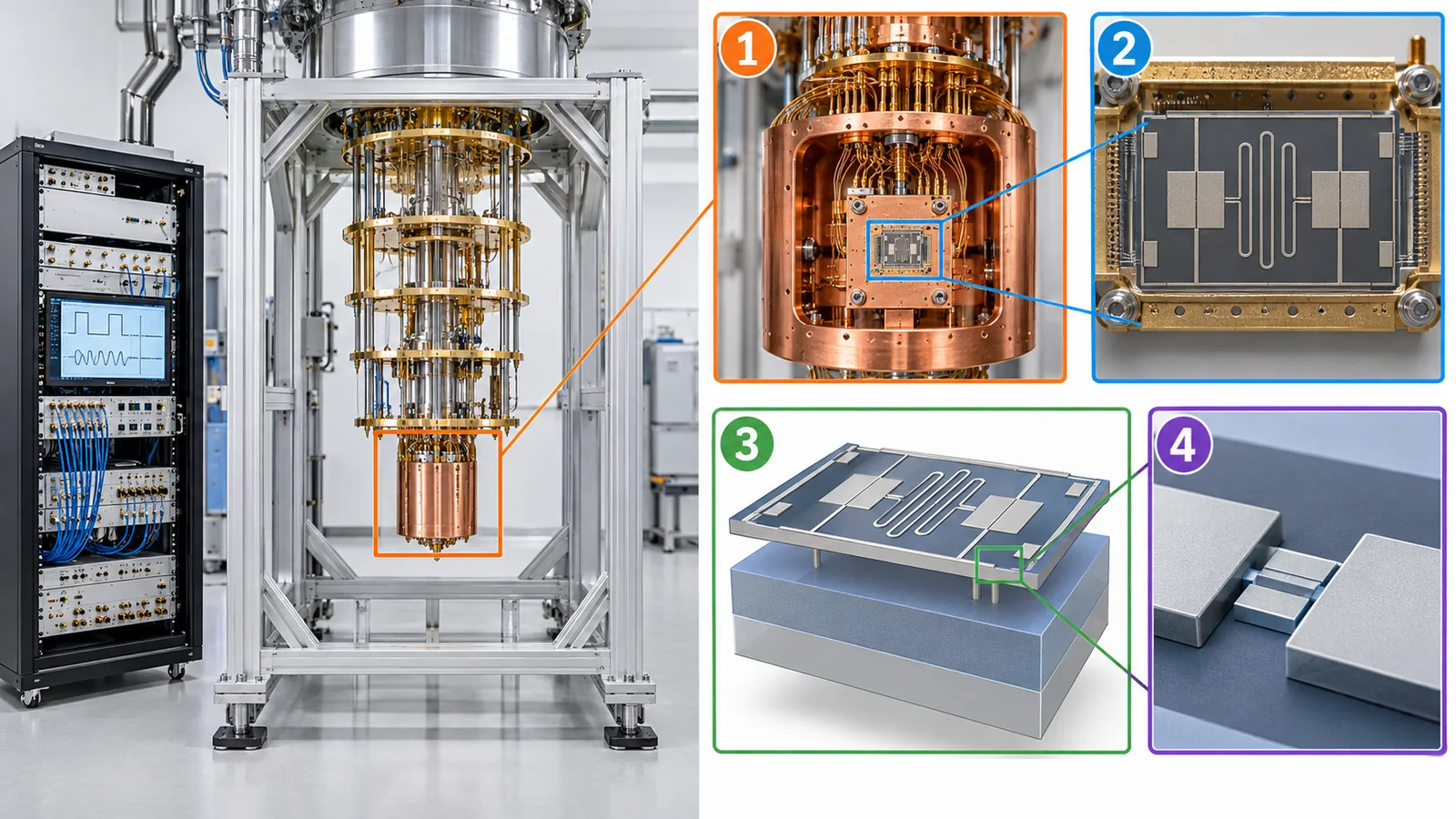
Some metals, cooled far enough, lose all electrical resistance. This is called superconductivity. IBM makes small electrical circuits from such metals (they include Josephson junctions, parts made of two superconductors separated by an extremely thin insulating film), cools them to about 0.015 kelvin (-273.135 °C) and drives them with microwaves, using them as qubits Sourced. The advantage is that they can be made with the same factory methods as silicon chips, so the count can grow. The difficulty is the size of the refrigerators that reach such low temperatures and the number of wires that must be run into them. See also our explainers on superconducting qubits and on cryogenics and control in this series.
4. Scale (kept brief, quantum only)
IBM is one of the world's largest IT companies, and quantum is only one part of it. The company as a whole fits in one table; quantum figures are shown separately Sourced.
| Measure (whole company) | Year to Dec 2023 | Year to Dec 2024 | Year to Dec 2025 |
|---|---|---|---|
| Revenue (US$ million) | 61,860 | 62,753 | 67,535 |
| Research and development expense (US$ million) | 6,775 | 7,479 | 8,316 |
| Employees (31 December 2025) | IBM and wholly owned subsidiaries 264.3 thousand; less-than-wholly owned subsidiaries 8.7 thousand; complementary workforce (temporary, part-time and limited-term, an approximate full-time equivalent) 13.8 thousand | ||
The figures above cover IBM as a whole. Quantum revenue, R&D spending and headcount are not broken out in the 10-K or the annual report Not yet confirmed. The 10-Q likewise describes R&D as "AI, hybrid cloud and quantum" together. The only quantum-specific figures confirmed are two that the company gave in an official announcement: (1) it has signed more than US$1.1 billion in contracts for its quantum programme since 2017 (2 June 2026), and (2) it plans to invest more than US$10 billion in quantum over the next five years (the same announcement). Figure (1) is the company's own number and is separate from the 10-K figures. This profile does not estimate quantum revenue or profit.
5. Resources committed to quantum computing
IBM is more explicit about its quantum commitments, in money, sites, investments and public funding, than companies in many other fields. Headcount is not disclosed. The table sorts the four points by whether they could be confirmed.
| Type of resource | What was confirmed (checked 16 October 2026) | Status |
|---|---|---|
| People | Dedicated quantum headcount is not disclosed. Related facts confirmed: (1) the IBM Quantum Network (IBM's membership network of companies, universities and government bodies that use its quantum computers) has more than 340 member organisations (company figure); (2) the HRL Laboratories acquisition, completed on 26 August 2026, adds its research team (no headcount given); (3) Mukesh Khare, formerly General Manager of IBM Semiconductors, is Anderon's chief executive | Sourced (headcount not confirmed) |
| Money (investment plan) | On 2 June 2026 IBM announced that it will invest more than US$10 billion in quantum over the next five years, spanning R&D, capital expenditure, manufacturing scale-up, ecosystem partnerships and M&A. The same announcement says this includes US$1 billion of cash contributed to Anderon | Not yet confirmed (plan) |
| Money (actual) | Actual quantum-only R&D and capital spending are not broken out in the 10-K or 10-Q | Not confirmed |
| Outside investments, acquisitions and new businesses | (1) Anderon, a new IBM company dedicated to quantum wafers (IBM contributes US$1 billion); (2) the acquisition of HRL Laboratories (agreement announced 23 July 2026, completed 26 August; price not disclosed; HRL was jointly owned by Boeing and General Motors) | Sourced |
| Public funding and government ties | (1) A US$1 billion award to Anderon under the U.S. Department of Commerce's CHIPS Act programme, finalised 16 September 2026 (progressing from the letter of intent of 21 May); (2) selection for Stage C of DARPA's Quantum Benchmarking Initiative (QBI) on 7 October 2026; (3) the quantum computer installed at RIKEN in June 2025, supported by a project of Japan's NEDO (under the Ministry of Economy, Trade and Industry); (4) joint research with U.S. Department of Energy laboratories (Oak Ridge National Laboratory and others) | Sourced |
| Universities and research institutes | A joint lab with the Massachusetts Institute of Technology (29 April 2026), a 10-year algorithms collaboration with ETH Zurich (31 March 2026), the University of Illinois Urbana-Champaign (16 April 2026), the University of Chicago (quantum advantage experiment, 30 July 2026), and the University of Tokyo (which hosts an IBM Quantum System One) | Sourced |
Status of the main devices (checked 16 October 2026; all from IBM's own materials)
Qubit counts are split into "physical" and "logical". Error rates are values IBM published under stated conditions and cannot be lined up against other companies' numbers to rank them.
| Device | Approach | Qubits | Typical error rate or performance (company's stated value, with conditions) | Stage | Date and source |
|---|---|---|---|---|---|
| Heron | Superconducting (heavy-hex layout) | 156 physical | Two-qubit gate error of 3 x 10⁻³ measured on a 100-qubit layered circuit (best two-qubit gate 1 x 10⁻³); CLOPS (circuit layer operations per second) of 250,000 | In operation | Announcement of 23 June 2025 (machine installed at RIKEN) |
| Nighthawk (r1 / r2) | Superconducting (square lattice; each qubit linked to up to four neighbours) | 120 physical (218 couplers) | Can run circuits with up to 5,000 two-qubit gates (r1). The company says r2 estimated observables accurately on circuits of more than 7,500 gates, and with faster reset runs over 100,000 circuits per second (about 25 times Heron, per the company) | Available (r1 at end-2025, r2 in August 2026) | Announcement of 12 November 2025; blog of 31 August 2026 |
| Loon | Superconducting (experimental) | Not confirmed | An experimental chip carrying the parts needed for error correction, such as long-range couplers (c-couplers). No performance figures in the announcement | In development (experimental chip announced) | Announcement of 12 November 2025 |
| Kookaburra | Superconducting (module) | Not disclosed | Planned to demonstrate one module combining a logical processing unit and a quantum memory | Planned (2026). No release announcement found | Roadmap updated March 2026 |
| Starling | Superconducting (fault-tolerant) | 200 logical | Planned to run circuits of 100 million gates | Planned (2029; Poughkeepsie, New York) | Blog of 10 June 2025; official roadmap |
| Blue Jay | Superconducting (fault-tolerant) | 2,000 | Planned to run circuits of 1 billion gates | Planned (the official roadmap says "2033+"; the HRL announcement says "mid-2030s") | Official roadmap; announcement of 23 July 2026 |
6. What it has done so far
IBM's quantum history is easiest to follow as three threads: "anyone can use it on the cloud", "publish a roadmap and keep to it", and "publish new error-correction methods in papers".
| When | What happened | Why it matters |
|---|---|---|
| 4 May 2016 | Put a quantum computer on the cloud (the company calls it the first cloud quantum computer) | Students, researchers and companies could try real hardware; the company says this was the start of today's user base |
| March 2024 | Published a new error-correction method in Nature (a type of qLDPC code, the bivariate bicycle code, which IBM calls the "gross code"). The paper presented a [[144,12,12]] code that protects 12 logical qubits with 144 data qubits (one "gross") | IBM says it corrects errors about as well as the surface code (the standard error-correction method) with roughly one-tenth of the qubits (a theory and design proposal, not a full hardware demonstration) |
| 10 June 2025 | Set out a framework to deliver a fault-tolerant quantum computer, Starling, in 2029, with an updated roadmap | Starling is to be built at IBM's existing site in Poughkeepsie, New York, according to IBM |
| 23 June 2025 | Unveiled at RIKEN (Kobe) the first IBM Quantum System Two outside the U.S., housed alongside and linked to the Fugaku supercomputer | The announcement says it was supported by a NEDO project (under the Ministry of Economy, Trade and Industry) |
| 26 August 2025 | Announced a plan with AMD to combine quantum computers with HPC (high-performance computing, i.e. supercomputing) | The release says AMD chips (CPUs, GPUs, FPGAs) may help with fast error-correction processing |
| 6 November 2025 | Selected for Stage B of DARPA's Quantum Benchmarking Initiative (QBI) | A public programme testing whether a useful fault-tolerant quantum computer can be built by 2033 |
| 12 November 2025 | Announced Nighthawk (120 qubits), the experimental Loon, real-time decoding of errors (under 480 nanoseconds), and the move of fabrication to a 300 mm facility | Decoding is the classical computation that infers, from measurement clues, which qubit went wrong. The company says it was a year ahead of plan |
| 20 November 2025 | Announced a joint study with Cisco on networking quantum computers together | Aims at a proof of concept by the end of 2030 (not yet confirmed) |
| 21 May 2026 | Announced a letter of intent with the U.S. Department of Commerce to set up Anderon, a company dedicated to quantum wafers | A proposed US$1 billion CHIPS award from Commerce and US$1 billion of IBM cash |
| 2 June 2026 | Announced a plan to invest more than US$10 billion in quantum over five years | Covers R&D, capital spending, manufacturing, partnerships and M&A. A plan |
| 30 July 2026 | Announced "quantum advantage" demonstrations with the University of Chicago, Qedma and Algorithmiq | Claims by the company and researchers; see chapters 7 and 11 |
| 19 and 31 August 2026 | Joined two cryogenic modules and cooled them below 15 millikelvin / made Nighthawk r2 available on the cloud | A step towards the larger machines needed for Starling |
| 26 August 2026 | Completed the acquisition of HRL Laboratories | Brings in a lab working on silicon spin qubits and quantum sensors |
| 16 September 2026 | Anderon announced the final agreement on the US$1 billion CHIPS award | Moved from the May letter of intent to a finalised agreement |
| 7 October 2026 | Selected for DARPA QBI Stage C | From here an independent verification team tests IBM's hardware |
In IBM's own explanation, error correction resembles "write the same value on three bits and take a majority vote" (write 0 as 000 and 1 as 111, and one flipped bit can be fixed). A qubit cannot simply be copied, so quantum error correction spreads the information over several qubits and regularly measures only "clues to mistakes" (syndromes) to work out where something broke. The classical computation that makes that inference quickly is the decoder. Because many qubits are bundled into one logical qubit, how many physical qubits it takes to reach a given level of protection is a major factor separating approaches. See our explainers on quantum error correction and the surface code, and on logical qubits and fault-tolerant computing, in this series.
7. What comes next (all of it plans)
Everything below is a plan stated in IBM's official materials. As of the check date (16 October 2026), no third party has confirmed that any of it will be kept Not yet confirmed.
Nighthawk at 7,500 gatesRoadmap (updated March 2026). Assumes up to three modules, 360 qubits in total
Several organisations, including IBM and Google, have announced that they achieved quantum advantage, and each time researchers on the classical side have answered that classical tricks could reproduce the result. IBM-related work has followed the same pattern.
An earlier example (2023): IBM published in Nature that a 127-qubit chip ran circuits larger than brute-force classical simulation could handle, obtaining observables for a model of magnetism (the kicked Ising model) (Kim et al., June 2023). A paper by classical researchers then reproduced the same experiment using tensor networks (Tindall et al., PRX Quantum, January 2024).
The announcements of 30 July 2026: IBM announced advantage demonstrations with the University of Chicago, Qedma and Algorithmiq. IBM says the Chicago experiment used 70 logical qubits and finished in about 15 minutes a computation that leading classical methods would need an impractical time to do. For the Qedma (up to 74 qubits) and Algorithmiq (56 qubits) experiments, IBM says several classical methods disagreed with one another and with the quantum result. IBM has posted these circuits and results on the public Quantum Advantage Tracker, which invites classical rebuttals.
What this profile could confirm: as of 16 October 2026, we found no peer-reviewed paper or official announcement in primary sources that reproduces the three July 2026 results classically. But the absence of a rebuttal does not mean the claim is right. Verification in this field can take months or years, and this profile treats the results as company claims Not yet confirmed. See also our explainer on how to read quantum advantage claims.
8. What the company is aiming for in quantum computing
This part includes things the company has not said directly. They are written as inferences from what the primary sources allow, with the evidence alongside.
| What can be read from the record | Primary evidence | Status |
|---|---|---|
| A policy of staying focused on superconducting qubits while keeping fabrication inside the group | Move to a 300 mm facility (November 2025) and the creation of Anderon (May to September 2026). Anderon says it will supply wafers to quantum hardware companies other than IBM | Inference |
| It is keeping the silicon-spin approach in view, not only superconducting | The HRL announcements say superconducting and spin qubits both use silicon manufacturing, and that working with Anderon could allow spin-qubit manufacturing to be developed | Inference |
| The near-term business pillar is demonstrating quantum advantage and keeping users; the long-term pillar is a fault-tolerant machine (Starling) | The plan to reach advantage in 2026, more than US$1.1 billion in contracts since 2017, and the US$10 billion investment plan | Sourced (the plans exist); the ranking is an inference |
| It wants to make embedding quantum computers in HPC (supercomputing) the standard way to use them | The quantum-centric supercomputing reference architecture (March 2026); joint work with AMD, RIKEN and the University of Illinois | Inference |
| In the long run it intends to scale by linking several quantum computers | The Cisco study (November 2025); the roadmap says it will scale beyond Blue Jay with distributed quantum computing | Sourced (the plans exist) |
In November 2025 IBM said its quantum chips were now mainly made at a 300 mm facility, and in May 2026 it announced that it would spin that factory business out as a separate company, Anderon. Anderon says it will manufacture wafers on contract "for multiple quantum hardware vendors", IBM included Sourced. The shape is: turn the wafer capacity IBM needs for its own machines into a dedicated company that outside customers also use, gaining scale and U.S. government funding. It resembles the way in semiconductors a company's in-house fab became a "foundry" (a contract manufacturer). From this, this profile reads IBM as separating "qubit design" from "making qubits" and trying to lead in both Not yet confirmed.
9. Map of quantum computing partnerships
10. Technology, products and services
IBM's quantum offering is easiest to see as six layers: chips, the machines that run them, the cloud, software, a membership network, and wafer manufacturing.
| Layer | What it is (checked 16 October 2026) | Status |
|---|---|---|
| Quantum chips | Heron (156 qubits) and Nighthawk (120 qubits). Performance as in the table in chapter 5 (company's stated values, with conditions) | In operation, available |
| Quantum computers | IBM Quantum System One and System Two. Available through the cloud and also installed at customer sites (RIKEN, the University of Tokyo, Cleveland Clinic, the Basque Government and others). The company says it has deployed "over 90" systems | In operation (company figure) |
| Cloud | IBM Quantum Platform, successor to the cloud service started in May 2016. A free "Open Plan" account lets users run circuits, according to an official announcement | Available |
| Software | Qiskit, open-source software for programming quantum computers. The company says it is "used by nearly 70 percent of quantum developers" and has "executed over 4 trillion circuits". In November 2025 it added a C API and a C++ interface for use from HPC environments | Available (usage figures are the company's) |
| Membership network | IBM Quantum Network. More than 340 organisations in finance, healthcare, materials, universities and government take part (company figure) | In operation |
| HPC integration | In March 2026 IBM published a reference architecture for "quantum-centric supercomputing", in which a quantum processing unit (QPU) is used together with GPUs and CPUs | Published (design document) |
| Wafer manufacturing | Anderon. Contract manufacture of wafers for superconducting qubits and supporting circuits. On 16 September 2026 it said "the first quantum wafers are now running through" its facility. The number of customers and revenue were not confirmed | Ramp-up stage |
The big change IBM announced in November 2025 was moving the main fabrication of its quantum chips to a 300 mm (300 mm-diameter silicon wafer) semiconductor facility at Albany, New York Sourced. The company says it cut the time to build each new processor by at least half and raised the physical complexity of its chips tenfold. A superconducting qubit is made by drawing a circuit in superconducting thin films on a wafer, so "thin-film quality" and "how the factory is run" translate directly into performance and development speed. Anderon's 2026 materials list superconducting wiring, through-silicon vias (electrical paths that pass through the wafer), bumps (small contacts that join chips), process design kits and in-line wafer testing.
As qubit counts grow, wiring has to be routed out through "multiple layers" and chips have to be connected to one another. The long-range couplers on Loon (called c-couplers, a layer that links distant qubits on one chip) and the chip-to-chip links called L-couplers, from Cockatoo (2027) onward, are the mechanisms for this (all at the plan or experimental stage). On the equipment side, IBM announced in August 2026 that it had joined two cryogenic modules and cooled them below 15 millikelvin. Each module's vacuum enclosure is said to offer up to 12 times more wiring space than IBM's most widely used systems, which shows that making room for wiring is a challenge on the refrigerator side. The materials of the qubits themselves (which superconductor, which substrate) are not stated in the official announcements we checked, and this profile does not specify them Not yet confirmed.
11. The risks this company carries
What follows is fact drawn from official materials, plus this profile's own reading. It is not an assessment of any company and not an input for investment decisions.
| Risk | Detail | Status |
|---|---|---|
| Roadmap slippage | Kookaburra (2026), Cockatoo (2027), Starling (2029) and Blue Jay (2033 or later) are all company plans. IBM says it has kept to its earlier plans, but third parties have not verified that | Not yet confirmed |
| Verifying quantum advantage | IBM announced three advantage demonstrations in July 2026. In the 2023 case a classical team published a tensor-network reproduction of the same experiment. For the three 2026 results we found no primary source claiming a reproduction as of 16 October 2026, but verification will continue | Sourced (past history); the future is Not yet confirmed |
| The engineering of scaling up | By IBM's account it has so far joined two cryogenic modules. For Starling it plans for each module to hold "thousands of qubits", which will require large increases in wiring, cooling and chip-to-chip connection | Sourced (current stage); plans are Not yet confirmed |
| Ramping up the new business, Anderon | The US$1 billion CHIPS award was finalised on 16 September 2026. But it is at the stage where "the first wafers have started flowing", and customers other than IBM, revenue and the detailed terms of the award are not in the announcements, so they could not be confirmed | Sourced (stage); details not confirmed |
| Integrating an acquired business | The HRL acquisition was completed only on 26 August 2026. The price is undisclosed and we found no material showing integration results | Sourced (completion); results Not yet confirmed |
| Concentration on the superconducting approach | IBM's mainstay is superconducting qubits. Companies using other approaches (ions, neutral atoms, photons and others) are also advancing error-correction experiments. The HRL purchase can be read as a step towards the spin approach. This profile does not rank approaches against each other | Inference |
| Risks the company names itself | The 10-K says that if IBM cannot keep innovating in areas including quantum, or cannot commercialise and scale such innovations with sufficient speed, it could fail to maintain its market share and profit margins | Sourced |
12. Glossary
- Qubit
- The smallest unit of quantum computation. It can hold a blend of 0 and 1, but is fragile.
- Physical and logical qubits
- Physical qubits are those actually on the device. A logical qubit is a sturdier virtual qubit made by bundling many physical qubits for error correction.
- Superconducting qubit
- A qubit made from a circuit of metal that has zero electrical resistance at very low temperatures. IBM and Google are the best-known examples.
- Gate
- A basic operation on qubits. The two-qubit gate, which entangles two qubits, matters most and is also where errors are likeliest.
- Error correction
- A scheme that detects and fixes qubit errors by using many physical qubits to make one logical qubit.
- qLDPC code
- A family of quantum error-correcting codes. They need links between distant qubits but can protect data with fewer qubits than the surface code (IBM's statement).
- Decoder
- The classical processing that works out, from error-correction clues, where a mistake happened, and does so fast.
- Quantum advantage
- A quantum computer giving a better result on some task than the best classical method. Claims and rebuttals keep alternating.
- Quantum-centric supercomputing
- IBM's term for using quantum computers (QPUs) together with classical computing such as GPUs and CPUs.
- Foundry
- A factory that makes chips on contract for other companies. Anderon aims to be a foundry dedicated to quantum chips.
- CHIPS Act
- The U.S. law (CHIPS and Science Act) that funds semiconductor manufacturing and research. Anderon's award is made under it.
- DARPA QBI
- The Quantum Benchmarking Initiative of the U.S. Defense Advanced Research Projects Agency. It tests in stages whether a useful fault-tolerant quantum computer can be built by 2033.
- Millikelvin (mK)
- A unit of temperature close to absolute zero. 15 mK is about -273.135 °C. It is reached with a machine called a dilution refrigerator.
- Qiskit
- IBM's open-source software for programming quantum computers.
13. References
- IBM Form 10-K for the fiscal year ended 31 December 2025 (filed with the U.S. SEC on 24 February 2026). Risk factors, business description, revenue and R&D expense. https://www.sec.gov/Archives/edgar/data/51143/000005114326000010/ibm-20251231.htm
- IBM 2025 Annual Report to Stockholders (Exhibit 13 to the 10-K). Employee numbers, management's description of quantum, and R&D commentary. https://www.sec.gov/Archives/edgar/data/51143/000005114326000010/ibm-20251231_d2.htm
- IBM Form 10-Q for the quarter ended 30 June 2026 (filed 23 July 2026). Anderon and the quantum investment plan; R&D commentary. https://www.sec.gov/Archives/edgar/data/51143/000005114326000078/ibm-20260630.htm
- IBM Newsroom IBM and U.S. Department of Commerce Announce America's First Purpose-Built Quantum Foundry, Supported by Proposed $1 Billion CHIPS Award (21 May 2026). https://newsroom.ibm.com/ibm-and-u-s-department-of-commerce-announce-americas-first-purpose-built-quantum-foundry
- IBM Newsroom IBM Commits More Than $10 Billion to Quantum Computing (2 June 2026). The investment plan, Starling and Blue Jay, more than $1.1 billion in contracts, over 90 systems deployed, more than 340 network members. https://newsroom.ibm.com/2026-06-02-ibm-commits-more-than-10-billion-to-quantum-computing,-funding-its-roadmap-from-todays-leading-systems-to-the-worlds-first-fault-tolerant-quantum-computers
- Anderon Anderon Finalizes Agreement with U.S. Department of Commerce for USD 1 Billion in CHIPS Incentives (16 September 2026). https://www.anderon.com/blog/anderon-finalizes-agreement
- IBM Newsroom IBM to Acquire HRL Laboratories to Power the Future of Quantum (23 July 2026). https://newsroom.ibm.com/2026-07-23-ibm-to-acquire-hrl-laboratories-to-power-the-future-of-quantum
- IBM Newsroom IBM Completes Acquisition of HRL Laboratories (26 August 2026). https://newsroom.ibm.com/2026-08-26-ibm-completes-acquisition-of-hrl-laboratories-to-accelerate-the-future-of-quantum
- IBM Newsroom IBM Delivers New Quantum Processors, Software, and Algorithm Breakthroughs (12 November 2025). Nighthawk, Loon, decoding, 300 mm fabrication. https://newsroom.ibm.com/2025-11-12-ibm-delivers-new-quantum-processors,-software,-and-algorithm-breakthroughs-on-path-to-advantage-and-fault-tolerance
- IBM Quantum IBM lays out clear path to fault-tolerant quantum computing (IBM Quantum blog, 10 June 2025). Starling, the gross code, Relay-BP and the roadmap. https://www.ibm.com/quantum/blog/large-scale-ftqc
- IBM Technology Atlas Quantum 2026 (quantum roadmap, updated March 2026). https://www.ibm.com/roadmaps/quantum/2026/
- IBM Technology Atlas Quantum Roadmap (Starling in 2029, Blue Jay in 2033 or later). https://www.ibm.com/roadmaps/quantum/
- IBM Newsroom IBM Connects Its First Modular Cryogenic Systems (19 August 2026). https://newsroom.ibm.com/2026-08-19-ibm-connects-its-first-modular-cryogenic-systems-in-milestone-toward-fault-tolerant-quantum-computing
- IBM Quantum IBM Quantum Nighthawk r2: more circuits, faster (IBM Quantum blog, 31 August 2026). https://www.ibm.com/quantum/blog/nighthawk-r2
- IBM Newsroom IBM and The University of Chicago Demonstrate Quantum Advantage (30 July 2026). https://newsroom.ibm.com/2026-07-30-ibm-and-the-university-of-chicago-demonstrate-quantum-advantage,-establishing-trusted-quantum-computation-on-logical-circuits
- IBM Quantum Quantum advantage (IBM Quantum blog, 30 July 2026). Description of the three papers from the University of Chicago, Qedma and Algorithmiq. https://www.ibm.com/quantum/blog/quantum-advantage
- IBM Newsroom IBM Advances to Stage C of DARPA Quantum Benchmarking Initiative (7 October 2026). https://newsroom.ibm.com/2026-10-07-ibm-advances-to-stage-c-of-darpa-quantum-benchmarking-initiative
- IBM Newsroom IBM Advances to Next Phase of DARPA Quantum Benchmarking Initiative (Stage B, 6 November 2025). https://newsroom.ibm.com/2025-11-06-ibm-advances-to-next-phase-of-darpa-quantum-benchmarking-initiative
- IBM Newsroom IBM and RIKEN Unveil First IBM Quantum System Two Outside of the U.S. (23 June 2025). Heron error rate and CLOPS. https://newsroom.ibm.com/2025-06-23-ibm-and-riken-unveil-first-ibm-quantum-system-two-outside-of-the-u-s
- IBM Newsroom IBM and AMD Join Forces to Build the Future of Computing (26 August 2025). https://newsroom.ibm.com/2025-08-26-ibm-and-amd-join-forces-to-build-the-future-of-computing
- IBM Newsroom IBM and Cisco Announce Plans to Build a Network of Large-Scale, Fault-Tolerant Quantum Computers (20 November 2025). https://newsroom.ibm.com/2025-11-20-ibm-and-cisco-announce-plans-to-build-a-network-of-large-scale,-fault-tolerant-quantum-computers
- IBM Newsroom IBM: A Decade of Quantum on the Cloud (4 May 2026). https://newsroom.ibm.com/2026-05-04-ibm-a-decade-of-quantum-on-the-cloud
- IBM Newsroom IBM Releases a New Blueprint for Quantum-Centric Supercomputing (12 March 2026). https://newsroom.ibm.com/2026-03-12-ibm-releases-a-new-blueprint-for-quantum-centric-supercomputing
- IBM Newsroom IBM and ETH Zurich Join Forces to Shape the Future of Algorithms for the AI and Quantum Era (31 March 2026). https://newsroom.ibm.com/2026-03-31-IBM-and-ETH-Zurich-join-forces-to-shape-the-future-of-algorithms-for-the-AI-and-quantum-era
- IBM Newsroom The MIT-IBM Computing Research Lab Launches (29 April 2026). https://newsroom.ibm.com/2026-04-29-the-mit-ibm-computing-research-lab-launches-to-shape-the-future-of-ai-and-quantum-computing
- IBM Newsroom IBM and the University of Illinois Urbana-Champaign Expand Discovery Accelerator Institute (16 April 2026). https://newsroom.ibm.com/2026-04-16-ibm-and-the-university-of-illinois-urbana-champaign-expand-discovery-accelerator-institute-to-advance-ai-and-quantum-computing
- IBM Newsroom The University of Tokyo to Equip IBM Quantum System One with Heron (15 May 2025). https://newsroom.ibm.com/2025-05-15-the-university-of-tokyo-to-equip-ibm-quantum-system-one-with-most-performant-ibm-heron-processor
- IBM Newsroom Oak Ridge National Lab, Cleveland Clinic, and IBM Achieve First-Known Computations of Fusion Materials on a Quantum Computer (6 July 2026). https://newsroom.ibm.com/2026-07-06-oak-ridge-national-lab,-cleveland-clinic,-and-ibm-achieve-first-known-computations-of-fusion-materials-on-a-quantum-computer
- Bravyi et al. High-threshold and low-overhead fault-tolerant quantum memory. Nature 627, 778-782 (2024). DOI 10.1038/s41586-024-07107-7. https://doi.org/10.1038/s41586-024-07107-7
- Kim et al. Evidence for the utility of quantum computing before fault tolerance. Nature 618, 500-505 (2023). DOI 10.1038/s41586-023-06096-3. https://doi.org/10.1038/s41586-023-06096-3
- Tindall et al. Efficient Tensor Network Simulation of IBM's Eagle Kicked Ising Experiment. PRX Quantum 5, 010308 (2024). DOI 10.1103/PRXQuantum.5.010308. https://doi.org/10.1103/PRXQuantum.5.010308
- Quantum Advantage Tracker A shared project that publishes and verifies quantum advantage candidates (participants include IBM, Algorithmiq, the Flatiron Institute, BlueQubit and RIKEN). https://quantum-advantage-tracker.github.io/
- IBM Quantum IBM Quantum official website (source of the logo). https://www.ibm.com/quantum
14. Claim-to-source audit
Last updated 16 October 2026 / Troy Technical
Figures in this article come from IBM's statutory filings with the U.S. Securities and Exchange Commission, IBM and Anderon announcements, and peer-reviewed papers. Quantum advantage claims, roadmaps and performance figures are company claims or plans, not third-party confirmation. No research-firm estimates or press-based figures have been used. Passages marked "Inference" are this article's interpretation of primary sources, not statements by the company. The check date is 16 October 2026.