COMPANY PROFILE / QUANTUM COMPUTING
Infleqtion
- An NYSE-listed company that uses one "neutral atom" technology for both quantum computers and quantum sensors of time, radio waves and gravity
Infleqtion is a U.S. company that uses a technology for catching and operating electrically neutral atoms with lasers in its quantum computer, Sqale, and also in its optical atomic clock Tiqker, its radio-wave sensor SqyWire and its acceleration-and-gravity sensors Exaqt. It was formerly called ColdQuanta. On 13 February 2026 it completed its merger with a special purpose acquisition company (SPAC), Churchill Capital Corp X, and it has been listed on the NYSE (INFQ) since 17 February 2026. On 24 September 2026 it announced that it had entangled 30 logical qubits using 80 physical qubits. On the other hand, about nine-tenths of revenue comes from governments; in the second quarter of 2026 a single customer accounted for 82% of revenue; and the company has reported "material weaknesses" in internal control. This profile concentrates on the quantum-computing side and sets out the route to listing, business figures and future targets, using only U.S. SEC filings. Claims such as "quantum advantage" are treated as the company's own. Information checked on 16 October 2026.
- Infleqtion at a glance, and where it sits in quantum computing
- Logo and naming
- Where the company sits in the quantum-computing landscape
- Company size
- Resources committed to quantum computing
- What the company has done so far
- Plans
- What the company is aiming for in quantum computing
- Partnership map for quantum computing
- Technology, products and services
- Risks the company faces
- Glossary / References / Claim-to-source audit
1. Infleqtion at a glance, and where it sits in quantum computing
(from 17 February 2026)Merger with the SPAC Churchill Capital Corp X completed on 13 February 2026
(using 80 physical)Company announcement of 24 September 2026. The number entangled
Infleqtion is not a company that only builds quantum computers. The company says the same technology for catching and operating neutral atoms works in its quantum computer (Sqale), its atomic clock (Tiqker) and its radio-wave sensor (SqyWire) Sourced. At present, revenue comes mainly from government contracts for sensors and for research and development (NASA's gravity sensor, atomic clocks for the U.S. military and so on), and the filings (a single operating segment) do not show how much of revenue comes from quantum computing. On the computing side, it announced "30 logical qubits" in September 2026 and has contracted a machine of around 50 logical qubits to be installed in Illinois in 2027 Sourced. It has also disclosed accounting corrections and weaknesses in internal control. This profile keeps the technical milestones and the financial cautions apart.
2. Logo and naming

A note on names: the company is Infleqtion. Its legal name is Infleqtion, Inc., and before the merger the operating company was ColdQuanta, Inc. (doing business as Infleqtion). Sqale is the quantum computer, Superstaq is the quantum software, and Tiqker, SqyWire and Exaqt are sensor products; none is a company name. The merger partner, Churchill Capital Corp X, was renamed Infleqtion, Inc. after the merger and no longer exists as a separate company.
Official site: https://infleqtion.com/3. Where the company sits in the quantum-computing landscape
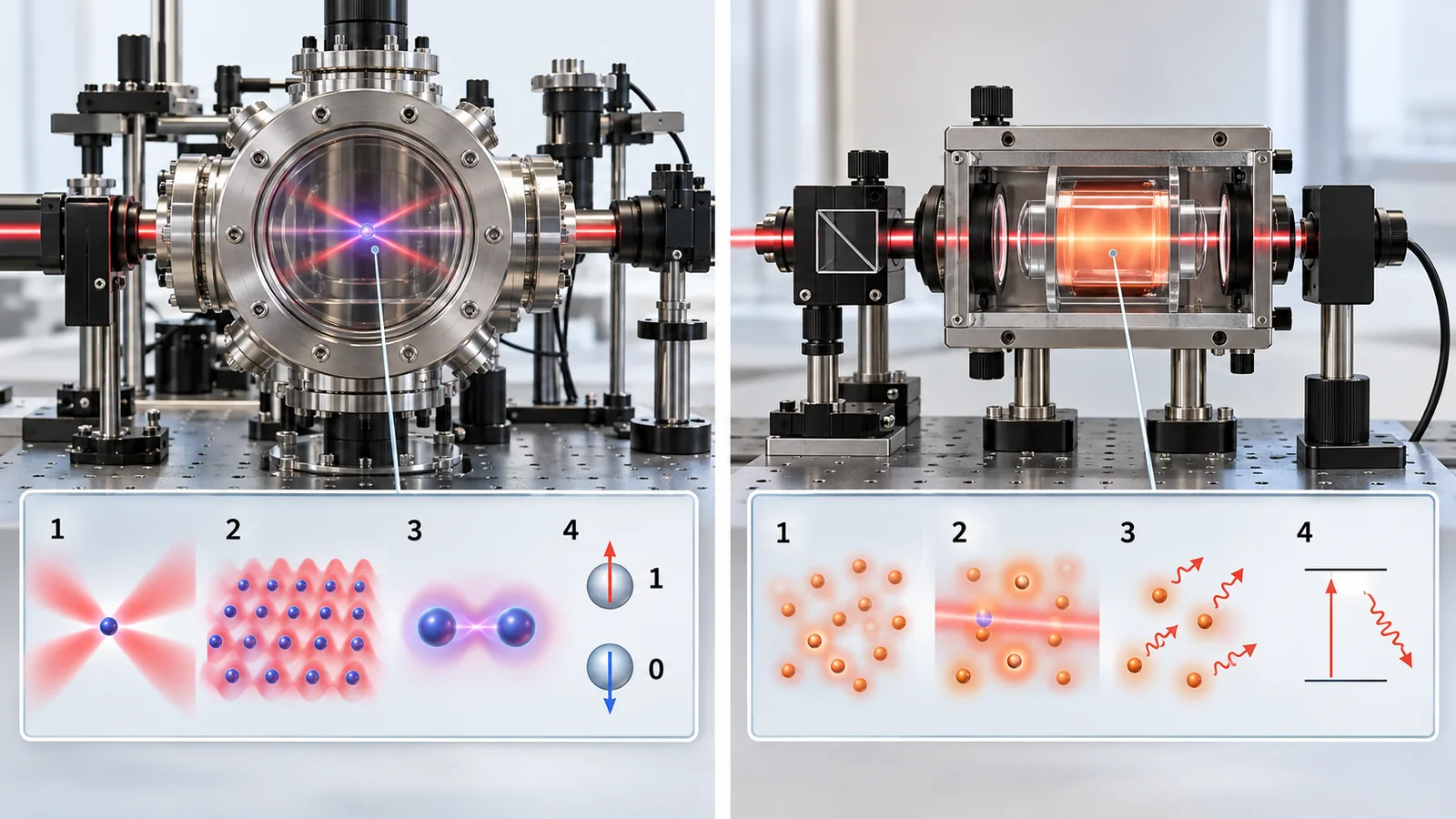
First, qubits and approaches. A qubit is the smallest part of a quantum computer, and it can be in a "superposition" of 0 and 1. Infleqtion makes its qubits from neutral atoms (atoms with no electric charge).
A key feature of Infleqtion is that it uses the same neutral-atom technology for both "computing" and "measuring". The illustration below shows the relationship in simple terms.
4. Company size
Infleqtion listed in February 2026 and files annual (Form 10-K) and quarterly (Form 10-Q) reports with the SEC. However, the Form 10-K for the year ended December 2025 contains the financial statements of the pre-merger SPAC (Churchill Capital Corp X); the operating company's (formerly ColdQuanta's) results for 2025 are in a Form 8-K/A filed the same day. Units are millions of US dollars. In its Form 10-Q of August 2026 the company made corrections of "immaterial errors" relating to when revenue is recognized and similar matters, so past figures below are shown "as adjusted" Sourced.
| Item (US$ million) | 2024 (adjusted) | 2025 (adjusted) | H1 2026 |
|---|---|---|---|
| Revenue | 28.1 | 31.1 | 23.4 (13.5 a year earlier) |
| of which second quarter | - | - | 13.5 (12.6 in the original announcement) |
| Research and development | 22.3 | 24.1 | 22.6 (10.5 a year earlier) |
| Net loss | (55.7) | (32.2) | (54.4) |
| Cash and cash equivalents | 47.9 | 11.7 | 59.3 (plus 522.5 of available-for-sale securities) |
2025 revenue was 32.5 before adjustment and 31.1 after. For 2024 the figures are 28.8 before and 28.1 after. The 2024 net loss includes an impairment of assets and goodwill of about 13.5. R&D for 2025 is the value before adjustment.
| Other measures of size | Details | Source |
|---|---|---|
| Employees | 205 (more than 160 of them physicists and engineers). About 55% are in the Denver area and about 78% hold advanced science or engineering degrees (31 December 2025) | Reference 1 https://www.sec.gov/Archives/edgar/data/2007825/000119312526134544/d94946d10k.htm |
| Patents | 125 issued and 108 pending (31 December 2025) | Reference 1 https://www.sec.gov/Archives/edgar/data/2007825/000119312526134544/d94946d10k.htm |
| Shares outstanding | 216,471,927 immediately after the merger | Reference 3 https://www.sec.gov/Archives/edgar/data/2007825/000162828026057508/infq-20260630.htm |
| Cash and securities | About US$582 million (cash and equivalents, restricted cash and available-for-sale securities combined; no debt). About US$27.4 million of that is tax withheld on stock-option exercises, to be remitted in the third quarter of 2026 | Reference 4 https://www.sec.gov/Archives/edgar/data/2007825/000162828026056222/infq-20260630xex991.htm |
| 2026 revenue outlook | About US$45.1 million (company outlook; raised from about US$43 million because of the correction in the timing of revenue recognition) | Reference 5 https://www.sec.gov/Archives/edgar/data/2007825/000162828026057510/infq-20260630xex9918x17x20.htm |
About nine-tenths of revenue is government-related, and it is concentrated in a single customer. In the second quarter of 2026, government customers were 92% of revenue and the largest customer (Customer A) 82% (for the first half: government 89%, Customer A 74%) Sourced. The company says the development of NASA's gravity gradiometer was the main driver of the rise. The company has also disclosed "material weaknesses" in internal control over financial reporting (insufficient accounting staff, controls over its U.K. subsidiary, approval procedures for equity records, IT controls and so on). After its second-quarter results of 12 August, an adjustment to the timing of revenue recognition was found, a corrected release followed on 17 August, and the Form 10-Q was filed one business day after the deadline. This profile does not judge any particular accounting treatment, but anyone reading the numbers should know the history of the corrections.
5. Resources committed to quantum computing
The table shows whether four items (people, money, outside investments and acquisitions, and ties to universities and public bodies) could be confirmed. Figures for quantum computing alone are not disclosed separately, so these are company-wide figures (quantum computing, sensors and software).
| Type of resource | Details | Status |
|---|---|---|
| People | 205 (end of 2025), more than 160 of them physicists and engineers. Sites in Colorado, the U.K., Australia, Illinois and Wisconsin. The number working only on quantum computing is not confirmed | Sourced |
| Money: R&D spending | About US$24.09 million in 2025 and about US$22.63 million in the first half of 2026 (about 2.2 times a year earlier). The quantum-computing share is not confirmed | Sourced |
| Money: funding | In the February 2026 merger the company received about US$528 million in gross proceeds (about US$402 million from the trust account and operating cash, and about US$126.5 million from a PIPE, a private investment in a public company). Redemptions from the trust account were only 0.09%. Direct transaction costs were about US$9.3 million (deducted from equity) and about US$11.5 million was expensed | Sourced |
| Money: public funding | A letter of intent with the U.S. Department of Commerce (up to US$100 million, with the possibility that Commerce receives company shares; subject to a final agreement and government approval). A US$20 million contract for the initial phase of NASA's gravity gradiometer, about US$11 million from the Army's APFIT program for atomic clocks, DARPA's HARQ (US$2 million), DOE's ARPA-E (US$5.3 million cost-sharing) and the Navy (US$1 million) | Sourced (Commerce part not final) |
| Outside investments, acquisitions, joint ventures | Super.tech (quantum software, acquired in 2022, now Superstaq) and Oratomic (a neutral-atom startup; about US$3 million invested in the second quarter of 2026, and it is a customer for quantum cores). An impairment of assets and goodwill of about US$13.54 million was recorded in 2024 (its object is not given in the materials checked here) | Sourced |
| Universities and research bodies | University of Colorado (exclusive and non-exclusive patent licenses), the Wisconsin Alumni Research Foundation (WARF; an exclusive license), SRI, the U.K.'s National Quantum Computing Centre (NQCC), the Moonshot program of Japan's Science and Technology Agency (JST), and DOE's Genesis Mission (three projects) | Sourced |
Here are the main machines and experiments, as far as filings and announcements allow (checked 16 October 2026). The numbers are the company's stated values or statements in its announcements. Because the methods and conditions differ, they are not lined up against other companies to rank them.
| Machine / experiment | Scale and content (approach: neutral atoms, gate-based) | Stage | Date | Source |
|---|---|---|---|---|
| Sqale (current machine) | Arrays of up to 1,600 atoms; two-qubit CZ gate fidelity of 99.73% (company's stated value; the measurement method and conditions are not given in the 10-K); all-to-all connectivity; 12 logical qubits demonstrated (end of 2025). The company describes it as "the largest neutral-atom array outside a research institution" | Operating (including at customer sites) | December 2025 | Reference 1 https://www.sec.gov/Archives/edgar/data/2007825/000119312526134544/d94946d10k.htm |
| Sqale for the U.K. NQCC | Delivered to the testbed of the U.K.'s National Quantum Computing Centre. The company describes it as "the largest quantum computer in the U.K." | Delivered | 10-K for 2025 | Reference 1 https://www.sec.gov/Archives/edgar/data/2007825/000119312526134544/d94946d10k.htm |
| Processor for Japan | A processor able to handle 529 physical qubits, delivered to the Institute for Molecular Science. The company says it is the only foreign quantum-computing company chosen for JST's Moonshot program | Delivered | 10-K for 2025 | Reference 1 https://www.sec.gov/Archives/edgar/data/2007825/000119312526134544/d94946d10k.htm |
| 30 logical qubits | 30 logical qubits brought into a single entangled state using 80 physical qubits, with about 1,000 physical operations (1 KiloQuOp). Confirmed, it says, by "a signal about 1,000 times stronger than the noise". It says AI assistance halved the number of physical gates needed for a logical operation (company announcement; the paper was not checked here) | Experiment (company announcement) | 24 September 2026 | Reference 6 https://www.sec.gov/Archives/edgar/data/2007825/000162828026063328/infq-20260924xexx991.htm |
| Fault-tolerant machine in Illinois | A neutral-atom quantum computer for the Illinois Quantum & Microelectronics Park (IQMP). It starts at about 50 logical qubits, with modular additions aiming at 100. It links to NVIDIA's NVQLink. Delivery is planned for 2027 | Contracted / plan Not yet confirmed | July 2026 | Reference 3 https://www.sec.gov/Archives/edgar/data/2007825/000162828026057508/infq-20260630.htm |
| Tiqker / SqyWire / Exaqt | An optical atomic clock, a quantum RF sensor, and inertial and gravity sensors. The company says optical atomic clocks perform 100 to 1,000 times better than conventional atomic clocks (company's claim). A third-generation Tiqker is on sale | On sale / in development | 2026 | References 1, 4 https://www.sec.gov/Archives/edgar/data/2007825/000119312526134544/d94946d10k.htm https://www.sec.gov/Archives/edgar/data/2007825/000162828026056222/infq-20260630xex991.htm |
The filings checked do not give the number of physical qubits or the error rate for the "12" logical qubits, and for the "30" only the company announcement exists (80 physical qubits). The stage "plan" does not mean the outcome is certain.
The number of physical qubits needed for a given number of logical qubits changes greatly with how the logical qubits are made. Infleqtion's 30 used 80 atoms, but which code was used, and whether errors are corrected or only detected, is not described in detail in the company's announcement Not yet confirmed. For that reason this profile does not set the figure beside other companies' logical-qubit counts, and gives the ratio (80 / 30 = about 2.7) only as "our calculation".
6. What the company has done so far
| When | What happened | Meaning |
|---|---|---|
| 2008 onward | Began selling machines that use neutral atoms (company statement). Uses research results from the University of Colorado, the University of Wisconsin and others under patent licenses | The business grew out of research-use "quantum cores" |
| 2022 | Acquired Super.tech (now Superstaq) | Took in quantum software |
| December 2023 | Announced work with L3Harris to move SqyWire from the lab to operational use | A radio-wave sensor for defense |
| June to December 2025 | Co-selling with SAIC (June), partnership with NVIDIA (October), a space partnership with Voyager Technologies (November), a precision-timing partnership with Safran (December) | Ties with defense, space and computing-infrastructure companies |
| 13 to 17 February 2026 | Completed the merger with the SPAC Churchill Capital Corp X (13th) and began trading on the NYSE (17th). The company received about US$528 million | Became a listed company |
| January to February 2026 | US$5.3 million cost-sharing from DOE's ARPA-E (January), US$2 million from DARPA's HARQ and US$1 million from the Navy (February) | A run of smaller government awards |
| 31 March 2026 | Filed the Form 10-K (with the SPAC's financials) and a Form 8-K/A with the operating company's financials. Disclosed "material weaknesses" | The first annual filings |
| April to July 2026 | Integrated NVIDIA's Ising models into Sqale for calibration and decoding (April). Commerce letter of intent (from May). Selected for three DOE Genesis Mission projects and contracted the fault-tolerant machine for Illinois (July) | Growth in applications and government work |
| August 2026 | After the second-quarter results (12 August), an accounting adjustment was found and a correction was issued on 17 August. The Form 10-Q was filed one business day after the deadline. Announced a relationship with Eaton | Corrections to the numbers |
| 24 September 2026 | Announced 30 logical qubits (80 physical) | The company says it reached its 2026 target of 30 |
7. Plans
About 50 logical qubits at firstModular additions aim at 100. Linked to NVIDIA's NVQLink (10-Q)
The company describes these as "targets", "outlooks" and "plans", and they are not accomplished facts Not yet confirmed. The 2026 target of 30 logical qubits was announced as "achieved" on 24 September 2026. That, however, is a number of qubits entangled, not a result of practical-scale computation.
None of the following could be confirmed from filings or company announcements Not yet confirmed: revenue and profit for quantum computing alone (reported as a single operating segment); a technical paper on the 30 logical qubits (the company says a write-up is on its blog, which was not checked here); error-rate figures for the 12- and 30-logical-qubit experiments; the price of the Illinois machine and the terms of any final Commerce agreement; third-party verification of the company's claim that its quantum sensors beat the classical state of the art; and the founding year. Third-party market forecasts quoted in the 10-K (about US$30 billion for quantum sensing and about US$130 billion for quantum computing by 2040) are market-research estimates, so this profile does not use them.
8. What the company is aiming for in quantum computing
This chapter includes points the company does not state directly. They are given as inferences, within what the primary sources support, together with the evidence.
| What can be read from the sources | Primary evidence | Status |
|---|---|---|
| It pursues quantum computing in a "dual track" alongside its sensor business | The 10-K says it advances toward 100+ logical-qubit systems while commercializing quantum sensors that "already deliver advantage" | Sourced |
| The main buyers are governments and defense, and mass markets come once the products become "small, light, low-power and low-cost" | The 10-K says government agencies and public programs are the largest buyers, and that reducing SWaP-C (size, weight, power and cost) opens high-value, high-volume enterprise markets | Sourced |
| The quantum computer is designed on the premise of connection to GPUs (NVIDIA) | NVQLink is used in the Illinois machine, and NVIDIA's Ising models were integrated into Sqale for calibration and decoding (April 2026) | Sourced |
| For now, revenue growth is carried by government development contracts rather than product sales | In the second quarter of 2026, product revenue was about US$3.17 million (about US$3.56 million a year earlier) and service revenue about US$10.37 million (about US$1.72 million). Service revenue comes mainly from government contracts | Inference |
| It has ample financial room and is in a hurry to raise its logical-qubit count | About US$582 million in cash and securities and no debt. Logical qubits went from 12 in December 2025 to 30 in September 2026, with 100 targeted for 2028 | Inference |
Revenue for the second quarter of 2026 was about US$13.54 million, of which service revenue was about US$10.37 million and product revenue about US$3.17 million. A year earlier, services were about US$1.72 million and products about US$3.56 million Sourced. The 10-Q says service revenue comes mainly from research and development on government contracts, and that the rise came mainly from U.S. government contracts (development of NASA's gravity gradiometer and so on). From this we read that "Infleqtion's current revenue growth is carried not by sales of mass-produced products (such as Tiqker) but by government development and demonstration contracts". The same 10-Q says revenue fell as U.K. government contracts ended while U.S. government contracts grew, which also shows a structure in which revenue can swing sharply with contract renewals. How much of this is quantum computing cannot be confirmed from the filings Not yet confirmed.
9. Partnership map for quantum computing
10. Technology, products and services
| Layer | Main product | What the filings and official materials say |
|---|---|---|
| Base | Quantum Core | A neutral-atom module combining a vacuum or vapor cell, lasers and control electronics. Sold on its own to researchers and used as the base of all its products |
| Quantum computer | Sqale | Arrays of up to 1,600 atoms, all-to-all connectivity and atom rearrangement. Installed on-premises or used over the cloud, with metered pricing by "shots" (repetitions). The service is at a "very early stage of commercialization" |
| Software | Superstaq, CML | Superstaq is a compiler and middleware that optimizes quantum circuits for each machine (it also supports other companies' hardware). CML is "quantum-inspired" AI software that runs on GPUs; in the company's tests it saved more than 10 times the memory of a standard Transformer on long-context processing (company's evaluation) |
| Sensors | Tiqker, SqyWire, Exaqt | An optical atomic clock, a quantum RF sensor, and inertial and gravity sensors. The company says it has validated them on roads, at sea, in flight and in space |
Glass vacuum cells: the heart of a neutral-atom machine is a vacuum or vapor cell. In its 10-K the company explains that atoms are isolated in a low-pressure glass cell to limit outside interaction and keep coherence Sourced. The glass material, the sealing method and low outgassing of the cell bear directly on atom lifetime and machine reliability, but the materials checked here give no specifics Not yet confirmed.
Works at room temperature: Infleqtion says the qubits do not have to be chilled cryogenically (the atoms are cooled with lasers). This differs sharply from superconducting machines, and the company claims that "no refrigerator is needed, so size and power are easier to cut" Sourced.
Vertically integrated manufacturing: the company says it develops and makes in-house its vacuum and vapor cells, control electronics, optical assemblies, calibration systems and firmware, and assembles them at its Colorado and Oxford sites Sourced. Reducing size, weight and power (SWaP) and hardening the products for roads, sea, air and space is described as the central challenge of the sensor business.
11. Risks the company faces
| Risk | Details | Status |
|---|---|---|
| Revenue concentrated in governments | In the second quarter of 2026, government customers were 92% of revenue and a single customer 82%. Government contracts have conditions at each phase and are affected by expiry and renewal | Sourced |
| Weaknesses in internal control over financial reporting | The company disclosed "material weaknesses" (accounting staffing, controls over its U.K. subsidiary, procedures for equity records, IT controls). In August 2026 it corrected "immaterial errors" in revenue recognition and loss provisions, revised its second-quarter revenue announcement (US$12.6 million) to US$13.5 million, and filed its Form 10-Q one business day late | Sourced |
| Continuing losses | In the first half of 2026 the operating loss was about US$62.89 million and the net loss about US$54.41 million (including interest income of about US$8.22 million) | Sourced |
| Conditions in a university license | If a quantum-computing hardware product cannot be bought on the market by 31 December 2026, WARF may change the exclusive license to a non-exclusive one or terminate it | Sourced |
| Checking the "quantum advantage" claim | The company says its clocks and RF sensors "already beat the classical state of the art". No third-party verification was found. Advantage in quantum computing is a future goal | Not yet confirmed |
| Commerce funding is not final | The letter of intent is subject to a final agreement and government approval, and assumes Commerce receiving shares | Not yet confirmed |
| Technology and competition | The company names competition from other approaches (superconducting, ion, photonic) and from other neutral-atom companies. In quantum sensing it also competes with established atomic-clock makers | Sourced |
| Export controls and regulation | Depending on use, its quantum sensors may be subject to the U.S. International Traffic in Arms Regulations (ITAR) or Export Administration Regulations (EAR). Tiqker requires registration with the U.S. Food and Drug Administration (FDA) as an electronic product | Sourced |
12. Glossary
- Qubit
- The smallest part of a quantum computer. It can be in a superposition of 0 and 1.
- Neutral atom
- An atom with no electric charge. It is caught and arranged with laser light and used as a qubit or a sensor.
- Logical qubit
- Several physical qubits combined into one qubit that is more robust against errors.
- CZ gate
- A basic operation that links two qubits (controlled-Z). 99.73% is its accuracy (company's stated value).
- All-to-all connectivity
- Any two qubits can be linked directly.
- Optical atomic clock
- A clock that uses the oscillation of light emitted by atoms as its scale. Said to be more precise than conventional atomic clocks.
- Quantum RF sensor
- A sensor that detects radio waves using atoms in a special state.
- SWaP-C
- Initials of size, weight, power and cost.
- KiloQuOp / MegaQuOp
- A measure of how many logical operations can be run in a row correctly: 1,000 or one million.
- SPAC / PIPE
- SPAC: a special purpose acquisition company. PIPE: a private investment in a public company, raised alongside the merger.
- Material weakness
- A state in which there is a reasonable possibility that a material error in financial reporting would not be prevented or found.
- Letter of intent (LOI)
- A statement of intent to provide support or do a deal, issued before the final agreement. Its legal force is limited.
13. References
- Infleqtion, Inc. (U.S. SEC) Annual Report on Form 10-K (year ended December 2025, filed 31 March 2026). Business description, technology, customers, regulation, competition, intellectual property, employees, risks, and the merger history. https://www.sec.gov/Archives/edgar/data/2007825/000119312526134544/d94946d10k.htm
- Infleqtion, Inc. (U.S. SEC) Form 8-K/A, Exhibit 99.1 (filed 31 March 2026). Financial statements of the operating company (formerly ColdQuanta) for the years ended December 2025 and 2024. https://www.sec.gov/Archives/edgar/data/2007825/000119312526134690/d104197dex991.htm
- Infleqtion, Inc. (U.S. SEC) Quarterly Report on Form 10-Q (quarter ended 30 June 2026, filed 17 August 2026). First-half financials, merger proceeds, corrections of errors in revenue, weaknesses in internal control, contracts and partnerships. https://www.sec.gov/Archives/edgar/data/2007825/000162828026057508/infq-20260630.htm
- Infleqtion, Inc. (U.S. SEC) Form 8-K, Exhibit 99.1 (12 August 2026). Second-quarter announcement (original), cash, Commerce letter of intent, Illinois contract. https://www.sec.gov/Archives/edgar/data/2007825/000162828026056222/infq-20260630xex991.htm
- Infleqtion, Inc. (U.S. SEC) Form 8-K/A, Exhibit 99.1 (17 August 2026). Correction of second-quarter revenue and full-year outlook. https://www.sec.gov/Archives/edgar/data/2007825/000162828026057510/infq-20260630xex9918x17x20.htm
- Infleqtion, Inc. (U.S. SEC) Form 8-K, Exhibit 99.1 (24 September 2026). Announcement of 30 logical qubits. https://www.sec.gov/Archives/edgar/data/2007825/000162828026063328/infq-20260924xexx991.htm
- U.S. SEC EDGAR list of filings by Infleqtion, Inc. (checked 16 October 2026). https://www.sec.gov/cgi-bin/browse-edgar?action=getcompany&CIK=0002007825&type=&dateb=&owner=include&count=40
- Infleqtion Official website (checked 16 October 2026). Logo and products. https://infleqtion.com/
14. Claim-to-source audit
| Claim in the text | Status | Source |
|---|---|---|
| What the business does (Sqale, Tiqker, SqyWire, Exaqt, Superstaq, CML), sales since 2008, sites, 205 employees, 125 patents | Sourced | Reference 1 https://www.sec.gov/Archives/edgar/data/2007825/000119312526134544/d94946d10k.htm |
| Completion of the merger (13 February 2026), NYSE trading from 17 February, about US$528 million, 0.09% redemptions, PIPE of about US$126.5 million, 216,471,927 shares outstanding | Sourced | References 3, 1 https://www.sec.gov/Archives/edgar/data/2007825/000162828026057508/infq-20260630.htm https://www.sec.gov/Archives/edgar/data/2007825/000119312526134544/d94946d10k.htm |
| The operating company's revenue and net loss for 2025 and 2024 (before adjustment) | Sourced | Reference 2 https://www.sec.gov/Archives/edgar/data/2007825/000119312526134690/d104197dex991.htm |
| First-half 2026 financials, adjusted revenue (US$31.1 million in 2025, US$28.1 million in 2024), customer concentration, government share, material weaknesses, cash and securities | Sourced | Reference 3 https://www.sec.gov/Archives/edgar/data/2007825/000162828026057508/infq-20260630.htm |
| Second-quarter revenue of US$13.5 million (12.6 originally), 2026 revenue outlook of about US$45.1 million, cash of about US$582 million, terms of the Commerce letter of intent | Sourced | References 4, 5 https://www.sec.gov/Archives/edgar/data/2007825/000162828026056222/infq-20260630xex991.htm https://www.sec.gov/Archives/edgar/data/2007825/000162828026057510/infq-20260630xex9918x17x20.htm |
| 30 logical qubits (80 physical), about 1,000 operations, AI assistance, targets of 100 in 2028 and 1,000 in 2030 | Not yet confirmed | Reference 6 https://www.sec.gov/Archives/edgar/data/2007825/000162828026063328/infq-20260924xexx991.htm |
| Sqale's 1,600 atoms, CZ gate at 99.73%, 12 logical qubits, target of 100 in 2028 and MegaQuOp, deliveries to the NQCC and Japan, the 100-1,000x statement for Tiqker | Sourced | Reference 1 https://www.sec.gov/Archives/edgar/data/2007825/000119312526134544/d94946d10k.htm |
| The Illinois machine (2027, about 50 logical qubits), Eaton, DOE Genesis, ARPA-E US$5.3 million, DARPA US$2 million, the Oratomic investment of about US$3 million | Not yet confirmed | Reference 3 https://www.sec.gov/Archives/edgar/data/2007825/000162828026057508/infq-20260630.htm |
| The WARF license condition (31 December 2026), NASA US$20 million, APFIT about US$11 million | Sourced | Reference 1 https://www.sec.gov/Archives/edgar/data/2007825/000119312526134544/d94946d10k.htm |
| Grouping of the company as "trapped ions & neutral atoms" | Our calculation | Our own grouping; company names are examples from this series |
| The ratio of physical to logical qubits of 80 / 30, about 2.7 | Our calculation | Our own division; differences in code and method are not reflected |
| Quantum-computing revenue, a paper on the 30 logical qubits, error rates for 12 and 30, Illinois price, a final Commerce agreement, verification of sensor advantage, founding year | Not yet confirmed | None could be confirmed; we do not estimate them. Within the statements in References 1, 3 and 6 https://www.sec.gov/Archives/edgar/data/2007825/000119312526134544/d94946d10k.htm https://www.sec.gov/Archives/edgar/data/2007825/000162828026057508/infq-20260630.htm https://www.sec.gov/Archives/edgar/data/2007825/000162828026063328/infq-20260924xexx991.htm |
| Revenue growth carried by government development contracts, and a hurry to raise logical-qubit counts | Inference | Our own interpretation of the revenue breakdown in the 10-Q and company announcements |
| The list of filings (10-K, 10-Q, 8-K and others) | Sourced | Reference 7 https://www.sec.gov/cgi-bin/browse-edgar?action=getcompany&CIK=0002007825&type=&dateb=&owner=include&count=40 |
Last updated: 16 October 2026 / Troy Technical
The figures in this profile are based on filings that Infleqtion, Inc. made with the U.S. Securities and Exchange Commission (Forms 10-K, 10-Q and 8-K). No market-research estimates or press-only figures are used (third-party market forecasts quoted in the filings are not used either). Passages marked "Inference" are our reading of the primary sources, not statements by the company. Performance figures are the company's stated values or statements in its announcements, and they are not lined up against other companies' figures that use different methods or conditions. Share prices and valuations are not discussed.