COMPANY PROFILE / QUANTUM COMPUTING
IonQ
- A trapped-ion quantum computing company that has bought its way up to a semiconductor foundry, aiming to scale by mass-producing chips
IonQ builds quantum computers on the trapped-ion approach: atoms are turned into electrically charged particles (ions), held floating in a vacuum and used as qubits. It is headquartered in College Park, Maryland, and listed on the New York Stock Exchange (ticker IONQ). What marks the company out is not only its technology but how many acquisitions it has made. It bought six companies in 2025 and several more in 2026, and on 31 July 2026 it completed the acquisition of the semiconductor manufacturer SkyWater Technology. In October it also agreed to acquire the network-security company Elisity. This profile concentrates on the parts that bear on quantum computing. It draws on the company's statutory filings (SEC filings), official announcements and papers, and separates what has been achieved from what is still a plan. Device performance figures are the company's stated values, given with their conditions. We do not comment on the share price or on investment decisions.
- IonQ in 30 seconds, and its place in quantum computing
- Logo and the company name
- Where the company sits in the quantum computing landscape
- Company size
- Resources committed to quantum computing
- Track record so far
- Plans
- What the company seems to be aiming for in quantum computing
- Partnership map in quantum computing
- Technology, products and services
- Risks the company faces
- Glossary / References / Claim-to-source audit
1. IonQ in 30 seconds, and its place in quantum computing
IonQ's qubits are atoms of ytterbium turned into ions (the company website's description; Reference 9). Atoms are made by nature, so every one behaves identically. Until now the qubits were operated by aiming a laser at each ion in turn. The technology of Oxford Ionics, which IonQ bought in 2025, replaces the lasers with electronic circuits on the chip (Electronic Qubit Control, EQC), and the company says this can be made with the same processes as ordinary semiconductors Sourced (the company's claim). It says it bought the SkyWater foundry in 2026 so that it can mass-produce these chips itself. The centre of this profile is that strategy: IonQ is shifting its emphasis from how to make a qubit to how to make a chip. But the 256-qubit chips have not yet reached customers (deliveries are for 2027), and full-system performance figures could not be confirmed in official materials.
2. Logo and the company name

A note on names: the company is IonQ, Inc. In the filings, the original quantum computing company (IonQ Quantum, Inc., formerly IonQ, Inc., and known as Legacy IonQ) was acquired on 30 September 2021 by a SPAC, dMY Technology Group, Inc. III, which listed and renamed itself IonQ, Inc. (Reference 1). Oxford Ionics is the name of a U.K. company IonQ bought in 2025 and is now part of IonQ. ID Quantique, Capella, Vector Atomic and SkyWater are also companies that IonQ has bought.
Official website: https://ionq.com/ (the logo is the white-lettered version from the site footer, shown on a dark background)3. Where the company sits in the quantum computing landscape
Quantum computing companies divide mainly by what the qubit is made of (the approach). IonQ's mainstay is the ion approach. Through acquisitions since 2025, however, it has also spread into quantum networking, quantum sensing, satellite-based space data, semiconductor manufacturing and cybersecurity. For that reason this profile takes the primary type as "Trapped ions & neutral atoms" and the secondary type as "Software, cloud & ecosystem," and highlights both boxes in Fig. 1 Our calculation.
4. Company size
Because the company is listed, its financial figures can be checked in statutory filings. The consolidated figures below were checked in the SEC's structured data (XBRL) (US$ millions) Sourced.
| Metric | 2024 | 2025 | January to June 2026 (six months) |
|---|---|---|---|
| Revenue | 43.1 | 130.0 | 144.7 (Q1: 64.7, Q2: 80.1) |
| R&D expenses | 136.8 | 305.7 | 286.4 |
| Operating loss | 232.5 | 633.7 | 608.8 |
| Cash and cash equivalents (end of period) | 54.4 | 1,030.9 | 1,235.7 (30 June 2026) |
| Item | Detail | Reference |
|---|---|---|
| Employees | 1,132 (31 December 2025, Form 10-K); 407 at the end of 2024. Most work in R&D | References 25, 5 |
| Sites | Headquarters in College Park, Maryland. About 14% of employees are around Washington, D.C. and about 18% around Seattle (end of 2025; 31% and 35% at the end of 2024). Acquisitions added sites such as the U.K. (Oxford Ionics) and Switzerland (ID Quantique) | References 1, 5 |
| Accumulated deficit | US$2,256.5 million (30 June 2026) | Reference 1 |
| Liquidity | Cash, cash equivalents and available-for-sale securities together were US$2,959.3 million on 30 June 2026 (US$3,091.9 million on 31 March 2026). Completing SkyWater on 31 July took about US$1,056.4 million in cash | References 26, 2 |
| New share offering (October 2026) | A prospectus supplement dated 14 October 2026 offers 20,500,000 common shares plus warrants. Net proceeds are expected to be about US$1,988.5 million (excluding any warrant exercises). The use is general purposes such as working capital, and may include strategic acquisitions and partnerships | Reference 1 |
The revenue above is not the figure for the quantum computing business alone. Besides selling quantum computers and cloud access, the company sells quantum networking, sensing and security products, and data such as synthetic-aperture radar imagery from satellites, and consolidated revenue includes all of these (Reference 1). We could not confirm the breakdown for the quantum computing part. Figures through June 2026 do not yet include the revenue of SkyWater, whose acquisition was completed on 31 July 2026. This article does not discuss the share price, valuation or investment decisions.
5. Resources committed to quantum computing
Quantum computing is the main business, so the table shows, for each of the four points (people, money, outside relationships, public-sector ties), whether primary sources let us confirm it.
| Type of resource | Detail | Status |
|---|---|---|
| People | 1,132 (end of 2025, Reference 25). The headcount of the quantum computing unit alone could not be confirmed | Sourced / Could not be confirmed |
| Money (R&D) | US$137 million in 2024, US$306 million in 2025 and US$286 million in January to June 2026 (Reference 4) | Sourced |
| Money (funding raised) | Net proceeds of about US$1.99 billion expected from the offering of 14 October 2026. Cash and cash equivalents were US$1.24 billion at 30 June 2026 (References 1, 4) | Sourced |
| Investments and acquisitions (2025) | Six acquisitions with a total price of US$2.659 billion (about US$2.54 billion of it in stock): ID Quantique (30 April 2025, about 86%, later about 91%), Lightsynq (30 May, quantum memory), a market-intelligence business (9 June), Capella Space (11 July, satellites), Oxford Ionics (16 September, electronic control of trapped ions) and Vector Atomic (2 October, quantum sensors) | Sourced |
| Investments and acquisitions (2026) | Skyloom (26 January, about US$190 million, free-space optical communications), Seed Innovations (30 January, about US$30.1 million, software), SkyWater Technology (agreed 25 January as a cash-and-stock deal of about US$1.8 billion, completed 31 July; the June 2026 10-Q says completing it took about US$1.06 billion [US$1,056.4 million] in cash, of which US$741 million was purchase consideration and the rest debt repayment and other costs) and Elisity (agreed 9 October, US$1.15 billion in stock, with up to US$150 million more if revenue milestones are met and US$100 million in stock awards for employees granted separately; not yet completed) | Sourced |
| Public funding and public bodies | Advanced to Stage C of DARPA's Quantum Benchmarking Initiative (QBI), potentially worth up to US$300 million. Stage C runs through 2029, and further funding depends on future appropriations (7 October 2026) | Sourced |
| Universities and research institutes | The company was founded on research from the University of Maryland and Duke University (licensed). It opened an "IonQ Quantum Innovation Centre" at the University of Cambridge. Florida International University (FIU) is buying a Superion 256 (installation expected in late 2027). Joint research with Oak Ridge National Laboratory and others | Sourced |
| Manufacturing | Chips are made at the semiconductor foundry owned by its subsidiary SkyWater. SkyWater is described as the largest U.S.-based pure-play semiconductor foundry and a "Trusted Foundry" accredited for defence-related work, with factories in Minnesota, Florida and Texas (Reference 6) | Sourced |
Status of the main devices and products (as far as the company's official materials confirm)
| Device | Approach | Qubit count | Representative figures (company's stated values, with conditions) | Stage | Checked / reference |
|---|---|---|---|---|---|
| Forte / Forte Enterprise | Trapped ion (laser control, ytterbium) | 36 physical | Two-qubit gate fidelity 99.6%, single-qubit 99.98% (company comparison page). #AQ 36 (IonQ's own metric) | Offered in the cloud / on-premises (rack-mounted) | 16 October 2026 / References 10, 11 |
| Tempo | Trapped ion (laser control) | 100 physical (target) | #AQ 64; two-qubit gate fidelity 99.9% (target). The comparison page shows availability as "Late 2026"; a September 2026 press release calls it the latest generation delivered to customers | Delivery status differs between materials (could not be confirmed) | 16 October 2026 / References 10, 11, 12 |
| Superion 256 | Trapped ion (EQC, electronic control on the chip) | 256 physical | No full-system fidelity published. A separate EQC experiment reported 99.99% two-qubit fidelity (see the note below) | Announced 8 September 2026. Taking orders; deliveries in 2027. First ions trapped in a prototype | 16 October 2026 / Reference 12 |
| Superion 10K | Trapped ion (EQC plus CMOS integrated on the chip) | About 10,000 physical as a target | Cryo-CMOS test chips shown. No performance figures published | Not yet confirmed (in development) | 16 October 2026 / Reference 12 |
| 2030 goal | Trapped ion | 2 million physical / 80,000 logical | Stated on the company's roadmap page | Not yet confirmed | 16 October 2026 / Reference 8 |
99.99% two-qubit fidelity: the company announced this as a "world record" in October 2025. The abstract of the paper (Hughes et al., arXiv, October 2025) reports electronically controlled two-qubit gates with an estimated error of 8.4(7)×10-5, achieved "without ground-state cooling." The company describes it as a result from a prototype in its research labs, not a value for a commercial system (Reference 16) Sourced. Whether Superion 256 as a whole reaches that level could not be confirmed in official materials.
Break-even for error correction: a June 2026 paper (Tham et al., arXiv) tried nine error-correcting codes on a single device. With a code that makes 4 logical qubits from 18 physical ones, it reports performance near break-even, with qubit lifetimes "comparable to or slightly exceeding" those of the underlying qubits. That is 4 logical qubits, and the paper is a preprint that has not been peer-reviewed (Reference 19).
#AQ is IonQ's own metric (Algorithmic Qubits) and cannot be compared directly with other companies' metrics. Figures such as these come with different conditions, so they cannot be lined up against other approaches' numbers to rank them.
On 22 September 2026 the company announced "the industry's first end-to-end real-time quantum error decoder." In error correction, a classical computer must work out "where the mistakes happened" from the information read out of the qubits, quickly enough to keep up (decoding). According to the paper (Ye et al., arXiv, September 2026), the decoder was benchmarked on workloads of up to 408 logical qubits and up to one million T gates, and a single ordinary CPU kept up (References 14, 15) Sourced. This is an evaluation on modelled workloads, not an experiment on a real machine with 408 logical qubits. The company's own announcement says the same, using the words "benchmark circuits simulating."
6. Track record so far
| When | What happened | What it means |
|---|---|---|
| 2015 | Legacy IonQ was founded, licensing research from the University of Maryland and Duke University | A university spin-out (Reference 24) |
| 30 September 2021 | Listed through the SPAC dMY Technology Group III | Went public (Reference 1) |
| From 2021 | Offered its quantum computers on the major clouds (AWS, Microsoft, Google) | Access through the cloud (Reference 1) |
| April to October 2025 | Bought six companies (ID Quantique, Lightsynq, Capella Space, Oxford Ionics, Vector Atomic and a market-intelligence business) | Broadening from quantum computers into communications, sensing and space (Reference 2) |
| October 2025 | Published a paper on EQC reaching 99.99% two-qubit gate fidelity (estimated error 8.4×10⁻⁵) | A result from a research-lab prototype (Reference 16) |
| January 2026 | Bought Skyloom and Seed Innovations. Agreed to buy SkyWater (25 January) | Free-space optical communications, software, and semiconductor manufacturing (Reference 2) |
| April 2026 | Published "Walking Cat," a blueprint for a fault-tolerant quantum computer (a design based on simulations) | A design proposal, not a demonstration on devices (Reference 18) |
| From June 2026 | An experiment near break-even for error correction (paper): 18 physical qubits and 4 logical qubits | Preprint (Reference 19) |
| 31 July 2026 | Completed the acquisition of SkyWater Technology | Acquired a semiconductor foundry (Reference 1) |
| 8 September 2026 | Announced Superion 256. Orders open; deliveries in 2027 | The sixth generation of its quantum computers (Reference 12) |
| 22 to 23 September 2026 | Announced the real-time decoder (22nd). Florida International University bought a Superion 256 (22nd). Plan to place a Superion 256 as the first machine at NVIDIA's research centre (23rd) | A component of error correction, and placements at research institutions (References 14, 21, 22) |
| 7 October 2026 | Advanced to DARPA QBI Stage C (potentially up to US$300 million) | Moving to independent verification (Reference 13) |
| 9 to 14 October 2026 | Agreed to acquire Elisity (9th). Announced an optical interconnect experiment (9th). Offered shares with expected net proceeds of about US$1.99 billion (14th) | Continued fundraising and acquisitions (References 3, 23, 1) |
7. Plans
Every number above is a target or plan set out by the company, not something already achieved Not yet confirmed. The company cautions that its forward-looking statements may differ materially from actual results. The DARPA Stage C contract is also only "potentially" worth up to US$300 million, and further funding depends on future budgets (Reference 13).
The following could not be confirmed in official materials Not yet confirmed.
Whole-system fidelity, power use and cooling figures for Superion 256 / when Tempo was actually delivered to customers, and how many / revenue, R&D and headcount for the quantum computing unit alone (the company reports a single segment, so only consolidated figures exist) / the price of Superion 256 and the contract values with FIU and NVIDIA / the latest schedule for the 2030 goal.
8. What the company seems to be aiming for in quantum computing
This part includes things the company has not said directly. It sets out inferences from what the primary sources show, with the basis for each.
| What can be read from the sources | Primary-source basis | Status |
|---|---|---|
| It is moving its competitive ground from "qubit quality" to "chips that can be mass-produced" | It explains the SkyWater purchase as access to "semiconductor foundry capabilities, advanced packaging and Technology as a Service," and calls Superion 256 "the first quantum computer platform designed to be built by the hundreds" (References 1, 12) | Inference |
| It wants to be a whole company bundling communications, sensing and security, not just quantum computers | The 2025 and 2026 acquisitions (ID Quantique, Capella, Vector Atomic, Skyloom, Elisity and others) and its description of itself as a "full-stack quantum platform and foundry" (References 2, 13, 20) | Inference |
| It is paying for acquisitions in stock | Of the US$2.659 billion total price of the 2025 acquisitions, about US$2.54 billion was stock; Elisity is also stock; and in October it offered shares for expected net proceeds of about US$1.99 billion (References 2, 3, 1) | Sourced |
| It uses hybrid work with classical computing such as GPUs, and national verification (DARPA), as support for its credibility | Placing a machine at NVIDIA's NVAQC and advancing to QBI Stage C (References 13, 22) | Inference |
In its September 2026 Superion announcement the company says, "Oxford Ionics enabled IonQ to control natural, trapped-ion qubits using standard electronics, and SkyWater unlocked the ability to manufacture at semiconductor costs and scale" Sourced. Reaching the 2030 target of "2 million physical qubits" would hardly be realistic with conventional machines that aim lasers at ions one by one, so we read the company as betting on putting control circuits on the chip and mass-producing it in a semiconductor foundry Not yet confirmed. This reading is our own, built from what the primary sources say, and is not something the company stated directly. Whether mass production delivers the cost and performance is yet to be seen.
9. Partnership map in quantum computing
10. Technology, products and services
| Name | What it does | Stage and conditions |
|---|---|---|
| Quantum computers (Forte / Tempo / Superion) | Trapped-ion quantum computers, offered both in the cloud and on-premises (at a customer's site) | See the table in Chapter 5 |
| Cloud | Offered through three major clouds, AWS Braket, Microsoft Azure Quantum and Google Cloud Marketplace, and through its own cloud | As stated in the prospectus supplement of 14 October 2026 (Reference 1) |
| Quantum networking and quantum memory | Technologies of ID Quantique (quantum communications) and Lightsynq (quantum memory). On 9 October 2026 it announced more than 1,000 entanglement events per second between a trapped-ion qubit and a solid-state quantum memory (silicon vacancy), linked by light | Company announcement; an experiment (Reference 23) |
| Quantum sensing | Vector Atomic (quantum sensors). It has an idea to combine them with satellites for positioning and timing services | Company description, stated as a future plan (Reference 1) |
| Space data and optical links | Capella Space (synthetic-aperture radar data from satellites) and Skyloom (free-space optical communications) | Acquired (References 1, 2) |
| Quantum security | Post-quantum cryptography (PQC) and quantum key distribution (QKD) technologies. With the Elisity acquisition it plans to combine them with enterprise "zero trust" security | The Elisity deal is only agreed (References 20, 3) |
| Semiconductor manufacturing (SkyWater) | A U.S. semiconductor foundry, accredited as a "Trusted Foundry" for defence-related work. Its "Technology as a Service" model makes chips for customers | Acquisition completed on 31 July 2026 (References 1, 6) |
| Applications and research | Drug discovery (joint work with AstraZeneca, AWS and NVIDIA), materials, finance and more. The company announces the results | Company announcements; no third-party verification could be confirmed (Reference 8) |
IonQ's Tempo product page says that "first movers in the quantum space will capture up to 80% of the commercial value in the quantum marketplace," presented as an estimate. No source is given for this market estimate, so this article does not use it (Reference 11). Likewise, expressions that rank the company above others ("the world's most powerful," and so on) are treated as the company's own claims.
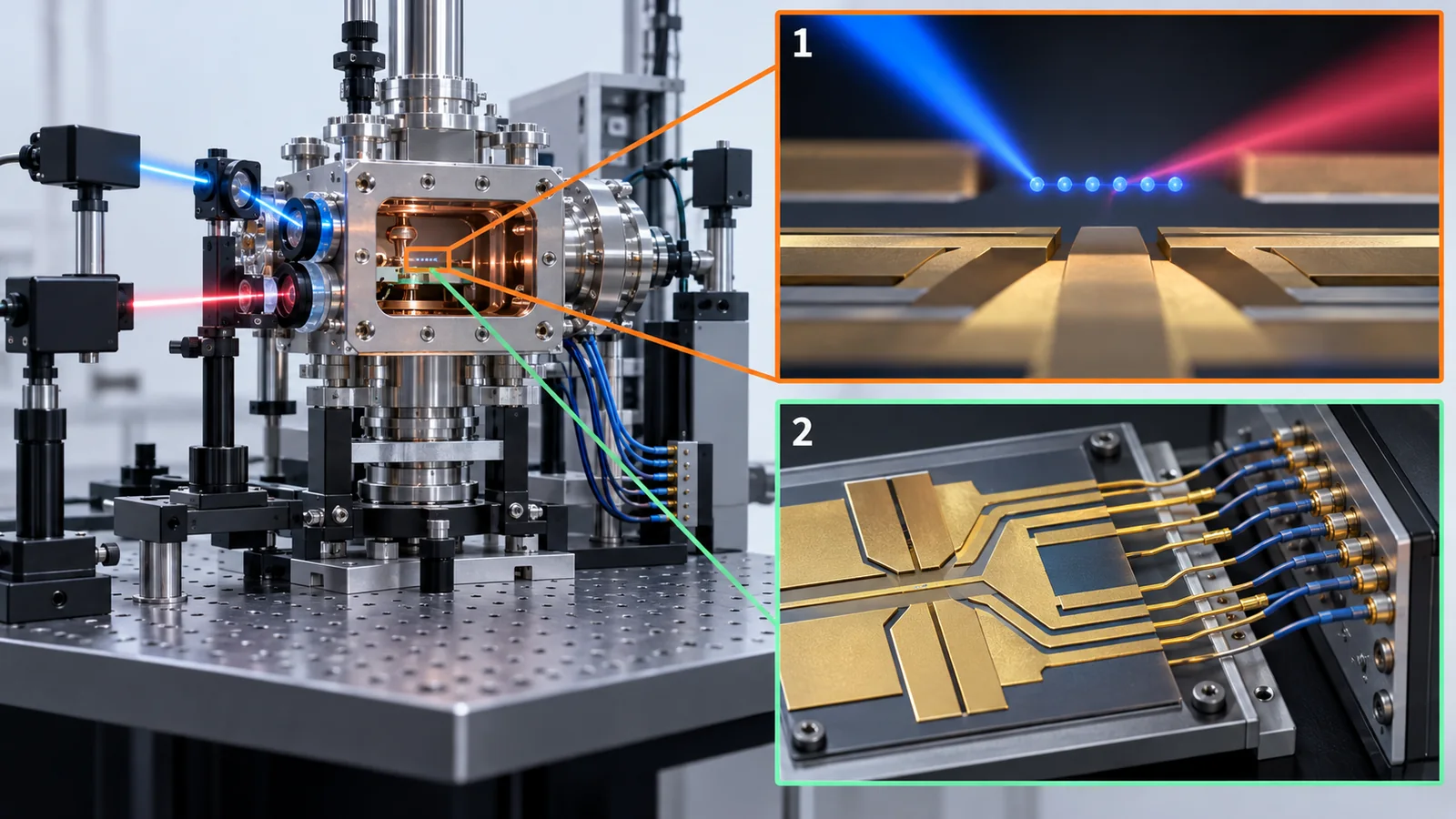
IonQ's earlier machines float ytterbium ions in a linear ion trap (a chip with about 100 electrodes made by lithography) and operate them with lasers (Reference 9). The materials and optics difficulty gathers in the precision of the electrodes that hold the ions and in the stability of the laser optics. The EQC of Oxford Ionics, which the company bought in 2025, replaces this "aim a laser" step with wiring and electronic circuits on the chip. The company says the control part of EQC can be made with standard semiconductor processes (Reference 12). A paper (Löschnauer et al., 2024) describes an experiment on a microfabricated chip with shared current-carrying traces and local tuning electrodes, in a seven-zone trap that can control up to 10 qubits (Reference 17) Sourced. In 2026 the company took over SkyWater's semiconductor foundry, so that EQC chips are made inside a subsidiary. It says it is developing a next generation (Superion 10K) that integrates CMOS (ordinary semiconductor circuitry) on the chip. If mass production is achieved, managing variation and yield (the share of good parts) will become new challenges. The official materials give no figures for these Not yet confirmed. The company's roadmap page also mentions work on "quantum-grade diamond thin films," so that devices such as quantum memories could be made at industrial scale (Reference 8).
11. Risks the company faces
| Risk | Detail | Status |
|---|---|---|
| Large operating losses continue | The operating loss was US$634 million in 2025 and US$609 million in January to June 2026. The company writes that it expects significant losses for the foreseeable future | Sourced |
| Integrating acquisitions, and dilution | Many acquisitions have been paid for in stock. The company writes that it expects to make more acquisitions and to use equity as consideration. It also offered shares and warrants in October | Sourced |
| Material weaknesses in internal control inherited from SkyWater | It took over two material weaknesses SkyWater had identified (access controls in revenue accounting, and account reconciliation at Fab 25). The company says remediation is under way but cannot be called complete until the controls have operated effectively for a sustained period | Sourced |
| The Elisity acquisition is not complete | The company notes that it depends on regulatory approvals and other conditions and may not be completed. Contractual deadline 7 January 2027 | Sourced |
| Whole-system performance of Superion 256 not published | Deliveries are in 2027. Whole-system fidelity, power use and similar figures could not be confirmed in official materials | Sourced |
| 99.99% is a prototype result | The 99.99% two-qubit gate fidelity is an estimated error from a research-lab prototype, not a value for a commercial machine | Sourced |
| The roadmap goal is very large | 2 million physical and 80,000 logical qubits by 2030 is far from today's 256. The route to it is, for now, a design (simulation) stage | Sourced |
| Progress in quantum computing is hard to see | Revenue includes non-quantum businesses and cannot be broken down. The more the company expands through acquisitions, the harder it becomes to read progress on quantum computers themselves from its results | Inference |
| DARPA funding depends on budgets | Up to US$300 million is a "potential" value, and further funding depends on future budgets | Sourced |
| Competition from other approaches | It competes with superconducting, neutral-atom, photonic and other approaches, and with other trapped-ion companies | Inference |
12. Glossary
- Ion
- An atom with an electron removed, so it carries an electric charge. Electric fields can hold it floating in space.
- Ion trap
- A device that uses electric fields to hold ions in a vacuum. The trapped ions serve as the qubits.
- EQC
- Electronic Qubit Control. A way of operating ions with electronic circuits on the chip instead of lasers.
- SPAC
- Special purpose acquisition company. It lists first and then merges with an operating company, which thereby becomes listed.
- Foundry
- A factory or company that manufactures semiconductor chips designed by others.
- CMOS
- The most common semiconductor circuit technology, used in the chips of phones and computers.
- Fidelity
- How closely an operation matches the ideal. 99.99% means about one error in 10,000 operations.
- Physical / logical qubit
- A physical qubit is the real device on the chip. A logical qubit bundles several under error correction into one that is hard to get wrong.
- Break-even
- The point where an error-corrected qubit performs better than an unprotected one.
- Decoder
- The classical-computer step in error correction that works out where errors happened from the data read out.
- qLDPC code
- A newer kind of error-correcting code that can protect many logical qubits with relatively few physical ones.
- #AQ
- IonQ's own performance metric (Algorithmic Qubits). It cannot be compared directly with other companies' metrics.
- Form 10-K / 10-Q / 424B5
- A 10-K is a U.S. listed company's annual report and a 10-Q its quarterly report; a 424B5 is the prospectus supplement used when new shares or similar securities are offered.
13. References
- IonQ, Inc. Prospectus Supplement, Form 424B5 (filed with the U.S. SEC, 14 October 2026). Business overview, completion of the SkyWater acquisition, Elisity, offering terms, internal-control risk. https://www.sec.gov/Archives/edgar/data/1824920/000119312526421074/d165327d424b5.htm
- IonQ, Inc. Form 10-Q for the quarter ended March 31, 2026 (7 May 2026). Description of the 2025 and 2026 acquisitions, SkyWater deal terms, liquidity. https://www.sec.gov/Archives/edgar/data/1824920/000119312526211876/ionq-20260331.htm
- IonQ, Inc. Form 8-K (13 October 2026). Merger agreement with Elisity (9 October 2026). https://www.sec.gov/Archives/edgar/data/1824920/000119312526419609/ionq-20261009.htm
- U.S. SEC EDGAR XBRL company facts API (IonQ, Inc., CIK 0001824920). Annual and quarterly values for revenue, R&D, operating loss and cash. https://data.sec.gov/api/xbrl/companyfacts/CIK0001824920.json
- IonQ, Inc. Form 10-K for the fiscal year ended December 31, 2024 (26 February 2025). Headcount. https://www.sec.gov/Archives/edgar/data/1824920/000095017025027722/ionq-20241231.htm
- IonQ, Inc. Form S-4 (registration statement for the SkyWater Technology acquisition, 20 March 2026). Description of SkyWater's business. https://www.sec.gov/Archives/edgar/data/1824920/000119312526117933/d88629ds4.htm
- U.S. SEC EDGAR filing list for IonQ, Inc. Filing status of the fiscal 2025 10-K (filed 25 February 2026), the 10-Q for the quarter ended June 2026 (filed 10 August 2026) and other filings. https://data.sec.gov/submissions/CIK0001824920.json
- IonQ Roadmap (the company's roadmap page). The 2030 goal. https://ionq.com/roadmap
- IonQ Our Trapped Ion Technology (technology explainer page). https://ionq.com/technology
- IonQ Compare quantum systems (product comparison page). Specifications of Forte and Tempo. https://ionq.com/quantum-systems/compare
- IonQ IonQ Tempo (product page). https://ionq.com/quantum-systems/tempo
- IonQ IonQ Launches Superion Product Line (8 September 2026). https://ionq.com/news/ionq-launches-superion-product-line-industry-leading-upgradeable-platform-designed-to-scale-manufacturable-fault-tolerant-quantum-computing
- IonQ IonQ Advances to Final Stage of DARPA's Quantum Benchmarking Initiative (7 October 2026). https://ionq.com/news/ionq-advances-to-final-stage-of-darpas-quantum-benchmarking-initiative
- IonQ IonQ Demonstrates Industry's First End-to-End Real-Time Quantum Error Decoder (22 September 2026). https://ionq.com/news/ionq-demonstrates-industrys-first-end-to-end-real-time-quantum-error-decoder
- Ye et al. Real-time decoder for a MegaQuOp quantum computer using a single CPU (arXiv:2608.25027, September 2026). https://arxiv.org/abs/2608.25027
- Hughes et al. Trapped-ion two-qubit gates with >99.99% fidelity without ground-state cooling (arXiv:2510.17286, October 2025). https://arxiv.org/abs/2510.17286
- Löschnauer et al. Scalable, high-fidelity all-electronic control of trapped-ion qubits (arXiv:2407.07694, July 2024). https://arxiv.org/abs/2407.07694
- Tripier et al. Fault-Tolerant Quantum Computing with Trapped Ions: The Walking Cat Architecture (arXiv:2604.19481, April 2026). https://arxiv.org/abs/2604.19481
- Tham et al. Breakeven demonstration of quantum low-density parity-check codes (arXiv:2606.06455, June 2026). https://arxiv.org/abs/2606.06455
- IonQ IonQ to Acquire Elisity to Accelerate Zero Trust for the Quantum Era (12 October 2026). https://ionq.com/news/ionq-to-acquire-elisity-to-accelerate-zero-trust-for-the-quantum-era
- IonQ IonQ's Superion 256 Platform Selected by Florida International University for Flagship Deployment (September 2026). https://ionq.com/news/ionqs-superion-256-platform-selected-by-florida-international-university-for-flagship-deployment
- IonQ IonQ to Advance Quantum Supercomputing by Bringing First QPU to NVIDIA Accelerated Quantum Research Center (23 September 2026). https://ionq.com/news/ionq-to-advance-quantum-supercomputing-by-bringing-first-qpu-to-nvidia-accelerated-quantum-research-center
- IonQ IonQ Demonstrates World-First Quantum Memory-Enhanced Interconnect (9 October 2026). https://ionq.com/news/ionq-demonstrates-world-first-quantum-memory-enhanced-interconnect-for-distributed-quantum-applications
- IonQ About IonQ (company page: history and founders). https://ionq.com/company
- IonQ, Inc. Form 10-K for the fiscal year ended December 31, 2025 (25 February 2026). Headcount; 2025 revenue, R&D and operating loss. https://www.sec.gov/Archives/edgar/data/1824920/000119312526071562/ionq-20251231.htm
- IonQ, Inc. Form 10-Q for the quarter ended June 30, 2026 (10 August 2026). January–June 2026 financials, liquidity, and the cash needed to complete SkyWater. https://www.sec.gov/Archives/edgar/data/1824920/000119312526341001/ionq-20260630.htm
14. Claim-to-source audit
| Claim in the text | Status | Reference |
|---|---|---|
| Headquarters, NYSE listing, listing through a SPAC merger (30 September 2021), founding of Legacy IonQ (2015) | Sourced | References 1, 24 https://www.sec.gov/Archives/edgar/data/1824920/000119312526421074/d165327d424b5.htm |
| Revenue, R&D, operating loss and cash for 2024, 2025 and January to June 2026 | Sourced | Reference 4 https://data.sec.gov/api/xbrl/companyfacts/CIK0001824920.json |
| 1,132 employees (31 December 2025); about 14% around Washington, D.C. and about 18% around Seattle | Sourced | Reference 25 https://www.sec.gov/Archives/edgar/data/1824920/000119312526071562/ionq-20251231.htm |
| Cash and similar holdings on 30 June 2026, and the cash needed to complete SkyWater (about US$1,056.4 million) | Sourced | Reference 26 https://www.sec.gov/Archives/edgar/data/1824920/000119312526341001/ionq-20260630.htm |
| The six acquisitions of 2025 and their total price of US$2.659 billion (about US$2.54 billion in stock) | Sourced | Reference 2 https://www.sec.gov/Archives/edgar/data/1824920/000119312526211876/ionq-20260331.htm |
| The acquisitions of Skyloom and Seed Innovations (January 2026); the SkyWater agreement and its terms | Sourced | Reference 2 https://www.sec.gov/Archives/edgar/data/1824920/000119312526211876/ionq-20260331.htm |
| Completion of the SkyWater acquisition (31 July 2026), the two inherited material weaknesses, the offering terms (net proceeds of about US$1.99 billion) | Sourced | Reference 1 https://www.sec.gov/Archives/edgar/data/1824920/000119312526421074/d165327d424b5.htm |
| SkyWater's business (pure-play foundry, Trusted Foundry accreditation, factories in three states) | Sourced | Reference 6 https://www.sec.gov/Archives/edgar/data/1824920/000119312526117933/d88629ds4.htm |
| The Elisity merger agreement (9 October 2026, US$1.15 billion, up to US$150 million more, contractual deadline 7 January 2027) | Sourced | Reference 3 https://www.sec.gov/Archives/edgar/data/1824920/000119312526419609/ionq-20261009.htm |
| Elisity's business and the purpose of the acquisition | Sourced | Reference 20 https://ionq.com/news/ionq-to-acquire-elisity-to-accelerate-zero-trust-for-the-quantum-era |
| Filing dates of the fiscal 2025 10-K and the 10-Q for the quarter ended June 2026 | Sourced | Reference 7 https://data.sec.gov/submissions/CIK0001824920.json |
| Ytterbium ions, a linear trap of about 100 electrodes, the 2030 goal (2 million physical, 80,000 logical) | Sourced | References 9, 8 https://ionq.com/technology |
| 36 qubits and the fidelities of Forte and Forte Enterprise; 100 qubits, #AQ 64 and "Late 2026" for Tempo | Sourced | References 10, 11 https://ionq.com/quantum-systems/compare |
| Announcement of Superion 256 (8 September 2026), EQC, 2027 deliveries, Superion 10K, Walking Cat | Sourced | Reference 12 https://ionq.com/news/ionq-launches-superion-product-line-industry-leading-upgradeable-platform-designed-to-scale-manufacturable-fault-tolerant-quantum-computing |
| The DARPA QBI Stage C contract (up to US$300 million, through 2029, budget-dependent) | Sourced | Reference 13 https://ionq.com/news/ionq-advances-to-final-stage-of-darpas-quantum-benchmarking-initiative |
| The real-time decoder (benchmarks equivalent to up to 408 logical qubits, a single CPU) | Sourced | References 14, 15 https://ionq.com/news/ionq-demonstrates-industrys-first-end-to-end-real-time-quantum-error-decoder |
| 99.99% two-qubit gate fidelity (estimated error 8.4(7)×10-5); the company calls it a result from a research-lab prototype | Sourced | Reference 16 https://arxiv.org/abs/2510.17286 |
| The all-electronic control experiment (seven zones, up to 10 qubits, single-qubit 99.99916%, entangled two-qubit state 99.97%) | Sourced | Reference 17 https://arxiv.org/abs/2407.07694 |
| The Walking Cat blueprint (a design proposal based on simulations) | Sourced | Reference 18 https://arxiv.org/abs/2604.19481 |
| The near-break-even qLDPC experiment (18 physical, 4 logical, preprint) | Sourced | Reference 19 https://arxiv.org/abs/2606.06455 |
| Florida International University's purchase of a Superion 256 (installation expected in late 2027) | Sourced | Reference 21 https://ionq.com/news/ionqs-superion-256-platform-selected-by-florida-international-university-for-flagship-deployment |
| Placing a Superion 256 at NVIDIA's NVAQC | Sourced | Reference 22 https://ionq.com/news/ionq-to-advance-quantum-supercomputing-by-bringing-first-qpu-to-nvidia-accelerated-quantum-research-center |
| The optical interconnect between an ion qubit and a solid-state memory (more than 1,000 entanglement events per second) | Sourced | Reference 23 https://ionq.com/news/ionq-demonstrates-world-first-quantum-memory-enhanced-interconnect-for-distributed-quantum-applications |
| The founders and the licences from the University of Maryland and Duke University | Sourced | Reference 24 https://ionq.com/company |
| The four-type classification of quantum computing companies, and IonQ's primary and secondary types | Our calculation | Our own grouping in this article; company names are examples from this series |
| The "up to 80%" estimate on the Tempo page is not used | Our calculation | Our own policy: market estimates without a stated source are not used |
| Whole-system performance and price of Superion 256, the latest headcount, revenue of the quantum unit | Not yet confirmed | Not stated in official materials or could not be confirmed. This article does not estimate them (our own policy) |
| Superion 10K, the 2030 goal (2 million and 80,000), completion of the Elisity deal | Not yet confirmed | Company targets and plans; this article treats them as an outlook and keeps them apart from achieved facts |
| When Tempo was actually delivered to customers | Not yet confirmed | The materials differ and we could not confirm it; this article does not assume it (our note) |
| The company is moving its competitive ground to chips that can be mass-produced | Inference | Our reading of the reasons given for the SkyWater purchase and of the Superion announcement (our own interpretation) |
| It wants to be a company bundling communications, sensing and security | Inference | Our reading of who it acquired in 2025 and 2026 (our own interpretation) |
| It uses GPU hybrids and national verification as support for its credibility | Inference | Our reading of the NVAQC placement and QBI Stage C (our own interpretation) |
| Progress in quantum computing may become harder to see in the results | Inference | Our reading of the fact that revenue includes non-quantum businesses (our own interpretation) |
| Competition from other approaches and other trapped-ion companies | Inference | Our own general interpretation |
Last updated: 16 October 2026 / Troy Technical
The figures in this article rest on statutory filings submitted by IonQ, Inc. to the U.S. Securities and Exchange Commission, the SEC's structured data, and the company's official announcements and papers. Device performance figures are the company's stated values, given with their measurement conditions. Market-research estimates are not used. Items marked "Inference" are our own readings of the primary sources, not statements by the company. This article is not investment advice.