COMPANY PROFILE / QUANTUM COMPUTING
IQM Quantum Computers
A Finnish company that sells superconducting quantum computers installed at the customer's site, listed on Nasdaq and Nasdaq Helsinki in July 2026
IQM is a Finnish company that builds its qubits, the basic units of quantum computation, from superconducting circuits. It was founded in 2018 by researchers from Aalto University in Espoo, Finland, and its core business is delivering a complete quantum computer that the customer owns and operates, at supercomputing centres, universities and research institutes. As of 30 June 2026 the company says it has sold 26 systems and delivered 17. On 1 July 2026 it completed a merger with a U.S. special purpose acquisition company (SPAC), Real Asset Acquisition Corp., and trading began on Nasdaq in the U.S. (ticker IQMX) on 2 July and on Nasdaq Helsinki on 3 July. But the business is still small: revenue for the year to December 2025 was EUR 31.3 million and the net loss EUR 54.4 million, and 98.0% of first-half 2026 revenue came from public-sector customers. This profile sets out what the company builds, whom it sells to and what plans it states, as far as the filings made with the U.S. SEC and its official announcements allow.
- IQM in 30 seconds, and where it stands in quantum computing
- The logo and how the name is written
- Where the company sits in the quantum computing field
- Scale
- Resources committed to quantum computing
- What it has done so far
- What comes next (all of it plans)
- What the company is aiming for in quantum computing
- Map of quantum computing partnerships
- Technology, products and services
- The risks this company carries
- Glossary, references and claim-to-source audit
1. IQM in 30 seconds, and where it stands in quantum computing
(Oyj is a Finnish company form)Founded in Finland in 2018, from research at Aalto University and VTT (the Technical Research Centre of Finland)
Nasdaq: IQMX and othersListed on Nasdaq (in the U.S., as American depositary shares) and on Nasdaq Helsinki in July 2026
Radiance (about 20 to 150 qubits)Quantum computers installed at the customer's site. The next generation, Halocene (more than 150 qubits), is in development
Even among quantum computing firms, IQM is a company that puts weight on selling the whole hardware system for the customer to own. Rather than renting time on the cloud, supercomputing centres and similar customers install it in their own facilities and run it Sourced. As a result, most revenue (98.0% in the first half of 2026) is from public-sector customers (universities, national laboratories, joint EU procurements and so on), and it is concentrated in a few customers (in the first half of 2026 two customers together made up 83% of revenue, 43% plus 40% Our calculation). IQM has not yet claimed to have achieved "quantum advantage", and its prospectus itself says success depends on achieving it. The error-correction plans (Halocene H4 in 2027 and H5 in 2029) are company plans Not yet confirmed. This profile keeps that distinction to the end.
Qubit: the smallest unit of quantum computation. It can hold a blend of 0 and 1 at once, but it is fragile: a little heat or electrical noise makes it err.
Physical and logical qubits: the qubits actually on the device are "physical". A sturdier virtual "logical" qubit is made by bundling many physical qubits so errors can be fixed. The two are counted very differently, so this profile always says which one it means.
Gate accuracy (fidelity): the probability that an operation on qubits is performed correctly. "Two-qubit gate accuracy of 99.9%" means it goes wrong about once in 1,000 tries. A value on a small test chip and a value for a whole system are different things, so the conditions must always be checked.
On-premises: the customer places the equipment in its own facility and owns and operates it, instead of renting through the cloud. It is the same idea as keeping a server in your own data centre.
2. The logo and how the name is written

A note on naming: the company is IQM Quantum Computers. As a legal entity it is IQM Quantum Computers Oyj (its English announcements also write Plc), a Finnish company form. In the U.S. its shares trade as American depositary shares (ADS), each representing one share. The logo is the one shown on IQM's official website.
Easily confused: Spark (5 qubits), Radiance (about 20 to 150 qubits) and Halocene (the next generation) are product names, and Resonance is the name of the cloud service. Crystal, Star and Constellation are names for the way qubits are connected on a chip (layouts).
Official site: https://iqm.tech/3. Where the company sits in the quantum computing field
Quantum computing companies are easiest to sort by how they build a qubit, which gives four groups. Superconducting means "cool an electrical circuit until it behaves as a qubit". Trapped ions and neutral atoms means "use individual atoms themselves as qubits". Photonic, silicon and other approaches means "use particles of light, or the spin of electrons in silicon". Software, cloud and ecosystem companies do not build qubits; they make quantum computers easier to use.
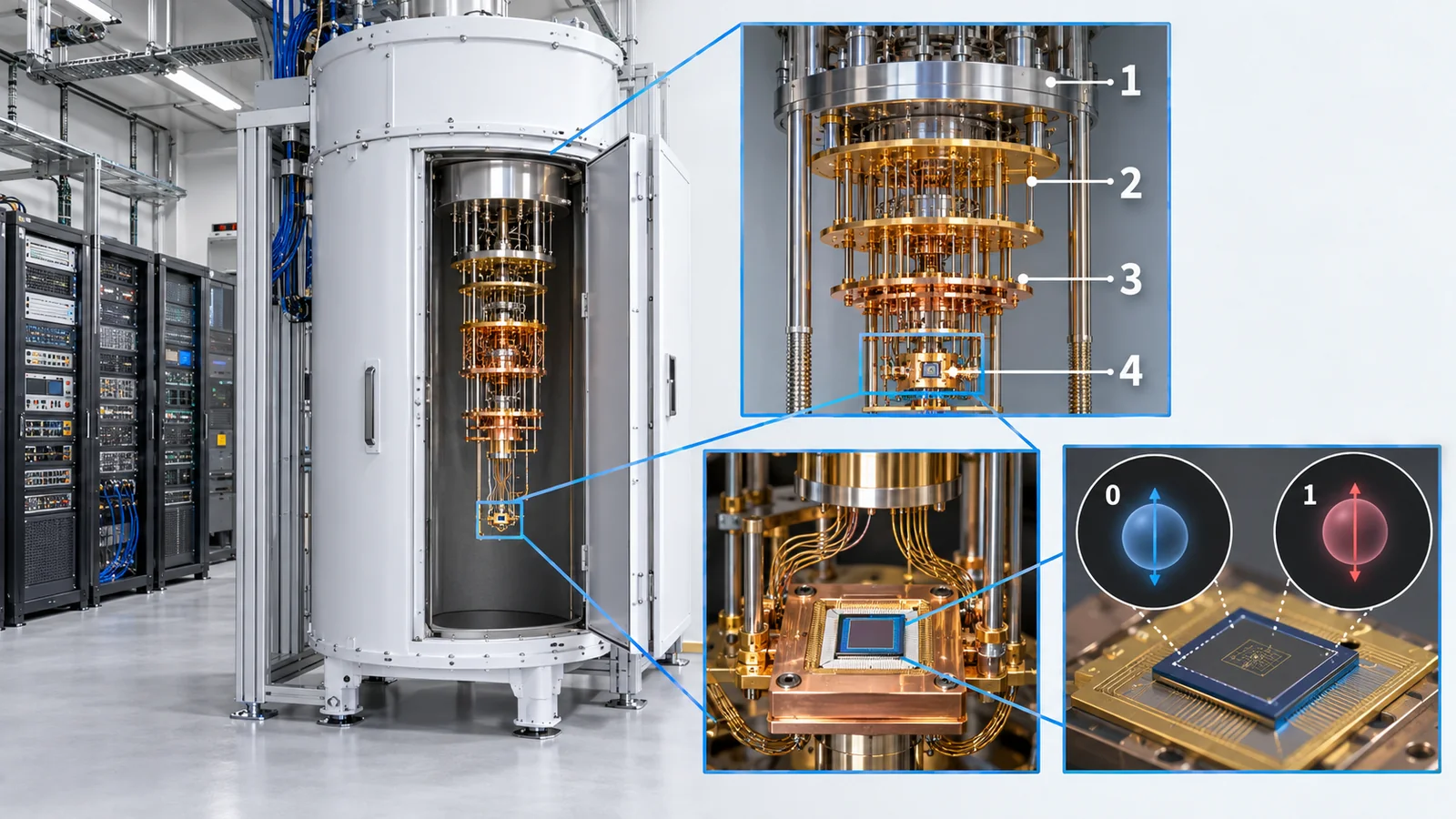
Some metals, cooled far enough, lose all electrical resistance. This is called superconductivity. IQM builds small electrical circuits from such metals (a type called the transmon) on silicon wafers, cools them to very low temperatures and drives them with microwaves Sourced. The prospectus lists as advantages that semiconductor manufacturing techniques can be used and that gates (operations on qubits) are fast (the company's view). The difficulties are the size of the cooling equipment, the number of wires, and keeping accuracy as the qubit count grows. See also our explainers on superconducting qubits and on cryogenics and control in this series.
4. Scale
IQM is a company of more than 400 people that listed only in July 2026. The table gives figures from the prospectus and the announcement of 4 August 2026 Sourced.
| Measure (EUR million) | Year to Dec 2024 | Year to Dec 2025 | H1 2025 (Jan to Jun) | H1 2026 (Jan to Jun) |
|---|---|---|---|---|
| Revenue | 16.4 | 31.3 | 6.0 | 8.9 |
| Research and development expense | 42.4 | 50.7 | 25.7 | 34.0 |
| Operating loss | 50.0 | 58.1 | 31.6 | 60.5 |
| Net loss | 54.1 | 54.4 | 34.6 | 74.9 |
| Employees | More than 400, of more than 55 nationalities (company announcement, August 2026). Headquarters in Espoo, Finland, with a major site in Munich, Germany | |||
| Cash | 30 June 2026: EUR 113.4 million. After the listing closed, 2 July 2026: EUR 309.4 million (company announcement; the company says this funds it until about the second quarter of 2028) | |||
The company explains that the first-half 2026 operating loss of EUR 60.5 million is mainly due to one-off costs of the listing (the SPAC merger and the dual listing) plus higher R&D and headcount. Keep this in mind when reading the size of the underlying loss. The accumulated deficit as of 30 June 2026 was EUR 307.1 million (EUR 232.2 million at the end of 2025). IQM's revenue figures are under IFRS (International Financial Reporting Standards); the order backlog (confirmed orders not yet recognised as revenue) is the company's own measure, not an IFRS measure. The company reports a backlog of EUR 67.3 million at the start of 2026, EUR 69.1 million at 30 June, and more than EUR 102.1 million on 3 August (after adding EUR 33.0 million for the LUMI AI Factory).
5. Resources committed to quantum computing
IQM is a quantum specialist, so its company-wide figures are its quantum figures. The table sorts the four points by whether they could be confirmed.
| Type of resource | What was confirmed (checked 16 October 2026) | Status |
|---|---|---|
| People | More than 400 employees (of more than 55 nationalities). 170 patent families (339 applications, 130 issued) as of 31 July 2026. In the first half of 2026 it strengthened its management team (including a CTO and a COO) and its board (company announcement) | Sourced |
| Money (spending) | R&D expense was EUR 50.7 million in 2025 (EUR 42.4 million in 2024). It announced more than EUR 40 million to expand its fab (doubling cleanroom capacity so as to allow up to 30 systems a year, a plan) | Sourced (the fab expansion is a plan) |
| Money (funding) | Net proceeds from share issues to date are EUR 489.5 million (end of June 2026). First tranche of Series B in March 2025 (EUR 282.2 million). With the SPAC merger in July 2026, cash rose to EUR 309.4 million after listing (a PIPE, an extra investment at listing, of about US$145.5 million). In December 2025 it set up a credit facility of up to EUR 50 million (Kreos Capital) and drew EUR 5 million, repaid in full on 31 July 2026. In 2022 it received a EUR 35 million convertible loan from the European Investment Bank (EIB), repaid in 2025 | Sourced |
| Outside investments, acquisitions and joint ventures | No investment in or acquisition of another company by IQM was found in the prospectus. It set up subsidiaries in Japan and Italy in October 2025 (and has others in Germany, France, Poland, Spain, Singapore, the U.S., the U.K. and elsewhere). The SPAC merger (Real Asset Acquisition Corp.), for its own listing, closed on 1 July 2026 | Sourced |
| Public funding and government ties | (1) 98.0% of first-half 2026 revenue was from public-sector customers, including projects funded by the EuroHPC Joint Undertaking, the EU's joint supercomputing procurement scheme. (2) LUMI-IQ is jointly funded by EuroHPC and Finland, Czechia, Norway and Poland. (3) The U.S. Department of Energy's Oak Ridge National Laboratory (ORNL) bought a system (June 2026). (4) IQM is not listed in DARPA's official lists of Quantum Benchmarking Initiative (QBI) participants (Stage A in April 2025, Stage B in November 2025, and the list as of 8 October 2026) | Sourced |
| Universities and research institutes | VTT (Finland) and LRZ (the Leibniz Supercomputing Centre in Germany): cooperation in superconducting chip production. CSC (Finland): operator of the LUMI supercomputer. The Technical University of Munich, CEA Leti, Fraunhofer, the University of California, Berkeley, Singapore's IMRE, and the EU Quantum Flagship | Sourced |
| Manufacturing and facilities | A quantum chip fab in Espoo, Finland (it fabricates, packages and 3D-integrates chips on 200 mm silicon wafers). The company says it can build about 20 on-premises machines a year (roadmap page) | Sourced (company's description) |
Status of the main devices (checked 16 October 2026; all from IQM's prospectus, filings and official announcements)
Qubit counts are split into "physical" and "logical". Accuracies are values IQM gave under stated conditions, and a small test chip is not the same as a whole system. They cannot be lined up against other approaches or companies to rank them.
| Device | Approach | Qubits | Typical accuracy or performance (company's stated value, with conditions) | Stage | Date and source |
|---|---|---|---|---|---|
| IQM Spark | Superconducting | 5 physical | For education and research. The company says it is priced so universities can use it for teaching and early experiments | On sale (on-premises) | Prospectus (August 2026) |
| IQM Radiance | Superconducting | About 20 to 150 physical (depends on configuration; upgradeable) | For supercomputing centres. ORNL's "Pathfinder" is a 20-qubit machine, operational on 16 June 2026. A 20-qubit machine was installed at LRZ in 2024 | Sold and delivered (on-premises) | Prospectus; ORNL announcement |
| Crystal layout | Superconducting (square lattice) | Depends on the model | Two-qubit gate accuracy of 99.9% in test systems (company's statement). A maximum of 99.95% (CZ gate) on a two-qubit test chip in 2025. The prospectus states 99.93% in an internal demonstration | Demonstrated (test chips and test systems) | Roadmap page; prospectus |
| Star layout (IQM Star 24) | Superconducting | 24 physical | A layout that links many qubits through a resonator, giving high connectivity. Available on Resonance (the cloud) | Offered on the cloud | Roadmap page |
| IQM Halocene (H4) | Superconducting (with error-correction features) | 150 physical | The first LUMI-IQ installation (2027). It has early error-correction capability. A plan to upgrade in 2028 to lower logical errors and support real-time error correction | Planned (ordered; 2027) | Announcements of 8 July and 10 September 2026 |
| IQM Halocene (H5) | Superconducting (towards fault tolerance) | Up to 9 logical (distance-3 surface and colour codes) | The final stage of LUMI-IQ (2029). Real-time feedback to sustain logical qubits and run operations between them (lattice surgery, T-gate teleportation). The company says it can also encode logical qubits of distance 11 (surface code) and distance 9 (colour code) | Planned (2029) | Announcement of 10 September 2026 |
6. What it has done so far
IQM's history is easiest to follow as four threads: "deliver equipment to customers' sites", "make it in our own fab", "advance error-correction designs" and "list to raise funds".
| When | What happened | Why it matters |
|---|---|---|
| 2018 | Founded as a company that grew out of Aalto University in Espoo, Finland, and also from research at VTT (the Technical Research Centre of Finland) (prospectus) | Focused on superconducting qubits from the start. The company says its early work covered qubit reset, readout and thermal management |
| 9 February 2022 | Signed a EUR 35 million convertible loan agreement with the European Investment Bank (EIB), in two tranches of EUR 25 million and EUR 10 million | Funding from a public financial institution. The prospectus says it was repaid in 2025 |
| 2024 | Installed a 20-qubit Radiance at the Leibniz Supercomputing Centre (LRZ, Germany), set up so quantum jobs can be booked through the supercomputer's scheduler | An example of "loose" integration of a quantum computer into HPC (supercomputing) |
| 2025 | The company announced a CZ gate accuracy of up to 99.95% on a two-qubit test chip | A value on a small test chip, not for a whole large system |
| 26 March 2025 | Closed the first tranche of its Series B (EUR 282.2 million in total) | The last large private round before listing |
| Late 2025 | Delivered to CINECA in Italy and to universities in Finland, Germany and Poland. Set up subsidiaries in Japan and Italy (October 2025) | A widening set of delivery sites and sales bases |
| 23 December 2025 | Credit agreement of up to EUR 50 million with Kreos Capital. It drew EUR 5 million in January 2026 and repaid it in full on 31 July 2026 | Bridge funding until listing |
| 22 February 2026 | Signed a merger agreement with the SPAC Real Asset Acquisition Corp. | The route it chose to a U.S. listing |
| 16 June 2026 | Delivered "Pathfinder", a 20-qubit Radiance, to the U.S. Department of Energy's Oak Ridge National Laboratory (ORNL), IQM's first installation in the U.S. | ORNL's first commercially procured quantum computer. ORNL owns and operates it |
| 1 to 3 July 2026 | Completed the merger (1 July). Trading in ADSs began on Nasdaq on 2 July and in ordinary shares on Nasdaq Helsinki on 3 July | The company says it is the first European quantum computing company listed on Nasdaq |
| 8 July 2026 | The LUMI AI Factory (CSC, Finland) selected IQM to deliver Halocene H4 (150 qubits) | EUR 33.0 million was added to the backlog. Co-funded by EuroHPC and four countries |
| 4 August 2026 | Reported its first results as a listed company (H1 2026 revenue EUR 8.9 million) and gave full-year 2026 guidance for the first time | See chapter 7 |
| 10 September 2026 | Announced a three-step upgrade path for LUMI-IQ (2027, 2028 and 2029) | A plan to expand step by step to a machine that handles logical qubits (chapter 7) |
Using a quantum computer on the cloud is like "renting a company's server". The on-premises route IQM stresses is like "putting the server in your own data centre". IQM's announcements say the customer controls not only ownership and operation but also the intellectual property. Supercomputing centres want to plug a quantum computer into their existing supercomputers and AI infrastructure, which gives them a reason to choose on-site installation. The flip side is that each unit needs installation, maintenance and upgrades, and revenue tends to be concentrated in a few large projects (chapter 11).
7. What comes next (all of it plans)
Everything below is a plan or outlook stated in IQM's filings and announcements. None had been achieved as of the check date (16 October 2026) Not yet confirmed.
New orders of EUR 65 million to 75 millionFull-year targets announced on 4 August 2026. Not a guarantee
Halocene H4 (150 physical qubits)With early error-correction features. At CSC in Kajaani, Finland
Up to 1 million qubitsThe company's long-term goal. The LUMI-IQ announcement says it is in line with a roadmap to fault tolerance by 2030
Against the 2026 revenue target (EUR 42 million to 47 million), first-half revenue was EUR 8.9 million. To meet the target, second-half revenue of EUR 33.1 million to 38.1 million would be needed Our calculation (42 minus 8.9, and 47 minus 8.9). The company says its order backlog (EUR 69.1 million at the end of June, more than EUR 102.1 million on 3 August) supports the revenue outlook. This calculation is not an assessment of whether the outlook is realistic; it only shows that the plan is weighted towards the second half. The company also announced on 5 October that it will publish its results for the third quarter (January to September 2026) on 5 November 2026.
IQM has not yet claimed to have achieved "quantum advantage". Its prospectus says success depends on achieving quantum advantage and demonstrating practical use cases. On error correction, the company writes that qLDPC codes can cut the number of physical qubits to about one-tenth of those for the surface code (prospectus), and says that in the first half of 2026 it announced "tile codes" and "barbell codes" tailored to IQM's qubit layout (Constellation). These are company claims, and we found no third-party verification in the materials checked. Other companies (for example IBM) make similar ratios for different codes, and this profile does not compare them to rank them Not yet confirmed.
IQM's roadmap page carries market-size forecasts (such as EUR 72 billion by 2035). They are not sourced, so this profile does not use them.
8. What the company is aiming for in quantum computing
This part includes things the company has not said directly. They are written as inferences from what the primary sources allow, with the evidence alongside.
| What can be read from the record | Primary evidence | Status |
|---|---|---|
| It sells a "quantum computer you can own", in step with Europe's push for technological independence (sovereignty) | The prospectus says it benefited from Europe's strong push for technological sovereignty. The CEO says it aims to be the partner of choice for sovereign and enterprise compute infrastructure, and stresses that customers get ownership and control | Sourced (company statements); the aim is an inference |
| It raises error-correction efficiency with qLDPC codes and a layout that tiles star-shaped cells (Constellation) | The roadmap page and the August 2026 announcement explain that combining the Crystal and Star layouts is meant to raise error-correction efficiency | Sourced (company policy) |
| Near-term revenue is large public-sector projects, with enterprise customers still being widened | 98.0% of first-half revenue was public-sector. On the other side it announced a train-scheduling experiment with Deutsche Bahn and links with NVIDIA, HPE and AWS | Inference |
| It is in a hurry to expand the fab and raise deliveries to turn the backlog into revenue | A fab expansion of more than EUR 40 million, an increase to up to 30 systems a year, and at the end of June 26 sold, 17 delivered and 8 in production | Inference |
| It makes integration with HPC (supercomputers) and AI its axis of differentiation | AI-driven qubit calibration with NVIDIA, integration with HPE's Cray, and the tie-up with the LUMI AI Factory | Sourced (partnerships announced); the axis is an inference |
As of 30 June 2026 IQM had sold 26 systems and delivered 17, and said it had 8 more in production. So 9 of the systems sold had not yet been delivered (26 minus 17 equals 9 Our calculation), and the company says separately that it is producing "a further eight" (we could not confirm the breakdown). In the same period it announced more than EUR 40 million to expand its fab (doubling cleanroom capacity). Revenue is recognised as systems are delivered, so the pace of building and delivery sets how fast revenue grows. The 2026 revenue target (EUR 33.1 million to 38.1 million in the second half) also depends on how that goes. Our reading is that the company lists "expanding manufacturing capacity" first because of this link Not yet confirmed.
9. Map of quantum computing partnerships
10. Technology, products and services
IQM's offering falls into five lines: "a complete quantum computer (on-premises)", "cloud", "software", "services such as maintenance and training", and "joint development".
| Layer | What it is (checked 16 October 2026) | Status |
|---|---|---|
| Complete quantum computer (on-premises) | Spark (5 qubits, for education and research) and Radiance (about 20 to 150 qubits, upgradeable, for supercomputing centres). Installed at the customer's site, which owns and operates it. EUR 30.6 million of 2025 revenue came from system sales | On sale |
| Next-generation machine | Halocene (more than 150 qubits, designed with error-correction features). The first LUMI-IQ installation (H4) is in 2027 | In development (ordered) |
| Cloud | IQM Resonance (its own cloud, with pulse-level access and integrated error mitigation) and AWS's Amazon Braket. Cloud usage was EUR 0.3 million of 2025 revenue | Available |
| Software | A software development kit (SDK) for HPC centres, the open-source Qrisp (co-developed with research partners) and others | Available |
| Services and joint development | Training, maintenance and technical support. Joint development (EUR 0.3 million of 2025 revenue, against EUR 1.4 million the year before) | Offered |
| Chip design and fabrication | Chips are designed with its own EDA software and made at its Espoo fab (200 mm silicon wafers). It plans to expand its cleanrooms | In operation; expansion planned |
IQM says it makes its quantum chips at its own fab in Espoo, Finland, from 200 mm silicon wafers, then packages them and integrates them in three dimensions into quantum processors Sourced. A superconducting qubit is made by drawing a circuit in superconducting thin films on silicon. To add qubits, the wiring on the chip has to be layered and several chips stacked and bonded. IQM says its "Star" layout uses a resonator (a small circuit that stores electrical oscillation) to link many qubits, and that "Constellation" tiles Star cells in a lattice (company's description). This is a design choice about how to route wiring between qubits, and it bears both on the number of wires that must be run into the refrigerator and on how crowded the wiring on the chip becomes.
On the manufacturing side, the company announced an investment of more than EUR 40 million to double the cleanroom capacity in Espoo, and the prospectus says it has help from VTT and LRZ in chip production. The specific superconducting materials and substrates used for its qubits are not stated in the prospectus and announcements we checked, and this profile does not specify them Not yet confirmed. On the materials and interface quality that set gate accuracy (99.95% on a small test chip, 99.9% in systems), IQM gives only general descriptions, and we could not confirm specific figures or methods.
11. The risks this company carries
What follows is fact drawn from the prospectus and filings, plus this profile's own reading. It is not an assessment of any company and not an input for investment decisions.
| Risk | Detail | Status |
|---|---|---|
| Dependence on the public sector | 98.0% of first-half 2026 revenue (99.5% in the first half of 2025) was from the public sector. The prospectus says that losing government or public-sector contracts, or a change in procurement or fiscal policy, could have a material effect. Many projects come through joint EU procurement (EuroHPC) | Sourced |
| Concentration in a few customers | In 2025 one customer was 29% of revenue, a second 20% and a third 19%. In the first half of 2026 one customer was 43% and a second 40%. A shift in delivery timing can change revenue sharply | Sourced |
| Losses and funding | The 2025 net loss was EUR 54.4 million and the first-half 2026 net loss EUR 74.9 million (including listing costs). The accumulated deficit at the end of June 2026 was EUR 307.1 million. The company says cash of EUR 309.4 million (after listing) funds it until about the second quarter of 2028, but the prospectus says additional financing may be needed | Sourced |
| Revenue weighted to the second half | To meet the 2026 revenue target, EUR 33.1 million to 38.1 million is needed in the second half (our calculation). Delays in building and delivery could move the outlook | Our calculation; achievement is Not yet confirmed |
| Reaching the roadmap | Halocene H4 (2027) and H5 (2029), error-correction demonstrators (2027 to 2028) and fault-tolerant machines (2030 onwards) are all company plans. The accuracy target (above 99.94%) must be met on large systems, not on small test chips | Not yet confirmed |
| Sourcing of parts | The prospectus says the company relies on third-party suppliers for components and does not have long-term supply agreements with all of them (dilution refrigerators, microwave components, CPUs, GPUs, FPGAs and so on) | Sourced |
| Competition and other approaches | The prospectus itself names competition from companies using other approaches, and from North American and Asian firms with larger funding pools, as a risk. This profile does not rank approaches or companies against each other | Sourced (the company's own statement) |
| Being a newly listed company | In the U.S. it reports as a foreign private issuer (disclosing through Forms 6-K and the like rather than quarterly Forms 10-Q). It listed only in July 2026 and has little track record of post-listing disclosure | Sourced |
| Outside verification | IQM does not appear in DARPA's official lists of QBI participants (Stage A in April 2025, Stage B in November 2025, and the list as of 8 October 2026). DARPA says QBI is not a competition between companies, so whether a company is listed cannot be used to judge its technology | Sourced |
12. Glossary
- Qubit
- The smallest unit of quantum computation. It can hold a blend of 0 and 1, but is fragile.
- Physical and logical qubits
- Physical qubits are those actually on the device. A logical qubit is a sturdier virtual qubit made by bundling many physical qubits for error correction.
- Superconducting qubit
- A qubit made from a circuit of metal that has zero electrical resistance at very low temperatures. IBM and Google also use it.
- On-premises
- The customer places the equipment in its own facility and owns and operates it, instead of renting through the cloud.
- Gate accuracy (fidelity)
- The probability that an operation on qubits is performed correctly. 99.9% means it goes wrong about once in 1,000 tries. A small test chip and a whole system differ.
- NISQ
- Noisy intermediate-scale quantum: machines of moderate size that do not use error correction. Most of today's devices are here.
- Error correction / qLDPC codes
- A scheme that detects and fixes errors with many qubits. qLDPC codes can protect data with fewer qubits than the surface code but need links between distant qubits.
- Surface code / colour code
- Representative error-correcting codes. The larger the code "distance", the more errors it can fix.
- Quantum advantage
- A quantum computer giving a better result on some task than the best classical method. IQM does not claim to have achieved it.
- EuroHPC
- The EU's framework for joint procurement of supercomputers (EuroHPC Joint Undertaking). It funds part of LUMI-IQ.
- SPAC
- A special purpose acquisition company: a company that lists first and later merges with an operating business to bring it to the market. IQM merged with Real Asset Acquisition Corp.
- ADS
- American depositary share: a form that lets a foreign company's shares trade in the U.S. One IQM ADS represents one share.
- Form 6-K / 20-F
- The current report and the annual report that a foreign private issuer files with the U.S. SEC.
- DARPA QBI
- The Quantum Benchmarking Initiative of the U.S. Defense Advanced Research Projects Agency. It tests in stages whether a useful fault-tolerant quantum computer can be built by 2033.
- IFRS
- International Financial Reporting Standards, the basis of IQM's financial statements.
13. References
- IQM Quantum Computers Prospectus (Form 424B3, 26 August 2026). Business description, products, finances, customers, risk factors, patents and the listing. https://www.sec.gov/Archives/edgar/data/2113060/000119312526368699/d36013d424b3.htm
- IQM Quantum Computers Form 6-K (filed 4 August 2026). Filing of the first-half and second-quarter 2026 results. https://www.sec.gov/Archives/edgar/data/2113060/000119312526331538/iqmx_6-k_q2_aug_2026_new.htm
- IQM Quantum Computers IQM Quantum Computers Reports First Earnings as Public Company (Exhibit 99.1 to the Form 6-K, 4 August 2026). Order backlog, full-year outlook and first-half highlights. https://www.sec.gov/Archives/edgar/data/2113060/000119312526331538/iqmx-ex99_1.htm
- IQM Quantum Computers Half year financial report (Exhibit 99.2 to the Form 6-K, 4 August 2026). First-half finances, CEO review and liquidity. https://www.sec.gov/Archives/edgar/data/2113060/000119312526331538/iqmx-ex99_2.htm
- IQM Quantum Computers Form 6-K (filed 1 July 2026). Completion of the SPAC merger and the start of trading on Nasdaq and Nasdaq Helsinki. https://www.sec.gov/Archives/edgar/data/2113060/000119312526292513/d61136d6k.htm
- IQM Quantum Computers Form 6-K (filed 5 October 2026). Notice that the January to September 2026 interim report will be published on 5 November 2026. https://www.sec.gov/Archives/edgar/data/2113060/000119312526414493/d177718d6k.htm
- IQM IQM Deploys Its First U.S. Quantum Computer at Oak Ridge National Laboratory (official announcement, 16 June 2026). https://iqm.tech/press-releases/iqm-deploys-its-first-u-s-quantum-computer-at-oak-ridge-national-laboratory/
- IQM LUMI AI Factory selects IQM to deploy advanced quantum computer (official announcement, 8 July 2026). https://iqm.tech/press-releases/lumi-ai-factory-selects-iqm-to-deploy-advanced-quantum-computer-accelerating-hybrid-hpc-and-ai-development/
- IQM LUMI AI Factory selects IQM's staged path to Europe's first superconducting quantum computer with logical qubits (official announcement, 10 September 2026). https://iqm.tech/press-releases/lumi-ai-factory-selects-iqms-staged-path-to-europes-first-superconducting-quantum-computer-with-logical-qubits/
- IQM IQM development roadmap (page on the official website). Layouts (Crystal, Star, Constellation), accuracy targets and technology milestones. https://meetiqm.com/technology/roadmap/
- DARPA Quantum Benchmarking Initiative (QBI) official page. List of participants as of 8 October 2026. https://www.darpa.mil/research/programs/quantum-benchmarking-initiative
- DARPA DARPA eyes companies targeting industrially useful quantum computers (3 April 2025; list of QBI Stage A companies). https://www.darpa.mil/news/2025/companies-targeting-quantum-computers
- DARPA Stage B selection (the 11 companies as of 6 November 2025). https://www.darpa.mil/research/programs/quantum-benchmarking-initiative/stage-b-selection
- IQM IQM official website (source of the logo). https://iqm.tech/
14. Claim-to-source audit
| Claim in the text | Status | Source |
|---|---|---|
| Legal name (IQM Quantum Computers Oyj), founding in 2018 (from Aalto University and VTT research), head office (Espoo), a Finnish company | Sourced | Reference 1 https://www.sec.gov/Archives/edgar/data/2113060/000119312526368699/d36013d424b3.htm |
| The merger agreement with the SPAC Real Asset Acquisition Corp. (22 February 2026), completion (1 July 2026), trading on Nasdaq (IQMX) on 2 July and Nasdaq Helsinki on 3 July, and a PIPE of about US$145.5 million | Sourced | References 1 and 5 https://www.sec.gov/Archives/edgar/data/2113060/000119312526368699/d36013d424b3.htm https://www.sec.gov/Archives/edgar/data/2113060/000119312526292513/d61136d6k.htm |
| Revenue (EUR 16.4 million in 2024, EUR 31.3 million in 2025), R&D (EUR 42.4 million, EUR 50.7 million), operating loss (EUR 50.04 million, EUR 58.06 million), net loss (EUR 54.1 million, EUR 54.4 million) | Sourced | IFRS figures. Reference 1 https://www.sec.gov/Archives/edgar/data/2113060/000119312526368699/d36013d424b3.htm |
| First half of 2026: revenue of EUR 8.9 million (EUR 6.0 million a year earlier), R&D of EUR 34.0 million, an operating loss of EUR 60.5 million (mainly listing costs) and a net loss of EUR 74.9 million | Sourced | References 4 and 3 https://www.sec.gov/Archives/edgar/data/2113060/000119312526331538/iqmx-ex99_2.htm https://www.sec.gov/Archives/edgar/data/2113060/000119312526331538/iqmx-ex99_1.htm |
| Cash (EUR 113.4 million on 30 June 2026, EUR 309.4 million on 2 July), an accumulated deficit of EUR 307.1 million and net proceeds of EUR 489.5 million from share issues | Sourced | Company announcement. The statement that funds last until about the second quarter of 2028 is the company's. References 4 and 3 https://www.sec.gov/Archives/edgar/data/2113060/000119312526331538/iqmx-ex99_2.htm https://www.sec.gov/Archives/edgar/data/2113060/000119312526331538/iqmx-ex99_1.htm |
| Order backlog (EUR 67.3 million at the start of 2026, EUR 69.1 million on 30 June, more than EUR 102.1 million on 3 August, with EUR 33.0 million added for the LUMI AI Factory) | Sourced | Order backlog is the company's own measure. References 4 and 3 https://www.sec.gov/Archives/edgar/data/2113060/000119312526331538/iqmx-ex99_2.htm https://www.sec.gov/Archives/edgar/data/2113060/000119312526331538/iqmx-ex99_1.htm |
| 26 systems sold, 17 delivered, 8 in production; revenue from 22 customers in 2025 (8 in 2024); four customers at 10% or more of revenue | Sourced | Company announcement. References 4 and 1 https://www.sec.gov/Archives/edgar/data/2113060/000119312526331538/iqmx-ex99_2.htm https://www.sec.gov/Archives/edgar/data/2113060/000119312526368699/d36013d424b3.htm |
| The public sector was 98.0% of first-half 2026 revenue and 99.5% of first-half 2025, including EuroHPC-funded projects | Sourced | Reference 1 https://www.sec.gov/Archives/edgar/data/2113060/000119312526368699/d36013d424b3.htm |
| Customer concentration (2025: 29%, 20% and 19%; first half of 2026: 43% and 40%) | Sourced | Reference 1 https://www.sec.gov/Archives/edgar/data/2113060/000119312526368699/d36013d424b3.htm |
| More than 400 employees; 170 patent families (339 applications, 130 issued) at 31 July 2026 | Sourced | References 1 and 3 https://www.sec.gov/Archives/edgar/data/2113060/000119312526368699/d36013d424b3.htm https://www.sec.gov/Archives/edgar/data/2113060/000119312526331538/iqmx-ex99_1.htm |
| The Espoo fab (200 mm silicon wafers), the investment of more than EUR 40 million for up to 30 systems a year, and about 20 a year at present | Sourced | The expansion is a company plan. References 1, 3 and 10 https://www.sec.gov/Archives/edgar/data/2113060/000119312526368699/d36013d424b3.htm https://www.sec.gov/Archives/edgar/data/2113060/000119312526331538/iqmx-ex99_1.htm https://meetiqm.com/technology/roadmap/ |
| The first tranche of Series B (26 March 2025, EUR 282.2 million), repayment of the EUR 35 million EIB convertible loan (2022), and repayment of the Kreos Capital loan (31 July 2026) | Sourced | References 1 and 4 https://www.sec.gov/Archives/edgar/data/2113060/000119312526368699/d36013d424b3.htm https://www.sec.gov/Archives/edgar/data/2113060/000119312526331538/iqmx-ex99_2.htm |
| Products: Spark (5 qubits), Radiance (about 20 to 150 qubits), Halocene (more than 150 qubits), Resonance (cloud), AWS Braket and Qrisp | Sourced | Reference 1 https://www.sec.gov/Archives/edgar/data/2113060/000119312526368699/d36013d424b3.htm |
| Two-qubit gate accuracy: 99.93% (internal demonstration), up to 99.95% on a test chip (2025) and 99.9% in Crystal test systems | Sourced | Company figures. The conditions are small test chips and test systems. References 1 and 10 https://www.sec.gov/Archives/edgar/data/2113060/000119312526368699/d36013d424b3.htm https://meetiqm.com/technology/roadmap/ |
| The delivery of a 20-qubit machine to ORNL (16 June 2026), IQM's first installation in the U.S. | Sourced | Reference 7 https://iqm.tech/press-releases/iqm-deploys-its-first-u-s-quantum-computer-at-oak-ridge-national-laboratory/ |
| Selection by the LUMI AI Factory (CSC) on 8 July 2026 and the three-step upgrade (2027 H4 with 150 physical qubits, 2028, 2029 H5 with up to 9 logical qubits), co-funded by EuroHPC and four countries | Sourced | The parts from 2027 onwards are company plans. References 8 and 9 https://iqm.tech/press-releases/lumi-ai-factory-selects-iqm-to-deploy-advanced-quantum-computer-accelerating-hybrid-hpc-and-ai-development/ https://iqm.tech/press-releases/lumi-ai-factory-selects-iqms-staged-path-to-europes-first-superconducting-quantum-computer-with-logical-qubits/ |
| The 2026 full-year outlook (revenue of EUR 42 million to 47 million, new orders of EUR 65 million to 75 million) and the notice of the 5 November 2026 interim report | Not yet confirmed | The company's outlook and notice. References 3 and 6 https://www.sec.gov/Archives/edgar/data/2113060/000119312526331538/iqmx-ex99_1.htm https://www.sec.gov/Archives/edgar/data/2113060/000119312526414493/d177718d6k.htm |
| Roadmap: above 99.94% in 2025 to 2026, error-correction demonstrators in 2027 to 2028, fault tolerance and up to 1 million qubits from 2030 | Not yet confirmed | Company plans. Reference 10 https://meetiqm.com/technology/roadmap/ |
| About one-tenth of the physical qubits of the surface code with qLDPC codes, and the tile codes and barbell codes | Not yet confirmed | Company claims. No third-party verification found. References 1 and 3 https://www.sec.gov/Archives/edgar/data/2113060/000119312526368699/d36013d424b3.htm https://www.sec.gov/Archives/edgar/data/2113060/000119312526331538/iqmx-ex99_1.htm |
| IQM has not yet claimed quantum advantage (the prospectus says success depends on achieving it) | Sourced | Reference 1 https://www.sec.gov/Archives/edgar/data/2113060/000119312526368699/d36013d424b3.htm |
| Prospectus risks: dependence on the public sector, concentration in a few customers, reliance on third-party suppliers, competition and disclosure as a foreign private issuer | Sourced | Reference 1 https://www.sec.gov/Archives/edgar/data/2113060/000119312526368699/d36013d424b3.htm |
| IQM does not appear in DARPA's QBI participant lists (Stage A in April 2025, Stage B in November 2025, and as of 8 October 2026). DARPA says QBI is not a competition | Sourced | References 11, 12 and 13 https://www.darpa.mil/research/programs/quantum-benchmarking-initiative https://www.darpa.mil/news/2025/companies-targeting-quantum-computers https://www.darpa.mil/research/programs/quantum-benchmarking-initiative/stage-b-selection |
| VTT, LRZ, CSC, TU Munich, CEA Leti, Fraunhofer, UC Berkeley and IMRE; links with NVIDIA, HPE and AWS; the Deutsche Bahn experiment | Sourced | References 1, 3 and 4 https://www.sec.gov/Archives/edgar/data/2113060/000119312526368699/d36013d424b3.htm https://www.sec.gov/Archives/edgar/data/2113060/000119312526331538/iqmx-ex99_1.htm https://www.sec.gov/Archives/edgar/data/2113060/000119312526331538/iqmx-ex99_2.htm |
| Second-half revenue needed in 2026 (EUR 33.1 million to 38.1 million) and 9 systems sold but not delivered (26 minus 17) | Our calculation | Our calculation. Not an assessment of whether the outlook is realistic |
| The sum of the two customers' shares of first-half 2026 revenue, 83% (43% plus 40%) | Our calculation | Our calculation from the figures in the source. Reference 1 https://www.sec.gov/Archives/edgar/data/2113060/000119312526368699/d36013d424b3.htm |
| The classification of IQM (superconducting) and the four types in Fig. 1 | Our calculation | Our own classification. Companies shown are examples from this series |
| Description of the superconducting approach (transmon type, semiconductor manufacturing, very low temperature) and the on-premises analogy | Sourced | General explanation is this article's own; the design statements are from the prospectus. Reference 1 https://www.sec.gov/Archives/edgar/data/2113060/000119312526368699/d36013d424b3.htm |
| The reading that it sells an ownable quantum computer in step with Europe's push for sovereignty | Inference | Our interpretation of the CEO's statements in the prospectus and results announcement. References 1 and 4 https://www.sec.gov/Archives/edgar/data/2113060/000119312526368699/d36013d424b3.htm https://www.sec.gov/Archives/edgar/data/2113060/000119312526331538/iqmx-ex99_2.htm |
| The reading that enterprise customers are still being widened (revenue is mainly public-sector) | Inference | Our interpretation. References 1 and 3 https://www.sec.gov/Archives/edgar/data/2113060/000119312526368699/d36013d424b3.htm https://www.sec.gov/Archives/edgar/data/2113060/000119312526331538/iqmx-ex99_1.htm |
| The reading that it is in a hurry to expand the fab and raise deliveries to turn the backlog into revenue | Inference | Our interpretation. References 3 and 4 https://www.sec.gov/Archives/edgar/data/2113060/000119312526331538/iqmx-ex99_1.htm https://www.sec.gov/Archives/edgar/data/2113060/000119312526331538/iqmx-ex99_2.htm |
| The reading that it makes integration with HPC and AI its axis of differentiation | Inference | Our interpretation. References 3 and 4 https://www.sec.gov/Archives/edgar/data/2113060/000119312526331538/iqmx-ex99_1.htm https://www.sec.gov/Archives/edgar/data/2113060/000119312526331538/iqmx-ex99_2.htm |
| The specific superconducting materials and substrates for the qubits, and the details of the materials and interfaces that set gate accuracy | Not yet confirmed | Not in the prospectus or announcements checked. This article does not specify them or guess. Reference 1 https://www.sec.gov/Archives/edgar/data/2113060/000119312526368699/d36013d424b3.htm |
| Any investment or acquisition by IQM in another company, and results from July to September 2026 onwards | Not yet confirmed | Not in the prospectus / to be announced. Not confirmed. References 1 and 6 https://www.sec.gov/Archives/edgar/data/2113060/000119312526368699/d36013d424b3.htm https://www.sec.gov/Archives/edgar/data/2113060/000119312526414493/d177718d6k.htm |
Last updated 16 October 2026 / Troy Technical
Figures in this article come from IQM Quantum Computers Oyj's prospectus and Forms 6-K filed with the U.S. Securities and Exchange Commission, its official announcements, and DARPA's official pages. Gate accuracies, roadmaps and error-correction efficiency are company claims or plans, not third-party confirmation. The order backlog is the company's own measure. No research-firm estimates or press-based figures have been used. Passages marked "Inference" are this article's interpretation of primary sources, not statements by the company. The check date is 16 October 2026.