COMPANY PROFILE / QUANTUM COMPUTING
Microsoft (quantum computing)
An attempt to build qubits from a “new state of matter”, with the company’s claims and the papers and critics’ replies set side by side
In quantum computing Microsoft has chosen a very different road from other companies. Ordinary qubits are fragile, so they need tricks to find and fix errors afterwards. Microsoft is trying to build qubits that are protected from the start (topological qubits), using a special combination of a semiconductor and a superconductor. It announced results with “Majorana 1” in February 2025 and “Majorana 2” in June 2026, but whether this approach has truly been realized is a matter on which papers and experts disagree. This profile does not draw a conclusion. It sets official materials, papers and critics’ replies side by side, and separates what has been confirmed from what is still open. It also covers the cloud service Azure Quantum and the error-correction work done on other companies’ machines.
- Microsoft in 30 seconds, and where it stands in quantum computing
- The logo and how the name is written
- Where the company sits in quantum computing
- Scale (limited to the quantum-related parts)
- Resources committed to quantum computing
- What it has done so far
- What comes next
- What the company is aiming for in quantum computing
- Map of quantum computing partnerships
- Technologies, products and services
- Risks this company carries
- Glossary, references and claim-to-source audit
1. Microsoft in 30 seconds, and where it stands in quantum computing
Washington, U.S.A quantum research center opened in Maryland in September 2026
(secondary: software, cloud)The main qubit approach is “topological”. It also provides cloud and software
and a superconductorDesigned to compute by measuring whether the electron count is even or odd (parity)
computer by 2029A company target, not an achievement
The most important thing in this article is to read “what the company claims” separately from “what third parties have confirmed”. Roughly, it breaks down like this.
Confirmed: Microsoft published device measurements in February 2025 and June 2026. The 2025 Nature paper showed the structure of a device that reads the parity of an electron count (even or odd) in a single measurement. The June 2026 preprint reports that the switching time of Z-type parity reached about 20 seconds.
Still open: whether those signals really come from Majorana zero modes (the states that serve as the raw material of this kind of qubit), and whether the operations needed for computation all work, are under discussion among the journal’s editors, independent researchers and Microsoft itself. The Nature editorial team wrote in the peer-review file of the 2025 paper that the results do not represent evidence for Majorana zero modes Sourced. This article does not reach a conclusion on that dispute.
Topological qubit: a qubit that tries to hold information in the “shape (topology)” of matter, spread out so that noise cannot easily damage it. If it works, it could greatly cut the effort spent on error correction.
Majorana zero mode: a special state said to appear at the two ends of a thin superconducting wire. Whether it has been created is the biggest point of contention in this approach.
Parity: whether the number of electrons in a wire is even or odd. In this approach, computation is done by measuring parity. A parity that stays unchanged for a long time is good news, but it does not by itself prove that the device works as a qubit (see section 10).
2. The logo and how the name is written

A note on names: the legal entity is Microsoft Corporation (U.S.). Its quantum unit is Microsoft Quantum, and Azure Quantum is the name of the cloud service. Majorana 1 and Majorana 2 are the names of the quantum processing units (QPUs, the prototype chips), which are different from the “Majorana zero modes” (the physical phenomenon) discussed here.
Official site: https://www.microsoft.com/en-us/ (the logo was taken from the image used in the site header)3. Where the company sits in quantum computing
Quantum computing companies have different strengths and challenges depending on what they use to make a qubit. Microsoft is mainly in the third type, “photonic, silicon and other approaches” (the new topological approach), with a secondary role in the fourth type, “software, cloud and ecosystem” (Azure Quantum, the development kit and error-correction software).
Here is each type in a sentence or two.
| Type | What the qubit is | Strength | Difficulty |
|---|---|---|---|
| Superconducting | An electrical circuit cooled to extremely low temperature | Circuits can be made with semiconductor-style processes | Needs refrigerators and a great deal of wiring |
| Trapped ions and neutral atoms | Atoms held in place with electric fields or light | Each one is identical, so precision is high | Increasing the number, and operating speed |
| Photonic, silicon and other | A particle of light (photon), the spin of an electron in silicon, a topological state at the ends of a wire, and so on | May be made in factories; hope for built-in robustness | The approach is still unproven |
| Software, cloud and ecosystem | No qubits of its own | Supports the whole field through cloud, software and communications | No hardware advantage of its own |
4. Scale (limited to the quantum-related parts)
Microsoft is a very large company, so company-wide figures are shown briefly and quantum figures only to the extent they could be confirmed Sourced.
| Metric (US$ million) | Year to June 2025 | Year to June 2026 |
|---|---|---|
| Revenue | 281,724 | 331,839 |
| Operating income | 128,528 | 155,237 |
| Research and development expense | 32,488 | 35,562 |
| Employees (30 June 2026) | - | about 223,000 |
The numbers above are for the whole company. Microsoft has not disclosed the revenue, investment or dedicated headcount of its quantum computing business Not yet confirmed. Searching the full text of the Form 10-K for the year to June 2026 turns up the word “quantum” not once (our check). So, in its statutory filings, quantum is not treated as a separate business. How much of the US$35.6 billion of R&D expense went to quantum is also unknown, and this article does not estimate it.
5. Resources committed to quantum computing
| Type of resource | Detail | Status |
|---|---|---|
| People | Headcount of the quantum unit is not disclosed. Key figures appearing on the official blog include Chetan Nayak (Technical Fellow, quantum hardware) and Matthias Troyer (software and error correction). The official page says the company has pursued this approach for more than twenty years | Sourced / headcount not disclosed |
| Money | R&D spending and capital expenditure on quantum are not disclosed. A 15,000-square-foot quantum research center was opened in Maryland (22 September 2026, built with the University of Maryland and the state; the investment amount could not be confirmed) | Sourced / amounts not disclosed |
| Outside investments, acquisitions, joint ventures | Microsoft is co-designing, with Atom Computing (neutral atoms), the logical-qubit machine “Magne”, operated by QuNorth in Denmark. No investments or acquisitions appear in the materials we checked. QuNorth is a joint initiative of the Export and Investment Fund of Denmark (EIFO) and the Novo Nordisk Foundation | Sourced / investments not found |
| Universities, research institutions, public funding | Reached the final phase of DARPA’s US2QC (the pilot program that preceded QBI); on 7 October 2026 DARPA included Microsoft among the Stage C companies / University of Maryland and the State of Maryland (research center, postdoctoral funding) / participants in the DARPA evaluation include the Air Force Research Laboratory, the Johns Hopkins University Applied Physics Laboratory and the Los Alamos, Oak Ridge, Lawrence Berkeley and Lawrence Livermore national laboratories / collaboration with Fermilab on control technology | Sourced |
| Investment in manufacturing | No investment in quantum chip manufacturing facilities appears in the materials we checked. The research center includes a hardware “makerspace” | Not found |
Status of the main devices and products
| Name | Approach and scale | Typical performance or content (as published by the company; method and conditions stated) | Stage | Date and source |
|---|---|---|---|---|
| Majorana 1 | Topological (InAs semiconductor with aluminum superconductor). The company says it placed eight topological qubits on a chip designed to hold one million (physical; company claim) | Described by the company as the first QPU powered by topological qubits (company claim). The Nature paper of the same day reports single-shot parity readout (measurement assignment error of 1%; signal-to-noise ratio of 1 in 3.6 microseconds). Z-type parity switching took about 1 to 12 ms | Experimental demonstration; assessments differ | 19 February 2025 |
| Majorana 2 | Topological (InAs semiconductor with lead superconductor). A multi-tetron device (a tetron is a pair of nanowires); the paper shows a four-qubit array design | Z-type parity switching time of about 20 s (some instances beyond a minute). Topological gap about 30 to about 70 microelectronvolts (top quintile of devices). The company describes a “1,000x improvement” (company claim). The paper reports no X-type result | Experimental demonstration (preprint); not peer-reviewed | 2 June 2026 (arXiv) |
| Logical-qubit experiment (on Quantinuum’s trapped-ion machine) | Trapped ions. Error-correcting codes designed by Microsoft (12 and 16 qubits) | Logical error rates 11 to 800 times lower than physical-circuit baselines (using error detection and post-selection). For a Bell-state circuit, about 0.8% falls to 0.001% | Experimental demonstration (Nature paper) | 10 June 2026 |
| Magne | Neutral atoms (Atom Computing, more than 1,200 physical qubits) with Microsoft’s software. Operated by QuNorth in Copenhagen | A “Level 2 (Resilient)” machine that performs error correction automatically and offers logical qubits to users. The company calls it the first commercial general-purpose machine of its kind (company claim) | Not yet confirmed | Due online in early 2027 (as of 3 August 2026) |
| Azure Quantum / QDK | Cloud and software (supports Q#, Qiskit, Cirq and OpenQASM; resource estimation) | Access to other companies’ hardware (IonQ, Pasqal, Quantinuum and Rigetti are listed as providers). The QDK is free and open source | Available | Official documentation (checked 16 October 2026) |
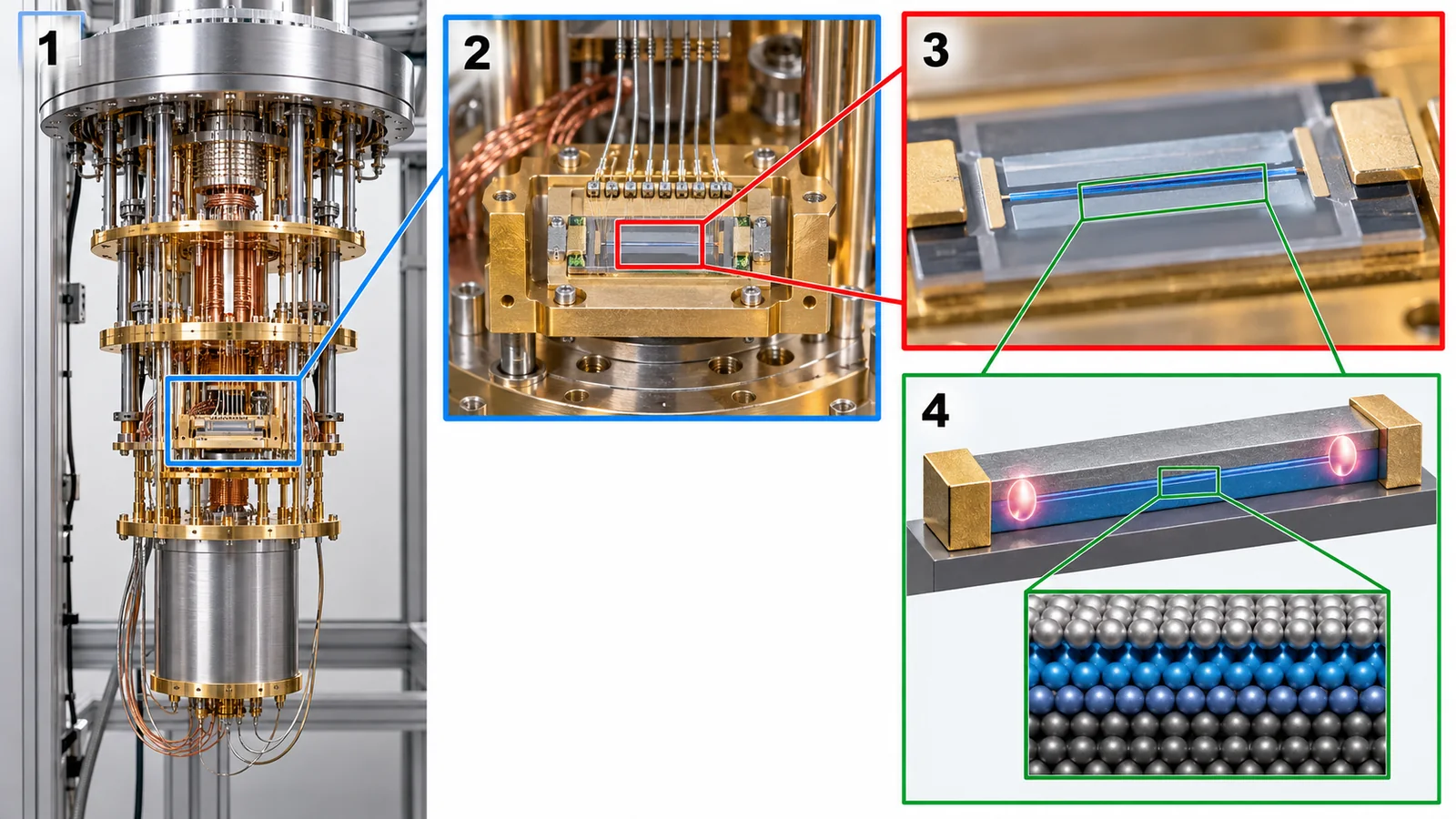
In this approach, materials matter in how cleanly a semiconductor and a superconductor can be joined. Microsoft’s devices stack a superconducting film on a thin layer of a semiconductor such as indium arsenide (InAs) and use gate electrodes to shape the nanowire Sourced. Majorana 1 used aluminum as the superconductor and Majorana 2 uses lead; the paper reports that the “topological gap” (the energy wall that protects the state) widened from about 30 to about 70 microelectronvolts in the top quintile of devices. The semiconductor layers also changed to a combination of indium arsenide and indium arsenide antimonide on a gallium antimonide substrate Sourced. The company’s explanation is that the wider the wall, the less likely heat or outside particles are to flip the parity. On the other hand, a central point of the critics is that if the material is disordered (impurities, defects), signals that look topological can have another cause (section 10). Through the eyes of materials, this is an unusual approach in which interface quality and uniformity are directly tied to whether the quantum part works.
6. What it has done so far
| When | Event | Meaning |
|---|---|---|
| March 2018 and March 2021 | A 2018 Nature paper in this field, “Quantized Majorana conductance”, was retracted on 8 March 2021 | An earlier claim about the same phenomenon did not meet the bar and was retracted. Microsoft’s page also says it learned from earlier claims |
| June 2023 | A Physical Review B paper reporting that InAs-Al devices passed the “topological gap protocol” | Presented a procedure (TGP) for looking for the topological phase |
| 19 February 2025 | Majorana 1 announced. A Nature paper on parity measurement, with an editorial note that the results are not evidence for Majorana zero modes | There is a gap between the company’s claim and the paper’s status |
| 26 February and 11 March 2025 | An independent researcher (Henry Legg) posted comments on the 2023 and 2025 papers to arXiv | Questions about the reliability of the procedure (TGP) and the interpretation of the region where readout occurred |
| 11 July 2025 | Microsoft posted to arXiv its X- and Z-type parity measurements of a tetron device. The X-type switching took about 14.5 microseconds and the Z-type about 12.4 ms; assignment errors were 16% (X) and 0.5% (Z) | The operation needed to use it as a qubit (X) switched on a timescale orders of magnitude shorter than the Z type |
| 2 June 2026 | Majorana 2 announced (at Build). Technical paper posted to arXiv. Z-type parity switching of about 20 s | Much longer than with aluminum. Not yet peer-reviewed |
| 10 June 2026 | A Nature paper on logical qubits, using Quantinuum’s machine, was published | Showed the effect of error-correction software on another company’s hardware |
| 24 June 2026 | Nature published Legg’s Matters Arising (a comment on the 2025 paper) together with a reply from Microsoft Quantum | A peer-reviewed exchange of objection and reply. It cannot be called settled |
| 22 September 2026 | Opened a quantum research center in Maryland. Provided Majorana 2 qubits for DARPA’s independent evaluation | An entry point for outside verification |
| 7 October 2026 | DARPA lists Microsoft among the Stage C companies (moved up from US2QC) | Government verification of the design and performance for utility scale continues |
| 8 October 2026 | Theorists (Laubscher, Sau, Das Sarma) posted to arXiv a paper showing that coupling to the measurement quantum dot can lengthen the observed X-parity lifetime | A new discussion on how to interpret the lifetime |
7. What comes next
due onlineThe company's plan (with Atom Computing and QuNorth)
computerA company target, described as brought forward from 2033
under wayNo results published
stated as achieved3 to 5 not yet achieved (company statement)
All of these are company targets and plans, not achievements Not yet confirmed. The official roadmap lists five milestones (1: create and control Majoranas; 2: a hardware-protected qubit; 3: high-quality qubits; 4: a multi-qubit system; 5: a fault-tolerant system with logical qubits) and says that 1 and 2 are accomplished. “Accomplished” is the company’s own assessment and does not mean that third parties have confirmed it.
None of the following appears in the primary sources we checked Not yet confirmed.
Revenue, investment and headcount of the quantum business / the gate fidelity of topological qubits (error rates of one- and two-qubit operations) / any X-type parity result for Majorana 2 / the outcome of DARPA’s verification / the content of Microsoft Quantum’s reply in Nature (not checked in this article) / whether and when the Majorana 2 paper is peer-reviewed.
8. What the company is aiming for in quantum computing
This section includes points the company does not state directly. They are inferences from what the primary sources show, given with their basis.
| What we read from the sources | Primary-source basis | Type |
|---|---|---|
| The aim is to reduce the effort of error correction through the properties of the material. If it succeeds, the number of qubits needed falls sharply | The official blog says topological qubits have inherently low error rates, small size and digital control | Sourced (company statement) |
| Without waiting for topological results, it is running a two-track approach: error-correction results on other companies’ machines, using its own software | The Nature paper on logical qubits on Quantinuum’s trapped-ion machine, and the plan for “Magne” with Atom Computing | Inference |
| Azure Quantum acts as a window while it is unclear which approach will win | Azure Quantum offers other companies’ machines side by side, and the QDK supports several languages and hardware | Inference |
| Whether the 2029 target holds depends strongly on the outcome of outside evaluation (DARPA) | Microsoft is providing Majorana 2 qubits to the Maryland research center for DARPA’s evaluation | Inference |
| The biggest remaining hurdle is a qubit shown with all operations, including X | The Majorana 2 paper reports Z-type parity lifetime and no X-type result. In the 2025 paper by Microsoft itself, X-type switching was about 14.5 microseconds | Inference |
Putting “20 seconds for Z” beside “14.5 microseconds for X” gives a ratio of about 1.4 million Our calculation (20 s / 14.5 microseconds = about 1.38 x 10⁶; but the 20 seconds is the Z type on Majorana 2 (lead) and the 14.5 microseconds is the X type on a 2025 aluminum device, so these are values from different devices and different materials, not a like-for-like comparison). A qubit of this kind can handle arbitrary states only when both Z and X measurements work. Even if Z alone stays long, a short X time would mean the device is not yet sufficient as a qubit. The Majorana 2 paper shows no X result and says it discusses the implications for the fidelity of Pauli measurements Sourced. We read this as the most important thing to check from here Not yet confirmed.
9. Map of quantum computing partnerships
The figure below shows only relationships stated in the official blog posts and documentation, with lines colored by type.
10. Technologies, products and services
Microsoft’s technology starts from the idea of computing by measuring whether the number of electrons is even or odd. The next figure splits the flow into three steps.
What is a topological qubit?
- Make a thin wire: a superconductor (aluminum, later lead) is laid over a semiconductor (indium arsenide) and gate electrodes squeeze it into a thin wire. The device is cooled to very low temperature and a magnetic field is applied.
- Special states are expected at the two ends of the wire (Majorana zero modes): if it works, a state that holds one electron split in two is said to appear at the ends. Information is kept in the parity of the two ends taken together, so it is meant to resist local noise.
- Compute by measuring: parity is read with a quantum dot (a tiny holder of charge) and microwaves. Computation proceeds through combinations of parity measurements (measurement-based). A pair of nanowires forms a “tetron”.
- Errors are meant to be guarded by the wire’s properties: ideally, because the information is spread over the ends, errors are less likely than in an ordinary qubit, as the company explains.
Claims, confirmed findings and critics’ replies side by side
| Issue | Company claim or official material | What was confirmed (papers, primary sources) | Objections and caveats | Status |
|---|---|---|---|---|
| Was a topological phase with Majorana zero modes created? | The Majorana 1 announcement says a new state of matter (topological superconductivity) was created | The Nature paper of the same day presented a device for single-shot parity measurement. The paper itself discusses both topological and non-topological origins of the signals. Nature’s editorial team noted in the peer-review file that the results are not evidence for Majorana zero modes and that the paper was published as a device architecture | Legg analyzes the underlying conductance data of the region where readout occurred as disordered with no visible gap, and points to a possible trivial mechanism (arXiv, March 2025; Nature Matters Arising, 24 June 2026). Microsoft Quantum’s reply appeared the same day (content not checked) | Not yet confirmed |
| A parity lifetime of about 20 s | The official blog says the mean qubit lifetime is 20 seconds, sometimes more than a minute, a 1,000-fold improvement | The technical paper (arXiv, 2 June 2026, not peer-reviewed) reports a “Z-type parity switching time of about 20 s” in an InAs-Pb tetron. With aluminum it was 1 to 12 ms. The gap went from about 30 to about 70 microelectronvolts | The blog’s “qubit lifetime” is, in the paper, the switching time of Z-type parity. The paper shows no X-type result. Legg was reported as saying the preprint does not resolve the fundamental issues; another researcher (Agarwal) was reported as calling it fantastic progress. A theory paper (arXiv, 8 October 2026) shows in a model that coupling to the measurement dot can lengthen the observed lifetime | Experimental demonstration (preprint); interpretation Not yet confirmed |
| A scalable quantum computer in 2029 | The official blog says the timeline was halved and 2029 is expected | The statement of the target was confirmed. No achievement | The company’s roadmap itself shows the prerequisite milestones (multi-qubit, logical qubits) as not yet achieved | Not yet confirmed |
| Verification by DARPA | In the final phase of US2QC; Majorana 2 qubits provided to DARPA in Maryland | DARPA said on 7 October 2026 that Microsoft moved from US2QC to Stage C. DARPA states that QBI is not a competition and not meant to pick winners | The results of verification are not published. Stage C means being a subject of verification, not a guarantee of success | Under way (results not published) |
This article does not state that topological qubits “have been realized” or “have not been realized”. Here are three pointers for reading.
1. “Parity stays for a long time” is not the same as “works as a qubit”. Computation needs not only Z but also X measurements and two-qubit operations. What has been published so far is mainly Z-type results.
2. The same signal can have several explanations. The paper’s authors discuss both topological and non-topological origins, the editors note it is not evidence, and the critics argue a trivial mechanism can explain it. Which is right will not be settled until independent experiments reproduce the results.
3. Outside verification has begun. DARPA plans to test the hardware independently, and results, once published, will add evidence. Neither the company nor the researchers are blamed here; check the official materials and papers side by side.
Azure Quantum and error-correction software
Azure Quantum is Microsoft’s cloud service for using quantum computers. Users write programs with Microsoft’s free development kit (QDK) and can send them to other companies’ real machines and simulators, such as those of IonQ, Pasqal, Quantinuum and Rigetti. The service also offers “resource estimation”, which estimates how many qubits and how much time a program needs Sourced. Microsoft is also investing in error-correction software (code design and decoders). In a Nature paper of June 2026 it reported logical error rates 11 to 800 times lower than physical circuits on Quantinuum’s trapped-ion machine. However, this result combines error detection with post-selection (discarding runs in which an error was found), and the official blog itself explains that post-selection alone does not scale to long computations Sourced.
11. Risks this company carries
| Risk | Detail | Type |
|---|---|---|
| The approach is not confirmed | Debate continues over whether Majorana zero modes exist. Nature’s editors also noted that the 2025 paper is not evidence | Sourced |
| Qubit-level performance not published | No fidelity for one- or two-qubit operations appears in the materials we checked. X-type measurement results are also unpublished | Not yet confirmed |
| Claims at preprint stage | The central result of Majorana 2 rests on a preprint on arXiv that has not been peer-reviewed | Sourced |
| Target date (2029) | A company target; the prerequisite milestones are not yet achieved | Not yet confirmed |
| Retraction of an earlier claim | In this field, a 2018 Nature paper was retracted in 2021. Microsoft also says it learned from earlier claims | Sourced |
| Finances not visible | Investment, revenue and headcount of the quantum business are not disclosed and not in the 10-K. The scale of investment cannot be checked from outside | Sourced |
| Parts that depend on other companies’ machines | Magne (Atom Computing) and the logical-qubit experiment (Quantinuum) depend on other companies’ hardware | Sourced |
| Competition among approaches | Superconducting, ion, neutral-atom, photonic, silicon and other approaches are also advancing. Which will reach utility scale first is not settled | Inference |
12. Glossary
- Qubit
- The basic unit of quantum computation. It uses a superposition of 0 and 1.
- Topological qubit
- A qubit that tries to hold information in the “shape (topology)” of matter so that noise cannot easily damage it.
- Majorana zero mode (MZM)
- A special state said to appear at the ends of a thin superconducting wire. The raw material of this approach.
- Parity
- Whether the number of electrons in a wire is even or odd.
- Z-type and X-type measurements
- Two kinds of parity measurement on a tetron. Computation needs both.
- Tetron
- A pair of superconducting nanowires, the basic unit of a topological qubit.
- Topological gap
- The energy wall that protects a topological state. A wider gap is said to mean more stability.
- Topological gap protocol (TGP)
- Microsoft’s procedure for judging from conductance data whether a device is in the topological phase.
- Quantum dot
- A tiny holder of charge that electrons can enter and leave one at a time. Used to read parity.
- Logical qubit
- A bundle of many physical qubits that lets errors be corrected, behaving like one reliable qubit.
- Error detection and post-selection
- Discarding runs in which an error is found, which improves the apparent result. Hard to use for long computations.
- Matters Arising
- A format in which Nature publishes a comment on a published paper together with the authors’ reply.
- Preprint
- A manuscript released before peer review (for example on arXiv).
- DARPA US2QC / QBI
- U.S. Defense Advanced Research Projects Agency programs that evaluate utility-scale quantum computers (US2QC is the pilot that preceded QBI).
- Azure Quantum / QDK
- Microsoft’s quantum cloud service and its free quantum development kit.
13. References
- Microsoft Corporation Form 10-K for the fiscal year ended June 30, 2026 (filed with the U.S. SEC, July 2026). Revenue, operating income, R&D expense, employees. We confirmed that the word “quantum” does not appear in the full text. https://www.sec.gov/Archives/edgar/data/789019/000119312526323660/msft-20260630.htm
- Microsoft (Chetan Nayak) Blog post “Microsoft unveils Majorana 1, the world’s first quantum processor powered by topological qubits” (19 February 2025). https://azure.microsoft.com/en-us/blog/quantum/2025/02/19/microsoft-unveils-majorana-1/
- Microsoft (Chetan Nayak) Blog post “Majorana 2 – Microsoft’s Scalable Quantum Processor With Reliable, Long-Lasting Qubits” (2 June 2026). https://quantum.microsoft.com/en-us/insights/blogs/majorana-2-scalable-quantum-processor
- Aghaee et al. (Microsoft Quantum) “20 Second Parity Lifetime in an InAs–Pb Tetron Device”, arXiv:2606.03884 (2 June 2026, not peer-reviewed). The technical paper on Majorana 2. https://arxiv.org/abs/2606.03884
- Microsoft Azure Quantum (Aghaee et al.) “Interferometric single-shot parity measurement in InAs–Al hybrid devices”, Nature 638, 651-655 (19 February 2025). https://doi.org/10.1038/s41586-024-08445-2
- Nature Peer Review File of the paper above. An editorial note appears at the start. https://static-content.springer.com/esm/art%3A10.1038%2Fs41586-024-08445-2/MediaObjects/41586_2024_8445_MOESM2_ESM.pdf
- Legg “On the robustness of topological gap detection via transport”, Nature 654, E22-E26 (Matters Arising, 24 June 2026). A comment on the 2025 Nature paper. https://doi.org/10.1038/s41586-026-10567-8
- Legg “Comment on ‘Interferometric single-shot parity measurement in InAs-Al hybrid devices’, Microsoft Quantum, Nature 638, 651-655 (2025)”, arXiv:2503.08944 (11 March 2025). https://arxiv.org/abs/2503.08944
- Legg “Comment on ‘InAs-Al hybrid devices passing the topological gap protocol’, Microsoft Quantum, Phys. Rev. B 107, 245423 (2023)”, arXiv:2502.19560 (26 February 2025). https://arxiv.org/abs/2502.19560
- Aghaee et al. (Microsoft Quantum) “Distinct Lifetimes for X and Z Loop Measurements in a Majorana Tetron Device”, arXiv:2507.08795 (11 July 2025). https://arxiv.org/abs/2507.08795
- Laubscher, Sau, Das Sarma “Measurement-induced enhancement of the X-parity lifetime in a Majorana tetron”, arXiv:2610.12223 (8 October 2026; a theory preprint). https://arxiv.org/abs/2610.12223
- Microsoft Azure Quantum (Aghaee et al.) “InAs-Al hybrid devices passing the topological gap protocol”, Physical Review B 107, 245423 (21 June 2023). https://doi.org/10.1103/PhysRevB.107.245423
- Nature Retraction note (8 March 2021) for the 2018 paper “Quantized Majorana conductance” (Nature 556, 74-79). https://doi.org/10.1038/s41586-021-03373-x
- Microsoft Quantum Official page “Our Quantum roadmap”. The five milestones and their status (checked 16 October 2026). https://quantum.microsoft.com/en-us/vision/quantum-roadmap
- Microsoft Quantum Official page “Path to Majorana 2”. The history of the approach and the company’s account (checked 16 October 2026). https://quantum.microsoft.com/en-us/vision/path-to-majorana-2
- Microsoft Quantum (Charles Tahan) Blog post “Microsoft’s quantum research center is open for discovery in Maryland” (22 September 2026). https://quantum.microsoft.com/en-us/insights/blogs/microsoft-quantum-research-center-maryland
- Microsoft Quantum (Paetznick, Reichardt) Blog post “From research to product engineering…” (3 August 2026). The account of Magne (Atom Computing, QuNorth). https://quantum.microsoft.com/en-us/insights/blogs/from-research-to-product-engineering-logical-qubit-demonstrations-shaping-microsoft-utility-scale-quantum-software-platform
- Microsoft Quantum (Matthias Troyer) Blog post “Microsoft’s application of error correction to trapped-ion qubits published in Nature”. https://quantum.microsoft.com/en-us/insights/blogs/microsoft-application-of-error-correction-to-trapped-ion-qubits
- Paetznick et al. (Microsoft, Quantinuum) “Improved quantum processor logical error rates via correction and detection”, Nature 654, 349-355 (10 June 2026). https://doi.org/10.1038/s41586-026-10628-y
- Microsoft “What is Azure Quantum?” official documentation (checked 16 October 2026). https://learn.microsoft.com/en-us/azure/quantum/overview-azure-quantum
- Defense Advanced Research Projects Agency (DARPA) Quantum Benchmarking Initiative (QBI) public page (list of participants current as of 8 October 2026). https://www.darpa.mil/research/programs/quantum-benchmarking-initiative
- Defense Advanced Research Projects Agency (DARPA) News item “Four more teams enter Quantum Benchmarking Initiative’s final stage” (7 October 2026). https://www.darpa.mil/news/2026/four-more-teams-enter-quantum-benchmarking-initiative-final-stage
- Science News (press coverage) “Microsoft’s quantum chip got an upgrade. Critics are still skeptical” (2 June 2026). Statements by independent researchers (secondary information). https://www.sciencenews.org/article/microsoft-quantum-chip-upgrade-majorana
- Microsoft Official website (source of the logo; company overview). https://www.microsoft.com/en-us/
14. Claim-to-source audit
| Claim in the text | Type | Source |
|---|---|---|
| Legal name, headquarters (Redmond, Washington), fiscal year (30 June), about 223,000 employees (30 June 2026) | Sourced | Reference 1 https://www.sec.gov/Archives/edgar/data/789019/000119312526323660/msft-20260630.htm |
| Revenue, operating income and R&D expense (years to June 2025 and June 2026) | Sourced | Reference 1 https://www.sec.gov/Archives/edgar/data/789019/000119312526323660/msft-20260630.htm |
| The word “quantum” does not appear in the full text of the 10-K for the year to June 2026 | Sourced | Our own check (a string search of the full 10-K text; Reference 1 https://www.sec.gov/Archives/edgar/data/789019/000119312526323660/msft-20260630.htm) |
| Revenue, investment and headcount of the quantum business, and the split of R&D expense for quantum | Not yet confirmed | Not stated in the primary sources we checked (not disclosed). This article does not estimate them |
| Majorana 1 announcement (19 February 2025), eight topological qubits placed on a chip, a design for one million, assignment error of 1%, Z-type switching about once per millisecond | Sourced | Reference 2 https://azure.microsoft.com/en-us/blog/quantum/2025/02/19/microsoft-unveils-majorana-1/ |
| Nature paper: single-shot interferometric parity measurement in InAs-Al devices, signal-to-noise ratio of 1 in 3.6 microseconds, dwell time above 1 ms, discussion of both topological and non-topological interpretations | Sourced | Reference 5 https://doi.org/10.1038/s41586-024-08445-2 |
| Nature editorial note: the results are not evidence for Majorana zero modes; published as a device architecture | Sourced | Reference 6 https://static-content.springer.com/esm/art%3A10.1038%2Fs41586-024-08445-2/MediaObjects/41586_2024_8445_MOESM2_ESM.pdf |
| Legg’s Matters Arising (24 June 2026): the region where readout occurred is disordered with no visible gap, suggesting trivial mechanisms | Sourced | Reference 7 https://doi.org/10.1038/s41586-026-10567-8 |
| Legg’s arXiv comments (26 February and 11 March 2025): reliability of the TGP and interpretation of the readout region | Sourced | Reference 9, 8 https://arxiv.org/abs/2502.19560 https://arxiv.org/abs/2503.08944 |
| Microsoft Quantum’s reply appeared in the same place on 24 June 2026 (content not checked in this article) | Sourced | Reference 5 https://doi.org/10.1038/s41586-024-08445-2 |
| Majorana 2 announcement (2 June 2026), change to lead, mean of 20 s, beyond one minute, 1,000x, target of 2029, DARPA | Sourced | Reference 3 https://quantum.microsoft.com/en-us/insights/blogs/majorana-2-scalable-quantum-processor |
| Technical paper: Z-type parity switching of about 20 s; 1 to 12 ms with aluminum; gap about 30 to about 70 microelectronvolts (top quintile); implications for Pauli-measurement fidelity discussed; no X-type result reported | Sourced | Reference 4 https://arxiv.org/abs/2606.03884 |
| Microsoft’s own July 2025 paper: X-type about 14.5 microseconds, Z-type about 12.4 ms, assignment errors of 16% (X) and 0.5% (Z) (aluminum devices) | Sourced | Reference 10 https://arxiv.org/abs/2507.08795 |
| Theory study (8 October 2026): in a model, coupling to the measurement dot can lengthen the observed X-parity lifetime; not peer-reviewed | Sourced | Reference 11 https://arxiv.org/abs/2610.12223 |
| Statements by independent researchers (Legg critical, Agarwal positive) | Sourced | Reference 23 https://www.sciencenews.org/article/microsoft-quantum-chip-upgrade-majorana |
| The June 2023 Physical Review B paper (TGP) | Sourced | Reference 12 https://doi.org/10.1103/PhysRevB.107.245423 |
| Retraction of the 2018 Nature paper (8 March 2021); Microsoft’s page says it learned from earlier claims | Sourced | Reference 13, 15 https://doi.org/10.1038/s41586-021-03373-x https://quantum.microsoft.com/en-us/vision/path-to-majorana-2 |
| The five milestones of the roadmap and the company’s statement that 1 and 2 are accomplished | Sourced | Reference 14 https://quantum.microsoft.com/en-us/vision/quantum-roadmap |
| The statement that the company has pursued this approach for more than twenty years | Sourced | Reference 15 https://quantum.microsoft.com/en-us/vision/path-to-majorana-2 |
| Quantum research center in Maryland (15,000 square feet, 22 September 2026), provision of Majorana 2 qubits to DARPA, makerspace partners, collaboration with Fermilab | Sourced | Reference 16 https://quantum.microsoft.com/en-us/insights/blogs/microsoft-quantum-research-center-maryland |
| Magne: more than 1,200 physical qubits from Atom Computing, operated by QuNorth, a joint initiative of EIFO and the Novo Nordisk Foundation, due online in early 2027 | Sourced | Reference 17 https://quantum.microsoft.com/en-us/insights/blogs/from-research-to-product-engineering-logical-qubit-demonstrations-shaping-microsoft-utility-scale-quantum-software-platform |
| The Nature paper on logical qubits on Quantinuum’s machine (logical error rates 11 to 800 times lower; error detection and post-selection used) | Sourced | Reference 19, 18 https://doi.org/10.1038/s41586-026-10628-y https://quantum.microsoft.com/en-us/insights/blogs/microsoft-application-of-error-correction-to-trapped-ion-qubits |
| The official blog’s explanation that post-selection alone does not scale to long computations | Sourced | Reference 17 https://quantum.microsoft.com/en-us/insights/blogs/from-research-to-product-engineering-logical-qubit-demonstrations-shaping-microsoft-utility-scale-quantum-software-platform |
| Azure Quantum providers (IonQ, Pasqal, Quantinuum, Rigetti), the QDK and resource estimation | Sourced | Reference 20 https://learn.microsoft.com/en-us/azure/quantum/overview-azure-quantum |
| Microsoft moved from US2QC to Stage C; QBI is not a competition and not meant to pick winners; the institutions taking part in verification | Sourced | Reference 22, 21, 3 https://www.darpa.mil/news/2026/four-more-teams-enter-quantum-benchmarking-initiative-final-stage https://www.darpa.mil/research/programs/quantum-benchmarking-initiative https://quantum.microsoft.com/en-us/insights/blogs/majorana-2-scalable-quantum-processor |
| Target of a scalable quantum computer in 2029 | Not yet confirmed | A company target, not confirmed. The statement of the target is in Reference 3 https://quantum.microsoft.com/en-us/insights/blogs/majorana-2-scalable-quantum-processor |
| Ratio of 20 s (Majorana 2, Z type) to 14.5 microseconds (2025 aluminum device, X type): about 1.4 million | Our calculation | Our calculation (20 / 14.5 x 10^-6 = about 1.38 x 10^6). The values are from different devices and materials, not a like-for-like comparison |
| Classification of companies into four types | Our calculation | Our own classification; company names are examples from this series |
| Whether topological qubits have been achieved, existence of Majorana zero modes, gate fidelity, the outcome of DARPA’s verification, peer review of the Majorana 2 paper | Not yet confirmed | Not stated in the primary sources we checked, or under debate. This article does not give a conclusion |
| Investments in, acquisitions of, joint ventures with or divestments of other companies | Not yet confirmed | Not in the materials we checked; this article does not claim they do not exist |
| Reading that the company runs a two-track approach (topological, and error correction on others’ machines) | Inference | Our own reading of the Quantinuum paper and the Magne plan |
| Reading that Azure Quantum is a window while the winning approach is unclear | Inference | Our own reading of the range of providers and the QDK’s coverage |
| Reading that the 2029 target depends on DARPA’s evaluation | Inference | Our own reading of the statement on supplying devices to DARPA |
| Reading that the biggest hurdle is a qubit shown with all operations, including X | Inference | Our own reading of the absence of an X result in the Majorana 2 paper and the X-type value in Microsoft’s 2025 paper |
| Risk from competing approaches | Inference | Our own reading of the progress of other approaches |
Last updated: 16 October 2026 (date checked) / Troy Technical
Figures in this article are based on Microsoft’s Form 10-K filed with the U.S. SEC, Microsoft’s official blog posts, technical paper and documentation, peer-reviewed papers, arXiv preprints and DARPA’s public pages. Market-research estimates and press figures are not used (statements by experts taken from press coverage are marked as such). Device names, roadmaps, contracts and corporate structure reflect what had been published as of 16 October 2026; because this field moves fast, check the company’s announcements and the papers for the latest. Passages marked “Inference” are our reading of primary sources and are not statements by the company. This article neither evaluates nor blames any company or researcher, and it does not give a conclusion on whether topological qubits have been achieved.