COMPANY PROFILE / QUANTUM COMPUTING
NVIDIA
It does not build qubits; it takes part in quantum computing through the classical computers that keep quantum machines running
NVIDIA does not make the body of a quantum computer, the quantum chip. Its own web page says it focuses on the classical supercomputing layer that quantum hardware depends on rather than building QPUs (quantum processors) directly. Qubits are fragile, so keeping a quantum machine running takes a fast classical computer that reads the measurement results instantly and sends back corrections. NVIDIA wants to supply that part with GPUs, software (CUDA-Q) and a high-speed link (NVQLink). At the same time, its annual report (Form 10-K) contains no discussion of quantum computing that we could find, and the company does not disclose quantum revenue or investment. This profile sticks to what could be confirmed from official pages and press releases.
- NVIDIA in 30 seconds, and where it stands in quantum computing
- The logo and how the name is written
- Where the company sits in the quantum computing field
- Scale (limited to what touches quantum)
- Resources committed to quantum computing
- What it has done so far
- What comes next
- What the company is aiming for in quantum computing
- Map of quantum computing partnerships
- Products, technologies and services
- The risks this company carries
- Glossary, references and claim-to-source audit
1. NVIDIA in 30 seconds, and where it stands in quantum computing
(builds no qubits)Main type. No secondary type
cuQuantum / IsingSoftware, interconnect, AI models, simulation
announced 14 Sep 2026A design tool for error-corrected quantum computers
QuEra, PsiQuantum, QuantinuumEach announced in September 2025. Amounts not disclosed
A quantum computer does not run on the quantum chip (QPU) alone. Qubits are easily disturbed by their surroundings, so in practice the machine has to keep repeating one loop: measure the chip, let a classical computer work out where an error occurred, and send back a correction, all in an extremely short time. NVIDIA aims to take on that classical side with GPUs (parts that began as graphics processors and are now used for AI too, good at doing huge numbers of calculations at once) Sourced.
So NVIDIA is not a company that makes qubits, as IBM and Google do. It is a company that can work with makers of any kind of quantum chip. That position is fundamentally different from the qubit makers profiled elsewhere in this series. The basics of quantum computing are explained in our explainers on quantum computing fundamentals and on quantum error correction and the surface code.
Qubit: the smallest unit of information in a quantum computer, a tiny component that can be in a special state of being 0 and 1 at once. QPU stands for quantum processing unit, a quantum chip with qubits laid out on it.
Error correction: because qubits are fragile, many qubits (physical qubits) are combined and treated as one sturdy qubit (a logical qubit), and errors are spotted and fixed.
Decoding: the calculation that works out, from the results measured for error correction, where an error occurred. Making this fast is the GPU's job.
Calibration: quantum chips drift out of adjustment easily, so their settings must be tuned again and again.
2. The logo and how the name is written
A note on naming: the legal name is NVIDIA Corporation, and this article shortens it to NVIDIA. The venture capital arm through which the company invests is called NVentures; it is announced under its own name, separate from NVIDIA itself, so we keep the two apart when we discuss investments. CUDA-Q, NVQLink and Ising are names of products and technologies, not companies.
Official logo (NVIDIA logo and brand usage page): https://www.nvidia.com/en-us/about-nvidia/legal-info/logo-brand-usage/3. Where the company sits in the quantum computing field
Companies involved in quantum computing are easiest to sort into four types according to how they build a qubit (the approach). This is our own classification Our calculation.
| Type (approach) | What serves as the qubit (plain-language explanation) |
|---|---|
| Superconducting | Tiny electrical circuits made of a metal that loses all electrical resistance at extremely low temperatures; two states of the circuit stand for 0 and 1. They can be made with methods close to chip manufacturing, but they need extreme cooling and a great deal of wiring. |
| Trapped ions & neutral atoms | Individual atoms, either electrically charged (ions) or neutral, held in a vacuum with electromagnetic fields or laser beams ("optical tweezers"); two internal states of each atom stand for 0 and 1. Atoms are all identical, which tends to give uniform qubits, but operations are slower and scaling up is hard. |
| Photonic, silicon & other approaches | Particles of light (photons), or the spin (the orientation of a tiny magnet) of an electron in silicon, and similar systems. They may be able to use existing semiconductor fabs and silicon photonics, but much of this work is still at the proof-of-concept stage. |
| Software, cloud & ecosystem | Companies that do not build qubits but help people use, run or connect quantum computers: cloud services, software, the classical computers that control them, and quantum communication. |
4. Scale (limited to what touches quantum)
NVIDIA as a whole is very large, so we note only its scale. Its fiscal year ends in January, so "FY2026" means 27 January 2025 to 25 January 2026 Sourced.
| Measure (US$ million) | FY2024 (year to Jan 2024) | FY2025 (year to Jan 2025) | FY2026 (year to Jan 2026) |
|---|---|---|---|
| Revenue | 60,922 | 130,497 | 215,938 |
| Research and development expense | 8,675 | 12,914 | 18,497 |
| Item (end of FY2026) | Detail |
|---|---|
| Employees | About 42,000 in 38 countries, of whom about 31,000 work in research and development |
| Headquarters and founding | Santa Clara, California. Incorporated in April 1993 |
| Listing | NASDAQ (ticker NVDA) |
The figures above are for the whole company. They do not show the size of its quantum computing business. NVIDIA discloses no quantum revenue, R&D expense, capital spending or dedicated headcount Not yet confirmed. A text search of the FY2026 10-K and the latest 10-Q (quarter ended 26 July 2026) found no discussion of quantum computing (in the 10-K the word "quantum" appears once, as part of another company's name in an executive's biography).
NVIDIA's press releases also quote a market forecast for quantum computing from a research firm. We do not use research-firm estimates in this article.
5. Resources committed to quantum computing
The table checks four kinds of resource (people, money, equity investments and acquisitions, and ties with universities and public bodies) against primary sources. "No mention" and "not disclosed" are findings too.
| Type of resource | What primary sources confirm | Category |
|---|---|---|
| People | Dedicated quantum headcount is not disclosed. Timothy Costa (Vice President and General Manager of quantum) is named as the quantum lead in the September 2026 release | Not disclosed / Sourced |
| Money | Quantum R&D and capital spending are not disclosed (nothing in the 10-K). Company-wide R&D is in section 4 | Not disclosed |
| Equity investments | NVentures invested in QuEra Computing (announced 9 September 2025), PsiQuantum (took part in its US$1 billion raise, announced 10 September 2025) and Quantinuum (joined as a new investor in the roughly US$600 million raise announced 4 September 2025). NVentures' own amounts are not stated in the companies' announcements and are not disclosed | Sourced |
| Acquisitions, joint ventures, disposals | No quantum-related acquisition, joint venture or disposal could be confirmed in the official material we checked | Not confirmed |
| Universities, research institutions, public bodies | U.S. national laboratories (which guided the development of NVQLink); the G-QuAT/ABCI-Q facility at Japan's National Institute of Advanced Industrial Science and Technology (AIST), with 2,020 H100 GPUs; the Harvard Quantum Initiative and MIT's EQuS group at NVAQC; universities and institutions in CUDA-Q Academic (25 names on the official page). The release on NVQLink carries a comment from the U.S. Secretary of Energy | Sourced |
Status of the main products and sites (qubit counts and error rates do not apply)
NVIDIA does not make quantum chips, so there is no column for qubit counts or error rates. Instead the table shows what stage each product or site has reached, separating announcement from availability (checked 16 October 2026). All figures are NVIDIA's own stated values.
| Product or site | What it does | Stage | Date | Reference |
|---|---|---|---|---|
| DGX Quantum | An early configuration linking a GPU system to Quantum Machines' control hardware (OPX+). Described as linking GPU and QPU in under 1 microsecond | Announced | 21 March 2023 | Ref. 10 |
| CUDA-Q | Open-source software to handle quantum chips, GPUs and CPUs in one program (Python, C++). Described as installable with pip install cudaq | Available | Checked 16 October 2026 | Ref. 9 |
| CUDA-Q QEC (CUDA-QX) | A library for decoding in error correction. The official page says it is 29 to 35 times faster per decode than "industry standard decoders" using a method called BP-OSD (see the page for conditions) | Available | Checked 16 October 2026 | Ref. 6 |
| NVQLink | An open design linking a quantum chip's controller to GPUs. Round-trip latency under 4.0 microseconds (FPGA to GPU to FPGA), up to 400 Gb/s | Announced, then API released | Announced 28 October 2025; cudaq-realtime released March 2026 | Refs. 2, 3, 4 |
| NVAQC (research site in Boston) | A research facility combining quantum hardware with GB200 NVL72 systems. Partners include Quantinuum, QuEra, Quantum Machines and MIT's EQuS group | Construction announced (opening date not confirmed) | 18 March 2025 | Refs. 5, 6 |
| Ising (Calibration / Decoding) | A vision-language model that automates calibration of quantum chips, and neural networks for error-correction decoding. Decoding is described as up to 2.5 times faster and 3 times more accurate than pyMatching | Released | 14 April 2026 | Ref. 7 |
| CUDA-Q Logical | A tool for designing and evaluating applications for error-corrected machines at the logical-qubit level | Released | 14 September 2026 | Ref. 8 |
6. What it has done so far
| When | What happened | Why it matters |
|---|---|---|
| 21 March 2023 | Announced DGX Quantum with Quantum Machines, and said it was open-sourcing CUDA Quantum | The first announcement of a configuration that links GPUs directly to a quantum chip's controller |
| 18 March 2024 | Announced that AIST's ABCI-Q in Japan would run on NVIDIA GPUs and CUDA-Q. Built by Fujitsu (more than 2,000 H100 GPUs) | A Japanese national project moves toward combining quantum and GPUs |
| 12 May 2024 | At ISC (the international supercomputing conference), computing centers in Germany, Japan and Poland announced they would run IQM, QuEra and ORCA quantum chips with CUDA-Q | Quantum chips of different types (superconducting, neutral atom, photonic) handled by the same software |
| 18 March 2025 | Announced it would build NVAQC in Boston, saying then that operations were expected to begin later in 2025 | NVIDIA gets its own research site |
| 18 May 2025 | Announced the opening of AIST's G-QuAT, the facility housing ABCI-Q, with 2,020 H100 GPUs | Described as the world's largest research supercomputer dedicated to quantum computing |
| September 2025 | NVentures invested in QuEra (announced 9 September), Quantinuum (4 September) and PsiQuantum (10 September) | Investments in three companies of different types (neutral atom, trapped ion, photonic) within weeks |
| 28 October 2025 | Announced NVQLink, with 17 QPU builders, five controller builders and nine U.S. national laboratories taking part | An attempt to make the connection a standard shape |
| March 2026 (GTC 2026) | Released NVQLink through the cudaq-realtime API. Showcased Dell products and a deployment by Anyon Computing and SDT at a data center in Korea | From announcement to something usable. No deployment-scale figures were given |
| 14 April 2026 | Announced Ising, AI models for calibration and decoding | A move to use AI in controlling quantum computers |
| 14 September 2026 | Announced CUDA-Q Logical. Said Fermilab cut its design study of fault-tolerant quantum computers from five months to three weeks (about 7 times faster), and made Sandia National Laboratories' QUOPS benchmark available in CUDA-Q | A tool for designing the world after error correction (logical qubits) |
7. What comes next
already releasedCompatible controllers and servers come from partners
as an operating facilityAnnounced as opening in 2025. Opening date not confirmed
None of the following appears in the official material we checked Not yet confirmed.
Quantum-related revenue, spending and headcount; the number of units or sites that have adopted NVQLink; the opening date and operating status of NVAQC; future availability dates for each product. Each press release carries a notice that availability is "when-and-if-available" and is not a commitment or legal obligation.
8. What the company is aiming for in quantum computing
This section includes things the company has not said directly. We set them out as inferences that can be read from primary sources, with the evidence beside each.
| What can be read | Primary evidence behind it | Category |
|---|---|---|
| It is taking the position of connecting every approach instead of betting on which one wins | NVQLink has 17 QPU builders (superconducting, trapped-ion, neutral-atom, photonic and others) taking part, and CUDA-Q is described as independent of the qubit type (Refs. 2, 9) | Inference |
| It wants error correction's "decode and correct" step to become a standing job for GPUs | Both NVQLink and Ising Decoding name real-time decoding as their main purpose (Refs. 3, 7) | Inference |
| Bringing AI into the control of quantum computers is the next pillar | Ising supplies calibration (a vision-language model) and decoding (neural networks). The CEO said AI becomes "the control plane" of quantum machines (Ref. 7) | Sourced (the reading is an Inference) |
| Its customers for now are national laboratories, computing centers and quantum companies, and quantum revenue is small or not yet tracked separately | Examples of adoption are mostly research institutions and quantum companies. The 10-K has no quantum discussion and revenue is not disclosed (Refs. 1, 2, 4) | Inference |
| It aims to extend its core GPU and AI demand into quantum | NVAQC and NVQLink both assume the use of GPU servers (GB200 NVL72 and similar) (Refs. 3, 5) | Inference |
NVQLink's official page says it deliberately does not set a latency target, because the response speed needed ranges from milliseconds to microseconds depending on the type of quantum chip. Instead it provides an open benchmark that anyone can measure in the same way, and says network designs other than NVIDIA's can be used as long as they support cudaq-realtime Sourced.
From this, our reading is that NVIDIA is putting adoption by many quantum chip companies ahead of locking customers into its own parts Inference. Which is right may change as adoption unfolds.
9. Map of quantum computing partnerships
10. Products, technologies and services
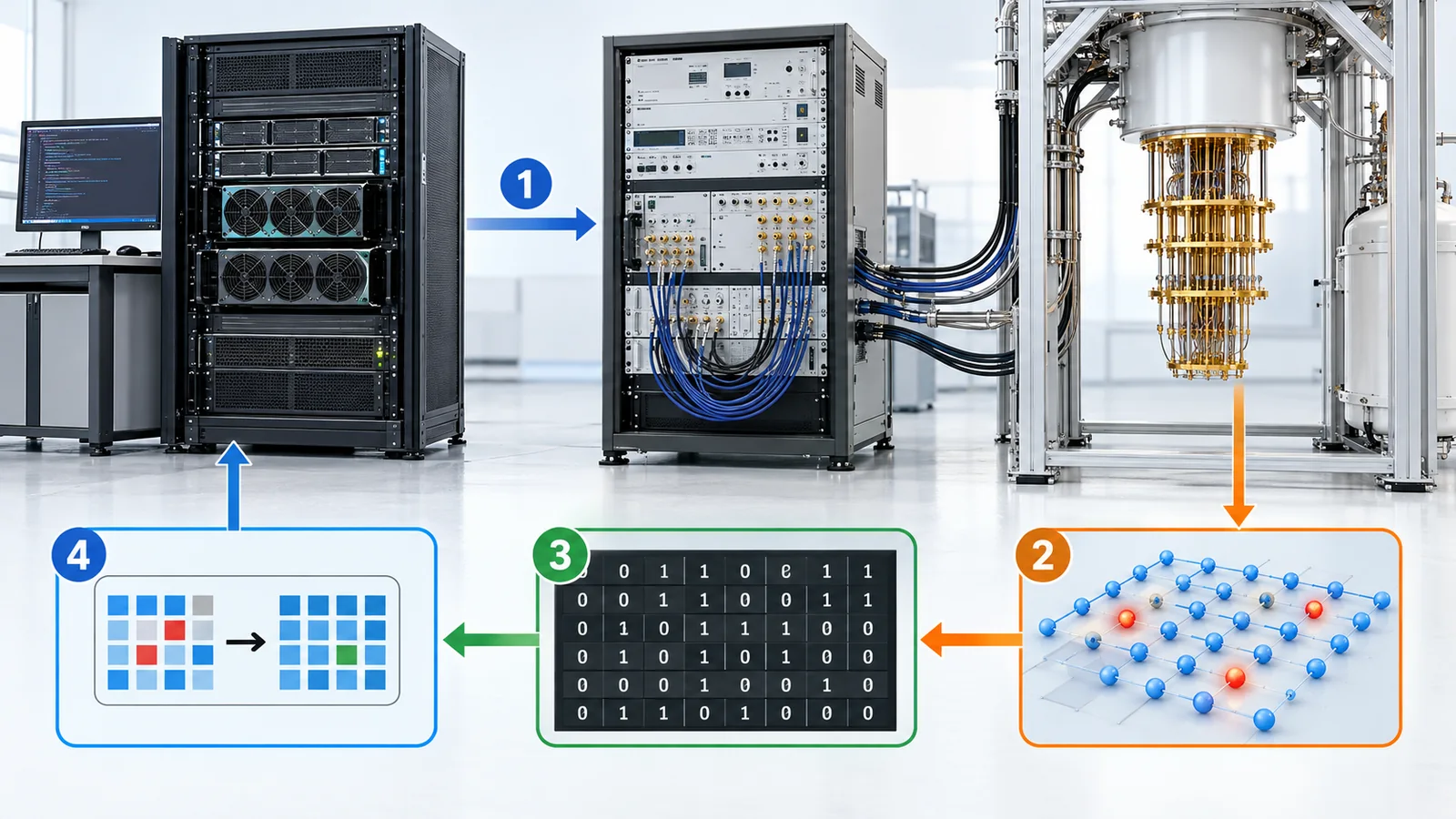
NVIDIA's quantum products are easiest to understand as a set of layered tools. The second illustration below reorders the product family named on NVIDIA's official pages by "what each layer does" Our calculation. First, the first illustration shows how a quantum chip and a GPU are connected.
NVIDIA does not make the materials of qubits (superconducting thin films, isotopically purified silicon, optical parts for lasers and so on). But from the point of view of materials and devices, the company says its tools help in two places Sourced.
The first is device design. NVAQC's official page says that quickly finding better qubit designs needs "comprehensive and challenging hardware simulations", run on AI supercomputers. In other words, candidate thin films and layouts can be narrowed down by simulation on GPUs before anything is fabricated. The second is calibration. Ising Calibration is described as cutting the time needed to tune a quantum chip "from days to hours", aiming to automate the work of re-tuning settings Sourced. Differences in each device's characteristics can stem partly from material defects or film-thickness variation (a general explanation by this article; the official material does not say which materials are affected or how).
At GTC 2026, NVIDIA also announced cuEST, which speeds up quantum-chemistry calculations on GPUs for semiconductor design, and named Samsung, Synopsys and TSMC as users Sourced. That is a classical GPU tool that calculates quantum mechanics, not a quantum computer, and it is a separate matter from qubits. Please do not confuse the two.
11. The risks this company carries
| Risk | Substance | Category |
|---|---|---|
| The size of the quantum business cannot be checked from outside | Revenue, spending and headcount are not disclosed, and the 10-K contains no discussion of quantum. Progress can be followed only through press releases and official pages | Sourced |
| Speed and accuracy figures are NVIDIA's own, and compared against limited baselines | Ising's "2.5 times, 3 times" is against pyMatching; CUDA-Q QEC's "29 to 35 times" is against "industry standard decoders" for a single decode. Results could differ with other methods or conditions | Sourced |
| It depends on the success of the quantum hardware makers | Because NVIDIA builds no quantum chips, demand for NVQLink and CUDA-Q is set by whether QPU makers can deliver large machines with error correction | Inference |
| Competition over standards for connection and software | NVQLink is an open design and other configurations can be used. Companies might choose their own control and connection schemes | Inference |
| The gap between "announced" and "available" | NVAQC has no confirmed opening date since its construction announcement; NVQLink went from announcement (October 2025) to API release (March 2026). The press releases state that availability is not a promise | Sourced |
| The timing of quantum computing itself is uncertain | The large fault-tolerant machines that tools such as CUDA-Q Logical assume have not yet been built. When they will be is the companies' outlook and is not fixed | Not yet confirmed |
12. Glossary
- Qubit
- The smallest unit of information in a quantum computer. It can be in a state of being 0 and 1 at once.
- Physical qubit / logical qubit
- A physical qubit is an actual qubit on the chip. A logical qubit is a sturdy "virtual" qubit built from many physical qubits through error correction.
- QPU
- Quantum processing unit: a quantum chip with qubits laid out on it.
- Quantum error correction (QEC)
- A mechanism that finds and fixes the mistakes of fragile qubits.
- Decoding
- The calculation that works out where an error occurred from the results measured for error correction. Speed matters.
- Calibration
- Tuning a quantum chip's settings again. It drifts easily, so it is needed regularly.
- FPGA
- An integrated circuit whose internals can be rewritten after manufacture. Often used as the controller of a quantum chip.
- GPU
- Originally for graphics; good at doing huge numbers of calculations at once. Also used for AI.
- CUDA-Q
- NVIDIA's open-source quantum computing software. It handles quantum chips, GPUs and CPUs in one program.
- NVQLink
- NVIDIA's open interconnect design linking a quantum chip's controller to GPUs at high speed.
- Hybrid (quantum-classical)
- Combining a quantum chip and a classical computer in one calculation.
- Form 10-K / 10-Q
- The annual and quarterly reports that U.S. listed companies file with the SEC.
13. References
- NVIDIA Form 10-K for the fiscal year ended 25 January 2026 (filed with the U.S. SEC on 25 February 2026). Revenue, R&D expense, headcount, headquarters. The word "quantum" appears only in an executive biography (another company's name); we found no discussion of quantum computing. https://www.sec.gov/Archives/edgar/data/1045810/000104581026000021/nvda-20260125.htm
- NVIDIA NVIDIA Introduces NVQLink — Connecting Quantum and GPU Computing for 17 Quantum Builders and Nine Scientific Labs (press release, 28 October 2025). https://nvidianews.nvidia.com/news/nvidia-nvqlink-quantum-gpu-computing
- NVIDIA NVIDIA NVQLink (official product page). Round-trip latency under 4.0 microseconds, up to 400 Gb/s, the cudaq-realtime API, the decision not to prescribe a latency figure, the open benchmark. Checked 16 October 2026. https://www.nvidia.com/en-us/solutions/quantum-computing/nvqlink/
- NVIDIA NVIDIA GTC 2026: Live Updates (NVIDIA blog, 19 March 2026). NVQLink released through the cudaq-realtime API, Dell products, deployment by Anyon Computing and SDT in Korea, cuEST. https://blogs.nvidia.com/blog/gtc-2026-news/
- NVIDIA NVIDIA to Build Accelerated Quantum Computing Research Center (press release, 18 March 2025). Announcement of NVAQC. https://nvidianews.nvidia.com/news/nvidia-to-build-accelerated-quantum-computing-research-center
- NVIDIA Accelerated Quantum Computing Solutions (official page). NVIDIA's role (it does not build QPUs directly), the product family, NVAQC, CUDA-Q Academic, the CUDA-Q QEC speed comparison. Checked 16 October 2026. https://www.nvidia.com/en-us/solutions/quantum-computing/
- NVIDIA NVIDIA Launches Ising, the World's First Open AI Models to Accelerate the Path to Useful Quantum Computers (press release, 14 April 2026). https://nvidianews.nvidia.com/news/nvidia-launches-ising-the-worlds-first-open-ai-models-to-accelerate-the-path-to-useful-quantum-computers
- NVIDIA NVIDIA Expands Open Source CUDA-Q Platform for Fault-Tolerant Quantum Computing (press release, 14 September 2026). CUDA-Q Logical, Sandia National Laboratories' QUOPS, the Fermilab case. https://nvidianews.nvidia.com/news/nvidia-expands-open-source-cuda-q-platform-for-fault-tolerant-quantum-computing
- NVIDIA NVIDIA CUDA-Q (developer page). Open source, Python and C++, QPU-agnostic design, how to install. Checked 16 October 2026. https://developer.nvidia.com/cuda-q
- NVIDIA NVIDIA Announces New System for Accelerated Quantum-Classical Computing (press release, 21 March 2023). DGX Quantum. https://nvidianews.nvidia.com/news/nvidia-announces-new-system-for-accelerated-quantum-classical-computing
- NVIDIA NVIDIA Powers Japan's ABCI-Q Supercomputer for Quantum Research (press release, 18 March 2024). Built by Fujitsu. https://nvidianews.nvidia.com/news/nvidia-powers-japans-abci-q-supercomputer-for-quantum-research
- NVIDIA NVIDIA Accelerates Quantum Computing Centers Worldwide With CUDA-Q Platform (press release, 12 May 2024). Jülich in Germany, AIST in Japan, Poznan in Poland. https://nvidianews.nvidia.com/news/nvidia-accelerates-quantum-computing-centers-worldwide-with-cuda-q-platform
- NVIDIA NVIDIA Powers World's Largest Quantum Research Supercomputer (press release, 18 May 2025). Opening of G-QuAT and ABCI-Q (2,020 H100 GPUs). https://nvidianews.nvidia.com/news/nvidia-powers-worlds-largest-quantum-research-supercomputer
- QuEra Computing QuEra Expands $230 Million Financing Round (press release, 9 September 2025). Investment by NVentures. https://www.quera.com/press-releases/quera-expands-230-million-financing-round-advancing-quantum-accelerated-supercomputing
- PsiQuantum PsiQuantum Raises $1 Billion to Build Million-Qubit Scale, Fault-Tolerant Quantum Computers (press release, 10 September 2025). Investment by NVentures and collaboration with NVIDIA. https://www.psiquantum.com/news-import/psiquantum-1b-fundraise
- Quantinuum / Honeywell Honeywell Announces $600 Million Capital Raise For Quantinuum (press release, 4 September 2025). NVentures joins as a new investor. https://www.quantinuum.com/press-releases/honeywell-announces-600-million-capital-raise-for-quantinuum-at-10b-pre-money-equity-valuation-to-advance-quantum-computing-at-scale
- Quantinuum Quantinuum selected as a founding collaborator for NVIDIA Accelerated Quantum Research Center (press release, 18 March 2025). https://www.quantinuum.com/press-releases/quantinuum-selected-as-a-founding-collaborator-for-nvidia-accelerated-quantum-research-center
- NVIDIA Form 10-Q for the quarterly period ended 26 July 2026 (filed with the U.S. SEC on 26 August 2026). The latest quarterly report also contains no discussion of quantum computing that we could find. https://www.sec.gov/Archives/edgar/data/1045810/000104581026000075/nvda-20260726.htm
14. Claim-to-source audit
| Claim in the article | Category | Source |
|---|---|---|
| Legal name, headquarters, listing and founding | Sourced | Reference 1 https://www.sec.gov/Archives/edgar/data/1045810/000104581026000021/nvda-20260125.htm |
| Revenue and R&D expense (FY2024 to FY2026); about 42,000 employees (about 31,000 in R&D) | Sourced | Reference 1 https://www.sec.gov/Archives/edgar/data/1045810/000104581026000021/nvda-20260125.htm |
| No discussion of quantum computing found in the 10-K or 10-Q (the 10-K's "quantum" is another company's name only) | Sourced | This article's own text search / References 1 and 18 https://www.sec.gov/Archives/edgar/data/1045810/000104581026000021/nvda-20260125.htm https://www.sec.gov/Archives/edgar/data/1045810/000104581026000075/nvda-20260726.htm |
| Quantum revenue, R&D expense, capital spending and dedicated headcount are not disclosed | Not yet confirmed | None is disclosed, and this article makes no estimate |
| NVIDIA does not build quantum chips (QPUs) directly and focuses on the classical supercomputing layer | Sourced | Reference 6 https://www.nvidia.com/en-us/solutions/quantum-computing/ |
| NVQLink announced 28 October 2025; 17 QPU builders, five controller builders and nine U.S. labs taking part | Sourced | Reference 2 https://nvidianews.nvidia.com/news/nvidia-nvqlink-quantum-gpu-computing |
| NVQLink round-trip latency under 4.0 microseconds, up to 400 Gb/s, no prescribed latency target, open benchmark | Sourced | NVIDIA's stated values / Reference 3 https://www.nvidia.com/en-us/solutions/quantum-computing/nvqlink/ |
| Release of cudaq-realtime at GTC 2026, Dell products, deployment by Anyon Computing and SDT in Korea | Sourced | Reference 4 https://blogs.nvidia.com/blog/gtc-2026-news/ |
| NVAQC announced 18 March 2025; partners; operations "expected later this year" | Sourced | References 5 and 17 https://nvidianews.nvidia.com/news/nvidia-to-build-accelerated-quantum-computing-research-center https://www.quantinuum.com/press-releases/quantinuum-selected-as-a-founding-collaborator-for-nvidia-accelerated-quantum-research-center |
| NVAQC uses GB200 NVL72; Quantinuum, QuEra, Quantum Machines and MIT's EQuS take part | Sourced | References 5 and 6 https://nvidianews.nvidia.com/news/nvidia-to-build-accelerated-quantum-computing-research-center https://www.nvidia.com/en-us/solutions/quantum-computing/ |
| Ising announced 14 April 2026; decoding up to 2.5 times faster and 3 times more accurate than pyMatching (NVIDIA's stated figure) | Sourced | Reference 7 https://nvidianews.nvidia.com/news/nvidia-launches-ising-the-worlds-first-open-ai-models-to-accelerate-the-path-to-useful-quantum-computers |
| CUDA-Q Logical announced 14 September 2026; Fermilab 5 months to 3 weeks (7x); Sandia's QUOPS | Sourced | Reference 8 https://nvidianews.nvidia.com/news/nvidia-expands-open-source-cuda-q-platform-for-fault-tolerant-quantum-computing |
| CUDA-Q is open source, supports Python and C++, and is QPU-agnostic | Sourced | Reference 9 https://developer.nvidia.com/cuda-q |
| CUDA-Q QEC's BP-OSD is 29 to 35 times faster than "industry standard decoders" (NVIDIA's stated figure) | Sourced | Reference 6 https://www.nvidia.com/en-us/solutions/quantum-computing/ |
| DGX Quantum announced 21 March 2023 with Quantum Machines' OPX+ | Sourced | Reference 10 https://nvidianews.nvidia.com/news/nvidia-announces-new-system-for-accelerated-quantum-classical-computing |
| ABCI-Q (announced 18 March 2024, built by Fujitsu) and the opening of G-QuAT (18 May 2025, 2,020 H100 GPUs) | Sourced | References 11 and 13 https://nvidianews.nvidia.com/news/nvidia-powers-japans-abci-q-supercomputer-for-quantum-research https://nvidianews.nvidia.com/news/nvidia-powers-worlds-largest-quantum-research-supercomputer |
| At ISC 2024, computing centers announced they would run IQM, QuEra and ORCA quantum chips with CUDA-Q | Sourced | Reference 12 https://nvidianews.nvidia.com/news/nvidia-accelerates-quantum-computing-centers-worldwide-with-cuda-q-platform |
| NVentures' investments in QuEra, PsiQuantum and Quantinuum (September 2025), and that amounts are not disclosed | Sourced | References 14, 15 and 16 https://www.quera.com/press-releases/quera-expands-230-million-financing-round-advancing-quantum-accelerated-supercomputing https://www.psiquantum.com/news-import/psiquantum-1b-fundraise https://www.quantinuum.com/press-releases/honeywell-announces-600-million-capital-raise-for-quantinuum-at-10b-pre-money-equity-valuation-to-advance-quantum-computing-at-scale |
| cuEST (classical GPU quantum-chemistry calculation) announced at GTC 2026; Samsung, Synopsys and TSMC as users | Sourced | Reference 4 https://blogs.nvidia.com/blog/gtc-2026-news/ |
| The division of quantum companies into four types | Our calculation | This article's own classification. Company names are examples from this series |
| No quantum-related acquisition, joint venture or disposal could be confirmed | Not yet confirmed | Not in the official material checked. This article does not assert that none exists |
| Number of NVQLink or NVAQC deployments, opening dates, year-by-year plans | Not yet confirmed | Not confirmed. This article makes no estimate |
| The reading that it takes a position of connecting every approach rather than betting on one | Inference | This article's interpretation / References 2 and 9 https://nvidianews.nvidia.com/news/nvidia-nvqlink-quantum-gpu-computing https://developer.nvidia.com/cuda-q |
| The reading that it wants decode-and-correct to become a standing GPU job | Inference | This article's interpretation / References 3 and 7 https://www.nvidia.com/en-us/solutions/quantum-computing/nvqlink/ https://nvidianews.nvidia.com/news/nvidia-launches-ising-the-worlds-first-open-ai-models-to-accelerate-the-path-to-useful-quantum-computers |
| The reading that bringing AI into quantum control is the next pillar | Inference | This article's interpretation / Reference 7 https://nvidianews.nvidia.com/news/nvidia-launches-ising-the-worlds-first-open-ai-models-to-accelerate-the-path-to-useful-quantum-computers |
| The reading that current customers are research institutions and quantum firms, with quantum revenue small or tracked separately | Inference | This article's interpretation / References 1 and 2 https://www.sec.gov/Archives/edgar/data/1045810/000104581026000021/nvda-20260125.htm https://nvidianews.nvidia.com/news/nvidia-nvqlink-quantum-gpu-computing |
| The reading that it aims to extend core GPU and AI demand into quantum | Inference | This article's interpretation / References 3 and 5 https://www.nvidia.com/en-us/solutions/quantum-computing/nvqlink/ https://nvidianews.nvidia.com/news/nvidia-to-build-accelerated-quantum-computing-research-center |
| The reading that it prioritizes broad adoption over lock-in | Inference | This article's interpretation / Reference 3 https://www.nvidia.com/en-us/solutions/quantum-computing/nvqlink/ |
| The risks of depending on quantum hardware makers and of competing connection standards | Inference | This article's interpretation of the partnership structure |
Last updated 16 October 2026 / Troy Technical
All figures in this article rest on NVIDIA's statutory filings with the U.S. Securities and Exchange Commission and on official announcements by NVIDIA and its partners. No research-firm estimates or press-based figures have been used. Passages marked "Inference" are this article's interpretation of primary sources, not statements made by the company. Performance figures are NVIDIA's stated values and do not rank NVIDIA against other companies. Checked 16 October 2026.