COMPANY PROFILE / QUANTUM COMPUTING
Toshiba
A company that makes quantum communication (quantum key distribution) a product, as protection against quantum computers breaking today's encryption
Toshiba's quantum work comes in two parts. The first is turning quantum key distribution (QKD), a form of quantum communication, into a product. QKD is not a quantum computer itself; it is a technology that delivers encryption keys by particles of light to prepare for the day a quantum computer could break today's encryption. The second is research on parts for superconducting quantum computers: with RIKEN it built a "double-transmon coupler" that joins two qubits, and showed a fidelity of 99.90% on a two-qubit gate. Toshiba was delisted in December 2023, and we could not find a securities report for it. This profile sticks to what could be confirmed from public material: Toshiba's results releases, official announcements and papers.
- Toshiba in 30 seconds, and where it stands in quantum computing
- The logo and how the name is written
- Where the company sits in the quantum computing field
- Scale (limited to what touches quantum)
- Resources committed to quantum computing
- What it has done so far
- What comes next
- What the company is aiming for in quantum computing
- Map of quantum computing partnerships
- Products, technologies and services
- The risks this company carries
- Glossary, references and claim-to-source audit
1. Toshiba in 30 seconds, and where it stands in quantum computing
(delisted 20 December 2023)TBJH Corporation holds all shares (end of March 2026)
Superconducting (research) secondaryIt does not offer a finished quantum computer
couplerWith RIKEN. November 2024: two-qubit gate 99.90%
(Tokyo-Nagoya-Osaka) begins30 June 2026. With NTT Docomo Business and NEC
year to March 20261 April to 31 March. U.S. GAAP
What Toshiba sells in quantum is not a quantum computer but equipment that delivers keys that stay hard to break even once quantum computers arrive (quantum key distribution, QKD). Today's widely used encryption (such as RSA) is thought to be breakable if a large enough quantum computer is built. So QKD carries an encryption key on single particles of light (photons); if someone snoops, the light's state is disturbed and that can be noticed Sourced.
One distinction matters. QKD is not a technology for running a quantum computer. Though both are called "quantum", a quantum computer is for computing, while QKD is for communication and encryption. Toshiba also has software that was only inspired by quantum computers and runs on classical computers (SQBM+), which is not a quantum computer either (section 10). The basics of quantum communication are explained in our explainers on quantum key distribution and quantum communication, and on the migration to post-quantum cryptography.
Quantum key distribution (QKD): a technology for sending an encryption "key" by photons. If someone snoops on the way, the photons' state changes and it is noticed (in theory; real-world security also depends on how the equipment is built).
Post-quantum cryptography (PQC): new encryption that uses mathematical problems thought hard even for quantum computers. It can be swapped in by software, a different kind of protection from QKD.
Qubit / gate / fidelity: a qubit is the smallest unit of information in a quantum computer, a gate is an operation on it, and fidelity is the probability that an operation goes as intended. 99.90% means about 0.1 failures in 100 operations.
"Harvest now, decrypt later": the worry that someone stores today's encrypted traffic and decrypts it with a future quantum computer. It matters most for information that must stay secret for a long time.
2. The logo and how the name is written

A note on naming: the company is Toshiba Corporation (its registered English name is written TOSHIBA CORPORATION in capitals). Toshiba Europe Limited in Cambridge, UK, Toshiba Digital Solutions Corporation in Japan, and the separately listed Toshiba Tec are different legal entities. Toshiba's QKD announcements come out under the names of Toshiba itself, Toshiba Europe or Toshiba Digital Solutions, so this article states which one made each announcement.
Official site (quantum key distribution): https://www.global.toshiba/ww/products-solutions/security-ict/qkd.html3. Where the company sits in the quantum computing field
Companies involved in quantum computing are easiest to sort into four types according to how they build a qubit (the approach). This is our own classification Our calculation.
| Type (approach) | What serves as the qubit (plain-language explanation) |
|---|---|
| Superconducting | Tiny electrical circuits made of a metal that loses all electrical resistance at extremely low temperatures; two states of the circuit stand for 0 and 1. They can be made with methods close to chip manufacturing, but they need extreme cooling and a great deal of wiring. |
| Trapped ions & neutral atoms | Individual atoms, either electrically charged (ions) or neutral, held in a vacuum with electromagnetic fields or laser beams ("optical tweezers"); two internal states of each atom stand for 0 and 1. Atoms are all identical, which tends to give uniform qubits, but operations are slower and scaling up is hard. |
| Photonic, silicon & other approaches | Particles of light (photons), or the spin (the orientation of a tiny magnet) of an electron in silicon, and similar systems. They may be able to use existing semiconductor fabs and silicon photonics, but much of this work is still at the proof-of-concept stage. |
| Software, cloud & ecosystem | Companies that do not build qubits but help people use, run or connect quantum computers: cloud services, software, the classical computers that control them, and quantum communication. |
4. Scale (limited to what touches quantum)
The table gives Toshiba's overall scale briefly. Figures come from Toshiba's own results release and corporate data. Accounting is under U.S. GAAP, and "FY2025" is April 2025 to March 2026 Sourced.
| Measure (consolidated, yen billion) | FY2024 (year to March 2025) | FY2025 (year to March 2026) |
|---|---|---|
| Net sales | 3,513.9 | 3,709.1 |
| Operating income | 198.5 | 300.8 |
| Item (as of 31 March 2026) | Detail |
|---|---|
| Employees (consolidated) | 94,051 |
| Headquarters and founding | 72-34 Horikawa-cho, Saiwai-ku, Kawasaki, Kanagawa. Founded July 1875 |
| Capital | Yen 201,449 million |
| Listing status | Common shares delisted on 20 December 2023. TBJH Corporation holds all shares (four shares) as of 31 March 2026 (Parent Company Status Report) |
The figures above are for the whole company, not the size of its quantum business. Toshiba discloses no quantum revenue, R&D expense, capital spending or dedicated headcount Not yet confirmed. The word "quantum" does not appear in the FY2025 results release (15 May 2026).
Because Toshiba is unlisted, we could not find a securities report; the only statutory document we found on EDINET was a Parent Company Status Report (a report in its role as parent of Toshiba Tec). The financial figures here come from Toshiba's own results releases.
5. Resources committed to quantum computing
The table checks four kinds of resource (people, money, equity investments and acquisitions, and ties with universities and public bodies) against primary sources. "No mention" and "not disclosed" are findings too.
| Type of resource | What primary sources confirm | Category |
|---|---|---|
| People | Dedicated quantum headcount is not disclosed. Quantum communication is carried by Toshiba Europe, which has a manufacturing base and the Cambridge Research Laboratory in Cambridge, UK (Dr Andrew Shields, Vice President, heads its Quantum Technology Division), and by Toshiba Digital Solutions in Japan. The quantum computer parts research is led by Hayato Goto (Senior Fellow) and colleagues at Toshiba's R&D center | Sourced / headcount not disclosed |
| Money | Quantum R&D and capital spending are not disclosed. Nothing in the FY2025 results release either | Not disclosed |
| Equity investments, acquisitions, joint ventures, disposals | Toshiba's corporate venture capital (CVC) arm invested in LQUOM (a quantum-repeater startup from Yokohama National University) in 2023 (amount not disclosed). No other quantum-related acquisition, joint venture or disposal could be confirmed | Sourced / others not confirmed |
| Universities, research institutions, public funding | RIKEN (joint superconducting research funded by the Q-LEAP program of the Ministry of Education, Culture, Sports, Science and Technology) / NICT (ordered QKD equipment deployment and operation in 2020) / The Ministry of Internal Affairs and Communications (aims for social implementation of QKD networks by 2030; the Tokyo-Nagoya-Osaka project works with it) / Heriot-Watt University (ground test of satellite QKD) / Purdue University and Oak Ridge National Laboratory (QKD demonstration in a reactor) / UK NPL (independent evaluation of QKD technology) / the University of Cambridge (joint paper) | Sourced |
Status of the main products and results
Toshiba does not offer a finished quantum computer, so there is no column for the qubit count of a whole machine. The superconducting parts research is a two-qubit result. All numbers are Toshiba's stated values or paper values, and we do not rank results of different kinds against each other (checked 16 October 2026).
| Product or result | Approach / content | Main figures (Toshiba's stated or paper values) | Stage | Date | Reference |
|---|---|---|---|---|---|
| Double-transmon coupler (two qubits) | Superconducting (two transmon qubits joined by a coupler). Two physical qubits, no logical qubits | Two-qubit CZ gate fidelity 99.90% (averaged over 12 hours), single-qubit gate 99.98%. Gate time 48 ns. Coherence times T1 210 to 230 microseconds and T2 130 to 360 microseconds (the two qubits) | Research result (paper) | 21 to 22 November 2024 | Refs. 21, 22, 23 |
| QKD products (multiplexed and long-distance types) | Carries keys on photons. The multiplexed type sends data and keys on the same fiber | Toshiba states a quantum-safe networking range of "150 km+" (Toshiba Europe) | In service (business launched October 2020) | 19 October 2020 | Refs. 5, 18 |
| High-speed key distribution | In a real environment (with Tohoku Medical Megabank Organization) | Key distribution speed above 10 Mbps as a monthly average | Demonstration | 11 September 2018 | Ref. 6 |
| Long-distance twin-field QKD | Dual-band stabilization (laboratory) | Repeater-like key rates over 555 km (finite-size) and 605 km (asymptotic) | Paper | 7 June 2021 | Ref. 7 |
| Coherent quantum communication | A commercial network (Frankfurt to Kehl, Germany), no cryogenic detectors | Key distribution at 110 bit/s over 254 km (Nature). Toshiba describes it as "about 250 km" | Paper and field trial | 23 April 2025 | Refs. 8, 9 |
| QKD transmitter and receiver for satellites | 1 GHz clock, semiconductor lasers (VCSELs) | Transmitter 1.6 kg (2U), receiver about 9 kg. Connection to a terrestrial fiber QKD network shown | Development and ground demonstration (tests with LEO satellites planned for fiscal 2027) | 28 January 2026 | Ref. 10 |
| High-capacity transmission on a commercial network (QKD plus PQC) | Keys delivered by QKD and PQC; encryption with AES and Rocca-S | Data transmission of 57.6 Tbps (C and L bands) | Demonstration (on KDDI's commercial network) | 18 February 2026 | Ref. 13 |
| Orange Quantum Defender | A service of Orange Business. Uses Toshiba's QKD plus PQC | Commercially offered in the Paris area | In service (the service provider is Orange Business) | 11 June 2025 | Ref. 14 |
6. What it has done so far
| When | What happened | Why it matters |
|---|---|---|
| 1999 | Began research and development of quantum key distribution (QKD) (Toshiba's account) | More than 20 years of accumulated research |
| 11 September 2018 | With the Tohoku Medical Megabank Organization, demonstrated key distribution above 10 Mbps as a monthly average in a real environment | Showed a practical key speed |
| 19 October 2020 | Launched its QKD system business. Won the NICT order, and began joint verification with BT in the UK of an industrial quantum-secure network (from 16 September 2020) | From research to products and business |
| 7 June 2021 | A paper on long-distance twin-field QKD (555 km and 605 km) was published in Nature Photonics | Research pushing the distance limit |
| September 2022 | Proposed the "double-transmon coupler" in theory (paper, September 2022) | A proposal for a part of quantum computers |
| 2023 | Its CVC arm invested in LQUOM (quantum repeaters) | An early investment in a part for longer distances |
| 21 to 22 November 2024 | With RIKEN, showed 99.90% two-qubit gate fidelity in an experiment on the double-transmon coupler (Physical Review X) | Confirmed the theoretical proposal on an actual chip |
| 23 April 2025 | Published in Nature a 254 km coherent quantum communication over a commercial network in Germany | Longer distance without cryogenic detectors |
| 11 June 2025 | Orange Business began "Orange Quantum Defender" in the Paris area, using Toshiba's QKD and PQC | Described as the first commercial quantum-safe network service in France (Orange Business's description) |
| 28 January 2026 | Developed a compact QKD transmitter and receiver for satellites and demonstrated its link to a terrestrial fiber QKD network | A component for intercontinental quantum networks |
| 18 February 2026 | With KDDI, KDDI Research and Nokia, carried 57.6 Tbps of data on a commercial network with keys from QKD and PQC | Described as a first in Japan (KDDI survey) |
| March 2026 | A function to join separate QKD networks using PQC (2 March), an intercontinental demonstration with QBT (OFC 2026), and a joint research agreement with LQUOM on quantum repeaters (19 March) | Several ways of crossing the distance barrier explored at once |
| 30 June 2026 | With NTT Docomo Business and NEC, began building a wide-area quantum cryptographic communication network of about 600 km linking Tokyo, Nagoya and Osaka | Verification on Japan's largest QKD network |
7. What comes next
and a ground station in fiscal 2027A company plan. Networks of several satellites also aimed at
March 2026 to March 2027Studying QKD extended with quantum repeaters
after constructionThe Ministry of Internal Affairs and Communications aims for social implementation of QKD networks by 2030
fidelity of 99.99%A company target. No date announced
None of the following appears in the official material we checked Not yet confirmed.
Quantum revenue, spending and headcount; the specific timing of the satellite QKD tests (somewhere in fiscal 2027); a development plan or qubit count for a whole quantum computer using the double-transmon coupler; the completion date of the 600 km Tokyo-Nagoya-Osaka network.
Toshiba's October 2020 release gave the company's own market forecast (about US$20 billion in fiscal 2035) and a share target (about 25% in fiscal 2030). We do not use market estimates by research firms or the company in this article.
8. What the company is aiming for in quantum computing
We separate what the company itself says from what this article infers.
| What can be read | Primary evidence behind it | Category |
|---|---|---|
| It treats the progress of quantum computers as a tailwind for its own quantum communication | The 2020 release said that, as progress is made toward quantum computers and data proliferates, the need to send sensitive information securely has never been greater. The 2026 release gives the same background (Refs. 5, 10) | Sourced (the positioning is an Inference) |
| It is moving toward combining QKD with PQC (defence in depth), not QKD alone | An announcement of integrated QKD and PQC, a function to join QKD networks with PQC, and a commercial-network demonstration that uses both (Refs. 13, 14, 15) | Sourced |
| It is trying to cross the distance barrier in three directions: satellites, quantum repeaters and PQC bridging | A satellite transmitter-receiver (January 2026), joint research with LQUOM (March 2026), PQC bridging (March 2026) (Refs. 10, 11, 15) | Sourced |
| Sales run mainly through telecom operators | Orange Business, BT, KDDI and NTT Docomo Business appear as the providers of services or demonstrations (Refs. 5, 12, 13, 14) | Inference |
| Its superconducting research aims to contribute parts to quantum computers, and it has no near-term plan to commercialize a finished machine | The research page presents proposals for parts (a coupler, a Kerr oscillator) and states no plan to offer a finished machine (Refs. 20, 21) | Inference |
Toshiba is a QKD company, but in March 2026 it announced a function that uses PQC (mathematics-based encryption) to join separate QKD networks. In the announcement with Quantum Bridge Technologies at OFC 2026, it says PQC "relies on computational security assumptions that could change", and it also demonstrates another method, DSKE Sourced.
From this, our reading is that Toshiba sells QKD not as a replacement for PQC but as one layer of defence used alongside PQC Inference. Whether QKD or PQC becomes the mainstream, or whether using both becomes standard, is not yet settled Not yet confirmed.
9. Map of quantum computing partnerships
10. Products, technologies and services
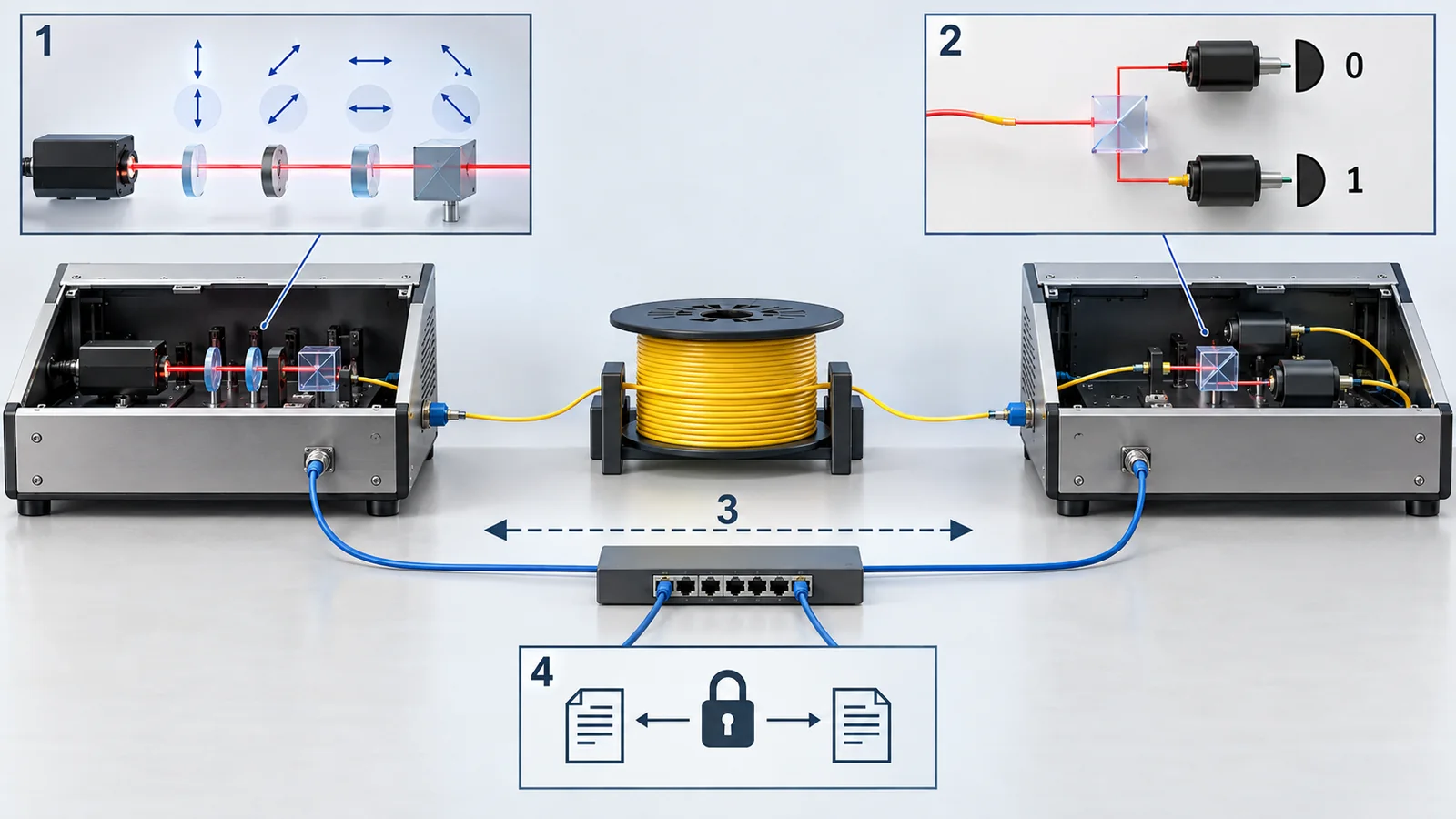
Toshiba's quantum offering has two parts: QKD equipment and key-management software (quantum communication), and research on parts for superconducting qubits. The first illustration shows how QKD works and the second shows how it differs from PQC.
Research on quantum computer parts: the "go-between" of two qubits
Toshiba's research page says that, toward quantum computers built from superconducting circuits, it has so far proposed three things: the Kerr parametric oscillator (a circuit that creates a Schrödinger's-cat state), the quantum bifurcation machine (a quantum computer built on it that could work as an annealing type or a gate type), and the double-transmon coupler (a go-between for two qubits) Sourced. The coupler was confirmed on an actual chip with RIKEN in 2024.
Toshiba's "SQBM+" is combinatorial-optimization software developed with ideas taken from quantum computing research, and it runs on ordinary computers such as GPUs and FPGAs. Toshiba itself describes it as "a new classical mechanical method" also known as "pseudo-quantum", so it is not a quantum computer Sourced (References 24, 25). As a profile of a quantum computing company, this article does not count that software as part of Toshiba's quantum computer business.
Toshiba says that for the double-transmon coupler to work, the coherence time must be longer than the gate operation, which required "the superconducting materials used, the surrounding circuit design, and the fabrication processes" to be "carefully considered" Sourced. Indeed, the two qubits are reported to have T1 (how long the excited state lasts) of 210 to 230 microseconds and T2 (how long the superposition's phase lasts) of 130 to 360 microseconds. RIKEN's announcement also says the chip used state-of-the-art fabrication with superconducting through-silicon vias (TSVs) Sourced.
The other area is optical parts for quantum communication. The transmitter for satellite QKD uses several semiconductor lasers (VCSELs), controlled by an FPGA, to send photons at 1 GHz. And the 2025 Nature paper reached 254 km without the "cryogenic photon detectors" previously needed, detecting single photons with semiconductor avalanche photodiodes Sourced. From a materials and components standpoint, the distance and speed of QKD depend on photon loss, detector noise and laser stability. These are covered in our explainers on semiconductor lasers, photodetectors, optical fiber, silicon photonics and superconducting qubits.
11. The risks this company carries
| Risk | Substance | Category |
|---|---|---|
| The size of the quantum business cannot be checked from outside | Revenue, spending and headcount are not disclosed. Because it is unlisted we could not find a securities report either (only Toshiba's own results releases) | Sourced |
| QKD is not "the only answer" to quantum computers | The same threat has another defence, PQC (which can be swapped in by software), and Toshiba itself is moving to use both. The more PQC is adopted, the more limited QKD demand could become | Inference |
| The walls of distance and cost | Fiber alone struggles beyond a few hundred kilometers because of signal loss. Satellites, quantum repeaters and PQC bridging are all still developing, and tests with LEO satellites are planned for fiscal 2027 | Sourced |
| Security also depends on how the equipment is built | QKD has theoretical security, but the actual equipment matters. An independent evaluation by the UK NPL exists, but this article has not checked the views of national agencies on QKD | Sourced |
| The gap between "demonstration" and "commercial" | The 57.6 Tbps result with KDDI is a demonstration on a commercial network, and the 600 km network with NTT Docomo Business has only begun construction. Commercial services are limited to places such as the Orange Business service in the Paris area | Sourced |
| The 2020 market forecast and share target are unverified | The "about US$20 billion in fiscal 2035 and about 25% share in fiscal 2030" in the October 2020 release was the company's view at the time, and we could not confirm how it has played out | Not yet confirmed |
| The quantum computer research is far from a finished machine | The double-transmon coupler is a two-qubit result. We could not confirm any plan or qubit count for a machine that lines up many qubits | Sourced |
| A change in corporate structure | Delisted in December 2023 and now wholly owned by TBJH Corporation. The form of its management and disclosure could change (the situation as of 16 October 2026) | Sourced |
12. Glossary
- Quantum key distribution (QKD)
- A technology that delivers an encryption key on photons and detects snooping. Not a quantum computer.
- Post-quantum cryptography (PQC)
- Encryption that uses math problems thought hard even for quantum computers. It can be swapped in by software.
- "Harvest now, decrypt later"
- The worry that someone saves today's ciphertext and decrypts it with a future quantum computer.
- Qubit
- The smallest unit of information in a quantum computer. It can be in a state of being 0 and 1 at once.
- Physical qubit / logical qubit
- A physical qubit is an actual qubit on the chip. A logical qubit is a sturdy qubit made through error correction.
- Gate and fidelity
- A gate is an operation on qubits. Fidelity is the probability that the operation goes as intended.
- Transmon
- A common form of superconducting qubit, relatively resistant to electrical noise around it.
- Coupler
- A circuit that adjusts the strength of the link between two qubits.
- T1 / T2
- How long a qubit keeps its excited state (T1) and how long it keeps the phase of a superposition (T2).
- Twin-field QKD
- A QKD scheme that extends distance by interfering light at a point between the sender and the receiver.
- Quantum repeater
- A part for carrying quantum states over long distances without destroying them. Still at the research stage.
- Quantum-inspired
- A method that takes hints from quantum computing but runs on ordinary computers. Not a quantum computer.
- Parent Company Status Report
- A statutory report that a parent files in Japan about a listed subsidiary.
13. References
- Toshiba FY2025 Consolidated Business Results (15 May 2026). Consolidated net sales and operating income (U.S. GAAP). The word "quantum" does not appear. https://www.global.toshiba/content/dam/toshiba/ww/ir/corporate/finance/pdf/tpr2025q4e.pdf
- Toshiba Corporate Data (as of 31 March 2026). Headquarters, founding, capital, consolidated net sales and consolidated headcount. Checked 16 October 2026. https://www.global.toshiba/ww/outline/corporate/profile.html
- Toshiba Financial Highlights (IR). A statement that Toshiba Corporation's common shares were delisted on 20 December 2023. Checked 16 October 2026. https://www.global.toshiba/ww/ir/corporate/finance.html
- Toshiba Corporation Parent Company Status Report for the 187th fiscal period (30 June 2026, filed with the Kanto Local Finance Bureau; EDINET document S100YNOK; in Japanese). TBJH Corporation holds all of Toshiba's shares (four shares). https://disclosure2dl.edinet-fsa.go.jp/searchdocument/pdf/S100YNOK.pdf
- Toshiba Toshiba launches Quantum Key Distribution (QKD) System Business (news release, 19 October 2020). https://www.global.toshiba/ww/news/corporate/2020/10/pr1901.html
- Toshiba High-speed quantum cryptographic communications with key distribution (news release, 11 September 2018). A one-month average above 10 Mbps. https://www.global.toshiba/ww/news/corporate/2018/09/pr1101.html
- Nature Photonics Long-distance key distribution by twin-field QKD with dual-band stabilization, Nature Photonics 15, 530–535 (published 7 June 2021). Cited as a Toshiba result in the LQUOM announcement. https://www.nature.com/articles/s41566-021-00811-0
- Pittaluga et al. (Toshiba Europe) Long-distance coherent quantum communications in deployed telecom networks, Nature 640, 911–917 (published 23 April 2025). DOI 10.1038/s41586-025-08801-w. https://www.nature.com/articles/s41586-025-08801-w
- Toshiba Europe Toshiba breakthrough brings quantum communications to existing national-scale telecommunications infrastructure (24 April 2025). https://www.toshiba.eu/quantum/news/toshiba-breakthrough-on-national-quantum-networking/
- Toshiba (Corporate Laboratory) Toshiba Successfully Develops High-Speed, Compact QKD Transmitter-Receiver System for Satellite Deployment (28 January 2026). https://www.global.toshiba/ww/technology/corporate/rdc/rd/topics/26/2601-02.html
- Toshiba and LQUOM Toshiba and LQUOM Sign Joint Research Agreement on Long-Distance QKD Using Quantum Repeater Technology (19 March 2026). https://www.global.toshiba/ww/news/corporate/2026/03/news-20260319-01.html
- NTT Docomo Business, Toshiba and NEC Construction begins on a wide-area quantum cryptographic communication network of about 600 km linking Tokyo, Nagoya and Osaka, a first for Japan (30 June 2026; in Japanese). https://www.ntt.com/about-us/press-releases/news/article/2026/0630_2.html
- Toshiba Digital Solutions and others Successful high-capacity data transmission using post-quantum security technologies on a commercial network (18 February 2026; in Japanese). https://www.global.toshiba/jp/news/digitalsolution/2026/02/news-20260218-01.html
- Toshiba Europe Orange Business and Toshiba partner to launch first commercial quantum-safe network service in France (11 June 2025). https://www.toshiba.eu/quantum/news/toshiba-orange-launch-commercial-quantum-network/
- Toshiba Europe Toshiba Enables Global Connectivity for Quantum-Safe Networks with Bridging Solution (2 March 2026). https://www.toshiba.eu/quantum/news/toshiba-enables-global-connectivity-for-quantum-safe-networks-with-bridging-solution/
- Toshiba Europe Toshiba Europe Limited and Quantum Bridge Technologies Demonstrate Global Quantum-Safe Networking capability (announced at OFC 2026). https://www.toshiba.eu/quantum/news/toshiba-europe-limited-and-quantum-bridge-technologies-demonstrate-global-quantum-safe-networking-capability/
- Toshiba Quantum Key Distribution (QKD product page). Checked 16 October 2026. https://www.global.toshiba/ww/products-solutions/security-ict/qkd.html
- Toshiba Europe Quantum Key Distribution (product page). The stated "150 km+" quantum-safe networking range. Checked 16 October 2026. https://www.toshiba.eu/quantum/products/quantum-key-distribution/
- Toshiba Europe Toshiba Quantum (quantum technology home page). Independent evaluation by the UK NPL, the reactor demonstration with Purdue University and ORNL, the trial with Quantum Corridor and other listed items. Checked 16 October 2026. https://www.toshiba.eu/quantum/
- Toshiba (Corporate R&D Center) Research and Development of Quantum Computers (research page). Research on quantum computers using superconducting circuits; proposals of the Kerr parametric oscillator, the quantum bifurcation machine and the double-transmon coupler. Checked 16 October 2026. https://www.global.toshiba/ww/technology/corporate/rdc/rd/quantum-computer.html
- Toshiba Toshiba's Proposed Double-Transmon Coupler for Superconducting Quantum Computers Achieves World-Class Two-Qubit Gate Performance (22 November 2024). https://www.global.toshiba/ww/technology/corporate/rdc/rd/topics/24/2411-03.html
- RIKEN Scientists develop novel high-fidelity quantum computing gate (RIKEN news, November 2024). Single-qubit gate fidelity 99.98%. https://www.riken.jp/en/news_pubs/research_news/pr/2024/20241122_2/index.html
- Li et al. (RIKEN and Toshiba) Realization of High-Fidelity CZ Gate Based on a Double-Transmon Coupler, Physical Review X 14, 041050 (21 November 2024). DOI 10.1103/PhysRevX.14.041050. https://doi.org/10.1103/PhysRevX.14.041050
- Toshiba Quantum-Inspired Optimization Solutions SQBM+ (product page). Quantum-inspired optimization software. Checked 16 October 2026. https://www.global.toshiba/ww/products-solutions/ai-iot/sbm.html
- Toshiba Digital Solutions Announcing the Launch of the Quantum-Inspired Optimization Solution SQBM+ (news release, 2 March 2022). https://www.global.toshiba/ww/company/digitalsolution/news/2022/0302.html
14. Claim-to-source audit
| Claim in the article | Category | Source |
|---|---|---|
| Toshiba's headquarters, founding, capital, consolidated net sales (FY2025: yen 3,709.1 billion) and 94,051 consolidated employees | Sourced | Reference 2 https://www.global.toshiba/ww/outline/corporate/profile.html |
| Consolidated net sales and operating income (FY2024 and FY2025); the word "quantum" does not appear in the results release | Sourced | This article's own text search / Reference 1 https://www.global.toshiba/content/dam/toshiba/ww/ir/corporate/finance/pdf/tpr2025q4e.pdf |
| Delisting on 20 December 2023; TBJH Corporation holds all shares (four shares) | Sourced | References 3 and 4 https://www.global.toshiba/ww/ir/corporate/finance.html https://disclosure2dl.edinet-fsa.go.jp/searchdocument/pdf/S100YNOK.pdf |
| Quantum revenue, R&D expense, capital spending and dedicated headcount are not disclosed | Not yet confirmed | None is disclosed, and this article makes no estimate |
| QKD business launch (19 October 2020), the NICT order, joint verification with BT, the 2020 market forecast and share target (not used), the manufacturing base in Cambridge | Sourced | The forecast is the company's view at the time / Reference 5 https://www.global.toshiba/ww/news/corporate/2020/10/pr1901.html |
| A monthly average key distribution speed above 10 Mbps (11 September 2018) | Sourced | Reference 6 https://www.global.toshiba/ww/news/corporate/2018/09/pr1101.html |
| Twin-field QKD over 555 km and 605 km (Nature Photonics, 2021) | Sourced | Reference 7 https://www.nature.com/articles/s41566-021-00811-0 |
| Coherent quantum communication over 254 km at 110 bit/s with non-cryogenic detectors (Nature, 23 April 2025) | Sourced | References 8 and 9 https://www.nature.com/articles/s41586-025-08801-w https://www.toshiba.eu/quantum/news/toshiba-breakthrough-on-national-quantum-networking/ |
| Satellite QKD transmitter and receiver (1 GHz, transmitter 1.6 kg, receiver about 9 kg), and the planned tests with LEO satellites in fiscal 2027 (28 January 2026) | Sourced | The fiscal 2027 tests are a company plan / Reference 10 https://www.global.toshiba/ww/technology/corporate/rdc/rd/topics/26/2601-02.html |
| Joint research with LQUOM (March 2026 to March 2027) and the 2023 CVC investment | Sourced | Reference 11 https://www.global.toshiba/ww/news/corporate/2026/03/news-20260319-01.html |
| Start of construction of the roughly 600 km Tokyo-Nagoya-Osaka QKD network (30 June 2026) and the Ministry's goal of social implementation by 2030 | Sourced | Reference 12 https://www.ntt.com/about-us/press-releases/news/article/2026/0630_2.html |
| 57.6 Tbps transmission on a commercial network with KDDI and Nokia (18 February 2026), QKD plus PQC, AES and Rocca-S | Sourced | Reference 13 https://www.global.toshiba/jp/news/digitalsolution/2026/02/news-20260218-01.html |
| Orange Quantum Defender (11 June 2025, QKD plus PQC, Paris area) | Sourced | Reference 14 https://www.toshiba.eu/quantum/news/toshiba-orange-launch-commercial-quantum-network/ |
| A function to join QKD networks with PQC (2 March 2026) | Sourced | Reference 15 https://www.toshiba.eu/quantum/news/toshiba-enables-global-connectivity-for-quantum-safe-networks-with-bridging-solution/ |
| Intercontinental demonstration with QBT using DSKE (OFC 2026), and the statement that PQC relies on computational assumptions | Sourced | Reference 16 https://www.toshiba.eu/quantum/news/toshiba-europe-limited-and-quantum-bridge-technologies-demonstrate-global-quantum-safe-networking-capability/ |
| The description of the QKD product and the "150 km+" claim, the UK NPL's independent evaluation, the reactor demonstration with Purdue University and ORNL | Sourced | Toshiba's stated values / References 17, 18 and 19 https://www.global.toshiba/ww/products-solutions/security-ict/qkd.html https://www.toshiba.eu/quantum/products/quantum-key-distribution/ https://www.toshiba.eu/quantum/ |
| Research on superconducting quantum computers (Kerr oscillator, quantum bifurcation machine, double-transmon coupler) | Sourced | Reference 20 https://www.global.toshiba/ww/technology/corporate/rdc/rd/quantum-computer.html |
| Double-transmon coupler: two-qubit gate 99.90% (12-hour average), 48 ns, about 6 kHz to about 80 MHz, T1 and T2, the 99.99% target | Sourced | Toshiba and RIKEN's stated values / References 21 and 23 https://www.global.toshiba/ww/technology/corporate/rdc/rd/topics/24/2411-03.html https://doi.org/10.1103/PhysRevX.14.041050 |
| Single-qubit gate 99.98% and the use of superconducting TSVs | Sourced | Reference 22 https://www.riken.jp/en/news_pubs/research_news/pr/2024/20241122_2/index.html |
| SQBM+ is quantum-inspired software on classical computers ("pseudo-quantum") | Sourced | References 24 and 25 https://www.global.toshiba/ww/products-solutions/ai-iot/sbm.html https://www.global.toshiba/ww/company/digitalsolution/news/2022/0302.html |
| The division of quantum companies into four types | Our calculation | This article's own classification. Company names are examples from this series |
| A finished quantum computer offering, the qubit count of any machine using the coupler, and the specific timing of the satellite tests | Not yet confirmed | Not confirmed. This article makes no estimate |
| The reading that it treats quantum computing progress as a tailwind for its own quantum communication | Inference | This article's interpretation / References 5 and 10 https://www.global.toshiba/ww/news/corporate/2020/10/pr1901.html https://www.global.toshiba/ww/technology/corporate/rdc/rd/topics/26/2601-02.html |
| The reading that sales run mainly through telecom operators | Inference | This article's interpretation / References 5, 12, 13 and 14 https://www.global.toshiba/ww/news/corporate/2020/10/pr1901.html https://www.ntt.com/about-us/press-releases/news/article/2026/0630_2.html https://www.global.toshiba/jp/news/digitalsolution/2026/02/news-20260218-01.html https://www.toshiba.eu/quantum/news/toshiba-orange-launch-commercial-quantum-network/ |
| The reading that the superconducting research aims to contribute parts, with no near-term commercial machine | Inference | This article's interpretation / References 20 and 21 https://www.global.toshiba/ww/technology/corporate/rdc/rd/quantum-computer.html https://www.global.toshiba/ww/technology/corporate/rdc/rd/topics/24/2411-03.html |
| The reading that QKD is sold as one layer used alongside PQC, not as its replacement | Inference | This article's interpretation / References 14, 15 and 16 https://www.toshiba.eu/quantum/news/toshiba-orange-launch-commercial-quantum-network/ https://www.toshiba.eu/quantum/news/toshiba-enables-global-connectivity-for-quantum-safe-networks-with-bridging-solution/ https://www.toshiba.eu/quantum/news/toshiba-europe-limited-and-quantum-bridge-technologies-demonstrate-global-quantum-safe-networking-capability/ |
| The risk that more PQC adoption limits QKD demand | Inference | This article's interpretation |
Last updated 16 October 2026 / Troy Technical
All figures in this article rest on official announcements by Toshiba, Toshiba Europe and its partners and on peer-reviewed papers. No research-firm estimates or press-based figures have been used (Toshiba's 2020 market forecast is mentioned only as the company's view and is not used). Passages marked "Inference" are this article's interpretation of primary sources, not statements made by the company. Performance figures are Toshiba's stated values or paper values and do not rank Toshiba against other companies. Checked 16 October 2026.