COMPANY PROFILE / QUANTUM COMPUTING
Xanadu
Building a quantum computer out of light: a Canadian company listed in the U.S. and Canada since March 2026
The qubits (the basic units of quantum computation) in most quantum computers are made from supercooled circuits or from atoms held in a vacuum. Xanadu is trying to make them from particles of light, called photons. Light travels through optical fiber, so the idea is to link many small computing modules together to build a large machine. Yet the company itself writes in its annual report that it is still at a pre-commercial stage. This profile explains what it builds, how much it spends, who it works with and what it is aiming for, using only primary sources we could check, and in terms a reader new to quantum computing can follow.
- Xanadu in 30 seconds, and where it stands in quantum computing
- The logo and how the name is written
- Where the company sits in quantum computing
- Scale
- Resources committed to quantum computing
- What it has done so far
- What comes next
- What the company is aiming for in quantum computing
- Map of quantum computing partnerships
- Technologies, products and services
- Risks this company carries
- Glossary, references and claim-to-source audit
1. Xanadu in 30 seconds, and where it stands in quantum computing
Technologies LimitedAn Ontario, Canada company; a holding company incorporated on 2 October 2025
XNDUMerger with a special purpose acquisition company (SPAC) completed on 26 March 2026; trading began the next day
& other (secondary: software)Qubits made from light; also provides the PennyLane software
GKP encodingComputation at room temperature, with only the detectors cooled, as the company describes it
500 logical qubits (2029-2030)A company target, not an achievement
Quantum computing companies differ mainly in how they build a qubit: from circuits (superconducting), from atoms or ions held in place, or from light or semiconductors. Xanadu belongs to the third group, and says in its own release that it is the first pure-play photonic quantum computing company to list on public markets Sourced. Its future therefore depends on whether light can really yield a large, error-resistant quantum computer. What is visible today is an experimental machine (Aurora) and papers on key components; shipments of quantum computers as products have not begun Sourced.
Qubit (quantum bit): the basic unit of a quantum computer. Unlike an ordinary bit, which is 0 or 1, a qubit can be in a superposition of 0 and 1.
Physical and logical qubits: a physical qubit is one real piece of hardware, and it makes mistakes easily because of noise. A logical qubit bundles hundreds of physical qubits so that errors can be found and fixed, and the bundle behaves like one reliable qubit. When you read a number, always check whether it counts physical or logical qubits.
Error correction: qubits are fragile, so a quantum computer is expected to detect and fix errors as it computes. For more, see our explainers on quantum error correction and the surface code, and on logical qubits and fault-tolerant quantum computing.
2. The logo and how the name is written

A note on names: the listed company is Xanadu Quantum Technologies Limited, a holding company set up in October 2025. The research and development is done by its subsidiary Xanadu Quantum Technologies Inc., founded in December 2016 and called “Old Xanadu” in the annual report. The SPAC was Crane Harbor Acquisition Corp., which became a subsidiary after the merger. This article writes “Xanadu” unless the distinction matters.
Official site: https://www.xanadu.ai/ (the logo was taken from the image embedded in the site header)3. Where the company sits in quantum computing
Quantum computing companies have different strengths and challenges depending on what they use to make a qubit. The figure below sorts the companies in this series into four types. Xanadu falls in the third type, “photonic, silicon and other approaches” (and its software also touches the fourth).
Here is each type in a sentence or two.
| Type | What the qubit is | Strength | Difficulty |
|---|---|---|---|
| Superconducting | An electrical circuit cooled to extremely low temperature | Circuits can be made with semiconductor-style processes | Needs refrigerators and a great deal of wiring |
| Trapped ions and neutral atoms | Atoms held in place with electric fields or light | Each one is identical, so precision is high | Increasing the number, and operating speed |
| Photonic, silicon and other | A particle of light (photon), the spin of an electron in a semiconductor, and so on | Can be linked by optical fiber; may be made in semiconductor factories | The approach is still unproven; light is easily lost |
| Software, cloud and ecosystem | No qubits of its own | Supports the whole field through cloud, software and communications | No hardware advantage of its own |
4. Scale
Nearly all of Xanadu’s business is quantum computing. These are the numbers in its annual report Sourced.
| Metric (US$ thousand) | Year to Dec 2023 | Year to Dec 2024 | Year to Dec 2025 |
|---|---|---|---|
| Revenue | 2,479 | 1,589 | 4,617 |
| Research and development expense | 35,718 | 39,223 | 55,237 |
| Net loss | 35,592 | 45,968 | 70,667 |
| Cash and cash equivalents at year end | 117,459 | 77,619 | 16,164 |
| 2026 (US$ million) | Q1 (January-March) | Q2 (April-June) |
|---|---|---|
| Revenue | 2.8 | 1.5 |
| Research and development expense | 17.3 (our calculation: 19.7 - 2.4) | 19.7 |
| Net loss | 20.6 | 42.1 |
| Cash and cash equivalents at period end | not checked in this article | 312.8 (30 June) |
| Item | Detail (as of 31 December 2025) |
|---|---|
| Employees | 264 (240 full-time, including 152 physicists and engineers working on quantum technology) |
| Headquarters facility | About 48,000 square feet of combined office and nanophotonics space leased in Toronto, under a lease running to 30 September 2032 |
| Patents | 70 patent families (groups of patents on the same invention); 33 patents granted and 98 applications pending |
| Revenue concentration | Three customers accounted for 78% of revenue in the year to December 2025 |
Changes in revenue do not show whether quantum computers are selling. The company itself writes that it is at a pre-commercial stage and does not yet offer quantum computers for commercial sale. Its income comes mainly from algorithm development, proof-of-concept projects, sponsored research and education, plus cloud access to its machines (quantum computing as a service, QCaaS) Sourced. The company also says that, in the near term, revenue will not be a reliable indicator of its performance. Cash at the end of 2025 had fallen to US$16.2 million. The annual report explains that the company’s history of losses and need for more funding had initially raised substantial doubt about its ability to continue as a going concern, and that the business combination of March 2026 and the concurrent financing (about US$302 million in gross proceeds) addressed it Sourced. Losses are common among research-stage companies, but how long the funding lasts is an important lens for reading this one.
5. Resources committed to quantum computing
This table lists what can be quantified and what cannot.
| Type of resource | Detail | Status |
|---|---|---|
| People | 152 of 264 employees are physicists and engineers working on quantum technology (end of 2025). Besides its Toronto headquarters and research site, the company has a photonic packaging facility (where optical chips are assembled) in Toronto. It is expanding in the United States: according to its second-quarter 2026 release, U.S. headcount has grown more than five-fold since 2023, with operations anchored in Albany, New York | Sourced |
| Money | R&D expense of US$55.2 million in 2025; capital expenditure of US$6.2 million in the same year. The financing that accompanied the business combination totalled about US$302 million (US$275 million from a PIPE, a private placement alongside the listing, plus US$27 million of cash from the SPAC trust account). In May 2026 the company set up a facility with Yorkville Advisors to issue up to US$300 million of shares, and raised US$67.2 million under it in the second quarter of 2026 | Sourced |
| Outside investments, acquisitions, joint ventures | No investments in, acquisitions of, joint ventures with or divestments of other companies appear in the annual report (it mentions possible future acquisitions). The SPAC, Crane Harbor, became a subsidiary in the merger | Not found |
| Universities, research institutions, public funding | Stages A (April 2025) and B (November 2025, up to US$15 million) of DARPA’s Quantum Benchmarking Initiative (QBI) / a four-year research partnership with the U.S. Air Force Research Laboratory (April 2025) / a three-year partnership with the University of Maryland (March 2025) / up to C$23 million under the Government of Canada’s Canadian Quantum Champions Program (December 2025) / C$195 million from the Government of Canada’s Strategic Response Fund (definitive agreement on 28 August 2026) | Sourced |
| Investment in manufacturing | A C$10 million photonic packaging facility in Toronto (opened June 2025). A plan to convert a 158,000-square-foot Toronto site into a manufacturing facility called “Inception” (announced by the company on 28 August 2026) | Sourced; the plan is Not yet confirmed |
Status of the main devices and products
| Name | Approach and scale | Typical performance or content (as published by the company) | Stage | Date and source |
|---|---|---|---|---|
| Borealis | Photonic; 216 squeezed-light modes (a Gaussian boson sampling machine, which solves only one specific kind of problem) | The paper reports that the machine produced in 36 microseconds a sample that exact methods on the best supercomputers would need more than 9,000 years to produce (company claim) | Experimental demonstration | Nature paper, June 2022 |
| Aurora | Photonic; 35 photonic chips, four racks, 84 squeezers, 36 photon-number-resolving detectors; 12 physical qubit modes per clock cycle | Produced a cluster state spanning 86.4 billion modes; ran a distance-2 repetition code with real-time decoding. The paper itself calls the machine a “sub-performant” scale model | Experimental demonstration | Nature paper, 22 January 2025 |
| GKP qubit source chip | Photonic; silicon nitride on 300 mm wafers | Generates GKP states on a chip, showing some of the features needed for fault tolerance | Experimental demonstration | Nature paper, 4 June 2025 |
| Next-generation system | Photonic; up to 100,000 physical and 500 logical qubits | The company’s design target | Not yet confirmed | Targeted for 2029-2030. No achievement as of 16 October 2026 |
| PennyLane / Catalyst | Software (a quantum programming toolkit and compiler) | Open source. Also works with Amazon Braket. PennyLane 0.45 and Catalyst 0.15 were released in the second quarter of 2026 | Available | Results release, 5 August 2026 |
Light is hard to disturb, but its great weakness is that it is lost bit by bit along the way. The Aurora paper itself says that optical loss is the dominant and most challenging hurdle to crossing the fault-tolerance threshold Sourced. So what Xanadu asks of its partners is largely materials and manufacturing. The GKP source chip, for example, is built from silicon nitride (SiN) waveguides (the paths that guide light) on 300 mm wafers, and the paper shows that lower loss means better states. The other items are thin-film lithium niobate (TFLN), a material that switches light quickly with electric signals (developed with HyperLight, with waveguide loss reported below 2 dB/m), the loss at the joint between optical fiber and chip (reported in the second-quarter 2026 release as 0.085 dB per facet on average), and a 300 mm process for transition edge sensors (TES), superconducting detectors that count photons (developed with Applied Materials) Sourced. Seen as a materials problem, this is less a quantum puzzle than a contest over how far the loss of semiconductor and optical parts can be reduced.
6. What it has done so far
| When | Event | Meaning |
|---|---|---|
| December 2016 | Xanadu Quantum Technologies Inc. (Old Xanadu) incorporated in Canada | The starting point of today’s business |
| June 2022 | Nature paper on Borealis, a 216-mode photonic processor | The company’s claim of quantum computational advantage; see the discussion below |
| 22 January 2025 | Nature paper on Aurora, with several racks linked by optical fiber | The company describes it as the first integration of the photonic building blocks in one machine |
| April and November 2025 | Selected for Stage A and then Stage B (up to US$15 million) of DARPA QBI | A U.S. government framework for testing plans for utility-scale machines |
| 4 June 2025 | Nature paper on a silicon-nitride chip that makes GKP qubit states | Experimental support for making the raw material of error-resistant qubits on a chip |
| 23 June 2025 | Opened a C$10 million photonic packaging facility in Toronto | In-house equipment for joining optical chips and fiber |
| 3 November 2025 | Announced a business combination agreement with Crane Harbor Acquisition Corp. (a SPAC) | Chose a merger with a SPAC as the route to a listing |
| 11 March 2026 | Announced it had entered negotiations with the governments of Canada and Ontario on up to C$390 million of support for “Project OPTIMISM”, a manufacturing plan | At that point only “under consideration”, not final |
| 26 and 27 March 2026 | Completed the business combination (26th). Class B subordinate voting shares began trading on Nasdaq and the TSX as “XNDU” (27th) | The listing itself. Gross proceeds were about US$302 million |
| May 2026 | Set up a facility to issue up to US$300 million of shares (Yorkville Advisors) | A line that lets the company raise money by issuing shares when it chooses |
| 28 August 2026 | Signed a definitive agreement with the Government of Canada for C$195 million of support. Announced the “Inception” manufacturing site in Toronto | The whole federal portion is now definitive. We could not confirm the Ontario portion |
| 8 October 2026 | On DARPA’s public page (current as of that date), Xanadu is a Stage B participant | It is not on the list of companies that have moved to Stage C |
7. What comes next
early fault-tolerance blocksThe company's outlook in its 20-F
500 logical qubitsThe company's design target
All of these are company targets and plans, not achievements Not yet confirmed. In its 20-F the company states a 2029-2030 target for reaching the level at which it can deliver broad commercially valuable applications Sourced.
None of the following appears in the primary sources we checked Not yet confirmed.
The price, delivery date and customers for its own quantum computers / the qubit count and error rate of the machine after Aurora / whether Ontario’s support is final, and its amount / the completion date and total investment for Inception. The 20-F also warns that government support may carry conditions such as job creation, performance targets and eligible spending.
8. What the company is aiming for in quantum computing
This section includes points the company does not state directly. They are inferences from what the primary sources show, given with their basis.
| What we read from the sources | Primary-source basis | Type |
|---|---|---|
| The goal is a data-center-style quantum computer: small machines linked by optical fiber into a large one | The 20-F describes racks connected by optical fiber, modular expansion and installation in data centers. Aurora links four racks by fiber | Sourced |
| Income will stay tilted toward government and research contracts for now | 78% of 2025 revenue came from three customers, and the 20-F says Canadian and U.S. government contracts have historically been a significant portion of revenue | Inference |
| The focus has shifted to cutting loss, that is, to manufacturing | The 20-F says the remaining challenges are mainly in manufacturing optimization, especially lowering optical loss on semiconductor platforms; investments with Applied Materials, Corning, Tower Semiconductor and the Inception site follow | Inference |
| PennyLane is meant as a doorway that also draws in users of other companies’ machines | The 20-F calls PennyLane an industry platform and a strategic channel, and expects users’ workloads to migrate naturally to its photonic hardware | Sourced (the company's own description) |
| Reaching the target requires growth by orders of magnitude | Aurora has 12 physical qubit modes per clock cycle; the target is up to 100,000 physical and 500 logical qubits | Inference |
Dividing the target of up to 100,000 physical qubits and up to 500 logical qubits gives at least 200 physical qubits for each logical qubit Our calculation (100,000 / 500 = 200). That implies the company expects the redundancy needed for error correction to be 200-fold or more. Aurora, by contrast, handles 12 physical qubit modes per clock cycle, and its paper calls itself a “sub-performant” scale model Sourced. So there is a large gap, in both scale and performance, between today’s experimental machine and the 2029-2030 target, and we read the main task in closing it as manufacturing technology that lowers optical loss Not yet confirmed.
9. Map of quantum computing partnerships
The figure below shows only relationships stated in the annual report and official announcements, with lines colored by type.
10. Technologies, products and services
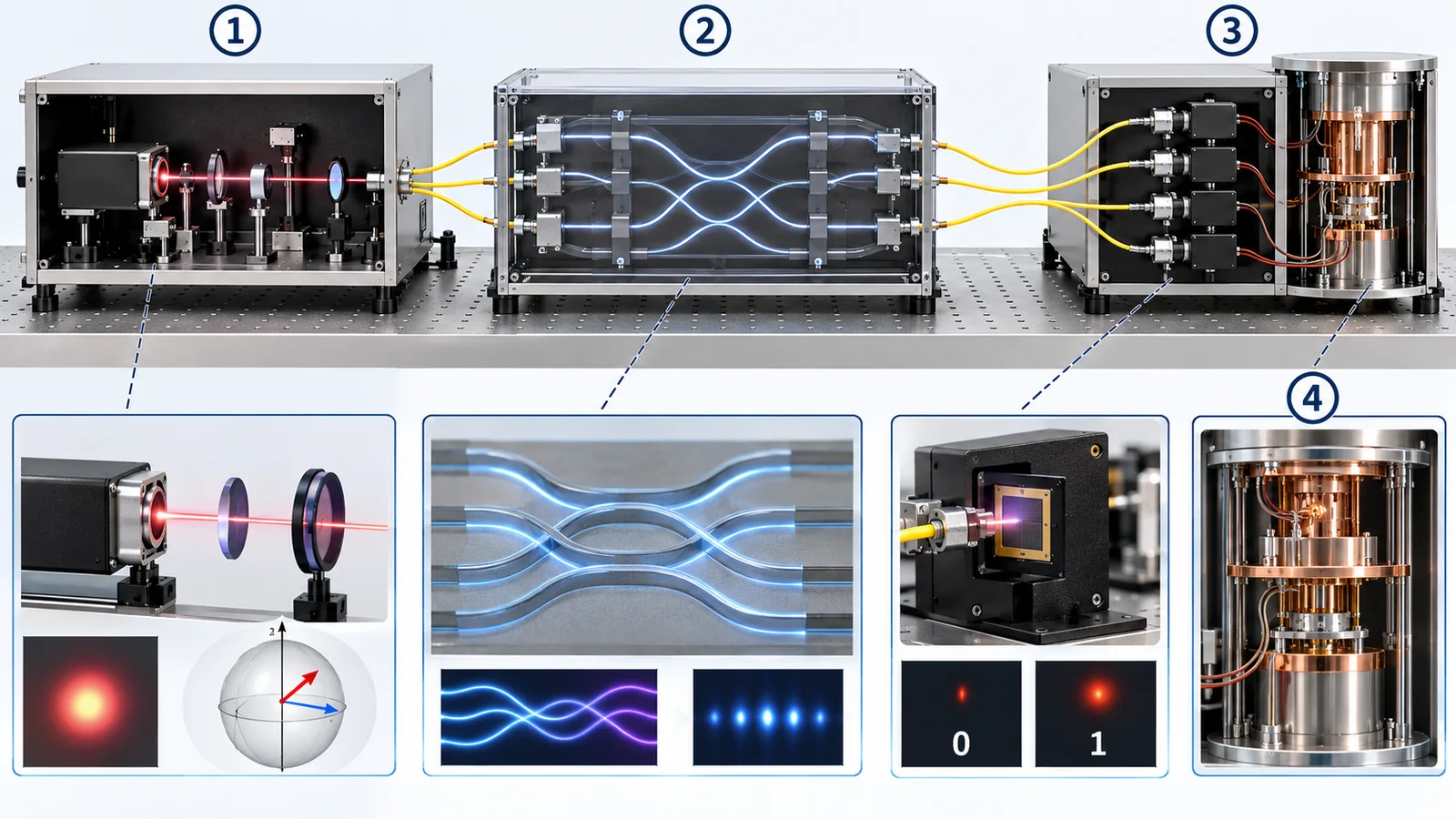
Xanadu’s technology begins with putting a qubit on a particle of light. The next figure splits the overall flow into three parts.
What does it mean to make a qubit from light?
- Use photons: a particle of light carries the qubit. Light travels far through optical fiber, so small parts can be linked afterwards; that is the advantage.
- Encode information in GKP states: a lattice-like pattern is built over two values of a light wave (its “height” and its “offset”), and one bit is stored in it. Even if a small shift occurs, it is easier to tell afterwards which value was intended.
- Compute by measuring: first prepare a large “entangled train of light” (a cluster state), then measure it step by step to advance the computation (measurement-based quantum computing). The company explains that the train is extended in time (the light is made to wait in fiber), so the path length of the light does not grow easily even as the computation gets longer.
- Detect and fix errors: dedicated electronics (FPGAs and ASICs) read the measurement results in real time and judge where errors occurred (the plan is to use qLDPC codes, one family of error-correcting codes).
The 20-F states that the brief step in which detectors that count single photons (TES or superconducting nanowire detectors) confirm success is the only part of the process that does not occur at room temperature Sourced. So this is not “a quantum computer with no refrigeration” but a design that confines the cooling to the detectors. That makes the process for producing detectors in volume (the 300 mm TES process with Applied Materials) important. The optical chips are built on two materials, silicon nitride and thin-film lithium niobate, and the company reported that in the second quarter of 2026 its fabrication runs at outside foundries (contract semiconductor manufacturers) rose by about 75% and about 50% respectively (the release does not state the baseline) Sourced.
Using the photonics technology beyond quantum computing
According to the 20-F, Xanadu supplies photonic integrated circuits (PICs) to a major defense contractor for a U.S. government quantum sensing program. It is also starting to use its low-loss photonic packaging technology in pilot projects with partners in communications Sourced.
The company’s claim: the 2022 Nature paper reports that Borealis ran Gaussian boson sampling on 216 modes and that, using exact methods, the best classical algorithms and supercomputers would need more than 9,000 years on average to produce a single sample, against 36 microseconds for Borealis. The 2026 annual report describes the same result as a computation of two minutes that would take Fugaku, a top-five supercomputer, about seven million years, so the paper and the annual report express the figure differently (a difference of basis and definition; this article does not judge between them) Sourced.
The later debate: for Gaussian boson sampling experiments in general, research has shown that when optical loss is high, a classical computer can reproduce the results. A 2024 Nature Physics paper, for example, presents an algorithm that simulates “the largest-scale” experiment to date with modest computing resources and questions the claims of quantum advantage Sourced. We could not confirm whether the experiment that paper targets is Borealis itself. For how to read such claims, see our explainer on reading quantum advantage. Note that Borealis solves one specific problem and is not a general-purpose quantum computer with error correction.
11. Risks this company carries
| Risk | Detail | Type |
|---|---|---|
| Pre-commercial stage | The company itself states that it has no quantum computer yet available for sale and has not earned sustained commercial revenue | Sourced |
| Technology still being proven | The Aurora paper calls the machine a sub-performant scale model and names lowering optical loss as the hardest challenge. The 2029-2030 target lies in the future | Not yet confirmed |
| Funding runway | Cash at the end of 2025 was US$16.2 million, and the annual report says substantial doubt about continuing as a going concern had initially arisen, then addressed by the merger and financing. Net loss is large, and the company itself notes that it may need more funding | Sourced |
| Share dilution | A facility for up to US$300 million of new shares exists; using it dilutes existing holders. The company says it will use it opportunistically | Sourced |
| Concentrated customers and funders | 78% of revenue came from three customers. The annual report says government contracts may be terminated or constrained by budgets | Sourced |
| Reliance on others for manufacturing | Optical chips depend on outside foundry processes, and some of the underlying intellectual property belongs to others. Some components have few sources | Sourced |
| Conditions on government support | Support may come with conditions such as job creation and performance targets | Sourced |
| Internal control weaknesses | The annual report says the company identified material weaknesses in its internal control over financial reporting | Sourced |
| Competition from other approaches | Superconducting, ion, neutral-atom, silicon and other approaches are also advancing. Which will first reach utility scale is not settled | Inference |
| The quantum advantage claim | Borealis’s claim belongs to a field in which classical-side research has raised doubts (see the box above) | Sourced |
12. Glossary
- Qubit
- The basic unit of quantum computation. It uses a superposition of 0 and 1.
- Photon
- A particle of light. Xanadu builds qubits from information carried on photons.
- Physical / logical qubit
- A physical qubit is one piece of hardware and is sensitive to noise. A logical qubit bundles many physical qubits so that errors can be corrected.
- GKP qubit
- A scheme that stores information as a lattice pattern over two values of a light wave. Said to resist small shifts.
- Measurement-based quantum computing (MBQC)
- A method that first prepares a large entangled state and then computes by measuring it step by step.
- Cluster state
- A state in which many qubits are entangled like a web. The “raw material” for measurement-based computing.
- Squeezed light
- Light whose fluctuation in one value of the wave has been reduced. A basic ingredient of photonic quantum computing.
- Photon-number-resolving (PNR) detector
- A detector that counts photons one, two, and so on. Examples are TES and superconducting nanowire detectors.
- Transition edge sensor (TES)
- A superconducting photon-counting detector used at very low temperature.
- qLDPC code
- A family of error-correcting codes that may correct errors with little redundancy.
- Gaussian boson sampling
- An experiment that uses light to produce a particular probability distribution. It cannot do general computation.
- Quantum advantage
- A claim that a quantum computer beats classical computers by a wide margin on a specific problem. Read it as the company's claim.
- Photonic integrated circuit (PIC)
- An optical circuit integrated on one chip, here on silicon nitride or thin-film lithium niobate.
- SPAC
- Special purpose acquisition company: a shell company used to merge with a private company and make it listed.
- Form 20-F
- The annual report that foreign companies file with the U.S. SEC.
- PennyLane
- Xanadu’s open-source quantum programming toolkit.
13. References
- Xanadu Quantum Technologies Limited Form 20-F for the fiscal year ended December 31, 2025 (filed with the U.S. SEC, 9 April 2026). Business overview, financials, employees, patents, facilities, plans, risk factors. https://www.sec.gov/Archives/edgar/data/2097163/000121390026042080/ea0285152-20f_xanadu.htm
- Xanadu Quantum Technologies Limited Shell Company Report on Form 20-F (filed with the U.S. SEC, 1 April 2026; event date 26 March 2026). Completion of the business combination with the SPAC and the listing. https://www.sec.gov/Archives/edgar/data/2097163/000121390026038614/ea0283946-20f_xanadu.htm
- Xanadu Quantum Technologies Limited Form 6-K (filed with the U.S. SEC, 5 August 2026). Second-quarter 2026 results release: cash, revenue, R&D expense, net loss, the Yorkville Advisors share facility, second-quarter milestones. https://www.sec.gov/Archives/edgar/data/2097163/000209716326000020/exhibit991pressrelease-aug.htm
- Xanadu Quantum Technologies Limited Press release attached to Form 6-K (28 August 2026): “Government of Canada Invests CAD $195 Million in Xanadu to Build the Quantum Supply Chain”. https://www.sec.gov/Archives/edgar/data/2097163/000121390026095089/ea030272601ex99-1.htm
- Xanadu Quantum Technologies Limited Press release attached to Form 6-K (28 August 2026): “Xanadu Secures CAD $195 Million and Establishes Landmark Advanced Photonics Facility” (the Inception site in Toronto, 158,000 square feet). https://www.sec.gov/Archives/edgar/data/2097163/000121390026095089/ea030272601ex99-2.htm
- Crane Harbor Acquisition Corp. Press release attached to Form 8-K (filed with the U.S. SEC, 3 November 2025): announcement of the business combination with Xanadu, size and investors of the PIPE. https://www.sec.gov/Archives/edgar/data/2054174/000121390025104918/ea026354401ex99-1_crane.htm
- Aghaee Rad et al. (Xanadu) “Scaling and networking a modular photonic quantum computer”, Nature 638, 912-919 (22 January 2025). Aurora. https://doi.org/10.1038/s41586-024-08406-9
- Larsen et al. (Xanadu) “Integrated photonic source of Gottesman-Kitaev-Preskill qubits”, Nature 642, 587-591 (4 June 2025). https://doi.org/10.1038/s41586-025-09044-5
- Madsen et al. (Xanadu) “Quantum computational advantage with a programmable photonic processor”, Nature 606, 75-81 (1 June 2022). Borealis. https://doi.org/10.1038/s41586-022-04725-x
- Defense Advanced Research Projects Agency (DARPA) Quantum Benchmarking Initiative (QBI) public page: the content of each stage and the list of participants (current as of 8 October 2026). https://www.darpa.mil/research/programs/quantum-benchmarking-initiative
- Oh et al. “Classical algorithm for simulating experimental Gaussian boson sampling”, Nature Physics 20, 1461-1468 (25 June 2024). Classical simulation of Gaussian boson sampling experiments. https://doi.org/10.1038/s41567-024-02535-8
- Xanadu Official website (source of the logo; company overview). https://www.xanadu.ai/
14. Claim-to-source audit
| Claim in the text | Type | Source |
|---|---|---|
| Legal name, headquarters, date the holding company was formed (2 October 2025), subsidiary (Old Xanadu, formed December 2016) | Sourced | Reference 1 https://www.sec.gov/Archives/edgar/data/2097163/000121390026042080/ea0285152-20f_xanadu.htm |
| Completion of the SPAC (Crane Harbor) merger (26 March 2026), start of trading on Nasdaq and the TSX (27 March 2026), ticker XNDU | Sourced | Reference 1, 2 https://www.sec.gov/Archives/edgar/data/2097163/000121390026042080/ea0285152-20f_xanadu.htm https://www.sec.gov/Archives/edgar/data/2097163/000121390026038614/ea0283946-20f_xanadu.htm |
| Announcement of the business combination agreement (3 November 2025) and the structure of the PIPE (US$275 million) | Sourced | Reference 6, 1 https://www.sec.gov/Archives/edgar/data/2054174/000121390025104918/ea026354401ex99-1_crane.htm https://www.sec.gov/Archives/edgar/data/2097163/000121390026042080/ea0285152-20f_xanadu.htm |
| Total financing alongside the merger of about US$302 million (PIPE US$275 million, trust account US$27 million) | Sourced | Reference 1 https://www.sec.gov/Archives/edgar/data/2097163/000121390026042080/ea0285152-20f_xanadu.htm |
| Revenue, R&D expense, net loss and year-end cash (years to December 2023-2025) | Sourced | Reference 1 https://www.sec.gov/Archives/edgar/data/2097163/000121390026042080/ea0285152-20f_xanadu.htm |
| 264 employees (240 full-time; 152 physicists and engineers), 70 patent families (33 granted, 98 pending), about 48,000 square feet in Toronto | Sourced | Reference 1 https://www.sec.gov/Archives/edgar/data/2097163/000121390026042080/ea0285152-20f_xanadu.htm |
| 78% of 2025 revenue from three customers | Sourced | Reference 1 https://www.sec.gov/Archives/edgar/data/2097163/000121390026042080/ea0285152-20f_xanadu.htm |
| Substantial doubt about going concern initially arisen, then addressed by the merger and financing | Sourced | Reference 1 https://www.sec.gov/Archives/edgar/data/2097163/000121390026042080/ea0285152-20f_xanadu.htm |
| Material weaknesses in internal control over financial reporting identified | Sourced | Reference 1 https://www.sec.gov/Archives/edgar/data/2097163/000121390026042080/ea0285152-20f_xanadu.htm |
| Second-quarter 2026 revenue US$1.5 million, R&D US$19.7 million, net loss US$42.1 million, cash US$312.8 million | Sourced | Reference 3 https://www.sec.gov/Archives/edgar/data/2097163/000209716326000020/exhibit991pressrelease-aug.htm |
| First-quarter 2026 revenue US$2.8 million and net loss US$20.6 million | Sourced | Reference 3 https://www.sec.gov/Archives/edgar/data/2097163/000209716326000020/exhibit991pressrelease-aug.htm |
| First-quarter 2026 R&D expense of US$17.3 million (backed out from the second-quarter US$19.7 million and the US$2.4 million increase) | Our calculation | Our calculation (19.7 - 2.4 = 17.3). The inputs are the US$2.4 million increase stated in Reference 3 |
| Share facility with Yorkville Advisors of up to US$300 million; US$67.2 million raised in the second quarter | Sourced | Reference 3 https://www.sec.gov/Archives/edgar/data/2097163/000209716326000020/exhibit991pressrelease-aug.htm |
| U.S. headcount more than five-fold since 2023, base in Albany, New York; rise in foundry runs (TFLN about 75%, SiN about 50%); 0.085 dB coupling loss per facet | Sourced | Reference 3 https://www.sec.gov/Archives/edgar/data/2097163/000209716326000020/exhibit991pressrelease-aug.htm |
| Selection for DARPA QBI Stage A (April 2025) and Stage B (November 2025, up to US$15 million) | Sourced | Reference 1, 10 https://www.sec.gov/Archives/edgar/data/2097163/000121390026042080/ea0285152-20f_xanadu.htm https://www.darpa.mil/research/programs/quantum-benchmarking-initiative |
| On DARPA’s page as of 8 October 2026, Xanadu is a Stage B participant and is not among the Stage C companies | Sourced | Reference 10 https://www.darpa.mil/research/programs/quantum-benchmarking-initiative |
| Four-year partnership with the U.S. Air Force Research Laboratory, three-year partnership with the University of Maryland, Canadian Quantum Champions Program (up to C$23 million), memorandum with A*STAR (Singapore) | Sourced | Reference 1 https://www.sec.gov/Archives/edgar/data/2097163/000121390026042080/ea0285152-20f_xanadu.htm |
| Definitive agreement with the Government of Canada’s Strategic Response Fund for C$195 million (28 August 2026); the up to C$390 million of 11 March 2026 was “under consideration” | Sourced | Reference 4, 1 https://www.sec.gov/Archives/edgar/data/2097163/000121390026095089/ea030272601ex99-1.htm https://www.sec.gov/Archives/edgar/data/2097163/000121390026042080/ea0285152-20f_xanadu.htm |
| The Inception manufacturing site plan (Toronto, 158,000 square feet, tooling suppliers) | Sourced | Reference 5 https://www.sec.gov/Archives/edgar/data/2097163/000121390026095089/ea030272601ex99-2.htm |
| Photonic packaging facility in Toronto (C$10 million, opened 23 June 2025) | Sourced | Reference 1 https://www.sec.gov/Archives/edgar/data/2097163/000121390026042080/ea0285152-20f_xanadu.htm |
| Borealis: 216 modes; the paper’s report (more than 9,000 years by exact methods versus 36 microseconds) | Sourced | Reference 9 https://doi.org/10.1038/s41586-022-04725-x |
| The annual report’s account of Borealis (two minutes; about seven million years on Fugaku) differs in expression from the paper’s figure | Sourced | Reference 1, 9 https://www.sec.gov/Archives/edgar/data/2097163/000121390026042080/ea0285152-20f_xanadu.htm https://doi.org/10.1038/s41586-022-04725-x |
| Aurora: 35 chips, 84 squeezers, 36 photon-number-resolving detectors, 12 physical qubit modes per clock cycle, a cluster state of 86.4 billion modes, a distance-2 repetition code, “sub-performant” scale model | Sourced | Reference 7 https://doi.org/10.1038/s41586-024-08406-9 |
| Aurora: four racks, about 13 km of optical fiber, room-temperature operation (company description) | Sourced | Reference 1 https://www.sec.gov/Archives/edgar/data/2097163/000121390026042080/ea0285152-20f_xanadu.htm |
| The paper’s statement that optical loss is the dominant and most challenging hurdle to fault tolerance | Sourced | Reference 7 https://doi.org/10.1038/s41586-024-08406-9 |
| GKP source chip: silicon nitride on 300 mm wafers, coupled to photon-number-resolving detectors, at least four peaks, a 3 x 3 grid of negative Wigner-function regions | Sourced | Reference 8 https://doi.org/10.1038/s41586-025-09044-5 |
| GKP encoding, measurement-based computing, qLDPC codes and the three parts (qubit factories, stitcher, QPU and decoder) | Sourced | Reference 1 https://www.sec.gov/Archives/edgar/data/2097163/000121390026042080/ea0285152-20f_xanadu.htm |
| The statement that only the detection step is not at room temperature (TES, superconducting nanowire detectors) | Sourced | Reference 1 https://www.sec.gov/Archives/edgar/data/2097163/000121390026042080/ea0285152-20f_xanadu.htm |
| Collaboration with Applied Materials (300 mm TES process), Corning, IMEC, SUNY, HyperLight, Tower Semiconductor, DISCO and Thorlabs | Sourced | Reference 1 https://www.sec.gov/Archives/edgar/data/2097163/000121390026042080/ea0285152-20f_xanadu.htm |
| Thin-film lithium niobate waveguide loss below 2 dB/m with HyperLight (announced July 2025; as stated in the annual report) | Sourced | Reference 1 https://www.sec.gov/Archives/edgar/data/2097163/000121390026042080/ea0285152-20f_xanadu.htm |
| Joint algorithm work with Volkswagen, Toyota Research Institute of North America, Mitsubishi Chemical and Rolls-Royce | Sourced | Reference 1 https://www.sec.gov/Archives/edgar/data/2097163/000121390026042080/ea0285152-20f_xanadu.htm |
| PennyLane on Amazon Braket, collaboration with Oak Ridge National Laboratory, release of PennyLane 0.45 and Catalyst 0.15 | Sourced | Reference 1, 3 https://www.sec.gov/Archives/edgar/data/2097163/000121390026042080/ea0285152-20f_xanadu.htm https://www.sec.gov/Archives/edgar/data/2097163/000209716326000020/exhibit991pressrelease-aug.htm |
| Supply of photonic integrated circuits to a defense contractor for a U.S. government quantum sensing program | Sourced | Reference 1 https://www.sec.gov/Archives/edgar/data/2097163/000121390026042080/ea0285152-20f_xanadu.htm |
| Target of up to 100,000 physical and 500 logical qubits in 2029-2030; performance improvement in 2026; scaling error-corrected operation through 2028 | Not yet confirmed | Plans, not confirmed. The statement of the target is in Reference 1 https://www.sec.gov/Archives/edgar/data/2097163/000121390026042080/ea0285152-20f_xanadu.htm |
| Existence of research on classical simulation of Gaussian boson sampling experiments (whether it targets Borealis itself is not confirmed) | Sourced | Reference 11 https://doi.org/10.1038/s41567-024-02535-8 |
| At least 200 physical qubits per logical qubit (100,000 / 500) | Our calculation | Our calculation. The inputs are the targets in Reference 1 |
| Classification of companies into four types | Our calculation | Our own classification; company names are examples from this series |
| Price, delivery date and customers for its own quantum computers; qubit count and error rate of the next machine | Not yet confirmed | Not stated in the primary sources we checked; this article does not guess |
| Whether Ontario’s support is final and its amount; completion date and total investment for Inception | Not yet confirmed | Not stated in the primary sources we checked; this article does not guess |
| Investments in, acquisitions of, joint ventures with or divestments of other companies | Not yet confirmed | Not in the annual report; this article does not claim they do not exist (scope of our check: Reference 1) |
| Reading that income stays tilted toward government and research contracts | Inference | Our own reading of the customer concentration and the reliance on government contracts |
| Reading that the focus has shifted to cutting optical loss, that is, to manufacturing | Inference | Our own reading of the 20-F statement on remaining manufacturing challenges and the pattern of manufacturing investment |
| Reading that reaching the target requires growth by orders of magnitude | Inference | Our own reading, comparing Aurora’s scale (12 modes) with the target |
| Risk from competing approaches | Inference | Our own reading of the progress of other approaches |
Last updated: 16 October 2026 (date checked) / Troy Technical
All figures in this article are based on documents Xanadu filed with the U.S. Securities and Exchange Commission, its official announcements, DARPA’s public page and peer-reviewed papers. Market-research estimates (such as the IDC figures cited in the annual report), share prices and valuations, and press figures are not used. Device names, roadmaps, contracts and corporate structure reflect what had been published as of 16 October 2026; because this field moves fast, check each company’s filings for the latest. Passages marked “Inference” are our reading of primary sources and are not statements by the company.