INSTITUTION PROFILE / QUANTUM COMPUTING
European Commission
The EU's quantum policymaker: it proposes, funds, and keeps the export-control list
The European Commission is the executive arm of the European Union (EU). It does not build quantum computers. Its job is to draw up quantum strategy, steer funding and infrastructure programmes, update the list of export-controlled items, and propose new laws. But laws are adopted by the European Parliament and the Council, and it is the Member States that put them into practice. This profile sets out what the Commission can and cannot decide on quantum computing, and keeps binding rules clearly apart from non-binding ones. Everything here was checked on 16 October 2026.
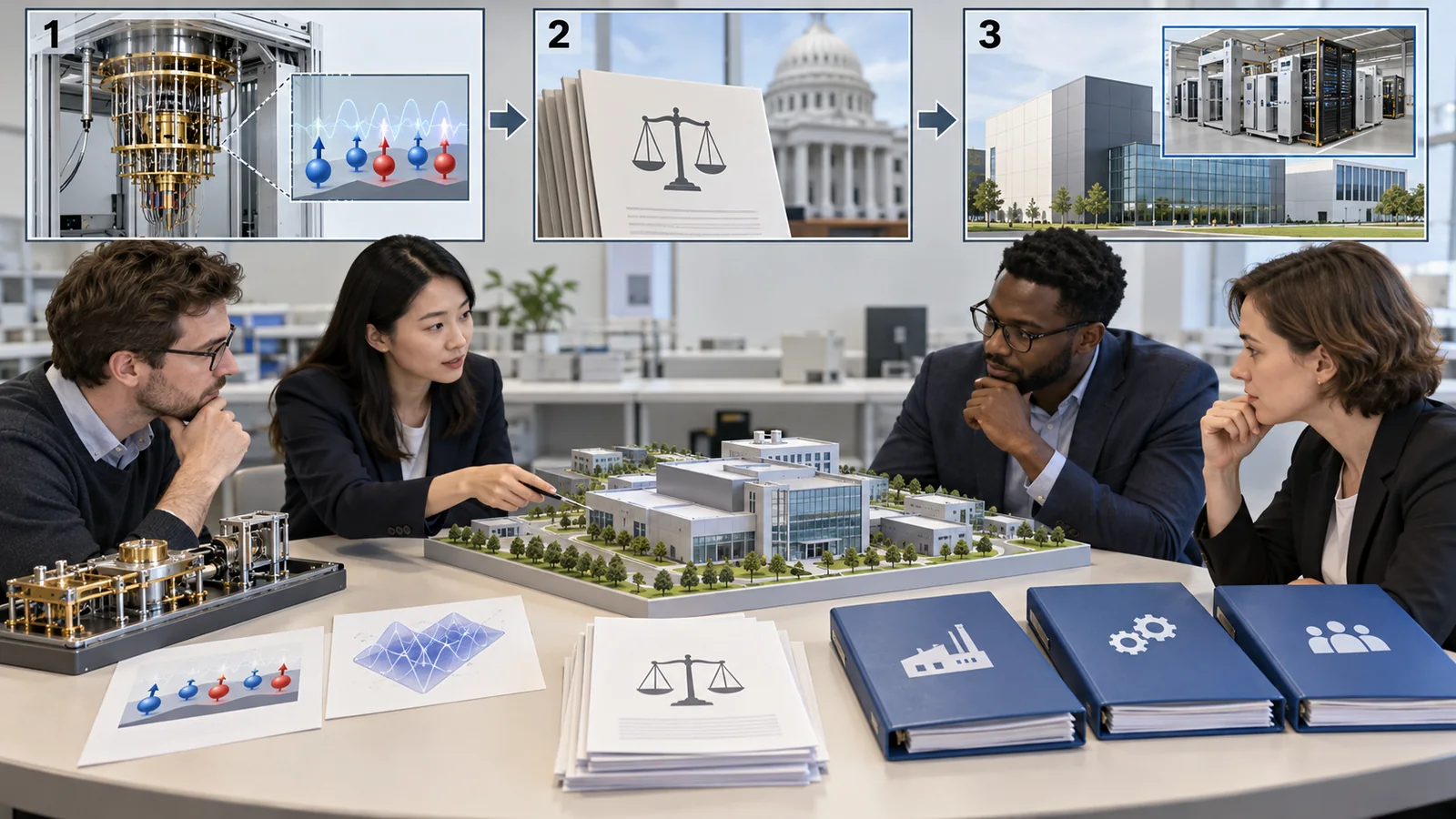
- The European Commission in 30 seconds
- What kind of institution? Four types of influence
- What it does for quantum computing
- How far its influence reaches (powers and geography)
- Who is involved, and how the money flows
- Outlook
- Glossary / References / Claim-to-source audit
1. The European Commission in 30 seconds
27 Member StatesThe Council, which co-adopts laws, is made up of representatives of the 27 EU countries
(proposes policy)Laws are adopted by Parliament and Council. The Commission submits the draft
The Commission's quantum documents are a mix of binding and non-binding ones. The Quantum Europe Strategy of July 2025 is a policy paper (a "Communication") addressed to the Parliament and the Council. It sets goals and an action plan, and it does not oblige companies or Member States to do anything Sourced. What does bind are a delegated regulation that added quantum computers to the export-control list (in force since 15 November 2025) and a Council regulation that added quantum technologies to the remit of the EuroHPC Joint Undertaking (in force since 20 January 2026) Sourced. The "Quantum Act" that the strategy announced had not been confirmed as a formal Commission proposal as of 16 October 2026 Not yet confirmed.
2. What kind of institution? Four types of influence
Unlike companies, the institutions that appear in quantum computing coverage do not sell quantum computers. Instead they can be sorted into four types by the route through which they influence the field. The Commission spans two of them: funding, and policy and regulation. Within regulation, though, it is the one that proposes laws and updates a list, not the one that decides laws.
3. What it does for quantum computing
An ordinary computer calculates with bits, each of which is either 0 or 1. A quantum computer calculates with quantum bits (qubits), which can be in a state that blends 0 and 1. But qubits are fragile, and machines need a way to correct their own errors (quantum error correction). Machines of a practical size are still to come. For more, see our explainers on the basics of quantum computing and on quantum error correction and the surface code. This article looks at how the Commission acts on the field through money (funding), equipment (infrastructure), export rules and draft laws.
The table below lists the Commission's quantum activities together with whether they are binding.
| Activity | Date and status | What it does | Binding? |
|---|---|---|---|
| Quantum Europe Strategy COM(2025) 363 | Adopted 2 July 2025 | Five areas for action (research and innovation; infrastructure; industrial base; space and dual-use; skills). Aims to make Europe a global quantum leader by 2030. States that the EU invested nearly EUR 2 billion in quantum over five years, and Member States more than EUR 9 billion | No (policy paper) |
| Quantum Technologies Flagship | Started 2018. The Commission page was last updated 22 May 2025 | A long-term research programme with about EUR 1 billion expected from the EU over 10 years. Supports four areas: quantum computing, simulation, communication, and sensing and metrology. Ramp-up phase (2018 to 2022): EUR 152 million and 24 projects. Current phase: over EUR 400 million and more than 20 projects | Funding (for selected projects) |
| Quantum computers bought through EuroHPC | Six sites chosen in October 2022. Six machines procured as of September 2025 | Placed at six sites (Czechia, Germany, Spain, France, Italy, Poland) and linked to supercomputers. Total EUR 100 million, split equally between the EU and 17 countries. First machine: Poznan, Poland (June 2025). Second: "VLQ" in Ostrava, Czechia (September 2025). "Euro-Q-Exa" in Munich was inaugurated on 12 February 2026 | Funding and procurement |
| EuroHPC Regulation amended Council Regulation (EU) 2026/150 | Adopted 16 January 2026; in force 20 January 2026 | Widens the EuroHPC Joint Undertaking's mission from supercomputers to quantum technologies. Adds a quantum technologies pillar spanning research to industrialisation. The Union's contribution is capped at EUR 4,122.3 million overall, of which up to EUR 1,660 million from Horizon Europe (including EUR 160 million for quantum research and innovation) | Yes (directly applicable in Member States) |
| Quantum chip pilot lines and a design facility | The strategy planned six pilot lines for 2025 and a design facility for 2026 | Under the Chips Joint Undertaking (Chips JU), six "pilot lines" to move quantum chips from prototype toward manufacturing. EUR 40 to 50 million per line, from the EU and Member States combined. A quantum chips industrialisation roadmap and a European quantum standards roadmap are also planned for 2026 | Funding. Roadmaps are plans |
| Export-control list updated Delegated Regulation (EU) 2025/2003 | Adopted 8 September 2025. Published 14 November, in force 15 November 2025 | Added quantum computers, qubit devices, cryogenic cooling equipment and more to the EU's dual-use (civil and military) list (see the table below). Individual licensing decisions are made by Member State authorities | Yes (applies to items leaving the EU) |
| Moving to post-quantum cryptography (PQC) Recommendation (EU) 2024/1101 | Recommendation 11 April 2024. Member States' roadmap 23 June 2025 | Encourages Member States to plan the replacement of cryptography in public administrations and critical infrastructure, in case future quantum computers can break today's codes. The roadmap says to start moving by the end of 2026, and to move critical infrastructure no later than the end of 2030 | The recommendation need not be followed. The roadmap was agreed by Member States |
| Quantum Act | Planned for Q2 (April to June) in the 2026 work programme. "Announced" on the Legislative Train as of 20 September 2026 | Aims to coordinate research and innovation, expand industrial capacity (including pilot lines and a design facility), and strengthen supply-chain resilience and governance. Indicative legal basis: Articles 173, 180 and 184 of the Treaty | Not yet proposed, so none for now |
Note: the Commission's quantum policy page was last updated on 23 June 2026. It still contains wording that reads as if a call for evidence on the Quantum Act is open (checked 16 October 2026).
Quantum-related items on the export-control list (version in force from 15 November 2025)
Export control means requiring a licence before items that could also serve military uses leave the EU. The question here is whether quantum computers could be used militarily. Item numbers and conditions are written in Annex I of the regulation in the Official Journal Sourced.
| Item number | What it covers (plain terms) | Main conditions |
|---|---|---|
| 4A506.a | Quantum computers themselves (gate-based and measurement-based; a note says quantum annealers are not covered) | For 34 to under 100 qubits, a CNOT error of 10-4 or less; for 100 to under 200, 10-3 or less; and so on, with an error ceiling for each size band. At 2,000 qubits or more there is no error condition |
| 4A506.b, c | Qubit devices and circuits, control components, and measurement equipment (those specially designed for the 4A506.a machines) | A note says this includes superconducting, semiconductor and photonic qubit chips and surface ion-trap arrays |
| 3A504 | Cryogenic cooling systems | Systems giving 600 microwatts or more of cooling at or below 0.1 kelvin for over 48 hours, or two-stage pulse-tube cryocoolers that hold below 4 kelvin and give 1.5 watts or more at 4.2 kelvin |
| 3A501.b.13 | Low-noise parametric amplifiers for cryogenic use (quantum-limited amplifiers) | Designed to operate below 1 kelvin, with a noise figure under 0.015 dB across 2 to 15 gigahertz, among other conditions |
| 3A501.a.15 | CMOS integrated circuits that work at cryogenic temperatures | Designed to operate at an ambient temperature of 4.5 kelvin or below |
What stands out in this table is that the rules cover not only the finished machine but also parts inside it (qubit chips, cryogenic cooling, low-noise amplifiers, cryogenic ICs). For suppliers of materials and components, that means cryogenic parts or superconducting materials for quantum computers may, in some cases, first have to be checked against this list before export from the EU. The Quantum Europe Strategy also says the Commission will assess weak points in the supply chain, from rare materials to precision components, control electronics and software (results expected in 2026) Not yet confirmed.
4. How far its influence reaches (powers and geography)
| Aspect | What the Commission has | What it does not have |
|---|---|---|
| Law | The power to propose laws (the Quantum Act). For export controls, the power to adopt delegated regulations that update the list (under Article 17 of Regulation 2021/821) | The power to decide laws itself. Normally Parliament and Council adopt them on an equal footing. In some cases, such as the EuroHPC amendment, the Council alone adopts |
| Funding | Allocating EU budget to the Quantum Flagship and others. Setting up co-funding through the EuroHPC and Chips Joint Undertakings | The power to set Member States' own quantum budgets (the strategy says Member States put in more than EUR 9 billion on top of the EU's nearly EUR 2 billion, but each country decides its own) |
| Export control | Updating the EU-wide list of items (Annex I) | The power to decide individual licences (Member State authorities decide). The list also follows international agreements (such as the Wassenaar Arrangement) and Member State commitments |
| Standards and certification | A plan to publish a "European quantum standards roadmap" in 2026 | The power to set how quantum computers are benchmarked or certified (the strategy only says it will publish a standards roadmap) |
| Cryptography migration | A recommendation that urges Member States to plan the move | The power to oblige private companies to migrate (a recommendation need not be followed) |
| Geography | The 27 EU Member States. Companies exporting (or shipping in transit) listed items | Direct influence on policy outside the EU. With countries such as the U.S. and Japan it works through cooperation frameworks (trade and technology councils, digital partnerships) |
| Scale | 33,071 staff (all areas). No single figure for total quantum computing spending could be found | A published count of staff working only on quantum (not found) |
The strategy's goal of about 100 error-corrected qubits per system by 2030 and thousands by 2035 is an EU target, not performance that has been achieved Not yet confirmed. Also, the qubit counts in the export-control list are "physical qubits" (raw qubits with no error correction), which are different from error-corrected "logical qubits". The list's own definitions draw this distinction Sourced.
5. Who is involved, and how the money flows
The Commission does not install quantum computers itself. It works through joint undertakings and similar frameworks. The diagram below shows only relationships stated on official pages.
The quantum lead is the Executive Vice-President for Technological Sovereignty, Security and Democracy. In a release of 26 May 2026, the Commission said she would meet the Top-level Advisory Board on Quantum Technologies the next day to discuss progress on the Quantum Europe Strategy, the Quantum Act, and the place of quantum in the next long-term EU budget (the multiannual financial framework) Sourced.
6. Outlook
| What we can read from the record | Primary evidence | Status |
|---|---|---|
| The timing of the Quantum Act proposal is not fixed | The 2026 work programme pointed to Q2, but the Legislative Train still showed "Announced" on 20 September 2026. The Commission's 26 May release also calls it "forthcoming" | Not yet confirmed |
| Even once proposed, Parliament and Council must negotiate before it becomes law, so it would apply later | The Commission explains that under the usual procedure a law is made only when Parliament and Council agree | Inference |
| The roadmaps the strategy plans for 2026 (quantum computing and simulation, quantum chips industrialisation, quantum standards, quantum communication, quantum sensing) and the design facility | The strategy's action list. We could not confirm individually, from primary sources, whether they had been published by 16 October 2026 | Not yet confirmed |
| The export-control list will probably keep being updated as international and Member State agreements change, so the quantum entries could change too | The recital of Delegated Regulation 2025/2003 says the list needs to be updated regularly. We did not check for amendments after the 2025 version | Inference |
| For cryptography, end-2026 (start) and end-2030 (critical infrastructure) are milestones for Member States' plans | Commission release of 23 June 2025 (roadmap by Member States and the NIS Cooperation Group) | Not yet confirmed |
7. Glossary
- Council (of the EU)
- The body made up of government representatives of the 27 Member States. It adopts laws alongside the European Parliament.
- Communication
- A policy paper the European Commission sends to the Parliament and the Council. It sets out direction and action plans but creates no legal obligation.
- Recommendation
- An EU instrument that urges Member States to act in a certain way. It need not be followed.
- Delegated regulation
- A regulation the Commission adopts within the scope a basic law has delegated to it. It is binding and applies directly in Member States.
- EuroHPC Joint Undertaking
- An organisation through which the EU and participating countries jointly buy and run supercomputers and quantum computers. Quantum technologies joined its mission through the January 2026 amendment.
- Chips Joint Undertaking (Chips JU)
- A joint undertaking under the EU Chips Act. It also handles pilot lines for quantum chips.
- Dual-use
- Usable for both civil and military purposes. Dual-use items fall under export control.
- Post-quantum cryptography (PQC)
- Cryptography thought to resist even future quantum computers. See our explainer on post-quantum cryptography.
8. References
- European Commission (DG CONNECT) Quantum (policy page: summary of the Quantum Europe Strategy, the three aims of the Quantum Act, the Quantum Flagship, EuroHPC's six sites and EUR 100 million, the Poznan and Ostrava openings, EuroQCI; last updated 23 June 2026). https://digital-strategy.ec.europa.eu/en/policies/quantum
- European Commission COM(2025) 363, Communication on the Quantum Europe Strategy (2 July 2025: the 2030 and 2035 targets, six pilot lines, design facility, action list, references to export controls). https://ec.europa.eu/newsroom/dae/redirection/document/117890
- European Commission (DG CONNECT) Quantum Technologies Flagship (budget, size of the ramp-up phase and the current phase; last updated 22 May 2025). https://digital-strategy.ec.europa.eu/en/policies/quantum-technologies-flagship
- Council of the EU Council Regulation (EU) 2026/150 of 16 January 2026 amending Regulation (EU) 2021/1173 on establishing the European High Performance Computing Joint Undertaking (Official Journal, 19 January 2026: the quantum pillar, the Union contribution cap, entry into force). https://eur-lex.europa.eu/eli/reg/2026/150/oj
- European Commission Commission Delegated Regulation (EU) 2025/2003 of 8 September 2025 (Official Journal, 14 November 2025: Annex I replaced in full; the quantum-related entries 4A506, 3A504 and 3A501). https://eur-lex.europa.eu/eli/reg_del/2025/2003/oj
- European Parliament and Council of the EU Regulation (EU) 2021/821 (the EU dual-use export-control regulation; its recitals say licensing decisions lie with national authorities). https://eur-lex.europa.eu/eli/reg/2021/821/oj
- European Commission Commission Recommendation (EU) 2024/1101 of 11 April 2024 on a Coordinated Implementation Roadmap for the transition to Post-Quantum Cryptography (Official Journal, 12 April 2024). https://eur-lex.europa.eu/eli/reco/2024/1101/oj
- European Commission Press release "EU reinforces its cybersecurity with post-quantum cryptography" (23 June 2025: the end-2026 and end-2030 milestones). https://digital-strategy.ec.europa.eu/en/news/eu-reinforces-its-cybersecurity-post-quantum-cryptography
- European Parliament Legislative Train, "Quantum Act" (status "Announced" as of 20 September 2026; work programme date Q2 2026; three lines of action; legal basis). https://www.europarl.europa.eu/legislative-train/theme-a-new-plan-for-europe-s-sustainable-prosperity-and-competitiveness/file-quantum-act
- European Commission Press release "Executive Vice-President Virkkunen meets Europe's top quantum scientists" (26 May 2026). https://digital-strategy.ec.europa.eu/en/news/executive-vice-president-virkkunen-meets-europes-top-quantum-scientists
- European Commission Key figures on European Commission staff (HR Key Figures 2026: 33,071 staff as of 1 January 2026). https://commission.europa.eu/publications/key-figures-european-commission-staff_en
- European Commission Adopting EU law (under the ordinary legislative procedure Parliament and Council adopt on an equal footing; the Commission submits the proposal). https://commission.europa.eu/law/law-making-process/adopting-eu-law_en
- European Commission Press release "Europe inaugurates its second quantum computer" (23 September 2025: VLQ; six quantum computers procured by EuroHPC). https://digital-strategy.ec.europa.eu/en/news/europe-inaugurates-its-second-quantum-computer
- European Commission Communications Networks, Content and Technology (DG CONNECT's responsibilities and the Executive Vice-President in charge; checked October 2026). https://commission.europa.eu/about-european-commission/departments-and-executive-agencies/communications-networks-content-and-technology_en
9. Claim-to-source audit
| Claim in the text | Status | Source |
|---|---|---|
| Adoption date of the Quantum Europe Strategy (2 July 2025), the five areas for action, the three aims of the Quantum Act, and the note that adoption is scheduled for 2026 | Sourced | Reference 1 https://digital-strategy.ec.europa.eu/en/policies/quantum |
| The strategy's targets (about 100 error-corrected qubits by 2030, thousands by 2035), six pilot lines (EUR 40 to 50 million each), 2026 plans for a design facility and roadmaps, nearly EUR 2 billion from the EU and over EUR 9 billion from Member States over five years, the supply-chain assessment, and that the strategy is a Communication | Sourced | Reference 2 https://ec.europa.eu/newsroom/dae/redirection/document/117890 |
| The Quantum Flagship's start (2018), expected budget of about EUR 1 billion, ramp-up phase of EUR 152 million and 24 projects, current phase of over EUR 400 million | Sourced | Reference 3 https://digital-strategy.ec.europa.eu/en/policies/quantum-technologies-flagship |
| Dates of the EuroHPC amendment (adopted 16 January 2026, in force 20 January), the quantum pillar, the Union contribution cap of EUR 4,122.3 million, EUR 1,660 million from Horizon Europe (including EUR 160 million for quantum), that it is a Council regulation, and that it is binding | Sourced | Reference 4 https://eur-lex.europa.eu/eli/reg/2026/150/oj |
| Adoption, publication and entry-into-force dates of Delegated Regulation 2025/2003, the entries and conditions in 4A506, 3A504 and 3A501, the exclusion of annealers, the definition of physical qubits, and the need for regular updates of the list | Sourced | Reference 5 https://eur-lex.europa.eu/eli/reg_del/2025/2003/oj |
| Licensing decisions are made by the competent authorities of each Member State | Sourced | Reference 6 https://eur-lex.europa.eu/eli/reg/2021/821/oj |
| Date of the PQC migration recommendation and its legal basis (Article 292 of the Treaty) | Sourced | Reference 7 https://eur-lex.europa.eu/eli/reco/2024/1101/oj |
| The Member States' roadmap (23 June 2025): start migrating by the end of 2026, move critical infrastructure no later than the end of 2030 | Sourced | Reference 8 https://digital-strategy.ec.europa.eu/en/news/eu-reinforces-its-cybersecurity-post-quantum-cryptography |
| Status of the Quantum Act ("Announced" as of 20 September 2026), work programme date Q2, indicative legal basis | Sourced | Reference 9 https://www.europarl.europa.eu/legislative-train/theme-a-new-plan-for-europe-s-sustainable-prosperity-and-competitiveness/file-quantum-act |
| The 26 May 2026 release (announcing the next day's meeting with the advisory board) and its description of the Quantum Act as forthcoming | Sourced | Reference 10 https://digital-strategy.ec.europa.eu/en/news/executive-vice-president-virkkunen-meets-europes-top-quantum-scientists |
| Staff of 33,071 (as of 1 January 2026) | Sourced | Reference 11 https://commission.europa.eu/publications/key-figures-european-commission-staff_en |
| Under the ordinary procedure Parliament and Council adopt laws and the Commission submits the proposal; the Council is made up of representatives of the 27 Member States | Sourced | Reference 12 https://commission.europa.eu/law/law-making-process/adopting-eu-law_en |
| VLQ opening (September 2025) and six quantum computers procured by EuroHPC (as of September 2025) | Sourced | Reference 13 https://digital-strategy.ec.europa.eu/en/news/europe-inaugurates-its-second-quantum-computer |
| The quantum lead is the Executive Vice-President for Technological Sovereignty, Security and Democracy; the department is DG CONNECT | Sourced | Reference 14 https://commission.europa.eu/about-european-commission/departments-and-executive-agencies/communications-networks-content-and-technology_en |
| Opening of Euro-Q-Exa (Munich) on 12 February 2026 | Sourced | Reference 1 (headline in its latest-news list); we did not retrieve the individual page https://digital-strategy.ec.europa.eu/en/policies/quantum |
| The four-type classification of institutions and the ranking by how binding documents are | Our calculation | This article's own classification |
| Total EU quantum spending and the number of staff working on quantum | Not yet confirmed | Not stated as a single figure in references 1 to 14. This article does not estimate it |
| Timing of the Quantum Act proposal, whether the roadmaps planned for 2026 have been published, and when the Act would be adopted and apply | Not yet confirmed | References 2, 9 and 10. Cannot be settled from primary sources as of 16 October 2026, so this article leaves them open |
| The two Section 6 inferences ("negotiation is needed before it becomes law" and "the list will probably keep being updated") | Inference | This article's reading of references 5 and 12 |
Last updated: 16 October 2026 / Troy Technical
Figures in this article come from official pages of the European Commission, the Official Journal of the EU and the European Parliament. Quantum policy moves fast, and the status of the bill, the publication of roadmaps and the version of the list may change, so each date of checking (16 October 2026) is shown. Items marked "Inference" are this article's own reading of the primary sources.