INSTITUTION PROFILE / QUANTUM COMPUTING
RIKEN
The national research institute that builds, runs and shares quantum computers
RIKEN is a national research and development agency of Japan. It is not a government body that sets policy or hands out subsidies. It is an institution that develops quantum computers itself, installs them, and lets researchers and companies use them. It builds superconducting machines jointly with Fujitsu, hosts an IBM quantum computer next to the supercomputer Fugaku in Kobe, and runs a trapped-ion machine at Wako. This profile sets out how far RIKEN's influence goes and what it cannot decide, keeping what has been achieved apart from what is only planned. Everything here was checked on 16 October 2026.
- RIKEN in 30 seconds
- What kind of institution? Four types of influence
- What it does for quantum computing
- How far its influence reaches (powers and geography)
- Who is involved, and how the money flows
- Outlook
- Glossary / References / Claim-to-source audit
1. RIKEN in 30 seconds
(National Research and Development Agency)Main office in Saitama Prefecture (RIKEN Act, Article 4)
RIKEN is the owner of quantum computers and the place where people get to use them. It does not decide national policy. The RIKEN Act defines its work as carrying out tests and research in science and technology, making its facilities and equipment available for shared use by researchers, and similar tasks Sourced. RIKEN's influence comes from holding the sites where machines from Fujitsu, IBM, Quantinuum and others are actually running, and from being able to bring researchers and companies to them. Policy and funding decisions are made by the Ministry of Education (RIKEN's competent ministry), the Ministry of Economy, Trade and Industry, and the Cabinet Office. RIKEN receives that money and carries out the research and installations Sourced.
2. What kind of institution? Four types of influence
Unlike companies, the institutions that appear in quantum computing coverage do not sell quantum computers. Instead they can be sorted into four types by the route through which they influence the field. RIKEN is of the "convening" type, because it holds places where researchers, companies and overseas institutions can do joint research on real machines. RIKEN is not a body that hands out funding, and it is itself on the receiving end of funding.
3. What it does for quantum computing
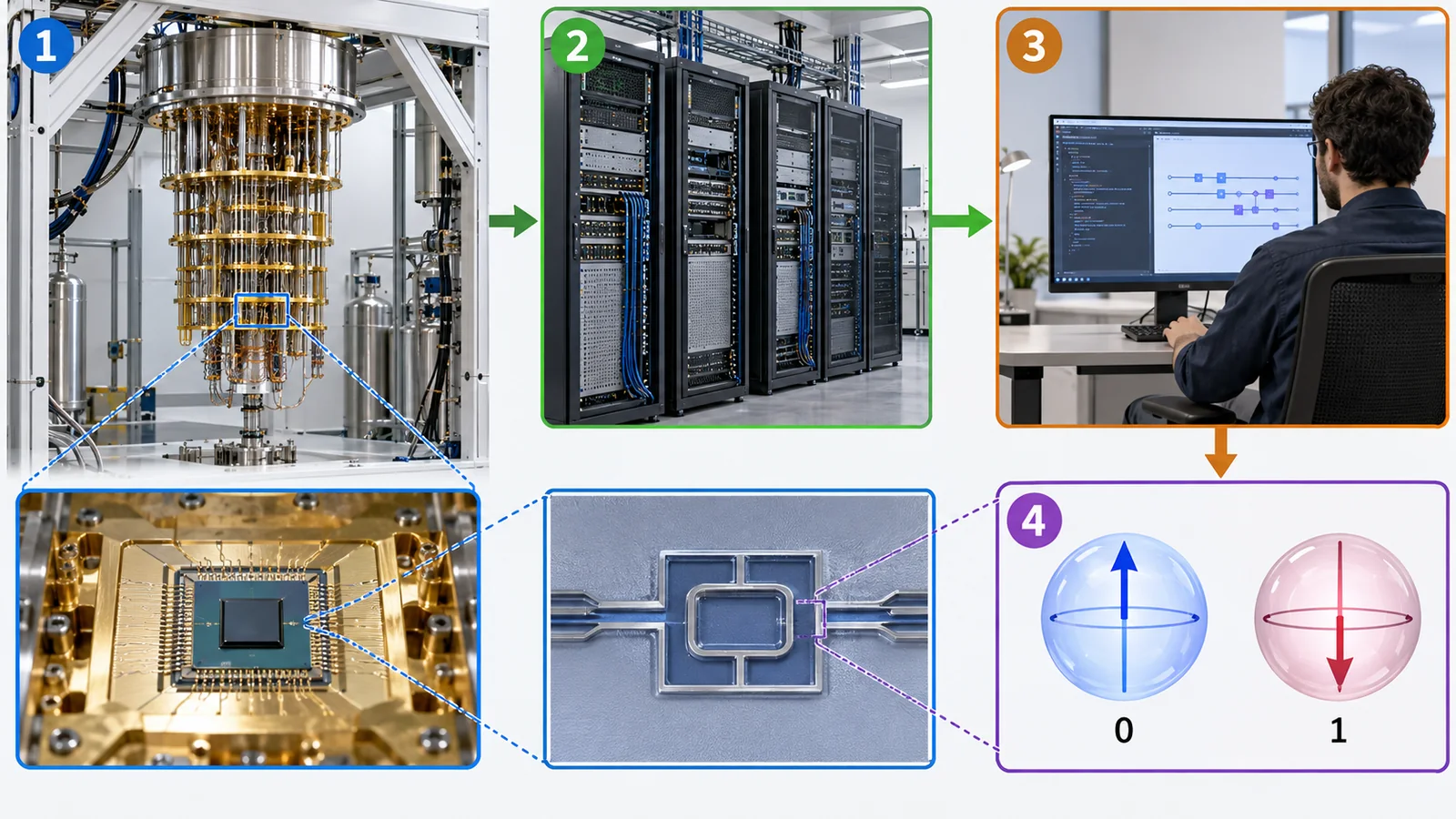
An ordinary computer calculates with bits, each of which is either 0 or 1. A quantum computer calculates with quantum bits (qubits), which can be in a state that blends 0 and 1. There are several approaches. This article mentions the superconducting approach (electrical circuits cooled to extremely low temperatures) and the trapped-ion approach (atoms held in place by electric forces). Numbers such as "256 qubits" count raw qubits with no error correction. For more, see our explainers on the basics of quantum computing, superconducting qubits and trapped ions.
The table below lists RIKEN's quantum computing activities, keeping what has been achieved apart from what is planned.
| Activity | Date and status | What it does | Status type |
|---|---|---|---|
| RIKEN Center for Quantum Computing (RQC) | Director: Yasunobu Nakamura (checked October 2026) | Has research teams on superconducting, optical, semiconductor and cold-atom approaches, and describes itself as one that develops and owns actual quantum computers. For the optical approach it cites "the world's first general-purpose optical quantum computing platform" | Under way |
| RIKEN RQC-FUJITSU Collaboration Center | Established 1 April 2021 | Combines RIKEN's superconducting-circuit technology with Fujitsu's computing technology and application know-how, to develop hardware and software for large-scale computing of up to 1,000 qubits, and applications on real devices | Under way |
| 64-qubit machine (RIKEN and Fujitsu) | Launched October 2023 with support from the Ministry of Education (MEXT) | A Japan-made superconducting quantum computer. It was the base for the 256-qubit machine below | Achieved |
| 256-qubit machine (RIKEN and Fujitsu) | Announced 23 April 2025. At the RQC-FUJITSU Collaboration Center in Wako | Scaled up through high-density implementation and cooling design inside the dilution refrigerator. The partners announced a plan to offer it, as part of their hybrid computing platform, to companies and research institutions in Japan and abroad from the first quarter of fiscal 2025. They cite demonstrating error-correction algorithms as a future use | Achieved. External access is a stated plan |
| 1,000-qubit machine (RIKEN and Fujitsu) | The April 2025 announcement said "scheduled to be launched in 2026". As of 16 October 2026 we could not find an announcement that it is running | The next step after the 256-qubit machine. A METI council paper (8 July 2026) says Fujitsu plans to build a 1,000 physical-qubit machine in its quantum building within 2026 | Not yet confirmed |
| Trapped-ion machine "Reimei" | Announced as installed at the Wako campus on 12 February 2025 | A trapped-ion machine on an architecture designed by Quantinuum, in a facility designed by RIKEN. It is planned to be linked to the supercomputer Fugaku in Kobe. Part of a project commissioned by NEDO | Achieved |
| IBM Quantum System Two (Kobe) | Ceremony on 24 June 2025 to mark the start of operation in Kobe | A machine carrying the 156-qubit superconducting "Heron" processor, installed at the RIKEN Center for Computational Science (R-CCS) and run together with Fugaku. Described as the first such installation outside North America. A NEDO-commissioned project, with SoftBank | Achieved |
| GPU supercomputer "ROQUO" | Operation announced 19 June 2026 | The computing core of the quantum-supercomputer hybrid platform. 540 NVIDIA GPUs and 19.80 petaflops on the HPL benchmark. Demonstrations linking Fugaku, the IBM machine and Reimei are planned. A NEDO-commissioned project (JHPC-quantum) | Achieved. The linking demonstrations are still to come |
Note: machine specifications (qubit counts, petaflops) are values published by RIKEN itself, not third-party evaluations.
The announcement of the 256-qubit machine says that high-density implementation techniques and cooling design inside the dilution refrigerator (the device that cools qubits to near absolute zero) overcame technical challenges that came with scaling up Sourced. What this suggests is that the denser the packaging, the harder the cooling design becomes at cryogenic temperatures. For suppliers of materials and components, a hub like RIKEN could be a place to try cryogenic parts on real machines Not yet confirmed. This article does not claim that RIKEN buys from any particular parts maker.
4. How far its influence reaches (powers and geography)
| Aspect | What RIKEN has | What it does not have |
|---|---|---|
| Powers | The power to research and develop quantum computers, install and run them, spread the results and make facilities available for shared use (RIKEN Act, Article 16). Choosing its joint-research partners | The power to set national policy or strategy. The power to decide subsidies or research-fund allocation. Regulatory or export-control powers |
| Funding | Pushing research and installation forward with money it receives: government operating grants, facility subsidies and commissioned-project income | The power to hand out research funds to other bodies (RIKEN is not an allocating agency) |
| Standards and certification | Publishing research results. It publishes its machines' specifications itself | The power to set benchmarks or certification for quantum computers |
| Geography | Sites in Japan (Wako and Kobe). Machines open to companies and institutions in Japan and abroad (the 256-qubit machine is a stated plan to offer abroad) | The power to move other countries' policies or sites |
| Scale | Over 3,000 employees and 1,930 research personnel (1 April 2026). FY2026 revenue of about JPY 110 billion in total (all fields) | A published headcount or budget for quantum alone (not found) |
The roughly JPY 110 billion is RIKEN's whole FY2026 revenue, not an amount spent on quantum. Its breakdown is: government operating funding JPY 58.8 billion, government subsidies for large-scale facilities JPY 28.0 billion, commissioned-project income JPY 21.4 billion, and other income JPY 1.7 billion Sourced. The commissioned projects include NEDO-funded quantum-supercomputer work, but RIKEN's materials do not give a quantum-only amount Not yet confirmed.
5. Who is involved, and how the money flows
RIKEN's quantum computers sit between the government bodies that provide funding, the companies that build or design the machines, and the researchers and companies that use them. The diagram below shows only relationships stated on RIKEN's own pages.
A METI council paper (8 July 2026) presents, as a case study, a simulation of a protein complex of up to 12,635 atoms by RIKEN together with IBM and the Cleveland Clinic in the United States Sourced. The same paper proposes positioning AIST's G-QuAT as a "key production base of national strategic importance". We could not confirm in any document how roles are divided between RIKEN and AIST (see our AIST profile in this series) Not yet confirmed.
6. Outlook
| What we can read from the record | Primary evidence | Status |
|---|---|---|
| Whether the 1,000-qubit machine goes into operation in 2026 cannot be confirmed as of 16 October 2026 | RIKEN news of 23 April 2025 (scheduled for 2026); METI paper of 8 July 2026 (Fujitsu plans to build it within 2026) | Not yet confirmed |
| Demonstrations linking quantum computers and supercomputers are about to get under way in earnest | R-CCS announcement of 19 June 2026 (ROQUO has started operating; the linking demonstrations are described as to come) | Not yet confirmed |
| RIKEN's influence will probably continue to rest on running machines of several approaches and letting outsiders use them | The Center for Quantum Computing has research on superconducting, optical, semiconductor and cold-atom approaches, and has also installed IBM (superconducting) and Quantinuum (trapped-ion) machines | Inference |
| How widely outside access is actually used (number of users, terms of use) | RIKEN's announcement states a plan to offer access. We did not check the detailed terms | Not yet confirmed |
7. Glossary
- National research and development agency
- A corporation that carries out national R&D. It is not a ministry itself and works under the supervision of a competent minister. RIKEN's is the Minister of Education.
- RQC
- RIKEN Center for Quantum Computing, which develops, owns and researches quantum computers.
- R-CCS
- RIKEN Center for Computational Science in Kobe. It runs the supercomputer Fugaku and handles quantum-supercomputer integration.
- Fugaku
- A Japanese supercomputer developed jointly by RIKEN and Fujitsu. It began shared use in March 2021.
- JHPC-quantum
- The common name of a NEDO-commissioned project that develops software and a platform for using quantum computers and supercomputers together.
- Dilution refrigerator
- A device that cools superconducting qubits to near absolute zero.
- HPL
- A standard benchmark for supercomputer performance (how fast it solves a large system of linear equations).
- NEDO
- A national research and development agency under the Ministry of Economy, Trade and Industry that allocates R&D funding. It is a separate body from RIKEN.
8. References
- RIKEN About RIKEN (founded in 1917; a national research and development agency). https://www.riken.jp/en/about/
- RIKEN Facts & Figures (over 3,000 employees; 1,930 research personnel as of 1 April 2026; graph of the FY2026 revenue breakdown). https://www.riken.jp/en/about/data/
- RIKEN RIKEN Center for Quantum Computing (RQC) (director, research teams, research results). https://www.riken.jp/en/research/labs/rqc/
- RIKEN RIKEN RQC-FUJITSU Collaboration Center (established 1 April 2021; R&D at up to 1,000 qubits). https://www.riken.jp/en/research/labs/rqc/riken_fujitsu/index.html
- RIKEN News "RIKEN and Fujitsu unveil world-leading 256-qubit quantum computer" (23 April 2025: the 64-qubit and 256-qubit machines, the access plan, the plan for a 1,000-qubit machine). https://www.riken.jp/en/news_pubs/news/2025/20250422_1/index.html
- RIKEN News "Commemorative ceremony for the launch of RIKEN Fugaku - IBM Quantum System Two integration" (1 July 2025: the ceremony of 24 June 2025, the 156-qubit Heron, the NEDO-commissioned project). https://www.riken.jp/en/news_pubs/news/2025/20250701_2/index.html
- RIKEN News "New quantum computer on the Wako campus" (12 February 2025: Reimei, a trapped-ion machine on a Quantinuum-designed architecture, NEDO-commissioned project). https://www.riken.jp/en/news_pubs/news/2025/20250212_1/index.html
- RIKEN Center for Computational Science Announcement "New Supercomputer "ROQUO" for the Quantum-HPC Hybrid Platform Enters Operation" (19 June 2026: 540 GPUs, 19.80 petaflops, JHPC-quantum, partners and builders). https://www.r-ccs.riken.jp/en/outreach/topics/20260619-2/index.html
- e-Gov Law Search Act on the National Research and Development Agency RIKEN (Article 3: purpose; Article 4: main office; Article 16: scope of work; Article 20: competent minister) (in Japanese). https://laws.e-gov.go.jp/law/414AC0000000160
- Ministry of Economy, Trade and Industry Future Direction of Quantum Computer Policy (8 July 2026, Innovation and Environment Bureau: the RIKEN case study, Fujitsu's planned 1,000 physical-qubit machine, the proposed positioning of G-QuAT) (in Japanese). https://www.meti.go.jp/shingikai/sankoshin/sangyo_gijutsu/innovation/pdf/014_04_02.pdf
9. Claim-to-source audit
| Claim in the text | Status | Source |
|---|---|---|
| RIKEN was founded in 1917 as a private research foundation and is now a national research and development agency | Sourced | Reference 1 https://www.riken.jp/en/about/ |
| Over 3,000 employees, 1,930 research personnel (1 April 2026), and the FY2026 revenue breakdown (operating funding JPY 58.8 billion, large-facility subsidies JPY 28.0 billion, commissioned-project income JPY 21.4 billion, other JPY 1.7 billion; about JPY 110 billion in total) | Sourced | Reference 2 https://www.riken.jp/en/about/data/ |
| The approaches of the RQC's research teams (superconducting, optical, semiconductor, cold-atom), the director, and its self-description as developing and owning real machines | Sourced | Reference 3 https://www.riken.jp/en/research/labs/rqc/ |
| Establishment of the RQC-FUJITSU Collaboration Center (1 April 2021) and its research aims | Sourced | Reference 4 https://www.riken.jp/en/research/labs/rqc/riken_fujitsu/index.html |
| The 64-qubit machine (October 2023, MEXT support), the 256-qubit machine (announced 23 April 2025), the plan to offer access in Japan and abroad, and the plan for a 1,000-qubit machine (scheduled for 2026) | Sourced | Reference 5 https://www.riken.jp/en/news_pubs/news/2025/20250422_1/index.html |
| Start of IBM Quantum System Two operation in Kobe (24 June 2025), 156 qubits, and the NEDO-commissioned project (with SoftBank, the University of Tokyo and Osaka University) | Sourced | Reference 6 https://www.riken.jp/en/news_pubs/news/2025/20250701_2/index.html |
| Installation of Reimei at Wako (12 February 2025), the Quantinuum-designed trapped-ion architecture, and the NEDO-commissioned project | Sourced | Reference 7 https://www.riken.jp/en/news_pubs/news/2025/20250212_1/index.html |
| Start of ROQUO operation (19 June 2026), 540 GPUs, HPL 19.80 petaflops, JHPC-quantum, the partners and the builders | Sourced | Reference 8 https://www.r-ccs.riken.jp/en/outreach/topics/20260619-2/index.html |
| RIKEN's purpose, main office (Saitama), scope of work and competent minister (Minister of Education) | Sourced | Reference 9 https://laws.e-gov.go.jp/law/414AC0000000160 |
| The case study of a 12,635-atom simulation by RIKEN, IBM and the Cleveland Clinic, Fujitsu's planned 1,000 physical-qubit machine (within 2026), and the proposed positioning of G-QuAT | Sourced | Reference 10 https://www.meti.go.jp/shingikai/sankoshin/sangyo_gijutsu/innovation/pdf/014_04_02.pdf |
| The four-type classification of institutions, and the Japanese-to-English grouping of the revenue categories and the chart | Our calculation | This article's own organisation of the material |
| RIKEN's quantum-only headcount and budget, the actual extent of outside use, and the division of roles between RIKEN and AIST | Not yet confirmed | Not stated in references 1 to 10. This article does not estimate them |
| Whether the 1,000-qubit machine is running, and how far the quantum-supercomputer linking demonstrations have progressed | Not yet confirmed | References 5, 8 and 10. These cannot be settled from primary sources as of 16 October 2026, so this article leaves them open |
| The Section 6 inference that RIKEN's influence rests on running machines of several approaches and letting outsiders use them | Inference | This article's reading of references 3, 6 and 7 |
Last updated: 16 October 2026 / Troy Technical
Figures in this article come from the official pages of RIKEN and its Center for Computational Science, e-Gov Law Search, and a METI council paper. Quantum computing moves fast, and the operating status of machines and the scope of access may change, so the date of checking (16 October 2026) is shown. Items marked "Inference" are this article's own reading of the primary sources.