TECHNOLOGY EXPLAINER
Logical Qubits and Fault-Tolerant Quantum Computing
— From "protecting" to "computing while protected"
The previous article showed how many qubits can protect one qubit: error correction. But how do you actually compute with the protected qubits? This article covers, step by step with figures and small numbers: (1) what "logical qubit" really means and how to read the numbers, (2) estimates of the physical qubits needed (whose order of magnitude depends on assumptions), (3) recent experiments, (4) the parts needed to compute while protected (logical gates and magic states), (5) where newer codes such as qLDPC fit, and (6) company plans (not yet confirmed). The goal is to be able to read an announcement of "N logical qubits" together with its conditions.
- The short version, what to know first, and where this fits in the series
- Physical and logical qubits — what is inside "one", and how to read the numbers
- Estimates of the physical qubits needed — assumptions change the order of magnitude
- Recent experiments (as of 16 October 2026)
- What fault-tolerant computing needs — logical gates and magic states
- Where qLDPC and other new codes fit
- Roadmaps and third-party evaluation (not yet confirmed)
- What could not be confirmed, and a summary
- How to read evaluations and standards
- Glossary
- References
- Claim-to-source audit
Sourced = stated in published material (source linked)
Our calculation = a value we computed from stated assumptions
Not yet confirmed = plans, targets and future estimates by companies and agencies that are not settled
Our readings and explanations are marked as commentary. An Inference is shown in bold.
Experimental values are quoted from each paper or announcement together with their conditions (detection or correction, whether post-selection was used, memory or computation). Company plans and targets are "not yet confirmed" and are not achieved facts. Company announcements are treated as "company claims", and we do not rank companies or approaches. This field moves fast, so the state of devices, plans and standards is as of the check date, 16 October 2026. Resource estimates (the qubits needed) are calculations under stated assumptions, not the performance of real machines.
1. The short version, what to know first, and where this fits in the series
- Read logical-qubit counts with their conditions: a logical qubit is "one low-error qubit protected by many physical qubits". But "N logical qubits" has no fixed meaning unless it says whether errors were corrected or merely detected and discarded, which code, and what logical error rate. For example, Quantinuum's 2026 experiment reports 48 error-corrected logical qubits, and up to 94 if error detection alone is counted, from 98 physical qubits Sourced [Ref. 17]
- Fault-tolerant computing needs logical gates and magic states: to compute while protected you need operations that do not break the code (logical gates). Only the T gate is especially costly, and its raw material is the magic state. The physical qubits required vary from under 1 million to tens of millions depending on assumptions Sourced [Ref. 9, 10, 11]
- New codes and plans are still work in progress: qLDPC codes promise fewer physical qubits but need links between distant qubits. IBM plans 200 logical qubits in 2029, but that is a plan Not yet confirmed [Ref. 32]
This article builds on the previous one, "Quantum Error Correction and the Surface Code" (error-correcting codes, code distance d, the threshold, and 2d²−1 physical qubits per surface-code qubit). In short: qubits are fragile, so many physical qubits protect one logical qubit. If the physical error rate is below the threshold, a bigger code gives fewer logical errors.
Read this after "Quantum Error Correction and the Surface Code". The refrigerators and wiring behind it are in "Cryogenics and Control", and the materials and fabrication of qubits in "Materials and Fabrication for Quantum Computers". "How to Read Claims of Quantum Advantage" also helps with reading numbers.
2. Physical and logical qubits — what is inside "one", and how to read the numbers
(1) An everyday example: keeping one vital document in several safes
Suppose you keep one irreplaceable document in ten separate safes and check every day only that "it agrees with the others". If one safe fails, you can rebuild it from the rest. A physical qubit is "one safe". A logical qubit is "the one document protected by all the safes together". The analogy has a limit. A qubit cannot be copied like a document. As the previous article showed, the information is spread over entangled qubits, and only the "disagreements" are measured.
As the figure shows, a physical qubit is a qubit of the real device, with about 10−3 error per operation [Ref. 1]. A logical qubit is a low-error qubit built on top of a code and a decoder. On top of that come logical gates (operations on logical qubits), and finally the algorithm. "N logical qubits" counts this middle layer.
(2) Three checks for reading "N logical qubits"
- Were errors "corrected", or "detected" and discarded? An error-detecting code removes errors from the surviving results by throwing away runs where an error was found (post-selection). That is different from error correction, which fixes errors and carries on
- Which code, what distance, what logical error rate? A distance-2 code can detect an error but cannot correct even one
- What was the experiment? Was a logical qubit merely stored (memory), or was a computation with logical gates carried out?
Take the example in the figure. Suppose 10% of runs are flagged as suspect and discarded in each layer. After 20 layers, 0.920 ≈ 12% remain (about 12 of 100 runs; Our calculation). Post-selection is handy and effective for shallow circuits, but as the circuit deepens, the usable results fall exponentially. Deep computations need error correction that does not discard (our commentary).
The 94 is a count with an error-detecting code only. A 2026 Quantinuum preprint on the 98-qubit Helios reports computations with up to 94 logical qubits using an error-detecting code and 48 logical qubits with a two-level concatenated (error-correcting) code, with better performance than physical qubits (beyond break-even). Post-selection is included Sourced [Ref. 17]. The right reading is "two numbers: 94 (detection) and 48 (correction)". A large logical count out of 98 physical qubits goes together with a small code distance (thin protection). The size of the number alone cannot rank performance.
(3) How many physical qubits per logical qubit?
The ratio of "physical per logical" varies enormously between codes. The table below lists examples we could confirm. Experiments, simulations and proposals are mixed, so watch the category column.
| Code or configuration | Physical : logical (our calculation) | What it does, and conditions | Category |
|---|---|---|---|
| Surface code, distance 7 (Google) | 101 : 1 (including helper qubits) | An experiment on storing (memory) a logical qubit. Logical error 0.143% per cycle [Ref. 1] | Experiment Sourced |
| Surface code, distance 27 (Google's extrapolation) | 1457 : 1 | The size estimated to be needed for a logical error of 10−6 (memory) [Ref. 1] | Future estimate Not yet confirmed |
| Gross code [[144,12,12]] (IBM) | 288 : 12 (24 : 1) | A memory protocol that keeps 12 qubits for about a million cycles (circuit-level simulation at 0.1% physical error). The authors estimate that the same suppression with the surface code would take about 3000 qubits [Ref. 23] | Proposal Not yet confirmed |
| Concatenated iceberg codes (Quantinuum, Helios) | 98 : 48 (about 2 : 1, correction) / 98 : 94 (about 1 : 1, detection) | A preprint. Correction uses a distance-4 concatenated code; detection is distance 2. Post-selection included; better than physical qubits is reported [Ref. 17] | Experiment Sourced |
| [[8,3,2]] blocks (Harvard and others, 2023) | Code ratio 8 : 3 (about 2.7 : 1) | Distance 2 means error detection only. Sampling circuits run with up to 48 logical qubits [Ref. 13] | Experiment Sourced |
| 12-qubit code (2 logical) and 16-qubit code (4 logical) (Quantinuum and Microsoft) | 6 : 1 and 4 : 1 | With error detection and post-selection, logical error rates 11 to 800 times lower than physical baselines are reported (Nature, 2026) [Ref. 16] | Experiment Sourced |
| High-rate qLDPC code [[1152,580,≤12]] (QuEra and others) | About 2 : 1 | In a circuit-level noise simulation at 0.1% physical error, 2.9×10⁻¹¹ per logical qubit per cycle. A memory result [Ref. 28] | Simulation Not yet confirmed |
| 4D geometric code [[96,6,8]] (Microsoft) | 16 : 1 | Estimated at about 10−6 per logical qubit per cycle under circuit-level noise at 10−3 physical error [Ref. 27] | Proposal Not yet confirmed |
The ratio is a simple division, physical qubits ÷ logical qubits (Our calculation). Code distance, logical error rate and what was measured all differ, so a row with a smaller ratio is not thereby "better".
Comparing "2 : 1" with "24 : 1", the 2 : 1 code saves more qubits. But the thickness of protection (distance) and the logical error rate obtained also differ. A distance-2 code can only detect; a distance-12 code can correct up to 5 errors. When comparing, ask how many physical qubits are needed to reach the same logical error rate (say 10−6). That is the idea of "resource estimation" in the next section.
3. Estimates of the physical qubits needed — assumptions change the order of magnitude
(1) First, a simple calculation to get the order of magnitude
A surface-code logical qubit of distance d uses 2d²−1 physical qubits. As the previous article showed, Google estimates that a logical error of 10−6 needs distance 27, that is 1457 qubits [Ref. 1]. Now take 1000 logical qubits: 1457 × 1000 = about 1.46 million (Our calculation; a minimum estimate that leaves out magic-state factories and space for wiring and movement). So "number of logical qubits" × "physical qubits per logical qubit" quickly reaches millions.
(2) Researchers' estimates vary widely with assumptions and the "task"
In practice the number depends on the content of the computation (how many T gates, how many qubits are used at once), the physical error rate, the cycle time and the run time. The table lists the estimates we could confirm.
| Estimate | Task (example) | Assumptions | Result |
|---|---|---|---|
| Gidney and Ekerå (arXiv 2019, Quantum 2021) | Factoring a 2048-bit RSA integer (a standard example workload for resource estimates) | Square grid, nearest-neighbour coupling, physical gate error 10−3, surface-code cycle 1 microsecond, control reaction time 10 microseconds | About 20 million qubits, about 8 hours [Ref. 9] Sourced |
| Gidney (2025, preprint) | The same | The same assumptions (0.1% error, 1 microsecond cycle, 10 microsecond reaction time). Savings from approximate residue arithmetic, parking idle logical qubits in "yoked" surface codes, and magic state cultivation | Under 1 million qubits, under 1 week [Ref. 10] Sourced |
| Lee et al. (2021) | A FeMoco calculation (an iron-molybdenum-sulfur cluster regarded as the cofactor of nitrogenase; a frequent hard example in quantum chemistry) | 1 microsecond cycle, physical gate error 0.1% or better | About 4 million qubits, under 4 days [Ref. 11] Sourced |
| Litinski (2019) | A classically intractable 100-qubit computation (108 T gates, T depth 106) | Physical error 10−4, 1 microsecond cycle | 4 hours: 55,000 / 22 minutes: 120,000 / 1 second: 330 million [Ref. 4] Sourced |
| Beverland et al. (2022, preprint) | Three large applications | A resource-estimation framework with qubit size, speed and controllability as variables | Hundreds of thousands to millions of physical qubits for practical quantum advantage [Ref. 12] Sourced |
Values are as stated in each paper's abstract. "RSA" is used as an example workload; this article does not cover attack procedures and does not predict when encryption might be broken (migration of cryptography is covered in "Migrating to Post-Quantum Cryptography" in this series).
Half right; half needs care. Under the same assumptions (0.1% error, 1 microsecond cycle), improvements in how the computation is carried out (the algorithm and use of the code) did cut the estimate by a factor of 20 or more [Ref. 9, 10]. But this is an estimate, not a number achieved on real hardware. Today's experiments are at the stage of a few to a few dozen logical qubits (next section). Also, the run time grew from 8 hours to under a week. Qubits and time are traded against each other (as in the Litinski example above).
More magic-state "factories" let you run T gates faster, but cost qubits. Fewer factories need fewer qubits but mean waiting longer for T gates. In Litinski's example the same computation takes 4 hours (55,000 qubits), 22 minutes (120,000) or 1 second (330 million), so time and qubit count are roughly inversely proportional [Ref. 4]. Compare the horizontal axis (time) with the vertical axis (qubits) in the figure.
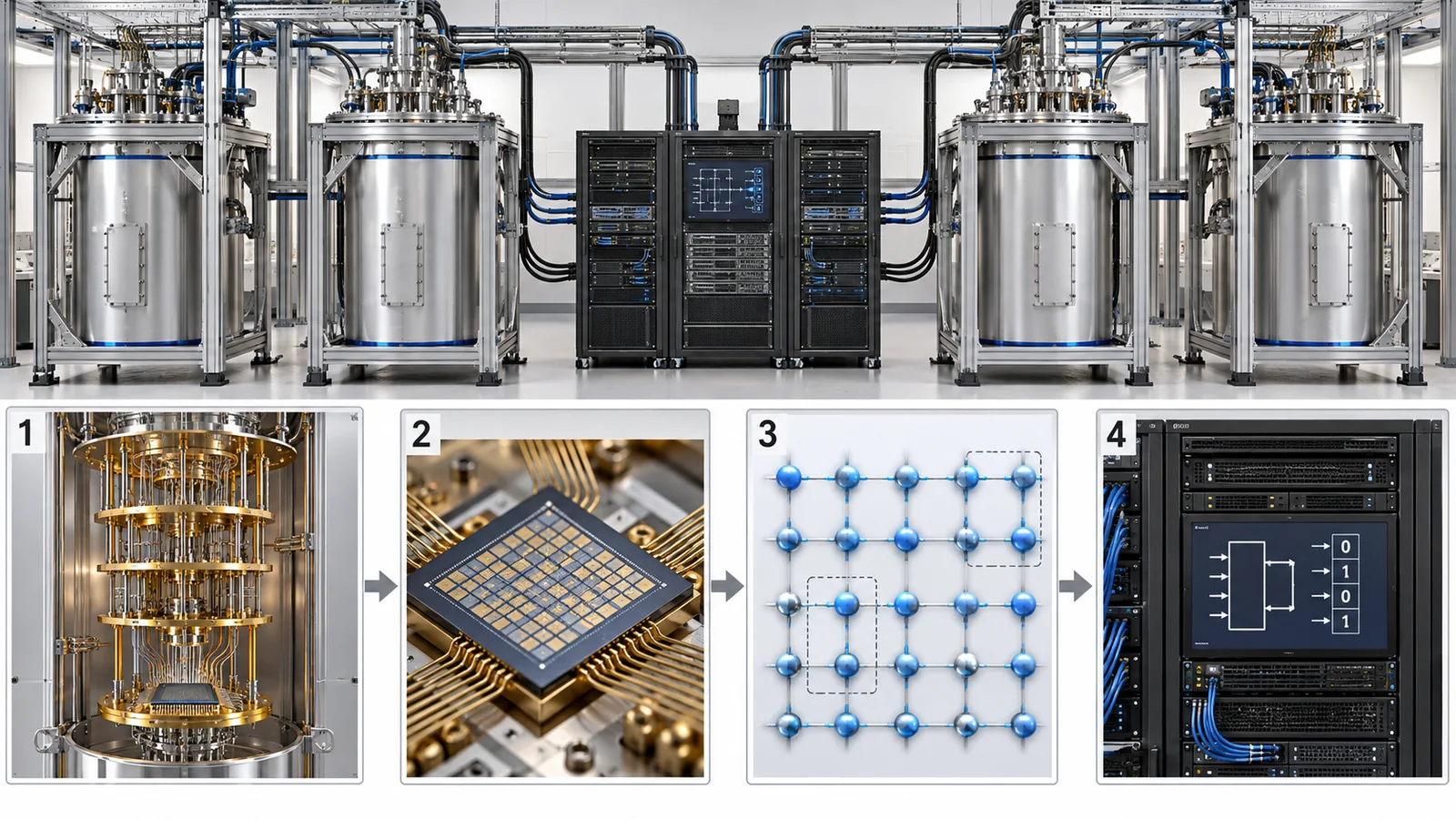
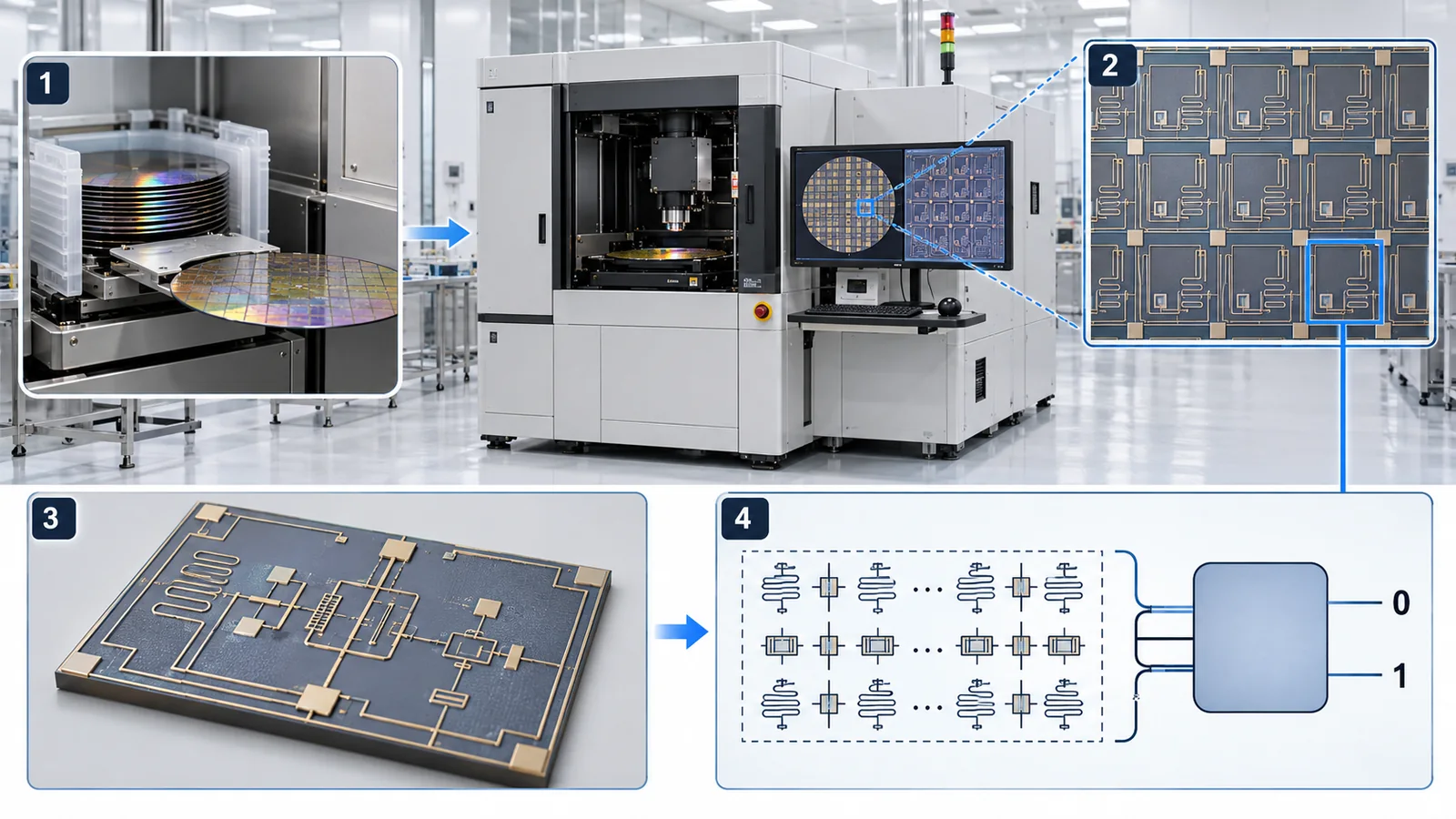
Millions of physical qubits will not fit on one chip. IBM shows a modular design in which separate chips are linked by "L couplers" (microwave cables) [Ref. 32] Sourced (company description). It also says it moved chip fabrication to a 300 mm wafer semiconductor facility and has cut the time to build a new chip by at least half [Ref. 31] Sourced (company claim). From the materials and manufacturing side, the walls to more logical qubits are making qubits in large numbers, uniformly and at high yield, and keeping many modules at cryogenic temperature (refrigerators, wiring and heat). (our commentary). These are covered in "Materials and Fabrication for Quantum Computers" and "Cryogenics and Control" in this series.
4. Recent experiments (as of 16 October 2026)
In the last few years, logical-qubit experiments have moved from "protecting one" to "running dozens and trying logical gates and magic states". The table lists the main papers we could confirm. The platforms, codes, ways of measuring and use of post-selection all differ, so do not line the numbers up to rank them. Preprints (not yet peer reviewed) are marked as such.
| Year and group | Platform and code | What was confirmed | Caution in reading |
|---|---|---|---|
| 2023 (Nature) Harvard, MIT, QuEra and others | Neutral atoms (up to 280 physical qubits). Surface code, colour code, [[8,3,2]] | Raising the surface-code distance from 3 to 7 improved a two-qubit logical gate. With the 3D [[8,3,2]] code, sampling circuits ran with up to 48 logical qubits, 228 logical two-qubit gates and 48 logical CCZ gates. Error detection beat the physical qubits' performance [Ref. 13] Sourced | The 48 are detection with a distance-2 code, not 48 error-corrected logical qubits |
| 2024 (arXiv) Microsoft, Atom Computing and others | Neutral ytterbium atoms (256 qubits) | Entangled 24 logical qubits (48 atoms), correcting on average 1.8 lost atoms. Ran the Bernstein-Vazirani algorithm with up to 28 logical qubits (112 atoms) with better-than-physical error rates [Ref. 15] Sourced | A preprint. Uses a design that turns atom loss into a detectable error ("erasure conversion") |
| 2025 (Nature) Harvard, MIT, QuEra and others | Neutral atoms (up to 448 atoms). Surface code, [[15,1,3]], [[7,1,3]], [[16,6,4]] | 2.14(13)-fold "below threshold" in a four-round characterisation circuit. Logical entanglement by transversal gates and lattice surgery. Arbitrary-angle synthesis with [[15,1,3]] codes. Dozens of logical qubits and hundreds of logical teleportations [Ref. 14] Sourced | The below-threshold check covers four rounds. It tested parts of a universal computer; it is not a deep computation |
| 2025 (Nature) Harvard, MIT, QuEra and others | Neutral atoms. Colour code, distance 3 and 5 | Magic state distillation with logical qubits. In distance-3 and distance-5 colour codes, the logical fidelity of the output magic states exceeded that of the inputs [Ref. 19] Sourced | An experiment on a building block. Whether the output error rate is enough for computation is a separate question |
| 2025 (Physical Review X) Quantinuum | Trapped ions. "Code switching" from the 15-qubit Reed-Muller code to the 7-qubit Steane code | Prepared a magic state in the Steane code with probability 82.58% and infidelity at most 5.1(2.7)×10−4, at least 2.7 times below the main physical error [Ref. 20] Sourced | A value conditioned on success (with its success probability). Includes detection and selection |
| 2025 (Nature) Google Quantum AI | Superconducting qubits. Colour code, distance 3 and 5 | In logical randomized benchmarking, transversal Clifford gates add an error of only 0.0027(3). Magic-state injection reached fidelity above 99% with post-selection (about 75% kept). Logical states were teleported between distance-3 colour codes by lattice surgery with fidelities of 86.5(1) to 90.7(1)% [Ref. 30] Sourced | The above-99% figure is with post-selection. Lattice-surgery fidelity is about 90%, not yet enough for computation |
| 2026 (Nature) Quantinuum, Microsoft | Trapped ions (QCCD). 12-qubit code (2 logical), 16-qubit code (4 logical) | With error detection and post-selection, logical error rates 11 to 800 times lower than several physical baselines [Ref. 16] Sourced | Includes post-selection. An improvement from "detection", not "correction" |
| 2026 (arXiv) Quantinuum | Trapped-ion Helios (98 qubits). Concatenated iceberg codes | With 48 to 94 logical qubits: state preparation and measurement, QEC cycles, logical gates, GHZ states and a partly fault-tolerant simulation of the 3D XY model of quantum magnetism, all better than the physical qubits (beyond break-even) [Ref. 17] Sourced | A preprint. Includes post-selection. 48 are corrected, 94 are detected |
| 2026 (arXiv, September 2026) Quantinuum | Trapped-ion Helios. The [[20,2,6]] C₄-Helix code | Repeated correction at 4.6+6.2−2.6×10⁻⁵ per logical qubit per cycle. Benchmarked the full Clifford group on two logical qubits under active correction: 2.8+1.0−1.6×10⁻⁴ per two-qubit logical Clifford. Linked to a distance-5 surface code for a three-logical-qubit GHZ state with a fidelity lower bound of 99.925%. In each case better than the physical baseline without post-selection [Ref. 18] Sourced | A preprint. The design targets the "early fault-tolerant regime"; the abstract does not state a demonstration of universal computation with magic states |
| 2026 (arXiv, June 2026) | Superconducting qubits. Lattice surgery between distance-3 surface codes | Made a logical Bell state and ran a two-qubit logical Deutsch-Jozsa algorithm. With magic-state injection and gate teleportation, a logical RX(π/4) at fidelity 0.943 (conditioned on no detected errors) [Ref. 21] Sourced | A preprint. Logical error per cycle is large, about 3% (after rejecting leakage events) |
| 2026 (arXiv, June 2026) | Trapped ions. Nine codes (qLDPC, topological, concatenated) on one device | With a qLDPC code encoding 4 logical qubits in 18 physical qubits, a logical error rate up to 9 times better than a previous similar demonstration on superconducting qubits. Break-even in some cases [Ref. 22] Sourced | A preprint. The comparison is with a different device under different conditions |
Values are as stated in each paper's abstract or text (notation as in the original). The preprints of June and September 2026 are not peer reviewed and may change. The organisation of the table is ours.
The horizontal axis is physical qubits and the vertical axis is logical qubits. Toward the lower right means "many physical for few logical" (thick protection); toward the upper left means "a number of logical close to the physical" (thin protection, or detection only). Green is "correction" experiments, amber is experiments that include "detection and post-selection", and purple circles are proposals and simulations that are not real devices. The experimental points cluster at lower left. The purple circles (upper right) are values expected from calculation, not results from real machines.
What is not yet shown: within the range we checked, we could not find an experiment that ran a deep computation including non-Clifford gates on error-corrected logical qubits, combined with real-time decoding. Most of the experiments above test the parts (memory, gates, magic states) one at a time.
5. What fault-tolerant computing needs — logical gates and magic states
(1) What "fault tolerant" means
Fault tolerant means designing so that the error-correction procedure itself may occasionally err, and so that errors do not spread as operations proceed. Preskill explains that "recovery works even if mistakes are made now and then during the recovery" and that "encoded information can be processed without serious propagation of errors" Sourced [Ref. 2]. If a single error doubled to two, then four, with each operation, correction could not keep up. Logical gates are built carefully so that this does not happen.
(2) How logical gates are built — three approaches
| Approach | Idea | Strength | Caution | Experimental example |
|---|---|---|---|---|
| Transversal gate | Apply the same operation to corresponding physical qubits of two code blocks | Errors do not spread. Simple operations | For a code that can detect errors, transversal gates alone cannot be universal (the Eastin-Knill theorem) [Ref. 8] Sourced | Google colour code: error added by a logical gate 0.0027(3) [Ref. 30] |
| Lattice surgery | Join two patches, measure the checks between them, then separate them (figure below) | Logical CNOT and more using only neighbour-to-neighbour couplings of the surface code [Ref. 3, 4] Sourced | Takes time (the measurement is repeated for several cycles) | Moving a logical state between distance-3 colour codes; a logical Bell state between distance-3 surface codes [Ref. 30, 21] |
| Code switching | Move a state made in one code into another code | Each code's best gates can be used in turn | The switching procedure's own errors must also be suppressed | From the Reed-Muller code to the Steane code [Ref. 20] |
The grouping of approaches is our commentary (sources are the references in each cell). The experimental column corresponds to the results in the table of Section 4.
(3) Clifford gates versus the T gate
Some logical gates are easy to build and some are especially hard. Put simply, operations that turn the arrow in 90-degree steps (Hadamard, S, CNOT and so on, called Clifford gates) are easy to build in many codes, while an "in-between" rotation such as 45 degrees (the T gate) is hard.
The reason is in the figure. With Clifford gates alone, the arrow can reach only six directions: north, south, east, west, front and back. Only when a 45-degree rotation is added can combinations approach any direction. And as Eastin and Knill showed, for a code that can detect errors, transversal gates alone cannot be universal [Ref. 8]. The T gate needs another method. That Clifford gates plus the T gate allow universal computation is also explained in a review of fault-tolerant computation [Ref. 45] Sourced.
(4) Magic states — "single-use raw material" for the T gate
The standard way to do a T gate on a logical qubit is to use a special state called a magic state as a single-use part [Ref. 6]. Think of a special mould that is carefully made at another factory, shipped in, and consumed each time it is used. The analogy has a limit. A magic state is a quantum state and cannot be copied. A new one must be made every time it is used.
The problem is making magic states accurate enough. A magic state made with nearby Clifford gates is not accurate enough as it is. So a method called distillation is used. Collect many rough magic states and check them; if any check disagrees, throw the batch away; if it passes, you get one high-accuracy state (figure below). In the 15-to-1 distillation, the output error is about 35p³ (Litinski's explanation [Ref. 5]; the original scheme is by Bravyi and Kitaev [Ref. 6]).
With p = 10−3 (0.1%), p³ = 10−9, and times 35 it is 3.5×10⁻⁸. The input error is cubed, so a small gain in input accuracy improves the output sharply. That is why distillation is practical. But distillation takes many qubits and time. Litinski showed that most of the logical qubits used in distillation can be encoded at a low code distance, and argued that the cost is not as large as thought [Ref. 5].
Recently, magic state cultivation has been proposed as an alternative to distillation. It grows the size and reliability of one state step by step inside a surface-code patch. Gidney and colleagues estimate by simulation that, under uniform circuit noise of 10−3, reaching a logical error of 2×10⁻⁹ takes about one order of magnitude fewer qubit-rounds than earlier methods, and write that further distillation may never be needed in practice [Ref. 7] Sourced (a preprint; the authors' estimate). Gidney's 2025 estimate (Section 3) also uses this cultivation to reduce the area given to magic-state factories [Ref. 10].
(5) How far have magic-state experiments gone?
- Distillation: on neutral atoms, magic states in distance-3 and distance-5 colour codes were distilled, and the logical fidelity of the output exceeded that of the input [Ref. 19] Sourced
- Code switching: on trapped ions, a Steane-code magic state was prepared with probability 82.58% and infidelity at most 5.1(2.7)×10−4 [Ref. 20] Sourced
- Injection (superconducting): in Google's colour code, magic-state injection reached fidelity above 99% with post-selection (about 75% kept) [Ref. 30] Sourced
- Gate teleportation: a 2026 preprint realised a logical RX(π/4) in a distance-3 surface code using magic-state injection and gate teleportation, at fidelity 0.943 (conditioned on no detected errors) [Ref. 21] Sourced
All of these are at the "a part works" stage. That magic states of the needed accuracy (say 10−9 to 10−12) can be supplied at the needed speed and volume has not yet been shown (within the range we checked).
(6) Classical processing, and time
Once a T gate is done with a magic state, its result has to be measured and used to decide the next operation. The time to read the measurement, decode it and feed it into the next instruction (the reaction time) sets how fast the computation can go. The estimates in Section 3 assume a control reaction time of 10 microseconds [Ref. 9, 10]. In Litinski's example, for a computation of T depth 106 to finish in 1 second, each layer must take 1 microsecond or less (Our calculation), and that needs 330 million qubits [Ref. 4]. In other words, not only the quantum parts but also fast classical processing (decoders and control) sets the speed limit of fault-tolerant computing. The decoder discussion of the previous article connects directly to this.
6. Where qLDPC and other new codes fit
The surface code is easy to implement, but at the price of 2d²−1 physical qubits per logical qubit (previous article). So new codes that need fewer physical qubits are being studied. The best known are qLDPC codes (quantum low-density parity-check codes). Like the surface code, a qLDPC code has each check look at only a few qubits. The difference is that the checks also reach distant qubits, which may let many logical qubits be protected by few physical qubits [Ref. 25] Sourced. On the theory side, Panteleev and Kalachev showed that "asymptotically good" qLDPC codes exist (distance and rate that both grow in proportion to the number of qubits) [Ref. 44] Sourced.
(1) IBM's gross code — a proposal and its claims
Bravyi and colleagues presented a fault-tolerant memory using a family of qLDPC codes that includes the gross code [[144,12,12]]. Under the standard circuit noise model it has a threshold of 0.8%, on a par with the surface code; one syndrome-measurement round is a depth-7 circuit of nearest-neighbour CNOT gates, and the required connectivity is a degree-6 graph (which splits into two planar graphs) Sourced [Ref. 23]. In a circuit-level simulation assuming 0.1% physical error, 12 logical qubits are kept for about a million cycles using 288 physical qubits. The authors estimate that the same suppression with the surface code would take about 3000 qubits [Ref. 23]. This is a proposal and an estimate for memory, not a demonstration on a real machine.
IBM has also described a computer design built on this code, "Tour de gross", and estimates that with the same number of physical qubits it can run logical circuits about one order of magnitude larger than surface-code architectures [Ref. 24] Sourced (a preprint; the company's estimate). In November 2025 IBM also announced "Loon", an experimental chip showing the processor components qLDPC codes need (company claim) [Ref. 31]. The design uses several low-loss wiring layers for "C couplers" that link distant qubits.
(2) High-rate codes on movable atoms and ions
Neutral atoms and trapped ions can be moved to link distant qubits (near all-to-all connectivity), so they are thought to suit qLDPC codes well. Xu and colleagues proposed a way to realise the long-range couplings of qLDPC codes by rearranging atoms [Ref. 26] Sourced. A 2026 preprint by QuEra, Harvard and MIT presents ultra-high-rate codes whose rate exceeds 1/2. For [[1152,580,≤12]] (580 logical qubits in 1152 physical), a circuit-level simulation at 0.1% physical error gives 2.9×10⁻¹¹ per logical qubit per cycle [Ref. 28] Sourced (a memory simulation, not an experiment). The construction builds on a new construction by Kasai [Ref. 29]. QuEra itself writes that this is a memory result and that not all the ingredients of fault-tolerant computation are in place [Ref. 46].
| Kind of code | Physical : logical example (our calculation) | Connectivity required | Status (as of 16 October 2026) |
|---|---|---|---|
| Surface code | Distance 7: 101 : 1. Distance 27: 1457 : 1 | Only 4 neighbours (planar) | The most advanced in experiments. Logical gates by lattice surgery [Ref. 1, 3, 4] Sourced |
| Colour code | Experiments at distance 3 and 5 | Neighbours (the checks are more complex) | Transversal Clifford gates are possible. Google experiment on superconducting qubits [Ref. 30] Sourced |
| qLDPC (gross code) | 24 : 1 (288 : 12) | Degree 6, splits into two planar graphs (long-range couplings) | Proposal and simulation. A real machine not confirmed [Ref. 23, 24] Not yet confirmed |
| High-rate qLDPC (QuEra and others) | About 2 : 1 | Atom rearrangement links distant qubits | Simulation [Ref. 28] Not yet confirmed |
| 4D geometric code (Microsoft) | 16 : 1 ([[96,6,8]]) | Near all-to-all (neutral atoms, ions, photons and so on) | Theory and estimates. Microsoft says it could be used for a 50-logical-qubit machine in the near term (company claim) [Ref. 27] Not yet confirmed |
| Concatenated iceberg codes (Quantinuum) | About 2 : 1 (correction) to about 1 : 1 (detection) | All-to-all (ions are moved) | Experiment (preprint). Includes post-selection [Ref. 17] Sourced |
| Bosonic code (cat qubits) plus an outer code | — | Neighbours | AWS reported in Nature an experiment with a distance-5 repetition code as the outer code (previous article) [Ref. 43] Sourced |
Ratios are simple divisions (Our calculation). Code distance, logical error rate and what was measured all differ, so comparison has to be made at the same logical error rate (Section 2).
With conditions. IBM says the gross code "cuts the physical qubits needed by about 90%" [Ref. 32] (company claim). That figure is from a circuit-level simulation of a memory protocol, compared with about 3000 qubits for the surface code [Ref. 23]. A comparison covering everything up to logical gates is a design and an estimate (Tour de gross), not a result from a real machine [Ref. 24]. There are also separate difficulties: the wiring for long-range couplings and its losses, and decoding speed. The right statement: "qLDPC is a promising proposal that may greatly reduce the number of qubits, but demonstration on real machines is still under way."
Building qLDPC codes with superconducting qubits needs long couplings between distant qubits. IBM says it uses several low-loss wiring layers for these "C couplers" [Ref. 31] Sourced (company description). The dielectric of a wiring layer is one of the places the qubit's electric field leaks into. Google's paper, discussed in the previous article, attributes its lifetime improvement to better fabrication and "participation ratio" design. The same thinking is likely to apply to the insulating films of wiring layers (our commentary; Inference). In other words, the loss of the interlayer insulator, the defect density of each layer and the quality of the through-connections could be the materials issues that decide whether new codes can be realised in superconductors.
For superconducting qubits, the issues are cryogenic refrigerators, wiring and material defects (previous article). For trapped ions, Quantinuum says the ion-trap chip for Apollo will be made with standard CMOS processing and controlled with CMOS electronics [Ref. 35] Sourced (company description). IonQ says it will use thin diamond films so that diamond quantum devices can be manufactured at industrial scale [Ref. 34] Sourced (company claim). Neutral atoms centre on vacuum and laser light (optical components) rather than a cryogenic refrigerator. The wall to more logical qubits moves from material defects to mass production of optics, vacuum and control electronics (our commentary). Keeping in mind that materials engineers get involved in different places for each platform makes company announcements easier to read.
7. Roadmaps and third-party evaluation (not yet confirmed)
Companies have published plans toward fault-tolerant quantum computing. Everything below is a plan or target, not an achieved fact Not yet confirmed. Plans are updated. How "logical qubits" are counted (detection or correction, distance, logical error rate) often cannot be confirmed from the published material, so the numbers cannot be lined up to rank anyone.
| Company or agency | Plan or target (gist of the published material) | Latest status we could confirm |
|---|---|---|
| IBM | IBM Quantum Starling in 2029: 200 logical qubits running 100 million operations. Beyond it, Blue Jay (2,000 logical qubits, 1 billion operations). On the way: Loon (2025), Kookaburra (2026), Cockatoo (2027) [Ref. 32, 33] Not yet confirmed | Loon announced in November 2025 (company claim) [Ref. 31]. As of the check date we could not confirm an announcement that Kookaburra is complete (it is not in the list of available processors on IBM's technology page) [Ref. 33] |
| Microsoft, Atom Computing | Magne, a Level 2 "Resilient" quantum computer. Atom Computing's neutral-atom hardware (1,200+ physical qubits) with Microsoft's software. Operated by QuNorth in Denmark. Expected to come online in early 2027 [Ref. 38, 39] Not yet confirmed | Microsoft's blog of August 2026 gives early 2027 for Magne. Level 2 is Microsoft's classification (company terminology) |
| Quantinuum | By the end of the decade, Apollo: hundreds of logical qubits, logical error rate better than 10−6, millions of operations (blog of 2024) [Ref. 35] Not yet confirmed | The March 2026 blog reports 48 error-corrected and up to 94 error-detected logical qubits on Helios (company description) [Ref. 36]. An update to Apollo's date could not be confirmed in official material |
| IonQ | By 2030, 2 million physical qubits and 80,000 logical qubits (physical : logical = 25 : 1; our calculation) [Ref. 34] Not yet confirmed | A target on the official roadmap (company target). The definition of "logical qubit" (code, distance, logical error rate) could not be confirmed on the page |
| Google Quantum AI | Next milestone: a long-lived logical qubit with under one logical error per million cycles (no year given) [Ref. 37] Not yet confirmed | The blog says that after below-threshold error correction on Willow (announced December 2024), the colour-code and dynamic-circuit experiments bring it closer to this milestone (company description) |
| DARPA (Quantum Benchmarking Initiative, QBI) | A programme to determine whether an industrially useful quantum computer can be built by 2033. Stage C verifies with the government that the concept can be built as designed and operated as intended (up to US$300 million) [Ref. 40] Not yet confirmed | DARPA's page (as checked) lists as currently participating: Stage C: Atom Computing, Diraq, IBM, IonQ, Microsoft, PsiQuantum. Stage B: Nord Quantique, Photonic, Quantinuum, Quantum Motion, QuEra, Silicon Quantum Computing, Xanadu. Stage A: Google Quantum AI, Quandela |
The table above summarises the gist of the published material. DARPA's page states that QBI is "not a competition between performers", and the stages show progress in verification, not a ranking. Company plans are checked against each company's official material, and dates are as of the check date.
IBM's "200 logical qubits, 100 million operations" works out to an average of 500,000 operations per logical qubit (100 million ÷ 200; Our calculation). For IonQ's "80,000 logical qubits", neither the number of operations nor the logical error rate could be confirmed on the official page. When reading a plan, look for how many operations, at what logical error rate, and not only "N logical qubits". A count alone does not tell you how large a computation can be.
8. What could not be confirmed, and a summary
What could not be confirmed
- A demonstration of deep fault-tolerant computation on real hardware: within the range we checked, we could not find an experiment that ran a deep computation including non-Clifford gates on error-corrected logical qubits together with real-time decoding.
- Completion of IBM's Kookaburra: as of the check date we could not confirm any announcement that it is complete.
- A real-machine demonstration of qLDPC codes (the gross code and others): we confirmed proposals and simulations, but not a demonstration of the gross code itself on a real machine (a trapped-ion qLDPC experiment was confirmed as a preprint).
- The definition of "logical qubit" in each company's plan: we could not confirm the code, distance or logical error rate on the official pages of IonQ and others.
- The text of ISO/IEC 4879 and the publication status of IEEE P7131: the former is paid, so we confirmed only the title and status. For the latter, we could not tell from the working group's site whether it has been published.
- Peer review of the 2026 preprints: as of the check date we could not confirm peer-reviewed versions of the Quantinuum, superconducting lattice-surgery and trapped-ion qLDPC papers.
- Read logical-qubit counts with their conditions. Correction or detection, code and distance, logical error rate, memory or computation, and use of post-selection must all be stated. From 98 physical qubits there were 48 corrected and up to 94 detected Sourced
- The qubits needed vary by orders of magnitude with assumptions. For the RSA-2048 example, 20 million (2019 estimate) down to under 1 million (2025); about 4 million for FeMoco. Time and qubit count are traded against each other Sourced
- Computing while protected needs logical gates and magic states. The magic state, raw material of the T gate, has an error of about 35p³ after 15-to-1 distillation. Experiments are at the parts stage, and the needed accuracy and volume have not been shown Sourced
- New codes such as qLDPC are promising proposals to cut physical qubits, but need long-range links and real-machine demonstration is still under way. Keep the purple circles (proposals and simulations) separate from experiments Sourced
- Every company plan is "not yet confirmed". IBM states 200 logical qubits in 2029, IonQ 80,000 in 2030 and so on, but these are not achieved facts Not yet confirmed
9. How to read evaluations and standards
Progress in logical qubits and fault-tolerant computing is measured by the logical error rate (how much a logical qubit is damaged per cycle or per operation), the number of logical qubits (separating detection from correction), the fidelity of logical gates, the quality of magic states and resource estimates (physical qubits and time needed). None has a meaning unless you state the code, the distance, whether post-selection was used and what was measured (memory or computation). As for standards, we could not confirm one that directly defines how to count logical qubits. Check date: 16 October 2026.
| Item evaluated | Representative benchmark or method (name and source) | Standards and guidance (ISO/IEC, IEEE and others) | Cautions in reading |
|---|---|---|---|
| Logical error rate | Error per cycle (or per logical operation). Google: 0.143% at distance 7 (memory) [Ref. 1]. C₄-Helix: 4.6×10⁻⁵ per logical qubit per cycle (preprint) [Ref. 18] Sourced | Could not be confirmed | Always give the code, distance, number of cycles, decoder and whether post-selection was used |
| Number of logical qubits | Quantinuum: 48 corrected, up to 94 detected [Ref. 17]. Harvard 2023: up to 48 with a distance-2 code (detection) [Ref. 13] Sourced | Could not be confirmed (no standard defining how to count was found) | Detection or correction, and what distance? Do not rank by the size of the number alone |
| Fidelity of logical gates | Logical randomized benchmarking. Google colour code: transversal Clifford gates add an error of 0.0027(3) [Ref. 30] Sourced | Could not be confirmed | Separate the kind of gate (Clifford, or one that needs a magic state) |
| Quality of magic states | Infidelity of the output and success probability. Quantinuum: infidelity at most 5.1(2.7)×10−4, success probability 82.58% [Ref. 20] Sourced | Could not be confirmed | Is it a value conditioned on success? Check the gap to the accuracy needed (about 10−9 or below) |
| Resource estimates | Physical qubits and time. Gidney and Ekerå, Gidney, Lee et al., Litinski. Framework by Beverland et al. [Ref. 4, 9, 10, 11, 12] Sourced | Could not be confirmed | State the assumptions (physical error rate, cycle, reaction time) and the task. Not the performance of a real machine |
| Third-party verification and progress | DARPA QBI: evaluation in Stages A, B and C, finally verifying whether an industrially useful machine can be built by 2033 [Ref. 40] Sourced | — | Stages show progress in verification, not a ranking (DARPA says it is not a competition). Microsoft's Levels 1, 2 and 3 are a company classification |
| Terms and definitions | — (a terminology standard rather than an evaluation) | ISO/IEC 4879:2024 "Information technology — Quantum computing — Vocabulary" (published May 2024; text is paid) [Ref. 41] Sourced | A standard for aligning definitions. Whether it contains a definition of "logical qubit" was not checked in the text |
| Standard for performance metrics and benchmarking | — | The site of the IEEE P7131 working group (a draft standard for quantum computing performance metrics and benchmarking) [Ref. 42] Not yet confirmed | At the draft stage. Publication status could not be confirmed |
The arrangement of the table is Our calculation (organising). Numbers, titles and publication months of standards were checked on each body's page (check date 16 October 2026). Standards texts are paid, so only titles and scope are given.
Cautions in reading (for materials engineers)
- "N logical qubits" is a different number for detection, correction and post-selection: one announcement may carry both a detection count and a correction count. Always read it together with the logical error rate and the distance
- Experiments are different from simulations and plans: the purple circles in the figure (proposals and simulations) and every company roadmap are not achieved facts. Company announcements are treated as "company claims" and non-peer-reviewed preprints are marked as such
- Resource estimates are not the performance of real machines: the order of magnitude changes with assumptions such as error rate, cycle and reaction time. That an estimate fell under the same assumptions is a different thing from achieving it on hardware
- Standards are still at the terminology stage: ISO/IEC 4879 is a terminology standard and has no legal force or power to decide pass or fail on performance (in general a standard becomes binding when cited in law or a contract; our commentary). The benchmarking standard (IEEE P7131) was a draft as of the check date
10. Glossary
- Physical qubit
- A qubit of the real device. Errors occur in it.
- Logical qubit
- A low-error qubit protected by many physical qubits.
- Error correction
- Finding and fixing errors and carrying on with the computation.
- Error detection
- Only finding errors. Suspect runs are discarded (post-selection).
- Post-selection
- Discarding runs in which an error was detected and using only the rest.
- Code distance
- The number of errors needed before an error becomes undetectable.
- Logical error rate
- The probability a logical qubit fails per cycle or per operation.
- Break-even
- The point where a logical qubit lasts longer (or is more accurate) than a physical qubit.
- Fault tolerant
- Designed so that errors do not spread even if the correction procedure itself errs.
- Logical gate
- An operation on logical qubits, built so as not to break the code.
- Transversal gate
- Applying the same operation to corresponding physical qubits of code blocks.
- Lattice surgery
- Joining two surface-code patches, measuring and separating them to do a logical operation.
- Code switching
- Moving the state of one code into another code.
- Clifford gate
- An easy-to-build operation such as turning the arrow in 90-degree steps (H, S, CNOT).
- T gate
- A 45-degree rotation. Especially hard to build on logical qubits.
- Magic state
- A special state used to perform a T gate. A single-use raw material.
- Distillation
- Turning many rough magic states into a few accurate ones.
- Cultivation
- Growing one magic state step by step inside a patch.
- qLDPC code
- A quantum low-density parity-check code, where each check looks at only a few qubits.
- Gross code
- One qLDPC code presented by IBM: [[144,12,12]].
- Resource estimation
- Estimating, under assumptions, the physical qubits and time a computation needs.
- Reaction time
- The time to read a measurement and feed it into the next instruction.
- Erasure conversion
- A design that turns errors into detectable ones, such as atom loss.
- DARPA QBI
- A US programme to verify whether an industrially useful quantum computer is feasible.
11. References
- Google Quantum AI and Collaborators "Quantum error correction below the surface code threshold", Nature 638, 920–926 (2025), DOI 10.1038/s41586-024-08449-y — doi.org/10.1038/s41586-024-08449-y
- Preskill J. "Reliable quantum computers", Proc. R. Soc. Lond. A 454, 385–410 (1998), DOI 10.1098/rspa.1998.0167 — doi.org/10.1098/rspa.1998.0167
- Horsman D., Fowler A. G., Devitt S., Van Meter R. "Surface code quantum computing by lattice surgery", New J. Phys. 14, 123011 (2012), DOI 10.1088/1367-2630/14/12/123011 — doi.org/10.1088/1367-2630/14/12/123011
- Litinski D. "A Game of Surface Codes: Large-Scale Quantum Computing with Lattice Surgery", Quantum 3, 128 (2019), DOI 10.22331/q-2019-03-05-128 — doi.org/10.22331/q-2019-03-05-128
- Litinski D. "Magic State Distillation: Not as Costly as You Think", Quantum 3, 205 (2019), DOI 10.22331/q-2019-12-02-205 — doi.org/10.22331/q-2019-12-02-205
- Bravyi S., Kitaev A. "Universal quantum computation with ideal Clifford gates and noisy ancillas", Phys. Rev. A 71, 022316 (2005), DOI 10.1103/PhysRevA.71.022316 — doi.org/10.1103/PhysRevA.71.022316
- Gidney C., Shutty N., Jones C. "Magic state cultivation: growing T states as cheap as CNOT gates", arXiv:2409.17595 (2024) (preprint) — arxiv.org/abs/2409.17595
- Eastin B., Knill E. "Restrictions on transversal encoded quantum gate sets", Phys. Rev. Lett. 102, 110502 (2009), DOI 10.1103/PhysRevLett.102.110502 — doi.org/10.1103/PhysRevLett.102.110502
- Gidney C., Ekerå M. "How to factor 2048 bit RSA integers in 8 hours using 20 million noisy qubits", Quantum 5, 433 (2021), DOI 10.22331/q-2021-04-15-433 — doi.org/10.22331/q-2021-04-15-433
- Gidney C. "How to factor 2048 bit RSA integers with less than a million noisy qubits", arXiv:2505.15917 (2025) (preprint) — arxiv.org/abs/2505.15917
- Lee J. et al. "Even more efficient quantum computations of chemistry through tensor hypercontraction", PRX Quantum 2, 030305 (2021), DOI 10.1103/PRXQuantum.2.030305 — doi.org/10.1103/PRXQuantum.2.030305
- Beverland M. E. et al. "Assessing requirements to scale to practical quantum advantage", arXiv:2211.07629 (2022) (preprint) — arxiv.org/abs/2211.07629
- Bluvstein D. et al. "Logical quantum processor based on reconfigurable atom arrays", Nature 626, 58–65 (2024), DOI 10.1038/s41586-023-06927-3 — doi.org/10.1038/s41586-023-06927-3
- Bluvstein D. et al. "A fault-tolerant neutral-atom architecture for universal quantum computation", Nature 649, 39–46 (2025), DOI 10.1038/s41586-025-09848-5 — doi.org/10.1038/s41586-025-09848-5
- Reichardt B. W. et al. "Fault-tolerant quantum computation with a neutral atom processor", arXiv:2411.11822 (2024) (preprint) — arxiv.org/abs/2411.11822
- Paetznick A. et al. "Improved quantum processor logical error rates via correction and detection", Nature 654, 349–355 (2026), DOI 10.1038/s41586-026-10628-y — doi.org/10.1038/s41586-026-10628-y
- Dasu S. et al. (Quantinuum) "Computing with many encoded logical qubits beyond break-even", arXiv:2602.22211 (2026) (preprint) — arxiv.org/abs/2602.22211
- Berthusen N. et al. (Quantinuum) "Experimental validation of a compact fault-tolerant architecture for trapped ions", arXiv:2609.03194 (2026) (preprint) — arxiv.org/abs/2609.03194
- Sales Rodriguez P. et al. "Experimental demonstration of logical magic state distillation", Nature 645, 620–625 (2025), DOI 10.1038/s41586-025-09367-3 — doi.org/10.1038/s41586-025-09367-3
- Daguerre L. et al. "Experimental demonstration of high-fidelity logical magic states from code switching", Phys. Rev. X 15, 041008 (2025), DOI 10.1103/dck4-x9c2 — doi.org/10.1103/dck4-x9c2
- Wang Y. et al. "A superconducting surface-code processor with lattice-surgery logical operations", arXiv:2606.06598 (2026) (preprint) — arxiv.org/abs/2606.06598
- Tham E. et al. "Breakeven demonstration of quantum low-density parity-check codes", arXiv:2606.06455 (2026) (preprint) — arxiv.org/abs/2606.06455
- Bravyi S. et al. (IBM) "High-threshold and low-overhead fault-tolerant quantum memory", Nature 627, 778–782 (2024), DOI 10.1038/s41586-024-07107-7 — doi.org/10.1038/s41586-024-07107-7
- Yoder T. J. et al. (IBM) "Tour de gross: A modular quantum computer based on bivariate bicycle codes", arXiv:2506.03094 (2025) (preprint) — arxiv.org/abs/2506.03094
- Breuckmann N. P., Eberhardt J. N. "Quantum low-density parity-check codes", PRX Quantum 2, 040101 (2021), DOI 10.1103/PRXQuantum.2.040101 — doi.org/10.1103/PRXQuantum.2.040101
- Xu Q. et al. "Constant-overhead fault-tolerant quantum computation with reconfigurable atom arrays", arXiv:2308.08648 (2023) (preprint) — arxiv.org/abs/2308.08648
- Aasen D. et al. (Microsoft) "A topologically fault-tolerant quantum computer with four dimensional geometric codes", arXiv:2506.15130 (2025) (preprint) — arxiv.org/abs/2506.15130
- Zhao C. et al. (QuEra, Harvard, MIT) "Towards ultra-high-rate quantum error correction with reconfigurable atom arrays", arXiv:2604.16209 (2026) (preprint) — arxiv.org/abs/2604.16209
- Kasai K. "Breaking the orthogonality barrier in quantum LDPC codes", Quantum (2026), DOI 10.22331/q-2026-09-09-2205 (arXiv:2601.08824) — arxiv.org/abs/2601.08824
- Lacroix N. et al. (Google Quantum AI) "Scaling and logic in the colour code on a superconducting quantum processor", Nature 645, 614–619 (2025), DOI 10.1038/s41586-025-09061-4 — doi.org/10.1038/s41586-025-09061-4
- IBM "IBM Delivers New Quantum Processors, Software, and Algorithm Breakthroughs on Path to Advantage and Fault Tolerance", press release (12 November 2025) (company announcement) — newsroom.ibm.com (2025-11-12)
- IBM "IBM Sets the Course to Build World's First Large-Scale, Fault-Tolerant Quantum Computer at New IBM Quantum Data Center", press release (10 June 2025) (company announcement) — newsroom.ibm.com (2025-06-10)
- IBM "IBM quantum technology" (official page; checked 16 October 2026) — ibm.com/quantum/technology
- IonQ "IonQ roadmap" (official page; checked 16 October 2026) — ionq.com/roadmap
- Quantinuum "Technical perspective: By the end of the decade, we will deliver universal, fully fault-tolerant quantum computing", official blog (September 2024) — quantinuum.com/blog/technical-perspective…
- Quantinuum "Skinny Logic: Quantum Codes Go on a Diet", official blog (4 March 2026) — quantinuum.com/blog/skinny-logic-quantum-codes-go-on-a-diet
- Google Research "Dynamic surface codes open new avenues for quantum error correction", official blog — research.google/blog/dynamic-surface-codes…
- Microsoft Quantum "From research to product: logical-qubit demonstrations shaping Microsoft's utility-scale quantum software platform", official blog (3 August 2026) — quantum.microsoft.com/…/from-research-to-product…
- Atom Computing "Building quantum supercomputers with Microsoft" (official page) — atom-computing.com/building-quantum-supercomputers-with-microsoft/
- DARPA "Quantum Benchmarking Initiative (QBI)" (official page; checked 16 October 2026) — darpa.mil/research/programs/quantum-benchmarking-initiative
- ISO/IEC 4879:2024 "Information technology — Quantum computing — Vocabulary" (published May 2024). Number, title, date and "Published" status were checked on the listing page of the Institute for Standardization of Serbia (ISS) — iss.rs/en/project/show/iso:proj:80432 (the official ISO page is https://www.iso.org/standard/80432.html; it could not be fetched automatically from our environment, and was confirmed through search-result listings)
- IEEE P7131 working group "Quantum Benchmarking Working Group P7131" (site of the working group on the draft standard for quantum computing performance metrics and benchmarking) — sagroups.ieee.org/7131
- Putterman H. et al. (AWS) "Hardware-efficient quantum error correction via concatenated bosonic qubits", Nature 638, 927–934 (2025), DOI 10.1038/s41586-025-08642-7 — doi.org/10.1038/s41586-025-08642-7
- Panteleev P., Kalachev G. "Asymptotically good quantum and locally testable classical LDPC codes", arXiv:2111.03654 (2021) (preprint; STOC 2022) — arxiv.org/abs/2111.03654
- Campbell E. T., Terhal B. M., Vuillot C. "Roads towards fault-tolerant universal quantum computation", Nature 549, 172–179 (2017), DOI 10.1038/nature23460 — doi.org/10.1038/nature23460
- QuEra Computing "Quantum Error Correction at Record Efficiency: Why Neutral Atoms Are Leading the Way", official blog (20 April 2026) — quera.com/blog-posts/quantum-error-correction-at-record-efficiency…
12. Claim-to-source audit
| Claim in the text | Basis | Label |
|---|---|---|
| The best physical operations have errors of about 10−3 (99.9% for two-qubit gates). A distance-7 surface code has 101 qubits. Extrapolation of distance 27 and 1457 qubits for a logical error of 10−6 | Google (2025) Reference 1 https://doi.org/10.1038/s41586-024-08449-y | Sourced |
| The idea of fault tolerance: recovery works even if mistakes occur during it, and encoded information can be processed without serious propagation of errors | Abstract of Preskill (1998) Reference 2 https://doi.org/10.1098/rspa.1998.0167 | Sourced |
| Surface-code computation by lattice surgery. The time-space trade-off (Litinski: 4 hours 55,000, 22 minutes 120,000, 1 second 330 million; physical error 10−4, 1 microsecond cycle, 108 T gates, T depth 106) | Abstracts of Horsman et al. (2012) and Litinski (2019) Reference 3 https://doi.org/10.1088/1367-2630/14/12/123011 Reference 4 https://doi.org/10.22331/q-2019-03-05-128 | Sourced |
| A reassessment of magic state distillation cost (encoding at low distance). The output error of 15-to-1 distillation is 35p³ (35 undetected combinations of three errors; the batch is discarded on failure). The original scheme (Bravyi and Kitaev) | Abstract and text of Litinski (2019) and Bravyi and Kitaev (2005) Reference 5 https://doi.org/10.22331/q-2019-12-02-205 Reference 6 https://doi.org/10.1103/PhysRevA.71.022316 | Sourced |
| Magic state cultivation: about one order of magnitude fewer qubit-rounds than distillation, logical error 2×10⁻⁹ under 10−3 noise. Distillation may become unnecessary (the authors' estimate, simulation) | Abstract of Gidney et al. (2024) Reference 7 https://arxiv.org/abs/2409.17595 | Sourced |
| For a code that can detect errors, no universal set of transversal gates exists | Abstract of Eastin and Knill (2009) Reference 8 https://doi.org/10.1103/PhysRevLett.102.110502 | Sourced |
| The account that Clifford gates plus the T gate give universal computation, and the comparison of magic state distillation with other approaches | Abstract of Campbell et al. (2017) Reference 45 https://doi.org/10.1038/nature23460 | Sourced |
| RSA-2048 factoring estimates: 20 million qubits and 8 hours in 2019; under 1 million and under 1 week in 2025 (assumptions: 0.1% error, 1 microsecond cycle, 10 microsecond reaction time) | Abstracts of Gidney and Ekerå (2021) and Gidney (2025) Reference 9 https://doi.org/10.22331/q-2021-04-15-433 Reference 10 https://arxiv.org/abs/2505.15917 | Sourced |
| FeMoco: about 4 million qubits and under 4 days (error 0.1% or better, 1 microsecond cycle). Hundreds of thousands to millions of qubits for three large applications | Abstracts of Lee et al. (2021) and Beverland et al. (2022) Reference 11 https://doi.org/10.1103/PRXQuantum.2.030305 Reference 12 https://arxiv.org/abs/2211.07629 | Sourced |
| Harvard and others (2023): up to 280 physical qubits, improvement from distance 3 to 7 in the surface code, up to 48 logical qubits with [[8,3,2]] (228 logical two-qubit gates, 48 logical CCZ), error detection | Abstract of Bluvstein et al. (2024) Reference 13 https://doi.org/10.1038/s41586-023-06927-3 | Sourced |
| Harvard and others (2025): up to 448 atoms, 2.14(13)-fold below threshold (four rounds), transversal gates and lattice surgery, arbitrary-angle synthesis with [[15,1,3]], dozens of logical qubits and hundreds of logical teleportations | Abstract of Bluvstein et al. (2025) Reference 14 https://doi.org/10.1038/s41586-025-09848-5 | Sourced |
| Microsoft and Atom Computing (2024): 256 qubits, entanglement of 24 logical qubits (48 atoms), correction of an average of 1.8 lost atoms, the Bernstein-Vazirani algorithm with 28 logical qubits (112 atoms) | Abstract of the preprint by Reichardt et al. Reference 15 https://arxiv.org/abs/2411.11822 | Sourced |
| Quantinuum and Microsoft (Nature, 2026): logical error rates 11 to 800 times lower, a 12-qubit code (2 logical) and a 16-qubit code (4 logical), error detection and post-selection | Abstract of Paetznick et al. (2026) Reference 16 https://doi.org/10.1038/s41586-026-10628-y | Sourced |
| Quantinuum Helios (2026, preprint): 98 qubits, [[k+2,k,2]] detection codes and concatenated codes, 48 to 94 logical qubits, post-selection, beyond break-even. 48 logical (correction) and 64 / 94 (detection) | Abstract of Dasu et al. and Quantinuum's blog Reference 17 https://arxiv.org/abs/2602.22211 Reference 36 https://www.quantinuum.com/blog/skinny-logic-quantum-codes-go-on-a-diet | Sourced |
| C₄-Helix (September 2026, preprint): [[20,2,6]], 4.6×10⁻⁵ per logical qubit per cycle, 2.8×10⁻⁴ per two-qubit logical Clifford, a fidelity lower bound of 99.925% for a three-logical-qubit GHZ state, no post-selection | Abstract of Berthusen et al. Reference 18 https://arxiv.org/abs/2609.03194 | Sourced |
| Magic state distillation (distance-3 and 5 colour codes, output fidelity above input), code switching (Steane code, 82.58%, infidelity 5.1(2.7)×10−4) | Abstracts of Sales Rodriguez et al. (2025) and Daguerre et al. (2025) Reference 19 https://doi.org/10.1038/s41586-025-09367-3 Reference 20 https://doi.org/10.1103/dck4-x9c2 | Sourced |
| Google colour code: error of transversal Clifford gates 0.0027(3), magic-state injection above 99% fidelity (post-selection, about 75% kept), fidelities of 86.5(1) to 90.7(1)% for logical state transfer by lattice surgery | Abstract of Lacroix et al. (2025) Reference 30 https://doi.org/10.1038/s41586-025-09061-4 | Sourced |
| Lattice surgery between distance-3 superconducting surface codes (June 2026, preprint): logical errors 0.0365(2) and 0.0282(1) (after rejecting leakage), a logical Bell state, a logical RX(π/4) fidelity of 0.943 | Abstract of Wang et al. Reference 21 https://arxiv.org/abs/2606.06598 | Sourced |
| Nine codes on trapped ions (June 2026, preprint): 4 logical qubits in 18 qubits, up to 9 times better than a previous similar demonstration on superconducting qubits, break-even | Abstract of Tham et al. Reference 22 https://arxiv.org/abs/2606.06455 | Sourced |
| Gross code: threshold 0.8%, depth-7 circuit, degree-6 connectivity (two planar graphs), 12 logical qubits for about a million cycles with 288 physical (0.1% physical error), about 3000 for the surface code | Abstract of Bravyi et al. (2024) Reference 23 https://doi.org/10.1038/s41586-024-07107-7 | Sourced |
| Tour de gross: an estimate that, with the same number of physical qubits, logical circuits about one order of magnitude larger can run than with surface-code architectures (company estimate) | Abstract of the preprint by Yoder et al. Reference 24 https://arxiv.org/abs/2506.03094 | Sourced |
| qLDPC codes as an alternative to the surface code, the existence of "asymptotically good" qLDPC codes, and a proposal to realise qLDPC codes by rearranging atoms | Abstracts of Breuckmann and Eberhardt, Panteleev and Kalachev, and Xu et al. Reference 25 https://doi.org/10.1103/PRXQuantum.2.040101 Reference 44 https://arxiv.org/abs/2111.03654 Reference 26 https://arxiv.org/abs/2308.08648 | Sourced |
| 4D geometric codes: [[96,6,8]], logical error of about 10−6 (physical 10−3, circuit-level noise) | Abstract of the preprint by Aasen et al. Reference 27 https://arxiv.org/abs/2506.15130 | Sourced |
| High-rate qLDPC codes: 1.3×10⁻¹³ for [[2304,1156,≤14]] and 2.9×10⁻¹¹ for [[1152,580,≤12]] (0.1% physical, circuit-level noise simulation). That it is a memory result | Abstract of the preprint by Zhao et al., QuEra's blog, and Kasai Reference 28 https://arxiv.org/abs/2604.16209 Reference 46 https://www.quera.com/blog-posts/quantum-error-correction-at-record-efficiency-why-neutral-atoms-are-leading-the-way Reference 29 https://arxiv.org/abs/2601.08824 | Sourced |
| AWS's experiment with cat qubits and an outer repetition code (distance 5) | Abstract of Putterman et al. (2025) Reference 43 https://doi.org/10.1038/s41586-025-08642-7 | Sourced |
| IBM: the announcement of Loon, low-loss wiring layers for C couplers, fabrication at a 300 mm wafer facility (build time cut by at least half) (company claims) | IBM press release (12 November 2025) Reference 31 https://newsroom.ibm.com/2025-11-12-ibm-delivers-new-quantum-processors,-software,-and-algorithm-breakthroughs-on-path-to-advantage-and-fault-tolerance | Sourced |
| IBM's plan: Starling (2029, 200 logical, 100 million operations), Blue Jay (2,000 logical, 1 billion), Loon (2025), Kookaburra (2026), Cockatoo (2027), L couplers, and the claim that qLDPC cuts the physical qubits needed by about 90% | IBM press release (10 June 2025) and IBM's technology page Reference 32 https://newsroom.ibm.com/2025-06-10-IBM-Sets-the-Course-to-Build-Worlds-First-Large-Scale,-Fault-Tolerant-Quantum-Computer-at-New-IBM-Quantum-Data-Center Reference 33 https://www.ibm.com/quantum/technology | Not yet confirmed |
| IonQ's plan: 2 million physical and 80,000 logical qubits by 2030. A claim about manufacturing devices from thin diamond films | IonQ's official roadmap Reference 34 https://www.ionq.com/roadmap | Not yet confirmed |
| Quantinuum's plan: by the end of the decade Apollo (hundreds of logical qubits, logical error better than 10−6, millions of operations). The Apollo ion-trap chip is made with CMOS processing | Quantinuum's official blog (September 2024) Reference 35 https://www.quantinuum.com/blog/technical-perspective-by-the-end-of-the-decade-we-will-deliver-universal-fault-tolerant-quantum-computing | Not yet confirmed |
| Google's next milestone (a long-lived logical qubit with under one error per million cycles), and below-threshold error correction on Willow (announced December 2024) | Google Research's official blog Reference 37 https://research.google/blog/dynamic-surface-codes-open-new-avenues-for-quantum-error-correction/ | Not yet confirmed |
| Magne: Level 2 "Resilient", 1,200+ physical qubits, operated by QuNorth, expected to come online in early 2027. Atom Computing's Level 2 goal | Microsoft Quantum's blog (3 August 2026) and Atom Computing's page Reference 38 https://quantum.microsoft.com/en-us/insights/blogs/from-research-to-product-engineering-logical-qubit-demonstrations-shaping-microsoft-utility-scale-quantum-software-platform Reference 39 https://atom-computing.com/building-quantum-supercomputers-with-microsoft/ | Not yet confirmed |
| DARPA's QBI: deciding by 2033 whether an industrially useful machine is possible; the content of Stages A, B and C and their participants (as checked); that it is not a competition | DARPA's official page Reference 40 https://www.darpa.mil/research/programs/quantum-benchmarking-initiative | Not yet confirmed |
| ISO/IEC 4879:2024 "Information technology — Quantum computing — Vocabulary" was published in May 2024 | Listing page of the Institute for Standardization of Serbia (ISS) Reference 41 https://iss.rs/en/project/show/iso:proj:80432 | Sourced |
| The IEEE P7131 working group has a draft standard for quantum computing performance metrics and benchmarking as its technical scope. Publication status could not be confirmed | The working group's site Reference 42 https://sagroups.ieee.org/7131 | Not yet confirmed |
| The table of physical : logical ratios, 1457 × 1000 = about 1.46 million, 0.920 ≈ 12%, 35 × (10−3)³ = 3.5 × 10⁻⁸, the second round of about 1.5 × 10⁻²¹, IBM's 100 million ÷ 200 = 500,000 per logical qubit, IonQ's 2 million ÷ 80,000 = 25 : 1, and one layer in 1 microsecond or less derived from Litinski's T depth of 106 in 1 second | Our calculation (assumptions stated in the text). Not results from a real machine | Our calculation |
| A demonstration of deep fault-tolerant computation on real hardware, completion of Kookaburra, a real-machine demonstration of the gross code, the definition of logical qubits in each company's plan, the text of ISO/IEC 4879, the publication status of IEEE P7131, and peer review of the 2026 preprints | Not described, because they could not be confirmed in the primary material available within the scope of this research | Commentary |
| The analogies of "a document kept in several safes" and "a single-use special mould", the readings "a smaller ratio is not automatically better", "interlayer insulator loss could be a challenge for new codes" and "the shape of the materials problem differs by platform" | Our organisation and commentary based on published content. Not views stated by the bodies concerned | Commentary |
| Fig. 1 and Fig. 5 are ImageGen-generated conceptual illustrations. The other figures are explanatory drawings, not observations of real data | Note in this article | Commentary |
Last updated 16 October 2026. Sources are limited to primary material (peer-reviewed papers, arXiv papers, official pages of companies and DARPA, and ISO standard listing pages). Company plans and announcements are marked as "company claims" and "not yet confirmed". Resource estimates and numerical examples are calculations under assumptions, not results from real machines. A demonstration of deep fault-tolerant computation on real hardware, completion of IBM's Kookaburra, a real-machine demonstration of the gross code, the definition of logical qubits in each company's plan, the text of ISO/IEC 4879, the publication status of IEEE P7131 and peer review of the 2026 preprints could not be confirmed and are not stated here. All figures are explanatory concept diagrams or drawings that include our calculations; Fig. 1 and Fig. 5 are ImageGen-generated conceptual illustrations.