TECHNOLOGY EXPLAINER
Neutral Atoms
― How atoms lined up by optical tweezers become qubits, and the optics and vacuum behind them
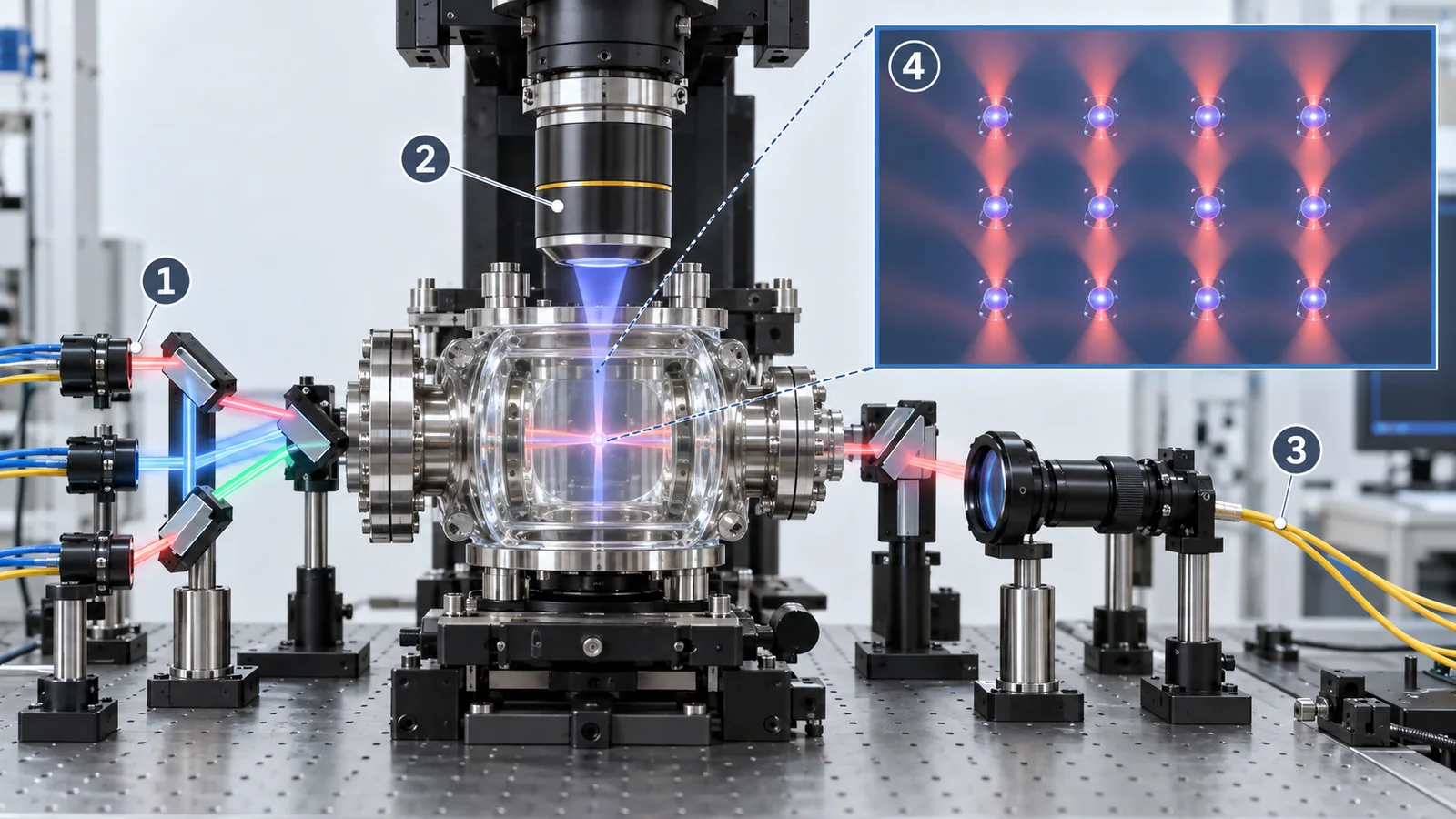
The neutral-atom approach catches atoms one by one in vacuum with laser "tweezers," lines them up, and turns each into a qubit. Like trapped ions, it uses identical atoms made by nature, but because an atom carries no charge it is caught by light, not by electric fields. Atoms without charge normally do not touch one another, so two-qubit gates use the "Rydberg state": lifting an atom to a highly excited state in which it temporarily swells. Its hallmarks are that thousands of identical atoms can be lined up and that atoms can be moved to change connections; error-correction experiments have advanced in recent years. The drawback is that atoms get lost. This article explains, with figures and small numerical examples: (1) how atoms are caught and lined up, (2) what the qubit is, (3) how it is controlled and read out, (4) strengths and weaknesses, (5) scaling up (the zoned approach), (6) the optics and vacuum of the apparatus, and (7) the state of play as of the check date (16 October 2026).
- In three lines / what to know first / where this sits in the series
- Recap: a qubit is an "arrow"
- Catching atoms with optical tweezers and lining them up
- The qubit is "two states inside an atom"
- Control: one-qubit gates, and two-qubit gates via the Rydberg state
- Readout, and atom loss
- The key points on a common "card," and a side-by-side with the other three approaches
- Scaling up: the zoned approach, and the number of atoms
- The apparatus, optics and vacuum
- Where things stand (checked 16 October 2026) and plans
- Limits, what we could not confirm, and a summary
- How to read evaluations and standards
- Glossary
- References (primary sources)
- Claim-to-source audit
Sourced = stated in a published source (with a link)
Our calculation = a value this article computed from stated assumptions
Not yet confirmed = plans, targets, drafts and other items that are not settled
Readings for materials research and analogies are marked as commentary. An inference is shown in bold.
A quantum-computing number means little unless it comes with what was measured and how. Here, error rates, fidelities and lifetimes come with the approach, the thing measured, whether it is an average or a best value, and the date. Company announcements are labeled as the company's claims, and plans and targets are shown as Not yet confirmed, kept apart from achieved facts. The ratio of the gate-pulse length to the Rydberg-state lifetime (about 0.3%) is our own example, combining two numbers from the same paper. We did not read the full texts of the standards (ISO/IEC, IEEE), which are paid; we give only titles and status. We do not tell lies to keep things simple. Every analogy comes with its limits.
1. In three lines / what to know first / where this sits in the series
- A neutral-atom qubit is a single atom caught in vacuum by an optical tweezer. 0 and 1 are two internal states of the atom (hyperfine levels, for example)[Ref. 1, 2]Sourced
- Thousands of identical atoms can be lined up and moved to change connections (an array of 6,100 atoms; over 3,000 atoms maintained for over 2 hours). Two-qubit gates briefly put atoms in a "Rydberg state," and fidelity of 99.5% (up to 60 atoms in parallel) has been reported[Ref. 3, 4, 1]Sourced
- The challenges are atoms getting lost and slow cycles. Loss, though, shows which atom escaped, so it can also be an easier kind of error to handle in error correction[Ref. 4, 5, 6]Sourced
Neutral atoms are an approach in which "light lines up and moves large numbers of identical atoms." Two-qubit gates between uncharged atoms use the Rydberg state, a "temporarily swollen state," and the biggest challenge is atoms escaping.
Prerequisites: none. The arrow picture is recapped in the next chapter (no quantum-mechanics formulas are used).
Place in the series: read this after "The Basics of Quantum Computing" and "Quantum Gates and Circuits." It pairs well with our explainer on trapped ions, the other approach that uses atoms. Error correction is covered in our explainers on quantum error correction and the surface code, and on logical qubits and fault-tolerant computing; vacuum and optics in our explainers on optical fiber, semiconductor lasers, photodetectors, and materials and manufacturing for quantum computers.
2. Recap: a qubit is an "arrow"
In this series, a qubit's state is drawn as an arrow from the center of a sphere to its surface. Pointing at the north pole means "0," pointing at the south pole means "1," and pointing in between is a superposition. When the arrow is tilted, a measurement always gives 0 or 1, and the chance of each is set by the tilt. After the measurement the arrow is fixed at a pole, and the old tilt does not come back.
That is wrong. A tilted arrow is not "holding both 0 and 1" but "pointing in a definite direction between 0 and 1." Measure it and you get just one of 0 or 1. A quantum computer's power comes from combining these arrow directions like waves so that the right answer reinforces itself (see our explainer on quantum algorithms).
3. Catching atoms with optical tweezers and lining them up
(1) Light draws atoms in
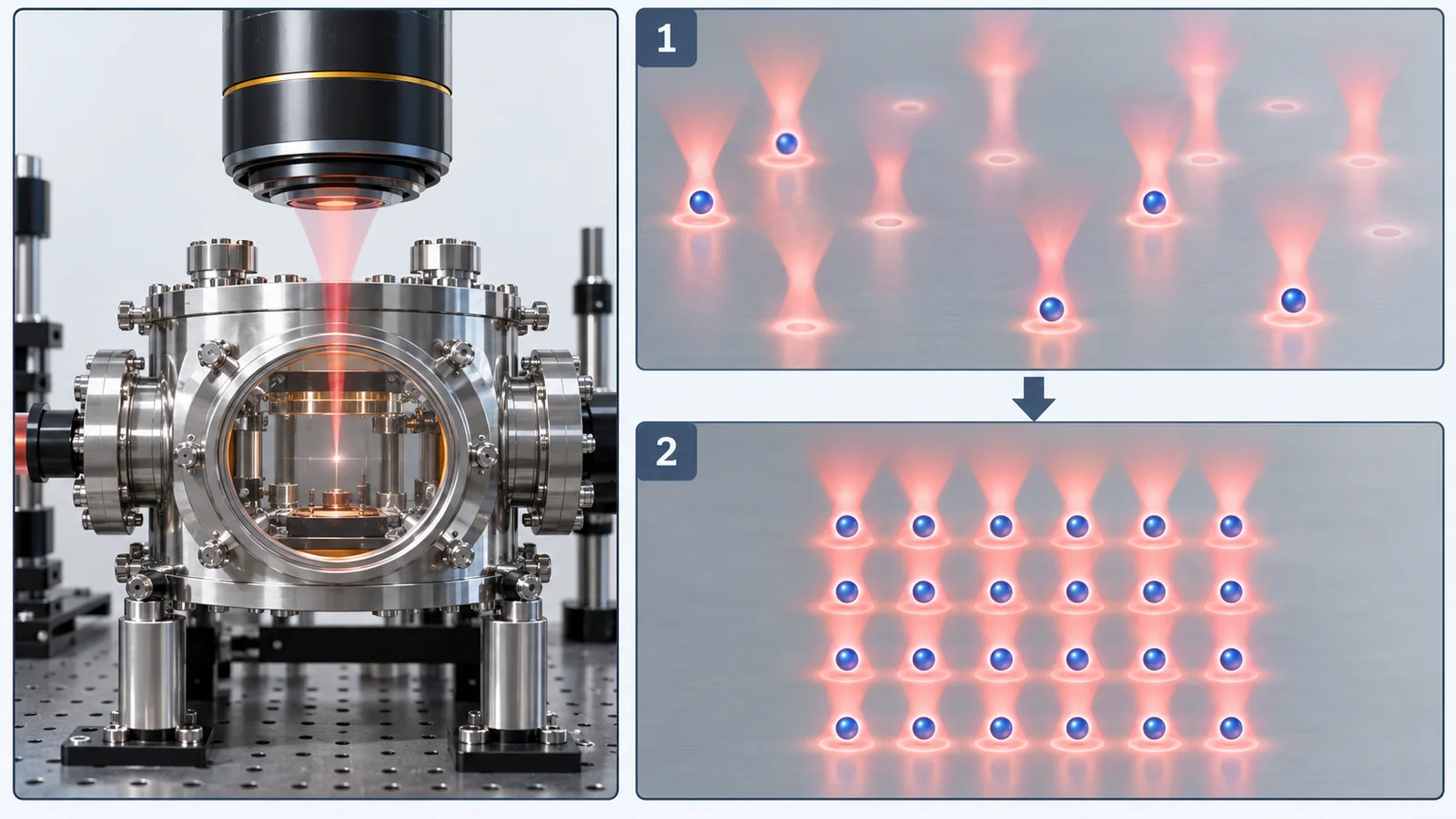
An atom without charge (a neutral atom) cannot be moved by an electric field. So the force of light is used instead. When laser light is focused to a needle-thin spot by a lens, a "valley" that draws atoms in forms at the focus (commentary: the light's electric field induces a small charge imbalance in the atom, which is pulled toward stronger light; this happens with light at a frequency below the atom's resonance). This thin valley of light is the optical tweezer, and one tweezer holds one atom[Ref. 7, 8]Sourced.
(2) Lining up: measure, then move
Many tweezers are created at once with a liquid-crystal phase plate (a spatial light modulator, SLM) or similar. But atoms enter a tweezer only probabilistically. So a picture is taken to find where the atoms are, and another tweezer (swept quickly by an element called an AOD) moves atoms to close the gaps. Endres et al. (2016) used this "measure first, then move" procedure to make defect-free arrays of over 50 atoms in under 400 ms[Ref. 9, 10]Sourced. In the machine of Evered et al., 87Rb atoms were loaded into 850 nm tweezers, rearranged with 810 nm tweezers, and cooled to about 10 μK in valleys about 1 mK deep[Ref. 1]Sourced.
View original SVG, values and sources
Original SVG reference: Drawing that includes our own calculation (vector drawing). Concept diagram of optical tweezers and atom rearrangement. The numbers come from Evered et al. [Ref. 1] and Endres et al. [Ref. 9]. "10 μK ÷ 20 mK = 1/2,000" is our calculation (the operating temperature of superconducting qubits is from the review by Krantz et al.).
The "about 10 μK" here is how violently the atoms shake, not that the apparatus is cold. The apparatus (vacuum chamber and optics) is at room temperature, and only the atoms are cooled by laser light. This differs from superconducting qubits, where a refrigerator cools the whole device[Ref. 1, 3]Sourced.
4. The qubit is "two states inside an atom"
A neutral-atom qubit is, as with ions, two internal states of the atom. Commonly used are two hyperfine levels of the ground state of an alkali atom (rubidium, cesium); Evered et al. take |F = 1, mF = 0⟩ and |F = 2, mF = 0⟩ as 0 and 1[Ref. 1, 2]Sourced. Another line uses alkaline-earth atoms (ytterbium, strontium). Ma et al. made the nuclear spin of a metastable state of 171Yb the qubit and showed a way to turn many errors into detectable loss[Ref. 11, 5]Sourced.
Some state-holding times are very long. Manetsch et al. showed, in an array of 6,100 atoms, a coherence time of 12.6 seconds for a hyperfine qubit (reported as the longest for hyperfine qubits in a tweezer array), a trapping lifetime of 23 minutes in a room-temperature apparatus, and an imaging survival of 99.98952%[Ref. 3]Sourced. But this is the performance of catching and holding atoms, which is a separate matter from the precision of two-qubit gates. Only during a gate is an atom excited to a "Rydberg state" and returned at once (next chapter).
This is wrong. 6,100 is a number that shows atoms can be caught in tweezers and keep coherence for a long time; it does not mean a computation was done with 6,100 qubits[Ref. 3]Sourced. The numbers used in computing experiments are, for example, up to 280 in the logical-qubit experiment and up to 448 in the error-correction experiment[Ref. 12, 13]Sourced. And the experiment that kept over 3,000 atoms for over 2 hours demonstrated continuous operation by refilling atoms, not computation[Ref. 4]Sourced. For "how many qubits," check what the number counts (arranged, held, gated, error-corrected) and physical versus logical.
5. Control: one-qubit gates, and two-qubit gates via the Rydberg state
(1) One-qubit control: turning the arrow
Light tuned to the frequency between 0 and 1 (a Raman transition using the frequency difference of two laser beams) or microwaves turn the arrow. Evered et al. used light applied to all atoms at once (Rabi frequency 1 MHz) and suppressed error by shaping the pulses (BB1 pulses)[Ref. 1]Sourced. Local control that addresses atoms individually was shown by Radnaev et al. with a local one-qubit-gate fidelity of 99.902(8)%, and the logical processor of Bluvstein et al. also has fully programmable one-qubit rotations[Ref. 2, 12]Sourced.
(2) Two-qubit control: briefly extending a "long arm"
This is the neutral-atom approach's biggest trick. Atoms in the ground state barely touch one another. So only during a gate, an atom is excited to a "Rydberg state." A Rydberg state is one in which the electron spreads very far out; interactions between atoms are strong and the lifetime is long (for a large quantum number n, the interaction grows as n⁴ and the lifetime as n³)[Ref. 14]Sourced. The idea was proposed by Jaksch et al. in 2000[Ref. 15]Sourced. When a nearby atom A is in the Rydberg state, atom B can no longer be excited by the same light (blockade). This relation, "if one is excited, the other is not," becomes an operation that depends on both atoms' states (a CZ gate).
Ground-state atoms indeed barely interact, but a two-qubit gate can be made by temporarily putting them in a Rydberg state and "borrowing" the force of interaction. Not interacting is also an advantage: while no gate is applied, atoms do not disturb one another and the state is kept for a long time (commentary). The two-qubit-gate fidelity of 99.5% (Evered et al.) was obtained this way[Ref. 1]Sourced.
Evered et al. shone the gate laser on everything at once and arranged atoms in pairs brought close together, so the gate acts only on the closely paired atoms through blockade. The light hits everything, but only the close pairs respond, and this ran up to 60 atoms in parallel[Ref. 1]Sourced. Where superconducting qubits and ions often need a separate signal for each qubit being addressed, neutral atoms are distinctive in that the light is shared and moving the atoms decides which pairs it acts on (commentary).
6. Readout, and atom loss
Readout is, as with ions, "bright or dark." A readout laser is applied and a camera takes a picture of the atoms' fluorescence. Only atoms in one state glow while the others stay dark. Because the picture shows each atom's position, many atoms can be read out at once (Manetsch et al. report imaging fidelity above 99.99%)[Ref. 3]Sourced. Radnaev et al. showed a way to read out alkali-atom qubits without destroying them (loss of 0.9(3)%)[Ref. 2]Sourced.
The biggest challenge: atoms escape
The tweezer valley is shallow and atoms escape little by little. Chiu et al. state that atom loss has bound neutral-atom machines to pulsed operation, and showed "continuous operation" that keeps refilling atoms to maintain an array of over 3,000 for over 2 hours (reloading 300,000 atoms into tweezers per second)[Ref. 4]Sourced. On the other hand, an escaped atom shows as an empty tweezer, so you know which atom, and the thought is that this is easier to handle than an error of unknown location (an erasure error). Scholl et al. and Ma et al. showed erasure conversion in alkaline-earth atoms, turning errors into detectable loss[Ref. 5, 11]Sourced, and Reichardt et al., in a machine of 256 ytterbium atoms designed so that the main errors are detected as atom loss, entangled 24 logical qubits encoded in 48 atoms[Ref. 6]Sourced (a preprint).
Not necessarily. Because the location of an escaped atom is known from the picture, that information can sometimes be used to correct errors (erasure errors). Reichardt et al. report an example in which errors detected as loss were corrected together with an average of 1.8 lost atoms[Ref. 6]Sourced (a preprint). But with too much loss correction fails, and refilling atoms and speeding up cycles are also needed. "How to handle loss" is a major research question for this approach.
7. The key points on a common "card," and a side-by-side with the other three approaches
Here is everything so far as a "card" that answers the series' five shared questions (what it is made of, what 0 and 1 are, how it is controlled, how it is read, strengths and weaknesses). The other three articles use the same card.
Reading the four approaches in the same format
| Item | Superconducting | Trapped ion | Neutral atom | Photonic |
|---|---|---|---|---|
| What the qubit is | A superconducting circuit (e.g., a transmon): an "artificial atom" about 1 mm across, drawn on a chip[Ref. 17] | One atomic ion floated in vacuum by radio-frequency electric fields (e.g., Ba⁺, Yb⁺)[Ref. 18, 19] | One neutral atom caught in vacuum by an optical tweezer, a tightly focused laser beam (e.g., Rb, Cs, Yb)[Ref. 1, 11, 2] | A photon (a particle of light) travelling in a waveguide, a path for light, or in an optical fiber[Ref. 20, 21] |
| How 0 and 1 are told apart | The lowest two energy steps of the circuit[Ref. 17] | Two internal states of the atom (e.g., two hyperfine levels of Ba⁺)[Ref. 19] | Two internal states of the atom (e.g., two hyperfine levels of Rb)[Ref. 1] | Which of two paths the photon takes (e.g., one of two waveguides); it can also be an early or late time slot[Ref. 20, 22] |
| How it is controlled | Microwave pulses. Two-qubit gates use a coupler or the cross-resonance effect[Ref. 17, 23] | Laser light (or microwaves or electrical signals). Two-qubit gates use the shared motion of the ions as a go-between[Ref. 18, 24, 25] | Laser light. In a two-qubit gate, atoms are lifted to a highly excited Rydberg state so that nearby atoms affect each other[Ref. 14, 1] | Interference in an optical circuit and photon detection (measurement). Photons pass through each other, so measurement creates the interaction[Ref. 22, 26] |
| How it is read out | Measure a small shift in the microwave response of a resonator (dispersive readout)[Ref. 27, 28] | Shine light and see whether it fluoresces (bright / dark)[Ref. 18] | Image the fluorescence and see which atoms are bright or dark[Ref. 3] | Photodetectors count which path the photon arrived on (one example runs superconducting nanowire detectors at about 2 K)[Ref. 20] |
| Operating environment | About 20 mK in a dilution refrigerator[Ref. 17] | Ultra-high vacuum. Traps exist at room temperature and in cooled form[Ref. 29, 30] | Lasers and optics around an ultra-high-vacuum chamber. Atoms at about 10 μK, apparatus at room temperature[Ref. 1, 3] | Most circuit parts run at room temperature. Detectors are often cooled[Ref. 21, 20] |
| Example two-qubit gate time | 43 ns (an example by Barends et al.) or about 200 ns (a cross-resonance example)[Ref. 17] | About 70 μs (an example from Helios). One study scanned 3.8 μs to 520 μs[Ref. 19, 29] | Gate pulses are on the order of hundreds of ns (one calibration value in Evered et al.: 275 ns). Rearranging and imaging take longer[Ref. 1, 13] | We could not confirm a representative value |
| Example of two-qubit quality (definitions differ) | EPLG 3.7×10⁻³ as shown on IBM's official page (measurement conditions could not be confirmed)[Ref. 23, 31] | Average infidelity 7.9×10⁻⁴ (Helios, average over all zones of a 98-qubit machine)[Ref. 19] | Fidelity 99.5% (up to 60 atoms in parallel, Evered et al.)[Ref. 1] | "Fusion" fidelity 99.22% (only when detection succeeds; loss not included)[Ref. 20] |
| Strengths | Fast. Semiconductor-style microfabrication can be used[Ref. 17] | Ions of one species are all identical. Control precision is high[Ref. 18, 19] | Many identical atoms can be lined up (6,100). The layout can be changed[Ref. 3, 32] | Easy to link with optical fiber. Optical circuits can be built in a semiconductor factory (the plan)[Ref. 20, 21] |
| Weaknesses | Qubit lifetimes are relatively short. Wiring and cooling; fabrication variation[Ref. 33, 34, 35, 36] | Gates are slow. Scaling adds electrodes, lasers and wiring[Ref. 19, 18] | Atoms get lost. Cycles are slow[Ref. 4, 13] | Photon loss is the biggest challenge. Photons barely interact with each other[Ref. 21, 22] |
The arrangement is commentary; the numbers and facts in each cell come from the references (checked 16 October 2026). The numbers are different quantities under different conditions, so please do not rank the approaches by them.
The answer is "not settled yet." Each has different strengths: speed (superconducting), precision and all-to-all connectivity (ions), large numbers and freedom of layout (neutral atoms), and compatibility with communication (photons). All of them attack the same hard problem — keeping quality while adding qubits — by different routes. The numbers in this article's table have different definitions and conditions, so please do not compare them directly.
8. Scaling up: the zoned approach, and the number of atoms
The scaling idea for neutral atoms is to move atoms and apply gates only where needed. In 2022, Bluvstein et al. showed a processor with dynamically changing connectivity in which arrays of entangled atoms are moved in two dimensions while staying entangled, with one- and two-qubit operations in between[Ref. 32]Sourced. In 2023 they reported, with a zoned approach (separate storage, entangling and readout regions, and moving atoms), logical qubits run on up to 280 physical qubits, an improvement of a two-qubit logical gate when the code distance was raised from 3 to 7, and up to 48 logical qubits entangled[Ref. 12]Sourced.
In 2025, Bluvstein et al., with up to 448 atoms, examined surface-code error correction in circuits of four measurement rounds and, using detection of atom loss and machine-learning decoding, showed below-threshold performance (2.14(13) times). They also tested operations between logical qubits (transversal gates, lattice surgery) and reuse of qubits (raising the cycle rate by two orders of magnitude)[Ref. 13]Sourced. Reichardt et al., a collaboration of Microsoft Quantum and Atom Computing, used a machine of 256 ytterbium atoms and report running the Bernstein–Vazirani algorithm with 28 logical qubits (112 atoms) at an error rate better than the physical one[Ref. 6]Sourced (a preprint).
As the figure shows, in neutral atoms "thousands of atoms" and "an error-correction experiment with hundreds" show different things. Look at qubits as a whole: number and quality (error rate), connectivity, speed, and physical versus logical. Even if a gate pulse is hundreds of ns, rearranging atoms and imaging take time, so the whole cycle is long (Bluvstein et al. report raising the cycle rate by two orders of magnitude by reusing qubits)[Ref. 13, 1]Sourced.
9. The apparatus, optics and vacuum
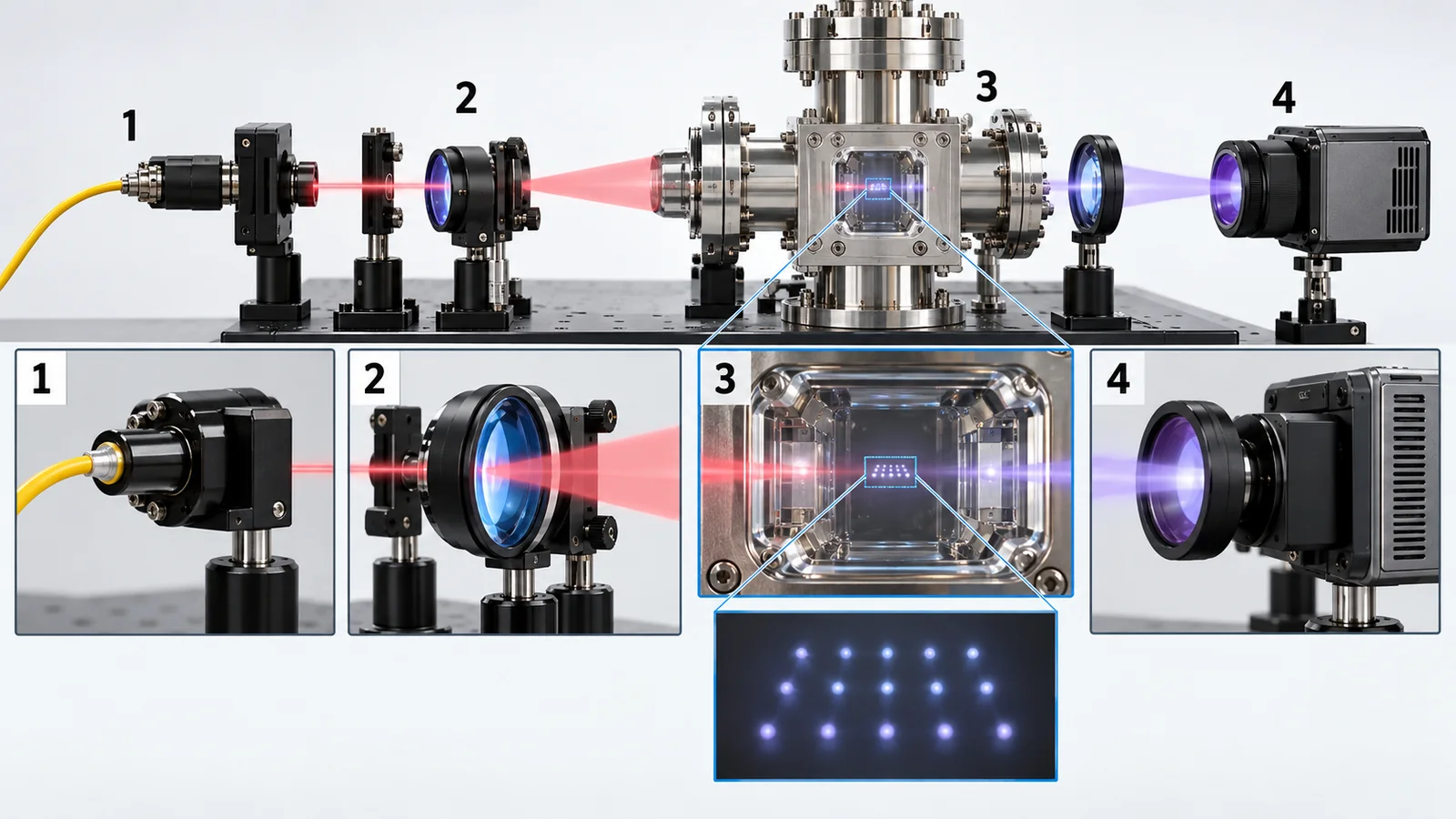
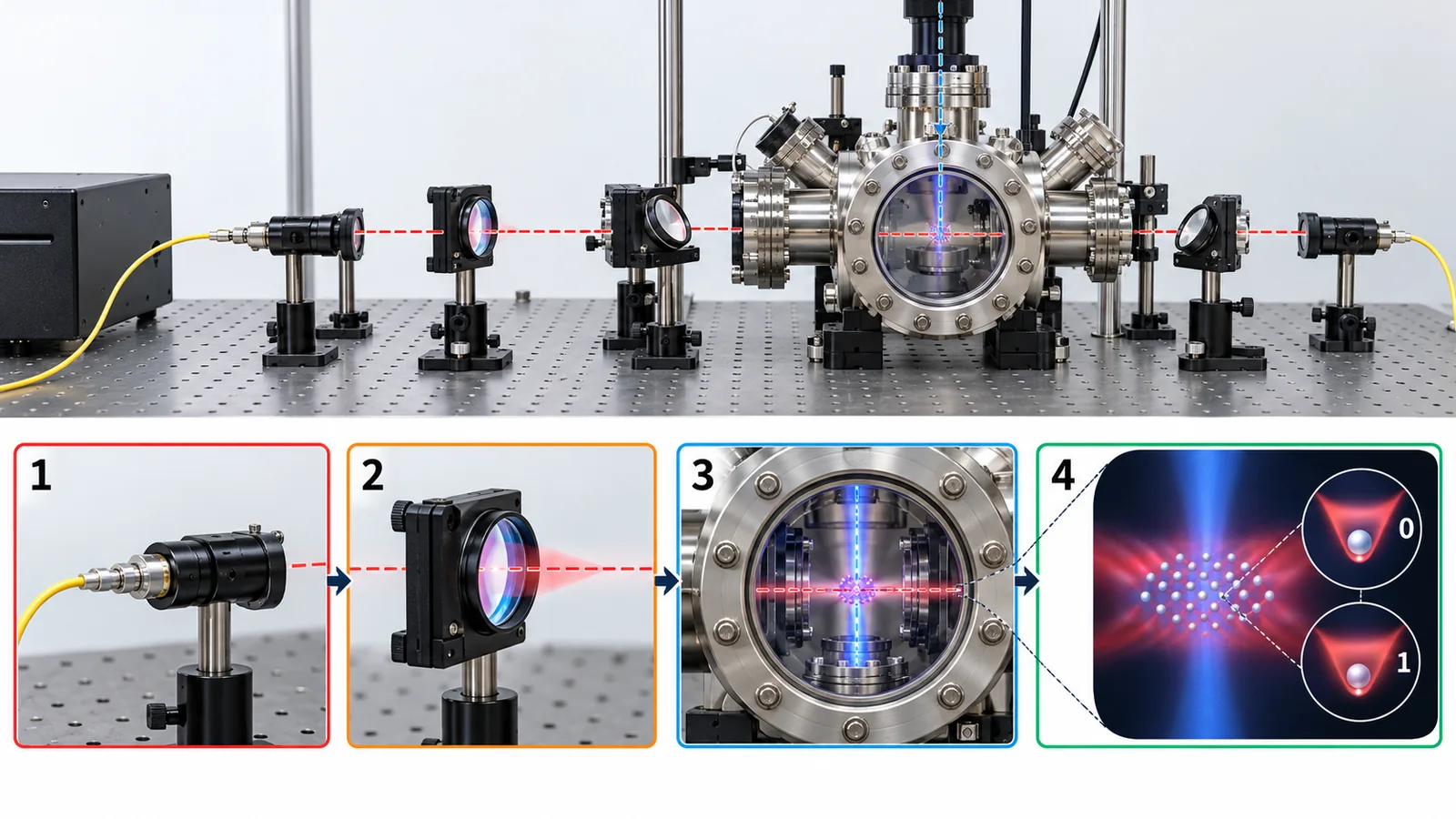
A neutral-atom machine does not need a cryogenic refrigerator, but it is a mass of optics and lasers. The issues relevant to materials engineers are summarized below, by the numbers in the figure.
View original SVG, values and sources
Original SVG reference: Concept diagram (vector drawing). Concept diagram of a neutral-atom apparatus and the materials, optics and vacuum issues. Numbers come from Evered et al. [Ref. 1], Radnaev et al. [Ref. 2] and Manetsch et al. [Ref. 3].
In neutral atoms, catching, moving, gating and reading are all done with light. Evered et al. shaped the Rydberg-excitation beams with SLMs into flat intensity profiles to reduce differences in light strength from atom to atom[Ref. 1]Sourced. If the light's strength differs from atom to atom, the gate's rotation angle differs. That is, the surface accuracy, uniformity, scattering and thermal deformation of optics such as lenses, mirrors, SLMs and AODs translate directly into gate errors (commentary). The materials, coatings and manufacturing of optics share topics with our explainers on optical fiber, semiconductor lasers and photodetectors.
An atom caught in a tweezer escapes when a residual gas molecule hits it. In the machine of Evered et al., the vacuum-limited atom lifetime was about 10 seconds[Ref. 1]Sourced. In the machine of Manetsch et al., the room-temperature trapping lifetime reached 23 minutes, which underlies the 6,100-atom array and the high imaging survival[Ref. 3]Sourced. The difference is probably due to the vacuum chamber's materials, the choice of parts that do not outgas, and the design of pumps and getters (inference). Ultra-high vacuum sets not just the atoms' lifetime but the length of the cycle and the amount of refilling needed, which is a highlight for materials engineers.
10. Where things stand (checked 16 October 2026) and plans
(1) Error-correction experiments (a peer-reviewed paper by a university research team)
The paper by Bluvstein et al., published in Nature in November 2025, showed, in an array of up to 448 neutral atoms, below-threshold error correction (2.14(13) times), operations between logical qubits, and reuse of qubits[Ref. 13]Sourced. These are experiments in circuits of a few measurement rounds, not the execution of a long computation. We could not confirm a reproduction of the same experiment by another laboratory.
(2) Company research teams
A research team at Infleqtion reported a general-purpose neutral-atom computer with cesium atoms that applies light to individual atoms separately (CZ gate 99.35(4)%, 99.73(3)% excluding atom-loss events)[Ref. 2]Sourced. Microsoft Quantum and Atom Computing report in a preprint an experiment of fault-tolerant computation with 256 ytterbium atoms[Ref. 6]Sourced. Both are papers by company teams, and we have not confirmed reproduction by other laboratories.
(3) Plans (not yet confirmed)
Papers state the outlook of aiming for computation and error correction with thousands to tens of thousands of atoms (for example, Manetsch et al. state that universal quantum computing and error correction with thousands to tens of thousands of physical qubits could be a near-term prospect)[Ref. 3]Not yet confirmed. We could not confirm companies' roadmaps (qubit counts, logical-qubit counts, years) in official materials, so we do not give them.
11. Limits, what we could not confirm, and a summary
(1) Full texts of standards
We did not read the full text of ISO/IEC 4879:2024, which is paid. For IEEE P7130 and P7131 we could not retrieve the IEEE pages and confirmed only the existence of the projects through StandICT.eu.
(2) Preprints and company papers
Reichardt et al. and Peper et al. are preprints, and Radnaev et al. is a company team's paper. Please distinguish peer review from reproduction by other laboratories.
(3) Gate time
The pulse length of Evered et al. (275 ns) is one value marked in a calibration figure, not a representative value for all machines. We could not confirm a representative time for the whole cycle including rearrangement and imaging.
(4) Content not covered
We do not cover molecules, optical lattices (placing atoms in a periodic grid of light), atom–photon links (quantum networks) or domestic Japanese research.
(5) Progress on plans
We could not confirm companies' roadmaps, so we do not state progress.
- A neutral-atom machine uses a single atom caught by an optical tweezer as the qubit. 0 and 1 are two internal states of the atomSourced
- A two-qubit gate is made by briefly putting atoms in the Rydberg state and using blockade. The light is shared, and moving atoms decides the pairsSourced
- Readout is fluorescence imaging. Many atoms are read at once, and escaped atoms show tooSourced
- The biggest challenge is atoms escaping. Continuous operation and treating loss as an "erasure error" are advancingSourced
- The number of atoms alone does not tell performance. The 6,100-atom array, the 448-atom error correction and the 280-qubit logical processor show different thingsSourced
12. How to read evaluations and standards
A neutral-atom machine's performance is read through two-qubit-gate precision, imaging and atom retention, and how far errors are suppressed by error correction. The numbers change with "whether atom loss is excluded," "whether preparation errors are corrected," and "what the number of atoms counts." For standards, vocabulary has come first, while standards for how to measure performance are still at the project stage (checked 16 October 2026).
| What is evaluated | Representative benchmarks and evaluation methods (name, source) | Standards and guidance (NIST, ISO/IEC, IEEE, ETSI, ITU-T, IETF, etc.) | Cautions in reading |
|---|---|---|---|
| Gate accuracy (two-qubit) | Estimate fidelity of Bell states or gates with benchmark gate sequences (close to randomized benchmarking, a method that repeats gates). Examples: Evered et al. 99.5% (up to 60 atoms in parallel), Radnaev et al. 99.35(4)%[Ref. 1, 2, 37]Sourced | We could not confirm one | The number changes depending on whether atom-loss events are excluded (Radnaev et al.: 99.35% → 99.73%) and whether preparation errors are corrected (Scholl et al.: ≥0.9971 → ≥0.9985)[Ref. 2, 5] |
| Imaging and atom retention | Imaging fidelity and survival probability, trapping lifetime, coherence time. Example: Manetsch et al. above 99.99%, 99.98952%, 23 minutes, 12.6 s[Ref. 3]Sourced | We could not confirm one | Retention performance is separate from gate precision. Do not rank it alongside the number of atoms |
| Progress in error correction | Logical error rate and the suppression factor when the code distance is raised (below threshold: 2.14(13) times) and the number of logical qubits (up to 48). Bluvstein et al.[Ref. 12, 13]Sourced | We could not confirm one | Check how many rounds the circuit had and whether loss detection and machine-learning decoding were used (it is not the length of a computation) |
| Plans versus achievements | The outlook stated in papers (computation and error correction with thousands to tens of thousands of physical qubits). We could not confirm companies' roadmaps[Ref. 3]Not yet confirmed | We could not confirm one | An outlook is not an achieved fact. Check whether the figure is physical or logical |
| Is the physical system a good raw material for a quantum computer? | DiVincenzo's seven items (five requirements plus two on communication): (1) many well-characterized qubits, (2) initialization, (3) coherence time much longer than a gate, (4) a universal set of gates, (5) qubit-specific measurement, (6)(7) two items on communication[Ref. 39]Sourced | We could not confirm one (this is a paper's framework, not a standard) | It is a checklist, not a score. Each of the four approaches meets the items in different ways and has different weak points |
| Gate accuracy (one- and two-qubit) | Randomized benchmarking (RB): run random gate sequences and infer the average error from how success decays (Knill et al., 2008; Magesan et al., 2011)[Ref. 40, 37]Sourced | IEEE P7131 (quantum computing performance metrics and benchmarking) is at the project stage[Ref. 41]Not yet confirmed | Read "99.9% fidelity" together with which operation was measured and how. RB numbers depend on how the test is done |
| Quality of the whole machine | Quantum volume (Cross et al., 2019), EPLG (McKay et al., 2023), CLOPS (Wack et al., 2021), a method to measure capabilities (Proctor et al., 2022)[Ref. 42, 31, 43, 44]Sourced | We could not confirm one (IEEE P7131 is at the project stage)[Ref. 41]Not yet confirmed | Each metric measures something different. Do not decide a machine's merit from one number (a survey of benchmarks: Acuaviva et al., 2026[Ref. 45]) |
| Terminology and definitions | — (a vocabulary standard, not an evaluation method) | ISO/IEC 4879:2024 "Information technology — Quantum computing — Vocabulary" (first edition, May 2024, published)[Ref. 38]Sourced. IEEE P7130 (quantum technology definitions) is at the project stage[Ref. 46]Not yet confirmed | The standards' full texts are paid, so we did not read them. We do not state their requirements or definitions |
The arrangement of the table is Our calculation (organization). Because the standards' full texts are paid, we give only titles and status (checked 16 October 2026).
Cautions in reading (for materials engineers)
- "How many qubits" alone does not tell performance. Check what the number counts (arranged, held, gated, error-corrected) and physical versus logical[Ref. 3, 12, 13]
- Check whether a number excludes or includes loss. Radnaev et al.'s 99.35% and 99.73% are two numbers for the same machine under different conditions[Ref. 2]
- A preprint and a peer-reviewed paper, a company paper and a third-party reproduction, are different. Reichardt et al. is a preprint; Radnaev et al. is a peer-reviewed paper by a company team[Ref. 6, 2]
- Check whether a standard is a recommendation or a requirement, and whether it is legally binding. ISO/IEC 4879 is a vocabulary standard and does not guarantee performance[Ref. 38]. Plans are Not yet confirmed
13. Glossary
- Qubit
- The unit of information in a quantum computer. It can point in a direction between 0 and 1. In the series' shared picture, an "arrow."
- Neutral atom
- An atom without charge. It is caught by the force of light, not by an electric field.
- Optical tweezer
- A "valley" of light, made by tightly focusing a laser, that draws an atom in.
- Spatial light modulator (SLM)
- An element that changes the phase of light, with liquid crystals for instance, to make many tweezers at once.
- Acousto-optic deflector (AOD)
- An element that swings the direction of light quickly with sound waves, making tweezers that move atoms.
- Hyperfine levels
- Two steps of very close energy in an atom's ground state; used as 0 and 1 in many neutral atoms.
- Raman transition
- A way to move between 0 and 1 using a frequency equal to the difference between two laser beams.
- Rydberg state
- A highly excited state in which the electron spreads very far out; interactions between atoms are strong.
- Blockade
- The effect that, if a nearby atom is in a Rydberg state, another cannot be excited by the same light.
- CZ gate
- A two-qubit gate that flips the phase only when both qubits are 1.
- Fluorescence imaging
- Taking a camera picture of the atoms' fluorescence and reading 0 and 1 from bright / dark.
- Loss (atoms escaping)
- Atoms escaping from tweezers. The biggest challenge of this approach.
- Erasure error
- An error whose location is known. Easier to correct than an error of unknown location.
- Erasure conversion
- A trick to turn errors into detectable loss.
- Continuous operation
- Operation that keeps refilling atoms to maintain an array for a long time.
- Zoned approach
- An approach with separate storage, entangling and readout regions, moving atoms between them.
- Alkali / alkaline-earth atoms
- Rubidium, cesium, etc. / ytterbium, strontium, etc. They differ in how the qubit is taken.
- Physical / logical qubit
- A real single atom / one qubit represented by many physical qubits protected by error correction.
- Coherence time
- A measure of how long a qubit holds its state.
- Fidelity
- How close an operation or state is to the ideal. Closer to 1 is better.
- Below threshold
- The state in which, if the physical error is small enough, a larger code gives a smaller logical error.
- Vacuum-limited atom lifetime
- A measure of how long it takes for residual gas molecules to knock an atom out.
14. References (primary sources)
- Evered S. J. et al. "High-fidelity parallel entangling gates on a neutral-atom quantum computer", Nature 622, 268–272 (2023), DOI 10.1038/s41586-023-06481-y (we also read the arXiv:2304.05420 version) — doi.org/10.1038/s41586-023-06481-y
- Radnaev A. G. et al. (Infleqtion) "A universal neutral-atom quantum computer with individual optical addressing and non-destructive readout", PRX Quantum 6, 030334 (2025), DOI 10.1103/66s8-jj18 — doi.org/10.1103/66s8-jj18
- Manetsch H. J. et al. "A tweezer array with 6,100 highly coherent atomic qubits", Nature 647, 60–67 (2025), DOI 10.1038/s41586-025-09641-4 (we read the abstract of the arXiv:2403.12021 version) — doi.org/10.1038/s41586-025-09641-4
- Chiu N.-C. et al. "Continuous operation of a coherent 3,000-qubit system", Nature 646, 1075–1080 (2025), DOI 10.1038/s41586-025-09596-6 — doi.org/10.1038/s41586-025-09596-6
- Scholl P. et al. "Erasure conversion in a high-fidelity Rydberg quantum simulator", Nature 622, 273–278 (2023), DOI 10.1038/s41586-023-06516-4 — doi.org/10.1038/s41586-023-06516-4
- Reichardt B. W. et al. (Microsoft Quantum, Atom Computing) "Fault-tolerant quantum computation with a neutral atom processor", arXiv:2411.11822 (preprint, November 2024) — arxiv.org/abs/2411.11822
- Kaufman A. M., Ni K.-K. "Quantum science with optical tweezer arrays of ultracold atoms and molecules", Nat. Phys. 17, 1324–1333 (2021), DOI 10.1038/s41567-021-01357-2 — doi.org/10.1038/s41567-021-01357-2
- Browaeys A., Lahaye T. "Many-body physics with individually controlled Rydberg atoms", Nat. Phys. 16, 132–142 (2020), DOI 10.1038/s41567-019-0733-z — doi.org/10.1038/s41567-019-0733-z
- Endres M. et al. "Atom-by-atom assembly of defect-free one-dimensional cold atom arrays", Science 354, 1024–1027 (2016), DOI 10.1126/science.aah3752 — doi.org/10.1126/science.aah3752
- Barredo D. et al. "An atom-by-atom assembler of defect-free arbitrary two-dimensional atomic arrays", Science 354, 1021–1023 (2016), DOI 10.1126/science.aah3778 — doi.org/10.1126/science.aah3778
- Ma S. et al. "High-fidelity gates and mid-circuit erasure conversion in an atomic qubit", Nature 622, 279–284 (2023), DOI 10.1038/s41586-023-06438-1 — doi.org/10.1038/s41586-023-06438-1
- Bluvstein D. et al. "Logical quantum processor based on reconfigurable atom arrays", Nature 626, 58–65 (2024), DOI 10.1038/s41586-023-06927-3 — doi.org/10.1038/s41586-023-06927-3
- Bluvstein D. et al. "A fault-tolerant neutral-atom architecture for universal quantum computation", Nature 649, 39–46 (2025), DOI 10.1038/s41586-025-09848-5 (we read the abstract of the arXiv:2506.20661 version) — doi.org/10.1038/s41586-025-09848-5
- Saffman M., Walker T. G., Mølmer K. "Quantum information with Rydberg atoms", Rev. Mod. Phys. 82, 2313–2363 (2010), DOI 10.1103/RevModPhys.82.2313 — doi.org/10.1103/RevModPhys.82.2313
- Jaksch D. et al. "Fast quantum gates for neutral atoms", Phys. Rev. Lett. 85, 2208–2211 (2000), DOI 10.1103/PhysRevLett.85.2208 — doi.org/10.1103/PhysRevLett.85.2208
- Peper M. et al. "Spectroscopy and modeling of 171Yb Rydberg states for high-fidelity two-qubit gates", arXiv:2406.01482 (preprint, June 2024) — arxiv.org/abs/2406.01482
- Krantz P. et al. "A quantum engineer's guide to superconducting qubits", Appl. Phys. Rev. 6, 021318 (2019), DOI 10.1063/1.5089550 — doi.org/10.1063/1.5089550
- Bruzewicz C. D. et al. "Trapped-ion quantum computing: Progress and challenges", Appl. Phys. Rev. 6, 021314 (2019), DOI 10.1063/1.5088164 — doi.org/10.1063/1.5088164
- Ransford A. et al. (Quantinuum) "A 98-qubit trapped-ion quantum computer with all-to-all connectivity", Nature 655, 81–86 (2026), DOI 10.1038/s41586-026-10676-4 (we read the preprint arXiv:2511.05465 "Helios: A 98-qubit trapped-ion quantum computer") — doi.org/10.1038/s41586-026-10676-4
- Alexander K. et al. (PsiQuantum) "A manufacturable platform for photonic quantum computing", Nature 641, 876–883 (2025), DOI 10.1038/s41586-025-08820-7 (we also read the arXiv:2404.17570 version) — doi.org/10.1038/s41586-025-08820-7
- Aghaee Rad J. et al. (Xanadu) "Scaling and networking a modular photonic quantum computer", Nature 638, 912–919 (2025), DOI 10.1038/s41586-024-08406-9 — doi.org/10.1038/s41586-024-08406-9
- Kok P. et al. "Linear optical quantum computing with photonic qubits", Rev. Mod. Phys. 79, 135–174 (2007), DOI 10.1103/RevModPhys.79.135 — doi.org/10.1103/RevModPhys.79.135
- IBM "IBM Quantum — Technology" (official page; checked 16 October 2026) — www.ibm.com/quantum/technology
- Sørensen A., Mølmer K. "Quantum computation with ions in thermal motion", Phys. Rev. Lett. 82, 1971–1974 (1999), DOI 10.1103/PhysRevLett.82.1971 — doi.org/10.1103/PhysRevLett.82.1971
- Löschnauer C. M. et al. (Oxford Ionics) "Scalable, high-fidelity all-electronic control of trapped-ion qubits", PRX Quantum 6, 040313 (2025), DOI 10.1103/h4wk-v31j — doi.org/10.1103/h4wk-v31j
- Bartolucci S. et al. (PsiQuantum) "Fusion-based quantum computation", Nat. Commun. 14, 912 (2023), DOI 10.1038/s41467-023-36493-1 — doi.org/10.1038/s41467-023-36493-1
- Blais A. et al. "Circuit quantum electrodynamics", Rev. Mod. Phys. 93, 025005 (2021), DOI 10.1103/RevModPhys.93.025005 — doi.org/10.1103/RevModPhys.93.025005
- Wallraff A. et al. "Strong coupling of a single photon to a superconducting qubit using circuit quantum electrodynamics", Nature 431, 162–167 (2004), DOI 10.1038/nature02851 — doi.org/10.1038/nature02851
- Ballance C. J. et al. "High-fidelity quantum logic gates using trapped-ion hyperfine qubits", Phys. Rev. Lett. 117, 060504 (2016), DOI 10.1103/PhysRevLett.117.060504 — doi.org/10.1103/PhysRevLett.117.060504
- Mehta K. K. et al. "Integrated optical multi-ion quantum logic", Nature 586, 533–537 (2020), DOI 10.1038/s41586-020-2823-6 — doi.org/10.1038/s41586-020-2823-6
- McKay D. C. et al. "Benchmarking quantum processor performance at scale", arXiv:2311.05933 (preprint, November 2023) — arxiv.org/abs/2311.05933
- Bluvstein D. et al. "A quantum processor based on coherent transport of entangled atom arrays", Nature 604, 451–456 (2022), DOI 10.1038/s41586-022-04592-6 — doi.org/10.1038/s41586-022-04592-6
- Google Quantum AI, Acharya R. et al. "Quantum error correction below the surface code threshold", Nature 638, 920–926 (2025), DOI 10.1038/s41586-024-08449-y (we also read the arXiv:2408.13687 version) — doi.org/10.1038/s41586-024-08449-y
- Bland M. P. et al. "Millisecond lifetimes and coherence times in 2D transmon qubits", Nature 647, 343–348 (2025), DOI 10.1038/s41586-025-09687-4 (we also read the arXiv:2503.14798 version) — doi.org/10.1038/s41586-025-09687-4
- Krinner S. et al. "Engineering cryogenic setups for 100-qubit scale superconducting circuit systems", EPJ Quantum Technol. 6, 2 (2019), DOI 10.1140/epjqt/s40507-019-0072-0 — doi.org/10.1140/epjqt/s40507-019-0072-0
- Zhang E. J. et al. "High-fidelity superconducting quantum processors via laser-annealing of transmon qubits", arXiv:2012.08475 (published as Sci. Adv. 8, eabi6690 (2022); we read the abstract of the arXiv version) — arxiv.org/abs/2012.08475
- Magesan E., Gambetta J. M., Emerson J. "Scalable and robust randomized benchmarking of quantum processes", Phys. Rev. Lett. 106, 180504 (2011), DOI 10.1103/PhysRevLett.106.180504 — doi.org/10.1103/PhysRevLett.106.180504
- ISO/IEC "ISO/IEC 4879:2024 Information technology — Quantum computing — Vocabulary" (ISO page; first edition, May 2024, published) — www.iso.org/standard/80432.html
- DiVincenzo D. P. "The physical implementation of quantum computation", Fortschr. Phys. 48, 771–783 (2000), arXiv:quant-ph/0002077 — arxiv.org/abs/quant-ph/0002077
- Knill E. et al. "Randomized benchmarking of quantum gates", Phys. Rev. A 77, 012307 (2008), DOI 10.1103/PhysRevA.77.012307 — doi.org/10.1103/PhysRevA.77.012307
- StandICT.eu "P7131 - Standard for Quantum Computing Performance Metrics & Performance Benchmarking" (an IEEE project, as listed in the StandICT.eu standards repository; the IEEE page itself could not be retrieved) — standict.eu/standards-repository/p7131-standard-quantum-computing-performance-metrics-performance-benchmarking
- Cross A. W. et al. "Validating quantum computers using randomized model circuits", Phys. Rev. A 100, 032328 (2019), DOI 10.1103/PhysRevA.100.032328 — doi.org/10.1103/PhysRevA.100.032328
- Wack A. et al. "Quality, speed, and scale: three key attributes to measure the performance of near-term quantum computers", arXiv:2110.14108 (preprint, October 2021) — arxiv.org/abs/2110.14108
- Proctor T. et al. "Measuring the capabilities of quantum computers", Nat. Phys. 18, 75–79 (2022), DOI 10.1038/s41567-021-01409-7 — doi.org/10.1038/s41567-021-01409-7
- Acuaviva A. et al. "Benchmarking quantum computers: towards a standard performance evaluation approach", Quantum Sci. Technol. 11, 025004 (2026), DOI 10.1088/2058-9565/ae4269 — doi.org/10.1088/2058-9565/ae4269
- StandICT.eu "P7130 - Standard for Quantum Technologies Definitions" (an IEEE project, as listed in the StandICT.eu standards repository; the IEEE page itself could not be retrieved) — standict.eu/standards-repository/p7130-standard-quantum-technologies-definitions
15. Claim-to-source audit
| Claim in the text | Basis | Type |
|---|---|---|
| Evered et al.: two-qubit 99.5% (up to 60 atoms in parallel), 87Rb, 850 nm SLM tweezers, 810 nm AODs, about 10 μK and about 1 mK deep, hyperfine levels |F=1,mF=0⟩ and |F=2,mF=0⟩, global Raman (Rabi frequency 1 MHz, BB1), two-photon excitation at 420 nm and 1013 nm, vacuum lifetime about 10 s, calibration value T = 275 ns, Rydberg-state lifetime 88 μs (an assumption of the error model), main error sources, flat beams by SLMs | Evered et al. (text of the arXiv version) Reference 1 https://doi.org/10.1038/s41586-023-06481-y | Sourced |
| The review by Saffman et al.: Rydberg interaction n⁴ and lifetime n³. Jaksch et al.: the proposal of fast gates using the Rydberg state (2000). Kaufman and Ni; Browaeys and Lahaye: reviews of tweezer arrays | Abstracts of each paper and review Reference 14 https://doi.org/10.1103/RevModPhys.82.2313 Reference 15 https://doi.org/10.1103/PhysRevLett.85.2208 Reference 7 https://doi.org/10.1038/s41567-021-01357-2 Reference 8 https://doi.org/10.1038/s41567-019-0733-z | Sourced |
| Endres et al. and Barredo et al. (2016): defect-free arrays of over 50 atoms in under 400 ms, by measuring then moving | Abstract of Endres et al. (arXiv) and the bibliographic record of Barredo et al. Reference 9 https://doi.org/10.1126/science.aah3752 Reference 10 https://doi.org/10.1126/science.aah3778 | Sourced |
| Manetsch et al.: 6,100 atoms in about 12,000 sites, coherence time 12.6 s, room-temperature trapping lifetime 23 minutes, imaging survival 99.98952% and fidelity above 99.99%, outlook | Abstract of Manetsch et al. (arXiv version) Reference 3 https://doi.org/10.1038/s41586-025-09641-4 | Sourced |
| Chiu et al.: over 3,000 atoms maintained for over 2 hours, reloading 300,000 per second, the statement that loss has bound machines to pulsed operation | Abstract of Chiu et al. Reference 4 https://doi.org/10.1038/s41586-025-09596-6 | Sourced |
| Bluvstein et al.: 2022 (moving while entangled), 2023 (up to 280 physical qubits, distance 3→7, up to 48 logical qubits, fully programmable one-qubit rotations), 2025 (up to 448 atoms, 2.14(13) times, transversal gates and lattice surgery, two orders of magnitude by reuse); Nature publication | Abstracts of each paper Reference 32 https://doi.org/10.1038/s41586-022-04592-6 Reference 12 https://doi.org/10.1038/s41586-023-06927-3 Reference 13 https://doi.org/10.1038/s41586-025-09848-5 | Sourced |
| Ma et al.: metastable nuclear spin of 171Yb; one-qubit 0.9990(1) and two-qubit 0.980(1); erasure conversion. Scholl et al.: erasure conversion; Bell state ≥0.9971 and ≥0.9985 after correction | Abstracts of each paper Reference 11 https://doi.org/10.1038/s41586-023-06438-1 Reference 5 https://doi.org/10.1038/s41586-023-06516-4 | Sourced |
| Radnaev et al. (Infleqtion): Cs, CZ 99.35(4)% (99.73(3)% excluding loss), local one-qubit 99.902(8)%, nondestructive readout with 0.9(3)% loss, 459 nm and 1040 nm, glass cell, EMCCD. Peper et al.: 171Yb, CZ 0.994(1) | Radnaev et al. (text of the arXiv version) and the abstract of Peper et al. Reference 2 https://doi.org/10.1103/66s8-jj18 Reference 16 https://arxiv.org/abs/2406.01482 | Sourced |
| Reichardt et al. (Microsoft Quantum, Atom Computing): 256 Yb atoms, 24 logical qubits in 48 atoms, 28 in 112 atoms, correcting an average of 1.8 lost atoms, erasure conversion (preprint) | Abstract of Reichardt et al. (arXiv) Reference 6 https://arxiv.org/abs/2411.11822 | Sourced |
| DiVincenzo's framework of five requirements (plus two on communication) | Abstract and text of DiVincenzo (2000) Reference 39 https://arxiv.org/abs/quant-ph/0002077 | Sourced |
| Existence and titles of the original randomized-benchmarking papers (Knill et al.; Magesan et al.) | Bibliographic records (checked via Crossref / the publisher's page) Reference 40 https://doi.org/10.1103/PhysRevA.77.012307 Reference 37 https://doi.org/10.1103/PhysRevLett.106.180504 | Sourced |
| Titles and abstracts of the papers on quantum volume, EPLG, CLOPS, capability measurement and the benchmarking survey | Abstracts of each paper Reference 42 https://doi.org/10.1103/PhysRevA.100.032328 Reference 31 https://arxiv.org/abs/2311.05933 Reference 43 https://arxiv.org/abs/2110.14108 Reference 44 https://doi.org/10.1038/s41567-021-01409-7 Reference 45 https://doi.org/10.1088/2058-9565/ae4269 | Sourced |
| Number, title and publication date of ISO/IEC 4879:2024 (first edition, May 2024, published) | ISO page Reference 38 https://www.iso.org/standard/80432.html | Sourced |
| IEEE P7130 and P7131 exist as IEEE projects (we treat their status as project stage and do not call them settled standards) | Listing in the StandICT.eu standards repository (the IEEE page itself could not be retrieved) Reference 46 https://standict.eu/standards-repository/p7130-standard-quantum-technologies-definitions Reference 41 https://standict.eu/standards-repository/p7131-standard-quantum-computing-performance-metrics-performance-benchmarking | Not yet confirmed |
| Facts on other approaches (the four-approach table): the review by Krantz et al.; ions such as Helios and Ballance et al.; photonic work by Alexander et al. and Aghaee Rad et al.; and others | Abstracts and texts of each paper Reference 17 https://doi.org/10.1063/1.5089550 Reference 33 https://doi.org/10.1038/s41586-024-08449-y Reference 34 https://doi.org/10.1038/s41586-025-09687-4 Reference 35 https://doi.org/10.1140/epjqt/s40507-019-0072-0 Reference 36 https://arxiv.org/abs/2012.08475 Reference 23 https://www.ibm.com/quantum/technology Reference 18 https://doi.org/10.1063/1.5088164 Reference 19 https://doi.org/10.1038/s41586-026-10676-4 Reference 24 https://doi.org/10.1103/PhysRevLett.82.1971 Reference 25 https://doi.org/10.1103/h4wk-v31j Reference 29 https://doi.org/10.1103/PhysRevLett.117.060504 Reference 30 https://doi.org/10.1038/s41586-020-2823-6 Reference 20 https://doi.org/10.1038/s41586-025-08820-7 Reference 21 https://doi.org/10.1038/s41586-024-08406-9 Reference 22 https://doi.org/10.1103/RevModPhys.79.135 Reference 26 https://doi.org/10.1038/s41467-023-36493-1 Reference 27 https://doi.org/10.1103/RevModPhys.93.025005 Reference 28 https://doi.org/10.1038/nature02851 Reference 31 https://arxiv.org/abs/2311.05933 | Sourced |
| 275 ns ÷ 88 μs ≈ 0.3%; 10 μK ÷ 20 mK = 1/2,000; loss per image (1 − 0.9998952 ≈ 1.05×10⁻⁴, about one in 9,500) | Our calculation (inputs are the sourced numbers above) | Our calculation |
| Explanations, analogies and the materials engineer's views, such as the principle of tweezers made by the force of light, the explanation of blockade, the summary that light is shared and moving atoms decides pairs, optical surface accuracy affecting gate errors, vacuum setting atom lifetime and cycle, causes of atom escape (residual gas, imaging light), plus the "In three lines" and "common misconception" boxes | This article's organization and commentary based on published content (our own explanation). Not views expressed by the institutions concerned | Commentary |
| Figures 1 and 11 being ImageGen-generated conceptual illustrations; the other figures being drawings made to explain, not observations of real data | A note in this article (our own) | Commentary |
| Not confirmed: the full texts of ISO/IEC and IEEE standards, the IEEE official pages, reproductions by other laboratories, companies' roadmaps, and a representative time for the whole cycle | Could not be confirmed in the primary sources accessible within this study, so not stated (our own) | Commentary |
Last updated: 16 October 2026. Sources are limited to primary ones (peer-reviewed papers, arXiv papers and ISO's official page). The standards' full texts are paid and were not read. The numerical examples (about 0.3%, 1/2,000, about one in 9,500) are our own calculations. We could not confirm reproductions by other laboratories, the IEEE official pages, companies' roadmaps, or a representative time for the whole cycle, so we do not state them. All figures are explanatory concept diagrams or drawings that include our own calculations; Figures 1 and 11 are ImageGen-generated conceptual illustrations.