TECHNOLOGY EXPLAINER
Post-Quantum Cryptography
— from how public-key encryption works, step by step, to lattice cryptography and the NIST standards
The public-key encryption that protects Internet traffic and digital signatures today stands on the belief that calculations such as factoring are hard. Quantum computers are known to solve this type of calculation quickly (Shor's algorithm). So cryptography was built on other "hard problems" believed hard even for quantum computers. This is post-quantum cryptography (PQC).
Assuming no knowledge of cryptography, this article (1) lets you try public-key encryption with small numbers, (2) explains, in concept only, why quantum computers are a threat, (3) outlines lattice cryptography and hash-based signatures, (4) covers the NIST standards fixed in 2024 (FIPS 203, 204, 205) and their current state, and (5) explains the hybrid approach. PQC is not cryptography that runs on quantum computers; it is new mathematical cryptography that runs on ordinary computers.
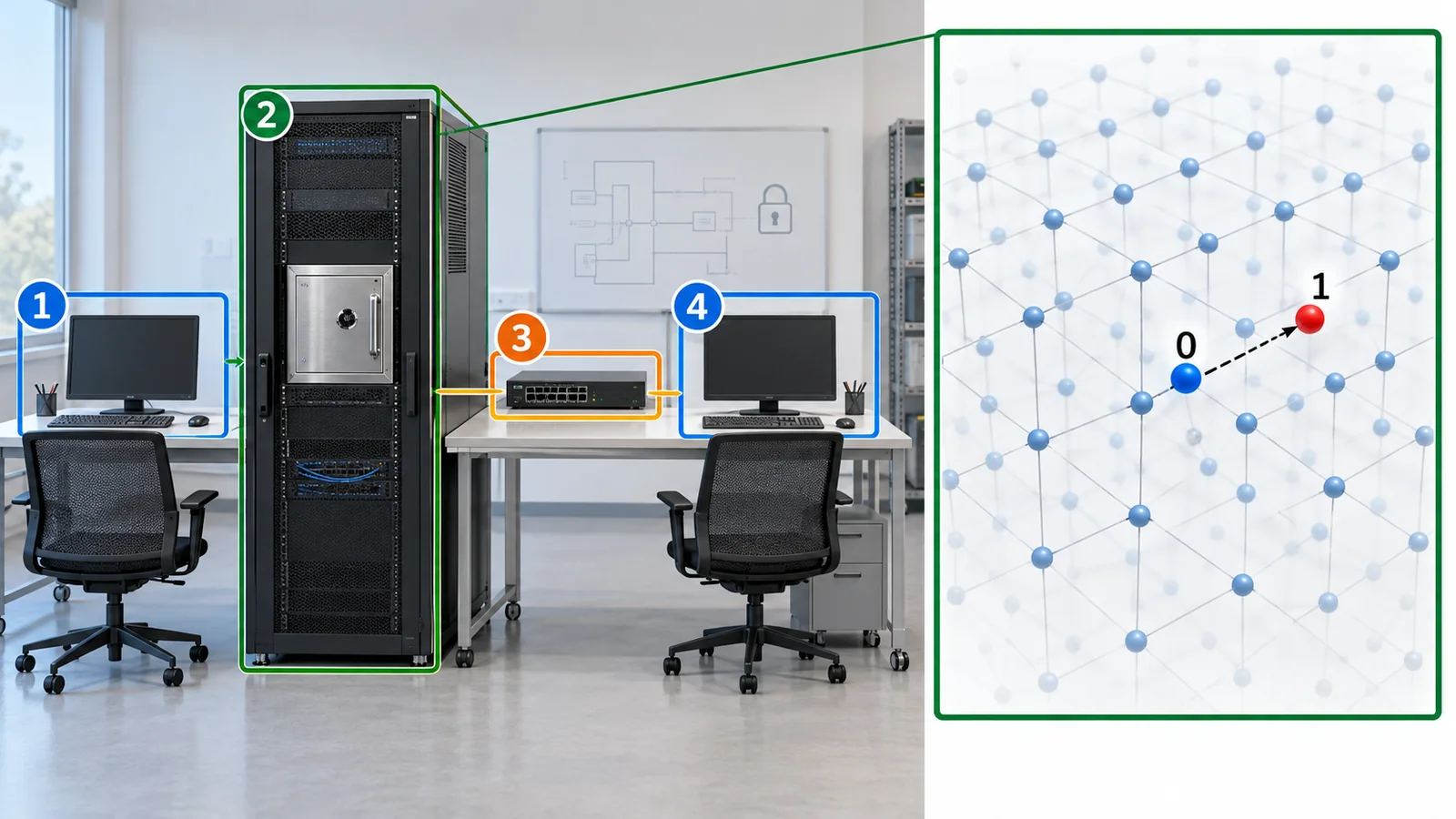
- The short version / before you read / where this fits in the series
- The foundations again: shared-key and public-key encryption
- Trying public-key encryption with small numbers
- Why quantum computers threaten it
- A new "hard problem": lattices
- Signatures: lattices and hash functions
- Where the NIST standards stand (checked 16 October 2026)
- Larger keys and signatures
- The hybrid approach
- Implementation cautions and lessons from broken schemes
- How to read evaluations and standards
- Glossary
- References (primary sources)
- Claim-to-source audit
Sourced = content stated in published material (with source links)
Our calculation = values we computed from stated assumptions
Not yet confirmed = drafts, plans, items selected but not yet standardised and other unsettled matters
Our own interpretation is labelled "Commentary". Inference is shown in bold.
The small-number examples (DH, RSA, LWE and Shor) are our own calculations to show the mechanism, not real keys. This article does not explain how to break cryptography or exploit implementation weaknesses. It does not assert when quantum computers will break cryptography (Chapter 4 shows how uncertain the estimates are). Standard numbers, status and dates are as confirmed on the official NIST, IETF and ETSI pages on the checking date (16 October 2026) and may change with revisions. It does not rank products or companies, and gives no legal or investment advice.
1. The short version / before you read / where this fits in the series
- Public-key encryption is built on trust in "computational hardness": RSA relies on factoring being hard, and Diffie-Hellman and elliptic-curve cryptography on the discrete logarithm being hard. Quantum computers are known to have an efficient method (Shor's algorithm) for both[Ref. 7, 9]
- The remedy is to switch to other "hard problems": on 13 August 2024 NIST published ML-KEM (key establishment, FIPS 203) and ML-DSA (signatures, FIPS 204), both based on lattices, and SLH-DSA (signatures, FIPS 205), based on hash functions[Ref. 19, 21, 22, 23]. For shared-key ciphers such as AES the response centres on longer keys
- Hardness is something that keeps being checked: new hard problems are examined over years. In 2022 two candidates in the standardisation process were broken by attacks on ordinary computers[Ref. 29, 30]. That is why the "hybrid approach" that uses a classical scheme and PQC together has also been standardised[Ref. 33]
No prior knowledge is needed. The basics of "keys" and "shared-key versus public-key" were explained in Chapter 2 of the previous article on quantum key distribution (and are briefly reviewed here). The only mathematics, "remainders after division" (clock arithmetic), is explained in Chapter 3.
This is best read after "Quantum Key Distribution and Quantum Communication" and "Quantum Networks and Quantum Repeaters". How far quantum computers have really come is covered in our explainers on logical qubits and fault-tolerant computing and on quantum algorithms. The next article, "Migrating to Post-Quantum Cryptography", covers when and where to start.
2. The foundations again: shared-key and public-key encryption
There are two broad kinds of encryption (see Fig. 2 of the previous article). Shared-key encryption has the sender and receiver hold the same key, locking and unlocking with it. It is fast and suits large data, but raises the question of how to hand over the first key safely. Public-key encryption hands out "padlocks" (public keys) to anyone, and only the holder of the secret key can open them, so no key has to be delivered in advance.
Public-key cryptography has another important use: the digital signature. A signature lets anyone check, with the public key, that "this data was made by the holder of this secret key and was not altered on the way"[Ref. 22]. It is used to confirm that a website is genuine and to verify software updates. PQC replaces both key establishment (making a key) and signatures (confirming authenticity).
In real communication the public-key mechanism is normally used only to share the first shared key, and the bulk of the data is then encrypted with a fast shared-key cipher. NIST's description of ML-KEM likewise says a shared secret made safely by key encapsulation is then used with symmetric-key algorithms for encryption and authentication[Ref. 21]. So replacing the public-key part leaves the encryption of the data itself usable (our commentary).
3. Trying public-key encryption with small numbers
What does it mean that public-key cryptography is made of "computational hardness"? Here we try two schemes with small numbers. The only mathematics is "remainders after division". A clock goes round at 12, so "5 hours after 10 o'clock" is "15 divided by 12, remainder 3, i.e. 3 o'clock". We multiply and take powers in this "world of remainders" (clock arithmetic).
(1) Making a shared secret in public: Diffie-Hellman
The scheme shown by Diffie and Hellman in 1976 lets two parties make a secret only they share, even while talking in public[Ref. 1]. First the paint analogy. Yellow paint is shared in public. Alice mixes in her private red to make orange, and Bob his private blue to make green, and they swap the mixtures in public. Each mixes their own private colour into what they received, and both end up with the same brown. An eavesdropper who sees yellow, orange and green cannot make that brown (the analogy is that mixing is easy but recovering the original colours from a mixture is hard).
In numbers, "mixing colours" corresponds to "raise a number to a power and take the remainder". With small numbers an eavesdropper can find the secret number by trial, but with numbers hundreds of digits long, finding it (the discrete logarithm problem) is believed to be extremely hard[Ref. 1]. Elliptic-curve cryptography does the same thing on a different mathematical object, an elliptic curve, and was introduced by Koblitz and others in the 1980s[Ref. 4].
(2) Multiplying is easy, finding the factors is hard: RSA
RSA, introduced by Rivest, Shamir and Adleman in 1978, relies on the fact that multiplying two primes is easy, but finding the original primes from the product (factoring) is hard[Ref. 2]. The public key contains the product, and the secret key can be made only by someone who knows the original primes.
With small numbers, "which two numbers multiply to 3233?" is found at once by trial. But a real key is 2048 bits (617 decimal digits). As a record for factoring on classical computers, Boudot et al. reported in a 2020 paper the factoring of RSA-240, a 795-bit number (240 digits)[Ref. 5]. A 2048-bit number is far larger. RSA has been considered safe because today's ordinary computers cannot solve this in realistic time.
Many public-key schemes rely not on "breaking is impossible" but on "even the best known method cannot solve it in realistic time". They differ from information-theoretically secure ciphers such as the one-time pad (previous article). So if a new way of solving is found (quantum computers being one example), the safety can collapse (our commentary).
4. Why quantum computers threaten it
In 1994 Shor showed that a quantum computer could solve factoring and discrete logarithms efficiently[Ref. 6, 7]. A 2016 NIST report explains that this could defeat many public-key schemes such as RSA, Diffie-Hellman and elliptic-curve cryptography[Ref. 9]. Here is the mechanism, in concept only.
The key is that factoring can be turned into the problem of finding a period. The sequence of "a to the power x, mod N" always repeats with some period. Once that period is known, an ordinary computer can calculate the prime factors of N. No method is known to find the period of a large N on a classical computer, and that is the difficulty of factoring. A quantum computer can find the period by "interference of waves" (adding up the waves of the arrows so that the correct period reinforces itself) (concept; see our explainer on quantum algorithms).
Another quantum algorithm is Grover's search algorithm of 1996[Ref. 8], which makes search "quadratically faster". The 2016 NIST report says it does not make cryptography obsolete but may require longer keys even for shared-key ciphers, gives the rule of thumb that doubling the key length preserves security, and adds that it is not known whether Grover's algorithm will ever be practically relevant[Ref. 9]. The NIST PQC FAQ also explains that in practical attacks, needs such as parallelisation reduce the advantage of Grover's algorithm[Ref. 28].
This is wrong. The big impact is on public-key cryptography (RSA, Diffie-Hellman, elliptic-curve cryptography). Shared-key ciphers and hash functions face only Grover's "quadratic speed-up" and can be handled by adjusting key lengths, according to NIST's account[Ref. 9]. And PQC is cryptography based on other problems believed hard even for quantum computers, and its standards have already been fixed[Ref. 19].
So when will it become a threat? Being honest that it is unknown
NIST describes quantum computers as machines that "may be years or decades away but could eventually break many of today's widely used cryptographic systems"[Ref. 19]. The timing cannot be asserted. Estimates of the scale needed are reported under assumptions. Gidney and Ekerå estimated that 2048-bit RSA could be factored in 8 hours with 20 million noisy qubits[Ref. 10]. In 2025 Gidney reported, under the same assumptions (a surface code, a gate error rate of 0.1%, a code cycle of one microsecond and so on), a lower estimate of fewer than a million qubits and less than a week[Ref. 11].
Experts' views also vary. The 2025 report by the Global Risk Institute and evolutionQ (published 9 March 2026) says that in a survey of 26 experts, respondents considered a cryptographically relevant quantum computer (CRQC) "quite possible (28-49%)" within 10 years and "likely (51-70%)" within 15[Ref. 12]. This is a survey of opinion, not a basis for prediction. Given that the estimated requirement fell greatly within a few years (the two estimates above) and that expert views span a range, not asserting "when" and instead estimating the time needed to prepare is the subject of the next article.
5. A new "hard problem": lattices
Several kinds of problem are believed to be hard for quantum computers. The foundation of ML-KEM and ML-DSA, standardised by NIST in 2024, is a problem about lattices[Ref. 21, 22].
(1) What a lattice is: a regularly spaced net of points
A lattice is the set of points made by "adding whole-number multiples of two (or many) arrows". Like the crossings on graph paper, the points are regularly spaced. The same lattice can be generated by many choices of arrows (the basis): a pair that is short and nearly at right angles (a good basis) or a pair that is long and skewed (a bad basis).
Consider the problem of finding the lattice point closest to a marked point. As in the figure, with a good basis a simple rounding recipe finds the closest point; the same recipe with a bad basis lands on a farther point (distances 31 and 45 in this example). In two dimensions either basis lets you find it by trial. But when the dimension reaches hundreds or a thousand, finding a good basis itself is believed to become extremely hard. Cryptography uses this hardness[Ref. 15].
If the secret key is likened to the "good basis" and the public key to the "bad basis", you get a lock in which someone who sees only the public key cannot find the close point, while the holder of the secret can (limit of the analogy: the real ML-KEM and ML-DSA do not take the form in this figure but use the "equations with errors" explained next).
(2) "Equations with errors" (LWE)
In 2005 Regev showed that mixing tiny errors into simultaneous equations makes them extremely hard to solve, linking this to the hardness of lattice problems (Learning With Errors, LWE)[Ref. 13]. Equations without errors can be solved by anyone who has as many equations as unknowns. But once each equation carries a slight error, no exact solution exists and it becomes a search for the "closest solution".
The small example in the figure (two unknowns, working mod 17) can be solved by trying 289 candidates. In the real ML-KEM-768 there are 768 unknowns, in a world of remainders mod 3329. The table of FIPS 203 gives the number of polynomial coefficients n = 256, the modulus q = 3329 and the parameter k = 3 (ML-KEM-768)[Ref. 21]. 3329 to the power 768 is about 10 to the power 2705, so trying all candidates is out of the question (Our calculation; however, real security is judged not by brute force but by the best attacks such as lattice reduction).
ML-KEM rests on LWE with a structure called a "module" (Module-LWE). Langlois and Stehlé gave grounds for the hardness of module-lattice problems[Ref. 14]. The scheme from which it was standardised is CRYSTALS-Kyber, designed by Bos et al.[Ref. 16]. FIPS 203 says it is named ML-KEM because it is based on the Module-LWE assumption[Ref. 21].
(3) What a "key-encapsulation mechanism" (KEM) is
ML-KEM is not for directly encrypting a message but a part for two parties to make a "shared secret". In the words of FIPS 203, a key-encapsulation mechanism (KEM) is a set of algorithms by which two parties can establish a shared secret key over a public channel[Ref. 21]. In the padlock analogy, Alice makes a "shared secret" herself, locks it inside Bob's padlock (the public key) (encapsulation) and sends it, and Bob opens it with his secret key (decapsulation). Both now hold the same shared secret, which they use for later encryption.
LWE resembles a feeling familiar from measurement: with noise in the measurements, it becomes hard to pin down the true value. For example, when fitting unknown parameters to many measured values (regression), a small noise makes the problem easy, but with more noise and more unknowns the solution turns unstable. LWE can be seen as deliberately using this property, "noise makes the inverse problem hard", as a cryptographic key (our commentary; an analogy, not a claim of mathematical identity).
6. Signatures: lattices and hash functions
There are two families of standards for signatures.
- ML-DSA (FIPS 204): a lattice-based signature. It derives from CRYSTALS-Dilithium, designed by Ducas et al.[Ref. 17, 22]. The signature size is 3,309 bytes for ML-DSA-65 (table in the next chapter).
- SLH-DSA (FIPS 205): a signature based on hash functions alone. It derives from SPHINCS+, designed by Bernstein et al.[Ref. 18, 23]. FIPS 205 says its security depends on the presumed difficulty of finding preimages for hash functions and several related properties[Ref. 23]. Because it does not rely on lattice assumptions, it serves as insurance should lattices be broken (our commentary).
How hash-based signatures work: a tree that gathers "one-time keys"
A hash function turns any data into a fixed-length "fingerprint" and is very hard to reverse. Hash-based signatures are built from such fingerprints alone. The basic part is a one-time signing key that can be used only once. Many one-time keys are made, their fingerprints are gathered into a tree (a hash tree) and only the fingerprint at the top is published as the public key. A signature carries the signature of the key used and the path up to the top of the tree (fingerprints for checking).
NIST SP 800-208 (2020) deals with stateful hash-based signatures (LMS and XMSS)[Ref. 24]. "Stateful" means the signer must remember, with every signature, which one-time key was used. Signing two messages with the same one-time key could let an attacker forge signatures, so the signer must guarantee that a key is used only once[Ref. 24]. SP 800-208 says that because this state management is difficult these schemes are not for general use and are mainly intended for uses such as signing firmware updates, where code is hard to change once devices are deployed[Ref. 24]. SLH-DSA stacks the tree in layers and chooses a key at random each time so that no state has to be remembered, at the price of larger signatures[Ref. 23].
Because the number of leaves (one-time keys) of the hash tree is finite. SLH-DSA is designed for a key pair to sign at most 2 to the power 64 messages (a footnote in FIPS 205 explains that at ten billion signatures per second it would take more than 58 years to reach 2 to the power 64)[Ref. 23]. In practice the limit is unlikely to be reached, but the idea of recording and managing the number of signatures is the key to understanding the design of hash-based signatures (our commentary).
Manufacturing equipment, instruments, sensors and embedded devices can keep running in the field for ten years or more (our commentary). The code that verifies signatures on firmware updates can be hard to change once the equipment has shipped. NIST SP 800-208 names exactly this case, "signatures are needed soon and code is hard to change once devices are deployed", as a main target for hash-based signatures[Ref. 24]. It is worth checking which signature scheme is built into the signature-verification code of your own equipment and products, and whether it can later be swapped for a new scheme (our commentary; this leads to the "cryptographic inventory" of the next article, "Migrating to Post-Quantum Cryptography").
Other families: codes, isogenies and multivariate schemes
In NIST's selection, besides ML-KEM, ML-DSA and SLH-DSA, the signature scheme Falcon and the key-establishment scheme HQC were chosen for standardisation. HQC was selected on 11 March 2025, and the rationale is in NIST IR 8545[Ref. 19, 26]. As of the checking date (16 October 2026), NIST's selection page shows "FIPS coming soon" for both Falcon and HQC, so they are not yet standards[Ref. 20].
7. Where the NIST standards stand (checked 16 October 2026)
After an international call that ran for several years, NIST published its first three PQC standards (FIPS 203, 204, 205) on 13 August 2024[Ref. 19]. NIST says these three should provide the foundation for most PQC deployments and "can and should be put into use now"[Ref. 19].
| Standard | Role and basis | Status (checked 16 October 2026) | Main sizes (bytes) |
|---|---|---|---|
| FIPS 203 ML-KEM | Key establishment (KEM); lattice (Module-LWE) | Final; published 13 August 2024. A planning note of 17 November 2025 says an issue will be corrected in a future revision[Ref. 21]Sourced | ML-KEM-512/768/1024: encapsulation key 800/1,184/1,568, ciphertext 768/1,088/1,568, shared secret 32 |
| FIPS 204 ML-DSA | Signature; lattice | Final; published 13 August 2024. A planning note of 31 July 2026 points to a list of minor issues to be corrected[Ref. 22]Sourced | ML-DSA-44/65/87: public key 1,312/1,952/2,592, signature 2,420/3,309/4,627 |
| FIPS 205 SLH-DSA | Signature; hash-based (stateless) | Final; published 13 August 2024[Ref. 23]Sourced | Twelve parameter sets: public key 32-64, signature 7,856 (128s) to 49,856 (256f) |
| SP 800-208 LMS and XMSS | Signature; hash-based (stateful) | October 2020; limited uses (such as firmware signing)[Ref. 24]Sourced | — |
| SP 800-227 recommendations for KEMs | Definitions, properties and recommendations for the safe use of KEMs | September 2025[Ref. 25]Sourced | — |
| Falcon (signature) | Selected for standardisation | "FIPS coming soon" on NIST's selection page[Ref. 20]Not yet confirmed | — |
| HQC (key establishment) | Selected for standardisation (as a backup or alternative) | Selected 11 March 2025, NIST IR 8545; "FIPS coming soon"[Ref. 19, 26, 20]Not yet confirmed | — |
| NIST IR 8547 transition | The approach to moving away from quantum-vulnerable algorithms | Initial public draft (12 November 2024); comment period closed; no final version was found at the checking date[Ref. 27]Not yet confirmed. NIST's PQC page says that under this report's timeline NIST will deprecate and remove quantum-vulnerable algorithms by 2035[Ref. 19] | — (covered in the next article) |
Sourced / Not yet confirmed. Sizes are from the tables of FIPS 203, 204 and 205. Even a "final" standard can have corrections scheduled.
FIPS 203 claims that ML-KEM-512, 768 and 1024 fall into the security strength categories 1, 3 and 5 defined by NIST. Instead of a single number such as "128 bits", strength is expressed as "at least as hard as a key search against AES of a given key length, or finding collisions in a hash function"[Ref. 21]. And NIST recommends ML-KEM-768 as the default parameter set, since it provides a large security margin at a reasonable performance cost[Ref. 21].
8. Larger keys and signatures
One big difference with PQC is that keys, signatures and ciphertexts are larger. The next figure sets the values from the FIPS tables beside the sizes of classical schemes (Ed25519, X25519, RSA-2048).
| Comparison | Ratio |
|---|---|
| ML-KEM-768 public (encapsulation) key ÷ X25519 | 37.0 times |
| ML-KEM-768 ciphertext ÷ X25519 | 34.0 times |
| ML-DSA-65 signature ÷ Ed25519 | 51.7 times |
| ML-DSA-65 signature ÷ RSA-2048 | 12.9 times |
| SLH-DSA-128s signature ÷ Ed25519 | 122.8 times |
Our calculation. Numerators are values from the FIPS tables; denominators are X25519 = 32 bytes, an Ed25519 signature = 64 bytes and an RSA-2048 signature = 256 bytes (RFC 7748, RFC 8032, 2048 bits = 256 bytes)[Ref. 38].
The difference in size affects traffic, memory and processing time. A change from some hundreds of bytes to some kilobytes per key exchange is small for PCs and servers, but can require a redesign for devices with narrow bandwidth, embedded devices with little memory, and protocols that assume one message fits in a small packet (our commentary).
The field of materials and processes includes instruments on the floor, sensor networks and battery-powered wireless devices. Such devices use power with every transmission and have little memory, so they are sensitive to the growth in the data of signatures and key exchange (our commentary). How much traffic results from using ML-KEM for key establishment and ML-DSA for signatures can be estimated from the sizes in the figure. For example an ML-DSA-65 signature is 3,309 bytes, about 52 times an Ed25519 signature (64 bytes). It is worth checking the data size and the power budget from the early stage of design.
9. The hybrid approach
The new "hard problems" have a short history, and a new way of solving them may be found in the future. So the hybrid approach runs both a classical scheme and PQC and mixes the two shared secrets into one key. IETF RFC 9954 explains hybrid key exchange as using several key-exchange algorithms simultaneously and combining the results, aiming to stay secure "even if a way is found to defeat the encryption for all but one of the component algorithms"[Ref. 34].
In August 2026 the IETF defined, in RFC 10024 (a Standards Track document), three hybrid key agreements for TLS 1.3 (X25519MLKEM768, SecP256r1MLKEM768 and SecP384r1MLKEM1024)[Ref. 33]. According to RFC 10024, X25519MLKEM768 is widely deployed and often the most practical choice for TLS 1.3. The client's value is 1,216 bytes, the server's reply 1,120 bytes and the shared secret 64 bytes[Ref. 33]. The general construction behind it is set out in RFC 9954 (July 2026, informational), and the terminology in RFC 9794 (June 2025, informational)[Ref. 34, 35].
PQC standardisation is also moving in other settings. For X.509 certificates, ML-DSA is in RFC 9881 (October 2025), ML-KEM in RFC 9935 (March 2026) and SLH-DSA in RFC 9909 (December 2025), and OpenPGP is in RFC 9980 (June 2026), all Standards Track documents[Ref. 36, 37]. Pure ML-KEM for TLS (not hybrid) was, in the IETF datatracker as of 12 October 2026, in the RFC Editor queue (we confirmed this from the datatracker display).
ETSI technical specification TS 103 744 (V1.2.2, February 2026), "Quantum-safe Hybrid Key Establishment", specifies how to derive keys from several shared secrets obtained from ECDH and a post-quantum key-encapsulation mechanism[Ref. 32]. NIST also explains in its FAQ that hybrid key establishment in a FIPS 140 approved mode can be done with the generic composition technique of SP 800-56C (updated 18 November 2024)[Ref. 28].
A hybrid is not a replacement for PQC; it uses both PQC and a classical scheme to double the insurance. When quantum computers become an issue the classical scheme alone does not protect. Conversely, whether to use PQC alone or a hybrid depends on what is protected, for how long, regulation and performance, and agencies' recommendations differ (the next article sets out the documents of each agency side by side). For TLS, RFC 10024 standardises hybrids[Ref. 33].
10. Implementation cautions and lessons from broken schemes
For PQC it is not enough that "the mathematics is safe". There are two lessons.
- Lesson 1: the "hardness" of mathematics is confirmed over time. In 2022 two candidates in the standardisation process were broken by attacks on ordinary computers. The scheme based on supersingular isogenies (SIDH/SIKE) fell to the attack of Castryck and Decru[Ref. 29], and the multivariate scheme Rainbow fell to an attack by Beullens that is reported to have broken a key on a laptop over a weekend[Ref. 30]. It is an example of the open examination of standardisation (call and evaluation) finding problems before the scheme became a standard (our commentary). It is no guarantee that ML-KEM, ML-DSA and SLH-DSA will stay safe in the future.
- Lesson 2: implementations can have holes. KyberSlash is a paper reporting that several software implementations of Kyber (the scheme from which ML-KEM derives), including the official reference code, had a weakness in which the time taken by a division depends on secret values. The paper explains the cause as the code being meant to run in constant time at source level while compilers can emit division instructions whose duration varies, and states that after responsible disclosure the affected libraries were patched[Ref. 31]. It is a hole in implementation, not in mathematics, a lesson of the same kind as the device holes of QKD in the previous article (our commentary; the procedure of the attack is not covered here).
The safety of PQC is an assessment that "the best currently known methods cannot solve it in realistic time", not a proven absolute guarantee. NIST's FIPS 203 likewise expresses security strength not as "a single number" but as a claim (a category) relative to reference problems[Ref. 21]. That is why the standards were examined openly over a long time and why hybrids and backup schemes (SLH-DSA, HQC and others) are provided (our commentary).
11. How to read evaluations and standards
The progress of PQC is measured by (1) whether it is a standard (number and status), (2) the security strength category (NIST's 1, 3 and 5), (3) how much open scrutiny it has received (years, and examples of schemes that were broken), (4) checks on implementations (cryptographic module validation, inspection for implementation holes) and (5) size and speed. Checked 16 October 2026.
| What is assessed | Representative benchmark or method (name, source) | Standards and guidance (NIST, IETF, ETSI and others) | Caution in reading |
|---|---|---|---|
| Key establishment (KEM) | NIST security strength categories (1, 3, 5); ML-KEM-768 is the recommended default (FIPS 203)[Ref. 21]Sourced | FIPS 203 ML-KEM (final, 13 August 2024), SP 800-227 recommendations for KEMs (September 2025)[Ref. 21, 25]Sourced. HQC is only selected (no FIPS yet)[Ref. 20]Not yet confirmed | A category is a claim of "as hard as a reference problem". Even a final standard can carry a note of corrections to come |
| Signatures | Signature sizes in bytes from the FIPS tables (ML-DSA 2,420-4,627; SLH-DSA 7,856-49,856)[Ref. 22, 23]Sourced | FIPS 204 ML-DSA, FIPS 205 SLH-DSA (final, 13 August 2024), SP 800-208 LMS and XMSS (2020)[Ref. 22, 23, 24]Sourced. Falcon is only selected[Ref. 20]Not yet confirmed | Stateful signatures presuppose state management; their use is limited |
| Open scrutiny and cryptanalytic progress | The NIST call and evaluation (fourth-round report NIST IR 8545)[Ref. 26]Sourced. The 2022 cases in which SIKE and Rainbow were broken[Ref. 29, 30]Sourced | Could not be confirmed (no criterion of the form "safe after N years of scrutiny" was found) | Evaluation continues; new attacks can appear even after standardisation |
| Use in protocols | RFC 10024: X25519MLKEM768 and others; the client value is 1,216 bytes and the server value 1,120 bytes[Ref. 33]Sourced | IETF RFC 10024 (Standards Track, August 2026), RFC 9954 (informational, July 2026), RFC 9794 (informational, June 2025), RFC 9881, 9909, 9935 and 9980 (Standards Track)[Ref. 33, 34, 35, 36, 37]Sourced. The pure ML-KEM TLS document is in the RFC Editor queue (12 October 2026)Not yet confirmed | RFCs include Standards Track and informational documents, which differ in force |
| Hybrid standards | — | ETSI TS 103 744 V1.2.2 (February 2026); the generic composition of NIST SP 800-56C (FAQ updated 18 November 2024)[Ref. 32, 28]Sourced | Whether hybrids are recommended or PQC alone is allowed differs between agencies (next article) |
| Checking implementations | An example of inspecting for implementation holes: KyberSlash (division that is not constant-time)[Ref. 31]Sourced | NIST administers the Cryptographic Module Validation Program (CMVP) (NIST PQC page)[Ref. 19]Sourced. The contents of the scheme and the number of validations could not be confirmed | A standard-conforming "algorithm" and a safe "implementation" are different; implementations must be checked |
| Size | The comparison of Fig. 9 (an ML-KEM-768 public key is about 37 times X25519; an ML-DSA-65 signature about 52 times Ed25519)Our calculation | The tables of FIPS 203, 204 and 205 | Check early the effect on devices with constraints on traffic and memory |
The organisation of the table is Our calculation (arrangement). Numbers and status checked on the official NIST, IETF and ETSI pages (checked 16 October 2026).
Cautions in reading (for materials engineers)
- Check which algorithm "PQC-ready" means: what became a standard in FIPS 203, 204 and 205 differs in status from what is only selected (Falcon, HQC). If a product says "PQC-ready", check which standard, which parameter set and in which protocol.
- Even a "final" standard can have corrections coming: FIPS 203 and 204 point to matters to be corrected in future revisions[Ref. 21, 22]. It helps to appoint someone to follow updates to the standards (our commentary).
- Do not compare on the size of a number alone: "smaller signature" or "faster" must be compared with the security strength category and the way of use (stateful or stateless, number of signatures) aligned.
- Check whether an RFC is Standards Track or informational: RFC 10024 is Standards Track, while RFC 9954 and 9794 are informational[Ref. 33, 34, 35].
12. Glossary
- PQC (post-quantum cryptography)
- Cryptography, running on ordinary computers, based on problems believed hard even for quantum computers.
- Shared-key (symmetric) cipher
- A cipher in which sender and receiver hold the same key, such as AES.
- Public-key cipher
- A cipher using a pair of a public key (padlock) and a secret key.
- Digital signature
- A mechanism for checking with the public key that data came from the holder of the secret key and was not altered.
- Remainder after division (clock arithmetic)
- Calculation that looks only at the remainder after dividing by a number.
- Diffie-Hellman (DH)
- A scheme for making a shared secret in public; relies on the hardness of the discrete logarithm.
- RSA
- A public-key scheme that relies on the hardness of factoring.
- Elliptic-curve cryptography
- DH and signatures carried out on an elliptic curve.
- Shor's algorithm
- A method for solving factoring and discrete logarithms efficiently on a quantum computer, by finding a period.
- Grover's algorithm
- A quantum algorithm that makes search quadratically faster; shared-key ciphers respond by doubling the key.
- Lattice
- A regularly spaced set of points made by adding whole-number multiples of arrows.
- LWE (learning with errors)
- The problem that mixing small errors into simultaneous equations makes them hard to solve.
- KEM (key-encapsulation mechanism)
- A set of algorithms by which two parties establish a shared secret over a public channel.
- ML-KEM (FIPS 203)
- A key-encapsulation mechanism based on Module-LWE; formerly Kyber.
- ML-DSA (FIPS 204)
- A lattice-based signature; formerly Dilithium.
- SLH-DSA (FIPS 205)
- A stateless signature based on hash functions alone; formerly SPHINCS+.
- LMS and XMSS
- Stateful hash-based signatures; SP 800-208.
- Hash function
- A function that turns data into a fixed-length "fingerprint" and is hard to reverse.
- Hash tree
- A tree that gathers many fingerprints into one at the top.
- Security strength category
- NIST categories 1 to 5; strength expressed as being as hard as, for example, a key search against AES of a given key length.
- Hybrid approach
- Running a classical scheme and PQC together and mixing the secrets into one key.
- Key derivation (HKDF)
- The procedure that makes the key actually used from shared secrets.
- Constant-time implementation
- An implementation whose running time does not depend on secret values.
- CRQC (cryptographically relevant quantum computer)
- A quantum computer large enough to actually break cryptography.
13. References (primary sources)
- Diffie W., Hellman M. "New directions in cryptography", IEEE Trans. Inf. Theory 22, 644–654 (1976), DOI 10.1109/TIT.1976.1055638 — doi.org/10.1109/TIT.1976.1055638
- Rivest R. L., Shamir A., Adleman L. "A method for obtaining digital signatures and public-key cryptosystems", Commun. ACM 21, 120–126 (1978), DOI 10.1145/359340.359342 — doi.org/10.1145/359340.359342
- Wootters W. K., Zurek W. H. "A single quantum cannot be cloned", Nature 299, 802–803 (1982), DOI 10.1038/299802a0 — doi.org/10.1038/299802a0
- Koblitz N. "Elliptic curve cryptosystems", Math. Comp. 48, 203–209 (1987), DOI 10.1090/S0025-5718-1987-0866109-5 — doi.org/10.1090/S0025-5718-1987-0866109-5
- Boudot F., Gaudry P., Guillevic A., Heninger N., Thomé E., Zimmermann P. "Comparing the Difficulty of Factorization and Discrete Logarithm: A 240-Digit Experiment", CRYPTO 2020, LNCS 12171, 62–91 (2020), DOI 10.1007/978-3-030-56880-1_3 (ePrint 2020/697) — eprint.iacr.org/2020/697
- Shor P. W. "Algorithms for quantum computation: discrete logarithms and factoring", Proc. 35th Annual Symposium on Foundations of Computer Science, 124–134 (1994), DOI 10.1109/SFCS.1994.365700 — doi.org/10.1109/SFCS.1994.365700
- Shor P. W. "Polynomial-Time Algorithms for Prime Factorization and Discrete Logarithms on a Quantum Computer", SIAM J. Comput. 26, 1484–1509 (1997), DOI 10.1137/S0097539795293172 — doi.org/10.1137/S0097539795293172
- Grover L. K. "A fast quantum mechanical algorithm for database search", Proc. 28th ACM Symposium on Theory of Computing (STOC '96), 212–219 (1996), DOI 10.1145/237814.237866 — doi.org/10.1145/237814.237866
- Chen L., Jordan S., Liu Y.-K., Moody D., Peralta R., Perlner R., Smith-Tone D. "Report on Post-Quantum Cryptography", NIST IR 8105 (2016), DOI 10.6028/NIST.IR.8105 — doi.org/10.6028/NIST.IR.8105
- Gidney C., Ekerå M. "How to factor 2048 bit RSA integers in 8 hours using 20 million noisy qubits", Quantum 5, 433 (2021), DOI 10.22331/q-2021-04-15-433 — doi.org/10.22331/q-2021-04-15-433
- Gidney C. "How to factor 2048 bit RSA integers with less than a million noisy qubits", arXiv:2505.15917 (2025) — arxiv.org/abs/2505.15917
- Mosca M., Piani M. (Global Risk Institute and evolutionQ) "Quantum Threat Timeline Report 2025" (published 9 March 2026; survey of 26 experts) — globalriskinstitute.org/publication/quantum-threat-timeline-report-2025b/
- Regev O. "On lattices, learning with errors, random linear codes, and cryptography", J. ACM 56 (6), article 34 (2009), DOI 10.1145/1568318.1568324 — doi.org/10.1145/1568318.1568324
- Langlois A., Stehlé D. "Worst-case to average-case reductions for module lattices", Des. Codes Cryptogr. 75, 565–599 (2015), DOI 10.1007/s10623-014-9938-4 — doi.org/10.1007/s10623-014-9938-4
- Peikert C. "A Decade of Lattice Cryptography", Found. Trends Theor. Comput. Sci. 10, 283–424 (2016), DOI 10.1561/0400000074 — doi.org/10.1561/0400000074
- Bos J. et al. "CRYSTALS - Kyber: A CCA-Secure Module-Lattice-Based KEM", 2018 IEEE European Symposium on Security and Privacy, 353–367 (2018), DOI 10.1109/EuroSP.2018.00032 — doi.org/10.1109/EuroSP.2018.00032
- Ducas L. et al. "CRYSTALS-Dilithium: A Lattice-Based Digital Signature Scheme", IACR TCHES 2018 (1), 238–268, DOI 10.46586/tches.v2018.i1.238-268 — doi.org/10.46586/tches.v2018.i1.238-268
- Bernstein D. J., Hülsing A., Kölbl S., Niederhagen R., Rijneveld J., Schwabe P. "The SPHINCS+ Signature Framework", Proc. 2019 ACM SIGSAC Conference on Computer and Communications Security, 2129–2146 (2019), DOI 10.1145/3319535.3363229 — doi.org/10.1145/3319535.3363229
- NIST "Post-Quantum Cryptography" project page, CSRC (checked 16 October 2026) — csrc.nist.gov/projects/post-quantum-cryptography
- NIST "Selected Algorithms" page of the PQC standardization process (shows HQC (2025) and FALCON (2022) as "FIPS coming soon"; checked 16 October 2026) — csrc.nist.gov/projects/post-quantum-cryptography/post-quantum-cryptography-stand
- NIST FIPS 203 "Module-Lattice-Based Key-Encapsulation Mechanism Standard" (published 13 August 2024), DOI 10.6028/NIST.FIPS.203 — csrc.nist.gov/pubs/fips/203/final
- NIST FIPS 204 "Module-Lattice-Based Digital Signature Standard" (published 13 August 2024), DOI 10.6028/NIST.FIPS.204 — csrc.nist.gov/pubs/fips/204/final
- NIST FIPS 205 "Stateless Hash-Based Digital Signature Standard" (published 13 August 2024), DOI 10.6028/NIST.FIPS.205 — csrc.nist.gov/pubs/fips/205/final
- NIST SP 800-208 "Recommendation for Stateful Hash-Based Signature Schemes" (October 2020), DOI 10.6028/NIST.SP.800-208 — csrc.nist.gov/pubs/sp/800/208/final
- NIST SP 800-227 "Recommendations for Key-Encapsulation Mechanisms" (September 2025), DOI 10.6028/NIST.SP.800-227 — csrc.nist.gov/pubs/sp/800/227/final
- NIST NIST IR 8545 "Status Report on the Fourth Round of the NIST Post-Quantum Cryptography Standardization Process" (March 2025), DOI 10.6028/NIST.IR.8545 — csrc.nist.gov/pubs/ir/8545/final
- NIST NIST IR 8547 (Initial Public Draft) "Transition to Post-Quantum Cryptography Standards" (12 November 2024; comment period closed 10 January 2025; no final version found at the checking date) — csrc.nist.gov/pubs/ir/8547/ipd
- NIST PQC FAQs, CSRC (including the answer on hybrid key establishment in a FIPS 140 approved mode, updated 18 November 2024; checked 16 October 2026) — csrc.nist.gov/projects/post-quantum-cryptography/faqs
- Castryck W., Decru T. "An Efficient Key Recovery Attack on SIDH", EUROCRYPT 2023, LNCS 14008, 423–447 (2023), DOI 10.1007/978-3-031-30589-4_15 — doi.org/10.1007/978-3-031-30589-4_15
- Beullens W. "Breaking Rainbow Takes a Weekend on a Laptop", CRYPTO 2022, LNCS 13508, 464–479 (2022), DOI 10.1007/978-3-031-15979-4_16 — doi.org/10.1007/978-3-031-15979-4_16
- Bernstein D. J. et al. "KyberSlash: Exploiting secret-dependent division timings in Kyber implementations", IACR TCHES 2025 (2), 209–234, DOI 10.46586/tches.v2025.i2.209-234 — tches.iacr.org/index.php/TCHES/article/view/12046
- ETSI TS 103 744 V1.2.2 (2026-02) "CYBER; Quantum-Safe Cryptography (QSC); Quantum-safe Hybrid Key Establishment" — etsi.org/deliver/etsi_ts/103700_103799/103744/01.02.02_60/ts_103744v010202p.pdf
- Kwiatkowski K., Kampanakis P., Westerbaan B. E., Stebila D. (IETF) RFC 10024 "Post-Quantum Traditional (PQ/T) Hybrid Key Agreement Mechanisms for TLS 1.3" (Standards Track, August 2026) — rfc-editor.org/rfc/rfc10024.html
- Stebila D., Fluhrer S., Gueron S. (IETF) RFC 9954 "Hybrid Key Exchange in TLS 1.3" (Informational, July 2026) — rfc-editor.org/rfc/rfc9954.html
- Driscoll F., Parsons M., Hale B. (IETF) RFC 9794 "Terminology for Post-Quantum Traditional Hybrid Schemes" (Informational, June 2025) — rfc-editor.org/rfc/rfc9794.html
- IETF (LAMPS) RFC 9881 "Internet X.509 Public Key Infrastructure -- Algorithm Identifiers for the Module-Lattice-Based Digital Signature Algorithm (ML-DSA)" (Standards Track, October 2025); see also RFC 9935 (ML-KEM, March 2026) and RFC 9909 (SLH-DSA, December 2025) — rfc-editor.org/rfc/rfc9881.html
- IETF (OpenPGP) RFC 9980 "Post-Quantum Cryptography in OpenPGP" (Standards Track, June 2026) — rfc-editor.org/rfc/rfc9980.html
- Josefsson S., Liusvaara I. (IETF) RFC 8032 "Edwards-Curve Digital Signature Algorithm (EdDSA)" (2017); RFC 7748 "Elliptic Curves for Security" (X25519; 2016) — rfc-editor.org/rfc/rfc8032.html
14. Claim-to-source audit
| Claim in the text | Basis | Category |
|---|---|---|
| Titles and bibliographic data of the public-key idea of Diffie and Hellman (1976), RSA (1978) and elliptic-curve cryptography (Koblitz, 1987) | Bibliographic data of the papers (confirmed through Crossref) Reference 1 https://doi.org/10.1109/TIT.1976.1055638 Reference 2 https://doi.org/10.1145/359340.359342 Reference 4 https://doi.org/10.1090/S0025-5718-1987-0866109-5 | Sourced |
| The factoring of RSA-240 (795 bits) and a 795-bit discrete logarithm computation; the factoring of RSA-250 is also reported in the paper | Abstract of Boudot et al. (2020) Reference 5 https://eprint.iacr.org/2020/697 | Sourced |
| Shor (1994, 1997) showed that factoring and discrete logarithms can be solved efficiently on a quantum computer; Grover's (1996) search algorithm | Titles and bibliographic data of the papers (Crossref) Reference 6 https://doi.org/10.1109/SFCS.1994.365700 Reference 7 https://doi.org/10.1137/S0097539795293172 Reference 8 https://doi.org/10.1145/237814.237866 | Sourced |
| Shor threatens RSA, discrete-logarithm and elliptic-curve schemes; Grover gives a quadratic speed-up and doubling the key preserves security as a rule of thumb; the statement that it is unknown whether Grover will be practically relevant | NIST IR 8105 (2016) Reference 9 https://doi.org/10.6028/NIST.IR.8105 | Sourced |
| The NIST FAQ explains that the advantage of Grover's algorithm may be small in practical attacks; hybrid key establishment can be done in a FIPS 140 approved mode with the generic composition of SP 800-56C | NIST PQC FAQs (including the answer updated 18 November 2024; checked 16 October 2026) Reference 28 https://csrc.nist.gov/projects/post-quantum-cryptography/faqs | Sourced |
| Estimates that 2048-bit RSA could be factored in 8 hours with 20 million noisy qubits (2021) and in under a week with fewer than a million (2025); the assumptions (square grid, 0.1% gate error, 1-microsecond code cycle, 10-microsecond control reaction time) | Title of Gidney and Ekerå (2021); abstract of Gidney (2025) Reference 10 https://doi.org/10.22331/q-2021-04-15-433 Reference 11 https://arxiv.org/abs/2505.15917 | Sourced |
| Global Risk Institute 2025 report (published 9 March 2026): in a survey of 26 experts a CRQC was "quite possible" (28-49%) within 10 years and "likely" (51-70%) within 15 | GRI page (checked 16 October 2026) Reference 12 https://globalriskinstitute.org/publication/quantum-threat-timeline-report-2025b/ | Sourced |
| NIST published FIPS 203, 204 and 205 on 13 August 2024, describes quantum computers as possibly "years or decades away", says ML-DSA, SLH-DSA and ML-KEM should be the foundation of deployments, selected Falcon and HQC for standardisation (HQC on 11 March 2025), and writes that under IR 8547 it will deprecate and remove quantum-vulnerable algorithms by 2035 | NIST PQC project page (checked 16 October 2026) Reference 19 https://csrc.nist.gov/projects/post-quantum-cryptography | SourcedNot yet confirmed |
| Falcon and HQC are shown as "FIPS coming soon"; the rationale for selecting HQC is in NIST IR 8545 | NIST Selected Algorithms page (checked 16 October 2026); NIST IR 8545 (March 2025) Reference 20 https://csrc.nist.gov/projects/post-quantum-cryptography/post-quantum-cryptography-standardization/selected-algorithms Reference 26 https://csrc.nist.gov/pubs/ir/8545/final | SourcedNot yet confirmed |
| FIPS 203: the definition of a KEM; based on Module-LWE; n = 256, q = 3329, k = 2/3/4; categories 1, 3, 5; ML-KEM-768 recommended as the default; sizes (800/1,184/1,568 and so on); the planning note of 17 November 2025 on a correction to come | Text of FIPS 203 and the NIST page Reference 21 https://csrc.nist.gov/pubs/fips/203/final | Sourced |
| FIPS 204: the definition of signatures; sizes of ML-DSA-44/65/87 (public key 1,312/1,952/2,592; signature 2,420/3,309/4,627); the planning note of 31 July 2026 | Text of FIPS 204 and the NIST page Reference 22 https://csrc.nist.gov/pubs/fips/204/final | Sourced |
| FIPS 205: based on hash functions; twelve parameter sets; signatures of 7,856-49,856 bytes; the limit on signatures (2 to the power 64) and the footnote that at ten billion per second it would take over 58 years | Text of FIPS 205 Reference 23 https://csrc.nist.gov/pubs/fips/205/final | Sourced |
| SP 800-208 (October 2020): state management for LMS and XMSS; not for general use, aimed at uses such as signing firmware updates | Text of SP 800-208 Reference 24 https://csrc.nist.gov/pubs/sp/800/208/final | Sourced |
| SP 800-227 (September 2025) describes definitions, properties and recommendations for KEMs; NIST IR 8547 is an initial public draft (12 November 2024) and no final version was found at the checking date | NIST pages Reference 25 https://csrc.nist.gov/pubs/sp/800/227/final Reference 27 https://csrc.nist.gov/pubs/ir/8547/ipd | SourcedNot yet confirmed |
| Titles and bibliographic data of LWE (Regev, 2005), the hardness of module lattices (Langlois and Stehlé), the review of lattice cryptography (Peikert) and the design papers of CRYSTALS-Kyber, Dilithium and SPHINCS+ | Bibliographic data of the papers (confirmed through Crossref) Reference 13 https://doi.org/10.1145/1568318.1568324 Reference 14 https://doi.org/10.1007/s10623-014-9938-4 Reference 15 https://doi.org/10.1561/0400000074 Reference 16 https://doi.org/10.1109/EuroSP.2018.00032 Reference 17 https://doi.org/10.46586/tches.v2018.i1.238-268 Reference 18 https://doi.org/10.1145/3319535.3363229 | Sourced |
| In 2022 SIDH/SIKE (Castryck and Decru) and Rainbow (Beullens) were broken by attacks on ordinary computers | Titles and bibliographic data of the papers (Crossref) Reference 29 https://doi.org/10.1007/978-3-031-30589-4_15 Reference 30 https://doi.org/10.1007/978-3-031-15979-4_16 | Sourced |
| KyberSlash: in several Kyber implementations the division time depends on secrets; the cause (compilers) and fixes after responsible disclosure | The TCHES 2025 paper (page) and the authors' explanation Reference 31 https://tches.iacr.org/index.php/TCHES/article/view/12046 | Sourced |
| RFC 10024 (Standards Track, August 2026): three hybrids including X25519MLKEM768; client value 1,216 bytes, server value 1,120 bytes, shared secret 64 bytes | Text of RFC 10024 Reference 33 https://www.rfc-editor.org/rfc/rfc10024.html | Sourced |
| The aim of hybrids in RFC 9954 (informational, July 2026); the terminology of RFC 9794 (informational, June 2025); RFC 9881, 9935, 9909 and 9980 (Standards Track); the pure ML-KEM document for TLS being in the RFC Editor queue | Texts of the RFCs; IETF datatracker display (checked 16 October 2026) Reference 34 https://www.rfc-editor.org/rfc/rfc9954.html Reference 35 https://www.rfc-editor.org/rfc/rfc9794.html Reference 36 https://www.rfc-editor.org/rfc/rfc9881.html Reference 37 https://www.rfc-editor.org/rfc/rfc9980.html | SourcedNot yet confirmed |
| ETSI TS 103 744 V1.2.2 (February 2026) specifies how to derive keys in quantum-safe hybrid key establishment | ETSI specification PDF (scope) Reference 32 https://www.etsi.org/deliver/etsi_ts/103700_103799/103744/01.02.02_60/ts_103744v010202p.pdf | Sourced |
| X25519 is 32 bytes; an Ed25519 key is 32 bytes and a signature 64 bytes | RFC 7748 and RFC 8032 Reference 38 https://www.rfc-editor.org/rfc/rfc8032.html | Sourced |
| The small examples in the figures (DH with p = 23 and g = 5; RSA with 3233; Shor with N = 15; LWE with two unknowns mod 17; a 2-dimensional lattice), 3329 to the power 768 ≈ 10 to the power 2705, and the size ratios (about 37 times, about 52 times and so on) | Our calculation (Python; small numbers for illustration, not real keys; the number of brute-force candidates is not a measure of security) | Our calculation |
| The analogies (mixing paint, padlocks, hash trees), the framing that "public keys rest on trust in computational hardness", the comparison of LWE with measurement noise, the viewpoint on equipment lifetime and firmware signing, the effect of size on sensors and IoT, and the comparison of implementation holes with QKD device holes | Our organisation and commentary based on published material; not views stated by the bodies or authors concerned | Commentary |
| The contents of the Falcon (FN-DSA) and HQC standards, any prediction of when quantum computers will break cryptography, procedures for breaking cryptography or exploiting implementation weaknesses, rankings of products, and migration deadlines (covered in the next article) | This article does not state these (they could not be confirmed or are outside its scope) | Commentary |
| Figures 2-10 are explanatory diagrams, not observations of real data; Figure 1 is an ImageGen-generated conceptual illustration | Note by this article | Commentary |
Last updated: 16 October 2026. Sources are limited to primary material (peer-reviewed and conference papers, NIST standards, reports and official pages, IETF RFCs and the datatracker, an ETSI technical specification and a Global Risk Institute report). Numbers, status and dates for NIST, IETF and ETSI are as of the checking date and may change with revisions. The small-number examples are our own calculations, not real keys. We do not state the contents of the Falcon (FN-DSA) and HQC standards, a final version of NIST IR 8547, the number of validations, or "when quantum computers will break cryptography", because these could not be confirmed or cannot be asserted. All figures are explanatory concept diagrams or charts including our calculation; Figure 1 is an ImageGen-generated conceptual illustration. This article is neither legal nor investment advice, and not an explanation of how to break cryptography.