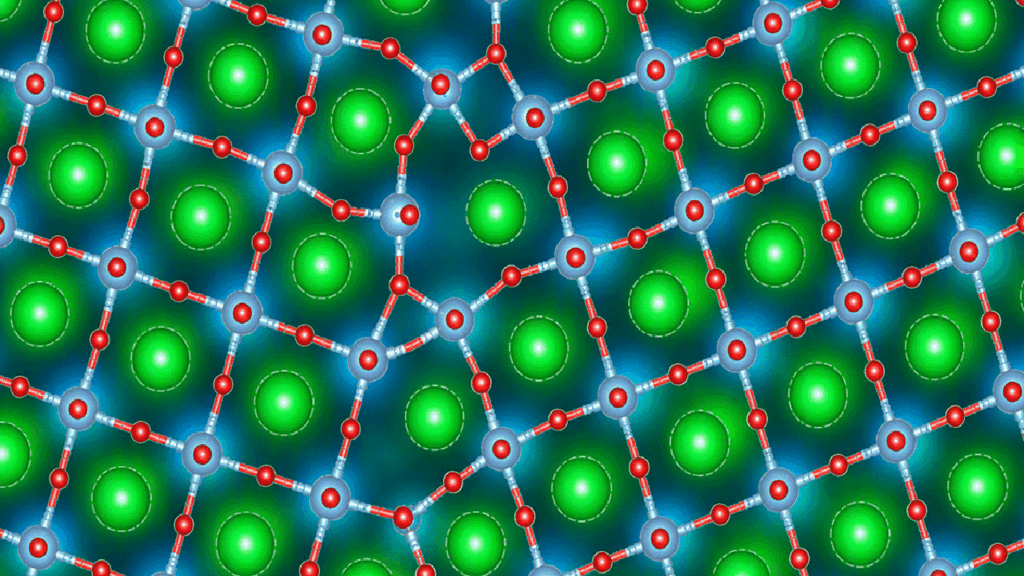
Density Functional Theory– tag –
-

EE Times: AI Adoption in Materials R&D Hinges More on People Than Technology, Toyota Example Highlights Accelerated Development
EE Times USA Overview EE Times argues that AI adoption in materials R&D increasingly depends on people and organizational factors rather than technological capabilities, as neural network potentials now offer DFT-comparable accuracy ... -
ACS Publications: OMol25-Trained MLIPs Enable High-Accuracy, High-Throughput Na-ion Battery Electrolyte Solvation Structure Prediction with Experimental Verification
ACS Publications USA Overview An ACS Publications paper demonstrates that OMol25-trained machine learning interatomic potentials (MLIPs) provide an efficient and accurate route to predictive, high-throughput electrolyte simulations for n... -
ACS Omega: Generative Models & MD Simulations Discover Electrolyte for High-Voltage, Low-Temp Li-ion Batteries
ACS Omega USA Overview Researchers deployed the generative machine learning model G-SchNet, trained on the QM9-GCDQE database, to accelerate electrolyte discovery for lithium-ion batteries operating at high voltages and low temperatures.... -
Scilight Press Publishes Review on AI-Driven Rational Design of Solid-State Electrolytes: Paving the Way for Next-Gen Batteries
Scilight Press Unknown Overview Scilight Press published a review paper on AI's role in advancing the rational design of solid-state electrolytes (SSEs) for high energy density and safety in next-generation rechargeable batteries. The pa... -
IIT KANPUR Elucidates Material Structure-Property Relationships with Computational Materials Science: Leveraging DFT, MD/MC, and PFM
MSE | IIT KANPUR India Overview IIT KANPUR emphasizes computational materials science as a powerful toolkit for solving material-related problems, citing Density Functional Theory (DFT) at the electronic level, Molecular Dynamics (MD) an... -
DOE Basic Energy Sciences Supports Software Development for New Materials and Chemical Processes Towards Next-Gen Exascale Computing
Department of Energy (DOE) USA Overview The U.S. Department of Energy's (DOE) Basic Energy Sciences (BES) division is supporting research teams developing software and databases to accelerate the design of new materials and chemical proc... -
Northwestern University Develops Novel AI-Driven Computational Method to Unravel Complex Atomic Structures at Material Interfaces
McCormick School of Engineering (Northwestern University) USA Overview Northwestern University researchers developed a new AI-driven computational method to reveal the complex atomic structures at material interfaces. This approach combi... -
Transferable Machine Learning Interatomic Potential Accurately Predicts Thermodynamics, Structure, and Dynamics of Entangled Polymers from Oligomer Training
arXiv USA Overview This paper investigates machine learning interatomic potential (MLIP) development for polymers, identifying Atomic Cluster Expansion (ACE) as the most effective descriptor for polyethylene. It demonstrates that ACE pot... -
ACS Materials Au Publishes Comprehensive Tutorial on Machine Learning Tools for Electrocatalysis Simulations
ACS Materials Au USA Overview ACS Materials Au has released a tutorial on machine learning tools for electrocatalysis simulations, showcasing instruments like ML exchange-correlation functionals, Gaussian process optimizers, and ML inter... -
Deletion Method Outperforms Generative AI Approaches for Extracting Atomic Environments in MLIP-Driven MD Simulations
arXiv USA Overview A systematic analysis of optimal methods for extracting small atomic environments suitable for DFT calculations from large structures, a challenge in applying machine learning interatomic potentials (MLIPs) to large-sc...