Key Encapsulation Mechanism– tag –
-

What is NIST-Standardized ML-KEM? Explaining Lattice-Based Key Encapsulation Mechanism as a Beginner’s Guide to Quantum-Resistant Encryption
Medium (by "AI-Blockchain-Quantum Insights") USA Overview ML-KEM (formerly CRYSTALS-Kyber) is a post-quantum cryptography (PQC) algorithm standardized by NIST, designed to be secure against both classical and quantum computer attacks. A ... -
PQC Center of Excellence Releases Post-Quantum Cryptography FAQ, Detailing NIST Standards and U.S. Federal Migration Mandates
PQC Center of Excellence USA Overview The PQC Center of Excellence has released an FAQ outlining post-quantum cryptography (PQC) and new mathematical algorithms designed to protect current networks, applications, cloud systems, and devic... -
NIST Finalizes Quantum-Resistant Cryptography Standards: ML-KEM and ML-DSA to Secure AI Infrastructure
Security Boulevard USA Overview The National Institute of Standards and Technology (NIST) has finalized its Post-Quantum Cryptography (PQC) standards, establishing a vital technical roadmap to protect digital security, especially AI infr... -
NIST Finalizes First Post-Quantum Cryptography Standards: ML-KEM for Key Exchange, ML-DSA for Digital Signatures, Mandating Enterprise Migration
QubitChain.io USA Overview The U.S. National Institute of Standards and Technology (NIST) announced the finalization of its first three post-quantum cryptography (PQC) standards in August 2024, designating ML-KEM (FIPS 203) for key excha... -
NIST Finalizes Post-Quantum Cryptography Standards FIPS 203/204/205; US Government Mandates ML-KEM/ML-DSA Transition by January 2027
NIST (U.S. Department of Commerce) USA Overview The National Institute of Standards and Technology (NIST) has published FIPS 203 (ML-KEM), FIPS 204 (ML-DSA), and FIPS 205 (SLH-DSA) as final post-quantum cryptography (PQC) standards to pr... -
SMBs Face Urgent PQC Migration Deadline by 2030 as NIST Finalizes Quantum-Resistant Standards
Infonaligy (via Google Cloud) USA Overview Small and medium-sized businesses (SMBs) are under increasing pressure to transition to post-quantum cryptography (PQC) by 2030, following NIST's finalization of standards like ML-KEM and ML-DSA... -
Marin Ivezic Warns: Massive PQC Key and Signature Sizes Threaten to Overwhelm Network Infrastructure
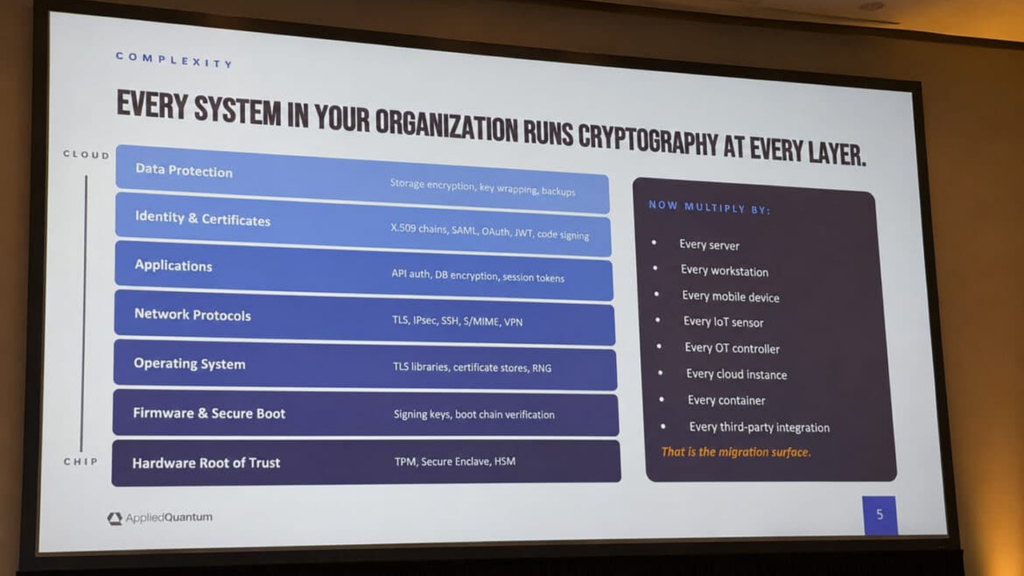
Marin Ivezic Global Overview Marin Ivezic cautions that the transition to Post-Quantum Cryptography (PQC) presents complex infrastructure challenges beyond mere algorithm replacement. He highlights that dramatically increased key and sig... -
NIST Releases Final Post-Quantum Cryptography Standards FIPS 203, 204, and 205: Urging Rapid PQC Migration Amid ‘Harvest Now, Decrypt Later’ Threat
QCecuring USA Overview NIST has released its final Post-Quantum Cryptography (PQC) standards: FIPS 203 (ML-KEM), FIPS 204 (ML-DSA), and FIPS 205 (SLH-DSA). These lattice-based and hash-based algorithms aim to protect global digital infra... -
Microsoft Windows Integrates Hybrid ML-KEM/ML-DSA Cryptography, Enabling Post-Quantum Security for API and Active Directory Certificate Services
Microsoft USA Overview Microsoft Windows platform now extends quantum-safe support to its protocols and platform components, facilitating the transition to post-quantum cryptography (PQC). New features include hybrid ML-KEM and ML-DSA su... -
MPI-SP Joins Pavona Open-Source Silicon Initiative, Delivers Six-Fold Performance Boost for Post-Quantum Cryptography
マックス・プランク・セキュリティ・プライバシー研究所 Germany Overview The Max Planck Institute for Security and Privacy (MPI-SP) has joined Pavona, a new open-source silicon distribution spearheaded by GlobalPlatform, which aims to integ...




12