Background
Continuous glucose monitoring is essential for diabetic patients, yet conventional blood sampling methods and existing continuous glucose monitoring (CGM) systems still pose challenges regarding invasiveness, cost, and convenience. There is a strong demand for wearable sensor technologies that integrate seamlessly into daily life, offer minimal pain, and provide accurate, real-time data. Microneedles (MNs) have emerged as a promising approach to address these challenges, capable of painlessly delivering drugs or collecting interstitial fluid (ISF) from the uppermost layers of the skin.
Key Findings / Results
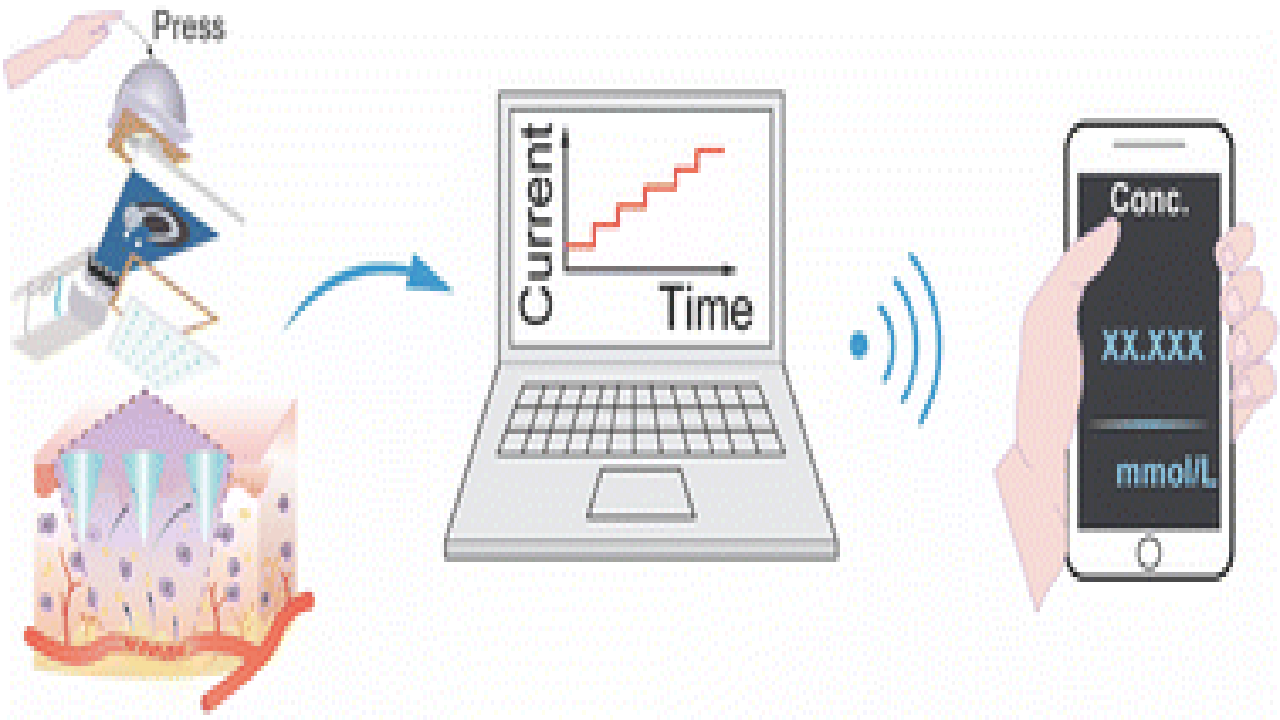
This study leveraged cutting-edge 3D printing technology to develop an electrochemical sensor based on hollow microneedles. Key features and achievements of this sensor system include:
- 3D-Printed Hollow Microneedle Array: Precision 3D printing fabricated microneedles with hollow structures. These hollow channels function for either aspiration or injection of artificial interstitial fluid when inserted into the skin, enabling biofluid sampling and subsequent glucose detection.
- Integration of Single-Atom Nanozymes: To enhance sensor sensitivity and selectivity, single-atom nanozymes (SANs) were incorporated as enzyme-mimicking catalysts. SANs provide catalytic activity similar to natural enzymes but with superior stability and activity, resulting in outstanding sensor performance.
- Exceptional Detection Performance: The developed sensor boasts a remarkably wide linear detection range, spanning from 0.1 μM to 50 mM, covering all physiologically relevant glucose concentrations. Furthermore, it achieves a low detection limit of 0.285 μM, enabling precise detection of subtle glucose fluctuations. High selectivity against co-existing interfering substances was also confirmed.
- Wireless Data Transmission: Glucose concentration data measured by the sensor is transmitted wirelessly in real-time to a smartphone application via technologies like Bluetooth. This allows patients and healthcare providers to monitor glucose trends anytime, anywhere.
- Continuous Monitoring Capability: The continuous extraction of artificial interstitial fluid and the inherent stability of the sensor enable long-term, continuous monitoring of dynamic glucose concentration changes.
Technical Significance & Outlook
This 3D-printed hollow microneedle-based wireless glucose sensor holds the potential to significantly transform diabetes management. Its pain-free nature, high accuracy, and wireless communication capabilities will dramatically reduce patient burden and improve compliance with daily glucose management. It offers an innovative solution particularly for point-of-care (POCT) environments and home-based self-health monitoring. Future advancements are expected to extend this technology into multiplex sensing platforms capable of simultaneously detecting multiple biomarkers beyond glucose (e.g., lactate, ketone bodies). Integrating with AI algorithms could also provide predictive health insights and personalized treatment recommendations based on collected data. This will contribute to a smarter, more proactive healthcare system, improving the quality of life for diabetic patients and reducing healthcare costs globally.
Source: https://pubs.rsc.org/en/content/articlelanding/2026/an/d5an01058f