Background
Achieving a sustainable society necessitates urgent efforts in waste reduction, resource valorization, and the development of environmentally benign materials. The concept of ‘upcycling,’ transforming industrial byproducts and waste into new value-added materials, is particularly crucial. Traditional materials often excel in single functionalities, making it challenging to combine multiple high-performance characteristics. Consequently, research into developing materials with multifaceted superior properties by integrating biodegradable plastics with industrial waste streams has garnered significant attention.
Key Findings / Results
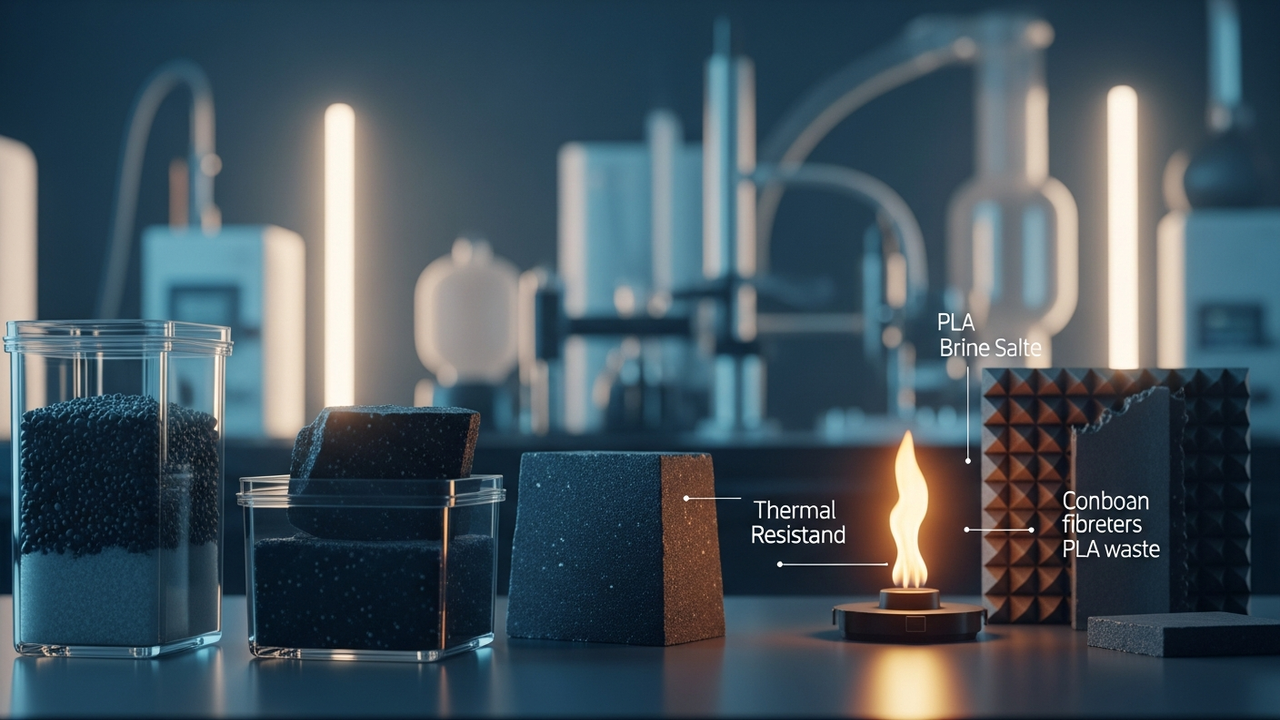
This study introduces an innovative composite material system utilizing polylactic acid (PLA) as the primary matrix, combined with two waste-derived fillers. The first filler consists of waste carbon fibers, generated from high-performance composite manufacturing processes. The second is brine salt, a byproduct from desalination and wastewater treatment. By carefully optimizing the proportions of these components, the resulting composites demonstrated remarkable properties:
- Thermal Insulation: Achieved superior thermal insulation performance through precise control of porosity and adjustment of material thermal conductivity.
- Acoustic Absorption: Exhibited excellent sound absorption characteristics, as the internal porous structure effectively dissipates sound wave energy.
- Fire Resistance: The inorganic components present in brine salt acted as flame retardant synergists during combustion, significantly suppressing material flammability.
This ‘triple waste valorization route’ represents a groundbreaking approach that simultaneously achieves efficient resource utilization and the creation of high-performance functional materials.
Technical Significance & Outlook
The development of these eco-smart PLA/carbon fiber/brine-salt composites holds significant implications for sustainable materials science and industrial applications. Firstly, by transforming waste streams into high-value products, it promotes a circular economy and reduces environmental burden. Secondly, its exceptional thermal, acoustic, and fire-resistant properties make it suitable for a wide range of applications where safety and functionality are paramount, such as insulation and sound-absorbing panels in buildings, interior components for automobiles, or enclosures for electronic devices. A major advantage is the reduction in reliance on fossil resources and a substantial decrease in carbon footprint, achieved by combining renewable PLA with industrial waste. Future work will focus on establishing scalable manufacturing techniques, comprehensive long-term durability assessments, and real-world performance validation. This research is poised to make a significant contribution toward realizing a more sustainable global society.
Source: https://www.tandfonline.com/doi/full/10.1080/19397038.2026.2650874









Comments