Stability Challenges in Wide-Bandgap Perovskites
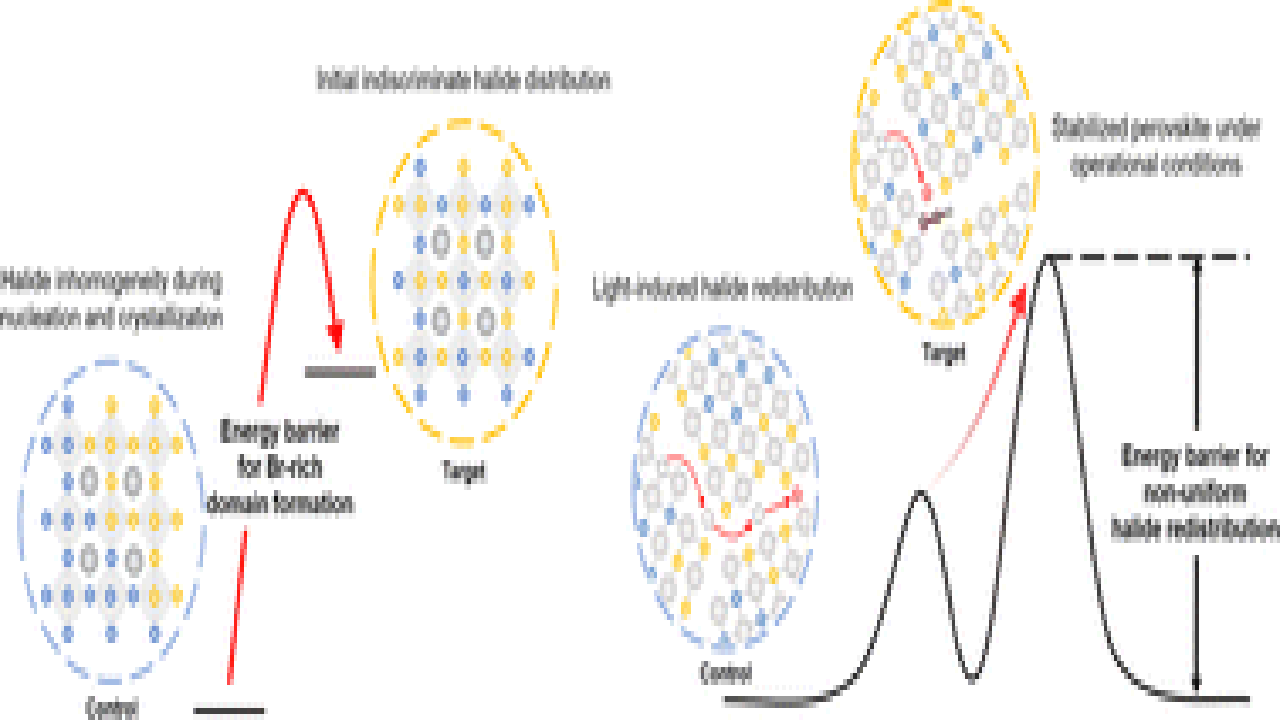
Perovskite solar cells are garnering significant attention as a next-generation photovoltaic technology due to their outstanding power conversion efficiencies. Specifically, wide-bandgap perovskites are essential components for achieving even higher overall efficiencies in tandem architectures when combined with conventional silicon solar cells. However, these materials are prone to light-induced halide phase segregation, where the halide composition becomes non-uniform under illumination, leading to operational instability. The formation of bromine-rich phases, in particular, has been identified as a direct cause of device performance degradation.
Thermodynamic Inhibition Strategy for Enhanced Stability
This study elucidated that the preferential nucleation of bromine-rich phases during the film formation process is the fundamental mechanism driving the intrinsic compositional inhomogeneity in wide-bandgap perovskites. To counteract this, the research team developed a novel ‘thermodynamic inhibition’ approach. This strategy precisely controls the perovskite layer’s crystal growth to intentionally suppress the nucleation of these undesirable bromine-rich phases.
- 1.68 eV Single-Junction Devices: Applying this thermodynamic inhibition strategy, the researchers fabricated 1.68 eV wide-bandgap single-junction perovskite solar cells that achieved a high power conversion efficiency of 23.50%. Furthermore, in long-term operational stability tests, these devices maintained 98% of their initial efficiency over 2240 hours, a remarkable result that significantly enhances the reliability of single-junction devices.
- Perovskite-Silicon Tandem Cells: When this stabilized wide-bandgap perovskite was used as the top cell in a tandem structure with a silicon bottom cell, it achieved an extraordinary efficiency of 33.08% (certified at 32.52% by an independent third party). This level of efficiency approaches the current records for solar cells. Moreover, the tandem devices maintained their performance after 540 hours of outdoor operation, with an extrapolated T90 lifetime (time to 90% of initial efficiency) exceeding 9700 hours, demonstrating exceptional operational stability.
Technical Significance and Outlook
This research presents a groundbreaking thermodynamic solution to the problem of light-induced phase segregation in wide-bandgap perovskites, removing one of the largest barriers to the commercialization of tandem solar cells. The simultaneous achievement of high efficiency and superior long-term stability represents a decisive advance in the development of practical next-generation solar cells. While challenges such as large-area scaling and manufacturing cost reduction remain, this achievement significantly boosts the potential for perovskite solar cells to become a competitive option in the energy market.
Source: https://pubs.rsc.org/en/content/articlelanding/2026/ee/d5ee06815k







Comments