Key Findings
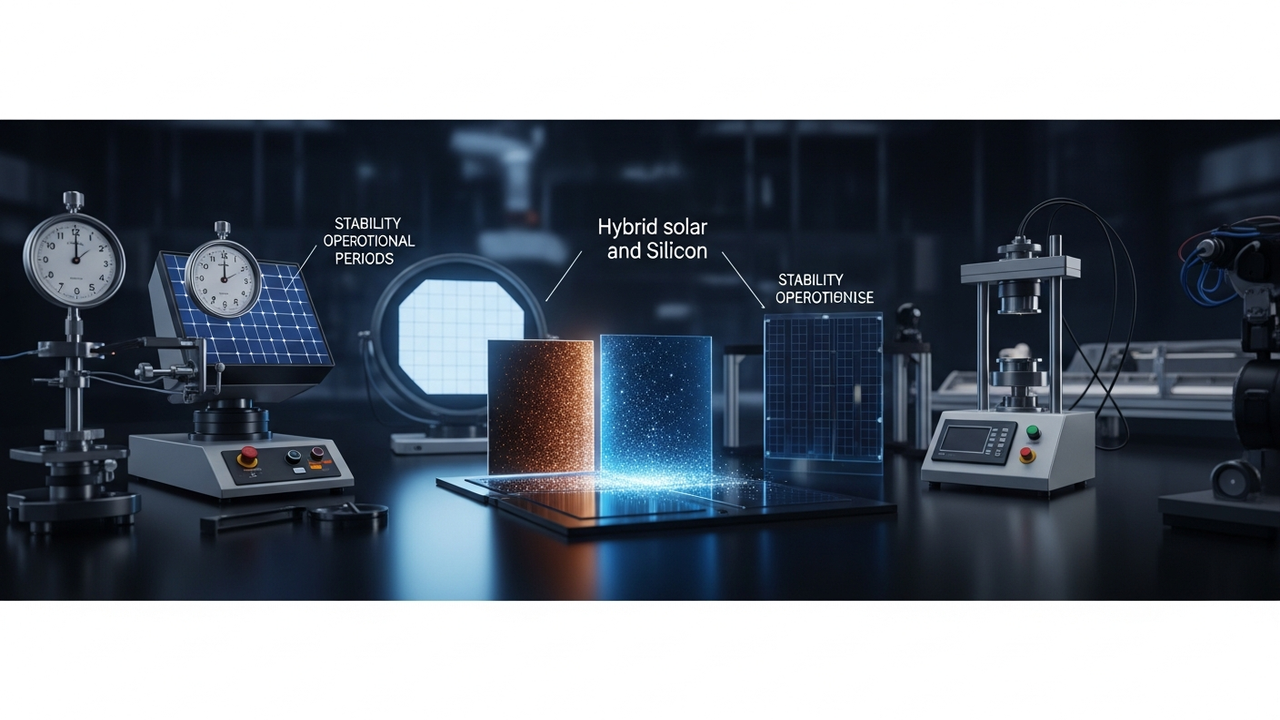
Chinese researchers have achieved a remarkable 33% power conversion efficiency (PCE) in an innovative tandem solar cell combining perovskite and silicon. The most critical aspect of this achievement is not merely the high efficiency, but a significant enhancement in durability. Specifically, the device demonstrated excellent stability, retaining approximately 90% of its initial performance after 1,000 hours of continuous operation. This breakthrough also boasts high compatibility with existing industrial production lines, which is expected to dramatically accelerate the commercial application of multi-junction perovskite and silicon solar cells. This clearly signals that the market introduction of next-generation solar cells has become a tangible reality.
Technical Details
This high-efficiency tandem solar cell maximizes the utilization of different solar light wavelengths by stacking a transparent perovskite layer on top of an optimized silicon cell. The 33% efficiency was achieved through advancements in interface engineering, optimized perovskite material composition, and improved charge transport layers. For durability, particular emphasis was placed on stabilizing the perovskite layer and enhancing its moisture and oxygen barrier properties. Researchers effectively suppressed ion migration and photo-degradation using proprietary additives and encapsulation techniques, ensuring long-term stability even under harsh conditions. The technology is designed to be easily integrated with existing silicon solar cell manufacturing infrastructure, requiring no major modifications to production equipment, thus enabling rapid mass production.
Background & Context
Perovskite solar cells are anticipated as a next-generation technology poised to surpass the limitations of conventional silicon solar cells, offering high efficiency and the potential for low-cost manufacturing. The perovskite-silicon tandem structure, in particular, is the most promising approach for achieving efficiencies unattainable with single materials. China leads the world in solar power R&D and manufacturing, and this achievement further solidifies its technological advantage. This breakthrough demonstrates that perovskite technology is overcoming the critical durability issues that were major barriers to commercialization, providing a crucial technological foundation for accelerating the global energy transition. Compatibility with existing production lines is highly attractive to investors and industry, as it can significantly reduce time-to-market and costs.
Strategic Significance & Outlook
This Chinese-led technology holds the potential to accelerate the commercialization of perovskite-silicon tandem solar cells and dramatically improve the cost-effectiveness of solar power. The 33% efficiency and 90% stability after 1,000 hours provide strong validation for adoption across a wide range of applications, including residential, commercial, and utility-scale power plants. Crucially, the ability to utilize existing manufacturing infrastructure will enable rapid market deployment. If widely adopted, this technology is expected to expand solar energy’s share in the global energy mix and significantly contribute to achieving renewable energy targets. This marks a groundbreaking step towards realizing a global decarbonized society.