
Background
The evolution of AI is revolutionizing scientific research methodologies. Traditional scientific discovery has often relied on laborious and costly trial-and-error processes. AI-driven ecosystems address this bottleneck, enabling faster and more efficient research and development. In fields such as materials science, environmental science, and energy science, where the exploration space is vast, AI-driven data analysis, prediction, and experimental design are indispensable. This proactive investment by the U.S. government is viewed as a strategic move to secure leadership in global AI technology competition and strengthen national economic power and security.
Key Findings
The U.S. Department of Energy (DOE) is actively advancing a leading AI innovation ecosystem, leveraging artificial intelligence across high-performance computing, environmental modeling, and materials research. Central to this initiative are closed-loop autonomous laboratories, exemplified by Lawrence Berkeley National Laboratory’s A-Lab, which autonomously predict, synthesize, and test materials, dramatically accelerating the pace and efficiency of scientific discovery. The DOE also funds foundational computer science and applied mathematics research to enable the development of generalizable foundation models for computational science across multiple domains, a critical strategy shaping the future of AI-driven science.
Technical Details
The DOE’s AI innovation ecosystem is built upon several critical components:
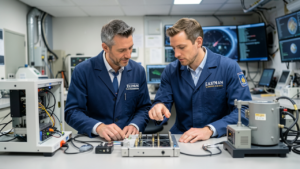
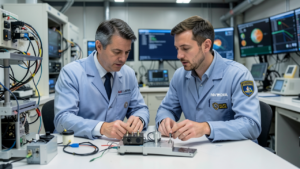
- AI-Driven Autonomous Laboratories: Lawrence Berkeley National Laboratory’s A-Lab is a pioneering example in this field. It operates a fully autonomous, closed-loop process where AI algorithms predict material properties, and robotic systems then automatically synthesize and test materials based on these predictions. This capability allows for the exploration and optimization of materials at speeds several orders of magnitude faster than traditional human-led experimental cycles, having, for instance, efficiently identified tens of thousands of novel inorganic material candidates in recent years.
- Funding for Foundation Model Development: The DOE is investing in foundational computer science and applied mathematics research to develop foundation models for computational science that span multiple scientific domains. Foundation models are versatile AI models pre-trained on vast and diverse datasets. They can then be fine-tuned for specific scientific problems, providing powerful predictions and insights even from limited domain-specific data. This approach accelerates the design of new materials, the simulation of complex physical phenomena, and the prediction of environmental changes.
- Leveraging Advanced Computing Infrastructure: The high-performance computing facilities operated by the DOE (e.g., Summit and Frontier at Oak Ridge National Laboratory) provide the indispensable infrastructure for training large AI models and executing large-scale scientific simulations. These resources are fundamental to enabling the expansion of the AI innovation ecosystem.
The integration of these technical elements allows the DOE to accelerate scientific discovery and generate innovative solutions for pressing challenges such as energy security, climate change, and national security.
Strategic Significance & Outlook
The DOE’s advancement of the AI innovation ecosystem holds the potential to fundamentally transform the future of scientific discovery. The combination of autonomous labs and foundation models will dramatically shorten new materials development cycles, accelerating advancements in areas such as more efficient batteries, novel catalysts, innovative environmental sensors, and quantum information technologies. Furthermore, this ecosystem is expected to strengthen interdisciplinary collaborations among AI researchers, materials scientists, and computational scientists, fostering knowledge sharing and innovation based on open science principles. This will enable the U.S. to further expand the frontiers of AI-driven science and solidify its position as a leader in next-generation technological innovation.
Source: https://www.energy.gov/cet/doe-advancing-ai-innovation-ecosystem
Get our weekly technology intelligence — free
Receive an infographic that lets you judge at a glance whether each field’s analysis report is worth reading.
Subscribe Free — Weekly Tech Intelligence
By subscribing, you’ll receive Troy-Technical’s weekly technology intelligence newsletter.
- Your email and selected fields are used only to deliver the newsletter.
- We never share your information with third parties.
- You can unsubscribe anytime via the link in each email.
See our Privacy Policy for details.
Takes about a minute · Unsubscribe anytime







Comments