Key Findings
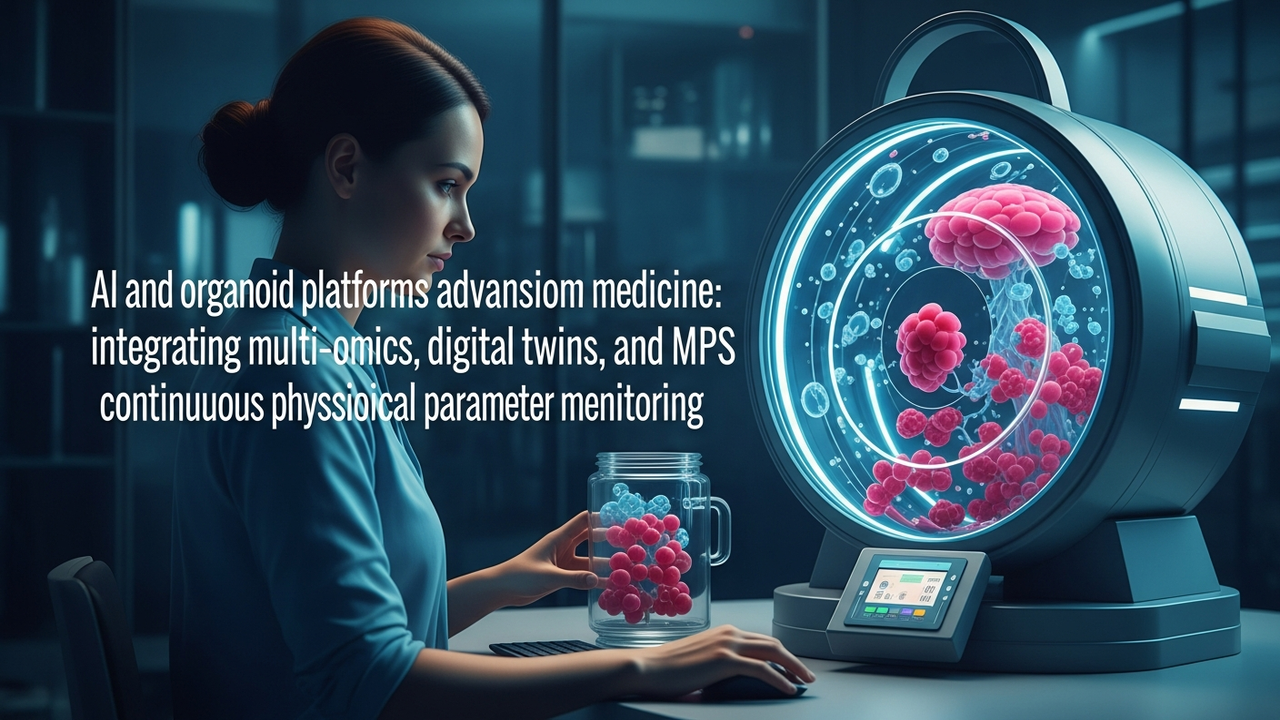
The innovative convergence of artificial intelligence (AI) and organoid technology is poised to bring about a paradigm shift in the field of precision medicine, as suggested by this paper. Recent advancements in organoid-on-a-chip technology clearly demonstrate the feasibility of seamlessly integrating biosensors, microfluidic platforms, and AI-driven analytics to establish sophisticated adaptive feedback control systems. These integrated platforms not only enable continuous monitoring of diverse physiological parameters—such as oxygen levels, nutrient consumption, metabolic activity, and tissue-specific functional outputs—but also dynamically update digital twin models based on real-time experimental observations. This capability promises to dramatically enhance the precision of drug screening, disease modeling, and personalized therapeutics.
Technical/Clinical Details
In this integrated system, organoids (self-organizing 3D cell culture models) are cultured on microfluidic chips, mimicking the in vivo microenvironment. Biosensors, including electrochemical and optical sensors, are embedded within the chip to detect real-time biochemical changes in the microenvironment surrounding the organoids (e.g., pH, oxygen concentration, glucose consumption, lactate production). The vast amount of data generated by these sensors is continuously analyzed by AI algorithms. The AI identifies data patterns, predicts organoid behavior and physiological states, and even implements feedback control loops to automatically adjust experimental conditions. For example, by monitoring an organoid’s response to a specific drug and detecting changes in its metabolic activity, the AI updates the digital twin model to improve predictions of pharmacokinetics and pharmacodynamics. This dynamic updating provides researchers with more accurate drug candidate selection and a deeper understanding of disease mechanisms.
Background and Industry Context
Traditional 2D cell cultures and animal models have limitations in fully replicating complex human physiological responses and drug pharmacokinetics. Organoids, with their more in vivo-like 3D structure and function, are seen as promising tools to overcome these challenges. However, organoids alone face difficulties in real-time, detailed monitoring of their physiological state and fully capturing dynamic responses to external stimuli. The integration of AI, biosensors, and microfluidic technologies maximizes the potential of organoids, enabling drug screening, disease mechanism research, and ultimately bridging to patient-specific therapies. This technology is expected to be key in reducing drug development failure rates and providing faster, more effective treatments to patients.
Strategic Significance & Outlook
The integration of AI and organoid platforms will play a crucial role in shaping the future of precision medicine. In the future, by utilizing organoids derived from patient-specific iPS cells on these platforms, ‘personalized drug discovery,’ enabling optimal drug selection and dosing regimens for individual patients, will become a reality. Furthermore, the expansion to ‘multi-organ-on-a-chip’ systems, connecting multiple organoids to simulate systemic pharmacokinetics and interactions, is also envisioned. AI will be a powerful tool to integrate the vast multi-omics data generated from these complex systems, discover new disease biomarkers, and predict treatment responses. This technology is expected to dramatically improve drug development efficiency and accelerate the discovery of breakthrough treatments for intractable diseases.
Source: https://www.mdpi.com/2674-1172/5/3/20
Get our weekly technology intelligence — free
Receive an infographic that lets you judge at a glance whether each field’s analysis report is worth reading.
Subscribe Free — Weekly Tech Intelligence
By subscribing, you’ll receive Troy-Technical’s weekly technology intelligence newsletter.
- Your email and selected fields are used only to deliver the newsletter.
- We never share your information with third parties.
- You can unsubscribe anytime via the link in each email.
See our Privacy Policy for details.
Takes about a minute · Unsubscribe anytime







Comments