Background
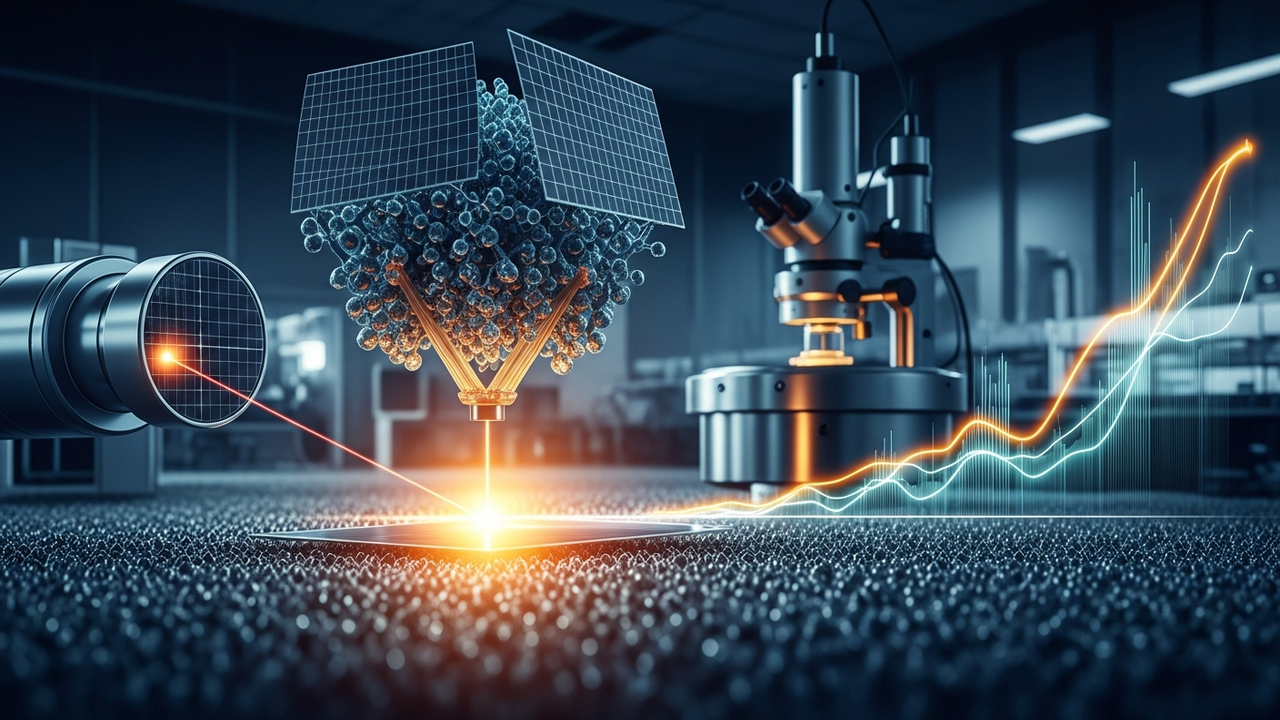
Perovskite solar cells are widely regarded as the ‘future of photovoltaics’ due to their impressive efficiency potential and promise of low-cost manufacturing. Among their various architectures, inverted perovskite solar cells (p-i-n type) are particularly well-suited for commercialization, benefiting from simpler, low-temperature fabrication processes and compatibility with solution processing. However, the dual challenge of achieving both high efficiency and long-term stability has historically been a significant hurdle. The recent development in 2024, where inverted PSCs surpassed n-i-p type cells in efficiency, signals a pivotal new phase in research and development, sending a strong message to the industry that could profoundly influence investment and technological strategies.
Key Findings
A comprehensive review published in ‘Chemical Society Reviews’ outlines the remarkable progress of inverted perovskite solar cells (PSCs), from fundamental research insights to the cusp of scalable commercialization. A particularly notable finding is that in 2024, inverted PSCs surpassed n-i-p type PSCs in efficiency for the first time, achieving a certified power conversion efficiency (PCE) of 26.15%. This groundbreaking achievement was largely propelled by the integration of self-assembled monolayers (SAMs) as highly effective hole transport layers (HTLs).
Technical Details
Perovskite solar cell structures are broadly categorized into regular (n-i-p) and inverted (p-i-n) types. While n-i-p type cells historically maintained an efficiency advantage, the optimization of the inverted structure has accelerated rapidly in recent years. This review critically analyzes the key technological factors contributing to the efficiency improvement of inverted PSCs. Self-assembled monolayers (SAMs), owing to their intrinsic self-forming ability and superior interfacial defect passivation effects, have dramatically enhanced their performance as hole transport layers. The introduction of SAMs effectively suppressed charge recombination at the interface, leading to significant improvements in open-circuit voltage (Voc) and fill factor (FF), ultimately culminating in the certified PCE of 26.15%. This milestone marks a pivotal turning point in solar cell research, demonstrating the capacity of a specific architectural advancement to surpass another after decades of development. Furthermore, the review discusses critical advancements in manufacturing processes, such as slot-die coating, which are essential for large-area, low-cost fabrication, alongside the ongoing strategic shift towards inorganic charge transport layers to enhance resistance against ion migration and environmental stress, crucial for long-term device stability.
Strategic Significance and Outlook
This review unequivocally indicates that inverted perovskite solar cells are rapidly maturing for scalable commercialization. The strategic deployment of SAMs as HTLs represents a critical technology for simultaneously enhancing both efficiency and stability, with further optimization efforts anticipated. The transition towards advanced manufacturing techniques like slot-die coating and the adoption of robust inorganic charge transport layers are concrete strategies designed to ensure mass production capabilities and long-term reliability. The continued advancement of this technology holds immense potential for perovskite solar cells to not only secure a crucial role in the existing photovoltaic market but also to unlock new application areas, including building-integrated photovoltaics (BIPV) and flexible electronic devices. Ultimately, these technological strides will significantly contribute to the widespread adoption of clean energy solutions and the realization of a sustainable global society.
Source: https://pubs.rsc.org/lv/content/articlelanding/2026/cs/d5cs01554e
Get our weekly technology intelligence — free
Receive an infographic that lets you judge at a glance whether each field’s analysis report is worth reading.
Subscribe Free — Weekly Tech Intelligence
By subscribing, you’ll receive Troy-Technical’s weekly technology intelligence newsletter.
- Your email and selected fields are used only to deliver the newsletter.
- We never share your information with third parties.
- You can unsubscribe anytime via the link in each email.
See our Privacy Policy for details.
Takes about a minute · Unsubscribe anytime


Comments