
Background
Driven by urgent environmental concerns, the development of lead-free solar cell materials is paramount. Tin (Sn)-based perovskites present a promising alternative to their toxic lead counterparts, yet their commercialization has been hampered by persistent performance and stability issues. Prior efforts largely focused on organic additives or process optimization, often yielding limited success. This study introduces a fundamental inorganic solution, leveraging binary metal fluorides—specifically SrF₂—to overcome these challenges, marking a significant advancement toward the practical implementation of lead-free perovskite solar cells.
Key Findings
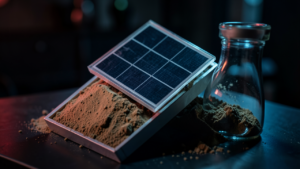
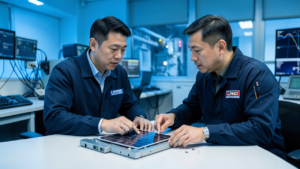
This study reports a significant breakthrough in lead-free tin (Sn)-based perovskite solar cells, elevating their power conversion efficiency from 9.7% to a record 12.6%. This dramatic improvement was achieved through the incorporation of binary metal fluoride additives, with strontium fluoride (SrF₂) proving most effective. Sn-based perovskites are highly susceptible to the facile oxidation of Sn²⁺ to Sn⁴⁺, high defect densities, and severe self-p-doping in ambient conditions, severely limiting their performance. The research team systematically investigated various fluoride-based additives (including BaF₂, SrF₂, and YbF₃) on FASnI₃ perovskites. They found that SrF₂ precisely controls the crystallization and morphology of the perovskite film, leading to a remarkable reduction in defect density. By meticulously regulating the crystallization process, defect chemistry, and electronic structure of FASnI₃ perovskites, SrF₂ effectively suppressed non-radiative recombination and significantly extended charge carrier lifetimes. This mechanistic control not only boosted efficiency but also substantially enhanced the device’s operational stability, directly addressing major commercialization hurdles. Achieving 12.6% efficiency alongside enhanced stability with an inorganic SrF₂ additive represents a crucial milestone for the commercialization of lead-free perovskite solar cells. This technology is poised to accelerate the development of high-performance, environmentally benign photovoltaic devices. Future work will focus on deeper mechanistic understanding of SrF₂’s role, further enhancing efficiency and long-term stability, scaling up for large-area fabrication, and reducing manufacturing costs. This innovation holds immense potential to significantly contribute to sustainable energy solutions and catalyze new advancements in the renewable energy sector.
Get our weekly technology intelligence — free
Receive an infographic that lets you judge at a glance whether each field’s analysis report is worth reading.
Subscribe Free — Weekly Tech Intelligence
By subscribing, you’ll receive Troy-Technical’s weekly technology intelligence newsletter.
- Your email and selected fields are used only to deliver the newsletter.
- We never share your information with third parties.
- You can unsubscribe anytime via the link in each email.
See our Privacy Policy for details.
Takes about a minute · Unsubscribe anytime





Comments