Background and Context
Perovskite solar cells hold the potential to surpass the theoretical efficiency of silicon solar cells, with tandem structures potentially achieving efficiencies over 30%. However, tandem structures require two perovskite layers with different bandgaps, and the stability and halide segregation resistance of the wide bandgap perovskite have been one of the biggest barriers to commercialization. This study provides an effective solution to this fundamental materials science challenge, significantly advancing the practical application of tandem solar cells. Suppressing halide segregation is essential for improving long-term device reliability and enabling stable operation outdoors.
Key Findings
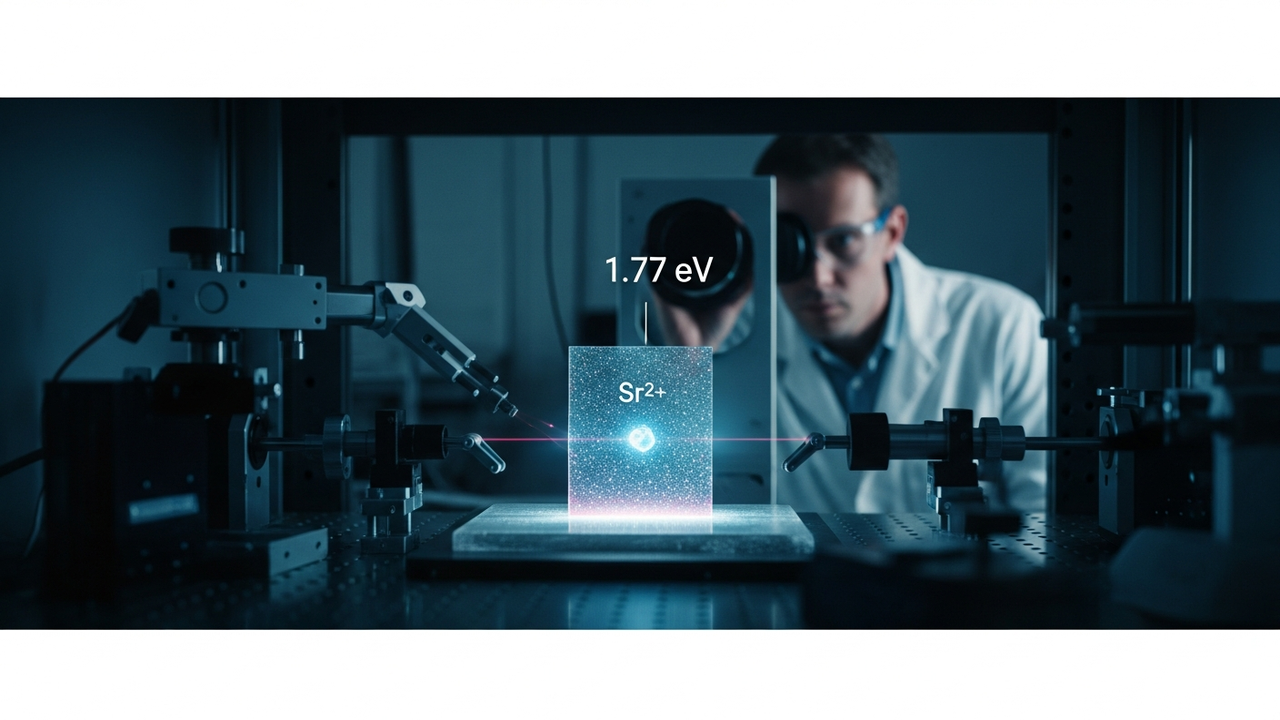
This research has established a groundbreaking design principle that overcomes the major stability challenge of “halide segregation” in wide bandgap perovskite solar cells through the addition of Sr²⁺ ions. This achievement suppresses the formation of triple halide intermediates, leading to high-performance and stable solar cells achieving champion efficiencies of 20.18% at a 1.77 eV bandgap and 19.02% at a 1.84 eV bandgap.
Technical Details
Halide segregation refers to the phenomenon in mixed-halide perovskites where halide ions become non-uniformly distributed under light illumination, leading to a change in the device’s bandgap and a consequent decrease in efficiency. This has been a significant issue, especially when wide bandgap perovskites are used as top cells in tandem solar cells. The research team discovered that introducing Sr²⁺ ions into the perovskite crystal lattice can physically suppress the formation of triple halide intermediates. This mechanism enables the maintenance of a homogeneous halide composition by limiting the migration of halide ions as Sr²⁺ ions occupy specific sites within the crystal structure. This synergistic effect improved the device’s open-circuit voltage (Voc) and fill factor (FF), resulting in both high efficiency and excellent stability. The 20.18% efficiency achieved for devices with a 1.77 eV bandgap is a level that has been difficult to attain for this type of wide bandgap perovskite.
Strategic Significance and Outlook
The achievement of halide segregation resistance and high efficiency through Sr²⁺ ion addition dramatically expands the application scope of wide bandgap perovskites. Specifically, their use as top cells in perovskite/silicon tandem and all-perovskite tandem solar cells will accelerate. The research team is expected to further optimize this design principle, focus on large-area fabrication, simplify manufacturing processes, and conduct further long-term durability evaluations. If this technology is introduced to the market, it is anticipated to significantly contribute to reducing costs and popularizing high-efficiency solar cells, becoming a powerful driving force in accelerating the global transition to clean energy.
Source: https://pubs.acs.org/doi/10.1021/acsenergylett.6c01113
Get our weekly technology intelligence — free
Receive an infographic that lets you judge at a glance whether each field’s analysis report is worth reading.
Subscribe Free — Weekly Tech Intelligence
By subscribing, you’ll receive Troy-Technical’s weekly technology intelligence newsletter.
- Your email and selected fields are used only to deliver the newsletter.
- We never share your information with third parties.
- You can unsubscribe anytime via the link in each email.
See our Privacy Policy for details.
Takes about a minute · Unsubscribe anytime






Comments